Glycosides
• Glycosides are compounds that yield one or more sugars upon hydrolysis.
The term glycoside is a generic term for natural product that is chemically
bound to a sugar. Thus the glycoside composes of two parts: the sugar and
the aglycone. The aglycon may be a terpene , a flavonoid, a coumarine or
any other natural product.
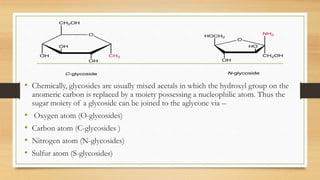
• Chemically, glycosides are usually mixed acetals in which the hydroxyl group on the
anomeric carbon is replaced by a moiety possessing a nucleophilic atom. Thus the
sugar moiety of a glycoside can be joined to the aglycone via –
• Oxygen atom (O-glycosides)
• Carbon atom (C-glycosides )
• Nitrogen atom (N-glycosides)
• Sulfur atom (S-glycosides)
• According to the type of glycosidic linkage: α- glycoside (α-sugar) and
β-glycosides (β-sugar).
2- According to the chemical group of the aglycone involved into the
acetal union:
a. O-glycoside (OH group)
b. S-glycoside (SH group).
c. N-glycoside (NH group).
d. C-glycoside (C group).
• Monoside
• Bioside
• Diglycoside or dioside
• Triglycoside or trioside
• Oligoside
According to the nature of the simple
sugarcomponent of the
glycoside:
a. Glucosides (the glycone is glucose).
b. Galacosides (the glycone is galacose).
c. Mannosides (the glycone is mannose).
d. Arabinosides (the glycone is arabinose).
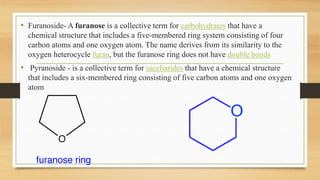
• Furanoside- A furanose is a collective term for carbohydrates that have a
chemical structure that includes a five-membered ring system consisting of four
carbon atoms and one oxygen atom. The name derives from its similarity to the
oxygen heterocycle furan, but the furanose ring does not have double bonds
• Pyranoside - is a collective term for saccharides that have a chemical structure
that includes a six-membered ring consisting of five carbon atoms and one oxygen
atom
Glycosides can be divided into these
groups for aglycone chemical structure….
• Aliphatic glycosides (fat acid and fat alcohol, glycerine glycoside)
• Alicyclic glycosides (cardenolides, bufadienolides, triterpene, steroid
saponins, mono-di and sesqueterpene glycosides, iridoids, glycoalkaloids)
• Aromatic glycosides (phenol glycoside, coumarines, anthraglycosides,
flavonoids)
• Heterocyclic glycosides (nucleotides, nucleosides)
Glycoside hydrolases are enzymes that catalyze the hydrolysis of the glycosidic linkage
of glycosides, leading to the formation of a sugar hemiacetal or hemiketal and the
corresponding free aglycon. Glycoside hydrolases are also referred to as glycosidases, and
sometimes also as glycosyl hydrolases. Glycoside hydrolases can catalyze the hydrolysis
of O-, N- and S-linked glycosides
glycosides acid hydrolysis
The most acceptable classification of glycosides is based on the chemical nature of the aglycone
moiety present in them, namely:
Anthracene glycosides
Phenol glycosides
Steroid glycosides
Flavonoid glycosides
Coumarin and Furanocoumarin glycosides
Cyanogenetic glycosides
Thioglycosides
Saponin glycosides
Aldehyde glycosides
Bitter glycosides
Miscellaneous glycosides
Steviol glycosides-These sweet glycosides found in the stevia plant Stevia rebaudiana Bertoni
have 40-300 times the sweetness of sucrose. The two primary glycosides, stevioside and
rebaudioside A, are used as natural sweeteners in many countries. These glycosides have steviol as
the aglycone part. Glucose or rhamnose-glucose combinations are bound to the ends of the
aglycone to form the different compounds.
Physical & chemical properties
• Colorless, solid, amorphous, crystalline, nonvolatile
(flavonoid- yellow, anthraquinone-red ororange.)
• Give positive reaction with Molisch's and
Fehling's solution test (after hydrolysis).
• They are water soluble compounds, insoluble in organic
solventsand dilute alcohol but in soluble in the CHCl3 and
ether. The aglycon moiety is insoluble in non polar solvent
like C6H6
• Most of them have bitter taste
(except: populin, glycyrrhizin, stevioside)
• Glycoside can not reduce fehling’s solution until they are
hydrolyzed
• They are believed to facilitates growth and protection of
plant
• Odorless except saponin
(glycyrrhizin).
• when a glycosides has a lot of sugars
its solubility in water decrease.
• Glycosides hydrolyzed by using
mineral acids and temperature or by
using enzymes. They show optical activity normally they
are levorotatory
• Glycoside contains sugar but still the physical, chemical
and therapeutic activity is based on aglycon portion. Sugar
facilitates the absorption of the glycoside . helping it to
reach the site of action
ISOLATION OF GLYCOSIDE
•
The method by which glycoside are isolated is called Stas-otto method. The drug
containing glycoside is finely powdered and subjected to successive extraction in a soxhlet
apparatus with alcohol or suitable solvent.
During this method at first take drug containing glycoside, finely powdered that, and it is
extracted with alcohol or water by using soxhlet apparatus. After extraction, collect the
extract and treat with lead acetate to precipitate tannins after that filter it and to the filtrate
pass H2S gas, no lead acetate the precipitate as lead sulphide as this is toxic. Now after the
extract again filter.
The filtrate is subjected to fractional crystallization, distillation or chromatography gives
pure component and the extract molecular structure is determined by the
spectrophotometer, Ultra Red assays, Infra red , NMR and mass spectroscopy etc.
Use in medicine
• Cardiac glycosides- heart diseases e.g. congestive heart
failure and arrhythmia.
• Phenolic glycosides (simple)- It has a urinary antiseptic effect.
• Alcoholic glycosides- analgesic, antipyretic and antiinflammatory effects.
• Flavonoid glycosides- to decrease capillary fragility
• Thio glycosides- irritating, pain killer in anti inflammatory
processes,rheumatism
• Bitter substances (iridoids)- antibiotic and antimicrobic action
Medicinal importance of glycosides:
1- Cardiac drugs: cardiotonic
glycosides e.g., digitalis glycosides,
strophanthus, squill.
 2- Laxatives e.g., anthraquinone
glycosides of senna, aloes, rhubarb,
cascara, frangula.
 3- Counter irritants e.g.,
thioglycosides and their hydrolytic
products ‘allylisothiocyanate’
4- Analgesics e.g., methylsalicylate ‘a
hydrolytic product of gaultherin.
5- Anti rheumatic e.g., salicin.
 6- Some glycosides are claimed to
reduce the capillary fragility e.g.,
flavonoidal glycosides, rutin,
hisperidin.
 7- Anti-inflamatory: e.g., the glycoside
glycyrrhizin has a demulcent,
expectorant and antispasmodic action.
8- More recently as an anticancer agent
e.g., amygdalin known in the U.S. as
Laetrile.
Glycosides

Glycosides

  • 1.
    Glycosides • Glycosides arecompounds that yield one or more sugars upon hydrolysis. The term glycoside is a generic term for natural product that is chemically bound to a sugar. Thus the glycoside composes of two parts: the sugar and the aglycone. The aglycon may be a terpene , a flavonoid, a coumarine or any other natural product.
  • 2.
    • Chemically, glycosidesare usually mixed acetals in which the hydroxyl group on the anomeric carbon is replaced by a moiety possessing a nucleophilic atom. Thus the sugar moiety of a glycoside can be joined to the aglycone via – • Oxygen atom (O-glycosides) • Carbon atom (C-glycosides ) • Nitrogen atom (N-glycosides) • Sulfur atom (S-glycosides)
  • 3.
    • According tothe type of glycosidic linkage: α- glycoside (α-sugar) and β-glycosides (β-sugar). 2- According to the chemical group of the aglycone involved into the acetal union: a. O-glycoside (OH group) b. S-glycoside (SH group). c. N-glycoside (NH group). d. C-glycoside (C group).
  • 4.
    • Monoside • Bioside •Diglycoside or dioside • Triglycoside or trioside • Oligoside
  • 5.
    According to thenature of the simple sugarcomponent of the glycoside: a. Glucosides (the glycone is glucose). b. Galacosides (the glycone is galacose). c. Mannosides (the glycone is mannose). d. Arabinosides (the glycone is arabinose).
  • 6.
    • Furanoside- Afuranose is a collective term for carbohydrates that have a chemical structure that includes a five-membered ring system consisting of four carbon atoms and one oxygen atom. The name derives from its similarity to the oxygen heterocycle furan, but the furanose ring does not have double bonds • Pyranoside - is a collective term for saccharides that have a chemical structure that includes a six-membered ring consisting of five carbon atoms and one oxygen atom
  • 7.
    Glycosides can bedivided into these groups for aglycone chemical structure…. • Aliphatic glycosides (fat acid and fat alcohol, glycerine glycoside) • Alicyclic glycosides (cardenolides, bufadienolides, triterpene, steroid saponins, mono-di and sesqueterpene glycosides, iridoids, glycoalkaloids) • Aromatic glycosides (phenol glycoside, coumarines, anthraglycosides, flavonoids) • Heterocyclic glycosides (nucleotides, nucleosides)
  • 8.
    Glycoside hydrolases areenzymes that catalyze the hydrolysis of the glycosidic linkage of glycosides, leading to the formation of a sugar hemiacetal or hemiketal and the corresponding free aglycon. Glycoside hydrolases are also referred to as glycosidases, and sometimes also as glycosyl hydrolases. Glycoside hydrolases can catalyze the hydrolysis of O-, N- and S-linked glycosides glycosides acid hydrolysis
  • 9.
    The most acceptableclassification of glycosides is based on the chemical nature of the aglycone moiety present in them, namely: Anthracene glycosides Phenol glycosides Steroid glycosides Flavonoid glycosides Coumarin and Furanocoumarin glycosides Cyanogenetic glycosides Thioglycosides Saponin glycosides Aldehyde glycosides Bitter glycosides Miscellaneous glycosides Steviol glycosides-These sweet glycosides found in the stevia plant Stevia rebaudiana Bertoni have 40-300 times the sweetness of sucrose. The two primary glycosides, stevioside and rebaudioside A, are used as natural sweeteners in many countries. These glycosides have steviol as the aglycone part. Glucose or rhamnose-glucose combinations are bound to the ends of the aglycone to form the different compounds.
  • 10.
    Physical & chemicalproperties • Colorless, solid, amorphous, crystalline, nonvolatile (flavonoid- yellow, anthraquinone-red ororange.) • Give positive reaction with Molisch's and Fehling's solution test (after hydrolysis). • They are water soluble compounds, insoluble in organic solventsand dilute alcohol but in soluble in the CHCl3 and ether. The aglycon moiety is insoluble in non polar solvent like C6H6 • Most of them have bitter taste (except: populin, glycyrrhizin, stevioside) • Glycoside can not reduce fehling’s solution until they are hydrolyzed • They are believed to facilitates growth and protection of plant • Odorless except saponin (glycyrrhizin). • when a glycosides has a lot of sugars its solubility in water decrease. • Glycosides hydrolyzed by using mineral acids and temperature or by using enzymes. They show optical activity normally they are levorotatory • Glycoside contains sugar but still the physical, chemical and therapeutic activity is based on aglycon portion. Sugar facilitates the absorption of the glycoside . helping it to reach the site of action
  • 11.
    ISOLATION OF GLYCOSIDE • Themethod by which glycoside are isolated is called Stas-otto method. The drug containing glycoside is finely powdered and subjected to successive extraction in a soxhlet apparatus with alcohol or suitable solvent. During this method at first take drug containing glycoside, finely powdered that, and it is extracted with alcohol or water by using soxhlet apparatus. After extraction, collect the extract and treat with lead acetate to precipitate tannins after that filter it and to the filtrate pass H2S gas, no lead acetate the precipitate as lead sulphide as this is toxic. Now after the extract again filter. The filtrate is subjected to fractional crystallization, distillation or chromatography gives pure component and the extract molecular structure is determined by the spectrophotometer, Ultra Red assays, Infra red , NMR and mass spectroscopy etc.
  • 12.
    Use in medicine •Cardiac glycosides- heart diseases e.g. congestive heart failure and arrhythmia. • Phenolic glycosides (simple)- It has a urinary antiseptic effect. • Alcoholic glycosides- analgesic, antipyretic and antiinflammatory effects. • Flavonoid glycosides- to decrease capillary fragility • Thio glycosides- irritating, pain killer in anti inflammatory processes,rheumatism • Bitter substances (iridoids)- antibiotic and antimicrobic action
  • 13.
    Medicinal importance ofglycosides: 1- Cardiac drugs: cardiotonic glycosides e.g., digitalis glycosides, strophanthus, squill.  2- Laxatives e.g., anthraquinone glycosides of senna, aloes, rhubarb, cascara, frangula.  3- Counter irritants e.g., thioglycosides and their hydrolytic products ‘allylisothiocyanate’ 4- Analgesics e.g., methylsalicylate ‘a hydrolytic product of gaultherin. 5- Anti rheumatic e.g., salicin.  6- Some glycosides are claimed to reduce the capillary fragility e.g., flavonoidal glycosides, rutin, hisperidin.  7- Anti-inflamatory: e.g., the glycoside glycyrrhizin has a demulcent, expectorant and antispasmodic action. 8- More recently as an anticancer agent e.g., amygdalin known in the U.S. as Laetrile.