THE S-BLOCK ELEMENTS
MS. CHETNA PRADIP DESHMUKH
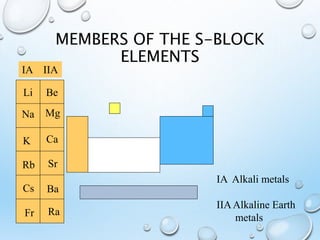
MEMBERS OF THE S-BLOCK
ELEMENTS
Li Be
Na
K
Rb
Cs
Fr
Mg
Ca
Sr
Ra
Ba
IA IIA
IA Alkali metals
IIAAlkaline Earth
metals
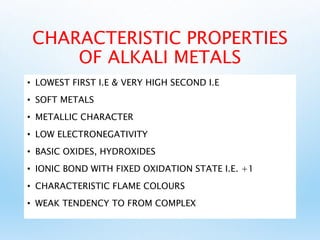
CHARACTERISTIC PROPERTIES
OF ALKALI METALS
• LOWEST FIRST I.E & VERY HIGH SECOND I.E
• SOFT METALS
• METALLIC CHARACTER
• LOW ELECTRONEGATIVITY
• BASIC OXIDES, HYDROXIDES
• IONIC BOND WITH FIXED OXIDATION STATE I.E. +1
• CHARACTERISTIC FLAME COLOURS
• WEAK TENDENCY TO FROM COMPLEX
ATOMIC RADII (NM)
Li 0.152
Na 0.186
K 0.231
Rb 0.244
Cs 0.262
Fr 0.270
IONIZATION ENERGIES
Group I 1st I.E. 2nd I.E.
Li 519 7300
Na 494 4560
K 418 3070
Rb 402 2370
Cs 376 2420
Alkali metals have the lowest I.E in each period and it decreases
down the group.
ELECTROPOSITIVE OR
METALLIC CHARACTER
• HIGH TENDENCY TO LOSE E- TO
FORM POSITIVE IONS.
• HIGHLY ELECTROPOSITIVE.
• METALLIC CHARACTER
INCREASES DOWN THE GROUP.
CHARACTERISTIC FLAME
COLOURATION
HCl(aq) sample
Li deep red
Na yellow
K lilac
Rb bluish red
Cs blue
Ca brick red
Sr blood red
Ba apple green
OXIDES, PEROXIDE, SUPEROXIDE
Reaction with water:
Oxide: O2- + H2O  2OH-
Peroxide: O2
2- + 2H2O  H2O2 + 2OH-
Superoxide: 2O2
- + 2H2O  2OH- + H2O2 + O2
.. .. 2-
:O:O:
.. ..
Peroxide ion
. . -
:O:.O:
.. ..
Super oxide
Li does not form
peroxide or super oxide
Li2O2  Li2O + ½ O2
BASIC OXIDES, HYDROXIDES
Oxide Hydroxides
Li2O LiOH
Na2O,
Na2O2
NaOH
K2O2, KO2 KOH
Rb2O2,
RbO2
RbOH
Cs2O2,
CsO2
CsOH
Oxide Hydroxides
BeO Be(OH)2
MgO Mg(OH)2
CaO Ca(OH)2
SrO Sr(OH)2
BaO, Ba2O2 Ba(OH)2
ACTION WITH HYDROGEN
All the alkali metals react directly with hydrogen to form
hydrides which are ionic in nature.
2Na(s) + H2(g)  2NaH(s)
The ionic character of hydrides increases from Li to Cs.
The stability of hydrides decreases from Li to Cs.
The hydrides behave as strong reducing agents and the latter
increases from Li to Cs.
ACTION OF HALOGENS
All the alkali metals react directly with halogen to produce
ionic halides.
The reactivity of halogen towards the alkali metal
increases down the group.
Action with water
Alkali metals react with water to form hydroxides and
hydrogen gas is evolved.
Li reacts slowly but Na and others react violently. That is why
they are kept in kerosene oil.
All are soluble and basic strength increases down the group.
CHARACTERISTIC PROPERTIES
OF ALKALINE EARTH METALS
• LOW FIRST I.E & SECOND I.E
• METALLIC CHARACTER
• LOW ELECTRONEGATIVITY
• BASIC OXIDES, HYDROXIDES
• IONIC BOND WITH FIXED OXIDATION STATE I.E. +2
• CHARACTERISTIC FLAME COLOURS
• WEAK TENDENCY TO FROM COMPLEX
ATOMIC RADII (NM)
Be 0.112
Mg 0.160
Ca 0.197
Sr 0.215
Ba 0.217
Ra 0.220
IONIZATION ENERGIES
Group I 1st I.E. 2nd I.E. 3rd I.E.
Be 900 1760 14800
Mg 736 1450 7740
Ca 590 1150 4940
Sr 548 1060 4120
Ba 502 966 3390
1. Have low 1st and 2nd IE.
2. Removal of the 3rd electron is much more difficult
as it involves the loss of an inner shell electron.
3. IE decrease as the group is descended.
4. IE of the group II is generally higher than group I.
HYDRATION ENTHALPY
General trends:
1. On going down both groups, hydration enthalpy
decreases.
(As the ions get larger, the charge density of the
ions decreases, the electrostatic attraction between
ions and water molecules gets smaller.)
2. Group 2 ions have hydration enthalpies higher
than group 1.
( Group 2 cations are doubly charged and have
smaller sizes)
BASIC OXIDES, HYDROXIDES
Oxide Hydroxides
BeO Be(OH)2
MgO Mg(OH)2
CaO Ca(OH)2
SrO Sr(OH)2
BaO, Ba2O2 Ba(OH)2
HYDROXIDES
Group II
hydroxide Be Mg Ca Sr Ba
Solubility increase, from
Amphoteric to basic, base strength
increase
VARIATION IN MELTING POINTS
Strength of metallic bond depends on:
1. Ionic radius
2. Number of e- contributed to the electron sea per atom
3. Crystal lattice structure
Note: The exceptionally high m.p. of calcium
is due to contribution of d-orbital participation
of metallic bonding.
REACTIONS WITH OXYGEN
Normal
Oxide
Peroxide
Structure
Formed by All alkaline
earth metals
Ba
.. .. 2-
:O-O:
.. ..
.. 2-
:O:
..
CHARACTERISTIC FLAME
COLOURATION
HCl(aq) sample
Ca brick red
Sr blood red
Ba apple green
REACTION WITH WATER
M(s)  M+(aq) + e-
H2O(l) + e-  OH-(aq) + ½ H2(g)
Li -3.05 volt
Na -2.71
K -2.93
Rb -2.99
Cs -3.20
Be -1.85 volt
Mg -2.38
Ca -2.87
Sr -2.89
Ba -2.90
Energetic vs. Kinetic Factor
ACTION WITH HYDROGEN
All except Be react directly with hydrogen.
Ca(s) + H2(g)  CaH2(s)
The reactivity increases down the group.
Only BeH2 and MgH2 are covalent, others are
ionic.
Action with halogens
BeCl2 is essentially covalent, with comparatively low
m.pt.
The lower members in group II form essentially ionic
chlorides, with Mg having intermediate properties.
ELECTRIC CONFIGURATION
s-block-elements [Autosaved].ppt

s-block-elements [Autosaved].ppt

  • 1.
    THE S-BLOCK ELEMENTS MS.CHETNA PRADIP DESHMUKH
  • 2.
    MEMBERS OF THES-BLOCK ELEMENTS Li Be Na K Rb Cs Fr Mg Ca Sr Ra Ba IA IIA IA Alkali metals IIAAlkaline Earth metals
  • 3.
    CHARACTERISTIC PROPERTIES OF ALKALIMETALS • LOWEST FIRST I.E & VERY HIGH SECOND I.E • SOFT METALS • METALLIC CHARACTER • LOW ELECTRONEGATIVITY • BASIC OXIDES, HYDROXIDES • IONIC BOND WITH FIXED OXIDATION STATE I.E. +1 • CHARACTERISTIC FLAME COLOURS • WEAK TENDENCY TO FROM COMPLEX
  • 4.
    ATOMIC RADII (NM) Li0.152 Na 0.186 K 0.231 Rb 0.244 Cs 0.262 Fr 0.270
  • 5.
    IONIZATION ENERGIES Group I1st I.E. 2nd I.E. Li 519 7300 Na 494 4560 K 418 3070 Rb 402 2370 Cs 376 2420 Alkali metals have the lowest I.E in each period and it decreases down the group.
  • 6.
    ELECTROPOSITIVE OR METALLIC CHARACTER •HIGH TENDENCY TO LOSE E- TO FORM POSITIVE IONS. • HIGHLY ELECTROPOSITIVE. • METALLIC CHARACTER INCREASES DOWN THE GROUP.
  • 7.
    CHARACTERISTIC FLAME COLOURATION HCl(aq) sample Lideep red Na yellow K lilac Rb bluish red Cs blue Ca brick red Sr blood red Ba apple green
  • 8.
    OXIDES, PEROXIDE, SUPEROXIDE Reactionwith water: Oxide: O2- + H2O  2OH- Peroxide: O2 2- + 2H2O  H2O2 + 2OH- Superoxide: 2O2 - + 2H2O  2OH- + H2O2 + O2 .. .. 2- :O:O: .. .. Peroxide ion . . - :O:.O: .. .. Super oxide Li does not form peroxide or super oxide Li2O2  Li2O + ½ O2
  • 9.
    BASIC OXIDES, HYDROXIDES OxideHydroxides Li2O LiOH Na2O, Na2O2 NaOH K2O2, KO2 KOH Rb2O2, RbO2 RbOH Cs2O2, CsO2 CsOH Oxide Hydroxides BeO Be(OH)2 MgO Mg(OH)2 CaO Ca(OH)2 SrO Sr(OH)2 BaO, Ba2O2 Ba(OH)2
  • 10.
    ACTION WITH HYDROGEN Allthe alkali metals react directly with hydrogen to form hydrides which are ionic in nature. 2Na(s) + H2(g)  2NaH(s) The ionic character of hydrides increases from Li to Cs. The stability of hydrides decreases from Li to Cs. The hydrides behave as strong reducing agents and the latter increases from Li to Cs.
  • 11.
    ACTION OF HALOGENS Allthe alkali metals react directly with halogen to produce ionic halides. The reactivity of halogen towards the alkali metal increases down the group. Action with water Alkali metals react with water to form hydroxides and hydrogen gas is evolved. Li reacts slowly but Na and others react violently. That is why they are kept in kerosene oil. All are soluble and basic strength increases down the group.
  • 12.
    CHARACTERISTIC PROPERTIES OF ALKALINEEARTH METALS • LOW FIRST I.E & SECOND I.E • METALLIC CHARACTER • LOW ELECTRONEGATIVITY • BASIC OXIDES, HYDROXIDES • IONIC BOND WITH FIXED OXIDATION STATE I.E. +2 • CHARACTERISTIC FLAME COLOURS • WEAK TENDENCY TO FROM COMPLEX
  • 13.
    ATOMIC RADII (NM) Be0.112 Mg 0.160 Ca 0.197 Sr 0.215 Ba 0.217 Ra 0.220
  • 14.
    IONIZATION ENERGIES Group I1st I.E. 2nd I.E. 3rd I.E. Be 900 1760 14800 Mg 736 1450 7740 Ca 590 1150 4940 Sr 548 1060 4120 Ba 502 966 3390 1. Have low 1st and 2nd IE. 2. Removal of the 3rd electron is much more difficult as it involves the loss of an inner shell electron. 3. IE decrease as the group is descended. 4. IE of the group II is generally higher than group I.
  • 15.
    HYDRATION ENTHALPY General trends: 1.On going down both groups, hydration enthalpy decreases. (As the ions get larger, the charge density of the ions decreases, the electrostatic attraction between ions and water molecules gets smaller.) 2. Group 2 ions have hydration enthalpies higher than group 1. ( Group 2 cations are doubly charged and have smaller sizes)
  • 16.
    BASIC OXIDES, HYDROXIDES OxideHydroxides BeO Be(OH)2 MgO Mg(OH)2 CaO Ca(OH)2 SrO Sr(OH)2 BaO, Ba2O2 Ba(OH)2
  • 17.
    HYDROXIDES Group II hydroxide BeMg Ca Sr Ba Solubility increase, from Amphoteric to basic, base strength increase
  • 18.
    VARIATION IN MELTINGPOINTS Strength of metallic bond depends on: 1. Ionic radius 2. Number of e- contributed to the electron sea per atom 3. Crystal lattice structure Note: The exceptionally high m.p. of calcium is due to contribution of d-orbital participation of metallic bonding.
  • 19.
    REACTIONS WITH OXYGEN Normal Oxide Peroxide Structure Formedby All alkaline earth metals Ba .. .. 2- :O-O: .. .. .. 2- :O: ..
  • 20.
    CHARACTERISTIC FLAME COLOURATION HCl(aq) sample Cabrick red Sr blood red Ba apple green
  • 21.
    REACTION WITH WATER M(s) M+(aq) + e- H2O(l) + e-  OH-(aq) + ½ H2(g) Li -3.05 volt Na -2.71 K -2.93 Rb -2.99 Cs -3.20 Be -1.85 volt Mg -2.38 Ca -2.87 Sr -2.89 Ba -2.90 Energetic vs. Kinetic Factor
  • 22.
    ACTION WITH HYDROGEN Allexcept Be react directly with hydrogen. Ca(s) + H2(g)  CaH2(s) The reactivity increases down the group. Only BeH2 and MgH2 are covalent, others are ionic. Action with halogens BeCl2 is essentially covalent, with comparatively low m.pt. The lower members in group II form essentially ionic chlorides, with Mg having intermediate properties.
  • 23.