Designing assessment
Ann Wilson,
Learning and Teaching Transformation
Welcome
• Introductions
• Agenda for the session
• Why is assessment important?
• How does assessment help learning? – through time and focus
• What makes good assessment?
- Constructive alignment
– Supporting learning
– Authentic assessment
Why is assessment important?
• Leeds Metropolitan University Diary Survey asked students to
record how they spent their time.
• 75% of student learning time was spent out of class and 95%
of this time was spent on assessed tasks.
• 5% of student time spent on out of class activity unrelated to
assessment.
Why do we assess?
• Motivating students
• Creating learning activities
• Feedback to students identifying strengths and weaknesses
• Feedback to staff on how well the message is getting across
• Judge performance – grade or degree
• Quality assurance – internal to the institution
• Quality assurance – external to the institution
Why do students attend to assessment?
• Cash nexus of learning (Brown, 2012)
Why do we as teachers attend to assessment?
• Quality control mechanism for our courses
• Check understanding and skills of our graduates
• Feedback to our learners about their progress
Some design considerations
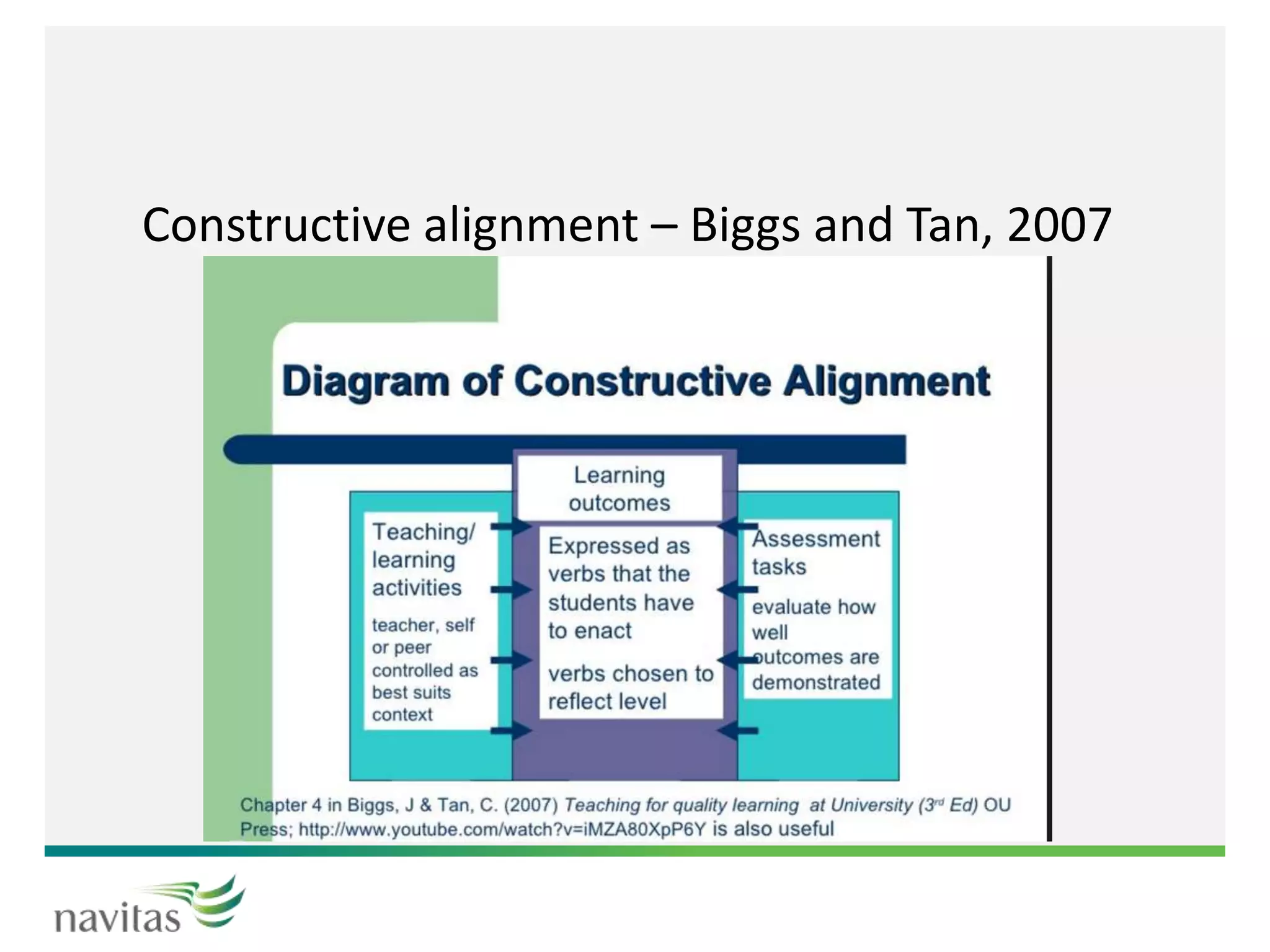
Constructive alignment – Biggs and Tan, 2007
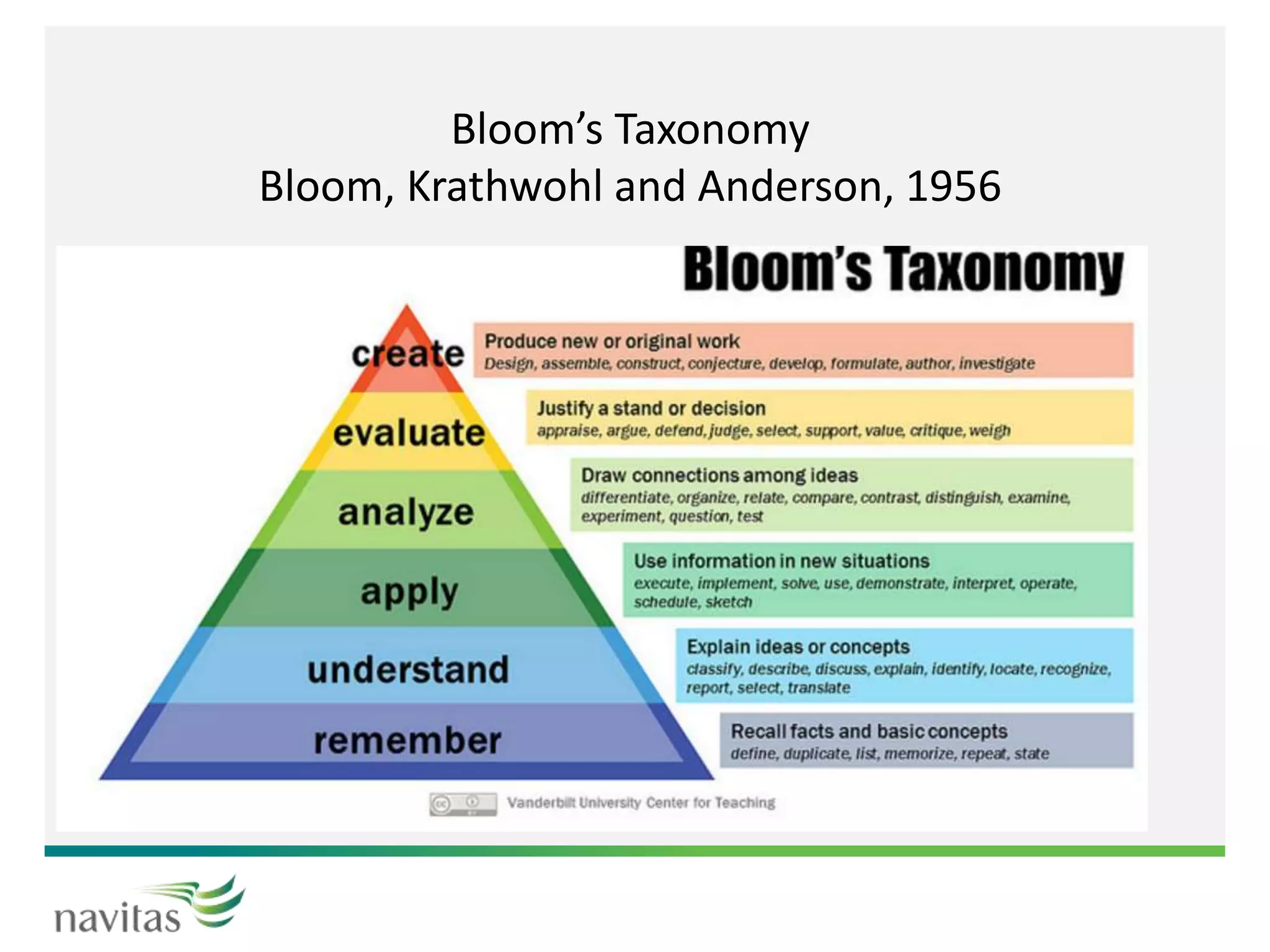
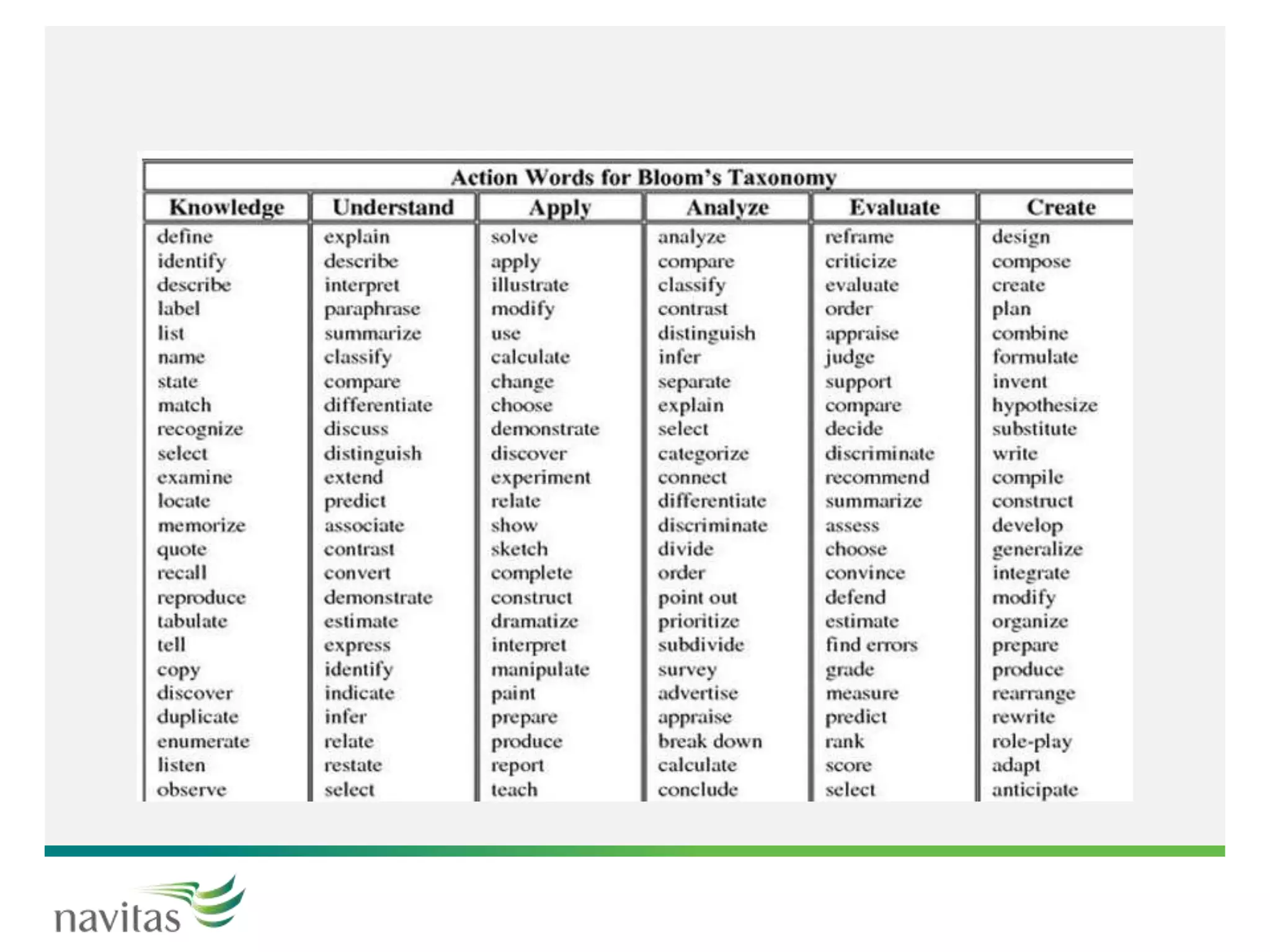
Bloom’s Taxonomy
Bloom, Krathwohl and Anderson, 1956
Mapping assessment
Conditions Under Which Assessment Supports
Students’ Learning
(Gibbs and Simpson, 2005)
Influences of assessment on the volume, focus
and quality of studying
• Condition 1: Sufficient assessed tasks are
provided for students to capture sufficient
study time
• Time on task
• https://sydney.edu.au/education-
portfolio/ei/assessmentresources/pdf/Gibbs%20and%20Simpson.pdf
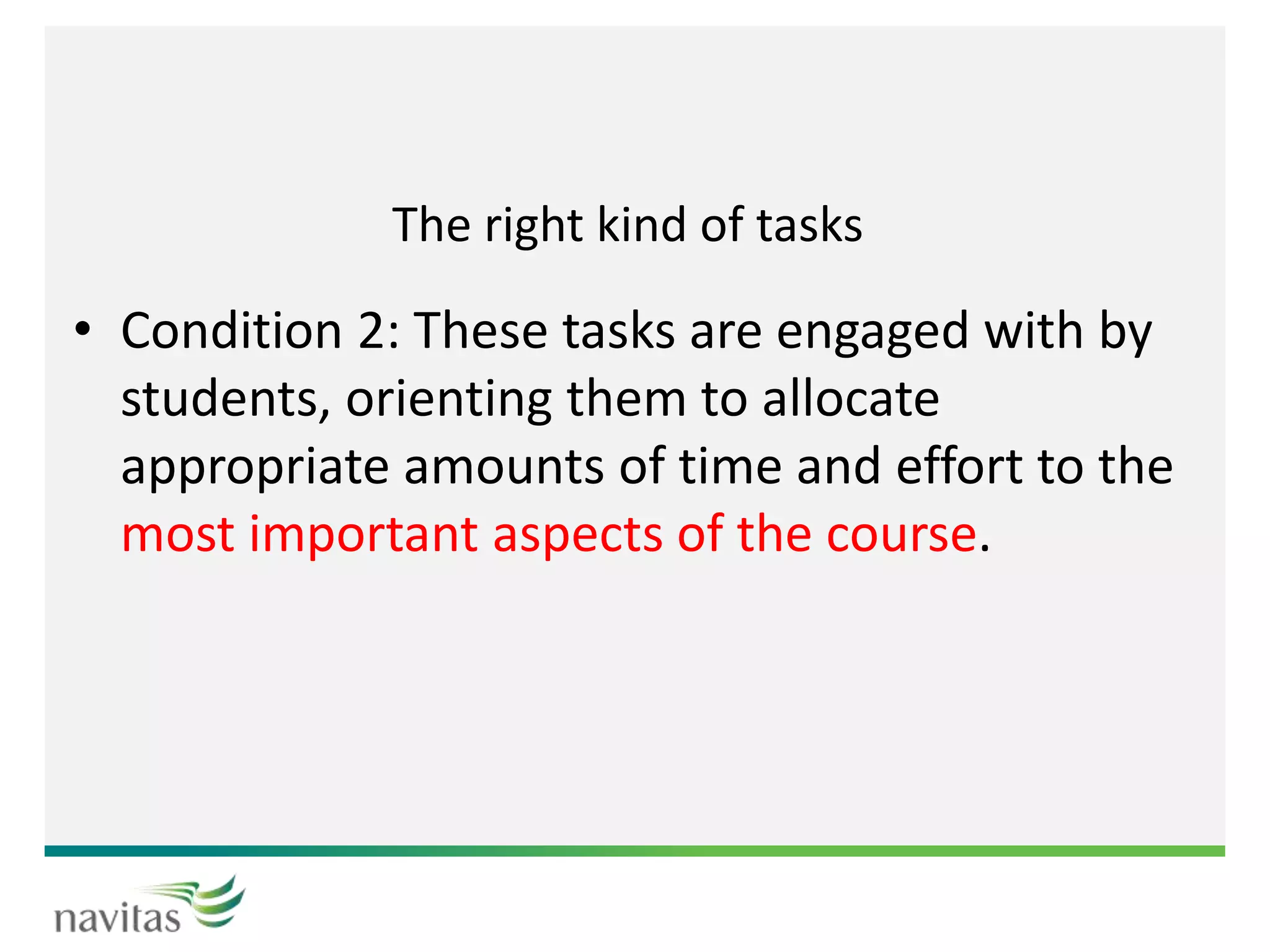
The right kind of tasks
• Condition 2: These tasks are engaged with by
students, orienting them to allocate
appropriate amounts of time and effort to the
most important aspects of the course.
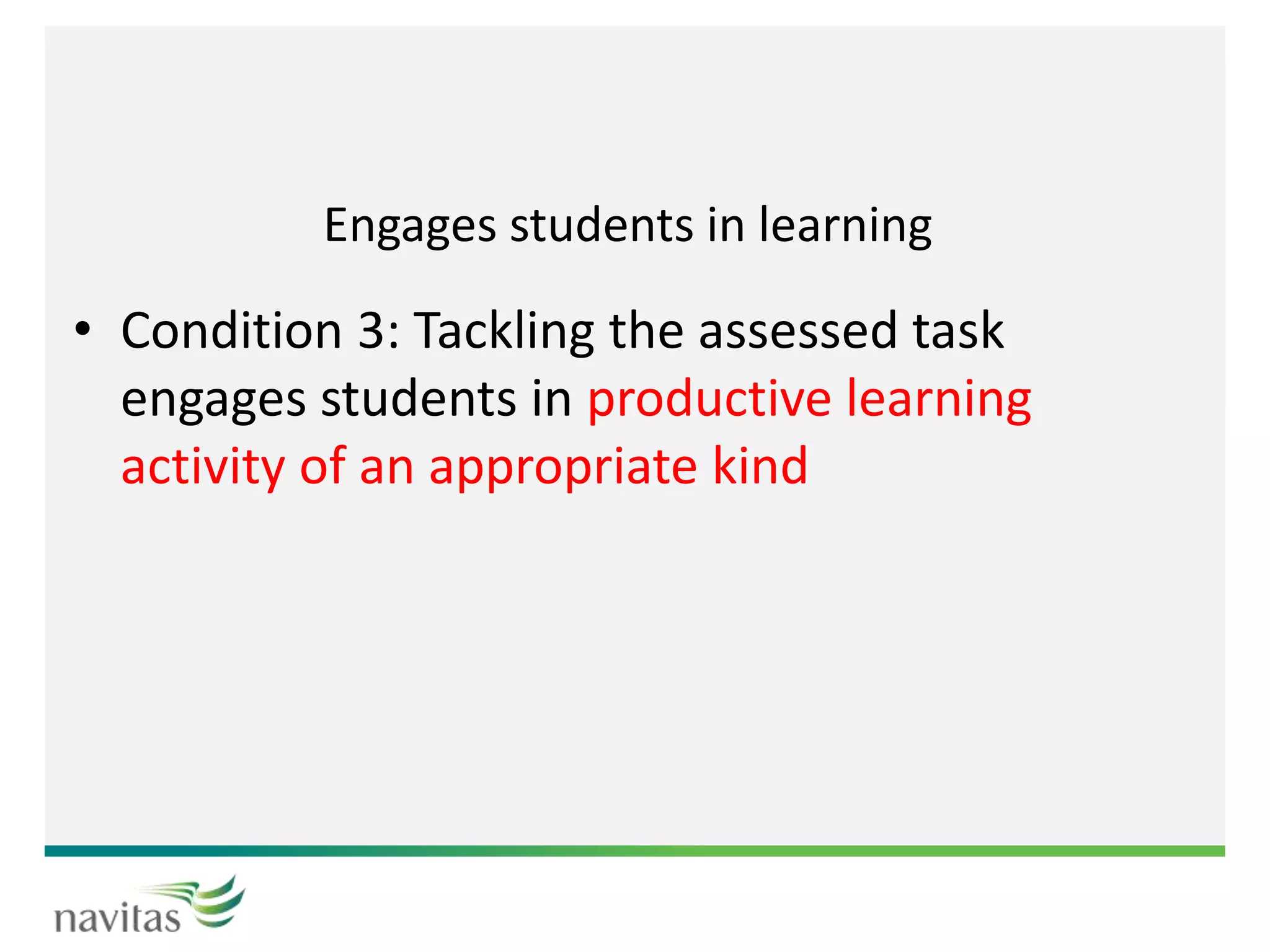
Engages students in learning
• Condition 3: Tackling the assessed task
engages students in productive learning
activity of an appropriate kind
Feedback issues – the teaching opportunity
4. Sufficient feedback is provided, both often enough and in enough detail (formative
assessment)
5. The feedback focuses on students’ performance, on their learning and on actions under
the students’ control, rather than on the students themselves and on their characteristics
6. The feedback is timely in that it is received by students while it still matters to them and
in time for them to pay attention to further learning or receive further assistance
7. Feedback is appropriate to the purpose of the assignment and to its criteria for success
8. Feedback is appropriate, in relation to students’ understanding of what they are supposed
to be doing
9. Feedback is received and attended to
10. Feedback is acted on
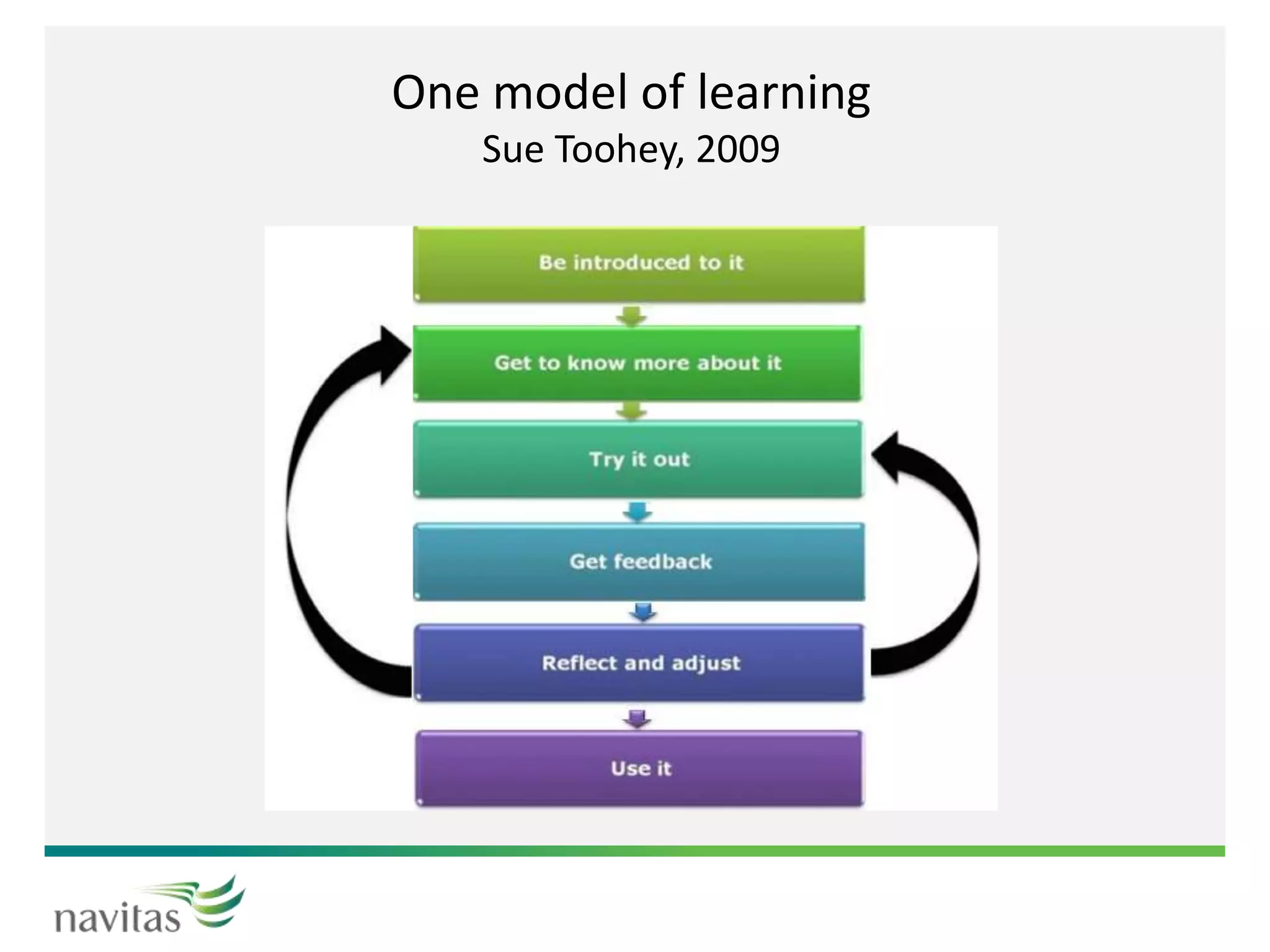
One model of learning
Sue Toohey, 2009
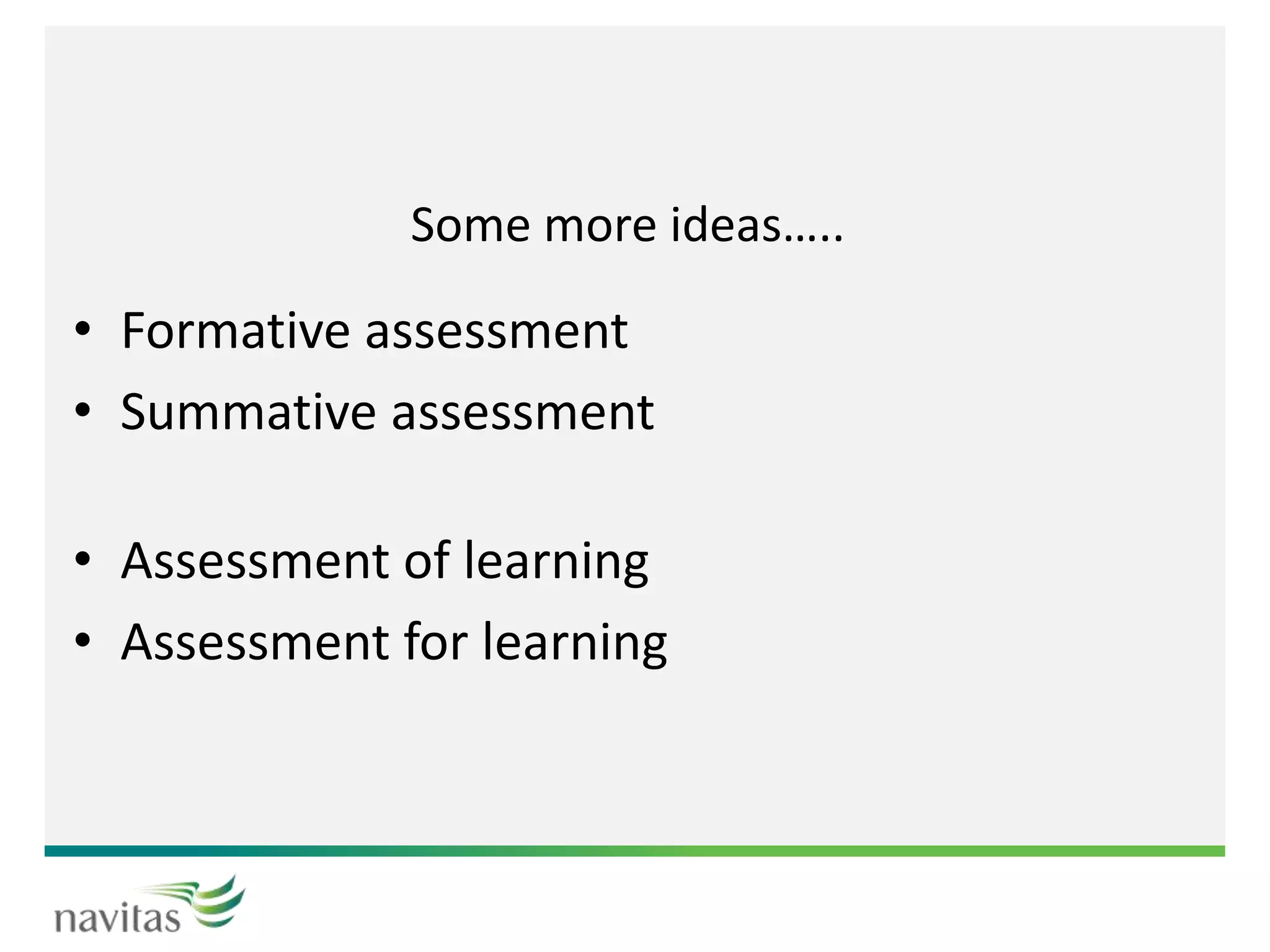
Some more ideas…..
• Formative assessment
• Summative assessment
• Assessment of learning
• Assessment for learning
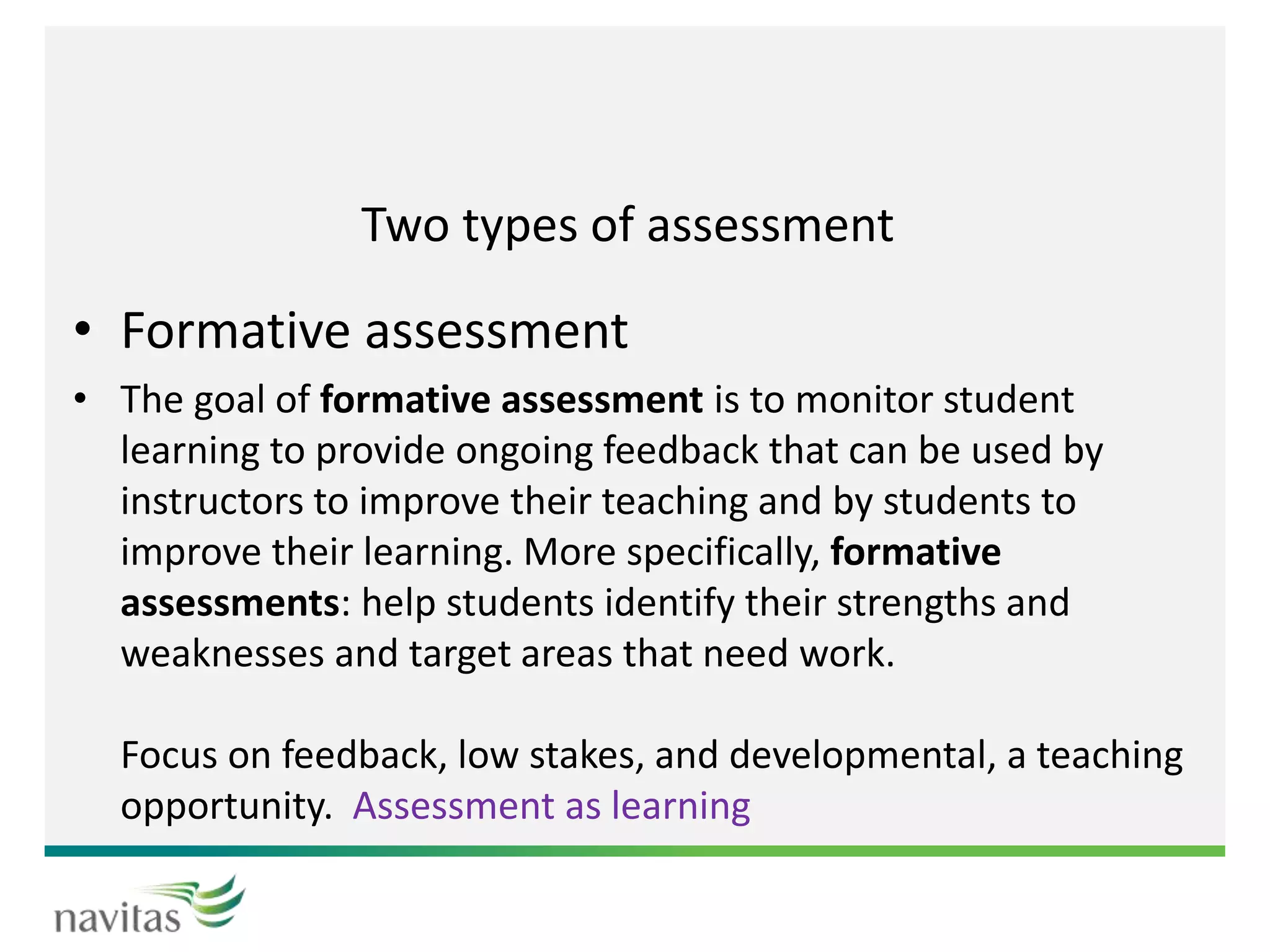
Two types of assessment
• Formative assessment
• The goal of formative assessment is to monitor student
learning to provide ongoing feedback that can be used by
instructors to improve their teaching and by students to
improve their learning. More specifically, formative
assessments: help students identify their strengths and
weaknesses and target areas that need work.
Focus on feedback, low stakes, and developmental, a teaching
opportunity. Assessment as learning
Summative assessment
• The goal of summative assessment is
to evaluate student learning at the end of an
instructional unit by comparing it against some
standard or benchmark.
• High stakes, about judgement, focused on
assessment of learning
Assessment of Learning
• Captures sufficient study time
• The right kind of learning activity
• Focusses on the main elements of the course
• Is aligned with the curriculum
• Is valid, reliable and fair
A note about fairness
Authentic assessment
• Authentic assessment focuses on students
applying knowledge and skills in real life
settings.
• The task- reflect what is done in professional practice.
• A physical context; real places of work
• Involve social processes that are equivalent to those in real life situations.
• The assessment result or form; What is the result of your efforts?
• Criteria and standards; how will you judge it?
Patchwork text assessment
• provides opportunity to use feedback
have another go at assessment
• assessment activities across a course of
programme, not just inside a course
• Could you build some opportunities to revisit
feedback or assessment later in a course or
programme?
Some other ideas
• Sustainable assessment - Prepares students for
future challenges, self assessment
• Task assessment vs evidence of learning
• Focus on what learners contribute not what
they collect
• Tracking a learning journey, assessment as part
of the learning process
Final thoughts - Workload and assessment
• Is the assessment task capturing the right kind
of work?
• Workload for students, how much time on
task?
• Workload for teachers/markers – how long will
it take to mark?
• Have you constructed a marking rubric?
Questions
Summary of key take aways
• Assessment is the curriculum
• Align what we teach, the way we teach it with
the way we assess it
• Capturing the right amount of time and the
right amount of effort

Designing good assessment

  • 1.
    Designing assessment Ann Wilson, Learningand Teaching Transformation
  • 2.
    Welcome • Introductions • Agendafor the session • Why is assessment important? • How does assessment help learning? – through time and focus • What makes good assessment? - Constructive alignment – Supporting learning – Authentic assessment
  • 3.
  • 4.
    Why is assessmentimportant? • Leeds Metropolitan University Diary Survey asked students to record how they spent their time. • 75% of student learning time was spent out of class and 95% of this time was spent on assessed tasks. • 5% of student time spent on out of class activity unrelated to assessment.
  • 5.
    Why do weassess? • Motivating students • Creating learning activities • Feedback to students identifying strengths and weaknesses • Feedback to staff on how well the message is getting across • Judge performance – grade or degree • Quality assurance – internal to the institution • Quality assurance – external to the institution
  • 6.
    Why do studentsattend to assessment? • Cash nexus of learning (Brown, 2012)
  • 7.
    Why do weas teachers attend to assessment? • Quality control mechanism for our courses • Check understanding and skills of our graduates • Feedback to our learners about their progress
  • 8.
  • 9.
    Constructive alignment –Biggs and Tan, 2007
  • 10.
  • 13.
  • 14.
    Conditions Under WhichAssessment Supports Students’ Learning (Gibbs and Simpson, 2005) Influences of assessment on the volume, focus and quality of studying • Condition 1: Sufficient assessed tasks are provided for students to capture sufficient study time • Time on task • https://sydney.edu.au/education- portfolio/ei/assessmentresources/pdf/Gibbs%20and%20Simpson.pdf
  • 15.
    The right kindof tasks • Condition 2: These tasks are engaged with by students, orienting them to allocate appropriate amounts of time and effort to the most important aspects of the course.
  • 16.
    Engages students inlearning • Condition 3: Tackling the assessed task engages students in productive learning activity of an appropriate kind
  • 17.
    Feedback issues –the teaching opportunity 4. Sufficient feedback is provided, both often enough and in enough detail (formative assessment) 5. The feedback focuses on students’ performance, on their learning and on actions under the students’ control, rather than on the students themselves and on their characteristics 6. The feedback is timely in that it is received by students while it still matters to them and in time for them to pay attention to further learning or receive further assistance 7. Feedback is appropriate to the purpose of the assignment and to its criteria for success 8. Feedback is appropriate, in relation to students’ understanding of what they are supposed to be doing 9. Feedback is received and attended to 10. Feedback is acted on
  • 18.
    One model oflearning Sue Toohey, 2009
  • 19.
    Some more ideas….. •Formative assessment • Summative assessment • Assessment of learning • Assessment for learning
  • 20.
    Two types ofassessment • Formative assessment • The goal of formative assessment is to monitor student learning to provide ongoing feedback that can be used by instructors to improve their teaching and by students to improve their learning. More specifically, formative assessments: help students identify their strengths and weaknesses and target areas that need work. Focus on feedback, low stakes, and developmental, a teaching opportunity. Assessment as learning
  • 21.
    Summative assessment • Thegoal of summative assessment is to evaluate student learning at the end of an instructional unit by comparing it against some standard or benchmark. • High stakes, about judgement, focused on assessment of learning
  • 22.
    Assessment of Learning •Captures sufficient study time • The right kind of learning activity • Focusses on the main elements of the course • Is aligned with the curriculum • Is valid, reliable and fair
  • 23.
    A note aboutfairness
  • 25.
    Authentic assessment • Authenticassessment focuses on students applying knowledge and skills in real life settings. • The task- reflect what is done in professional practice. • A physical context; real places of work • Involve social processes that are equivalent to those in real life situations. • The assessment result or form; What is the result of your efforts? • Criteria and standards; how will you judge it?
  • 26.
    Patchwork text assessment •provides opportunity to use feedback have another go at assessment • assessment activities across a course of programme, not just inside a course • Could you build some opportunities to revisit feedback or assessment later in a course or programme?
  • 27.
    Some other ideas •Sustainable assessment - Prepares students for future challenges, self assessment • Task assessment vs evidence of learning • Focus on what learners contribute not what they collect • Tracking a learning journey, assessment as part of the learning process
  • 28.
    Final thoughts -Workload and assessment • Is the assessment task capturing the right kind of work? • Workload for students, how much time on task? • Workload for teachers/markers – how long will it take to mark? • Have you constructed a marking rubric?
  • 29.
  • 30.
    Summary of keytake aways • Assessment is the curriculum • Align what we teach, the way we teach it with the way we assess it • Capturing the right amount of time and the right amount of effort