Algorithms
Definition
An algorithm is any well-defined
computational procedure that
takes some values or set of values
as input and produces some values
or set of values as output
Definition
A sequence of computational steps
that transforms the input into
output
4
Algorithms
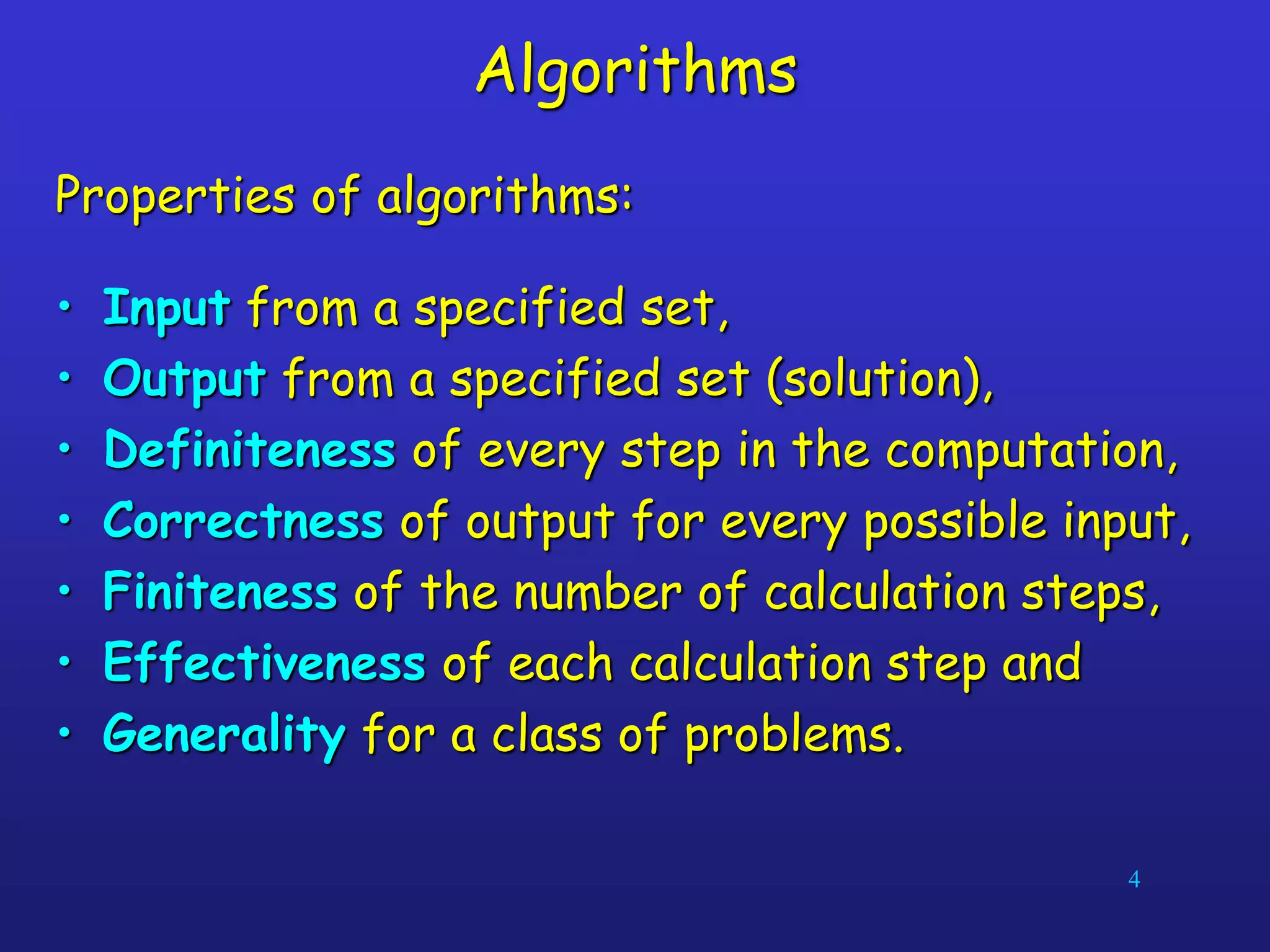
Properties of algorithms:
• Input from a specified set,
• Output from a specified set (solution),
• Definiteness of every step in the computation,
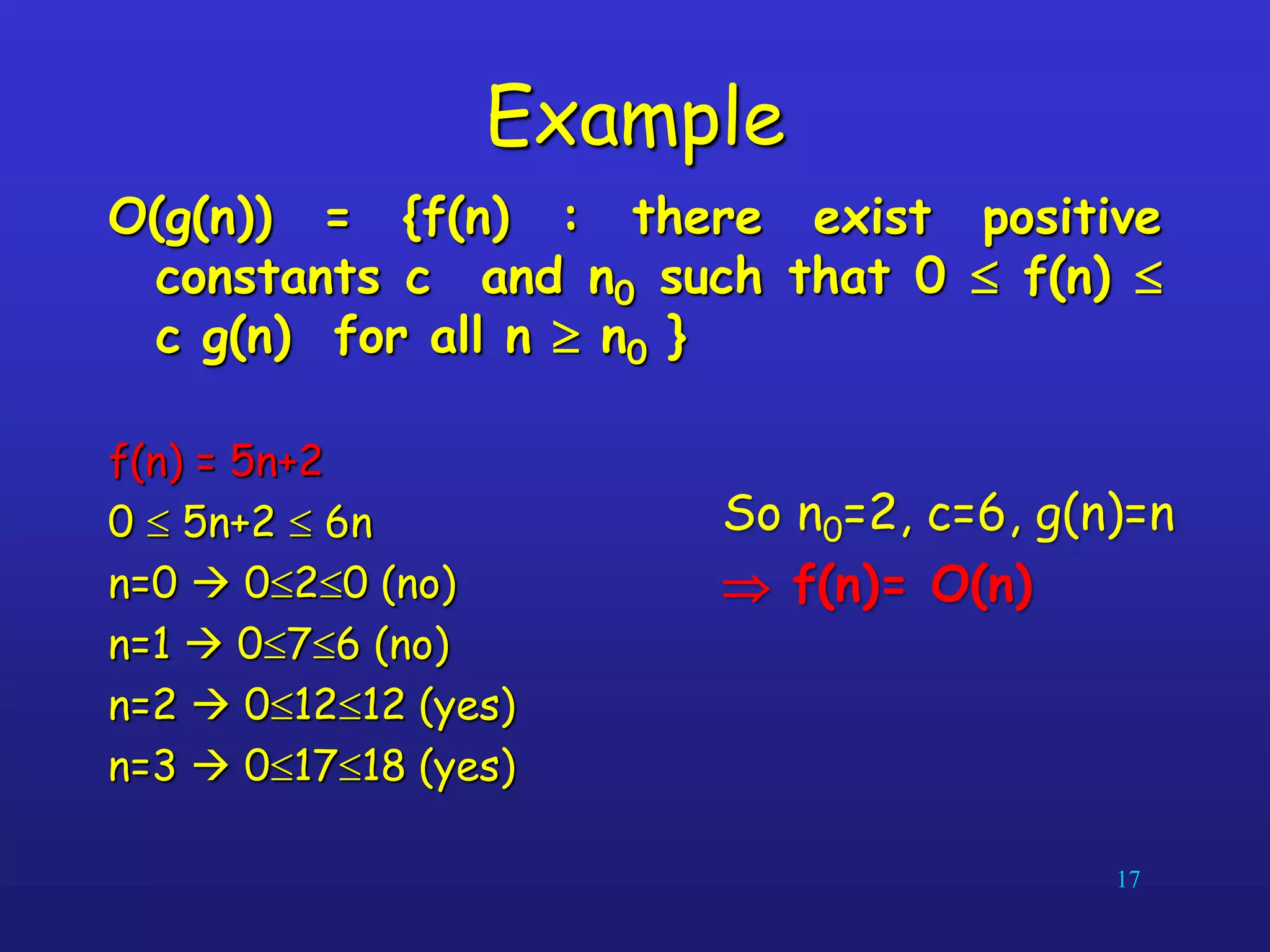
• Correctness of output for every possible input,
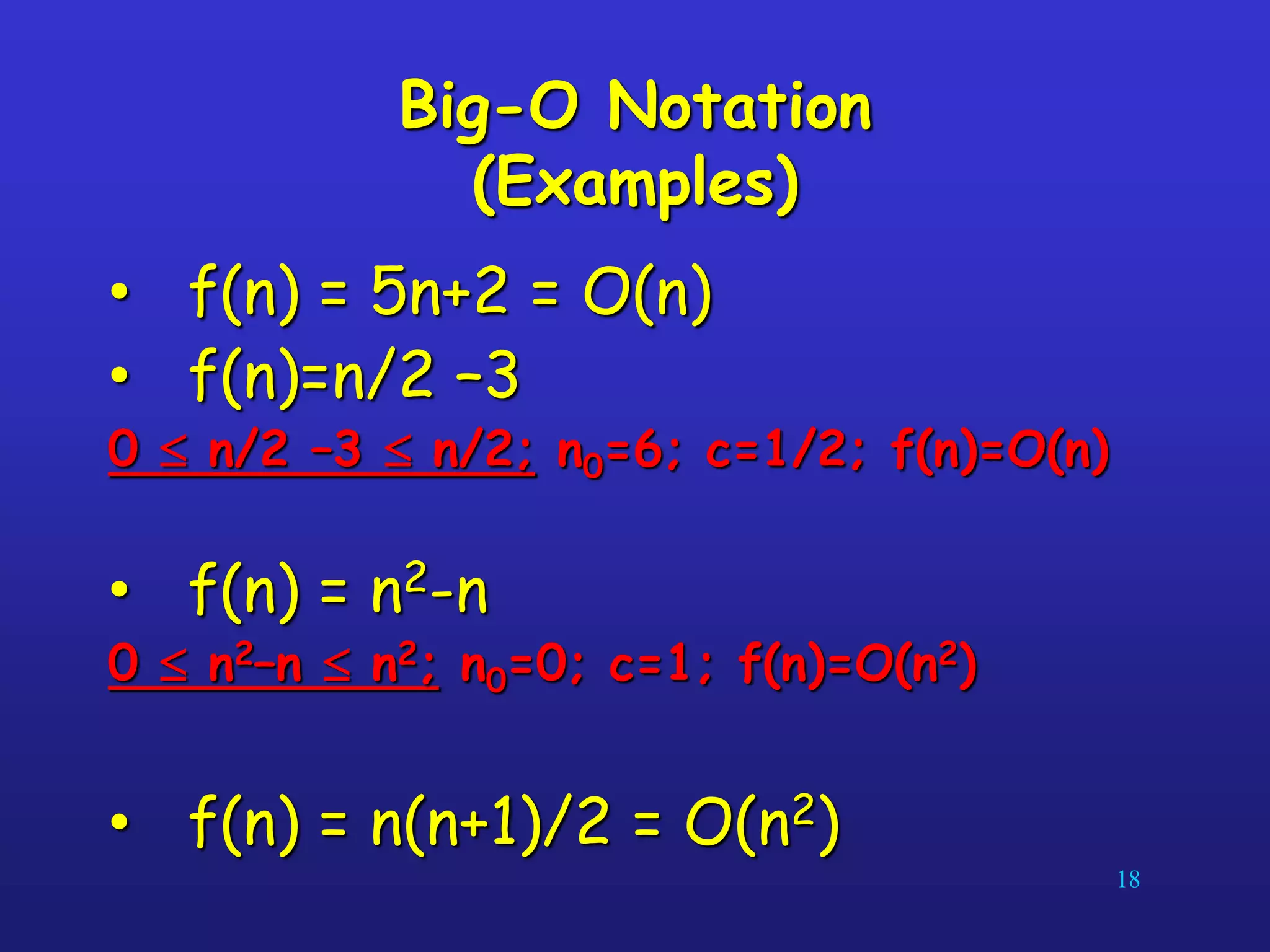
• Finiteness of the number of calculation steps,
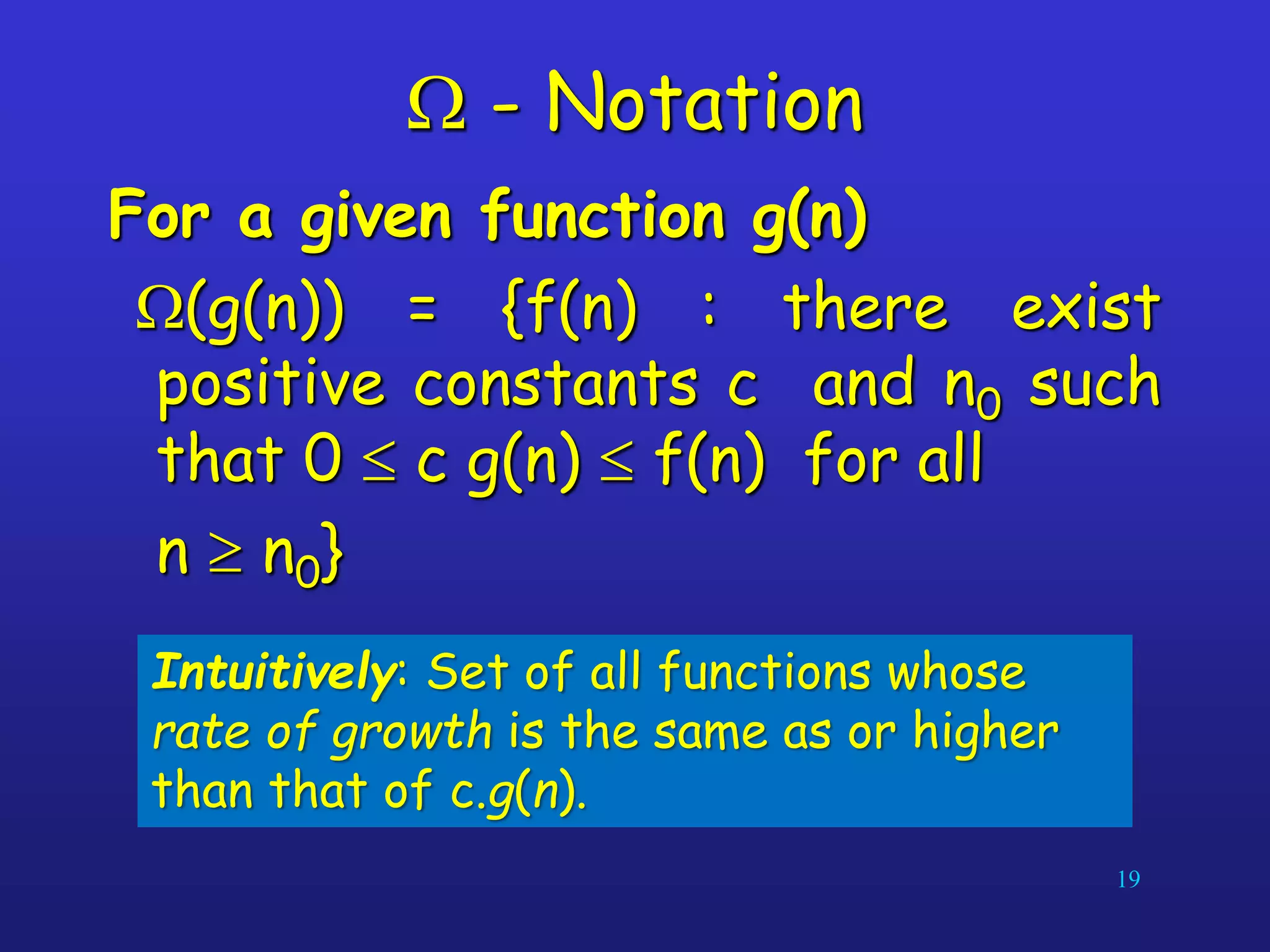
• Effectiveness of each calculation step and
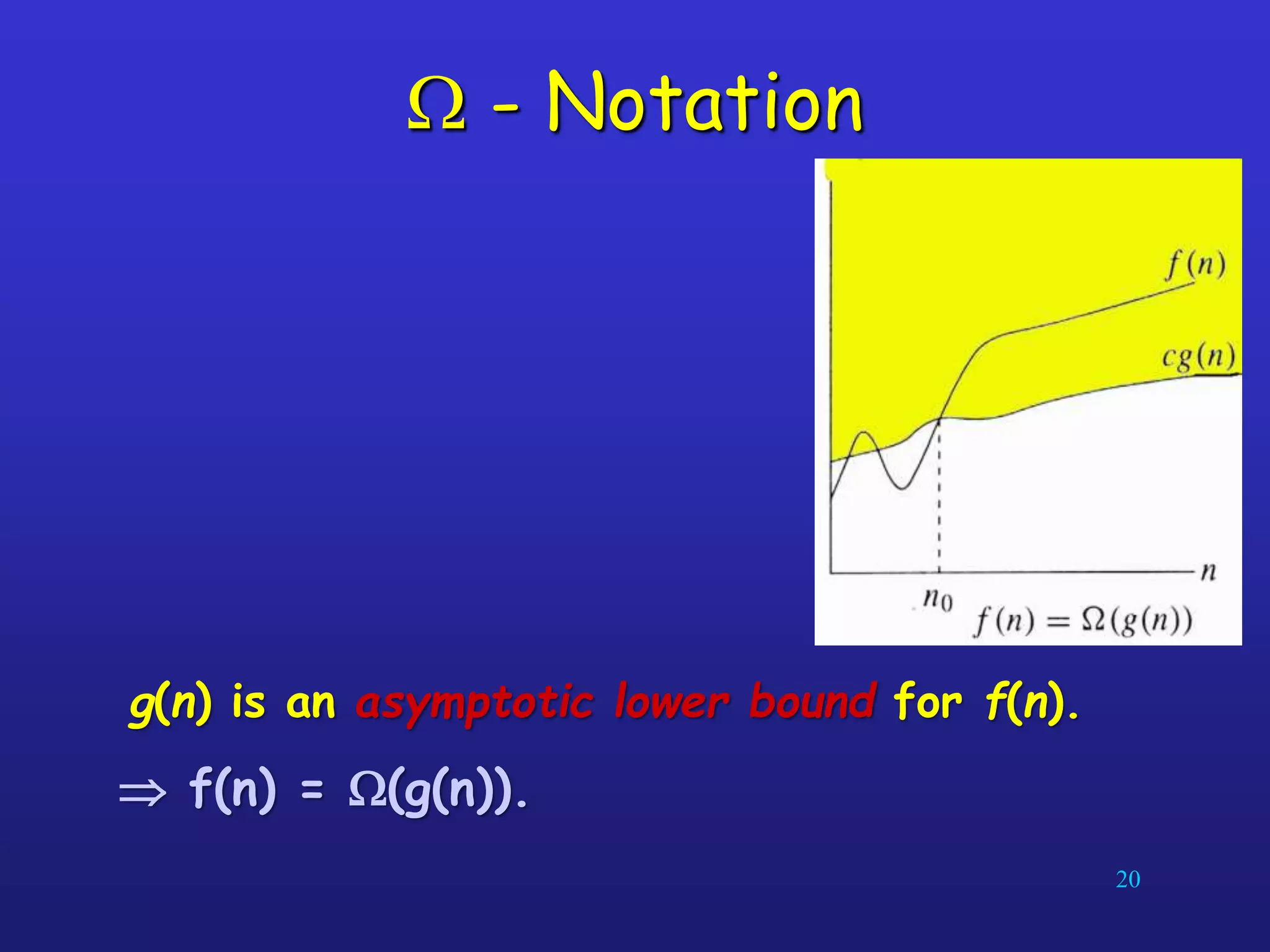
• Generality for a class of problems.
?
Suppose computers were infinitely fast and
computer memory are free
Is there any reason to study algorithm ?
Yes
– Demonstrate that solution methods
terminates and does so with correct
answer.
In reality
• Computers may be fast, but
they are not infinitely fast and
• Memory may be cheap but it is
not free
• Computing time is therefore a
bounded resource and so is the
space in memory
7
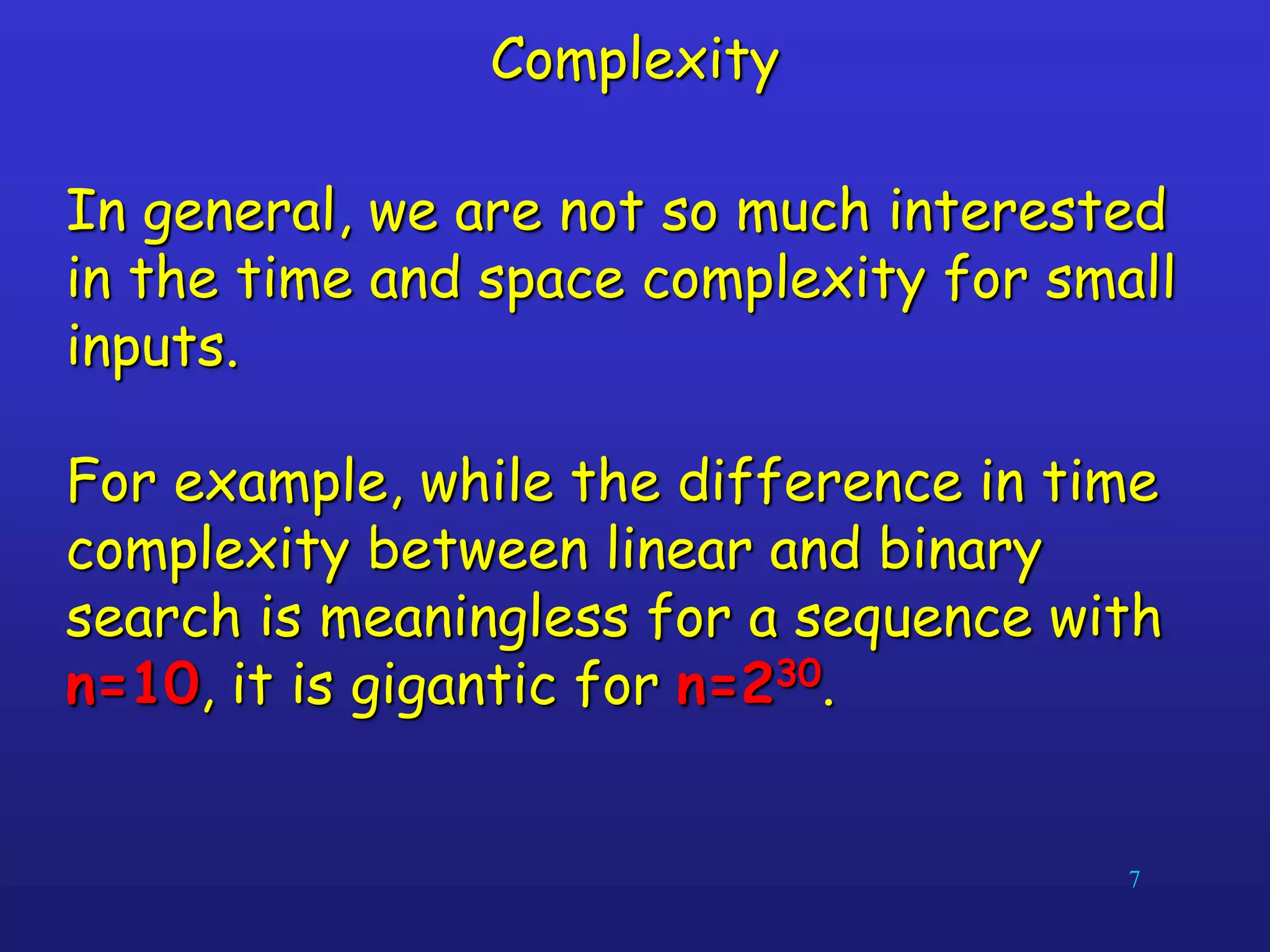
Complexity
In general, we are not so much interested
in the time and space complexity for small
inputs.
For example, while the difference in time
complexity between linear and binary
search is meaningless for a sequence with
n=10, it is gigantic for n=230.
8
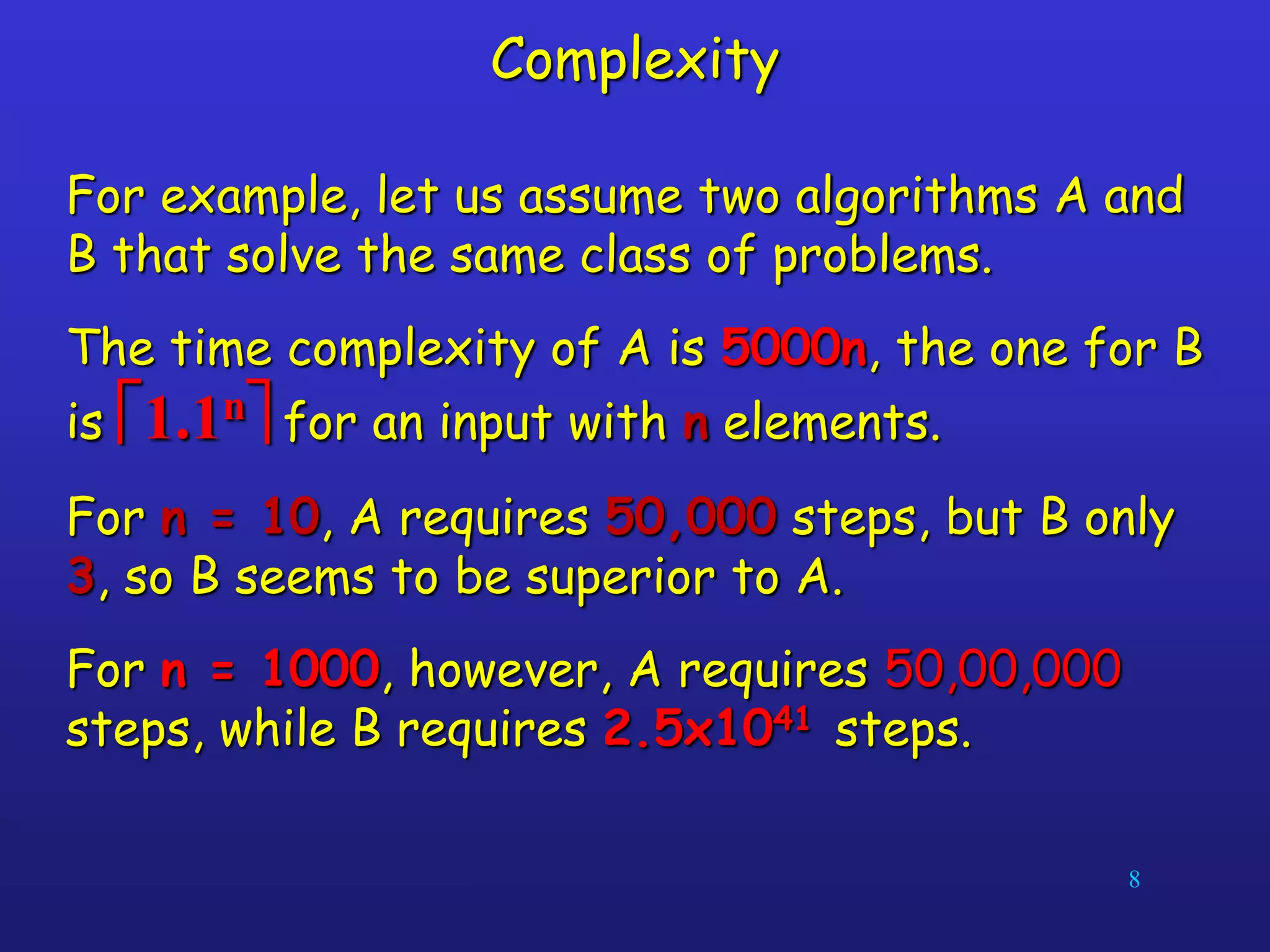
Complexity
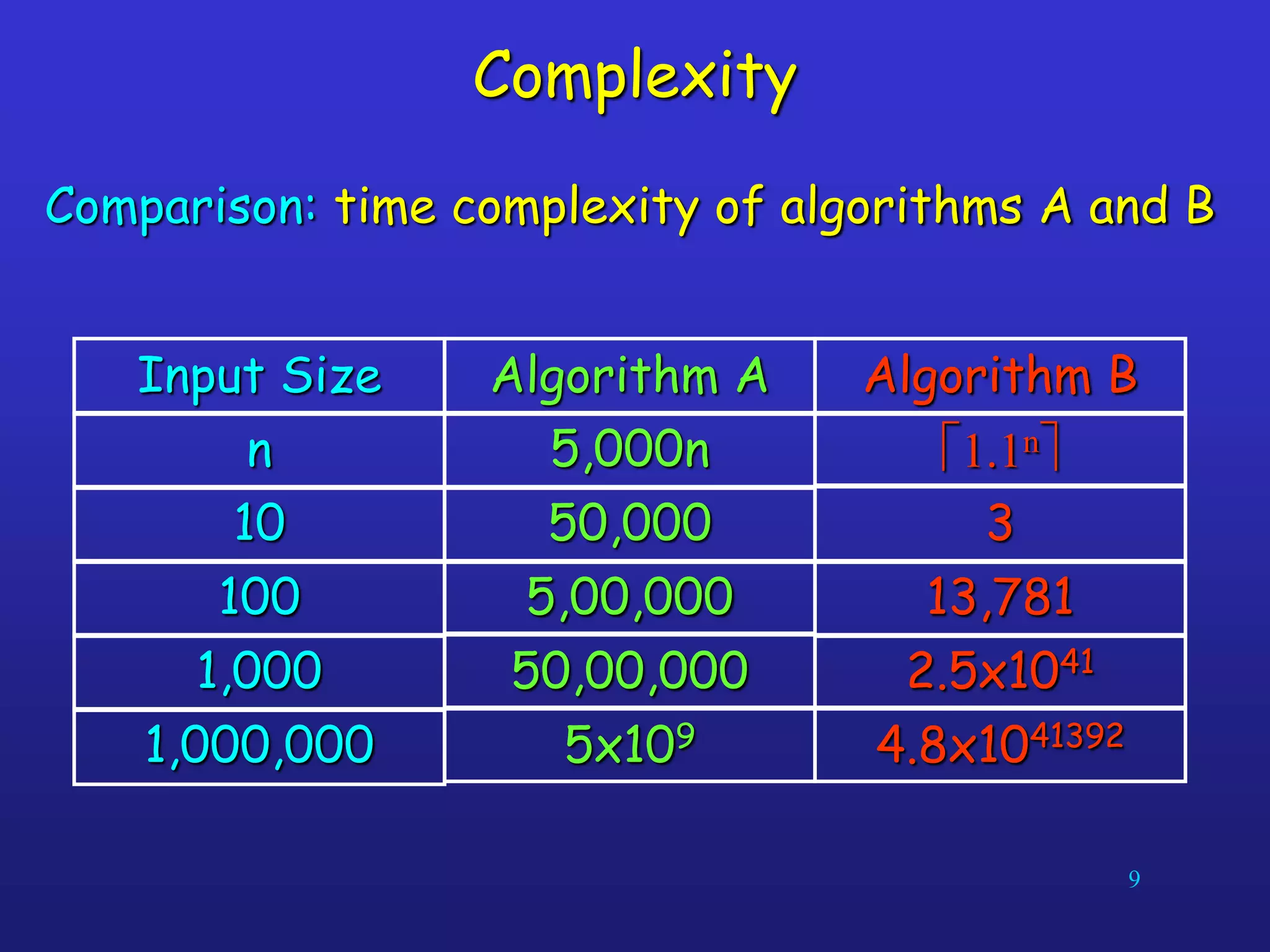
For example, let us assume two algorithms A and
B that solve the same class of problems.
The time complexity of A is 5000n, the one for B
is 1.1n for an input with n elements.
For n = 10, A requires 50,000 steps, but B only
3, so B seems to be superior to A.
For n = 1000, however, A requires 50,00,000
steps, while B requires 2.5x1041 steps.
9
Complexity
Comparison: time complexity of algorithms A and B
Algorithm A Algorithm BInput Size
n
10
100
1,000
1,000,000
5,000n
50,000
5,00,000
50,00,000
5x10⁹
1.1n
3
2.5x1041
13,781
4.8x1041392
10
Complexity
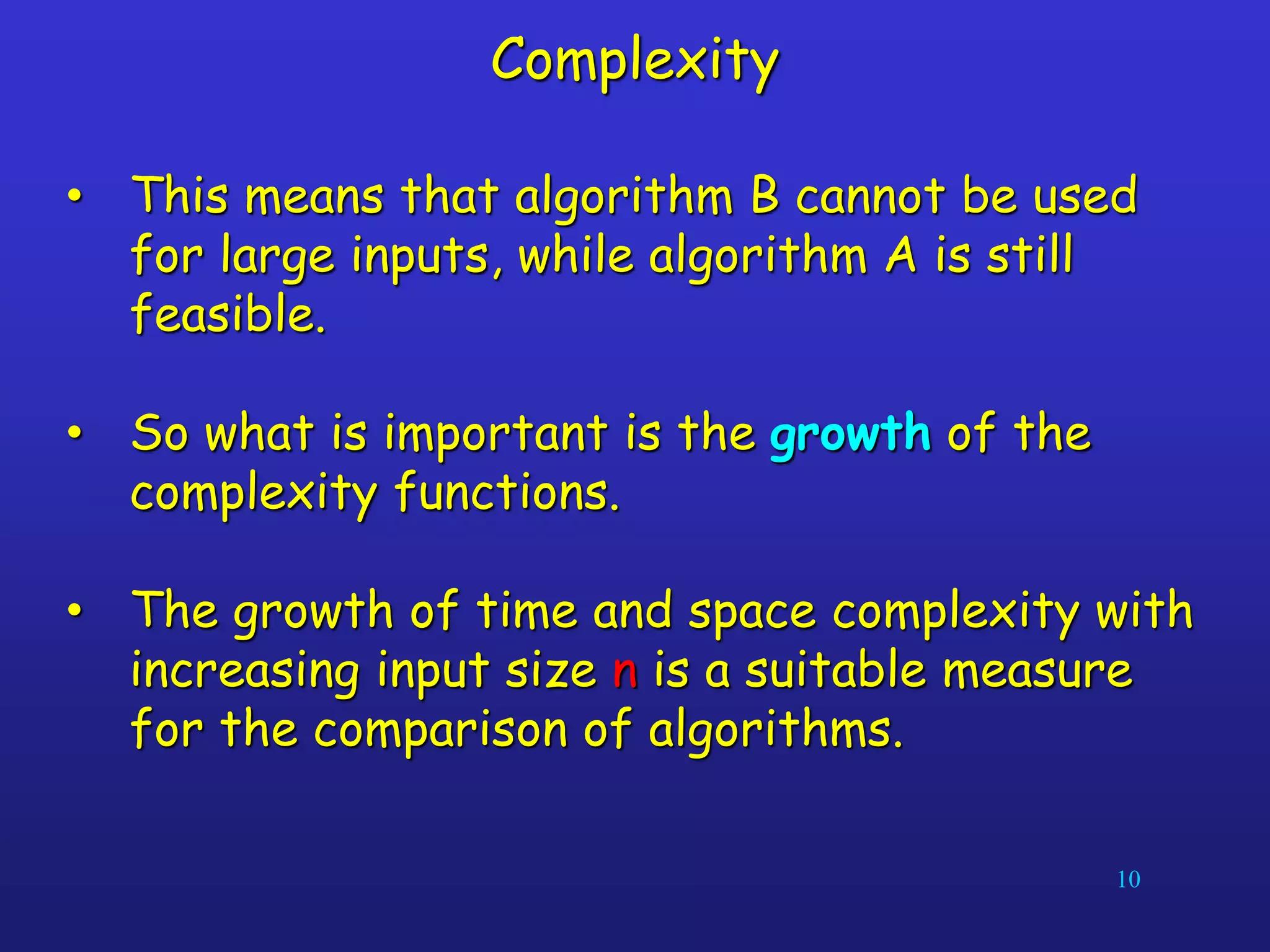
• This means that algorithm B cannot be used
for large inputs, while algorithm A is still
feasible.
• So what is important is the growth of the
complexity functions.
• The growth of time and space complexity with
increasing input size n is a suitable measure
for the comparison of algorithms.
Asymptotic Efficiency
Algorithm
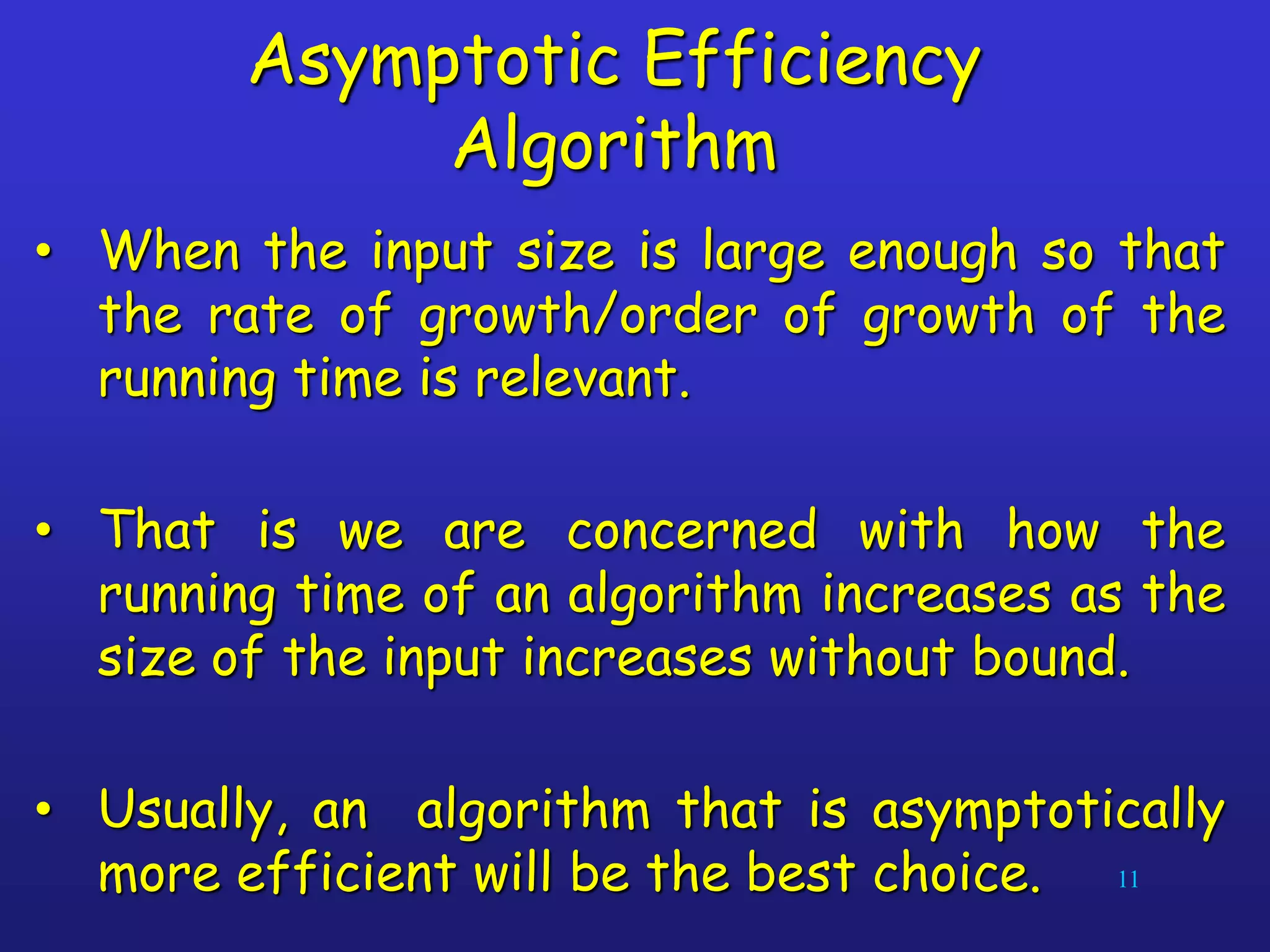
• When the input size is large enough so that
the rate of growth/order of growth of the
running time is relevant.
• That is we are concerned with how the
running time of an algorithm increases as the
size of the input increases without bound.
• Usually, an algorithm that is asymptotically
more efficient will be the best choice. 11
Asymptotic Notation
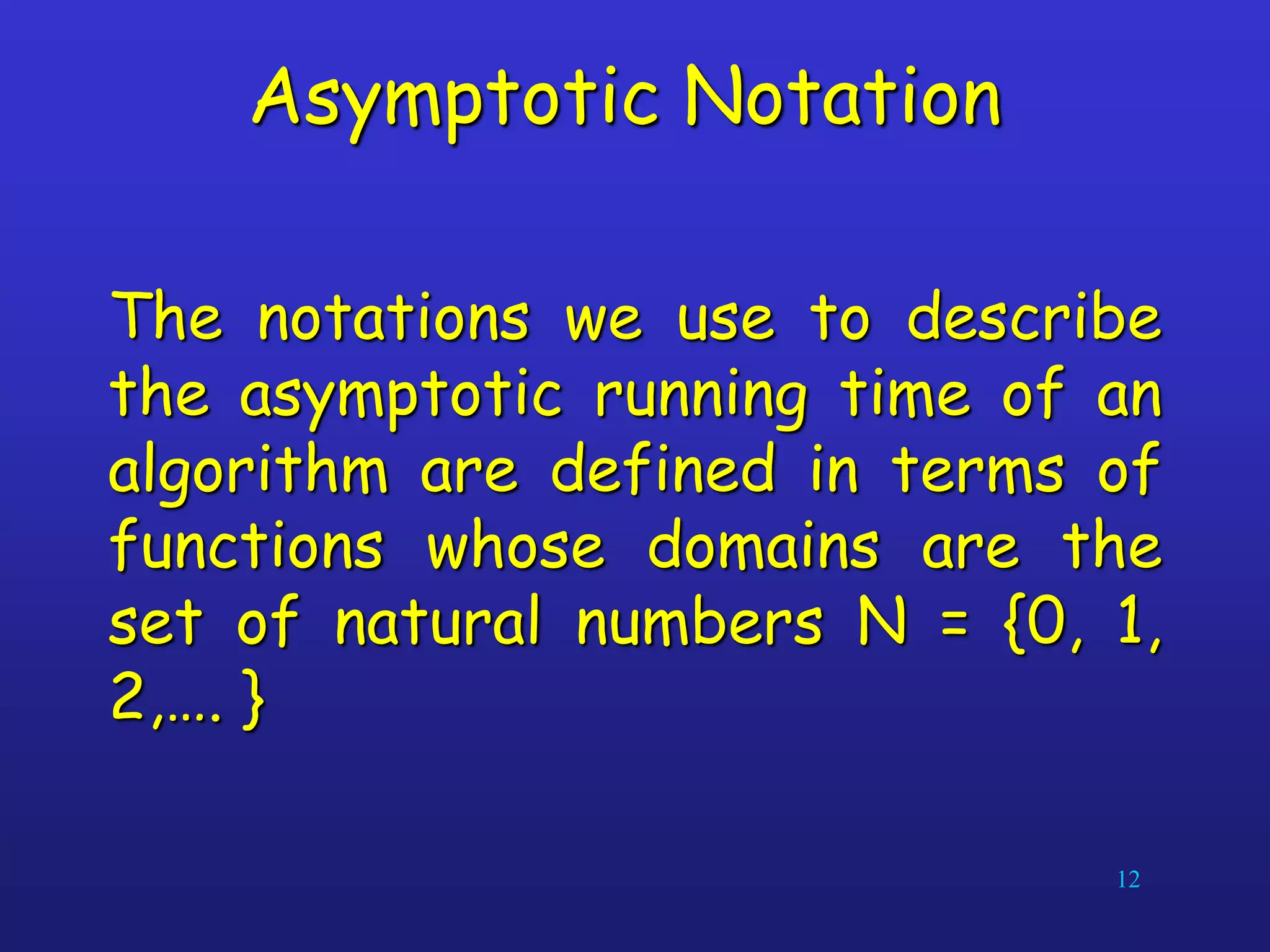
The notations we use to describe
the asymptotic running time of an
algorithm are defined in terms of
functions whose domains are the
set of natural numbers N = {0, 1,
2,…. }
12
13
Asymptotic Notation
Let f(n) and g(n) be two positive
functions, representing the number
of basic calculations (operations,
instructions) that an algorithm
takes (or the number of memory
words an algorithm needs).
Asymptotic Notation
Q - Big Theta
O – Big O
W - Big Omega
o – Small o
w - Small Omega
14
15
O-Notation
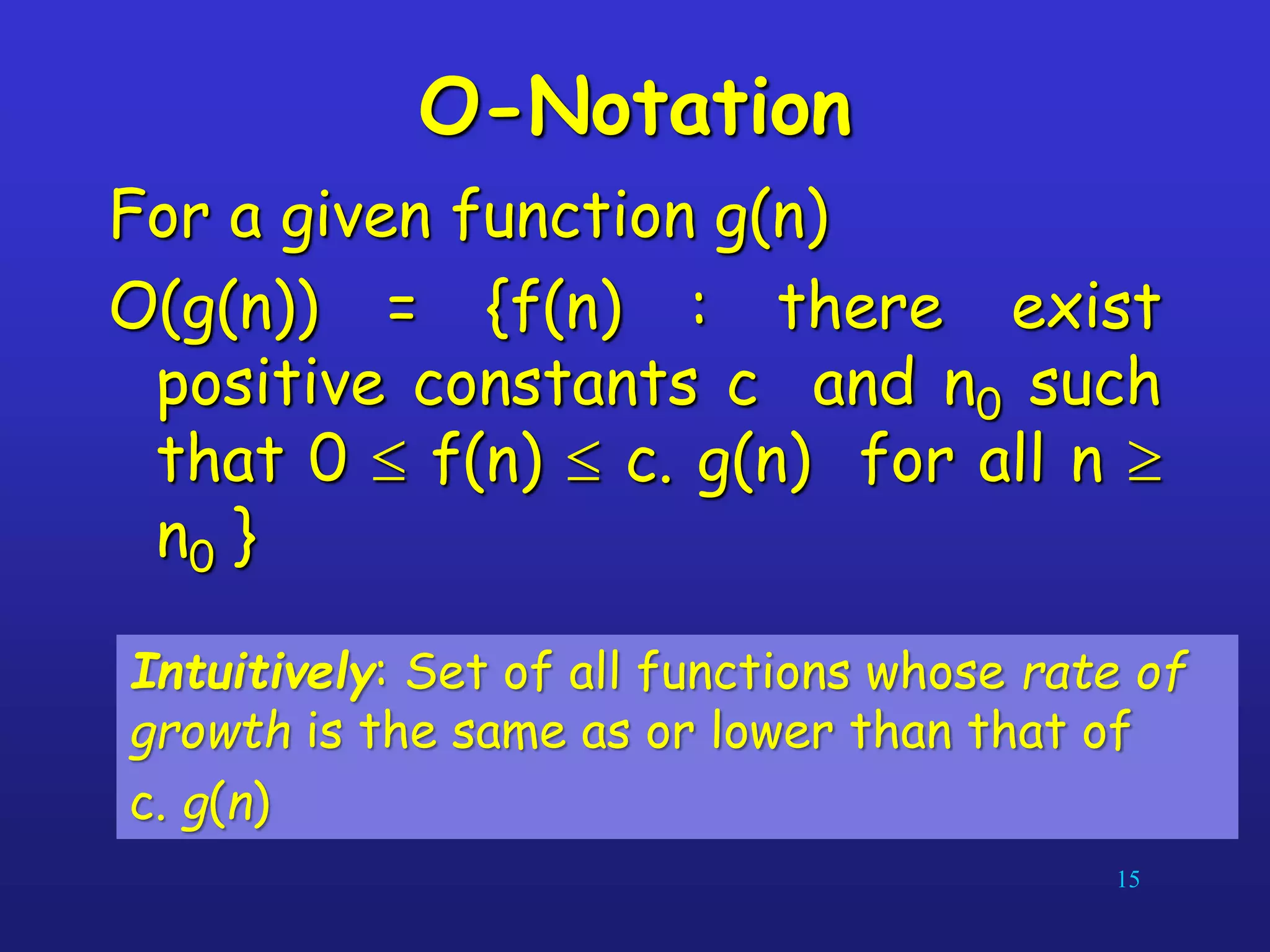
For a given function g(n)
O(g(n)) = {f(n) : there exist
positive constants c and n0 such
that 0  f(n)  c. g(n) for all n 
n0 }
Intuitively: Set of all functions whose rate of
growth is the same as or lower than that of
c. g(n)
O-Notation
16
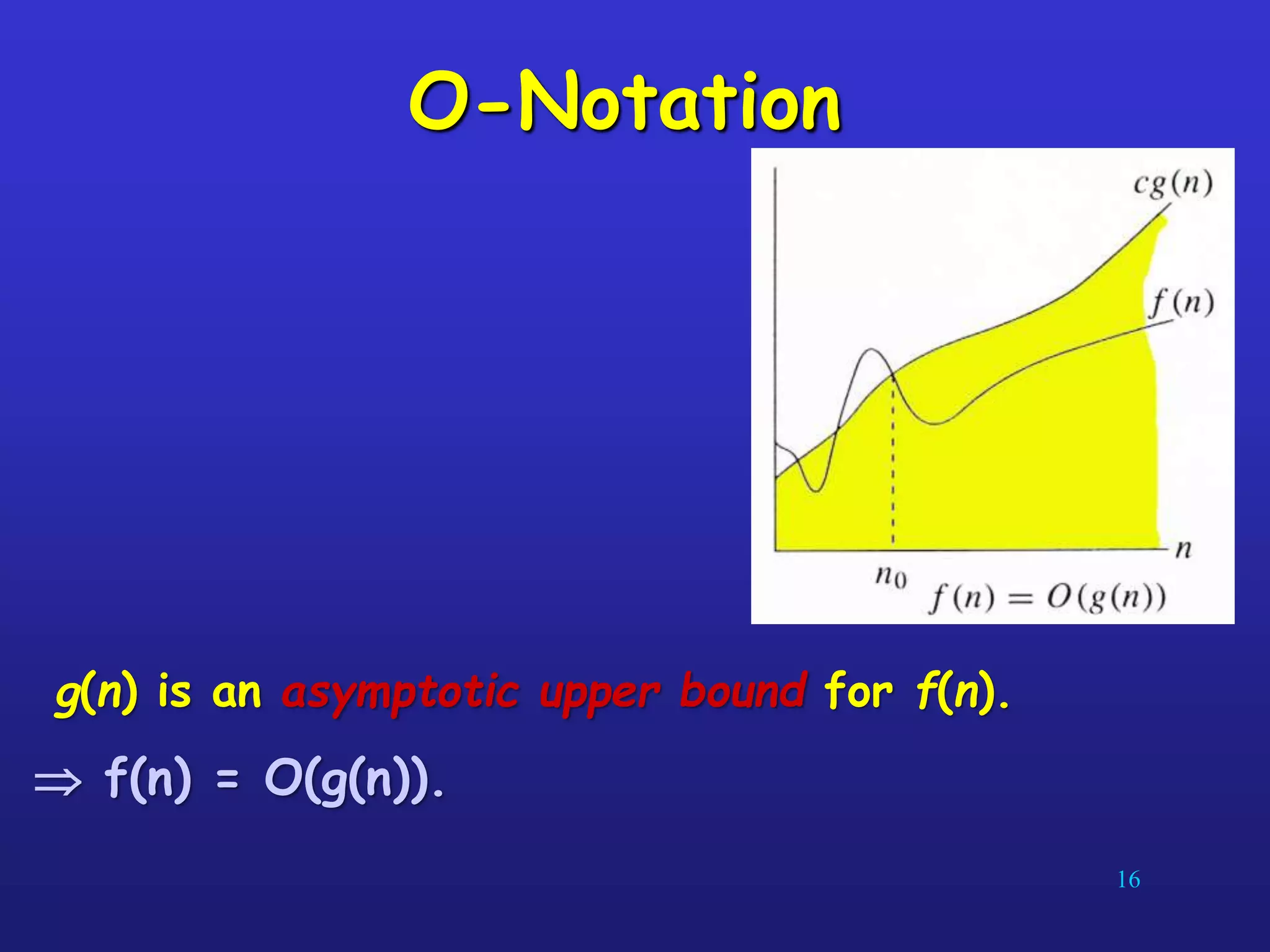
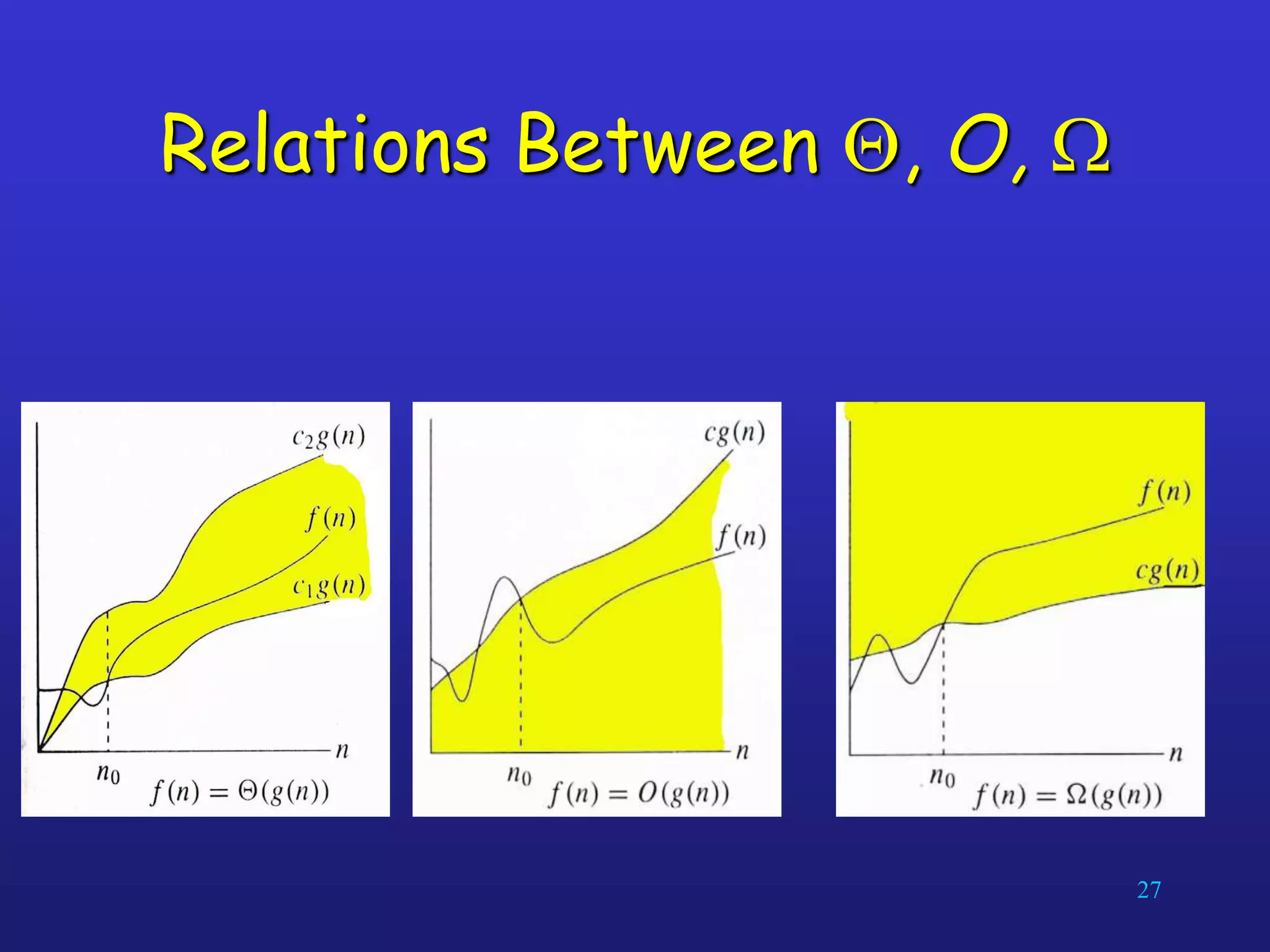
g(n) is an asymptotic upper bound for f(n).
 f(n) = O(g(n)).
Example
O(g(n)) = {f(n) : there exist positive
constants c and n0 such that 0  f(n) 
c g(n) for all n  n0 }
f(n) = 5n+2
0  5n+2  6n
n=0  020 (no)
n=1  076 (no)
n=2  01212 (yes)
n=3  01718 (yes)
17
So n0=2, c=6, g(n)=n
 f(n)= O(n)
18
Big-O Notation
(Examples)
• f(n) = 5n+2 = O(n)
• f(n)=n/2 –3
0  n/2 –3  n/2; n0=6; c=1/2; f(n)=O(n)
• f(n) = n2-n
0  n2–n  n2; n0=0; c=1; f(n)=O(n2)
• f(n) = n(n+1)/2 = O(n2)
W - Notation
For a given function g(n)
W(g(n)) = {f(n) : there exist
positive constants c and n0 such
that 0  c g(n)  f(n) for all
n  n0}
19
Intuitively: Set of all functions whose
rate of growth is the same as or higher
than that of c.g(n).
W - Notation
20
g(n) is an asymptotic lower bound for f(n).
 f(n) = W(g(n)).
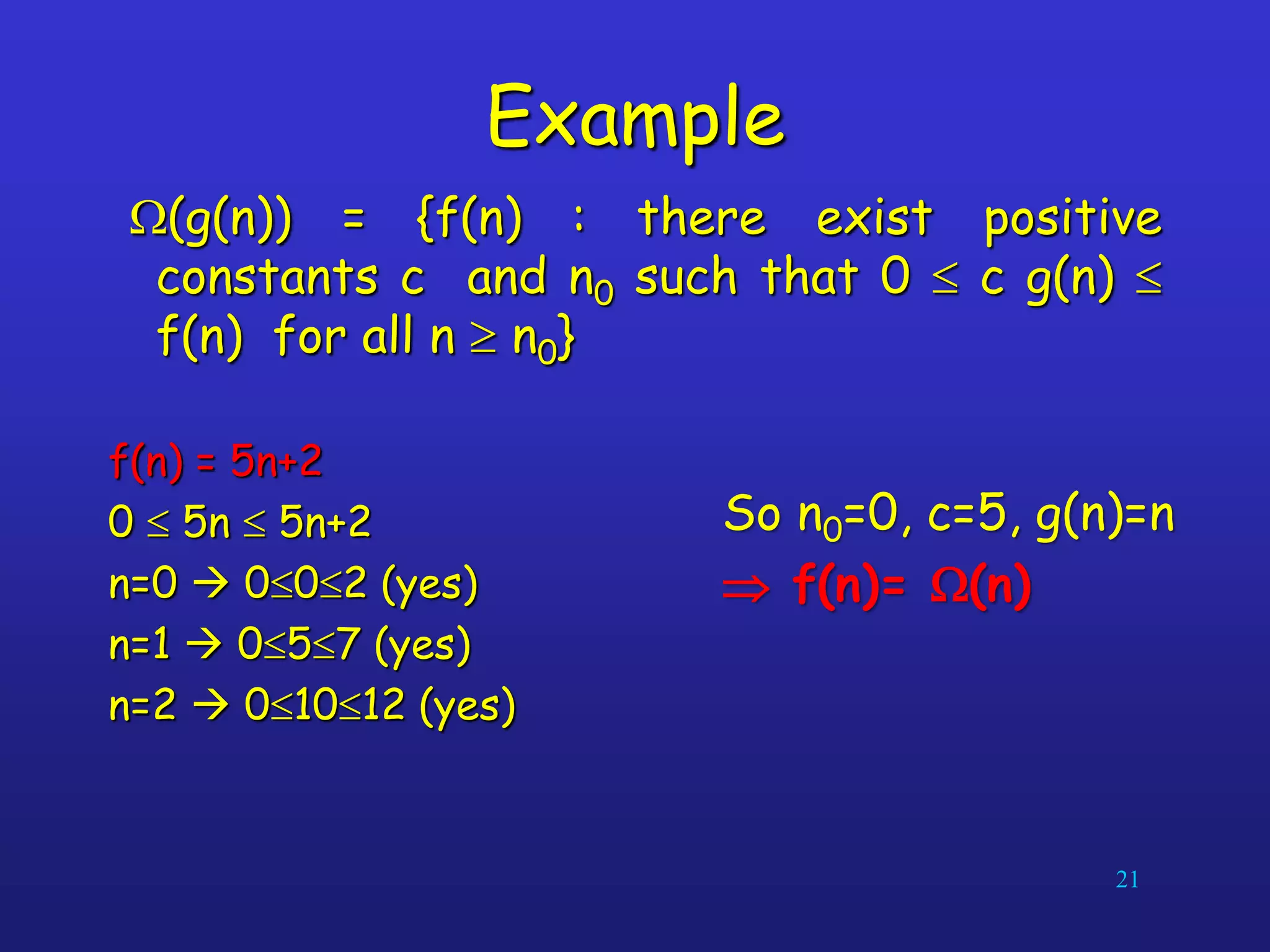
Example
W(g(n)) = {f(n) : there exist positive
constants c and n0 such that 0  c g(n) 
f(n) for all n  n0}
f(n) = 5n+2
0  5n  5n+2
n=0  002 (yes)
n=1  057 (yes)
n=2  01012 (yes)
21
So n0=0, c=5, g(n)=n
 f(n)= W(n)
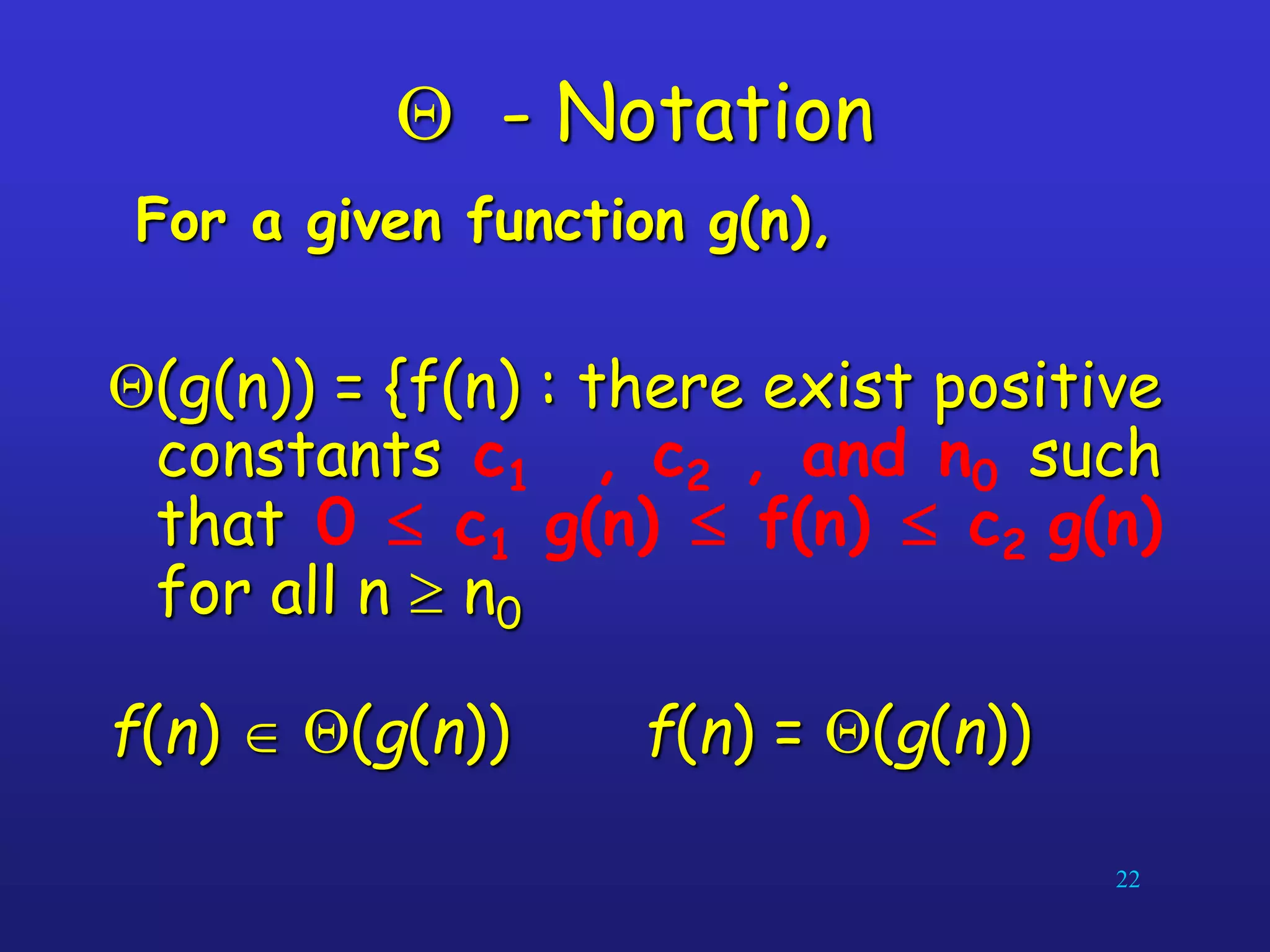
Q - Notation
For a given function g(n),
Q(g(n)) = {f(n) : there exist positive
constants c1 , c2 , and n0 such
that 0  c1 g(n)  f(n)  c2 g(n)
for all n  n0
f(n)  Q(g(n)) f(n) = Q(g(n))
22
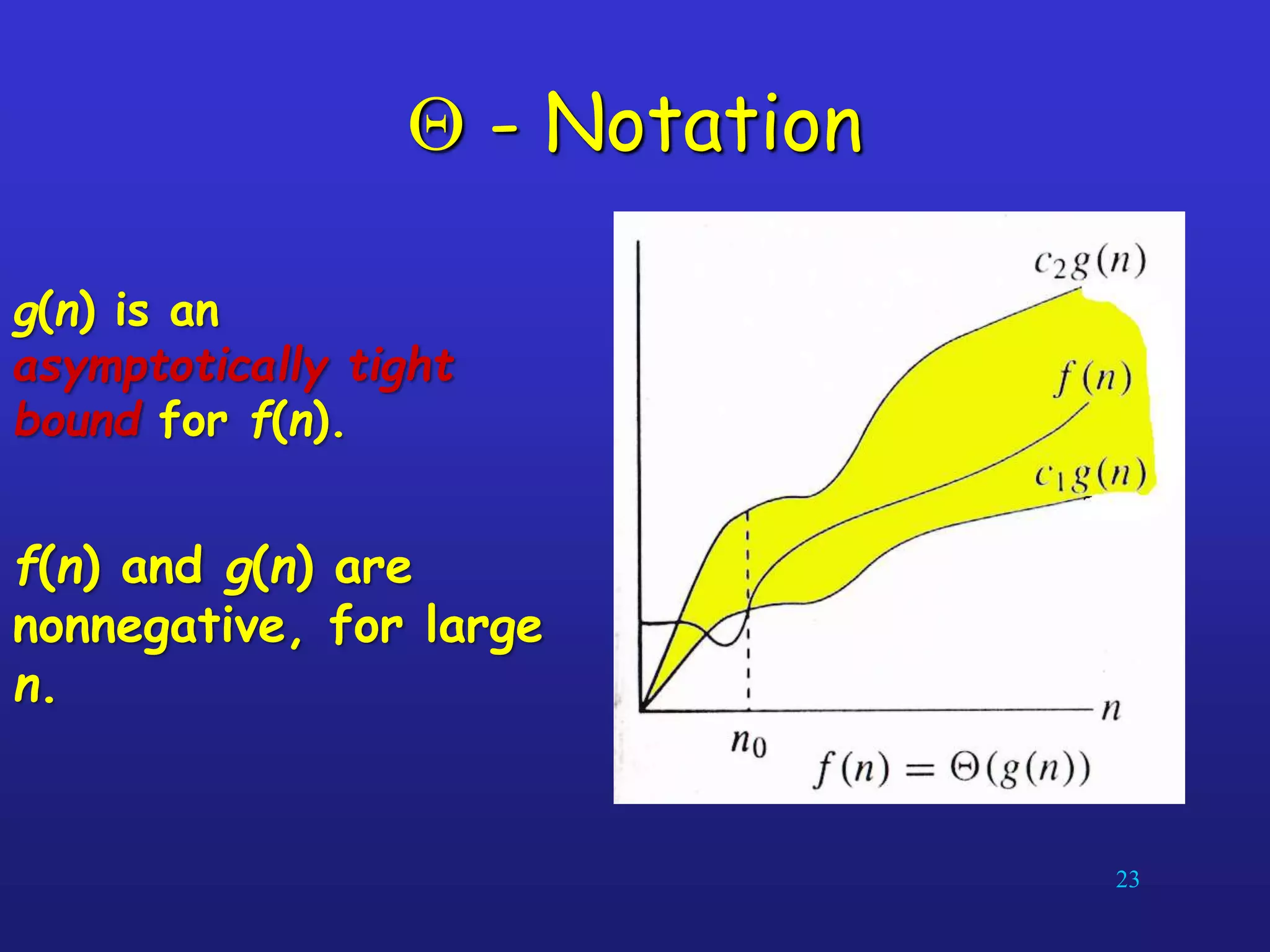
Q - Notation
23
g(n) is an
asymptotically tight
bound for f(n).
f(n) and g(n) are
nonnegative, for large
n.
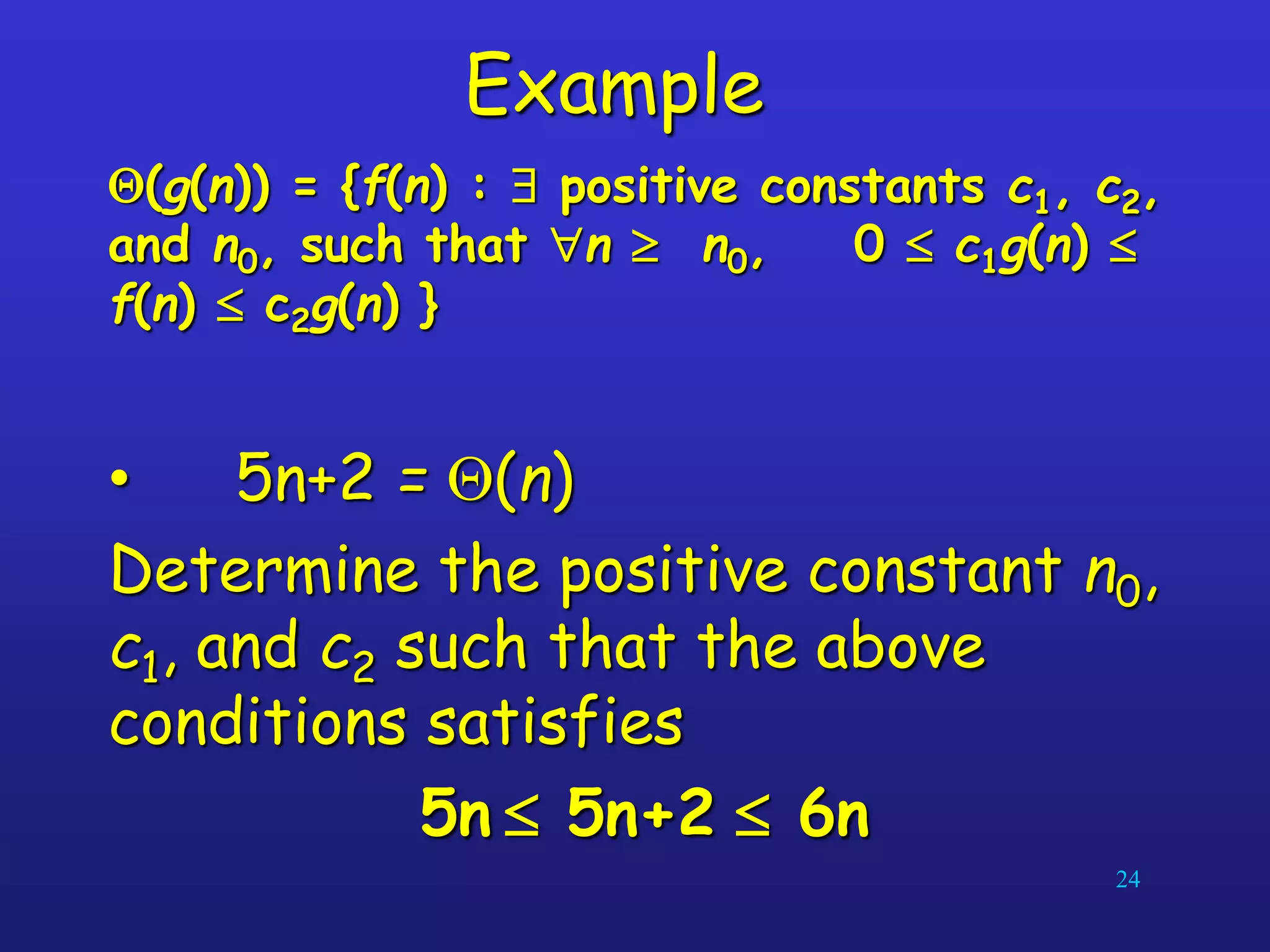
Example
Q(g(n)) = {f(n) :  positive constants c1, c2,
and n0, such that n  n0, 0  c1g(n) 
f(n)  c2g(n) }
• 5n+2 = Q(n)
Determine the positive constant n0,
c1, and c2 such that the above
conditions satisfies
5n  5n+2  6n
24
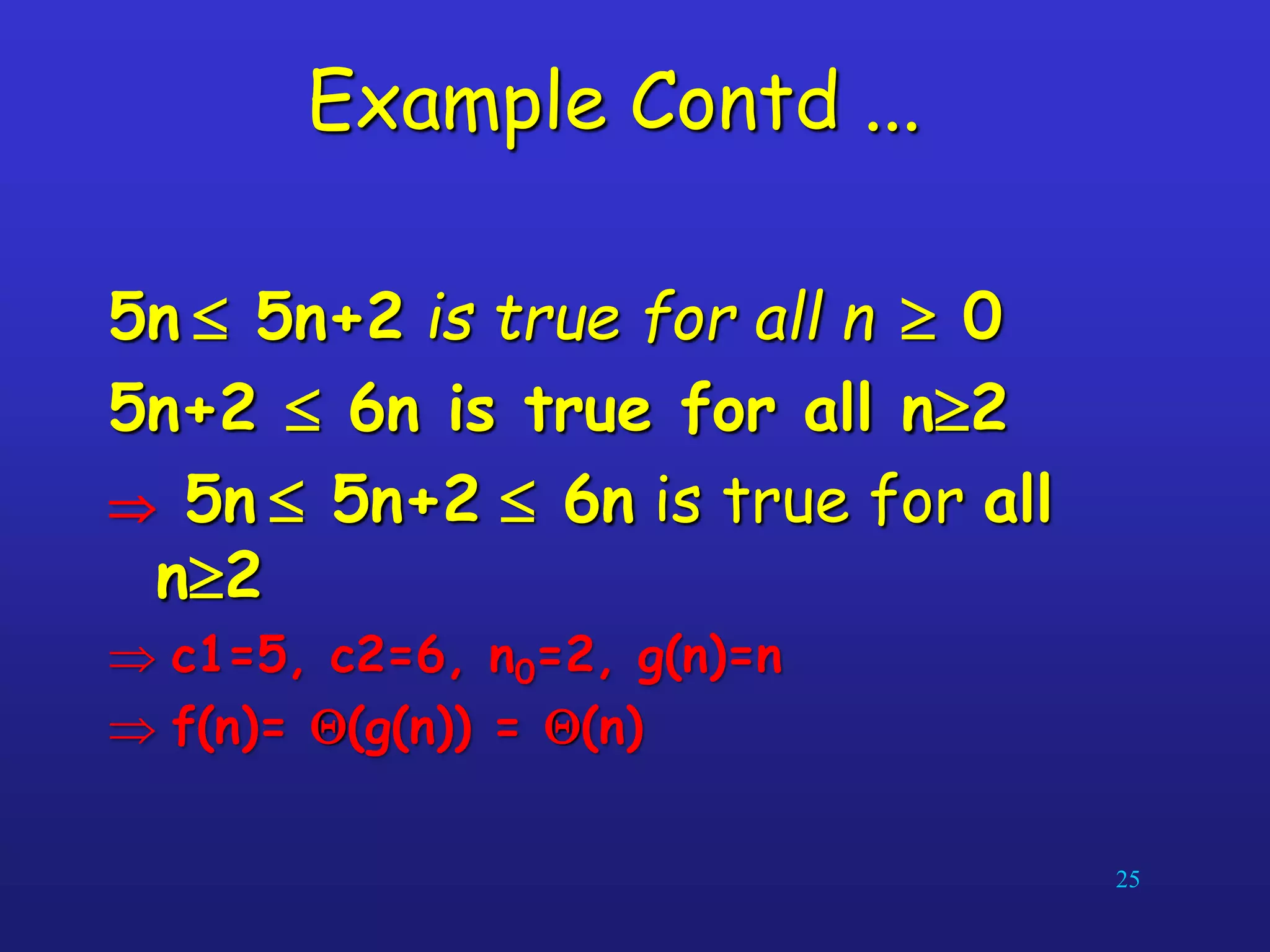
Example Contd ...
5n  5n+2 is true for all n  0
5n+2  6n is true for all n2
 5n  5n+2  6n is true for all
n2
 c1=5, c2=6, n0=2, g(n)=n
 f(n)= Q(g(n)) = Q(n)
25
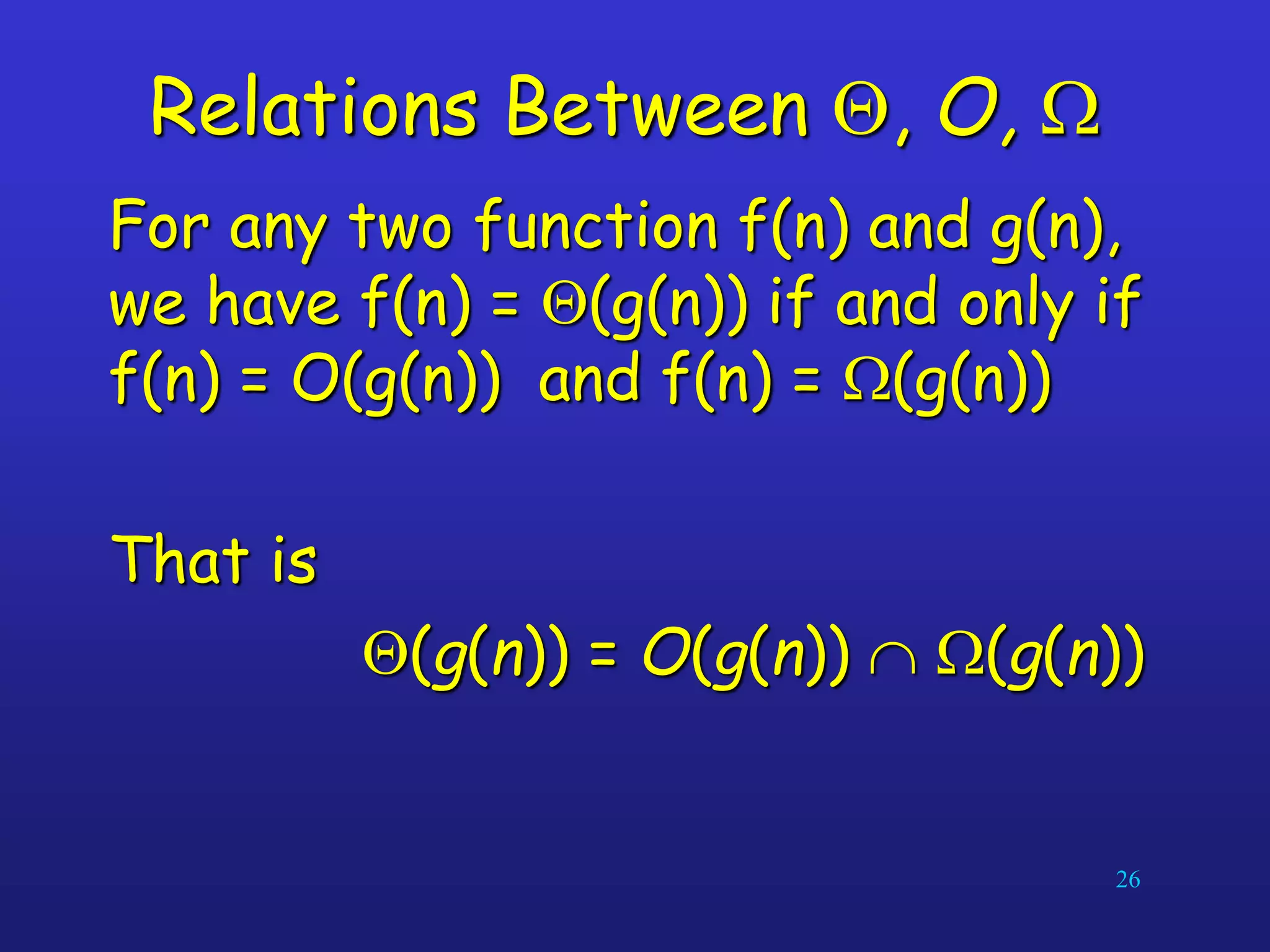
Relations Between Q, O, W
For any two function f(n) and g(n),
we have f(n) = Q(g(n)) if and only if
f(n) = O(g(n)) and f(n) = W(g(n))
That is
Q(g(n)) = O(g(n))  W(g(n))
26
Relations Between Q, O, W
27
28
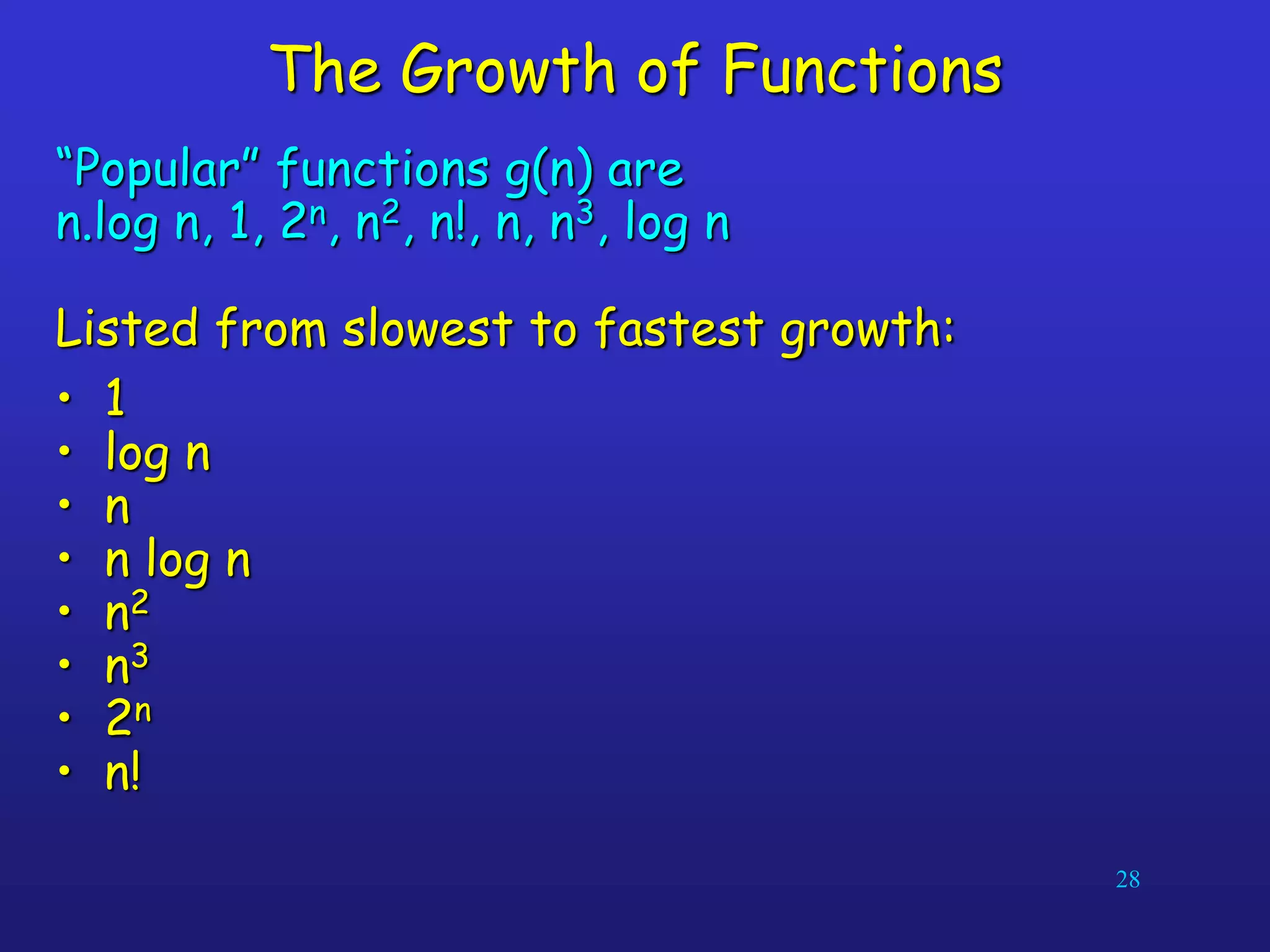
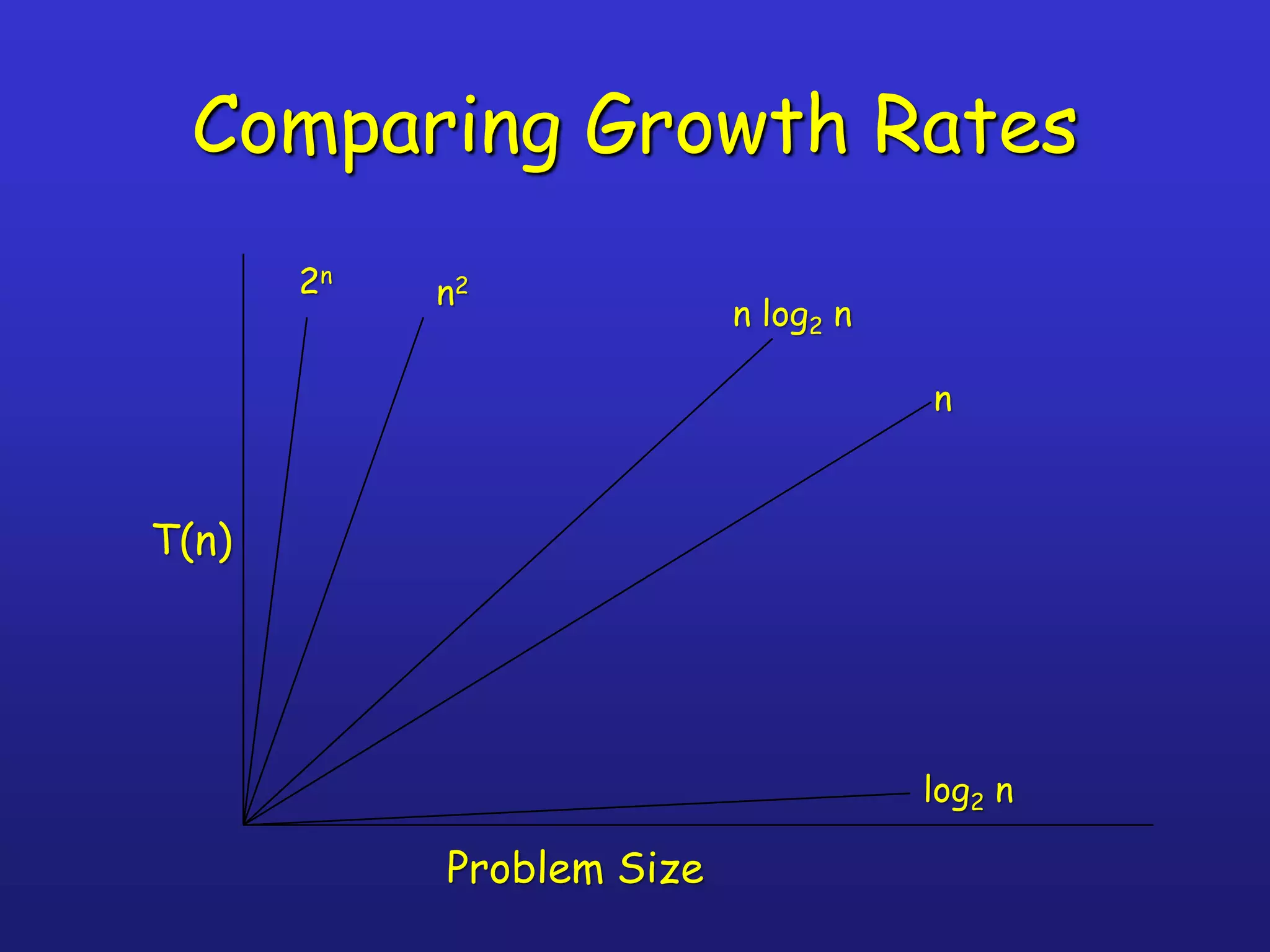
The Growth of Functions
“Popular” functions g(n) are
n.log n, 1, 2n, n2, n!, n, n3, log n
Listed from slowest to fastest growth:
• 1
• log n
• n
• n log n
• n2
• n3
• 2n
• n!
Comparing Growth Rates
Problem Size
T(n)
log2 n
n
n log2 n
n22n
Example: Find sum of array elements
Input size: n (number of array elements)
Total number of steps: 2n + 3 = f(n)
Algorithm arraySum (A, n)
Input array A of n integers
Output Sum of elements of A # operations
sum  0 1
for i  0 to n  1 do n+1
sum  sum + A [i] n
return sum 1
Algorithm arrayMax(A, n)
Input array A of n integers
Output maximum element of A # operations
currentMax  A[0] 1
for i  1 to n  1 do n
if A [i]  currentMax then n -1
currentMax  A [i] n -1
return currentMax 1
Example: Find max element of an
array
 Input size: n (number of array elements)
 Total number of steps: f(n)=3n

Algorithms required for data structures(basics like Arrays, Stacks ,Linked Lists etc)

  • 1.
  • 2.
    Definition An algorithm isany well-defined computational procedure that takes some values or set of values as input and produces some values or set of values as output
  • 3.
    Definition A sequence ofcomputational steps that transforms the input into output
  • 4.
    4 Algorithms Properties of algorithms: •Input from a specified set, • Output from a specified set (solution), • Definiteness of every step in the computation, • Correctness of output for every possible input, • Finiteness of the number of calculation steps, • Effectiveness of each calculation step and • Generality for a class of problems.
  • 5.
    ? Suppose computers wereinfinitely fast and computer memory are free Is there any reason to study algorithm ? Yes – Demonstrate that solution methods terminates and does so with correct answer.
  • 6.
    In reality • Computersmay be fast, but they are not infinitely fast and • Memory may be cheap but it is not free • Computing time is therefore a bounded resource and so is the space in memory
  • 7.
    7 Complexity In general, weare not so much interested in the time and space complexity for small inputs. For example, while the difference in time complexity between linear and binary search is meaningless for a sequence with n=10, it is gigantic for n=230.
  • 8.
    8 Complexity For example, letus assume two algorithms A and B that solve the same class of problems. The time complexity of A is 5000n, the one for B is 1.1n for an input with n elements. For n = 10, A requires 50,000 steps, but B only 3, so B seems to be superior to A. For n = 1000, however, A requires 50,00,000 steps, while B requires 2.5x1041 steps.
  • 9.
    9 Complexity Comparison: time complexityof algorithms A and B Algorithm A Algorithm BInput Size n 10 100 1,000 1,000,000 5,000n 50,000 5,00,000 50,00,000 5x10⁹ 1.1n 3 2.5x1041 13,781 4.8x1041392
  • 10.
    10 Complexity • This meansthat algorithm B cannot be used for large inputs, while algorithm A is still feasible. • So what is important is the growth of the complexity functions. • The growth of time and space complexity with increasing input size n is a suitable measure for the comparison of algorithms.
  • 11.
    Asymptotic Efficiency Algorithm • Whenthe input size is large enough so that the rate of growth/order of growth of the running time is relevant. • That is we are concerned with how the running time of an algorithm increases as the size of the input increases without bound. • Usually, an algorithm that is asymptotically more efficient will be the best choice. 11
  • 12.
    Asymptotic Notation The notationswe use to describe the asymptotic running time of an algorithm are defined in terms of functions whose domains are the set of natural numbers N = {0, 1, 2,…. } 12
  • 13.
    13 Asymptotic Notation Let f(n)and g(n) be two positive functions, representing the number of basic calculations (operations, instructions) that an algorithm takes (or the number of memory words an algorithm needs).
  • 14.
    Asymptotic Notation Q -Big Theta O – Big O W - Big Omega o – Small o w - Small Omega 14
  • 15.
    15 O-Notation For a givenfunction g(n) O(g(n)) = {f(n) : there exist positive constants c and n0 such that 0  f(n)  c. g(n) for all n  n0 } Intuitively: Set of all functions whose rate of growth is the same as or lower than that of c. g(n)
  • 16.
    O-Notation 16 g(n) is anasymptotic upper bound for f(n).  f(n) = O(g(n)).
  • 17.
    Example O(g(n)) = {f(n): there exist positive constants c and n0 such that 0  f(n)  c g(n) for all n  n0 } f(n) = 5n+2 0  5n+2  6n n=0  020 (no) n=1  076 (no) n=2  01212 (yes) n=3  01718 (yes) 17 So n0=2, c=6, g(n)=n  f(n)= O(n)
  • 18.
    18 Big-O Notation (Examples) • f(n)= 5n+2 = O(n) • f(n)=n/2 –3 0  n/2 –3  n/2; n0=6; c=1/2; f(n)=O(n) • f(n) = n2-n 0  n2–n  n2; n0=0; c=1; f(n)=O(n2) • f(n) = n(n+1)/2 = O(n2)
  • 19.
    W - Notation Fora given function g(n) W(g(n)) = {f(n) : there exist positive constants c and n0 such that 0  c g(n)  f(n) for all n  n0} 19 Intuitively: Set of all functions whose rate of growth is the same as or higher than that of c.g(n).
  • 20.
    W - Notation 20 g(n)is an asymptotic lower bound for f(n).  f(n) = W(g(n)).
  • 21.
    Example W(g(n)) = {f(n): there exist positive constants c and n0 such that 0  c g(n)  f(n) for all n  n0} f(n) = 5n+2 0  5n  5n+2 n=0  002 (yes) n=1  057 (yes) n=2  01012 (yes) 21 So n0=0, c=5, g(n)=n  f(n)= W(n)
  • 22.
    Q - Notation Fora given function g(n), Q(g(n)) = {f(n) : there exist positive constants c1 , c2 , and n0 such that 0  c1 g(n)  f(n)  c2 g(n) for all n  n0 f(n)  Q(g(n)) f(n) = Q(g(n)) 22
  • 23.
    Q - Notation 23 g(n)is an asymptotically tight bound for f(n). f(n) and g(n) are nonnegative, for large n.
  • 24.
    Example Q(g(n)) = {f(n):  positive constants c1, c2, and n0, such that n  n0, 0  c1g(n)  f(n)  c2g(n) } • 5n+2 = Q(n) Determine the positive constant n0, c1, and c2 such that the above conditions satisfies 5n  5n+2  6n 24
  • 25.
    Example Contd ... 5n 5n+2 is true for all n  0 5n+2  6n is true for all n2  5n  5n+2  6n is true for all n2  c1=5, c2=6, n0=2, g(n)=n  f(n)= Q(g(n)) = Q(n) 25
  • 26.
    Relations Between Q,O, W For any two function f(n) and g(n), we have f(n) = Q(g(n)) if and only if f(n) = O(g(n)) and f(n) = W(g(n)) That is Q(g(n)) = O(g(n))  W(g(n)) 26
  • 27.
  • 28.
    28 The Growth ofFunctions “Popular” functions g(n) are n.log n, 1, 2n, n2, n!, n, n3, log n Listed from slowest to fastest growth: • 1 • log n • n • n log n • n2 • n3 • 2n • n!
  • 29.
    Comparing Growth Rates ProblemSize T(n) log2 n n n log2 n n22n
  • 30.
    Example: Find sumof array elements Input size: n (number of array elements) Total number of steps: 2n + 3 = f(n) Algorithm arraySum (A, n) Input array A of n integers Output Sum of elements of A # operations sum  0 1 for i  0 to n  1 do n+1 sum  sum + A [i] n return sum 1
  • 31.
    Algorithm arrayMax(A, n) Inputarray A of n integers Output maximum element of A # operations currentMax  A[0] 1 for i  1 to n  1 do n if A [i]  currentMax then n -1 currentMax  A [i] n -1 return currentMax 1 Example: Find max element of an array  Input size: n (number of array elements)  Total number of steps: f(n)=3n