Chapter 3

Systems Analysis and Design in a Changing World, 6t
1
Use Cases
Chapter 3
Systems Analysis and Design
in a Changing World 6th Ed
Satzinger, Jackson & Burd
Chapter 3 Outline
 Use

Cases and User Goals
 Use Cases and Event Decomposition
 Use Cases and CRUD
 Use Cases in the Ridgeline Mountain
Outfitters Case
 User Case Diagrams

Systems Analysis and Design in a Changing World, 6t
3
Learning Objectives












Explain why identifying use cases is the key to defining
functional requirements
Describe the two techniques for identifying use cases
Apply the user goal technique to identify use cases
Apply the event decomposition technique to identify use
cases
Apply the CRUD technique to validate and refine the list
of use cases
Describe the notation and purpose for the use case
diagram
Draw use case diagrams by actor and by subsystem

Systems Analysis and Design in a Changing World, 6t
4
Overview







Chapter 2 provided an overview of systems analysis
activities, functional and non-functional requirements,
modeling, and information gathering techniques
This chapter focuses on identifying and modeling the key
aspect of functional requirements– use cases
In the RMO Tradeshow System from Chapter 1, some
use cases are Look up supplier, Enter/update product
information, Enter/Update contact information
In this chapter’s opening case Waiters on Call, examples
of use cases are Record an order, Record delivery,
Update an order, Sign in driver, Reconcile driver
receipts, Produce end of day deposit slip, and Produce
weekly sales reports

Systems Analysis and Design in a Changing World, 6t
5
Use Cases
Use case— an activity that the system performs,
usually in response to a request by a user
 Use cases define functional requirements
 Analysts decompose the system into a set of
use cases (functional decomposition)
 Two techniques for Identifying use cases







User goal technique
Event decomposition technique

Name each use case using Verb-Noun

Systems Analysis and Design in a Changing World, 6t
6
User Goal Technique
This technique is the most common in industry
 Simple and effective
 Identify all of the potential categories of users of
the system
 Interview and ask them to describe the tasks the
computer can help them with
 Probe further to refine the tasks into specific
user goals, “I need to Ship items, Track a
shipment, Create a return”


Systems Analysis and Design in a Changing World, 6t
7
User Goal Technique
Some RMO CSMS Users and Goals

Systems Analysis and Design in a Changing World, 6t
8
User Goal Technique:
Specific Steps
1.
2.

3.

4.

Identify all the potential users for the new system
Classify the potential users in terms of their
functional role (e.g., shipping, marketing, sales)
Further classify potential users by organizational
level (e.g., operational, management, executive)
For each type of user, interview them to find a list
of specific goals they will have when using the
new system (current goals and innovative
functions to add value)

Systems Analysis and Design in a Changing World, 6t
9
User Goal Technique
Specific Steps (continued)
5.

6.

7.

8.

Create a list of preliminary use cases
organized by type of user
Look for duplicates with similar use case
names and resolve inconsistencies
Identify where different types of users need the
same use cases
Review the completed list with each type of
user and then with interested stakeholders

Systems Analysis and Design in a Changing World, 6t
10
Event Decomposition
Technique
More Comprehensive and Complete Technique








Identify the events that occur to which the system
must respond.
For each event, name a use case (verb-noun) that
describes what the system does when the event
occurs

Event– something that occurs at a specific time
and place, can be described, and should be
remembered by the system

Systems Analysis and Design in a Changing World, 6t
11
Events and Use Cases

Systems Analysis and Design in a Changing World, 6t
12
Types of Events


External Event




Temporal Event




an event that occurs outside the system, usually
initiated by an external agent or actor
an event that occurs as a result of reaching a
point in time

State Event



an event that occurs when something happens
inside the system that triggers some process
reorder point is reached for inventory item

Systems Analysis and Design in a Changing World, 6t
13
External Event Checklist
External agent or actor wants something resulting
in a transaction





Customer buys a product

External agent or actor wants some information




Customer wants to know product details

External data changed and needs to be updated




Customer has new address and phone

Management wants some information




Sales manager wants update on production plans

Systems Analysis and Design in a Changing World, 6t
14
Temporal Event Checklist


Internal outputs needed at points in time






Management reports (summary or exception)
Operational reports (detailed transactions)
Internal statements and documents (including
payroll)

External outputs needed at points of time


Statements, status reports, bills, reminders

Systems Analysis and Design in a Changing World, 6t
15
Finding the actual event that affects
the system

Systems Analysis and Design in a Changing World, 6t
16
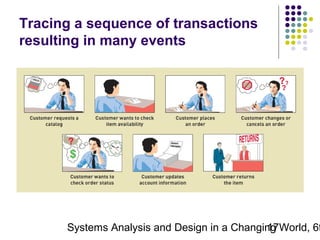
Tracing a sequence of transactions
resulting in many events

Systems Analysis and Design in a Changing World, 6t
17
Perfect Technology
Assumption


Don’t worry about functions built into system because
of limits in technology and people. Wait until design.

Systems Analysis and Design in a Changing World, 6t
18
Event Decomposition Technique:
Specific Steps
1.

2.
3.

4.

Consider the external events in the system
environment that require a response from the
system by using the checklist shown in Figure 3-3
For each external event, identify and name the use
case that the system requires
Consider the temporal events that require a
response from the system by using the checklist
shown in Figure 3-4
For each temporal event, identify and name the use
case that the system requires and then establish the
point of time that will trigger the use case

Systems Analysis and Design in a Changing World, 6t
19
Event Decomposition Technique:
Specific Steps (continued)
5.

6.

7.

Consider the state events that the system might
respond to, particularly if it is a real-time system in
which devices or internal state changes trigger use
cases.
For each state event, identify and name the use
case that the system requires and then define the
state change.
When events and use cases are defined, check to
see if they are required by using the perfect
technology assumption. Do not include events that
involve such system controls as login, logout,
change password, and backup or restore the
database, as these are put in later.

Systems Analysis and Design in a Changing World, 6t
20
Event Decomposition
Technique: Benefits






Events are broader than user goal: Capture
temporal and state events
Help decompose at the right level of analysis: an
elementary business process (EBP)
EBP is a fundamental business process performed
by one person, in one place, in response to a
business event
Uses perfect technology assumption to make sure
functions that support the users work are identified
and not additional functions for security and
system controls

Systems Analysis and Design in a Changing World, 6t
21
Use Cases and CRUD
Technique







CRUD is Create, Read/Report, Update, and
Delete (archive)
Often introduced in database context
Technique to validate, refine or cross-check
use cases
NOT for primarily identifying use cases

Systems Analysis and Design in a Changing World, 6t
22
Use Cases and CRUD
Technique


For Customer domain class, verify that there are
use cases that create, read/report, update, and
delete (archive) the domain class

Systems Analysis and Design in a Changing World, 6t
23
CRUD Technique
Steps
1.

2.

3.

4.

Identify all the data entities or domain classes involved in the
new system. (more in Chapter 4)
For each type of data (data entity or domain class), verify that a
use case has been identified that creates a new instance,
updates existing instances, reads or reports values of instances,
and deletes (archives) an instance.
If a needed use case has been overlooked, add a new use case
and then identify the stakeholders.
With integrated applications, make sure it is clear which
application is responsible for adding and maintaining the data
and which system merely uses the data.

Systems Analysis and Design in a Changing World, 6t
24
CRUD Technique
Use Case vs. Domain Class Table


To summarize CRUD analysis results, create a matrix of
use cases and domain classes indicating which use case
C, R, U, or D a domain class

Systems Analysis and Design in a Changing World, 6t
25
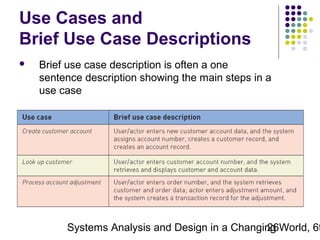
Use Cases and
Brief Use Case Descriptions


Brief use case description is often a one
sentence description showing the main steps in a
use case

Systems Analysis and Design in a Changing World, 6t
26
RMO
CSMS
Project
Use
Cases

Systems Analysis and Design in a Changing World, 6t
27
RMO
CSMS
Project
Use
Cases

Systems Analysis and Design in a Changing World, 6t
28
RMO
CSMS
Project
Use
Cases

Systems Analysis and Design in a Changing World, 6t
29
RMO
CSMS
Project
Use
Cases

Systems Analysis and Design in a Changing World, 6t
30
Use Case Diagrams







Use case diagram— a UML model used to graphically
show uses cases and their relationships to actors
Recall UML is Unified Modeling Language, the
standard for diagrams and terminology for developing
information systems
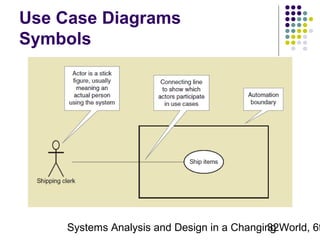
Actor is the UML name for a end user
Automation boundary— the boundary between the
computerized portion of the application and the users
who operate the application

Systems Analysis and Design in a Changing World, 6t
31
Use Case Diagrams
Symbols

Systems Analysis and Design in a Changing World, 6t
32
Use Case
Diagrams
Draw for each
subsystem

Systems Analysis and Design in a Changing World, 6t
33
Use Case
Diagrams
Draw for
actor, such as
customer

Systems Analysis and Design in a Changing World, 6t
34
Use Case Diagrams
Draw for internal RMO actors

Systems Analysis and Design in a Changing World, 6t
35
Use Case Diagrams
The <<Includes>> relationship


A relationship between use cases where one use case is
stereotypically included within the other use case— like a called
subroutine. Arrow points to subroutine

Systems Analysis and Design in a Changing World, 6t
36
Use Case Diagrams:
Steps
1.

2.

3.

4.

Identify all the stakeholders and users who would benefit by
seeing a use case diagram
Determine what each stakeholder or user needs to review
in a use case diagram: each subsystem, for each type of
user, for use cases that are of interest
For each potential communication need, select the use
cases and actors to show and draw the use case diagram.
There are many software packages that can be used to
draw use case diagrams
Carefully name each use case diagram and then note how
and when the diagram should be used to review use cases
with stakeholders and users

Systems Analysis and Design in a Changing World, 6t
37
Summary










This chapter is the first of three that focuses on modeling
functional requirements as a part of systems analysis
Use cases are the functions identified, the activities the system
carries out usually in response to a user request
Two techniques for identifying use cases are the user goal
technique and the event decomposition technique
The user goal technique begins by identifying end users called
actors and asking what specific goals they have when
interacting with the system
The event decomposition technique begins by identifying
events that occur that require the system to respond.

Systems Analysis and Design in a Changing World, 6t
38
Summary











Three types of events include external, temporal, and
state events
Brief use case descriptions are written for use cases
The CRUD technique is used to validate and refine the
use cases identified
The use case diagram is the UML diagram used to
show the use cases and the actors
The use case diagram shows the actors, the
automation boundary, the uses cases that involve each
actor, and the <<includes>> relationship.
A variety of use case diagrams are draw depending on
the presentation needs of the analysis

Systems Analysis and Design in a Changing World, 6t
39

Sadcw 6e chapter3

  • 1.
    Chapter 3 Systems Analysisand Design in a Changing World, 6t 1
  • 2.
    Use Cases Chapter 3 SystemsAnalysis and Design in a Changing World 6th Ed Satzinger, Jackson & Burd
  • 3.
    Chapter 3 Outline Use Cases and User Goals  Use Cases and Event Decomposition  Use Cases and CRUD  Use Cases in the Ridgeline Mountain Outfitters Case  User Case Diagrams Systems Analysis and Design in a Changing World, 6t 3
  • 4.
    Learning Objectives        Explain whyidentifying use cases is the key to defining functional requirements Describe the two techniques for identifying use cases Apply the user goal technique to identify use cases Apply the event decomposition technique to identify use cases Apply the CRUD technique to validate and refine the list of use cases Describe the notation and purpose for the use case diagram Draw use case diagrams by actor and by subsystem Systems Analysis and Design in a Changing World, 6t 4
  • 5.
    Overview     Chapter 2 providedan overview of systems analysis activities, functional and non-functional requirements, modeling, and information gathering techniques This chapter focuses on identifying and modeling the key aspect of functional requirements– use cases In the RMO Tradeshow System from Chapter 1, some use cases are Look up supplier, Enter/update product information, Enter/Update contact information In this chapter’s opening case Waiters on Call, examples of use cases are Record an order, Record delivery, Update an order, Sign in driver, Reconcile driver receipts, Produce end of day deposit slip, and Produce weekly sales reports Systems Analysis and Design in a Changing World, 6t 5
  • 6.
    Use Cases Use case—an activity that the system performs, usually in response to a request by a user  Use cases define functional requirements  Analysts decompose the system into a set of use cases (functional decomposition)  Two techniques for Identifying use cases     User goal technique Event decomposition technique Name each use case using Verb-Noun Systems Analysis and Design in a Changing World, 6t 6
  • 7.
    User Goal Technique Thistechnique is the most common in industry  Simple and effective  Identify all of the potential categories of users of the system  Interview and ask them to describe the tasks the computer can help them with  Probe further to refine the tasks into specific user goals, “I need to Ship items, Track a shipment, Create a return”  Systems Analysis and Design in a Changing World, 6t 7
  • 8.
    User Goal Technique SomeRMO CSMS Users and Goals Systems Analysis and Design in a Changing World, 6t 8
  • 9.
    User Goal Technique: SpecificSteps 1. 2. 3. 4. Identify all the potential users for the new system Classify the potential users in terms of their functional role (e.g., shipping, marketing, sales) Further classify potential users by organizational level (e.g., operational, management, executive) For each type of user, interview them to find a list of specific goals they will have when using the new system (current goals and innovative functions to add value) Systems Analysis and Design in a Changing World, 6t 9
  • 10.
    User Goal Technique SpecificSteps (continued) 5. 6. 7. 8. Create a list of preliminary use cases organized by type of user Look for duplicates with similar use case names and resolve inconsistencies Identify where different types of users need the same use cases Review the completed list with each type of user and then with interested stakeholders Systems Analysis and Design in a Changing World, 6t 10
  • 11.
    Event Decomposition Technique More Comprehensiveand Complete Technique     Identify the events that occur to which the system must respond. For each event, name a use case (verb-noun) that describes what the system does when the event occurs Event– something that occurs at a specific time and place, can be described, and should be remembered by the system Systems Analysis and Design in a Changing World, 6t 11
  • 12.
    Events and UseCases Systems Analysis and Design in a Changing World, 6t 12
  • 13.
    Types of Events  ExternalEvent   Temporal Event   an event that occurs outside the system, usually initiated by an external agent or actor an event that occurs as a result of reaching a point in time State Event   an event that occurs when something happens inside the system that triggers some process reorder point is reached for inventory item Systems Analysis and Design in a Changing World, 6t 13
  • 14.
    External Event Checklist Externalagent or actor wants something resulting in a transaction   Customer buys a product External agent or actor wants some information   Customer wants to know product details External data changed and needs to be updated   Customer has new address and phone Management wants some information   Sales manager wants update on production plans Systems Analysis and Design in a Changing World, 6t 14
  • 15.
    Temporal Event Checklist  Internaloutputs needed at points in time     Management reports (summary or exception) Operational reports (detailed transactions) Internal statements and documents (including payroll) External outputs needed at points of time  Statements, status reports, bills, reminders Systems Analysis and Design in a Changing World, 6t 15
  • 16.
    Finding the actualevent that affects the system Systems Analysis and Design in a Changing World, 6t 16
  • 17.
    Tracing a sequenceof transactions resulting in many events Systems Analysis and Design in a Changing World, 6t 17
  • 18.
    Perfect Technology Assumption  Don’t worryabout functions built into system because of limits in technology and people. Wait until design. Systems Analysis and Design in a Changing World, 6t 18
  • 19.
    Event Decomposition Technique: SpecificSteps 1. 2. 3. 4. Consider the external events in the system environment that require a response from the system by using the checklist shown in Figure 3-3 For each external event, identify and name the use case that the system requires Consider the temporal events that require a response from the system by using the checklist shown in Figure 3-4 For each temporal event, identify and name the use case that the system requires and then establish the point of time that will trigger the use case Systems Analysis and Design in a Changing World, 6t 19
  • 20.
    Event Decomposition Technique: SpecificSteps (continued) 5. 6. 7. Consider the state events that the system might respond to, particularly if it is a real-time system in which devices or internal state changes trigger use cases. For each state event, identify and name the use case that the system requires and then define the state change. When events and use cases are defined, check to see if they are required by using the perfect technology assumption. Do not include events that involve such system controls as login, logout, change password, and backup or restore the database, as these are put in later. Systems Analysis and Design in a Changing World, 6t 20
  • 21.
    Event Decomposition Technique: Benefits     Eventsare broader than user goal: Capture temporal and state events Help decompose at the right level of analysis: an elementary business process (EBP) EBP is a fundamental business process performed by one person, in one place, in response to a business event Uses perfect technology assumption to make sure functions that support the users work are identified and not additional functions for security and system controls Systems Analysis and Design in a Changing World, 6t 21
  • 22.
    Use Cases andCRUD Technique     CRUD is Create, Read/Report, Update, and Delete (archive) Often introduced in database context Technique to validate, refine or cross-check use cases NOT for primarily identifying use cases Systems Analysis and Design in a Changing World, 6t 22
  • 23.
    Use Cases andCRUD Technique  For Customer domain class, verify that there are use cases that create, read/report, update, and delete (archive) the domain class Systems Analysis and Design in a Changing World, 6t 23
  • 24.
    CRUD Technique Steps 1. 2. 3. 4. Identify allthe data entities or domain classes involved in the new system. (more in Chapter 4) For each type of data (data entity or domain class), verify that a use case has been identified that creates a new instance, updates existing instances, reads or reports values of instances, and deletes (archives) an instance. If a needed use case has been overlooked, add a new use case and then identify the stakeholders. With integrated applications, make sure it is clear which application is responsible for adding and maintaining the data and which system merely uses the data. Systems Analysis and Design in a Changing World, 6t 24
  • 25.
    CRUD Technique Use Casevs. Domain Class Table  To summarize CRUD analysis results, create a matrix of use cases and domain classes indicating which use case C, R, U, or D a domain class Systems Analysis and Design in a Changing World, 6t 25
  • 26.
    Use Cases and BriefUse Case Descriptions  Brief use case description is often a one sentence description showing the main steps in a use case Systems Analysis and Design in a Changing World, 6t 26
  • 27.
    RMO CSMS Project Use Cases Systems Analysis andDesign in a Changing World, 6t 27
  • 28.
    RMO CSMS Project Use Cases Systems Analysis andDesign in a Changing World, 6t 28
  • 29.
    RMO CSMS Project Use Cases Systems Analysis andDesign in a Changing World, 6t 29
  • 30.
    RMO CSMS Project Use Cases Systems Analysis andDesign in a Changing World, 6t 30
  • 31.
    Use Case Diagrams     Usecase diagram— a UML model used to graphically show uses cases and their relationships to actors Recall UML is Unified Modeling Language, the standard for diagrams and terminology for developing information systems Actor is the UML name for a end user Automation boundary— the boundary between the computerized portion of the application and the users who operate the application Systems Analysis and Design in a Changing World, 6t 31
  • 32.
    Use Case Diagrams Symbols SystemsAnalysis and Design in a Changing World, 6t 32
  • 33.
    Use Case Diagrams Draw foreach subsystem Systems Analysis and Design in a Changing World, 6t 33
  • 34.
    Use Case Diagrams Draw for actor,such as customer Systems Analysis and Design in a Changing World, 6t 34
  • 35.
    Use Case Diagrams Drawfor internal RMO actors Systems Analysis and Design in a Changing World, 6t 35
  • 36.
    Use Case Diagrams The<<Includes>> relationship  A relationship between use cases where one use case is stereotypically included within the other use case— like a called subroutine. Arrow points to subroutine Systems Analysis and Design in a Changing World, 6t 36
  • 37.
    Use Case Diagrams: Steps 1. 2. 3. 4. Identifyall the stakeholders and users who would benefit by seeing a use case diagram Determine what each stakeholder or user needs to review in a use case diagram: each subsystem, for each type of user, for use cases that are of interest For each potential communication need, select the use cases and actors to show and draw the use case diagram. There are many software packages that can be used to draw use case diagrams Carefully name each use case diagram and then note how and when the diagram should be used to review use cases with stakeholders and users Systems Analysis and Design in a Changing World, 6t 37
  • 38.
    Summary      This chapter isthe first of three that focuses on modeling functional requirements as a part of systems analysis Use cases are the functions identified, the activities the system carries out usually in response to a user request Two techniques for identifying use cases are the user goal technique and the event decomposition technique The user goal technique begins by identifying end users called actors and asking what specific goals they have when interacting with the system The event decomposition technique begins by identifying events that occur that require the system to respond. Systems Analysis and Design in a Changing World, 6t 38
  • 39.
    Summary       Three types ofevents include external, temporal, and state events Brief use case descriptions are written for use cases The CRUD technique is used to validate and refine the use cases identified The use case diagram is the UML diagram used to show the use cases and the actors The use case diagram shows the actors, the automation boundary, the uses cases that involve each actor, and the <<includes>> relationship. A variety of use case diagrams are draw depending on the presentation needs of the analysis Systems Analysis and Design in a Changing World, 6t 39