Subsets
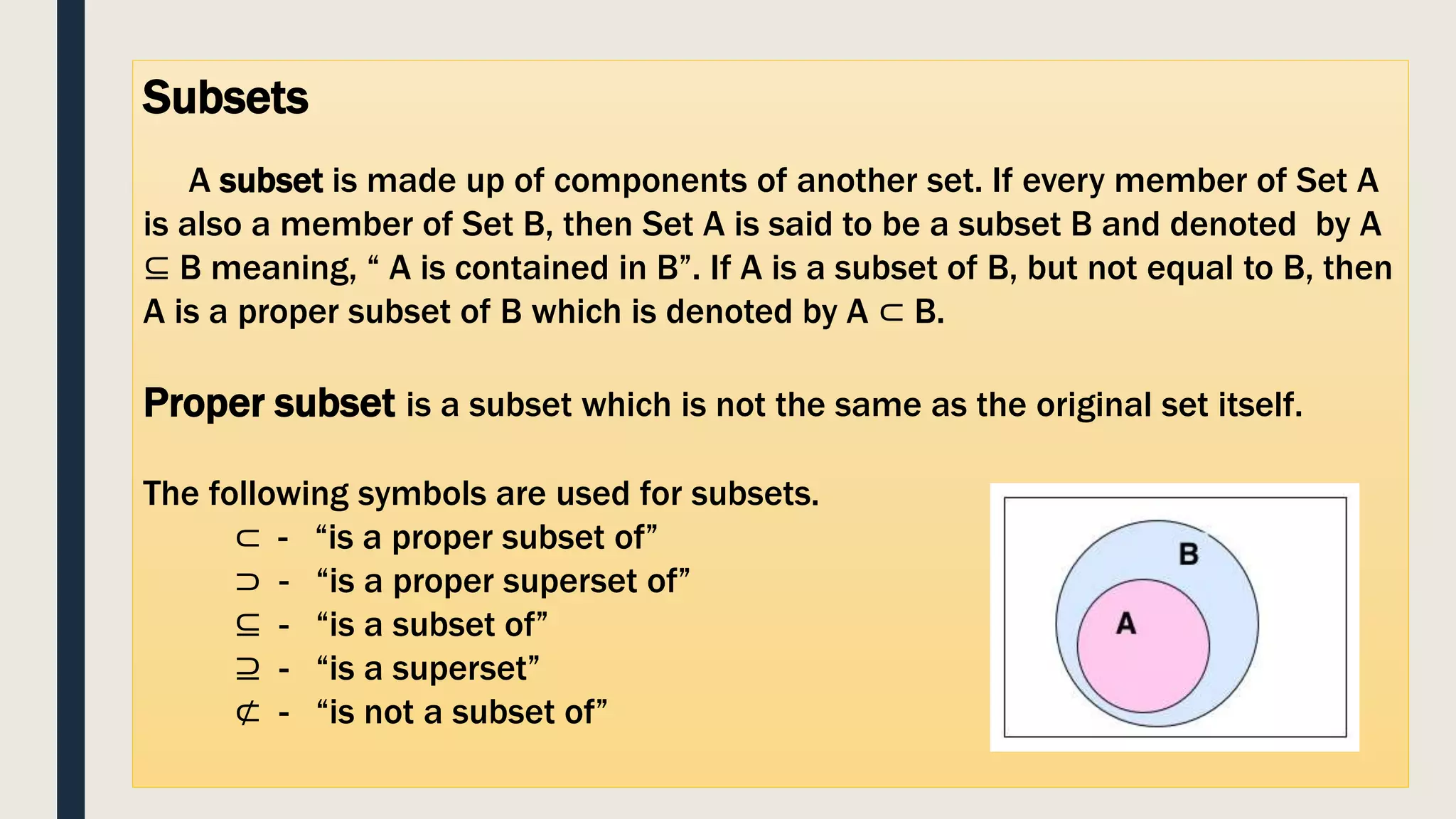
A subset is made up of components of another set. If every member of Set A
is also a member of Set B, then Set A is said to be a subset B and denoted by A
⊆ B meaning, “ A is contained in B”. If A is a subset of B, but not equal to B, then
A is a proper subset of B which is denoted by A ⊂ B.
Proper subset is a subset which is not the same as the original set itself.
The following symbols are used for subsets.
⊂ - “is a proper subset of”
⊃ - “is a proper superset of”
⊆ - “is a subset of”
⊇ - “is a superset”
⊄ - “is not a subset of”
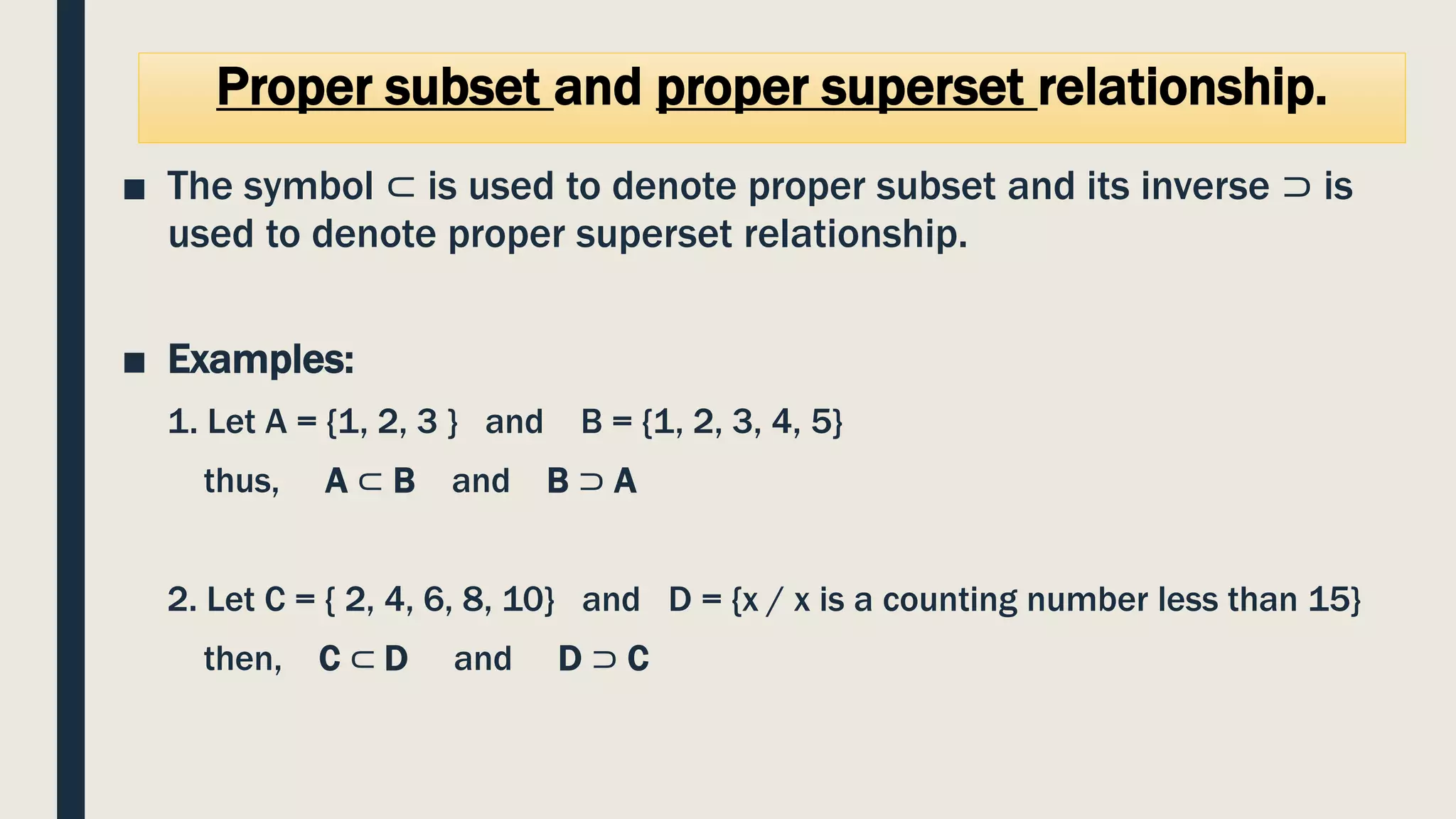
Proper subset and proper superset relationship.
■ The symbol ⊂ is used to denote proper subset and its inverse ⊃ is
used to denote proper superset relationship.
■ Examples:
1. Let A = {1, 2, 3 } and B = {1, 2, 3, 4, 5}
thus, A ⊂ B and B ⊃ A
2. Let C = { 2, 4, 6, 8, 10} and D = {x / x is a counting number less than 15}
then, C ⊂ D and D ⊃ C
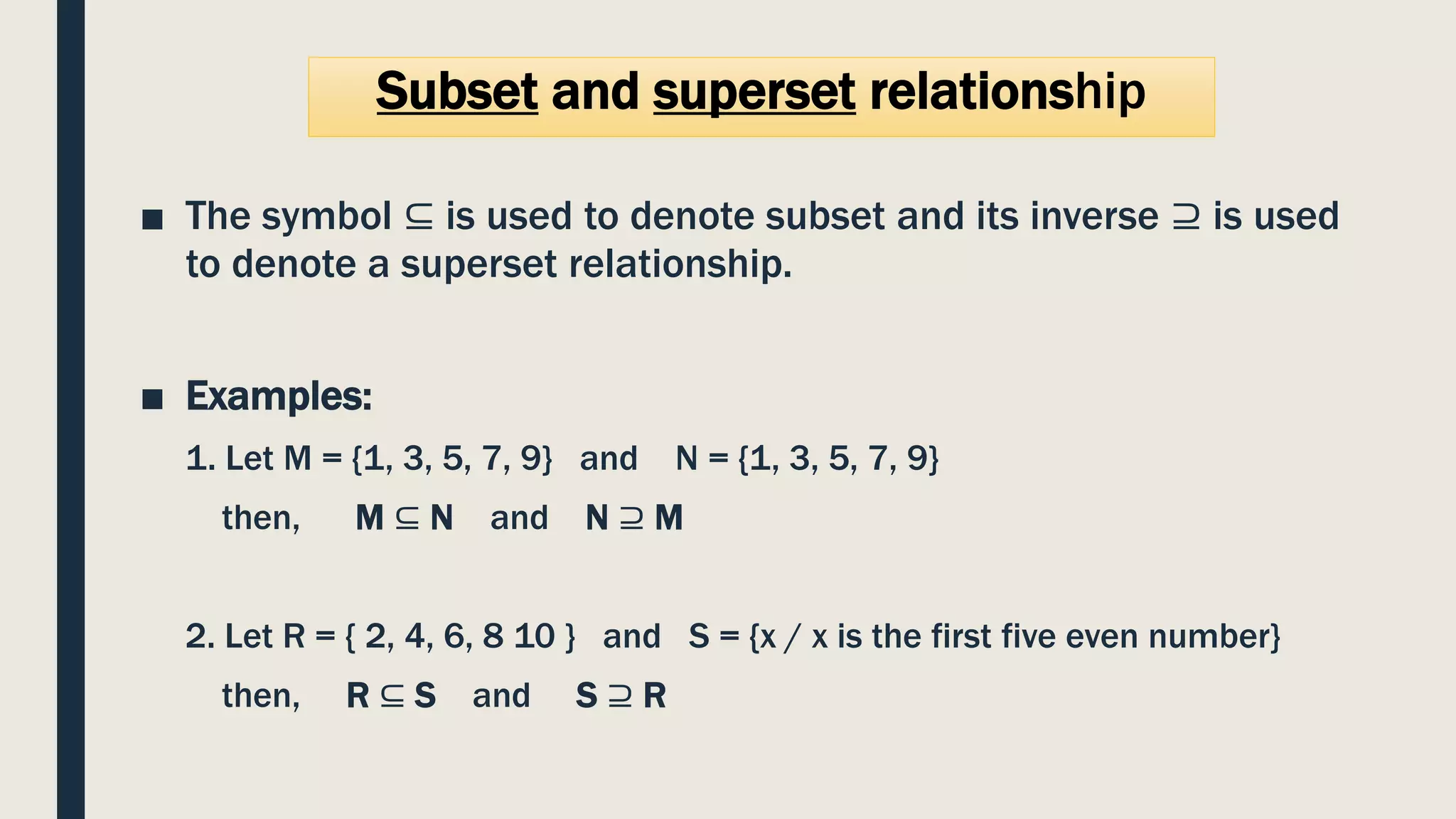
Subset and superset relationship
■ The symbol ⊆ is used to denote subset and its inverse ⊇ is used
to denote a superset relationship.
■ Examples:
1. Let M = {1, 3, 5, 7, 9} and N = {1, 3, 5, 7, 9}
then, M ⊆ N and N ⊇ M
2. Let R = { 2, 4, 6, 8 10 } and S = {x / x is the first five even number}
then, R ⊆ S and S ⊇ R
Let’s Learn More!
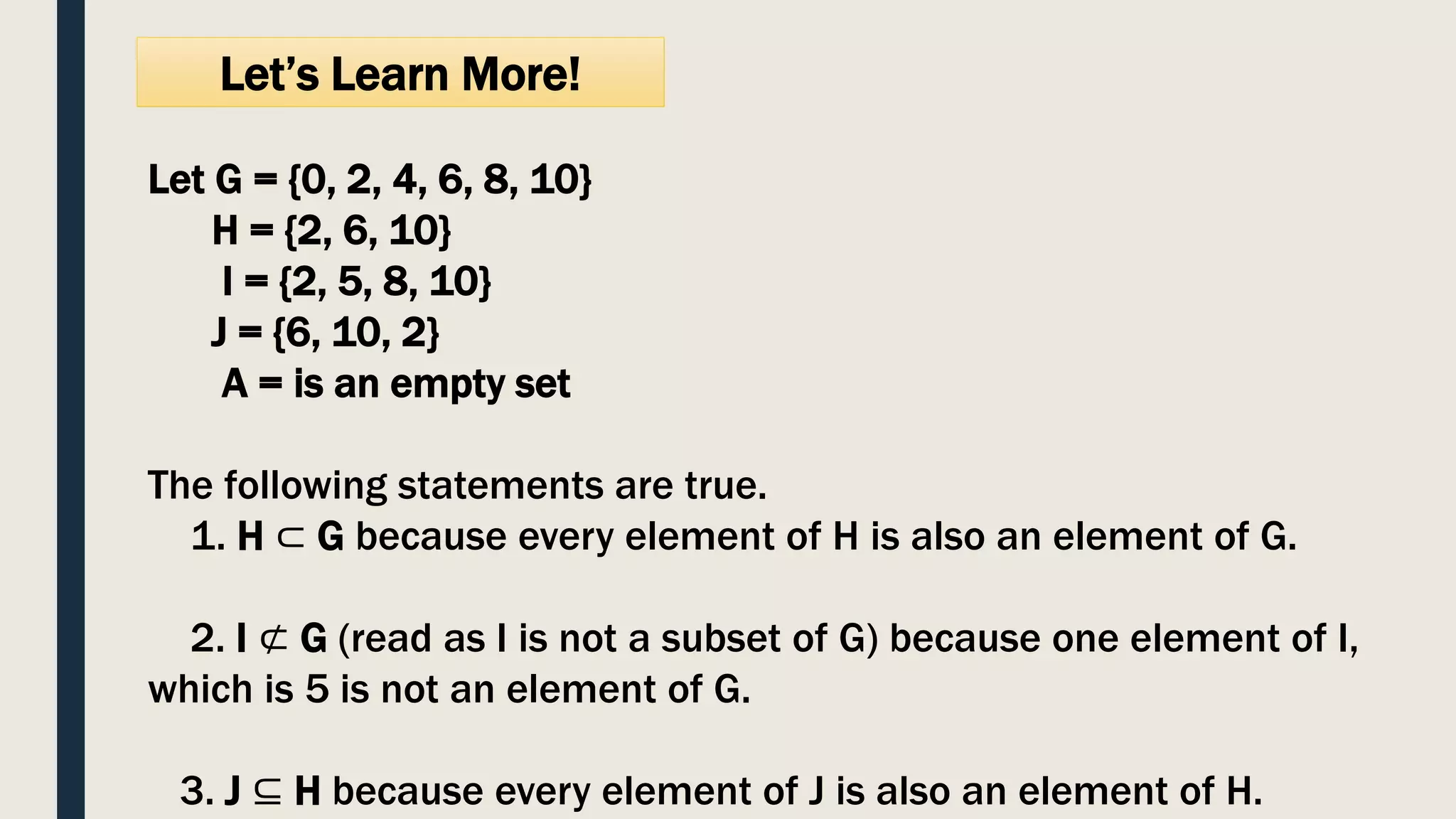
Let G = {0, 2, 4, 6, 8, 10}
H = {2, 6, 10}
I = {2, 5, 8, 10}
J = {6, 10, 2}
A = is an empty set
The following statements are true.
1. H ⊂ G because every element of H is also an element of G.
2. I ⊄ G (read as I is not a subset of G) because one element of I,
which is 5 is not an element of G.
3. J ⊆ H because every element of J is also an element of H.
The empty set is always a subset of any set.
So, we write ø ⊂ A or { } ⊂ A.
Moreover, every set is a subset of itself. We write A ⊆ A.
Example:
Let A = { 2, 4}. Can you list all the subsets of A?
The null set / empty set is a subset of A.
A is a subset of itself.
The other subsets of A are {2} and {4}
So, the subsets of A are { }, {2}, {4}, and {2, 4}. There are 4 subsets of A.
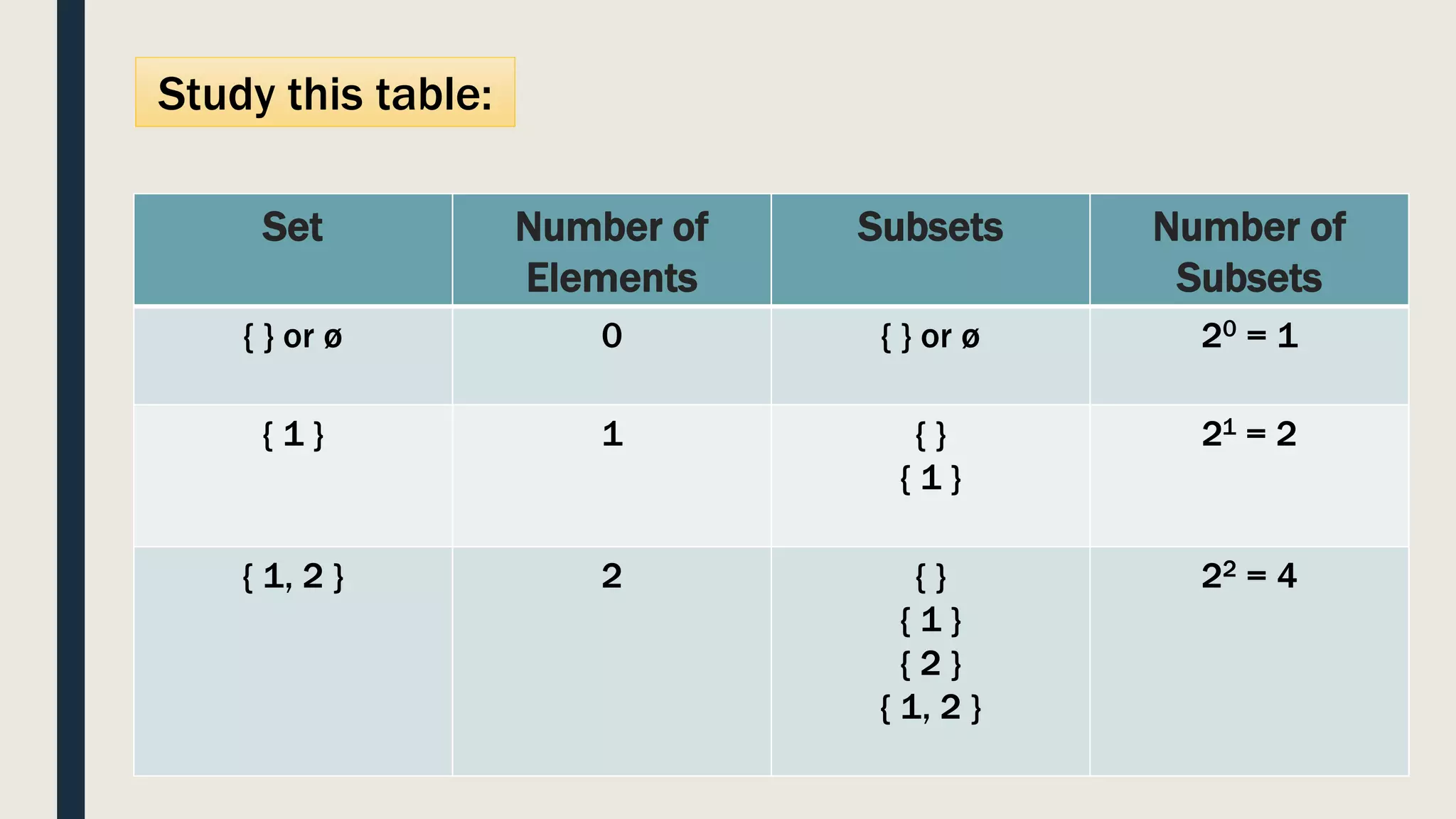
Study this table:
Set Number of
Elements
Subsets Number of
Subsets
{ } or ø 0 { } or ø 20 = 1
{ 1 } 1 { }
{ 1 }
21 = 2
{ 1, 2 } 2 { }
{ 1 }
{ 2 }
{ 1, 2 }
22 = 4
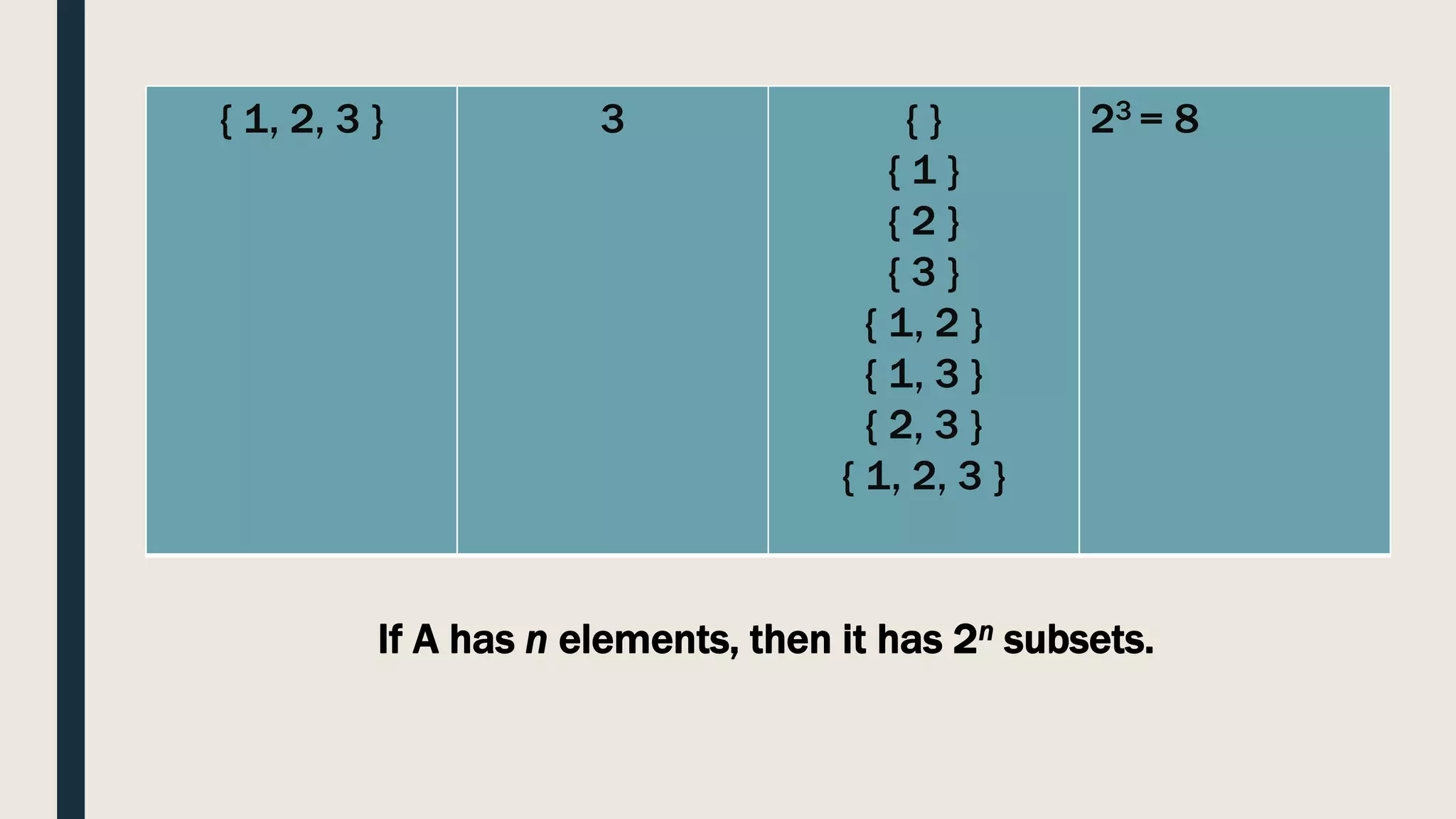
{ 1, 2, 3 } 3 { }
{ 1 }
{ 2 }
{ 3 }
{ 1, 2 }
{ 1, 3 }
{ 2, 3 }
{ 1, 2, 3 }
23 = 8
If A has n elements, then it has 2n subsets.
Thank You!

Identifying subsets of a set

  • 2.
    Subsets A subset ismade up of components of another set. If every member of Set A is also a member of Set B, then Set A is said to be a subset B and denoted by A ⊆ B meaning, “ A is contained in B”. If A is a subset of B, but not equal to B, then A is a proper subset of B which is denoted by A ⊂ B. Proper subset is a subset which is not the same as the original set itself. The following symbols are used for subsets. ⊂ - “is a proper subset of” ⊃ - “is a proper superset of” ⊆ - “is a subset of” ⊇ - “is a superset” ⊄ - “is not a subset of”
  • 3.
    Proper subset andproper superset relationship. ■ The symbol ⊂ is used to denote proper subset and its inverse ⊃ is used to denote proper superset relationship. ■ Examples: 1. Let A = {1, 2, 3 } and B = {1, 2, 3, 4, 5} thus, A ⊂ B and B ⊃ A 2. Let C = { 2, 4, 6, 8, 10} and D = {x / x is a counting number less than 15} then, C ⊂ D and D ⊃ C
  • 4.
    Subset and supersetrelationship ■ The symbol ⊆ is used to denote subset and its inverse ⊇ is used to denote a superset relationship. ■ Examples: 1. Let M = {1, 3, 5, 7, 9} and N = {1, 3, 5, 7, 9} then, M ⊆ N and N ⊇ M 2. Let R = { 2, 4, 6, 8 10 } and S = {x / x is the first five even number} then, R ⊆ S and S ⊇ R
  • 5.
    Let’s Learn More! LetG = {0, 2, 4, 6, 8, 10} H = {2, 6, 10} I = {2, 5, 8, 10} J = {6, 10, 2} A = is an empty set The following statements are true. 1. H ⊂ G because every element of H is also an element of G. 2. I ⊄ G (read as I is not a subset of G) because one element of I, which is 5 is not an element of G. 3. J ⊆ H because every element of J is also an element of H.
  • 6.
    The empty setis always a subset of any set. So, we write ø ⊂ A or { } ⊂ A. Moreover, every set is a subset of itself. We write A ⊆ A. Example: Let A = { 2, 4}. Can you list all the subsets of A? The null set / empty set is a subset of A. A is a subset of itself. The other subsets of A are {2} and {4} So, the subsets of A are { }, {2}, {4}, and {2, 4}. There are 4 subsets of A.
  • 7.
    Study this table: SetNumber of Elements Subsets Number of Subsets { } or ø 0 { } or ø 20 = 1 { 1 } 1 { } { 1 } 21 = 2 { 1, 2 } 2 { } { 1 } { 2 } { 1, 2 } 22 = 4
  • 8.
    { 1, 2,3 } 3 { } { 1 } { 2 } { 3 } { 1, 2 } { 1, 3 } { 2, 3 } { 1, 2, 3 } 23 = 8 If A has n elements, then it has 2n subsets.
  • 9.