Chapter 6

Systems Analysis and Design in a Changing World, 6t
1
Essentials of Design an the
Design Activities

Chapter 6
Systems Analysis and Design
in a Changing World 6th Ed
Satzinger, Jackson & Burd
Chapter 6 Outline
 The

Elements of Design
 Inputs and Outputs for Systems Design
 Design Activities
 Design Activity: Design the Environment

Systems Analysis and Design in a Changing World, 6t
3
Learning Objectives
 Describe

the difference between systems
analysis and systems design
 Explain each major design activity
 Describe the major hardware and network
environment options
 Describe the various hosting services
available

Systems Analysis and Design in a Changing World, 6t
4
Overview










Analysis says “what” is required and design tells us
“how” the system will be configured and constructed
Chapters 2, 3, 4 and 5 covered systems analysis
activities (requirements)
This chapter introduces system design and the
design activities involved in systems development
Design bridges the gap between requirements to
actual implementation
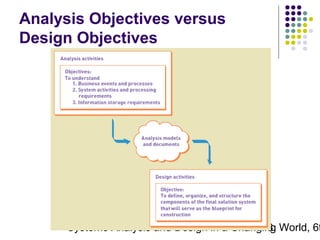
Objective of design is to define, organize, and
structure the components of the final solution to
serve as a blue print for construction

Systems Analysis and Design in a Changing World, 6t
5
Major Components of Design

Systems Analysis and Design in a Changing World, 6t
6
Two Levels of Design


Architectural Design





Broad design of the overall system structure
Also called General Design and Conceptual Design

Detailed Design


Low level design that includes the design of the specific
program details





Design of each use case
Design of the database
Design of user and system interfaces
Design of controls and security

Systems Analysis and Design in a Changing World, 6t
7
Analysis Objectives versus
Design Objectives

Systems Analysis and Design in a Changing World, 6t
8
Analysis
vs.
Design
Models

Systems Analysis and Design in a Changing World, 6t
9
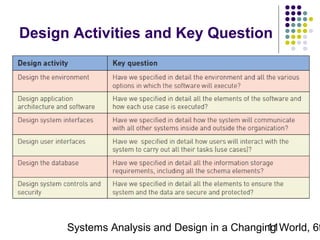
Design Activities

Systems Analysis and Design in a Changing World, 6t
10
Design Activities and Key Question

Systems Analysis and Design in a Changing World, 6t
11
Design Activities:
Design the environment


The environment is all of the technology
required to support the software application




Servers, Desktop computers
Mobile devices, Operating systems
Communication capabilities, Input and output
capabilities

In Chapter 2 this was called the Technology
Architecture
 This activity is discussed in more detail later in
the chapter


Systems Analysis and Design in a Changing World, 6t
12
Design Activities:
Design the application architecture and software

Partition system into subsystems
 Define software architecture






Three layer or model-view-controller

Detailed design of each use case




Design class diagrams
Sequence diagrams
State machine diagrams

Systems Analysis and Design in a Changing World, 6t
13
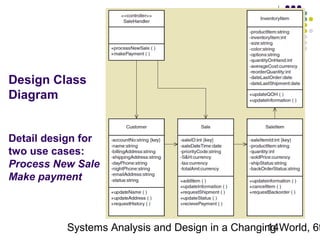
Design Class
Diagram
Detail design for
two use cases:
Process New Sale
Make payment

Systems Analysis and Design in a Changing World, 6t
14
Design Activities:
Design the user interfaces


Dialog design begins with requirements



Use case flow of activities
System sequenced diagram

Design adds in screen layout, look and feel,
navigation, user experience
 Now we require interface design for many
different environment and devices





Smart phone
Notebooks, tablets, iPads

Systems Analysis and Design in a Changing World, 6t
15
Design Activities:
Design the system interfaces


Information system interacts with many other
systems, internal and external




Much more integration now

System interfaces connect with other systems
in many different ways





Save data another system uses
Read data another system saved
Real time request for information
Software services

Systems Analysis and Design in a Changing World, 6t
16
System to system interface
using XML

Systems Analysis and Design in a Changing World, 6t
17
Design Activities:
Design the database
Starting with the domain model class diagram
(or ERD)
 Choose database structure





Usually relational database
Could be ODBMS framework

Design architecture (distributed, etc.)
 Design database schema






Tables and columns in relational

Design referential integrity constraints


Foreign key references

Systems Analysis and Design in a Changing World, 6t
18
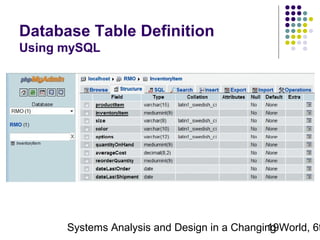
Database Table Definition
Using mySQL

Systems Analysis and Design in a Changing World, 6t
19
Design Activities:
Design the security and system controls
 Protect

the organization’s assets
 Becomes crucial in Internet and wireless
 User interface controls
 Application controls
 Database controls
 Network controls

Systems Analysis and Design in a Changing World, 6t
20
Design the Environment
The design activity now in more detail
 Design


Stand alone software systems




for Internal Deployment

Run on one device without networking

Internal network-based systems
Local area network, client-server architecture
 Desktop applications and browser-based
applications




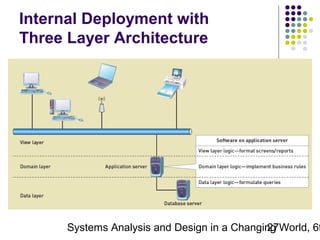
Three-layer client server architecture
View layer, domain layer, and data layer
 Desktop and browser based applications


Systems Analysis and Design in a Changing World, 6t
21
Network Diagram
Internal Network System

Systems Analysis and Design in a Changing World, 6t
22
Internal Network Terminology


Local area network




Client-server architecture




a computer network configuration with user’s computers
and central computers that provide common services
Client computers




a computer network in which the cabling and hardware
are confined to a single location

the computers at which the users work to perform their
computational tasks

Server computer


the central computer that provides services (such as
database access) to the client computers over a network

Systems Analysis and Design in a Changing World, 6t
23
Internal Network Terminology
 Browser-based


Hypertext markup language (HTML)




internal network

the predominant language for constructing Web
pages and which consists of tags and rules about
how to display pages

Transmission Control Protocol/Internet
Protocol (TCP/IP)


The foundation protocol of the Internet; used to
provide reliable delivery of messages between
networked computers

Systems Analysis and Design in a Changing World, 6t
24
Three Layer Architecture


Three Layer Client-Server Architecture




View layer




the part of the three-layer architecture that contains the user
interface

Business logic layer or domain layer




a client/server architecture that divides an application into view
layer, business logic layer, and data layer

the part of a three-layer architecture that contains the
programs that implement the business rules and processes

Data layer


the part of a three-layer architecture that interacts with the data

Systems Analysis and Design in a Changing World, 6t
25
Abstract Three Layer
Architecture

Systems Analysis and Design in a Changing World, 6t
26
Internal Deployment with
Three Layer Architecture

Systems Analysis and Design in a Changing World, 6t
27
Design the Environment
(continued)
 Design


Configuration for Internet deployment




for External Deployment

Advantages and risks

Hosting Alternatives for Internet deployment
Colocation
 Managed services
 Virtual Servers
 Cloud computing




Diversity of Client Devices with Internet
deployment


Full size, tablets and notebooks, smart phones

Systems Analysis and Design in a Changing World, 6t
28
Configuration for Internet
Deployment

Systems Analysis and Design in a Changing World, 6t
29
Configuration for Internet
Deployment


Advantages






Accessibility—Web-based applications are accessible to a
large number of potential users (including customers, suppliers,
and off-site employees).
Low-cost communication—The high-capacity networks that
form the Internet backbone were initially funded primarily by
governments. Traffic on the backbone networks travels free of
extra charges to the end user. Connections to the Internet can
be purchased from a variety of private Internet service providers
at relatively low costs.
Widely implemented standards—Web standards are well
known, and many computing professionals are already trained in
their use.

Systems Analysis and Design in a Changing World, 6t
30
Configuration for Internet
Deployment


Potential Problems






Security—Web servers are a well-defined target for security
breaches because Web standards are open and widely known.
Wide-scale interconnection of networks and the use of Internet
and Web standards make servers accessible to a global pool of
hackers.
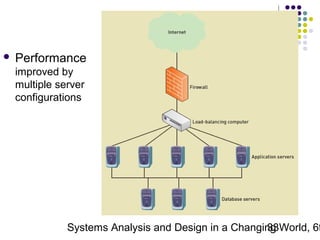
Throughput—When high loads occur, throughput and response
time can suffer significantly. The configuration must support not
only daily average users but also a peak-load number of users.
Changing standards—Web standards change rapidly. Client
software is updated every few months. Developers of widely
used applications are faced with a dilemma: Use the latest
standards to increase functionality or use older standards to
ensure greater compatibility with older user software.

Systems Analysis and Design in a Changing World, 6t
31
Configuration for Internet
Deployment
 Security


Hypertext Transfer Protocol Secure (HTTPS)




improved by:

an encrypted form of information transfer on the Internet
that combines HTTP and TLS

Transport Layer Security (TLS)


An advanced version of Secure Sockets Layer (SSL)
protocol used to transmit information over the Internet
securely

Systems Analysis and Design in a Changing World, 6t
32


Performance
improved by
multiple server
configurations

Systems Analysis and Design in a Changing World, 6t
33
Hosting Alternatives for Internet
Deployment


Hosting:






Running and maintaining a computer system on
someone’s behalf where the application software and
the database reside
The process of providing physical servers at a secure
location and selling those services to other
businesses that wish to deploy Web sites

Issues when considering hosting alternatives


Reliability, security, physical facilities, staff, potential
for growth

Systems Analysis and Design in a Changing World, 6t
34
Hosting Alternatives for Internet
Deployment (continued)

Systems Analysis and Design in a Changing World, 6t
35
Hosting Alternatives for Internet
Deployment (continued)


Colocation




Managed Services




a hosting service with a secure location but in which the
computers are usually owned by the client businesses
a client owns software but may want to purchase
additional services, such as installing and managing the
operating system, the Internet servers, database servers,
and load balancing software

Virtual servers


the client company leases a virtual server that is
configured as a real server, with a certain amount of CPU
capacity, internal memory, hard drive memory, and
bandwidth to the Internet

Systems Analysis and Design in a Changing World, 6t
36
Hosting Alternatives for Internet
Deployment (continued)


Cloud Computing







an extension of virtual servers in which the resources
available include computing, storage, and Internet access
and they appear to have unlimited availability
a client should be able to buy computing capacity much
like one purchases such a utility as water or electricity
the client shouldn’t have to be concerned with such
environmental issues as how or where this computing
capacity is provided, just as an individual doesn’t have to
worry about how electricity is generated

Service Level Agreement


For all alternatives, part of the contract between a
business and a hosting company that guarantees a
specific level of system availability

Systems Analysis and Design in a Changing World, 6t
37
Diversity of Client Devices with
Internet Deployment


Full size devices




Mid level tablet devices




Desktops, laptops, 15-27” high resolution
Tablets 8-10 inches, landscape or portrait mode,
lower resolution, might need specific view layer

Small mobile computing devices


Very small screens, regular web sites hard to read,
really need specific view layer for mobile web viewing

Systems Analysis and Design in a Changing World, 6t
38
Design for Remote, Distributed
Environment


Two interfaces to same Web app for internal vs.
external access





Back end, Front end UI to same Web app
Not as secure

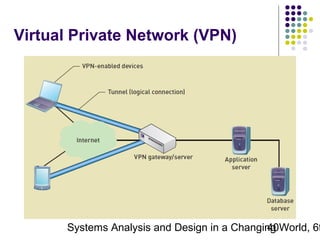
Virtual private network (VPN)


Closed network with security and closed access built
on top of a public network (Internet)

Systems Analysis and Design in a Changing World, 6t
39
Virtual Private Network (VPN)

Systems Analysis and Design in a Changing World, 6t
40
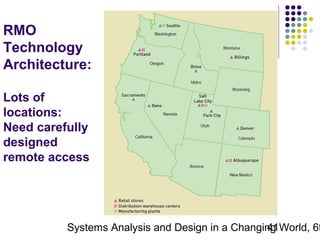
RMO
Technology
Architecture:
Lots of
locations:
Need carefully
designed
remote access

Systems Analysis and Design in a Changing World, 6t
41
RMO’s Current Technology
Architecture

Systems Analysis and Design in a Changing World, 6t
42
Summary








This chapter discussed system design, the six design
activities, and designing the environment.
System design is he bridge between requirements and
implementation—a blue print for what needs to be built.
Design occurs at two levels: architectural design and
detail design.
Models of the functional requirements (domain model
class diagrams, use case diagrams, system sequence
diagrams, use case descriptions, state machine diagrams,
and activities diagrams) are used as the basis for creating
design models.

Systems Analysis and Design in a Changing World, 6t
43
Summary (continued)








There are six design activities: design the environment,
design the application architecture and software, design
user interfaces, design system interfaces, design the
database, and design system controls and security.
The first activity, Design the environment, is covered in
detail. This includes designing for internal deployment
and design for external deployment.
Important issues are three layer architecture, deploying
using the Internet, and hosting alternatives.
Hosting alternatives include colocation, managed
services, virtual servers, and cloud computing.

Systems Analysis and Design in a Changing World, 6t
44

Sadcw 6e chapter6

  • 1.
    Chapter 6 Systems Analysisand Design in a Changing World, 6t 1
  • 2.
    Essentials of Designan the Design Activities Chapter 6 Systems Analysis and Design in a Changing World 6th Ed Satzinger, Jackson & Burd
  • 3.
    Chapter 6 Outline The Elements of Design  Inputs and Outputs for Systems Design  Design Activities  Design Activity: Design the Environment Systems Analysis and Design in a Changing World, 6t 3
  • 4.
    Learning Objectives  Describe thedifference between systems analysis and systems design  Explain each major design activity  Describe the major hardware and network environment options  Describe the various hosting services available Systems Analysis and Design in a Changing World, 6t 4
  • 5.
    Overview      Analysis says “what”is required and design tells us “how” the system will be configured and constructed Chapters 2, 3, 4 and 5 covered systems analysis activities (requirements) This chapter introduces system design and the design activities involved in systems development Design bridges the gap between requirements to actual implementation Objective of design is to define, organize, and structure the components of the final solution to serve as a blue print for construction Systems Analysis and Design in a Changing World, 6t 5
  • 6.
    Major Components ofDesign Systems Analysis and Design in a Changing World, 6t 6
  • 7.
    Two Levels ofDesign  Architectural Design    Broad design of the overall system structure Also called General Design and Conceptual Design Detailed Design  Low level design that includes the design of the specific program details     Design of each use case Design of the database Design of user and system interfaces Design of controls and security Systems Analysis and Design in a Changing World, 6t 7
  • 8.
    Analysis Objectives versus DesignObjectives Systems Analysis and Design in a Changing World, 6t 8
  • 9.
    Analysis vs. Design Models Systems Analysis andDesign in a Changing World, 6t 9
  • 10.
    Design Activities Systems Analysisand Design in a Changing World, 6t 10
  • 11.
    Design Activities andKey Question Systems Analysis and Design in a Changing World, 6t 11
  • 12.
    Design Activities: Design theenvironment  The environment is all of the technology required to support the software application    Servers, Desktop computers Mobile devices, Operating systems Communication capabilities, Input and output capabilities In Chapter 2 this was called the Technology Architecture  This activity is discussed in more detail later in the chapter  Systems Analysis and Design in a Changing World, 6t 12
  • 13.
    Design Activities: Design theapplication architecture and software Partition system into subsystems  Define software architecture    Three layer or model-view-controller Detailed design of each use case    Design class diagrams Sequence diagrams State machine diagrams Systems Analysis and Design in a Changing World, 6t 13
  • 14.
    Design Class Diagram Detail designfor two use cases: Process New Sale Make payment Systems Analysis and Design in a Changing World, 6t 14
  • 15.
    Design Activities: Design theuser interfaces  Dialog design begins with requirements   Use case flow of activities System sequenced diagram Design adds in screen layout, look and feel, navigation, user experience  Now we require interface design for many different environment and devices    Smart phone Notebooks, tablets, iPads Systems Analysis and Design in a Changing World, 6t 15
  • 16.
    Design Activities: Design thesystem interfaces  Information system interacts with many other systems, internal and external   Much more integration now System interfaces connect with other systems in many different ways     Save data another system uses Read data another system saved Real time request for information Software services Systems Analysis and Design in a Changing World, 6t 16
  • 17.
    System to systeminterface using XML Systems Analysis and Design in a Changing World, 6t 17
  • 18.
    Design Activities: Design thedatabase Starting with the domain model class diagram (or ERD)  Choose database structure    Usually relational database Could be ODBMS framework Design architecture (distributed, etc.)  Design database schema    Tables and columns in relational Design referential integrity constraints  Foreign key references Systems Analysis and Design in a Changing World, 6t 18
  • 19.
    Database Table Definition UsingmySQL Systems Analysis and Design in a Changing World, 6t 19
  • 20.
    Design Activities: Design thesecurity and system controls  Protect the organization’s assets  Becomes crucial in Internet and wireless  User interface controls  Application controls  Database controls  Network controls Systems Analysis and Design in a Changing World, 6t 20
  • 21.
    Design the Environment Thedesign activity now in more detail  Design  Stand alone software systems   for Internal Deployment Run on one device without networking Internal network-based systems Local area network, client-server architecture  Desktop applications and browser-based applications   Three-layer client server architecture View layer, domain layer, and data layer  Desktop and browser based applications  Systems Analysis and Design in a Changing World, 6t 21
  • 22.
    Network Diagram Internal NetworkSystem Systems Analysis and Design in a Changing World, 6t 22
  • 23.
    Internal Network Terminology  Localarea network   Client-server architecture   a computer network configuration with user’s computers and central computers that provide common services Client computers   a computer network in which the cabling and hardware are confined to a single location the computers at which the users work to perform their computational tasks Server computer  the central computer that provides services (such as database access) to the client computers over a network Systems Analysis and Design in a Changing World, 6t 23
  • 24.
    Internal Network Terminology Browser-based  Hypertext markup language (HTML)   internal network the predominant language for constructing Web pages and which consists of tags and rules about how to display pages Transmission Control Protocol/Internet Protocol (TCP/IP)  The foundation protocol of the Internet; used to provide reliable delivery of messages between networked computers Systems Analysis and Design in a Changing World, 6t 24
  • 25.
    Three Layer Architecture  ThreeLayer Client-Server Architecture   View layer   the part of the three-layer architecture that contains the user interface Business logic layer or domain layer   a client/server architecture that divides an application into view layer, business logic layer, and data layer the part of a three-layer architecture that contains the programs that implement the business rules and processes Data layer  the part of a three-layer architecture that interacts with the data Systems Analysis and Design in a Changing World, 6t 25
  • 26.
    Abstract Three Layer Architecture SystemsAnalysis and Design in a Changing World, 6t 26
  • 27.
    Internal Deployment with ThreeLayer Architecture Systems Analysis and Design in a Changing World, 6t 27
  • 28.
    Design the Environment (continued) Design  Configuration for Internet deployment   for External Deployment Advantages and risks Hosting Alternatives for Internet deployment Colocation  Managed services  Virtual Servers  Cloud computing   Diversity of Client Devices with Internet deployment  Full size, tablets and notebooks, smart phones Systems Analysis and Design in a Changing World, 6t 28
  • 29.
    Configuration for Internet Deployment SystemsAnalysis and Design in a Changing World, 6t 29
  • 30.
    Configuration for Internet Deployment  Advantages    Accessibility—Web-basedapplications are accessible to a large number of potential users (including customers, suppliers, and off-site employees). Low-cost communication—The high-capacity networks that form the Internet backbone were initially funded primarily by governments. Traffic on the backbone networks travels free of extra charges to the end user. Connections to the Internet can be purchased from a variety of private Internet service providers at relatively low costs. Widely implemented standards—Web standards are well known, and many computing professionals are already trained in their use. Systems Analysis and Design in a Changing World, 6t 30
  • 31.
    Configuration for Internet Deployment  PotentialProblems    Security—Web servers are a well-defined target for security breaches because Web standards are open and widely known. Wide-scale interconnection of networks and the use of Internet and Web standards make servers accessible to a global pool of hackers. Throughput—When high loads occur, throughput and response time can suffer significantly. The configuration must support not only daily average users but also a peak-load number of users. Changing standards—Web standards change rapidly. Client software is updated every few months. Developers of widely used applications are faced with a dilemma: Use the latest standards to increase functionality or use older standards to ensure greater compatibility with older user software. Systems Analysis and Design in a Changing World, 6t 31
  • 32.
    Configuration for Internet Deployment Security  Hypertext Transfer Protocol Secure (HTTPS)   improved by: an encrypted form of information transfer on the Internet that combines HTTP and TLS Transport Layer Security (TLS)  An advanced version of Secure Sockets Layer (SSL) protocol used to transmit information over the Internet securely Systems Analysis and Design in a Changing World, 6t 32
  • 33.
     Performance improved by multiple server configurations SystemsAnalysis and Design in a Changing World, 6t 33
  • 34.
    Hosting Alternatives forInternet Deployment  Hosting:    Running and maintaining a computer system on someone’s behalf where the application software and the database reside The process of providing physical servers at a secure location and selling those services to other businesses that wish to deploy Web sites Issues when considering hosting alternatives  Reliability, security, physical facilities, staff, potential for growth Systems Analysis and Design in a Changing World, 6t 34
  • 35.
    Hosting Alternatives forInternet Deployment (continued) Systems Analysis and Design in a Changing World, 6t 35
  • 36.
    Hosting Alternatives forInternet Deployment (continued)  Colocation   Managed Services   a hosting service with a secure location but in which the computers are usually owned by the client businesses a client owns software but may want to purchase additional services, such as installing and managing the operating system, the Internet servers, database servers, and load balancing software Virtual servers  the client company leases a virtual server that is configured as a real server, with a certain amount of CPU capacity, internal memory, hard drive memory, and bandwidth to the Internet Systems Analysis and Design in a Changing World, 6t 36
  • 37.
    Hosting Alternatives forInternet Deployment (continued)  Cloud Computing     an extension of virtual servers in which the resources available include computing, storage, and Internet access and they appear to have unlimited availability a client should be able to buy computing capacity much like one purchases such a utility as water or electricity the client shouldn’t have to be concerned with such environmental issues as how or where this computing capacity is provided, just as an individual doesn’t have to worry about how electricity is generated Service Level Agreement  For all alternatives, part of the contract between a business and a hosting company that guarantees a specific level of system availability Systems Analysis and Design in a Changing World, 6t 37
  • 38.
    Diversity of ClientDevices with Internet Deployment  Full size devices   Mid level tablet devices   Desktops, laptops, 15-27” high resolution Tablets 8-10 inches, landscape or portrait mode, lower resolution, might need specific view layer Small mobile computing devices  Very small screens, regular web sites hard to read, really need specific view layer for mobile web viewing Systems Analysis and Design in a Changing World, 6t 38
  • 39.
    Design for Remote,Distributed Environment  Two interfaces to same Web app for internal vs. external access    Back end, Front end UI to same Web app Not as secure Virtual private network (VPN)  Closed network with security and closed access built on top of a public network (Internet) Systems Analysis and Design in a Changing World, 6t 39
  • 40.
    Virtual Private Network(VPN) Systems Analysis and Design in a Changing World, 6t 40
  • 41.
    RMO Technology Architecture: Lots of locations: Need carefully designed remoteaccess Systems Analysis and Design in a Changing World, 6t 41
  • 42.
    RMO’s Current Technology Architecture SystemsAnalysis and Design in a Changing World, 6t 42
  • 43.
    Summary     This chapter discussedsystem design, the six design activities, and designing the environment. System design is he bridge between requirements and implementation—a blue print for what needs to be built. Design occurs at two levels: architectural design and detail design. Models of the functional requirements (domain model class diagrams, use case diagrams, system sequence diagrams, use case descriptions, state machine diagrams, and activities diagrams) are used as the basis for creating design models. Systems Analysis and Design in a Changing World, 6t 43
  • 44.
    Summary (continued)     There aresix design activities: design the environment, design the application architecture and software, design user interfaces, design system interfaces, design the database, and design system controls and security. The first activity, Design the environment, is covered in detail. This includes designing for internal deployment and design for external deployment. Important issues are three layer architecture, deploying using the Internet, and hosting alternatives. Hosting alternatives include colocation, managed services, virtual servers, and cloud computing. Systems Analysis and Design in a Changing World, 6t 44