Chapter 12

Systems Analysis and Design in a Changing World, 6t
1
Databases, Controls, and
Security

Chapter 12
Systems Analysis and Design
in a Changing World 6th Ed
Satzinger, Jackson & Burd
Chapter 12 Outline
 Databases

and Database Management
Systems (DBMS)
 Relational Databases (RDBMS)
 Data Access Classes
 Distributed Database Architectures
 Database Design Timing and Risks
 Designing Integrity Controls
 Designing Security Controls

Systems Analysis and Design in a Changing World, 6t
3
Learning Objectives
Design a relational database schema based on a class
diagram
 Evaluate and improve the quality of a database
schema
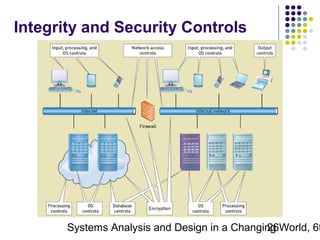
 Describe the different architectural models for
distributed databases
 Determine when and how to design the database
 Explain the importance of integrity controls for inputs,
outputs, data, and processing
 Discuss issues related to security that affect the design
and operation of information systems


Systems Analysis and Design in a Changing World, 6t
4
Overview
 Databases

and database management
systems are important components of a
modern information system
 Database design transforms the domain
model class diagram into a detailed database
model for the system
 A database management system is used to
implement and interact with the database
 System controls and security are crucial
issues to databases and also apply to other
aspects of the system

Systems Analysis and Design in a Changing World, 6t
5
Some Database Concepts








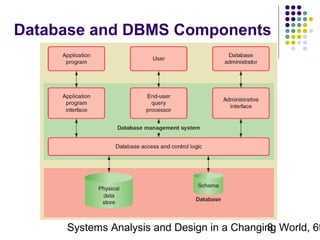
Database (DB) -- an integrated collection of stored
data that is centrally managed and controlled
Database management system (DBMS) -- a system
software component that manages and controls one or
more databases
Physical data store -- database component that stores
the raw bits and bytes of data
Schema -- database component that contains
descriptive information about the data stored in the
physical data store

Systems Analysis and Design in a Changing World, 6t
6
Database Schema
Organization of individual stored data items into
higher level groups, such as tables
 Associations among tables or classes
 Details of physical data store organization,
including types, lengths, locations, and indexing of
data items
 Access and content controls, including allowable
values for specific data items, value dependencies
among multiple data items, and lists of users
allowed to read or update data items


Systems Analysis and Design in a Changing World, 6t
7
Database and DBMS Components

Systems Analysis and Design in a Changing World, 6t
8
Relational Databases









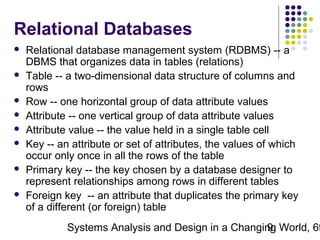
Relational database management system (RDBMS) -- a
DBMS that organizes data in tables (relations)
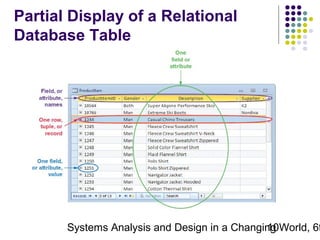
Table -- a two-dimensional data structure of columns and
rows
Row -- one horizontal group of data attribute values
Attribute -- one vertical group of data attribute values
Attribute value -- the value held in a single table cell
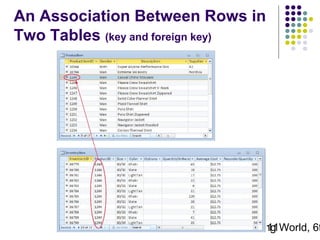
Key -- an attribute or set of attributes, the values of which
occur only once in all the rows of the table
Primary key -- the key chosen by a database designer to
represent relationships among rows in different tables
Foreign key -- an attribute that duplicates the primary key
of a different (or foreign) table

Systems Analysis and Design in a Changing World, 6t
9
Partial Display of a Relational
Database Table

Systems Analysis and Design in a Changing World, 6t
10
An Association Between Rows in
Two Tables (key and foreign key)

Systems Analysis and Design in a Changing World, 6t
11
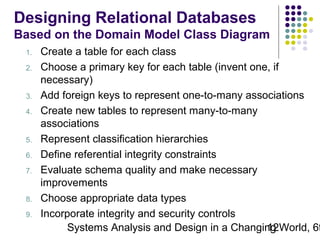
Designing Relational Databases
Based on the Domain Model Class Diagram
1.
2.

3.
4.

5.
6.
7.

8.
9.

Create a table for each class
Choose a primary key for each table (invent one, if
necessary)
Add foreign keys to represent one-to-many associations
Create new tables to represent many-to-many
associations
Represent classification hierarchies
Define referential integrity constraints
Evaluate schema quality and make necessary
improvements
Choose appropriate data types
Incorporate integrity and security controls
Systems Analysis and Design in a Changing World, 6t
12
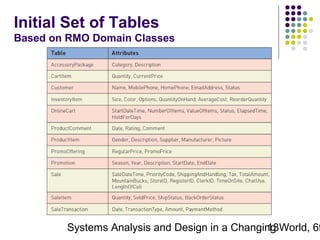
Initial Set of Tables
Based on RMO Domain Classes

Systems Analysis and Design in a Changing World, 6t
13
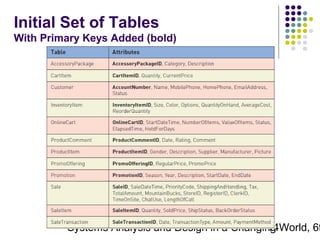
Initial Set of Tables
With Primary Keys Added (bold)

Systems Analysis and Design in a Changing World, 6t
14
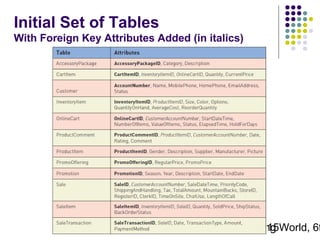
Initial Set of Tables
With Foreign Key Attributes Added (in italics)

Systems Analysis and Design in a Changing World, 6t
15
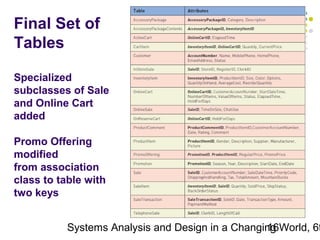
Final Set of
Tables
Specialized
subclasses of Sale
and Online Cart
added
Promo Offering
modified
from association
class to table with
two keys

Systems Analysis and Design in a Changing World, 6t
16
Designing Relational Databases
Referential Integrity and Schema Quality






Referential integrity -- a consistent state among
foreign key and primary key values
Referential integrity constraint -- a constraint, stored
in the schema, that the DBMS uses to automatically
enforce referential integrity
A high-quality relational database schema has these
features:





Flexibility or ease of implementing future data model changes
Lack of redundant data

Normalization -- a formal technique for evaluating and
improving the quality of a relational database schema

Systems Analysis and Design in a Changing World, 6t
17
Designing Relational Databases
Database Normalization
 First normal form (1NF) -- restriction that all rows of a
table must contain the same number of columns




Functional dependency -- a one-to-one association
between the values of two attributes






No repeating groups of attributes

Attribute A is functionally dependent on attribute B if for each value
of attribute B there is only one corresponding value of attribute A

Second normal form (2NF) -- restriction that a table is in
1NF and that each non-key attribute is functionally
dependent on the entire primary key
Third normal form (3NF) -- restriction that a table is in 2NF
and that no non-key attribute is functionally dependent on
any other non-key attribute
Systems Analysis and Design in a Changing World, 6t
18
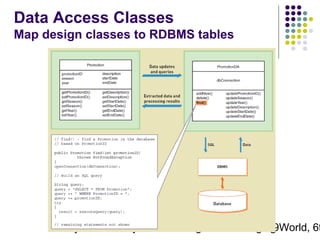
Data Access Classes
Map design classes to RDBMS tables

Systems Analysis and Design in a Changing World, 6t
19
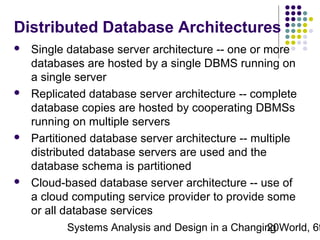
Distributed Database Architectures








Single database server architecture -- one or more
databases are hosted by a single DBMS running on
a single server
Replicated database server architecture -- complete
database copies are hosted by cooperating DBMSs
running on multiple servers
Partitioned database server architecture -- multiple
distributed database servers are used and the
database schema is partitioned
Cloud-based database server architecture -- use of
a cloud computing service provider to provide some
or all database services

Systems Analysis and Design in a Changing World, 6t
20
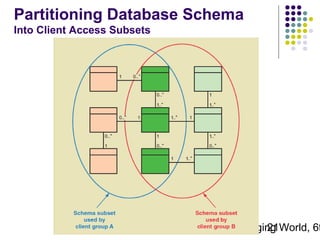
Partitioning Database Schema
Into Client Access Subsets

Systems Analysis and Design in a Changing World, 6t
21
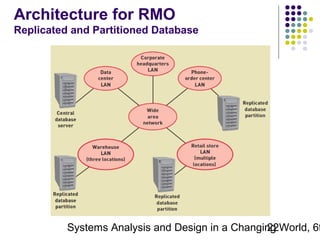
Architecture for RMO
Replicated and Partitioned Database

Systems Analysis and Design in a Changing World, 6t
22
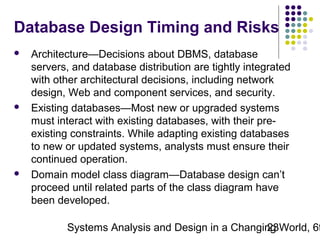
Database Design Timing and Risks






Architecture—Decisions about DBMS, database
servers, and database distribution are tightly integrated
with other architectural decisions, including network
design, Web and component services, and security.
Existing databases—Most new or upgraded systems
must interact with existing databases, with their preexisting constraints. While adapting existing databases
to new or updated systems, analysts must ensure their
continued operation.
Domain model class diagram—Database design can’t
proceed until related parts of the class diagram have
been developed.

Systems Analysis and Design in a Changing World, 6t
23
The Need for System Controls






A furniture store sells merchandise on credit with internal
financing. Salespeople sometimes sell furniture on credit to
friends and relatives. How do we ensure that only authorized
employees can extend credit and record payments and
adjustments to credit accounts?
A bookkeeper uses accounting software to generate
electronic payments to suppliers. How does the system
ensure that the payment is for goods or services that were
actually received? How does the system ensure that no one
can generate payments to a bogus supplier?
An online retailer collects and stores credit card and other
information about customers. How does the company ensure
that customer data is protected and secure?

Systems Analysis and Design in a Changing World, 6t
24
Designing System Controls








Controls -- mechanisms and procedures that are
built into a system to safeguard the system and the
information within it
Integrity control -- a control that rejects invalid data
inputs, prevents unauthorized data outputs, and
protects data and programs against accidental or
malicious tampering
Security controls -- are part of the operating system
and the network and tend to be less application
specific.
There is some overlap between Integrity and
Security controls

Systems Analysis and Design in a Changing World, 6t
25
Integrity and Security Controls

Systems Analysis and Design in a Changing World, 6t
26
Integrity Controls
Input Controls










Input control -- a control that prevents invalid or
erroneous data from entering the system
value limit control -- a control that checks numeric data
input to ensure that the value is reasonable
completeness control -- a control that ensures that all
required data values describing an object or transaction
are present
data validation control -- a control that ensures that
numeric fields that contain codes or identifiers are correct
field combination control -- a control that reviews
combinations of data inputs to ensure that the correct
data are entered

Systems Analysis and Design in a Changing World, 6t
27
Integrity Controls
Access controls, Transaction logging, Complex
update controls, Output controls








Access control -- a control that restricts which persons or
programs can add, modify, or view information resources
Transaction logging -- a technique by which any update
to the database is logged with such audit information as
user ID, date, time, input data, and type of update
Complex update control -- a control that prevents errors
that can occur when multiple programs try to update the
same data at the same time or when recording a single
transaction requires multiple related database updates
Output control -- a control that ensures that output
arrives at the proper destination and is accurate, current,
and complete
Systems Analysis and Design in a Changing World, 6t
28
Integrity Controls
Redundancy, Backup, and Recovery








Designed to protect data from hardware failure and
catastrophes
Redundancy – continuous access to data through
redundant databases, servers, and sites
Backup – procedures make partial or full copies of a
database to removable storage media, such as magnetic
tape, or to data storage devices or servers at another site
Recovery – procedures read the off-site copies and
replicate their contents to a database server that can then
provide access to programs and users.

Systems Analysis and Design in a Changing World, 6t
29
Integrity Controls
To Prevent Fraud


Fraud triangle -- model of fraud that states that
opportunity, motivation, and rationalization must all exist
for a fraud to occur






Opportunity—the ability of a person to take actions that perpetrate
a fraud. For example, unrestricted access to all functions of an
accounts payable system enables an employee to generate false
vendor payments.
Motivation—a desire or need for the results of the fraud. Money is
the usual motivation, although a desire for status or power as well
as a need to be a “team player” may be contributing factors.
Rationalization—an excuse for committing the fraud or an intention
to “undo” the fraud in the future. For example, an employee might
falsify financial reports to stave off bankruptcy, thus enabling
fellow workers to keep their jobs.

Systems Analysis and Design in a Changing World, 6t
30
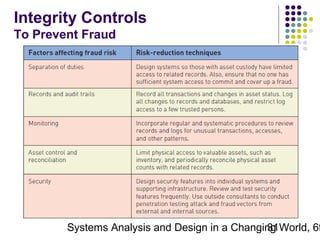
Integrity Controls
To Prevent Fraud

Systems Analysis and Design in a Changing World, 6t
31
Designing Security Controls




Security control -- a control that protects the assets of an
organization from all threats, with a primary focus on
external threats
Two Objectives




Maintain a stable, functioning operating environment for
users and application systems (usually 24 hours a day, 7
days a week).
 Firewalls to protect from hackers, viruses, works, and denial
of service attacks
Protect information and transactions during transmission
across the Internet and other insecure environments
 Information could be intercepted, destroyed or modified

Systems Analysis and Design in a Changing World, 6t
32
Security Controls
Access Controls











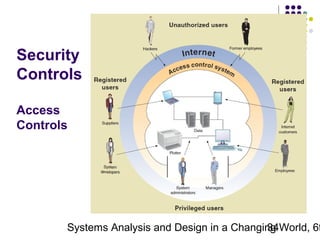
Authentication -- the process of identifying users who
request access to sensitive resources
Authorization -- the process of allowing or restricting a
specific authenticated user’s access to a specific
resource based on an access control list
Multifactor authentication -- using multiple authentication
methods for increased reliability
Unauthorized user -- a person who isn’t allowed access
to any part or functions of the system
Registered user -- a person who is authorized to access
Privileged user -- a person who has access to the source
code, executable program, and database structure of the
system
Systems Analysis and Design in a Changing World, 6t
33
Security
Controls
Access
Controls

Systems Analysis and Design in a Changing World, 6t
34
Security Controls
Data Encryption


Common types of data requiring additional
protection








Financial information
Credit card numbers, bank account numbers, payroll
information, healthcare information, and other
personal data
Strategies and plans for products and other missioncritical data
Government and sensitive military information
Data stored on such portable devices as laptop
computers and cell phones

Systems Analysis and Design in a Changing World, 6t
35
Security Controls
Data Encryption










Encryption -- the process of altering data so
unauthorized users can’t view them
Decryption -- the process of converting encrypted data
back to their original state
Encryption algorithm -- a complex mathematical
transformation that encrypts or decrypts binary data
Encryption key -- a binary input to the encryption
algorithm—typically a long string of bits
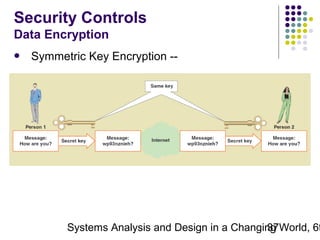
Symmetric key encryption -- encryption method that
uses the same key to encrypt and decrypt the data

Systems Analysis and Design in a Changing World, 6t
36
Security Controls
Data Encryption


Symmetric Key Encryption --

Systems Analysis and Design in a Changing World, 6t
37
Security Controls
Data Encryption




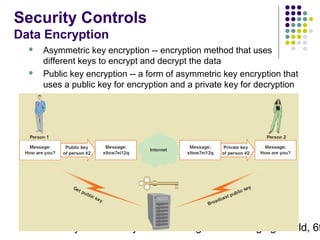
Asymmetric key encryption -- encryption method that uses
different keys to encrypt and decrypt the data
Public key encryption -- a form of asymmetric key encryption that
uses a public key for encryption and a private key for decryption

Systems Analysis and Design in a Changing World, 6t
38
Security Controls
Digital Certificate




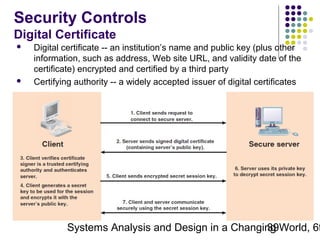
Digital certificate -- an institution’s name and public key (plus other
information, such as address, Web site URL, and validity date of the
certificate) encrypted and certified by a third party
Certifying authority -- a widely accepted issuer of digital certificates

Systems Analysis and Design in a Changing World, 6t
39
Security Controls
Secure Transactions








Secure Sockets Layer (SSL) -- a standard set of
methods and protocols that address authentication,
authorization, privacy, and integrity
Transport Layer Security (TLS) -- an Internet
standard equivalent to SSL
IP Security (IPSec) -- an Internet standard for secure
transmission of low-level network packets
Secure Hypertext Transport Protocol (HTTPS) -- an
Internet standard for securely transmitting Web
pages

Systems Analysis and Design in a Changing World, 6t
40
Summary








Most modern information systems store data and
access data using a database management systems
(DBMS)
The most common database model is a relational
database (RDBMS), which is a collection of data
stored in tables
The relational database schema is developed based
on the domain model class diagram Each class is
represented as a table. One to many associations
are represented by adding foreign keys
Database design is usually performed in an early
iteration of a system development project

Systems Analysis and Design in a Changing World, 6t
41
Summary (continued)








System controls are designed into the system to
protect the system’s data and other resources
Controls are either integrity controls, which focus
primarily on the specific application, or security
controls, which apply across systems to include
operating systems, Web sites, and networks
Integrity controls include input controls, access
controls, transaction logging, complex update
controls, redundancy-backup-recovery, output
controls, and fraud controls
Security controls include access controls, data
encryption, digital signatures/certificates, and secure
transactions

Systems Analysis and Design in a Changing World, 6t
42

Sadcw 6e chapter12

  • 1.
    Chapter 12 Systems Analysisand Design in a Changing World, 6t 1
  • 2.
    Databases, Controls, and Security Chapter12 Systems Analysis and Design in a Changing World 6th Ed Satzinger, Jackson & Burd
  • 3.
    Chapter 12 Outline Databases and Database Management Systems (DBMS)  Relational Databases (RDBMS)  Data Access Classes  Distributed Database Architectures  Database Design Timing and Risks  Designing Integrity Controls  Designing Security Controls Systems Analysis and Design in a Changing World, 6t 3
  • 4.
    Learning Objectives Design arelational database schema based on a class diagram  Evaluate and improve the quality of a database schema  Describe the different architectural models for distributed databases  Determine when and how to design the database  Explain the importance of integrity controls for inputs, outputs, data, and processing  Discuss issues related to security that affect the design and operation of information systems  Systems Analysis and Design in a Changing World, 6t 4
  • 5.
    Overview  Databases and databasemanagement systems are important components of a modern information system  Database design transforms the domain model class diagram into a detailed database model for the system  A database management system is used to implement and interact with the database  System controls and security are crucial issues to databases and also apply to other aspects of the system Systems Analysis and Design in a Changing World, 6t 5
  • 6.
    Some Database Concepts     Database(DB) -- an integrated collection of stored data that is centrally managed and controlled Database management system (DBMS) -- a system software component that manages and controls one or more databases Physical data store -- database component that stores the raw bits and bytes of data Schema -- database component that contains descriptive information about the data stored in the physical data store Systems Analysis and Design in a Changing World, 6t 6
  • 7.
    Database Schema Organization ofindividual stored data items into higher level groups, such as tables  Associations among tables or classes  Details of physical data store organization, including types, lengths, locations, and indexing of data items  Access and content controls, including allowable values for specific data items, value dependencies among multiple data items, and lists of users allowed to read or update data items  Systems Analysis and Design in a Changing World, 6t 7
  • 8.
    Database and DBMSComponents Systems Analysis and Design in a Changing World, 6t 8
  • 9.
    Relational Databases         Relational databasemanagement system (RDBMS) -- a DBMS that organizes data in tables (relations) Table -- a two-dimensional data structure of columns and rows Row -- one horizontal group of data attribute values Attribute -- one vertical group of data attribute values Attribute value -- the value held in a single table cell Key -- an attribute or set of attributes, the values of which occur only once in all the rows of the table Primary key -- the key chosen by a database designer to represent relationships among rows in different tables Foreign key -- an attribute that duplicates the primary key of a different (or foreign) table Systems Analysis and Design in a Changing World, 6t 9
  • 10.
    Partial Display ofa Relational Database Table Systems Analysis and Design in a Changing World, 6t 10
  • 11.
    An Association BetweenRows in Two Tables (key and foreign key) Systems Analysis and Design in a Changing World, 6t 11
  • 12.
    Designing Relational Databases Basedon the Domain Model Class Diagram 1. 2. 3. 4. 5. 6. 7. 8. 9. Create a table for each class Choose a primary key for each table (invent one, if necessary) Add foreign keys to represent one-to-many associations Create new tables to represent many-to-many associations Represent classification hierarchies Define referential integrity constraints Evaluate schema quality and make necessary improvements Choose appropriate data types Incorporate integrity and security controls Systems Analysis and Design in a Changing World, 6t 12
  • 13.
    Initial Set ofTables Based on RMO Domain Classes Systems Analysis and Design in a Changing World, 6t 13
  • 14.
    Initial Set ofTables With Primary Keys Added (bold) Systems Analysis and Design in a Changing World, 6t 14
  • 15.
    Initial Set ofTables With Foreign Key Attributes Added (in italics) Systems Analysis and Design in a Changing World, 6t 15
  • 16.
    Final Set of Tables Specialized subclassesof Sale and Online Cart added Promo Offering modified from association class to table with two keys Systems Analysis and Design in a Changing World, 6t 16
  • 17.
    Designing Relational Databases ReferentialIntegrity and Schema Quality    Referential integrity -- a consistent state among foreign key and primary key values Referential integrity constraint -- a constraint, stored in the schema, that the DBMS uses to automatically enforce referential integrity A high-quality relational database schema has these features:    Flexibility or ease of implementing future data model changes Lack of redundant data Normalization -- a formal technique for evaluating and improving the quality of a relational database schema Systems Analysis and Design in a Changing World, 6t 17
  • 18.
    Designing Relational Databases DatabaseNormalization  First normal form (1NF) -- restriction that all rows of a table must contain the same number of columns   Functional dependency -- a one-to-one association between the values of two attributes    No repeating groups of attributes Attribute A is functionally dependent on attribute B if for each value of attribute B there is only one corresponding value of attribute A Second normal form (2NF) -- restriction that a table is in 1NF and that each non-key attribute is functionally dependent on the entire primary key Third normal form (3NF) -- restriction that a table is in 2NF and that no non-key attribute is functionally dependent on any other non-key attribute Systems Analysis and Design in a Changing World, 6t 18
  • 19.
    Data Access Classes Mapdesign classes to RDBMS tables Systems Analysis and Design in a Changing World, 6t 19
  • 20.
    Distributed Database Architectures     Singledatabase server architecture -- one or more databases are hosted by a single DBMS running on a single server Replicated database server architecture -- complete database copies are hosted by cooperating DBMSs running on multiple servers Partitioned database server architecture -- multiple distributed database servers are used and the database schema is partitioned Cloud-based database server architecture -- use of a cloud computing service provider to provide some or all database services Systems Analysis and Design in a Changing World, 6t 20
  • 21.
    Partitioning Database Schema IntoClient Access Subsets Systems Analysis and Design in a Changing World, 6t 21
  • 22.
    Architecture for RMO Replicatedand Partitioned Database Systems Analysis and Design in a Changing World, 6t 22
  • 23.
    Database Design Timingand Risks    Architecture—Decisions about DBMS, database servers, and database distribution are tightly integrated with other architectural decisions, including network design, Web and component services, and security. Existing databases—Most new or upgraded systems must interact with existing databases, with their preexisting constraints. While adapting existing databases to new or updated systems, analysts must ensure their continued operation. Domain model class diagram—Database design can’t proceed until related parts of the class diagram have been developed. Systems Analysis and Design in a Changing World, 6t 23
  • 24.
    The Need forSystem Controls    A furniture store sells merchandise on credit with internal financing. Salespeople sometimes sell furniture on credit to friends and relatives. How do we ensure that only authorized employees can extend credit and record payments and adjustments to credit accounts? A bookkeeper uses accounting software to generate electronic payments to suppliers. How does the system ensure that the payment is for goods or services that were actually received? How does the system ensure that no one can generate payments to a bogus supplier? An online retailer collects and stores credit card and other information about customers. How does the company ensure that customer data is protected and secure? Systems Analysis and Design in a Changing World, 6t 24
  • 25.
    Designing System Controls     Controls-- mechanisms and procedures that are built into a system to safeguard the system and the information within it Integrity control -- a control that rejects invalid data inputs, prevents unauthorized data outputs, and protects data and programs against accidental or malicious tampering Security controls -- are part of the operating system and the network and tend to be less application specific. There is some overlap between Integrity and Security controls Systems Analysis and Design in a Changing World, 6t 25
  • 26.
    Integrity and SecurityControls Systems Analysis and Design in a Changing World, 6t 26
  • 27.
    Integrity Controls Input Controls      Inputcontrol -- a control that prevents invalid or erroneous data from entering the system value limit control -- a control that checks numeric data input to ensure that the value is reasonable completeness control -- a control that ensures that all required data values describing an object or transaction are present data validation control -- a control that ensures that numeric fields that contain codes or identifiers are correct field combination control -- a control that reviews combinations of data inputs to ensure that the correct data are entered Systems Analysis and Design in a Changing World, 6t 27
  • 28.
    Integrity Controls Access controls,Transaction logging, Complex update controls, Output controls     Access control -- a control that restricts which persons or programs can add, modify, or view information resources Transaction logging -- a technique by which any update to the database is logged with such audit information as user ID, date, time, input data, and type of update Complex update control -- a control that prevents errors that can occur when multiple programs try to update the same data at the same time or when recording a single transaction requires multiple related database updates Output control -- a control that ensures that output arrives at the proper destination and is accurate, current, and complete Systems Analysis and Design in a Changing World, 6t 28
  • 29.
    Integrity Controls Redundancy, Backup,and Recovery     Designed to protect data from hardware failure and catastrophes Redundancy – continuous access to data through redundant databases, servers, and sites Backup – procedures make partial or full copies of a database to removable storage media, such as magnetic tape, or to data storage devices or servers at another site Recovery – procedures read the off-site copies and replicate their contents to a database server that can then provide access to programs and users. Systems Analysis and Design in a Changing World, 6t 29
  • 30.
    Integrity Controls To PreventFraud  Fraud triangle -- model of fraud that states that opportunity, motivation, and rationalization must all exist for a fraud to occur    Opportunity—the ability of a person to take actions that perpetrate a fraud. For example, unrestricted access to all functions of an accounts payable system enables an employee to generate false vendor payments. Motivation—a desire or need for the results of the fraud. Money is the usual motivation, although a desire for status or power as well as a need to be a “team player” may be contributing factors. Rationalization—an excuse for committing the fraud or an intention to “undo” the fraud in the future. For example, an employee might falsify financial reports to stave off bankruptcy, thus enabling fellow workers to keep their jobs. Systems Analysis and Design in a Changing World, 6t 30
  • 31.
    Integrity Controls To PreventFraud Systems Analysis and Design in a Changing World, 6t 31
  • 32.
    Designing Security Controls   Securitycontrol -- a control that protects the assets of an organization from all threats, with a primary focus on external threats Two Objectives   Maintain a stable, functioning operating environment for users and application systems (usually 24 hours a day, 7 days a week).  Firewalls to protect from hackers, viruses, works, and denial of service attacks Protect information and transactions during transmission across the Internet and other insecure environments  Information could be intercepted, destroyed or modified Systems Analysis and Design in a Changing World, 6t 32
  • 33.
    Security Controls Access Controls       Authentication-- the process of identifying users who request access to sensitive resources Authorization -- the process of allowing or restricting a specific authenticated user’s access to a specific resource based on an access control list Multifactor authentication -- using multiple authentication methods for increased reliability Unauthorized user -- a person who isn’t allowed access to any part or functions of the system Registered user -- a person who is authorized to access Privileged user -- a person who has access to the source code, executable program, and database structure of the system Systems Analysis and Design in a Changing World, 6t 33
  • 34.
  • 35.
    Security Controls Data Encryption  Commontypes of data requiring additional protection      Financial information Credit card numbers, bank account numbers, payroll information, healthcare information, and other personal data Strategies and plans for products and other missioncritical data Government and sensitive military information Data stored on such portable devices as laptop computers and cell phones Systems Analysis and Design in a Changing World, 6t 35
  • 36.
    Security Controls Data Encryption      Encryption-- the process of altering data so unauthorized users can’t view them Decryption -- the process of converting encrypted data back to their original state Encryption algorithm -- a complex mathematical transformation that encrypts or decrypts binary data Encryption key -- a binary input to the encryption algorithm—typically a long string of bits Symmetric key encryption -- encryption method that uses the same key to encrypt and decrypt the data Systems Analysis and Design in a Changing World, 6t 36
  • 37.
    Security Controls Data Encryption  SymmetricKey Encryption -- Systems Analysis and Design in a Changing World, 6t 37
  • 38.
    Security Controls Data Encryption   Asymmetrickey encryption -- encryption method that uses different keys to encrypt and decrypt the data Public key encryption -- a form of asymmetric key encryption that uses a public key for encryption and a private key for decryption Systems Analysis and Design in a Changing World, 6t 38
  • 39.
    Security Controls Digital Certificate   Digitalcertificate -- an institution’s name and public key (plus other information, such as address, Web site URL, and validity date of the certificate) encrypted and certified by a third party Certifying authority -- a widely accepted issuer of digital certificates Systems Analysis and Design in a Changing World, 6t 39
  • 40.
    Security Controls Secure Transactions     SecureSockets Layer (SSL) -- a standard set of methods and protocols that address authentication, authorization, privacy, and integrity Transport Layer Security (TLS) -- an Internet standard equivalent to SSL IP Security (IPSec) -- an Internet standard for secure transmission of low-level network packets Secure Hypertext Transport Protocol (HTTPS) -- an Internet standard for securely transmitting Web pages Systems Analysis and Design in a Changing World, 6t 40
  • 41.
    Summary     Most modern informationsystems store data and access data using a database management systems (DBMS) The most common database model is a relational database (RDBMS), which is a collection of data stored in tables The relational database schema is developed based on the domain model class diagram Each class is represented as a table. One to many associations are represented by adding foreign keys Database design is usually performed in an early iteration of a system development project Systems Analysis and Design in a Changing World, 6t 41
  • 42.
    Summary (continued)     System controlsare designed into the system to protect the system’s data and other resources Controls are either integrity controls, which focus primarily on the specific application, or security controls, which apply across systems to include operating systems, Web sites, and networks Integrity controls include input controls, access controls, transaction logging, complex update controls, redundancy-backup-recovery, output controls, and fraud controls Security controls include access controls, data encryption, digital signatures/certificates, and secure transactions Systems Analysis and Design in a Changing World, 6t 42