4-5 QUADRATIC EQUATIONS
Chapter 4 Quadratic Functions and Equations
©Tentinger
ESSENTIAL UNDERSTANDING AND
OBJECTIVES
   Essential Understanding: Standard Form: to find
    zeros of a quadratic function y = ax2 + bx + c, solve
    the related quadratic equation = ax2 + bx + c

 Objectives:
 Students will be able to:
     Solve quadratic equations by factoring
     Solve quadratic equations by graphing
IOWA CORE CURRICULUM
   Algebra
   A.SSE.1a. Interpret parts of an expressions, such as
    terms, factors, and coefficients
   A.APR.3. Identify zeros of polynomials when suitable
    factorizations are available, and use the zeros to
    construct a rough graph of the function defined by the
    polynomial.
   A.CED.1. Create equations and inequalities in one
    variable and use them to solve problems. Include
    equations arising from linear and quadratic
    functions, and simple rational and exponential functions.
   A.CED.2. Create equations in two or more variables to
    represent relationships between quantities; graph
    equations on coordinate axes with labels and scales.
    (concept byte)
ZERO

   What do you think when I say the zero of a
    function?

 Zero of a function is where the graph crosses the x-
  axis.
 You can solve quadratic equations in standard form
  by factoring, using the zero product property

   Zero product property: if ab = 0, then a = 0 or b =
    0
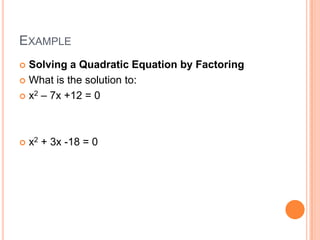
EXAMPLE
 Solving a Quadratic Equation by Factoring
 What is the solution to:

 x2 – 7x +12 = 0


   x2 + 3x -18 = 0
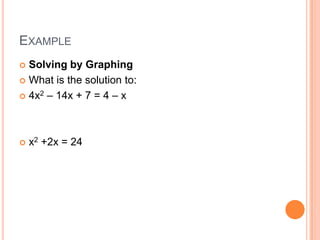
EXAMPLE
 Solving by Graphing
 What is the solution to:

 4x2 – 14x + 7 = 4 – x


   x2 +2x = 24
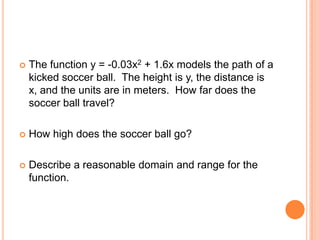
   The function y = -0.03x2 + 1.6x models the path of a
    kicked soccer ball. The height is y, the distance is
    x, and the units are in meters. How far does the
    soccer ball travel?

   How high does the soccer ball go?

   Describe a reasonable domain and range for the
    function.
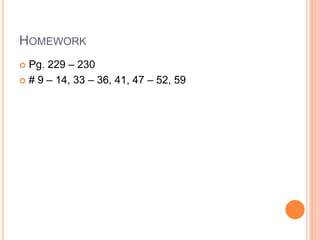
HOMEWORK
 Pg. 229 – 230
 # 9 – 14, 33 – 36, 41, 47 – 52, 59

Alg II Unit 4-5 Quadratic Equations

  • 1.
    4-5 QUADRATIC EQUATIONS Chapter4 Quadratic Functions and Equations ©Tentinger
  • 2.
    ESSENTIAL UNDERSTANDING AND OBJECTIVES  Essential Understanding: Standard Form: to find zeros of a quadratic function y = ax2 + bx + c, solve the related quadratic equation = ax2 + bx + c  Objectives:  Students will be able to:  Solve quadratic equations by factoring  Solve quadratic equations by graphing
  • 3.
    IOWA CORE CURRICULUM  Algebra  A.SSE.1a. Interpret parts of an expressions, such as terms, factors, and coefficients  A.APR.3. Identify zeros of polynomials when suitable factorizations are available, and use the zeros to construct a rough graph of the function defined by the polynomial.  A.CED.1. Create equations and inequalities in one variable and use them to solve problems. Include equations arising from linear and quadratic functions, and simple rational and exponential functions.  A.CED.2. Create equations in two or more variables to represent relationships between quantities; graph equations on coordinate axes with labels and scales. (concept byte)
  • 4.
    ZERO  What do you think when I say the zero of a function?  Zero of a function is where the graph crosses the x- axis.  You can solve quadratic equations in standard form by factoring, using the zero product property  Zero product property: if ab = 0, then a = 0 or b = 0
  • 5.
    EXAMPLE  Solving aQuadratic Equation by Factoring  What is the solution to:  x2 – 7x +12 = 0  x2 + 3x -18 = 0
  • 6.
    EXAMPLE  Solving byGraphing  What is the solution to:  4x2 – 14x + 7 = 4 – x  x2 +2x = 24
  • 7.
    The function y = -0.03x2 + 1.6x models the path of a kicked soccer ball. The height is y, the distance is x, and the units are in meters. How far does the soccer ball travel?  How high does the soccer ball go?  Describe a reasonable domain and range for the function.
  • 8.
    HOMEWORK  Pg. 229– 230  # 9 – 14, 33 – 36, 41, 47 – 52, 59