3-4 Linear
Programming
Algebra II Unit 3 Linear Systems
© Tentinger
Essential Understanding and
  Objectives
● Essential Understanding: Some real-world problems involve multiple linear
  relationships. Linear programming accounts for all of these linear
  relationships and gives the solution to the problem.
● Objectives:
  ● Students will be able to:
     ● Solving problems using linear programming
     ● Define constraint, linear programming, feasible region, and objective function
Iowa Core Curriculum
• Algebra
• A.CED.3 Represent constraints by equations or inequalities,
  and by systems of equations and/or inequalities, and interpret
  solutions as viable or nonviable options in a modeling context.
  For example, represent inequalities describing nutritional and
  cost constraints on combinations of different foods.
Linear Programming
    Businesses use linear
programming to find out how to
maximize profit or minimize
costs. Most have constraints on
what they can use or buy.
Linear Programming

Linear programming is a process of finding
a maximum or minimum of a function by
using coordinates of the polygon formed
by the graph of the constraints.
What is a constraint?

  A restriction...
  A boundary…
  A limitation…
What is the feasible region?


The feasible region is the area of the
graph in which all the constraints are met.
Objective Function
• The quantity you are trying to maximize or minimize is
  modeled by this.
• Usually this quantity is the cost or profit
• Looks something like this C = ax + by, where a and b are real
  numbers
Vertex Principle
 • If there is a maximum or minimum value of the linear objective
   function, it occurs at one or more vertices of the feasible
   region.


                   Online Example
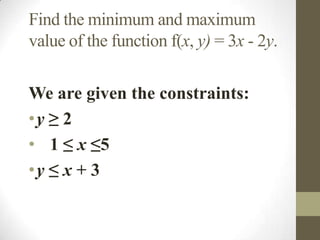
Find the minimum and maximum
value of the function f(x, y) = 3x - 2y.

We are given the constraints:
•y ≥ 2
• 1 ≤ x ≤5
•y ≤ x + 3
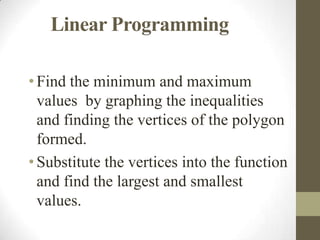
Linear Programming

• Find the minimum and maximum
  values by graphing the inequalities
  and finding the vertices of the polygon
  formed.
• Substitute the vertices into the function
  and find the largest and smallest
  values.
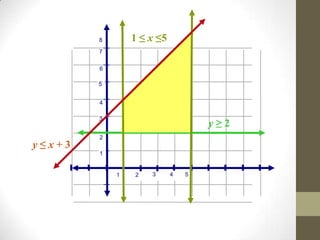
8       1 ≤ x ≤5
        7

        6

        5


        4

        3
                                   y≥2
        2
y≤x+3
        1


            1   2   3      4   5
Linear Programming


•The vertices of the quadrilateral
 formed are:
  (1, 2) (1, 4) (5, 2) (5, 8)
•Plug these points into the
 objective function
 f(x, y) = 3x - 2y
Linear Programming


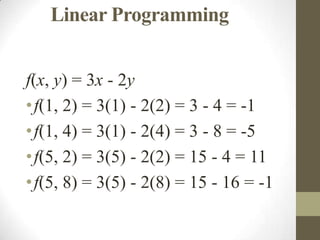
f(x, y) = 3x - 2y
• f(1, 2) = 3(1) - 2(2) = 3 - 4 = -1
• f(1, 4) = 3(1) - 2(4) = 3 - 8 = -5
• f(5, 2) = 3(5) - 2(2) = 15 - 4 = 11
• f(5, 8) = 3(5) - 2(8) = 15 - 16 = -1
Linear Programming


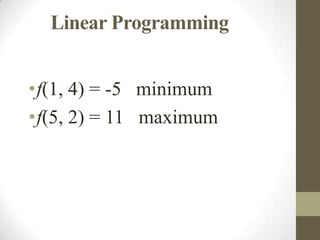
•f(1, 4) = -5 minimum
•f(5, 2) = 11 maximum
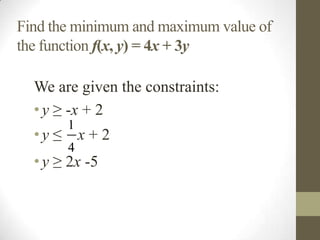
Find the minimum and maximum value of
the function f(x, y) = 4x + 3y

  We are given the constraints:
  • y ≥ -x + 2
         1
  •y ≤       x+2
         4
  • y ≥ 2x -5
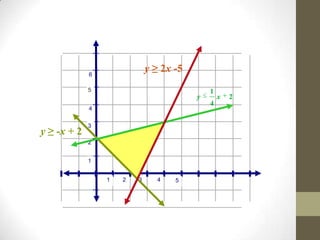
6
                             y ≥ 2x -5
             5                               1
                                         y       x   2
                                             4
             4

             3
y ≥ -x + 2
             2


             1


                 1   2   3      4   5
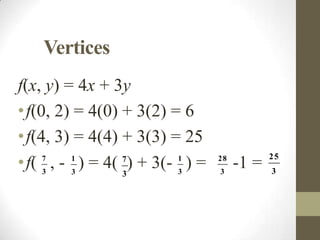
Vertices
f(x, y) = 4x + 3y
• f(0, 2) = 4(0) + 3(2) = 6
• f(4, 3) = 4(4) + 3(3) = 25
• f( 3 , - 3 ) = 4( 3) + 3(- 3 ) =
     7     1        7        1       28
                                     3
                                          -1 =   25
                                                 3
Linear Programming


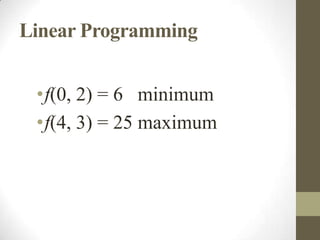
 •f(0, 2) = 6 minimum
 •f(4, 3) = 25 maximum
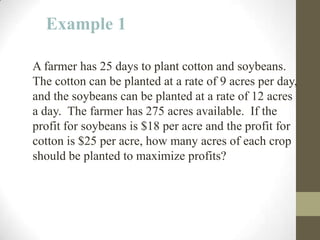
Example 1

A farmer has 25 days to plant cotton and soybeans.
The cotton can be planted at a rate of 9 acres per day,
and the soybeans can be planted at a rate of 12 acres
a day. The farmer has 275 acres available. If the
profit for soybeans is $18 per acre and the profit for
cotton is $25 per acre, how many acres of each crop
should be planted to maximize profits?
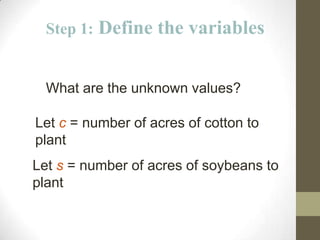
Step 1:   Define the variables


  What are the unknown values?

Let c = number of acres of cotton to
plant
Let s = number of acres of soybeans to
plant
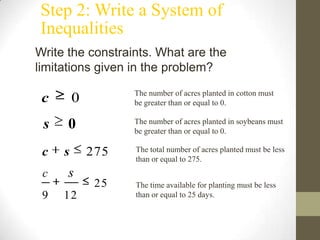
Step 2: Write a System of
Inequalities
Write the constraints. What are the
limitations given in the problem?
                   The number of acres planted in cotton must
 c       0         be greater than or equal to 0.

 s    0            The number of acres planted in soybeans must
                   be greater than or equal to 0.

 c   s       275   The total number of acres planted must be less
                   than or equal to 275.
 c    s
              25   The time available for planting must be less
 9   12            than or equal to 25 days.
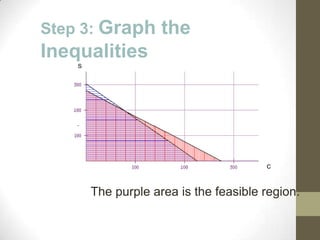
Step 3: Graph        the
Inequalities
    s


                                        c


        The purple area is the feasible region.
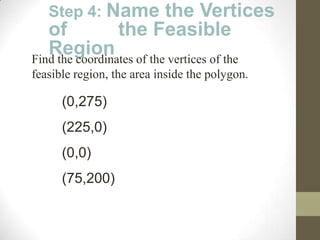
Step 4: Name       the Vertices
   of            the Feasible
   Region of the vertices of the
Find the coordinates
feasible region, the area inside the polygon.

      (0,275)
      (225,0)
      (0,0)
      (75,200)
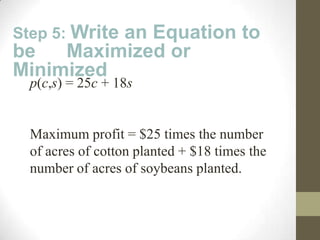
Step 5: Write
          an Equation to
be   Maximized or
Minimized
  p(c,s) = 25c + 18s


  Maximum profit = $25 times the number
  of acres of cotton planted + $18 times the
  number of acres of soybeans planted.
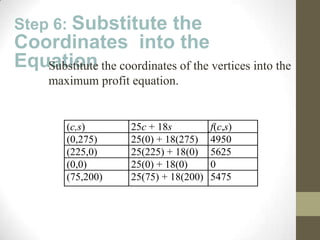
Step 6: Substitute     the
Coordinates into the
Equation the coordinates of the vertices into the
   Substitute
      maximum profit equation.


         (c,s)       25c + 18s          f(c,s)
         (0,275)     25(0) + 18(275)    4950
         (225,0)     25(225) + 18(0)    5625
         (0,0)       25(0) + 18(0)      0
         (75,200)    25(75) + 18(200)   5475
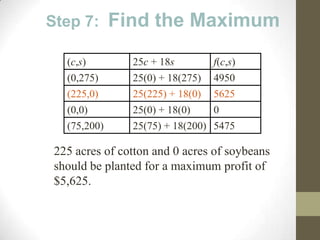
Step 7:       Find the Maximum
   (c,s)        25c + 18s          f(c,s)
   (0,275)      25(0) + 18(275)    4950
   (225,0)      25(225) + 18(0)    5625
   (0,0)        25(0) + 18(0)      0
   (75,200)     25(75) + 18(200)   5475

 225 acres of cotton and 0 acres of soybeans
 should be planted for a maximum profit of
 $5,625.
Example 2:
The Bethlehem Steel Mill can convert steel into
girders and rods. The mill can produce at most
100 units of steel a day. At least 20 girders and
at least 60 rods are required daily by regular
customers. If the profit on a girder is $8 and the
profit on a rod is $6, how many units of each
type of steel should the mill produce each day to
maximize the profits?
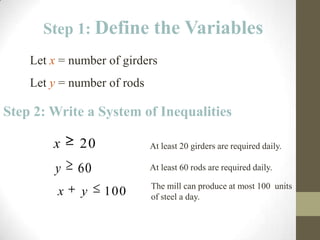
Step 1: Define the Variables
    Let x = number of girders
    Let y = number of rods

Step 2: Write a System of Inequalities

        x    20              At least 20 girders are required daily.

        y    60              At least 60 rods are required daily.

                             The mill can produce at most 100 units
         x    y   100        of steel a day.
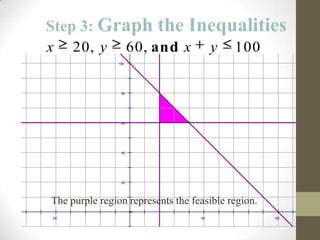
Step 3: Graph             the Inequalities
x     20, y           60, and x         y   100
                100


                 80


                 60


                 40


                 20


The purple region represents the feasible region.
-50                                50               100
Step 4: Name the Vertices of the
Feasible Region
 Find the coordinates of the vertices of the feasible region, the
 area inside the polygon.

      (20, 60)
      (20, 80)
      (40, 60)
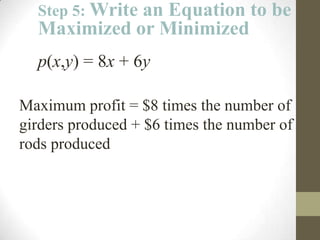
Step 5: Write an
               Equation to be
  Maximized or Minimized
  p(x,y) = 8x + 6y

Maximum profit = $8 times the number of
girders produced + $6 times the number of
rods produced
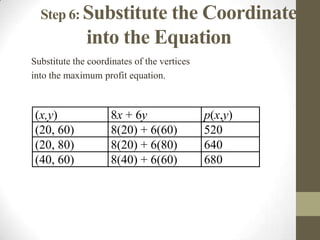
Step 6: Substitute the Coordinates
              into the Equation
Substitute the coordinates of the vertices
into the maximum profit equation.


 (x,y)               8x + 6y                 p(x,y)
 (20, 60)            8(20) + 6(60)           520
 (20, 80)            8(20) + 6(80)           640
 (40, 60)            8(40) + 6(60)           680
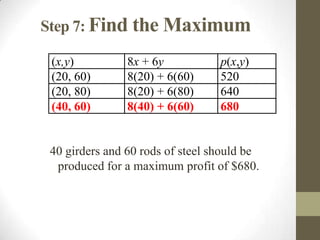
Step 7: Find the Maximum

 (x,y)          8x + 6y           p(x,y)
 (20, 60)       8(20) + 6(60)     520
 (20, 80)       8(20) + 6(80)     640
 (40, 60)       8(40) + 6(60)     680


 40 girders and 60 rods of steel should be
  produced for a maximum profit of $680.
Homework
• Pg 160-161
  #10-13, 16-19
• 8 problems

Alg II 3-4 Linear Programming

  • 1.
    3-4 Linear Programming Algebra IIUnit 3 Linear Systems © Tentinger
  • 2.
    Essential Understanding and Objectives ● Essential Understanding: Some real-world problems involve multiple linear relationships. Linear programming accounts for all of these linear relationships and gives the solution to the problem. ● Objectives: ● Students will be able to: ● Solving problems using linear programming ● Define constraint, linear programming, feasible region, and objective function
  • 3.
    Iowa Core Curriculum •Algebra • A.CED.3 Represent constraints by equations or inequalities, and by systems of equations and/or inequalities, and interpret solutions as viable or nonviable options in a modeling context. For example, represent inequalities describing nutritional and cost constraints on combinations of different foods.
  • 4.
    Linear Programming Businesses use linear programming to find out how to maximize profit or minimize costs. Most have constraints on what they can use or buy.
  • 5.
    Linear Programming Linear programmingis a process of finding a maximum or minimum of a function by using coordinates of the polygon formed by the graph of the constraints.
  • 6.
    What is aconstraint? A restriction... A boundary… A limitation…
  • 7.
    What is thefeasible region? The feasible region is the area of the graph in which all the constraints are met.
  • 8.
    Objective Function • Thequantity you are trying to maximize or minimize is modeled by this. • Usually this quantity is the cost or profit • Looks something like this C = ax + by, where a and b are real numbers
  • 9.
    Vertex Principle •If there is a maximum or minimum value of the linear objective function, it occurs at one or more vertices of the feasible region. Online Example
  • 10.
    Find the minimumand maximum value of the function f(x, y) = 3x - 2y. We are given the constraints: •y ≥ 2 • 1 ≤ x ≤5 •y ≤ x + 3
  • 11.
    Linear Programming • Findthe minimum and maximum values by graphing the inequalities and finding the vertices of the polygon formed. • Substitute the vertices into the function and find the largest and smallest values.
  • 12.
    8 1 ≤ x ≤5 7 6 5 4 3 y≥2 2 y≤x+3 1 1 2 3 4 5
  • 13.
    Linear Programming •The verticesof the quadrilateral formed are: (1, 2) (1, 4) (5, 2) (5, 8) •Plug these points into the objective function f(x, y) = 3x - 2y
  • 14.
    Linear Programming f(x, y)= 3x - 2y • f(1, 2) = 3(1) - 2(2) = 3 - 4 = -1 • f(1, 4) = 3(1) - 2(4) = 3 - 8 = -5 • f(5, 2) = 3(5) - 2(2) = 15 - 4 = 11 • f(5, 8) = 3(5) - 2(8) = 15 - 16 = -1
  • 15.
    Linear Programming •f(1, 4)= -5 minimum •f(5, 2) = 11 maximum
  • 16.
    Find the minimumand maximum value of the function f(x, y) = 4x + 3y We are given the constraints: • y ≥ -x + 2 1 •y ≤ x+2 4 • y ≥ 2x -5
  • 17.
    6 y ≥ 2x -5 5 1 y x 2 4 4 3 y ≥ -x + 2 2 1 1 2 3 4 5
  • 18.
    Vertices f(x, y) =4x + 3y • f(0, 2) = 4(0) + 3(2) = 6 • f(4, 3) = 4(4) + 3(3) = 25 • f( 3 , - 3 ) = 4( 3) + 3(- 3 ) = 7 1 7 1 28 3 -1 = 25 3
  • 19.
    Linear Programming •f(0,2) = 6 minimum •f(4, 3) = 25 maximum
  • 20.
    Example 1 A farmerhas 25 days to plant cotton and soybeans. The cotton can be planted at a rate of 9 acres per day, and the soybeans can be planted at a rate of 12 acres a day. The farmer has 275 acres available. If the profit for soybeans is $18 per acre and the profit for cotton is $25 per acre, how many acres of each crop should be planted to maximize profits?
  • 21.
    Step 1: Define the variables What are the unknown values? Let c = number of acres of cotton to plant Let s = number of acres of soybeans to plant
  • 22.
    Step 2: Writea System of Inequalities Write the constraints. What are the limitations given in the problem? The number of acres planted in cotton must c 0 be greater than or equal to 0. s 0 The number of acres planted in soybeans must be greater than or equal to 0. c s 275 The total number of acres planted must be less than or equal to 275. c s 25 The time available for planting must be less 9 12 than or equal to 25 days.
  • 23.
    Step 3: Graph the Inequalities s c The purple area is the feasible region.
  • 24.
    Step 4: Name the Vertices of the Feasible Region of the vertices of the Find the coordinates feasible region, the area inside the polygon. (0,275) (225,0) (0,0) (75,200)
  • 25.
    Step 5: Write an Equation to be Maximized or Minimized p(c,s) = 25c + 18s Maximum profit = $25 times the number of acres of cotton planted + $18 times the number of acres of soybeans planted.
  • 26.
    Step 6: Substitute the Coordinates into the Equation the coordinates of the vertices into the Substitute maximum profit equation. (c,s) 25c + 18s f(c,s) (0,275) 25(0) + 18(275) 4950 (225,0) 25(225) + 18(0) 5625 (0,0) 25(0) + 18(0) 0 (75,200) 25(75) + 18(200) 5475
  • 27.
    Step 7: Find the Maximum (c,s) 25c + 18s f(c,s) (0,275) 25(0) + 18(275) 4950 (225,0) 25(225) + 18(0) 5625 (0,0) 25(0) + 18(0) 0 (75,200) 25(75) + 18(200) 5475 225 acres of cotton and 0 acres of soybeans should be planted for a maximum profit of $5,625.
  • 28.
    Example 2: The BethlehemSteel Mill can convert steel into girders and rods. The mill can produce at most 100 units of steel a day. At least 20 girders and at least 60 rods are required daily by regular customers. If the profit on a girder is $8 and the profit on a rod is $6, how many units of each type of steel should the mill produce each day to maximize the profits?
  • 29.
    Step 1: Definethe Variables Let x = number of girders Let y = number of rods Step 2: Write a System of Inequalities x 20 At least 20 girders are required daily. y 60 At least 60 rods are required daily. The mill can produce at most 100 units x y 100 of steel a day.
  • 30.
    Step 3: Graph the Inequalities x 20, y 60, and x y 100 100 80 60 40 20 The purple region represents the feasible region. -50 50 100
  • 31.
    Step 4: Namethe Vertices of the Feasible Region Find the coordinates of the vertices of the feasible region, the area inside the polygon. (20, 60) (20, 80) (40, 60)
  • 32.
    Step 5: Writean Equation to be Maximized or Minimized p(x,y) = 8x + 6y Maximum profit = $8 times the number of girders produced + $6 times the number of rods produced
  • 33.
    Step 6: Substitutethe Coordinates into the Equation Substitute the coordinates of the vertices into the maximum profit equation. (x,y) 8x + 6y p(x,y) (20, 60) 8(20) + 6(60) 520 (20, 80) 8(20) + 6(80) 640 (40, 60) 8(40) + 6(60) 680
  • 34.
    Step 7: Findthe Maximum (x,y) 8x + 6y p(x,y) (20, 60) 8(20) + 6(60) 520 (20, 80) 8(20) + 6(80) 640 (40, 60) 8(40) + 6(60) 680 40 girders and 60 rods of steel should be produced for a maximum profit of $680.
  • 35.
    Homework • Pg 160-161 #10-13, 16-19 • 8 problems