Students will be able to write and solve
ratios
Students will be able to write and solve
proportions
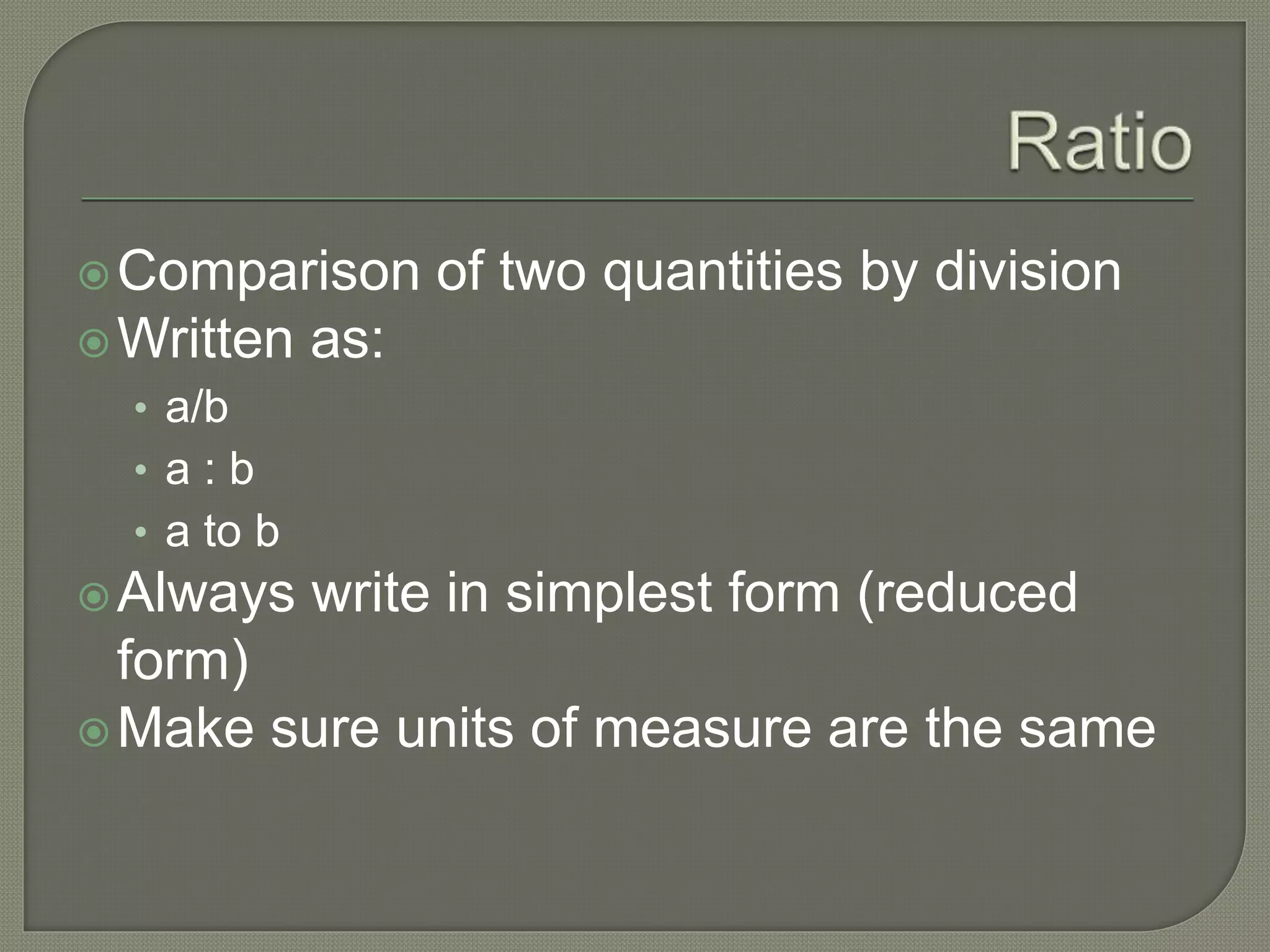
Comparison of two quantities by division
Written as:
• a/b
• a : b
• a to b
Always write in simplest form (reduced
form)
Make sure units of measure are the same
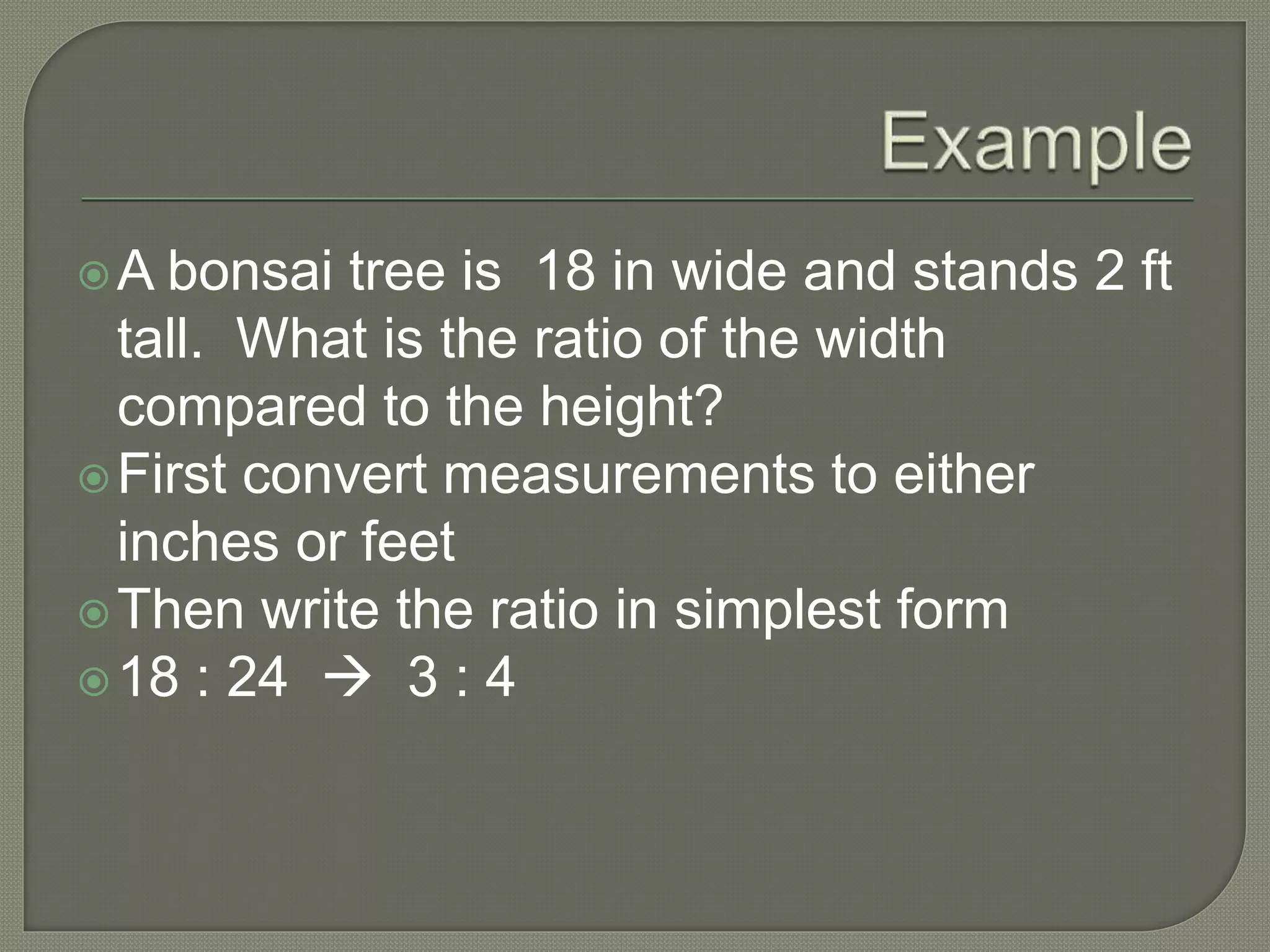
A bonsai tree is 18 in wide and stands 2 ft
tall. What is the ratio of the width
compared to the height?
First convert measurements to either
inches or feet
Then write the ratio in simplest form
18 : 24  3 : 4
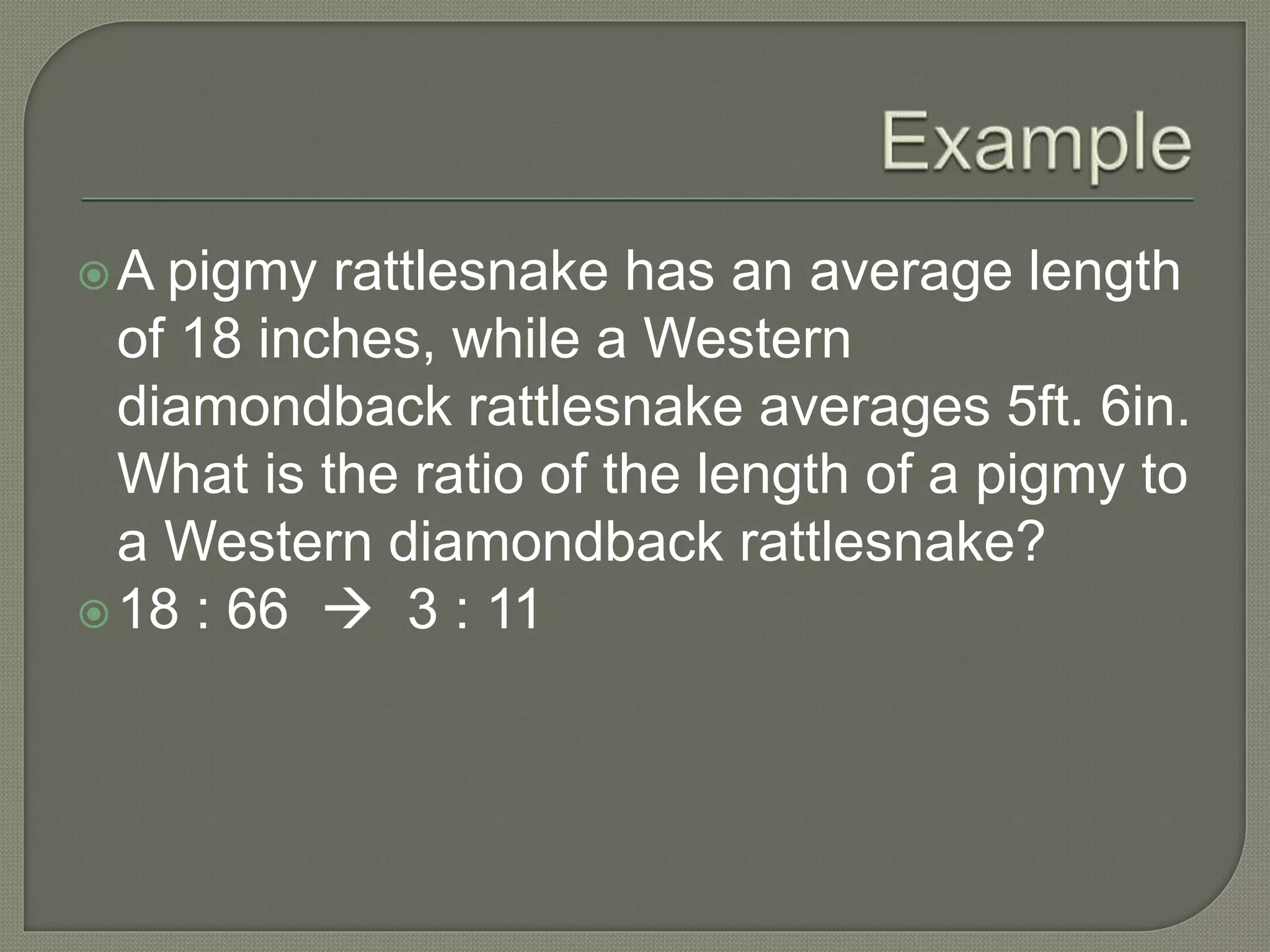
A pigmy rattlesnake has an average length
of 18 inches, while a Western
diamondback rattlesnake averages 5ft. 6in.
What is the ratio of the length of a pigmy to
a Western diamondback rattlesnake?
18 : 66  3 : 11
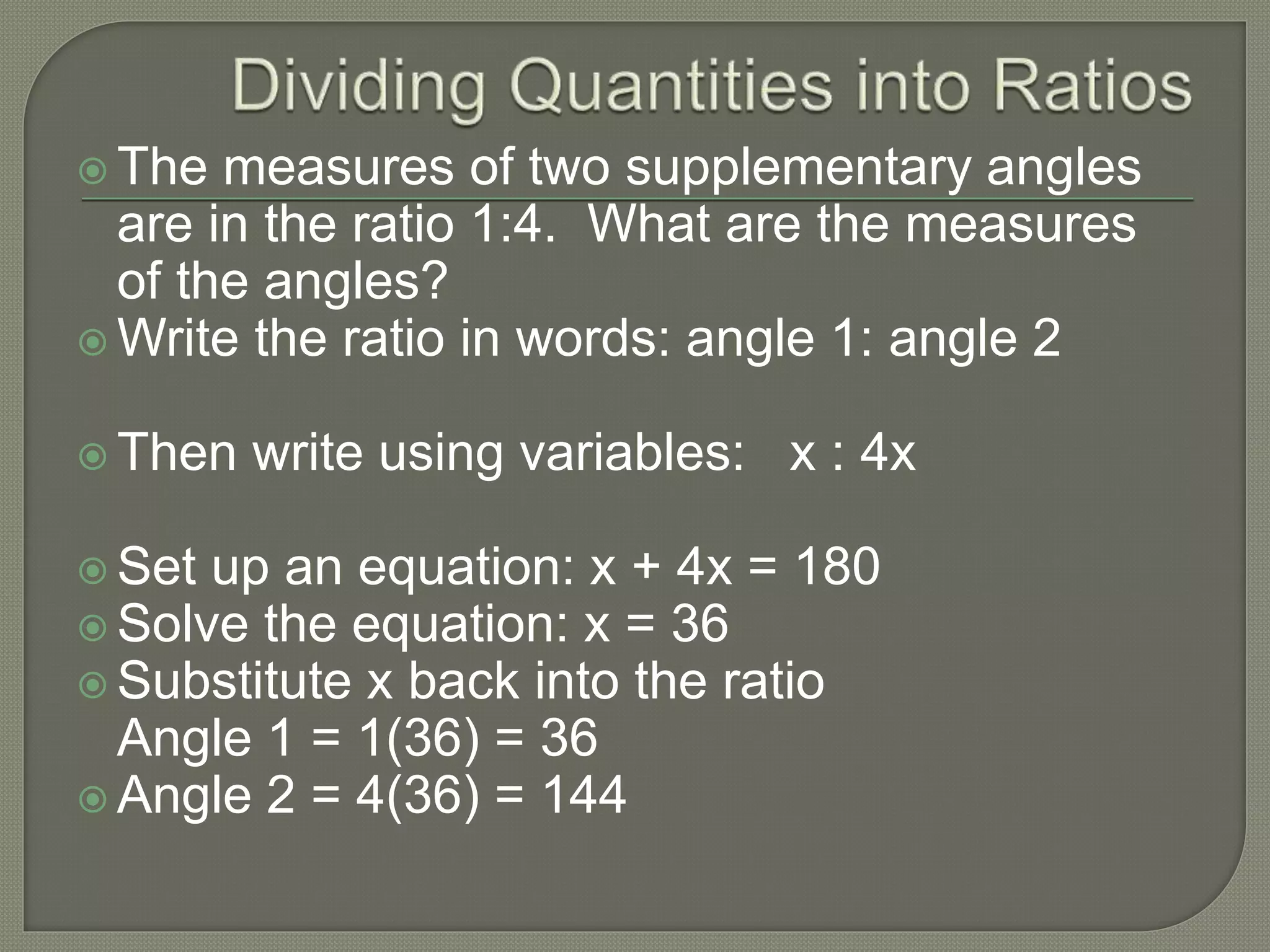
 The measures of two supplementary angles
are in the ratio 1:4. What are the measures
of the angles?
 Write the ratio in words: angle 1: angle 2
 Then write using variables: x : 4x
 Set up an equation: x + 4x = 180
 Solve the equation: x = 36
 Substitute x back into the ratio
Angle 1 = 1(36) = 36
 Angle 2 = 4(36) = 144
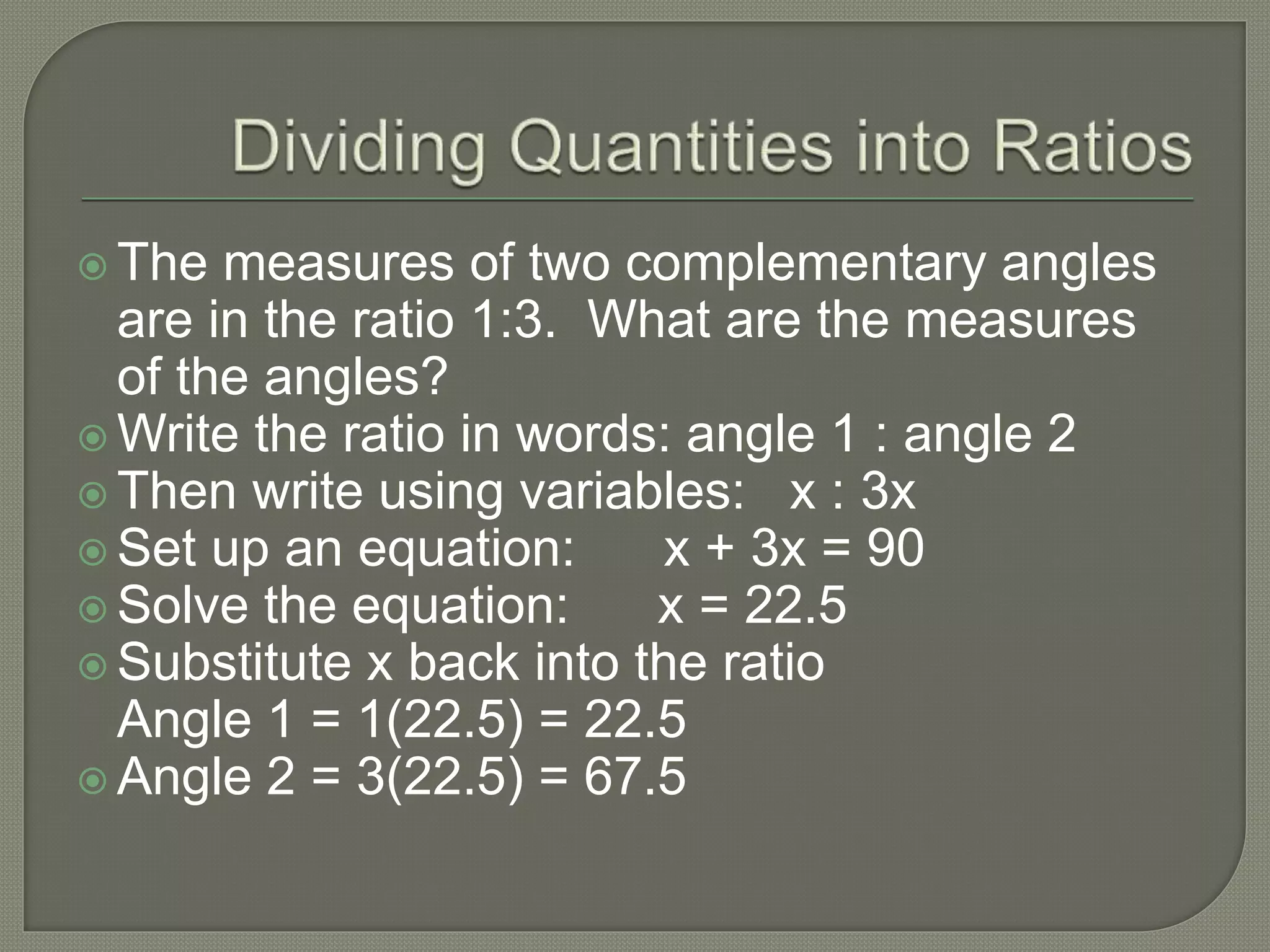
 The measures of two complementary angles
are in the ratio 1:3. What are the measures
of the angles?
 Write the ratio in words: angle 1 : angle 2
 Then write using variables: x : 3x
 Set up an equation: x + 3x = 90
 Solve the equation: x = 22.5
 Substitute x back into the ratio
Angle 1 = 1(22.5) = 22.5
 Angle 2 = 3(22.5) = 67.5
Compares 3 or more numbers
Written as
• a : b : c
The lengths of the sides of a triangle are in
the extended ratio 4 : 7 : 9. The perimeter
is 60 cm. What are the lengths of the
sides?
Write an equation: 4x + 7x + 9x = 60
Solve for x: x = 3
So the lengths of the sides are:
• 4(3) = 12
• 7(3) = 21
• 9(3) = 27
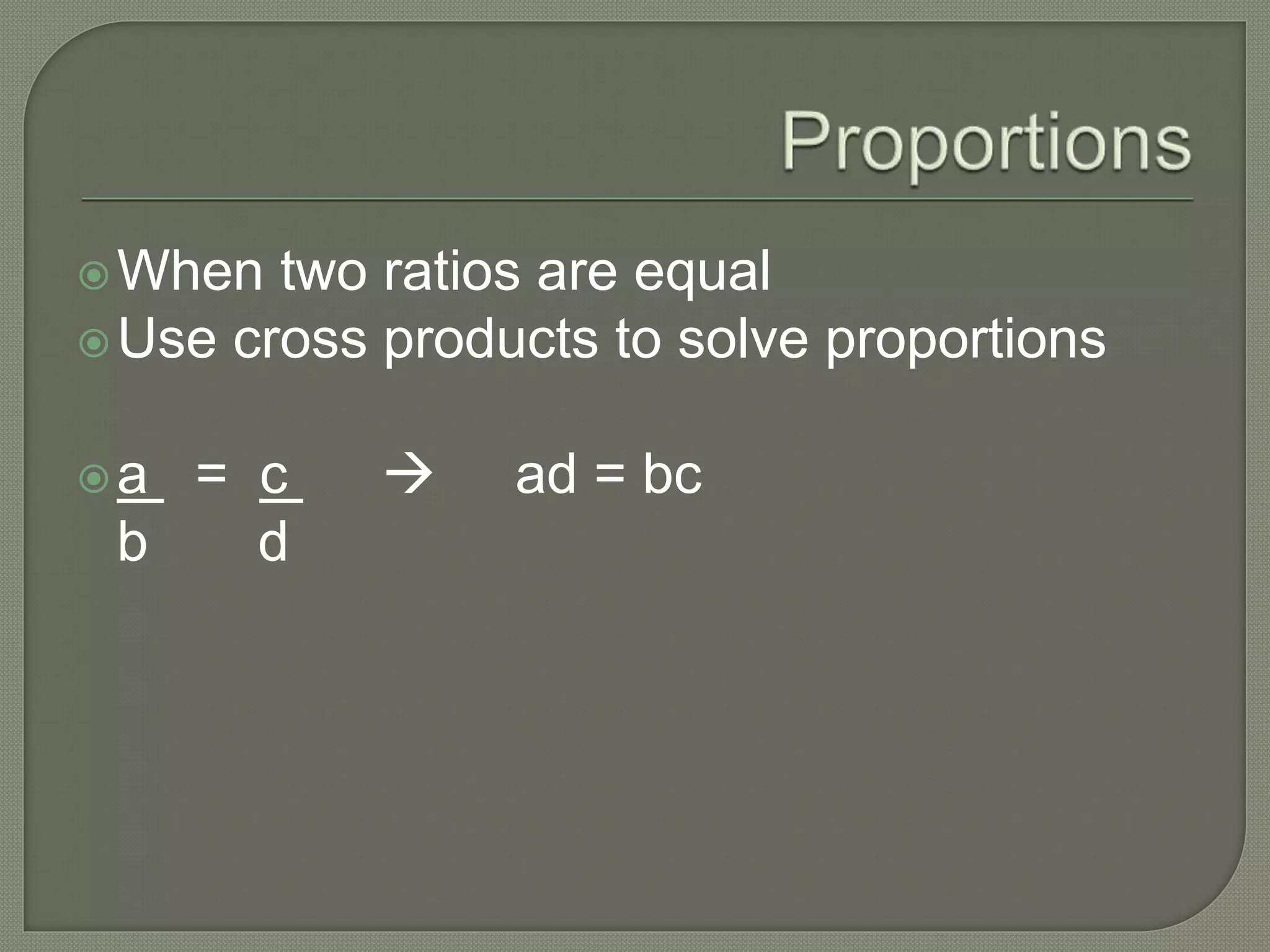
When two ratios are equal
Use cross products to solve proportions
a = c  ad = bc
b d
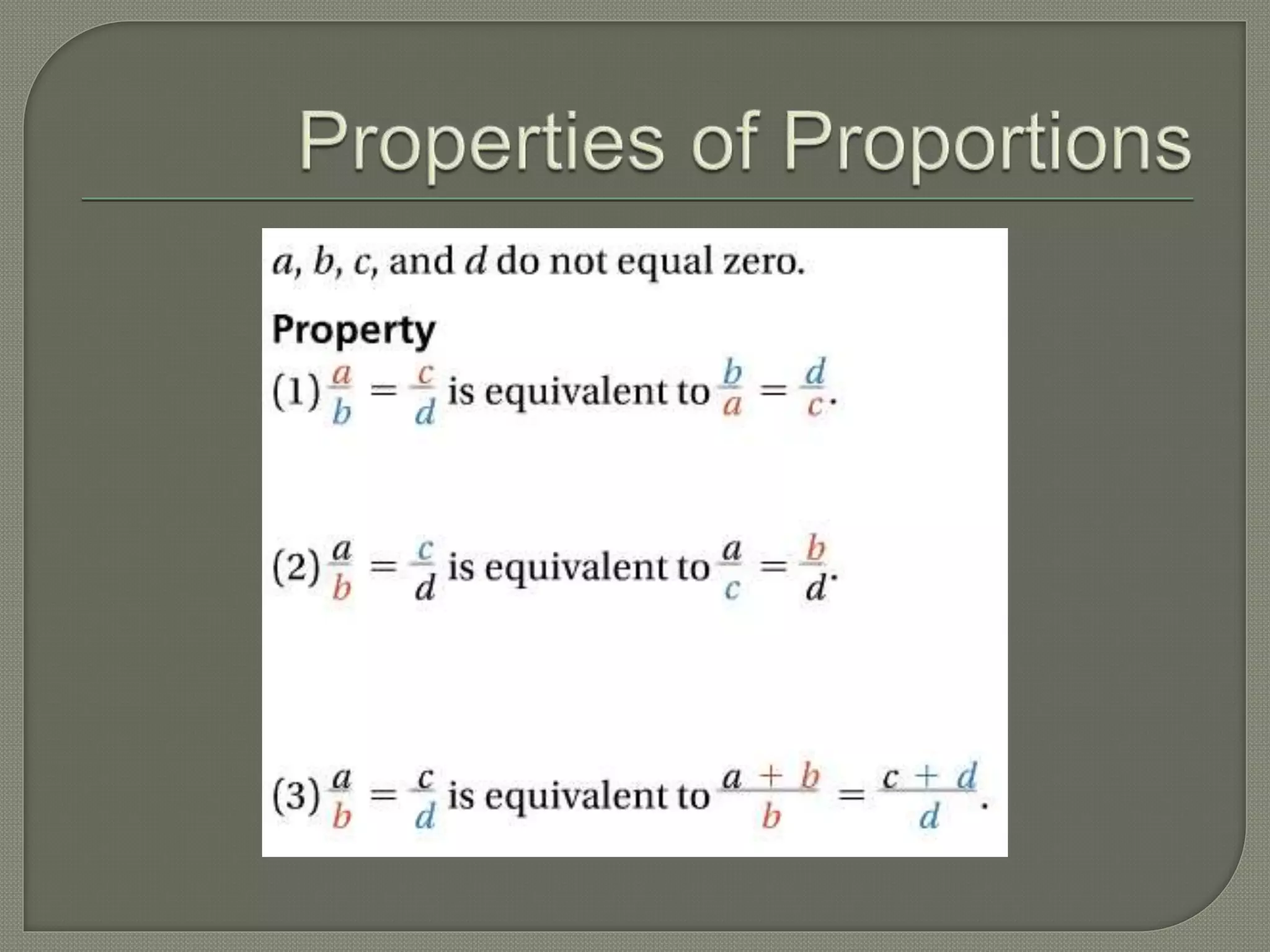
x/6 = y/7 What ratio completes the
equivalent proportion?
• x/y = ?
• 6/x = ?
• (y + 7)/7 = ?
9 = a
2 14
 15 = 3
m+1 m
 X = X+2
X – 1 X
Pg. 368
#2 – 20 even, 21, 26 – 28 all, 37 - 40 all
18 problems


Geo 7-1 Ratios and Proportions

  • 2.
    Students will beable to write and solve ratios Students will be able to write and solve proportions
  • 3.
    Comparison of twoquantities by division Written as: • a/b • a : b • a to b Always write in simplest form (reduced form) Make sure units of measure are the same
  • 4.
    A bonsai treeis 18 in wide and stands 2 ft tall. What is the ratio of the width compared to the height? First convert measurements to either inches or feet Then write the ratio in simplest form 18 : 24  3 : 4
  • 5.
    A pigmy rattlesnakehas an average length of 18 inches, while a Western diamondback rattlesnake averages 5ft. 6in. What is the ratio of the length of a pigmy to a Western diamondback rattlesnake? 18 : 66  3 : 11
  • 6.
     The measuresof two supplementary angles are in the ratio 1:4. What are the measures of the angles?  Write the ratio in words: angle 1: angle 2  Then write using variables: x : 4x  Set up an equation: x + 4x = 180  Solve the equation: x = 36  Substitute x back into the ratio Angle 1 = 1(36) = 36  Angle 2 = 4(36) = 144
  • 7.
     The measuresof two complementary angles are in the ratio 1:3. What are the measures of the angles?  Write the ratio in words: angle 1 : angle 2  Then write using variables: x : 3x  Set up an equation: x + 3x = 90  Solve the equation: x = 22.5  Substitute x back into the ratio Angle 1 = 1(22.5) = 22.5  Angle 2 = 3(22.5) = 67.5
  • 8.
    Compares 3 ormore numbers Written as • a : b : c
  • 9.
    The lengths ofthe sides of a triangle are in the extended ratio 4 : 7 : 9. The perimeter is 60 cm. What are the lengths of the sides? Write an equation: 4x + 7x + 9x = 60 Solve for x: x = 3 So the lengths of the sides are: • 4(3) = 12 • 7(3) = 21 • 9(3) = 27
  • 10.
    When two ratiosare equal Use cross products to solve proportions a = c  ad = bc b d
  • 12.
    x/6 = y/7What ratio completes the equivalent proportion? • x/y = ? • 6/x = ? • (y + 7)/7 = ?
  • 13.
    9 = a 214  15 = 3 m+1 m  X = X+2 X – 1 X
  • 14.
    Pg. 368 #2 –20 even, 21, 26 – 28 all, 37 - 40 all 18 problems 