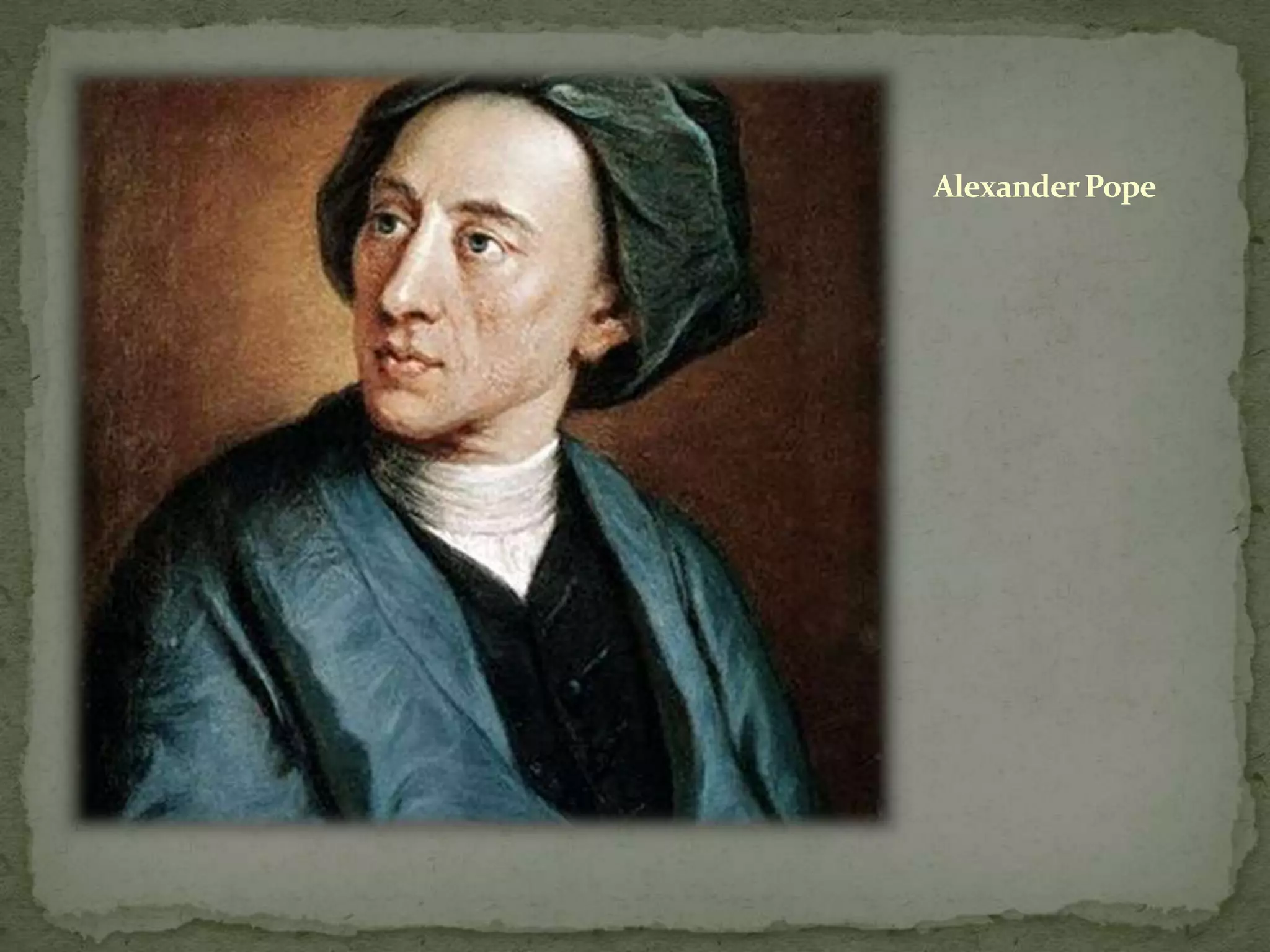
Alexander Pope
 Alexander Pope (1688 – 1744)      In 1711 he published “An Essay
  suffered from poor health.           on Criticism”.
 He was a Roman Catholic ( a         In 172 he published “The Rape
  member of a minority religion        of the Lock.”
  at that time.)                      He translated Homer’s Iliad
 His religion was a barrier for       and Odyssey.
  getting Education.                   He could afford a small State
 He was a man of genius: He           at Twickenham, near London,
  dug out knowledge by                 and lived a secluded life.
  himself.                            He wrote the Dunciad and
                                       Essay of Man.
                                      At his death he was acclaimed
                                       as England’s greatest poet.
 It was written in 1709.         The form of the Epigrams
 Pope was trying to write a       of An Essay on Criticism
  poetical essay which would       are perfect an their
  hold the same important          expression is witty.
  place in English Criticism      The topics in this literary
  that Boleau’s Art Poetique       work are strange for poetry.
  was holding in French            The purpose of the
  Criticism.                       classicists was to instruct
 Pope´s Essay of Criticism is     rather than entertaining.
  not only the last but the       It covers a range of good
  most rewarding of the            criticism and advise.
  important critical essays in    It also presents many of the
  verse modeled on Horace’s        chief literary ideals of
  Art of Poetry                    Pope’s age.
But you who seek to give and merit Fame,
       And justly bear a Critick's noble Name,
   Be sure your self and your own Reach to know.
   How far your Genius, Taste, and Learning go;
 Launch not beyond your Depth, but be discreet,
And mark that Point where Sense and Dulness meet.
       Nature to all things fix'd the Limits fit,
  And wisely curb'd proud Man's pretending Wit:
    As on the Land while here the Ocean gains,
     In other Parts it leaves wide sandy Plains;
      Thus in the Soul while Memory prevails,
       The solid Pow'r of Understanding fails;
     Where Beams of warm Imagination play,
        The Memory's soft Figures melt away.
        One Science only will one Genius fit;
        So vast is Art, so narrow Human Wit;
         Not only bounded to peculiar Arts,
      But oft in those, confin'd to single Parts.
  Like Kings we lose the Conquests gain'd before,
    By vain Ambition still to make them more:
  Each might his sev'ral Province well command,
   Wou'd all but stoop to what they understand.
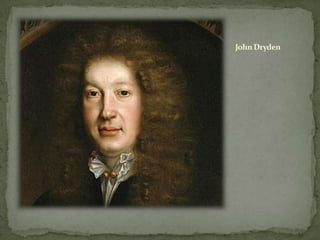
John Dryden
 Dryden was born into a well-to-do Puritan Family.
 He was a man of changeable ideas.
 After attending Trinity College, Cambridge, he
  married Lady Elizabeth Howard.
 As a writer of Comedies he was successful, but his
  heroic tragedies were more important:
   All for Love
   The world well Lost (Anthony and Cleopatra)
 He wrote satires : “Absalom and Achitopel”
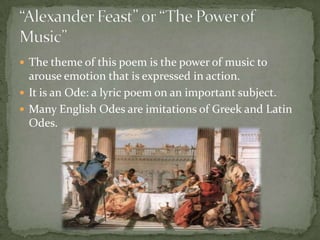
 The theme of this poem is the power of music to
  arouse emotion that is expressed in action.
 It is an Ode: a lyric poem on an important subject.
 Many English Odes are imitations of Greek and Latin
  Odes.
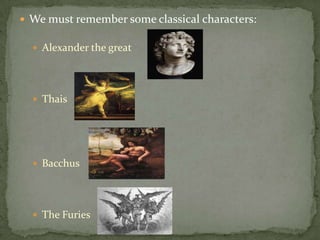
 We must remember some classical characters:

   Alexander the great


   Thais


   Bacchus


   The Furies
 Argument:
       The main body of the poem describes the feast
given by Alexander the Great at the Persian
capital Persepolis, after his defeat of Darius. Alexander's
bard Timotheus sings praises of him. Alexander's
emotions are manipulated by the singer's poetry and
music. Timotheus glorifies him as a god, puffing up
Alexander's pride. He then sings of the pleasures of
wine, encouraging Alexander to drink. Seeing Alexander
becoming too boisterous, he sings of the sad death of
Darius; the king becomes quiet. He then lauds the
beauty of Thaïs, Alexander's lover, making the king's
heart melt. Finally, he encourages feelings of anger and
vengeance, causing Thaïs and Alexander to burn down
the Persian palace in revenge for Persia's previous
outrages against Greece.

Alexander Pope and John Dryden

  • 1.
  • 2.
     Alexander Pope(1688 – 1744)  In 1711 he published “An Essay suffered from poor health. on Criticism”.  He was a Roman Catholic ( a  In 172 he published “The Rape member of a minority religion of the Lock.” at that time.)  He translated Homer’s Iliad  His religion was a barrier for and Odyssey. getting Education.  He could afford a small State  He was a man of genius: He at Twickenham, near London, dug out knowledge by and lived a secluded life. himself.  He wrote the Dunciad and Essay of Man.  At his death he was acclaimed as England’s greatest poet.
  • 3.
     It waswritten in 1709.  The form of the Epigrams  Pope was trying to write a of An Essay on Criticism poetical essay which would are perfect an their hold the same important expression is witty. place in English Criticism  The topics in this literary that Boleau’s Art Poetique work are strange for poetry. was holding in French The purpose of the Criticism. classicists was to instruct  Pope´s Essay of Criticism is rather than entertaining. not only the last but the  It covers a range of good most rewarding of the criticism and advise. important critical essays in  It also presents many of the verse modeled on Horace’s chief literary ideals of Art of Poetry Pope’s age.
  • 4.
    But you whoseek to give and merit Fame, And justly bear a Critick's noble Name, Be sure your self and your own Reach to know. How far your Genius, Taste, and Learning go; Launch not beyond your Depth, but be discreet, And mark that Point where Sense and Dulness meet. Nature to all things fix'd the Limits fit, And wisely curb'd proud Man's pretending Wit: As on the Land while here the Ocean gains, In other Parts it leaves wide sandy Plains; Thus in the Soul while Memory prevails, The solid Pow'r of Understanding fails; Where Beams of warm Imagination play, The Memory's soft Figures melt away. One Science only will one Genius fit; So vast is Art, so narrow Human Wit; Not only bounded to peculiar Arts, But oft in those, confin'd to single Parts. Like Kings we lose the Conquests gain'd before, By vain Ambition still to make them more: Each might his sev'ral Province well command, Wou'd all but stoop to what they understand.
  • 5.
  • 6.
     Dryden wasborn into a well-to-do Puritan Family.  He was a man of changeable ideas.  After attending Trinity College, Cambridge, he married Lady Elizabeth Howard.  As a writer of Comedies he was successful, but his heroic tragedies were more important:  All for Love  The world well Lost (Anthony and Cleopatra)  He wrote satires : “Absalom and Achitopel”
  • 7.
     The themeof this poem is the power of music to arouse emotion that is expressed in action.  It is an Ode: a lyric poem on an important subject.  Many English Odes are imitations of Greek and Latin Odes.
  • 8.
     We mustremember some classical characters:  Alexander the great  Thais  Bacchus  The Furies
  • 9.
     Argument: The main body of the poem describes the feast given by Alexander the Great at the Persian capital Persepolis, after his defeat of Darius. Alexander's bard Timotheus sings praises of him. Alexander's emotions are manipulated by the singer's poetry and music. Timotheus glorifies him as a god, puffing up Alexander's pride. He then sings of the pleasures of wine, encouraging Alexander to drink. Seeing Alexander becoming too boisterous, he sings of the sad death of Darius; the king becomes quiet. He then lauds the beauty of Thaïs, Alexander's lover, making the king's heart melt. Finally, he encourages feelings of anger and vengeance, causing Thaïs and Alexander to burn down the Persian palace in revenge for Persia's previous outrages against Greece.