
Alexander Pope (1688-1744)
Introduction:
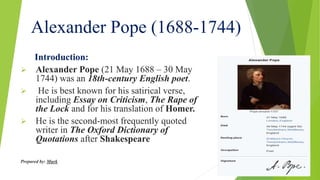
 Alexander Pope (21 May 1688 – 30 May
1744) was an 18th-century English poet.
 He is best known for his satirical verse,
including Essay on Criticism, The Rape of
the Lock and for his translation of Homer.
 He is the second-most frequently quoted
writer in The Oxford Dictionary of
Quotations after Shakespeare
Prepared by: Murk
Life:
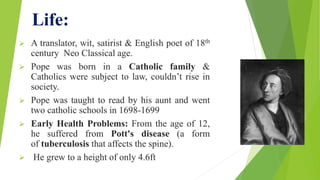
 A translator, wit, satirist & English poet of 18th
century Neo Classical age.
 Pope was born in a Catholic family &
Catholics were subject to law, couldn’t rise in
society.
 Pope was taught to read by his aunt and went
two catholic schools in 1698-1699
 Early Health Problems: From the age of 12,
he suffered from Pott's disease (a form
of tuberculosis that affects the spine).
 He grew to a height of only 4.6ft
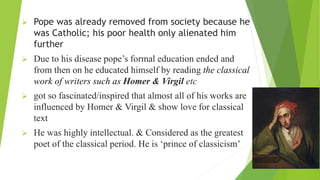
 Pope was already removed from society because he
was Catholic; his poor health only alienated him
further
 Due to his disease pope’s formal education ended and
from then on he educated himself by reading the classical
work of writers such as Homer & Virgil etc
 got so fascinated/inspired that almost all of his works are
influenced by Homer & Virgil & show love for classical
text
 He was highly intellectual. & Considered as the greatest
poet of the classical period. He is ‘prince of classicism’
 Lived and worked at a time in England when Catholics were subject to
laws
 Literature was just becoming something that people could do for living
 Studied many languages & read works by English, French, Italian latin
& greek poets.
 It is known that no other poet made as many enemies as much as Pope
made because of his criticism over the writers
 At his death he was acclaimed(praised) as England’s greatest poet.
Major works of Pope
1709: Pastorals (first work)
1711: An Essay on Criticism
1712: The Rape of the Lock
1713: Windsor Forest
1715-1720: Translation of the Iliad
1723–1725: The Works of Shakespear, in Six Volumes
1725–1726: Translation of the Odyssey
1733–1734: Essay on Man
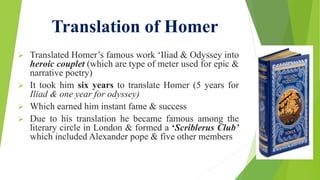
Translation of Homer
 Translated Homer’s famous work ‘Iliad & Odyssey into
heroic couplet (which are type of meter used for epic &
narrative poetry)
 It took him six years to translate Homer (5 years for
Iliad & one year for odyssey)
 Which earned him instant fame & success
 Due to his translation he became famous among the
literary circle in London & formed a ‘Scriblerus Club’
which included Alexander pope & five other members
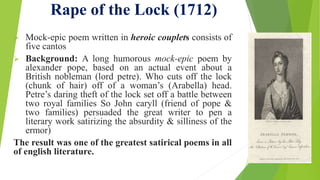
Rape of the Lock (1712)
 Mock-epic poem written in heroic couplets consists of
five cantos
 Background: A long humorous mock-epic poem by
alexander pope, based on an actual event about a
British nobleman (lord petre). Who cuts off the lock
(chunk of hair) off of a woman’s (Arabella) head.
Petre’s daring theft of the lock set off a battle between
two royal families So John caryll (friend of pope &
two families) persuaded the great writer to pen a
literary work satirizing the absurdity & silliness of the
ermor)
The result was one of the greatest satirical poems in all
of english literature.
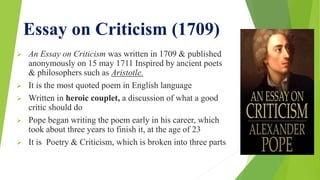
Essay on Criticism (1709)
 An Essay on Criticism was written in 1709 & published
anonymously on 15 may 1711 Inspired by ancient poets
& philosophers such as Aristotle.
 It is the most quoted poem in English language
 Written in heroic couplet, a discussion of what a good
critic should do
 Pope began writing the poem early in his career, which
took about three years to finish it, at the age of 23
 It is Poetry & Criticism, which is broken into three parts
 First part: opens by describing the way literary critics can actually cause
harm.
 In second part: pope lists the mistakes that critics make.
 In third part: Pope finally offer positive prescription, after having laid
out what’s wrong with criticism in part I & II.
Analysis of
An Essay on Criticism
 “An Essay on Criticism” is more to the critics than to
poets and artists. Pope believes that critics must know
literary tradition in order to develop taste and make
critical judgments. His message throughout the work is
that art should imitate nature, and the critics must have an
understanding of both classical works and the link
between nature & art. These understandings are crucial,
he claims, to ensuring that critics approach their work
with fairness and can recognize literary talent.
 Murk Razzaque

Alexander Pope - Life and Work

  • 1.
    Alexander Pope (1688-1744) Introduction: Alexander Pope (21 May 1688 – 30 May 1744) was an 18th-century English poet.  He is best known for his satirical verse, including Essay on Criticism, The Rape of the Lock and for his translation of Homer.  He is the second-most frequently quoted writer in The Oxford Dictionary of Quotations after Shakespeare Prepared by: Murk
  • 2.
    Life:  A translator,wit, satirist & English poet of 18th century Neo Classical age.  Pope was born in a Catholic family & Catholics were subject to law, couldn’t rise in society.  Pope was taught to read by his aunt and went two catholic schools in 1698-1699  Early Health Problems: From the age of 12, he suffered from Pott's disease (a form of tuberculosis that affects the spine).  He grew to a height of only 4.6ft
  • 3.
     Pope wasalready removed from society because he was Catholic; his poor health only alienated him further  Due to his disease pope’s formal education ended and from then on he educated himself by reading the classical work of writers such as Homer & Virgil etc  got so fascinated/inspired that almost all of his works are influenced by Homer & Virgil & show love for classical text  He was highly intellectual. & Considered as the greatest poet of the classical period. He is ‘prince of classicism’
  • 4.
     Lived andworked at a time in England when Catholics were subject to laws  Literature was just becoming something that people could do for living  Studied many languages & read works by English, French, Italian latin & greek poets.  It is known that no other poet made as many enemies as much as Pope made because of his criticism over the writers  At his death he was acclaimed(praised) as England’s greatest poet.
  • 5.
    Major works ofPope 1709: Pastorals (first work) 1711: An Essay on Criticism 1712: The Rape of the Lock 1713: Windsor Forest 1715-1720: Translation of the Iliad 1723–1725: The Works of Shakespear, in Six Volumes 1725–1726: Translation of the Odyssey 1733–1734: Essay on Man
  • 6.
    Translation of Homer Translated Homer’s famous work ‘Iliad & Odyssey into heroic couplet (which are type of meter used for epic & narrative poetry)  It took him six years to translate Homer (5 years for Iliad & one year for odyssey)  Which earned him instant fame & success  Due to his translation he became famous among the literary circle in London & formed a ‘Scriblerus Club’ which included Alexander pope & five other members
  • 7.
    Rape of theLock (1712)  Mock-epic poem written in heroic couplets consists of five cantos  Background: A long humorous mock-epic poem by alexander pope, based on an actual event about a British nobleman (lord petre). Who cuts off the lock (chunk of hair) off of a woman’s (Arabella) head. Petre’s daring theft of the lock set off a battle between two royal families So John caryll (friend of pope & two families) persuaded the great writer to pen a literary work satirizing the absurdity & silliness of the ermor) The result was one of the greatest satirical poems in all of english literature.
  • 8.
    Essay on Criticism(1709)  An Essay on Criticism was written in 1709 & published anonymously on 15 may 1711 Inspired by ancient poets & philosophers such as Aristotle.  It is the most quoted poem in English language  Written in heroic couplet, a discussion of what a good critic should do  Pope began writing the poem early in his career, which took about three years to finish it, at the age of 23  It is Poetry & Criticism, which is broken into three parts
  • 9.
     First part:opens by describing the way literary critics can actually cause harm.  In second part: pope lists the mistakes that critics make.  In third part: Pope finally offer positive prescription, after having laid out what’s wrong with criticism in part I & II.
  • 10.
    Analysis of An Essayon Criticism  “An Essay on Criticism” is more to the critics than to poets and artists. Pope believes that critics must know literary tradition in order to develop taste and make critical judgments. His message throughout the work is that art should imitate nature, and the critics must have an understanding of both classical works and the link between nature & art. These understandings are crucial, he claims, to ensuring that critics approach their work with fairness and can recognize literary talent.
  • 11.