


T.S.Eliot
By
Prof.R.R.Borse,
Eng.Dept.,
BP Arts,SMA Sci,KKC Com.College,
Chalisgaon
life
Awards &
Recognitions
work
style
life
1888-1965
Thomas Stearns
Eliot
A poet, dramatist,
literary critic, and
modernist
life
• He was born in Missouri on September 26, 1888.
• His father, Henry Ware Eliot, was the president of the
Hydraulic Brick Company. His mother, Charlotte Champe
Stearns, was a volunteer at the Humanity Club of St. Louis.
• He lived in St. Louis during the first eighteen years of his
life and attended Harvard University.
• In 1910, he left the United States for the Sorbonne, having
earned both undergraduate and masters degrees and having
contributed several poems to the Harvard Advocate.
• After a year in Paris, he returned to Harvard to pursue a
doctorate in philosophy, but returned to Europe and settled
in England in 1914.
life
• The following year, he married Vivienne Haigh-Wood and
began working in London, first as a teacher, and later for
Lloyd's Bank.
• It was in London that Eliot came under the influence of his
contemporary Ezra Pound, who recognized his poetic
genius at once, and assisted in the publication of his work
in a number of magazines.
• In 1927 he became a British citizen .
• After a notoriously unhappy first marriage, Eliot
separated from his first wife in 1933, and was remarried,
to Valerie Fletcher, in 1956.
• In 1948 he received the Nobel Prize for Literature.
• In 1965 he died in London.
Eliot’s Works
• Prufrock and Other Observations. (1917).
• Ara Vos Prec. (1919). Republished in the US as Poems. (1920).
• The Sacred Wood. (1920).
• The Waste Land. (1922).
• Homage to John Dryden. (1924).
• Poems 1909-1925 (includes "The Hollow Men"). (1925).
• Sweeney Agonistes (in Criterion). (1926).
• For Lancelot Andrewes. (1928).
• Ash-Wednesday. (1930).
• Anabasis, a Poem by St-John Perse (Eliot translation). (1930).
• Selected Essays 1917-1932. (1932).
• The Use of Poetry and the Use of Criticism. (1933).
• After Strange Gods (1933 lectures at the University of Virginia). (1934).
• The Rock: A Pageant Play. (1934).
• Murder in the Cathedral. (1935).
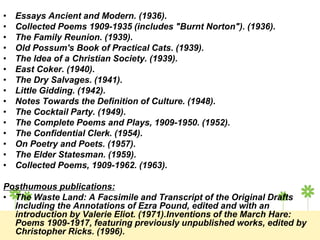
• Essays Ancient and Modern. (1936).
• Collected Poems 1909-1935 (includes "Burnt Norton"). (1936).
• The Family Reunion. (1939).
• Old Possum's Book of Practical Cats. (1939).
• The Idea of a Christian Society. (1939).
• East Coker. (1940).
• The Dry Salvages. (1941).
• Little Gidding. (1942).
• Notes Towards the Definition of Culture. (1948).
• The Cocktail Party. (1949).
• The Complete Poems and Plays, 1909-1950. (1952).
• The Confidential Clerk. (1954).
• On Poetry and Poets. (1957).
• The Elder Statesman. (1959).
• Collected Poems, 1909-1962. (1963).
Posthumous publications:
• The Waste Land: A Facsimile and Transcript of the Original Drafts
Including the Annotations of Ezra Pound, edited and with an
introduction by Valerie Eliot. (1971).Inventions of the March Hare:
Poems 1909-1917, featuring previously unpublished works, edited by
Christopher Ricks. (1996).
First period(1911-1922)
1911 The Love Song of J. Alfred
Prufrock 《J.阿尔弗雷德·普鲁弗洛
克的情歌》 —the first masterpiece
of Modernism in English
1917 Prufrock and Other
Observations 《普鲁弗洛克及其他
》 — First volume of poetry
The Love Song of J. Alfred Prufrock
1.This poem marked the start of Eliot’s career as
one of the 20th century's most influential
poets.
2.“Prufrock" is about a lonely, timid middle-aged
man who, lacking self-confidence, wants to
propose marriage to a lady but is afraid to do
so, and ultimately does not.
3.This poem showed that he was influenced by
French Symbolism,and his attention to the
predicament of modern civilization and mood
postwar disillusionment appeared in the poem.
second period
1922 The Waste Land《荒原》:
Eliot’s epochal masterpiece, a
representative work of the High
Modernism of the 1920s
1925 The Hollow Man《透明人》
: the spiritual and emotional
aridity of modern men,
exhibiting a pessimism
The Waste Land
433 lines, mainly free verse
Many quoted lines in German, French, Italian and
references and allusions to English writers as
Spencer, Shakespeare, Middleton, Milton and
Goldsmith with many explanatory notes
A picture of the spiritual ruins in Europe shortly
after the end of WWI and expressed the
disillusionment of a generation of intellectuals
A landmark in English poetry, ending the Romantic
period and signifying the emergence of Modernism
.
Third Period
1930 Ash Wednesday
1943 Four Quartets — Noble
Prize for literature in 1948
Literary criticism: Selected
Essays 1932, The Uses of
Poetry 1933, On Poetry and
Poets 1957, etc
1935-1958 verse plays: Murder
in the Cathedral 《大教堂中的
谋杀》
Style
Eliot’s poetry is difficult to read.
For one reason, the images and symbols seem very
much disconnected.
And another obvious source of difficulty lies in his
learned quotations and allusions.
To appreciate him it is good to understand that the
essence of his thought lies in the interaction between
the past, the present and the future.
Awards & Recognitions
Eliot received:
• the Nobel Prize for Literature in 1948.
• the Order of Merit in January 1948.
• the Hanseatic Gothe Prize in 1954
• the Dante Gold Medal in 1959.
• Eliot was recognized as an Officier de la Legion d’Honneur.
T.s.eliot...

T.s.eliot...

  • 1.
  • 2.
  • 3.
    life 1888-1965 Thomas Stearns Eliot A poet,dramatist, literary critic, and modernist
  • 4.
    life • He wasborn in Missouri on September 26, 1888. • His father, Henry Ware Eliot, was the president of the Hydraulic Brick Company. His mother, Charlotte Champe Stearns, was a volunteer at the Humanity Club of St. Louis. • He lived in St. Louis during the first eighteen years of his life and attended Harvard University. • In 1910, he left the United States for the Sorbonne, having earned both undergraduate and masters degrees and having contributed several poems to the Harvard Advocate. • After a year in Paris, he returned to Harvard to pursue a doctorate in philosophy, but returned to Europe and settled in England in 1914.
  • 5.
    life • The followingyear, he married Vivienne Haigh-Wood and began working in London, first as a teacher, and later for Lloyd's Bank. • It was in London that Eliot came under the influence of his contemporary Ezra Pound, who recognized his poetic genius at once, and assisted in the publication of his work in a number of magazines. • In 1927 he became a British citizen . • After a notoriously unhappy first marriage, Eliot separated from his first wife in 1933, and was remarried, to Valerie Fletcher, in 1956. • In 1948 he received the Nobel Prize for Literature. • In 1965 he died in London.
  • 6.
    Eliot’s Works • Prufrockand Other Observations. (1917). • Ara Vos Prec. (1919). Republished in the US as Poems. (1920). • The Sacred Wood. (1920). • The Waste Land. (1922). • Homage to John Dryden. (1924). • Poems 1909-1925 (includes "The Hollow Men"). (1925). • Sweeney Agonistes (in Criterion). (1926). • For Lancelot Andrewes. (1928). • Ash-Wednesday. (1930). • Anabasis, a Poem by St-John Perse (Eliot translation). (1930). • Selected Essays 1917-1932. (1932). • The Use of Poetry and the Use of Criticism. (1933). • After Strange Gods (1933 lectures at the University of Virginia). (1934). • The Rock: A Pageant Play. (1934). • Murder in the Cathedral. (1935).
  • 7.
    • Essays Ancientand Modern. (1936). • Collected Poems 1909-1935 (includes "Burnt Norton"). (1936). • The Family Reunion. (1939). • Old Possum's Book of Practical Cats. (1939). • The Idea of a Christian Society. (1939). • East Coker. (1940). • The Dry Salvages. (1941). • Little Gidding. (1942). • Notes Towards the Definition of Culture. (1948). • The Cocktail Party. (1949). • The Complete Poems and Plays, 1909-1950. (1952). • The Confidential Clerk. (1954). • On Poetry and Poets. (1957). • The Elder Statesman. (1959). • Collected Poems, 1909-1962. (1963). Posthumous publications: • The Waste Land: A Facsimile and Transcript of the Original Drafts Including the Annotations of Ezra Pound, edited and with an introduction by Valerie Eliot. (1971).Inventions of the March Hare: Poems 1909-1917, featuring previously unpublished works, edited by Christopher Ricks. (1996).
  • 8.
    First period(1911-1922) 1911 TheLove Song of J. Alfred Prufrock 《J.阿尔弗雷德·普鲁弗洛 克的情歌》 —the first masterpiece of Modernism in English 1917 Prufrock and Other Observations 《普鲁弗洛克及其他 》 — First volume of poetry
  • 9.
    The Love Songof J. Alfred Prufrock 1.This poem marked the start of Eliot’s career as one of the 20th century's most influential poets. 2.“Prufrock" is about a lonely, timid middle-aged man who, lacking self-confidence, wants to propose marriage to a lady but is afraid to do so, and ultimately does not. 3.This poem showed that he was influenced by French Symbolism,and his attention to the predicament of modern civilization and mood postwar disillusionment appeared in the poem.
  • 10.
    second period 1922 TheWaste Land《荒原》: Eliot’s epochal masterpiece, a representative work of the High Modernism of the 1920s 1925 The Hollow Man《透明人》 : the spiritual and emotional aridity of modern men, exhibiting a pessimism
  • 11.
    The Waste Land 433lines, mainly free verse Many quoted lines in German, French, Italian and references and allusions to English writers as Spencer, Shakespeare, Middleton, Milton and Goldsmith with many explanatory notes A picture of the spiritual ruins in Europe shortly after the end of WWI and expressed the disillusionment of a generation of intellectuals A landmark in English poetry, ending the Romantic period and signifying the emergence of Modernism .
  • 12.
    Third Period 1930 AshWednesday 1943 Four Quartets — Noble Prize for literature in 1948 Literary criticism: Selected Essays 1932, The Uses of Poetry 1933, On Poetry and Poets 1957, etc 1935-1958 verse plays: Murder in the Cathedral 《大教堂中的 谋杀》
  • 13.
    Style Eliot’s poetry isdifficult to read. For one reason, the images and symbols seem very much disconnected. And another obvious source of difficulty lies in his learned quotations and allusions. To appreciate him it is good to understand that the essence of his thought lies in the interaction between the past, the present and the future.
  • 14.
    Awards & Recognitions Eliotreceived: • the Nobel Prize for Literature in 1948. • the Order of Merit in January 1948. • the Hanseatic Gothe Prize in 1954 • the Dante Gold Medal in 1959. • Eliot was recognized as an Officier de la Legion d’Honneur.

Editor's Notes

  • #11 去除PPT模板上的--无忧PPT整理发布的文字 首先打开PPT模板,选择视图,然后选择幻灯片母版 然后再在幻灯片母版视图中点击“无忧PPT整理发布”的文字文本框,删除,保存即可 更多PPT模板资源,请访问 无忧PPT网站--http://www.51ppt.com.cn 使用时删除本备注即可   将此幻灯片插入到演示文稿中 将此模板作为演示文稿(.ppt 文件)保存到计算机上。 打开将包含该图像幻灯片的演示文稿。 在“幻灯片”选项卡上,将插入点置于将位于该图像幻灯片之前的幻灯片之后。(确保不要选择幻灯片。插入点应位于幻灯片之间。) 在“插入”菜单上,单击“幻灯片(从文件)”。 在“幻灯片搜索器”对话框中,单击“搜索演示文稿”选项卡。 单击“浏览”,找到并选择包含该图像幻灯片的演示文稿,然后单击“打开”。 在“幻灯片(从文件)”对话框中,选择该图像幻灯片。 选中“保留源格式”复选框。如果不选中此复选框,复制的幻灯片将继承在演示文稿中位于它之前的幻灯片的设计。 单击“插入”。 单击“关闭”。