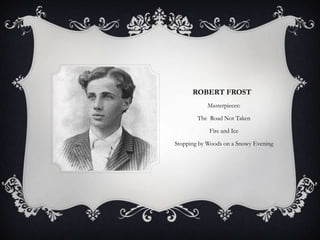
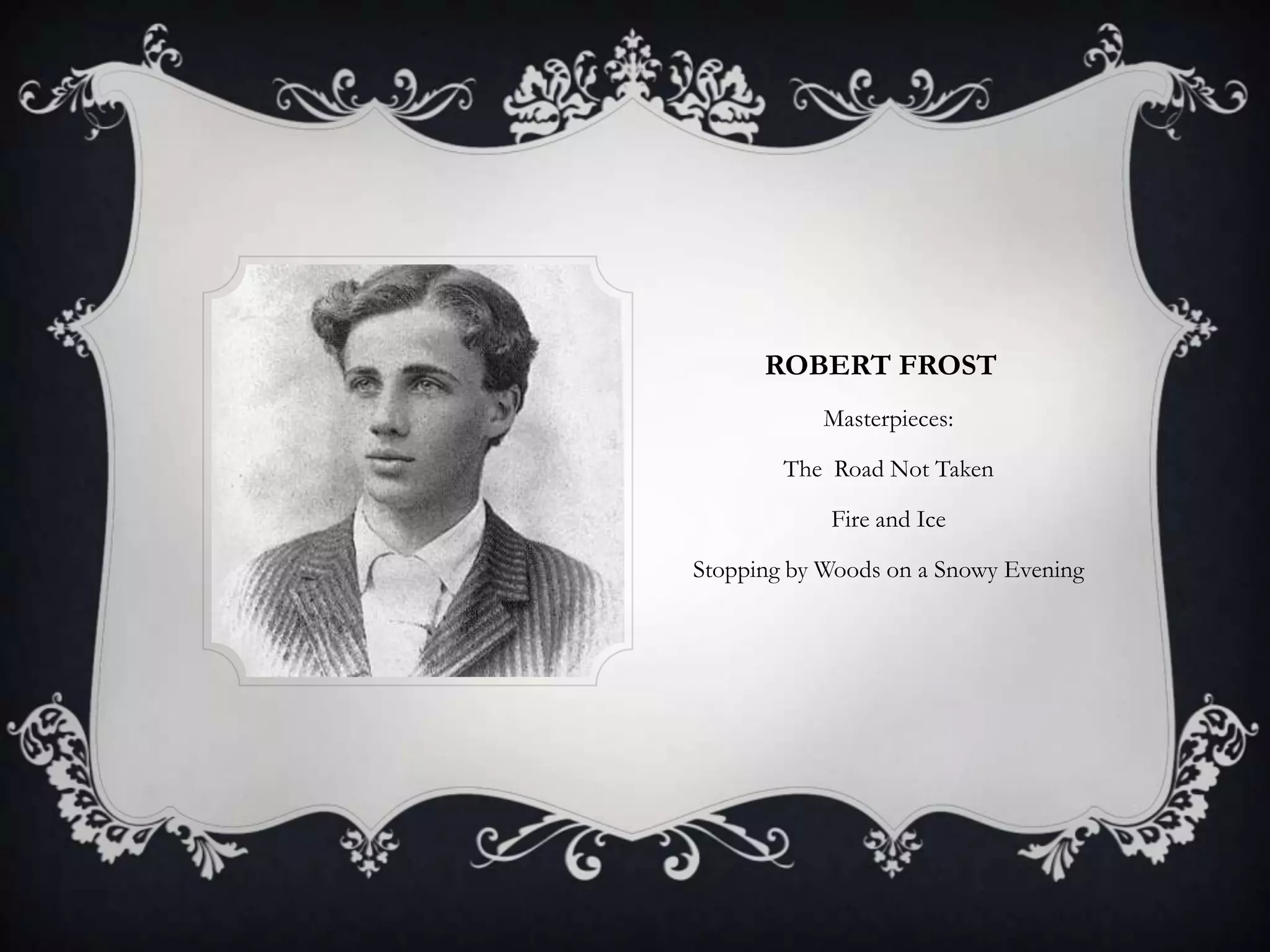


ROBERT FROST
            Masterpieces:

        The Road Not Taken

            Fire and Ice

Stopping by Woods on a Snowy Evening
BIOGRAPHY

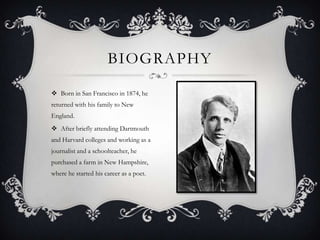
 Born in San Francisco in 1874, he
returned with his family to New
England.
 After briefly attending Dartmouth
and Harvard colleges and working as a
journalist and a schoolteacher, he
purchased a farm in New Hampshire,
where he started his career as a poet.
BIOGRAPHY

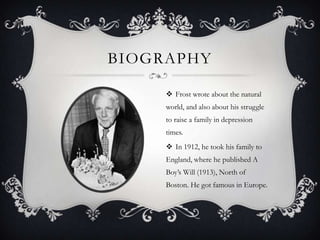
      Frost wrote about the natural
     world, and also about his struggle
     to raise a family in depression
     times.
      In 1912, he took his family to
     England, where he published A
     Boy’s Will (1913), North of
     Boston. He got famous in Europe.
BIOGRAPHY

 He was familiar with the ideas       We find in Frost’s poems some of

of William James and other            Thoreau’s love of isolation,
                                      Hawthorne’s dark vision, Longfellow’s
modern psychologists, but also he
                                      traditional craftsmanship, Dickinson’s
was equally familiar with the works
                                      dry humor, and Robinson’s realistic
of William Cullen Bryant, Ralph
                                      characterization.
Waldo Emerson, and other     19th
                                       He speaks in a common speech,
century masters, coupled with a       unaffected, a modern Plain Style.
modern sense of irony.
POEM ANALISYS
THE ROAD NOT TAKEN
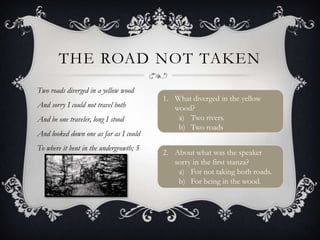
Two roads diverged in a yellow wood
                                         1. What diverged in the yellow
And sorry I could not travel both           wood?
And be one traveler, long I stood            a) Two rivers.
                                             b) Two roads
And looked down one as far as I could
To where it bent in the undergrowth; 5
                                         2. About what was the speaker
                                            sorry in the first stanza?
                                             a) For not taking both roads.
                                             b) For being in the wood.
THE ROAD NOT TAKEN

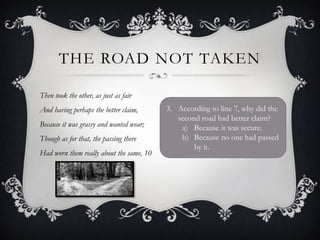
Then took the other, as just as fair
And having perhaps the better claim,      3. According to line 7, why did the
                                             second road had better claim?
Because it was grassy and wanted wear;        a) Because it was secure.
Though as for that, the passing there         b) Because no one had passed
                                                  by it.
Had worn them really about the same, 10
THE ROAD NOT TAKEN

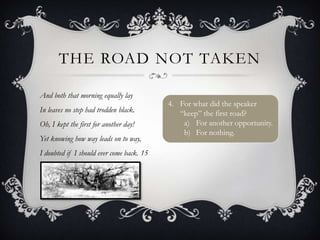
And both that morning equally lay
                                           4. For what did the speaker
In leaves no step had trodden black.          “keep” the first road?
Oh, I kept the first for another day!          a) For another opportunity.
                                               b) For nothing.
Yet knowing how way leads on to way,
I doubted if I should ever come back. 15
THE ROAD NOT TAKEN

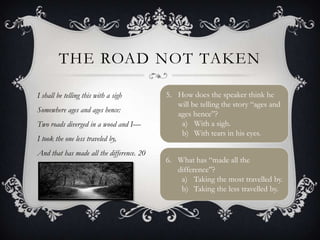
I shall be telling this with a sigh        5. How does the speaker think he
                                              will be telling the story “ages and
Somewhere ages and ages hence:
                                              ages hence”?
Two roads diverged in a wood and I—            a) With a sigh.
                                               b) With tears in his eyes.
I took the one less traveled by,
And that has made all the difference. 20
                                           6. What has “made all the
                                              difference”?
                                               a) Taking the most travelled by.
                                               b) Taking the less travelled by.
THE ROAD NOT TAKEN

 Interpreting:
     • What might the roads represent?

         The choices we have to take in the different stages of our lives.

     • Does the speaker think he made the wrong choice? Why or why
       not?

          At the moment he doesn’t think like that, but he knows that in the
     future he will regret not having taken the other choice, or at least,
     imaging how things would be if he had taken the other opportunity .
FIRE AND ICE
                                           1. What are the two things “some
Some say the world will end in fire,
                                              say” the world will end in,
Some say in ice.                              according to the speaker?
From what I’ve tasted of desire                a. Wind and fire
I hold with those who favor fire.              b. Fire and Ice
But if it had to perish twice,         5
I think I know enough of hate              2. What emotion does the poet
To say that for destruction ice               suggest that the two emotions
Is also great                                 have in common?
                                           a) Fire/ pain – ice/indifference
And would suffice.                     9
                                           b) Fire/desire – Ice/hate
FIRE AND ICE

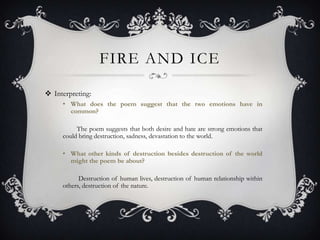
 Interpreting:
     • What does the poem suggest that the two emotions have in
       common?

          The poem suggests that both desire and hate are strong emotions that
     could bring destruction, sadness, devastation to the world.

     • What other kinds of destruction besides destruction of the world
       might the poem be about?

           Destruction of human lives, destruction of human relationship within
     others, destruction of the nature.
STOPPING BY WOODS ON A
        SNOWY EVENING
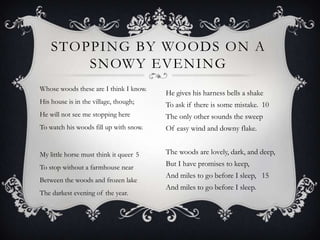
Whose woods these are I think I know.
                                        He gives his harness bells a shake
His house is in the village, though;    To ask if there is some mistake. 10
He will not see me stopping here        The only other sounds the sweep
To watch his woods fill up with snow.   Of easy wind and downy flake.


My little horse must think it queer 5   The woods are lovely, dark, and deep,

To stop without a farmhouse near        But I have promises to keep,
                                        And miles to go before I sleep, 15
Between the woods and frozen lake
                                        And miles to go before I sleep.
The darkest evening of the year.
STOPPING BY WOODS ON A
     SNOWY EVENING
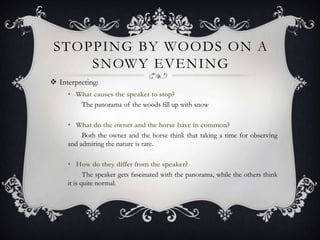
 Interpreting:
     • What causes the speaker to stop?
        The panorama of the woods fill up with snow

     • What do the owner and the horse have in common?
          Both the owner and the horse think that taking a time for observing
     and admiring the nature is rare.

     • How do they differ from the speaker?
            The speaker gets fascinated with the panorama, while the others think
     it is quite normal.
STOPPING BY WOODS ON A
    SNOWY EVENING
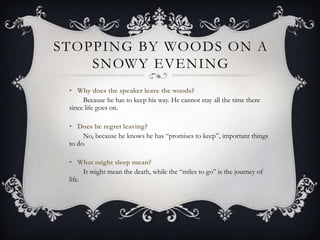
 • Why does the speaker leave the woods?
      Because he has to keep his way. He cannot stay all the time there
 since life goes on.

 • Does he regret leaving?
      No, because he knows he has “promises to keep”, important things
 to do.

 • What might sleep mean?
       It might mean the death, while the “miles to go” is the journey of
 life.
Robert frost
Robert frost

Robert frost

  • 1.
    ROBERT FROST Masterpieces: The Road Not Taken Fire and Ice Stopping by Woods on a Snowy Evening
  • 2.
    BIOGRAPHY  Born inSan Francisco in 1874, he returned with his family to New England.  After briefly attending Dartmouth and Harvard colleges and working as a journalist and a schoolteacher, he purchased a farm in New Hampshire, where he started his career as a poet.
  • 3.
    BIOGRAPHY  Frost wrote about the natural world, and also about his struggle to raise a family in depression times.  In 1912, he took his family to England, where he published A Boy’s Will (1913), North of Boston. He got famous in Europe.
  • 4.
    BIOGRAPHY  He wasfamiliar with the ideas  We find in Frost’s poems some of of William James and other Thoreau’s love of isolation, Hawthorne’s dark vision, Longfellow’s modern psychologists, but also he traditional craftsmanship, Dickinson’s was equally familiar with the works dry humor, and Robinson’s realistic of William Cullen Bryant, Ralph characterization. Waldo Emerson, and other 19th  He speaks in a common speech, century masters, coupled with a unaffected, a modern Plain Style. modern sense of irony.
  • 5.
  • 6.
    THE ROAD NOTTAKEN Two roads diverged in a yellow wood 1. What diverged in the yellow And sorry I could not travel both wood? And be one traveler, long I stood a) Two rivers. b) Two roads And looked down one as far as I could To where it bent in the undergrowth; 5 2. About what was the speaker sorry in the first stanza? a) For not taking both roads. b) For being in the wood.
  • 7.
    THE ROAD NOTTAKEN Then took the other, as just as fair And having perhaps the better claim, 3. According to line 7, why did the second road had better claim? Because it was grassy and wanted wear; a) Because it was secure. Though as for that, the passing there b) Because no one had passed by it. Had worn them really about the same, 10
  • 8.
    THE ROAD NOTTAKEN And both that morning equally lay 4. For what did the speaker In leaves no step had trodden black. “keep” the first road? Oh, I kept the first for another day! a) For another opportunity. b) For nothing. Yet knowing how way leads on to way, I doubted if I should ever come back. 15
  • 9.
    THE ROAD NOTTAKEN I shall be telling this with a sigh 5. How does the speaker think he will be telling the story “ages and Somewhere ages and ages hence: ages hence”? Two roads diverged in a wood and I— a) With a sigh. b) With tears in his eyes. I took the one less traveled by, And that has made all the difference. 20 6. What has “made all the difference”? a) Taking the most travelled by. b) Taking the less travelled by.
  • 10.
    THE ROAD NOTTAKEN  Interpreting: • What might the roads represent? The choices we have to take in the different stages of our lives. • Does the speaker think he made the wrong choice? Why or why not? At the moment he doesn’t think like that, but he knows that in the future he will regret not having taken the other choice, or at least, imaging how things would be if he had taken the other opportunity .
  • 11.
    FIRE AND ICE 1. What are the two things “some Some say the world will end in fire, say” the world will end in, Some say in ice. according to the speaker? From what I’ve tasted of desire a. Wind and fire I hold with those who favor fire. b. Fire and Ice But if it had to perish twice, 5 I think I know enough of hate 2. What emotion does the poet To say that for destruction ice suggest that the two emotions Is also great have in common? a) Fire/ pain – ice/indifference And would suffice. 9 b) Fire/desire – Ice/hate
  • 12.
    FIRE AND ICE Interpreting: • What does the poem suggest that the two emotions have in common? The poem suggests that both desire and hate are strong emotions that could bring destruction, sadness, devastation to the world. • What other kinds of destruction besides destruction of the world might the poem be about? Destruction of human lives, destruction of human relationship within others, destruction of the nature.
  • 13.
    STOPPING BY WOODSON A SNOWY EVENING Whose woods these are I think I know. He gives his harness bells a shake His house is in the village, though; To ask if there is some mistake. 10 He will not see me stopping here The only other sounds the sweep To watch his woods fill up with snow. Of easy wind and downy flake. My little horse must think it queer 5 The woods are lovely, dark, and deep, To stop without a farmhouse near But I have promises to keep, And miles to go before I sleep, 15 Between the woods and frozen lake And miles to go before I sleep. The darkest evening of the year.
  • 14.
    STOPPING BY WOODSON A SNOWY EVENING  Interpreting: • What causes the speaker to stop? The panorama of the woods fill up with snow • What do the owner and the horse have in common? Both the owner and the horse think that taking a time for observing and admiring the nature is rare. • How do they differ from the speaker? The speaker gets fascinated with the panorama, while the others think it is quite normal.
  • 15.
    STOPPING BY WOODSON A SNOWY EVENING • Why does the speaker leave the woods? Because he has to keep his way. He cannot stay all the time there since life goes on. • Does he regret leaving? No, because he knows he has “promises to keep”, important things to do. • What might sleep mean? It might mean the death, while the “miles to go” is the journey of life.