Classical Tradition – Epics, Tragedies, Myths – Homer, Virgil, Sophocles, Ovid, Catullus


                                                                                           A History of English Literature....
1350 – Geoffrey Chaucer (courtly love/ fabliaux)

1400 – Petrarch and Dante – beginning of the Renaissance. Rise of the Sonnet.

1500 – Tudor Poetry – Wyatt, Spenser, Sidney, Shakespeare

1600 – Elizabethan/ Jacobean – Donne, Marvell, Milton

1700 – Augustine Age – Pope, Dryden

1800 – Romantics – Wordsworth, Coleridge, Byron, Shelley, Keats

1830 – 1901 – Victorian era.                        Homework Presentation!

1900 – 1914 – Turn of the century – Yeats, Millay, Hardy etc.

1920s - Modernism (Joyce, T. S. Eliot, e. e. Cummings)

1930s – 30s – Auden, Macniece

1950s – Mid-century Disillusionment – Philip Larkin, Betjemen

1960s – Confessional Poetry – Sylvia Plath, Red Hughes

1970s – Post-modernism – Duffy, Dunn, Cope etc.
Homework – Mini-Lesson on how Love is
   presented in a Victorian Poet...
 Choose your poet and bring in 1 poem they wrote about
   love.

 • Summarise the poem.
 • What kinds of love are presented in the poem?
 • How does the writer use structure, form and language
   to present it?
 • Provide 2 interpretations of love in the poem (i.e. Do
   some research or provide a feminist vs Marxist reading)
 • How does it link to the context of Victorian Poetry?
 • What other poems could we link to?
Victorian Poets...
Alfred Lord Tennyson (In Memoriam, Maud)
Elizabeth Barrett Browning (Sonnets from the
   Portugese)
Robert Browning (A Woman’s Last Word, My Last
   Duchess)
Christina Rossetti (Goblin Market, Remember, In an
   Artist’s Studio)
Emily Dickinson (He fumbles at your spirit, Wild
   Nights)
Thomas Hardy (I said to Love, The Going, The Voice)
Epic
A long story, told in hexameter, passed down
  originally through the oral tradition. Often
  involves mythological heroes, gods and
  nymphs. Famous epics:
Homer – The Iliad and the Odyssey
Virgil – The Aeneid
Dante – The Divine Comedy
Milton – Paradise Lost
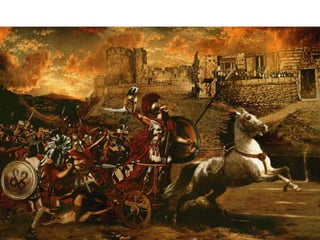
What kind of love is presented in the
following pictures and key couples?
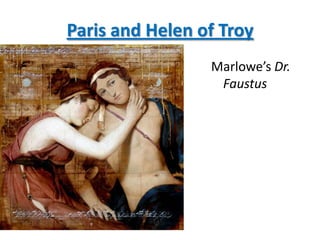
Paris and Helen of Troy
                 Marlowe’s Dr.
                  Faustus
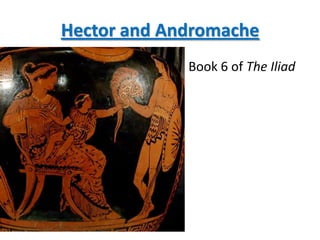
Hector and Andromache
             Book 6 of The Iliad
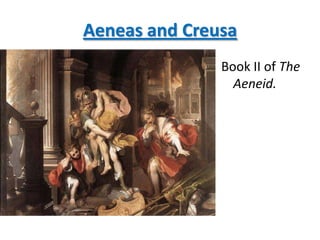
Aeneas and Creusa
               Book II of The
                 Aeneid.
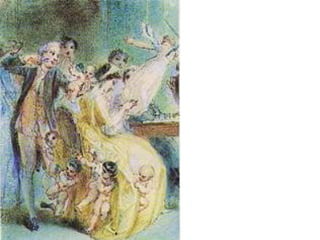
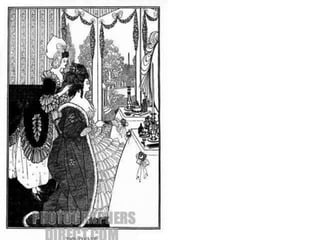
What kind of love is presented in the
        following pictures?
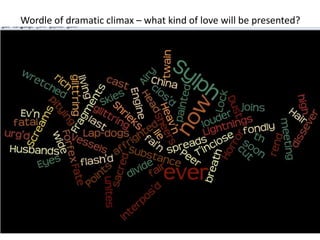
Wordle of dramatic climax – what kind of love will be presented?
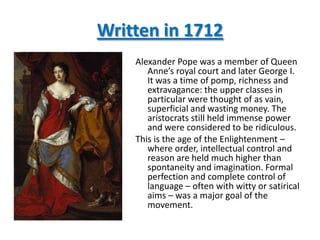
Written in 1712
    Alexander Pope was a member of Queen
       Anne’s royal court and later George I.
       It was a time of pomp, richness and
       extravagance: the upper classes in
       particular were thought of as vain,
       superficial and wasting money. The
       aristocrats still held immense power
       and were considered to be ridiculous.
    This is the age of the Enlightenment –
       where order, intellectual control and
       reason are held much higher than
       spontaneity and imagination. Formal
       perfection and complete control of
       language – often with witty or satirical
       aims – was a major goal of the
       movement.
Two Households, Both alike in dignity
Alexander Pope has attempted to mend the rift
  between two families at war through writing a
  long poem. Lord Petre has been accused by his
  former flirting partner, Arabella Fermor, of
  sneaking up behind her and stealing a curl of her
  hair without asking permission first. Arabella’s
  father, Lord Fermor, is obviously shocked and
  appalled by such radical independence and has
  since banned Lord Petre from seeing his
  daughter. Now both families are at war. Only
  Pope’s poem can save us from the unhumanity of
  such an argument.
Mock Epic
Mock-epics parody the high-flown and elaborate
 conventions of classical literature, particularly
 Homer’s The Iliad and The Odyssey.

Humour is created through juxtaposing the great
  and the little, exaggerating the heroic until it
  becomes absurd and through the incongruity of
  the situation versus the style of rhetoric.

Very popular during the Augustine period.
•   Commentary
•   This canto is full of classic examples of Pope’s masterful use of the heroic couplet. In
    introducing Hampton Court Palace, he describes it as the place where Queen Anne
    “dost sometimes counsel take—and sometimes tea.” This line employs a zeugma, a
    rhetorical device in which a word or phrase modifies two other words or phrases in a
    parallel construction, but modifies each in a different way or according to a different
    sense. Here, the modifying word is “take”; it applies to the paralleled terms “counsel”
    and “tea.” But one does not “take” tea in the same way one takes counsel, and the
    effect of the zeugma is to show the royal residence as a place that houses both serious
    matters of state and frivolous social occasions. The reader is asked to contemplate that
    paradox and to reflect on the relative value and importance of these two different
    registers of activity. (For another example of this rhetorical technique, see lines 157–8:
    “Not louder shrieks to pitying heaven are cast, / when husbands, or when lapdogs
    breathe their last.”) A similar point is made, in a less compact phrasing, in the second
    and third verse-paragraphs of this canto. Here, against the gossip and chatter of the
    young lords and ladies, Pope opens a window onto more serious matters that are
    occurring “meanwhile” and elsewhere, including criminal trials and executions, and
    economic exchange.
•   The rendering of the card game as a battle constitutes an amusing and deft narrative
    feat. By parodying the battle scenes of the great epic poems, Pope is suggesting that
    the energy and passion once applied to brave and serious purposes is now expended
    on such insignificant trials as games and gambling, which often become a mere front for
    flirtation. The structure of “the three attempts” by which the lock is cut is a convention
    of heroic challenges, particularly in the romance genre. The romance is further invoked
    in the image of Clarissa arming the Baron—not with a real weapon, however, but with a
    pair of sewing scissors. Belinda is not a real adversary, or course, and Pope makes it
    plain that her resistance—and, by implication, her subsequent distress—is to some
    degree an affectation. The melodrama of her screams is complemented by the ironic
    comparison of the Baron’s feat to the conquest of nations.

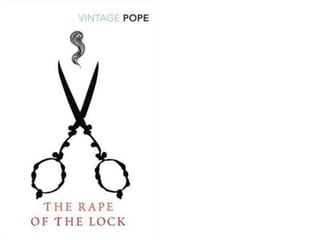
Rape of the lock

  • 1.
    Classical Tradition –Epics, Tragedies, Myths – Homer, Virgil, Sophocles, Ovid, Catullus A History of English Literature.... 1350 – Geoffrey Chaucer (courtly love/ fabliaux) 1400 – Petrarch and Dante – beginning of the Renaissance. Rise of the Sonnet. 1500 – Tudor Poetry – Wyatt, Spenser, Sidney, Shakespeare 1600 – Elizabethan/ Jacobean – Donne, Marvell, Milton 1700 – Augustine Age – Pope, Dryden 1800 – Romantics – Wordsworth, Coleridge, Byron, Shelley, Keats 1830 – 1901 – Victorian era. Homework Presentation! 1900 – 1914 – Turn of the century – Yeats, Millay, Hardy etc. 1920s - Modernism (Joyce, T. S. Eliot, e. e. Cummings) 1930s – 30s – Auden, Macniece 1950s – Mid-century Disillusionment – Philip Larkin, Betjemen 1960s – Confessional Poetry – Sylvia Plath, Red Hughes 1970s – Post-modernism – Duffy, Dunn, Cope etc.
  • 2.
    Homework – Mini-Lessonon how Love is presented in a Victorian Poet... Choose your poet and bring in 1 poem they wrote about love. • Summarise the poem. • What kinds of love are presented in the poem? • How does the writer use structure, form and language to present it? • Provide 2 interpretations of love in the poem (i.e. Do some research or provide a feminist vs Marxist reading) • How does it link to the context of Victorian Poetry? • What other poems could we link to?
  • 3.
    Victorian Poets... Alfred LordTennyson (In Memoriam, Maud) Elizabeth Barrett Browning (Sonnets from the Portugese) Robert Browning (A Woman’s Last Word, My Last Duchess) Christina Rossetti (Goblin Market, Remember, In an Artist’s Studio) Emily Dickinson (He fumbles at your spirit, Wild Nights) Thomas Hardy (I said to Love, The Going, The Voice)
  • 5.
    Epic A long story,told in hexameter, passed down originally through the oral tradition. Often involves mythological heroes, gods and nymphs. Famous epics: Homer – The Iliad and the Odyssey Virgil – The Aeneid Dante – The Divine Comedy Milton – Paradise Lost
  • 6.
    What kind oflove is presented in the following pictures and key couples?
  • 7.
    Paris and Helenof Troy Marlowe’s Dr. Faustus
  • 8.
    Hector and Andromache Book 6 of The Iliad
  • 9.
    Aeneas and Creusa Book II of The Aeneid.
  • 10.
    What kind oflove is presented in the following pictures?
  • 13.
    Wordle of dramaticclimax – what kind of love will be presented?
  • 14.
    Written in 1712 Alexander Pope was a member of Queen Anne’s royal court and later George I. It was a time of pomp, richness and extravagance: the upper classes in particular were thought of as vain, superficial and wasting money. The aristocrats still held immense power and were considered to be ridiculous. This is the age of the Enlightenment – where order, intellectual control and reason are held much higher than spontaneity and imagination. Formal perfection and complete control of language – often with witty or satirical aims – was a major goal of the movement.
  • 17.
    Two Households, Bothalike in dignity Alexander Pope has attempted to mend the rift between two families at war through writing a long poem. Lord Petre has been accused by his former flirting partner, Arabella Fermor, of sneaking up behind her and stealing a curl of her hair without asking permission first. Arabella’s father, Lord Fermor, is obviously shocked and appalled by such radical independence and has since banned Lord Petre from seeing his daughter. Now both families are at war. Only Pope’s poem can save us from the unhumanity of such an argument.
  • 18.
    Mock Epic Mock-epics parodythe high-flown and elaborate conventions of classical literature, particularly Homer’s The Iliad and The Odyssey. Humour is created through juxtaposing the great and the little, exaggerating the heroic until it becomes absurd and through the incongruity of the situation versus the style of rhetoric. Very popular during the Augustine period.
  • 19.
    Commentary • This canto is full of classic examples of Pope’s masterful use of the heroic couplet. In introducing Hampton Court Palace, he describes it as the place where Queen Anne “dost sometimes counsel take—and sometimes tea.” This line employs a zeugma, a rhetorical device in which a word or phrase modifies two other words or phrases in a parallel construction, but modifies each in a different way or according to a different sense. Here, the modifying word is “take”; it applies to the paralleled terms “counsel” and “tea.” But one does not “take” tea in the same way one takes counsel, and the effect of the zeugma is to show the royal residence as a place that houses both serious matters of state and frivolous social occasions. The reader is asked to contemplate that paradox and to reflect on the relative value and importance of these two different registers of activity. (For another example of this rhetorical technique, see lines 157–8: “Not louder shrieks to pitying heaven are cast, / when husbands, or when lapdogs breathe their last.”) A similar point is made, in a less compact phrasing, in the second and third verse-paragraphs of this canto. Here, against the gossip and chatter of the young lords and ladies, Pope opens a window onto more serious matters that are occurring “meanwhile” and elsewhere, including criminal trials and executions, and economic exchange. • The rendering of the card game as a battle constitutes an amusing and deft narrative feat. By parodying the battle scenes of the great epic poems, Pope is suggesting that the energy and passion once applied to brave and serious purposes is now expended on such insignificant trials as games and gambling, which often become a mere front for flirtation. The structure of “the three attempts” by which the lock is cut is a convention of heroic challenges, particularly in the romance genre. The romance is further invoked in the image of Clarissa arming the Baron—not with a real weapon, however, but with a pair of sewing scissors. Belinda is not a real adversary, or course, and Pope makes it plain that her resistance—and, by implication, her subsequent distress—is to some degree an affectation. The melodrama of her screams is complemented by the ironic comparison of the Baron’s feat to the conquest of nations.