John Dryden
Cricelyn D. Magamong
MAT-English
URS-Morong, Rizal
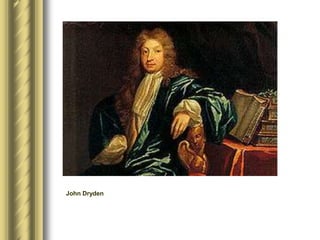
John Dryden
John Dryden (9 August 1631 –
12 May 1700)
 was an influential English poet, literary
critic, translator, and playwright who
dominated the literary life of Restoration
England to such a point that the period
came to be known in literary circles as
the Age of Dryden.
 Regarded by many scholars as the father
of modern English poetry and criticism
An Essay of Dramatic Poesy
SUMMARY:
An Essay of Dramatic
Poesy (sometimes also referred to
as Of Dramatic Poesy)
An Essay, which more closely
matches the form of the original
Latin title) is a critical examination of
English literature presented in
dialogue form.
Four Critics:
1) Eugenius--favors the moderns over the
ancients, arguing that the moderns
exceed the ancients because of having
learned and profited from their example.
2) Crites--argues in favor of the
ancients: they established the unities;
dramatic rules were spelled out by
Aristotle which the current--and
esteemed--French playwrights follow;
and Ben Jonson--the greatest English
playwright, according to Crites--followed
the ancients' example by adhering to the
unities.
3) Lisideius--argues that French drama is
superior to English drama, basing this
opinion of the French writer's close
adherence to the classical separation of
comedy and tragedy. For Lisideius "no
theater in the world has anything so
absurd as the English tragicomedy . . .
in two hours and a half, we run through
all the fits of Bedlam."
4)Neander (thought to represent
Dryden)--favors the moderns, but
does not disparage the ancients. He
also favors English drama--and has
some critical things to say of French
drama:"those beauties of the French
poesy are such as will raise
perfection higher where it is, but are
not sufficient to give it where it is
not: they are indeed the beauties of
a statue, but not of a man."
The discussion begins when the characters
comment on the terrible poems that the scenic
battle will no doubt inspire; Crites says that they
will never be able to duplicate (much less
surpass) the achievements of the ancients,
while Eugenius disagrees. This part of the
discussion very much resembles standard
debates between the ancients and moderns:
Crites’s main argument is that all of the
conventions of modern literature come from the
ancients; Egenius’s main argument is that just
as the ancient built upon the foundation of poets
who came before them, modern poets have built
upon the foundation laid by the ancients.
 Eventually, the combatants decide to restrict
their discussion to one form of literature: drama.
Lisideius then enters the argument in order to
defend the strict formalism of the modern
French dramatists, while Neander cites the
richer emotional content and wit of the
Elizabethans, particularly Shakespeare. From
there, the discussion evolves into a discussion
on whether or not rhymed verse is the most
appropriate for the stage. Each of the characters
has a tenable position here, with the main point
of contention being whether the requirement for
verisimilitude is better filled with plain prose,
blank verse or elegantly-composed rhyming
verse.
Five issues:
1) Ancients vs. Moderns
2) Unities
3) French vs. English Drama
4) Separation of Tragedy and
Comedy vs. Tragicomedy
5) Appropriateness of Rhyme in
Drama
Dryden is a neoclassic critic, and as
such he deals in his criticism with
issues of form and morality in
drama. However, he is not a rule
bound critic, tied down to the
classical unities or to notions of
what constitutes a "proper"
character for the stage. He relies
heavily on Corneille--and through
him on Horace--which places him in
a pragmatic tradition.
The main point of Dryden's essay
seems to be a valuation of
becoming (the striving, nature-
imitating, large scope of
tragicomedy and Shakespeare) over
being (the static perfection of the
ideal-imitating
Classical/French/Jonsonian drama).
An Essay of
Dramatick Poesie
By John Dryden
.
To the Right Honourable
CHARLES LORD BUCKHURST.
 [1] It was that memorable day, in the first Summer of the
late War, when our Navy ingag'd the Dutch: a day wherein
the two most mighty and best appointed Fleets which any
age had ever seen, disputed the command of the greater
half of the Globe, the commerce of Nations, and the riches
of the Universe. While these vast floating bodies, on either
side, mov'd against each other in parallel lines, and our
Country men, under the happy conduct of his Royal
Highness, went breaking, by little and little, into the line of
the Enemies; the noise of the Cannon from both Navies
reach'd our ears about the City: so that all men, being
alarm'd with it, and in a dreadful suspence of the event,
which we knew was then deciding, every one went
following the sound as his fancy led him; and leaving the
Town almost empty, some took towards the Park, some
cross the River, others down it; all seeking the noise in
the depth of silence.
[2] Amongst the rest, it was the
fortune
of Eugenius, Crites, Lisideius and N
eander, to be in company together:
three of them persons whom their
witt and Quality have made known
to all the Town: and whom I have
chose to hide under these borrowed
names, that they may not suffer by
so ill a relation as I am going to
make of their discourse..(up to 122)
Alexander Pope
Cricelyn D. Magamong
MAT-English
URS-Morong, Rizal
Alexander Pope
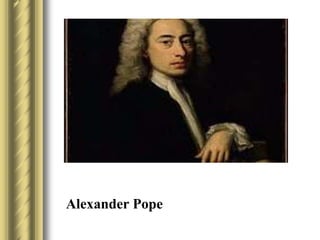
Alexander Pope(1688-1744)
English essayist, critic, satirist, and
one of the greatest poets of
Enlightenment. Alexander Pope
wrote his first verses at the age of
12. His breakthrough work, AN
ESSAY ON CRITICISM (1711),
appeared when he was twenty-three.
An Essay on Criticism
….is a didactic poem in heroic couplets,
begun, perhaps, as early as 1705, and
published, anonymously, in 1711.
….is at once a treatise of literary
theory and working manual of
versification.
…. is one of the first major poems written
by the English writer Alexander
Pope (1688–1744).
An Essay on Criticism
 It is divided into three parts: part one
creates a vision of the golden era of art
and criticism, part two presents a vision
of decay and disorder in literary criticism,
and part three puts forth a means of
reformation and restoration in literary
endeavors, emphasizing in particular the
basic precepts of clarity, impartiality, and
public responsibility.
An Essay on Criticism
 It is a verse essay written in
the Horatian mode and is primarily
concerned with how writers and
critics behave in the new literary
commerce of Pope's contemporary
age. The poem covers a range of
good criticism and advice. It also
represents many of the chief literary
ideals of Pope's age.
Pope contends in the poem's opening couplets that
bad criticism does greater harm than bad writing:
'Tis hard to say, if greater Want of Skill
Appear in Writing or in Judging ill,
But, of the two, less dang'rous is th' Offence,
To tire our Patience, than mis-lead our Sense
Some few in that, but Numbers err in this,
Ten Censure wrong for one who Writes amiss;
A Fool might once himself alone expose,
Now One in Verse makes many more in Prose. ...
(1–8)
Despite the harmful effects of bad criticism, literature
requires worthy criticism.
Pope delineates common faults of critics, e.g., settling for
easy and cliché rhymes:
And ten low words oft creep in one dull line:
While they ring round the same unvaried chimes,
With sure returns of still expected rhymes;
Wher'er you find "the cooling western breeze",
In the next line, it "whispers through the trees";
If crystal streams "with pleasing murmurs creep",
The reader's threatened (not in vain) with "sleep" .
. . (347–353)
Throughout the poem, Pope refers to ancient
writers such
as Virgil, Homer, Aristotle, Horace and Longinus.
This is a testament to his belief that the "Imitation
of the ancients" is the ultimate standard for taste.
Pope also says:
"True ease in writing comes from art,
not chance, / As those move easiest
who have learned to dance" (362–
363),
meaning poets are made, not born.
 As is usual in Pope's poems, the "Essay"
concludes with a reference to Pope
himself. Walsh, the last of the critics
mentioned, was a mentor and friend of
Pope who had died in 1710.
 An Essay on Criticism was famously and
fiercely attacked by John Dennis, who is
mentioned mockingly in the work.
 Consequently, Dennis also appears in
Pope's later satire, the Dunciad.
Part II is also the source of this famous line:
“To err is human, to forgive divine”
The line "Fools Rush In Where
Angels Fear to Tread"
from Part III has become part of the
popular lexicon, and has been used
for and in various works.
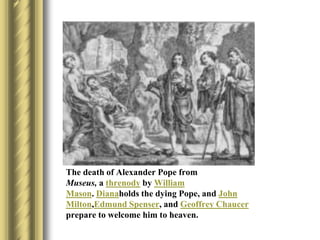
The death of Alexander Pope from
Museus, a threnody by William
Mason. Dianaholds the dying Pope, and John
Milton,Edmund Spenser, and Geoffrey Chaucer
prepare to welcome him to heaven.
the end

Alexander pope slide

  • 1.
    John Dryden Cricelyn D.Magamong MAT-English URS-Morong, Rizal
  • 2.
  • 3.
    John Dryden (9August 1631 – 12 May 1700)  was an influential English poet, literary critic, translator, and playwright who dominated the literary life of Restoration England to such a point that the period came to be known in literary circles as the Age of Dryden.  Regarded by many scholars as the father of modern English poetry and criticism
  • 4.
    An Essay ofDramatic Poesy SUMMARY: An Essay of Dramatic Poesy (sometimes also referred to as Of Dramatic Poesy) An Essay, which more closely matches the form of the original Latin title) is a critical examination of English literature presented in dialogue form.
  • 5.
    Four Critics: 1) Eugenius--favorsthe moderns over the ancients, arguing that the moderns exceed the ancients because of having learned and profited from their example. 2) Crites--argues in favor of the ancients: they established the unities; dramatic rules were spelled out by Aristotle which the current--and esteemed--French playwrights follow; and Ben Jonson--the greatest English playwright, according to Crites--followed the ancients' example by adhering to the unities.
  • 6.
    3) Lisideius--argues thatFrench drama is superior to English drama, basing this opinion of the French writer's close adherence to the classical separation of comedy and tragedy. For Lisideius "no theater in the world has anything so absurd as the English tragicomedy . . . in two hours and a half, we run through all the fits of Bedlam."
  • 7.
    4)Neander (thought torepresent Dryden)--favors the moderns, but does not disparage the ancients. He also favors English drama--and has some critical things to say of French drama:"those beauties of the French poesy are such as will raise perfection higher where it is, but are not sufficient to give it where it is not: they are indeed the beauties of a statue, but not of a man."
  • 8.
    The discussion beginswhen the characters comment on the terrible poems that the scenic battle will no doubt inspire; Crites says that they will never be able to duplicate (much less surpass) the achievements of the ancients, while Eugenius disagrees. This part of the discussion very much resembles standard debates between the ancients and moderns: Crites’s main argument is that all of the conventions of modern literature come from the ancients; Egenius’s main argument is that just as the ancient built upon the foundation of poets who came before them, modern poets have built upon the foundation laid by the ancients.
  • 9.
     Eventually, thecombatants decide to restrict their discussion to one form of literature: drama. Lisideius then enters the argument in order to defend the strict formalism of the modern French dramatists, while Neander cites the richer emotional content and wit of the Elizabethans, particularly Shakespeare. From there, the discussion evolves into a discussion on whether or not rhymed verse is the most appropriate for the stage. Each of the characters has a tenable position here, with the main point of contention being whether the requirement for verisimilitude is better filled with plain prose, blank verse or elegantly-composed rhyming verse.
  • 10.
    Five issues: 1) Ancientsvs. Moderns 2) Unities 3) French vs. English Drama 4) Separation of Tragedy and Comedy vs. Tragicomedy 5) Appropriateness of Rhyme in Drama
  • 11.
    Dryden is aneoclassic critic, and as such he deals in his criticism with issues of form and morality in drama. However, he is not a rule bound critic, tied down to the classical unities or to notions of what constitutes a "proper" character for the stage. He relies heavily on Corneille--and through him on Horace--which places him in a pragmatic tradition.
  • 12.
    The main pointof Dryden's essay seems to be a valuation of becoming (the striving, nature- imitating, large scope of tragicomedy and Shakespeare) over being (the static perfection of the ideal-imitating Classical/French/Jonsonian drama).
  • 13.
    An Essay of DramatickPoesie By John Dryden . To the Right Honourable CHARLES LORD BUCKHURST.
  • 14.
     [1] Itwas that memorable day, in the first Summer of the late War, when our Navy ingag'd the Dutch: a day wherein the two most mighty and best appointed Fleets which any age had ever seen, disputed the command of the greater half of the Globe, the commerce of Nations, and the riches of the Universe. While these vast floating bodies, on either side, mov'd against each other in parallel lines, and our Country men, under the happy conduct of his Royal Highness, went breaking, by little and little, into the line of the Enemies; the noise of the Cannon from both Navies reach'd our ears about the City: so that all men, being alarm'd with it, and in a dreadful suspence of the event, which we knew was then deciding, every one went following the sound as his fancy led him; and leaving the Town almost empty, some took towards the Park, some cross the River, others down it; all seeking the noise in the depth of silence.
  • 15.
    [2] Amongst therest, it was the fortune of Eugenius, Crites, Lisideius and N eander, to be in company together: three of them persons whom their witt and Quality have made known to all the Town: and whom I have chose to hide under these borrowed names, that they may not suffer by so ill a relation as I am going to make of their discourse..(up to 122)
  • 17.
    Alexander Pope Cricelyn D.Magamong MAT-English URS-Morong, Rizal
  • 18.
  • 19.
    Alexander Pope(1688-1744) English essayist,critic, satirist, and one of the greatest poets of Enlightenment. Alexander Pope wrote his first verses at the age of 12. His breakthrough work, AN ESSAY ON CRITICISM (1711), appeared when he was twenty-three.
  • 20.
    An Essay onCriticism ….is a didactic poem in heroic couplets, begun, perhaps, as early as 1705, and published, anonymously, in 1711. ….is at once a treatise of literary theory and working manual of versification. …. is one of the first major poems written by the English writer Alexander Pope (1688–1744).
  • 21.
    An Essay onCriticism  It is divided into three parts: part one creates a vision of the golden era of art and criticism, part two presents a vision of decay and disorder in literary criticism, and part three puts forth a means of reformation and restoration in literary endeavors, emphasizing in particular the basic precepts of clarity, impartiality, and public responsibility.
  • 22.
    An Essay onCriticism  It is a verse essay written in the Horatian mode and is primarily concerned with how writers and critics behave in the new literary commerce of Pope's contemporary age. The poem covers a range of good criticism and advice. It also represents many of the chief literary ideals of Pope's age.
  • 23.
    Pope contends inthe poem's opening couplets that bad criticism does greater harm than bad writing: 'Tis hard to say, if greater Want of Skill Appear in Writing or in Judging ill, But, of the two, less dang'rous is th' Offence, To tire our Patience, than mis-lead our Sense Some few in that, but Numbers err in this, Ten Censure wrong for one who Writes amiss; A Fool might once himself alone expose, Now One in Verse makes many more in Prose. ... (1–8)
  • 24.
    Despite the harmfuleffects of bad criticism, literature requires worthy criticism. Pope delineates common faults of critics, e.g., settling for easy and cliché rhymes: And ten low words oft creep in one dull line: While they ring round the same unvaried chimes, With sure returns of still expected rhymes; Wher'er you find "the cooling western breeze", In the next line, it "whispers through the trees"; If crystal streams "with pleasing murmurs creep", The reader's threatened (not in vain) with "sleep" . . . (347–353)
  • 25.
    Throughout the poem,Pope refers to ancient writers such as Virgil, Homer, Aristotle, Horace and Longinus. This is a testament to his belief that the "Imitation of the ancients" is the ultimate standard for taste. Pope also says: "True ease in writing comes from art, not chance, / As those move easiest who have learned to dance" (362– 363), meaning poets are made, not born.
  • 26.
     As isusual in Pope's poems, the "Essay" concludes with a reference to Pope himself. Walsh, the last of the critics mentioned, was a mentor and friend of Pope who had died in 1710.  An Essay on Criticism was famously and fiercely attacked by John Dennis, who is mentioned mockingly in the work.  Consequently, Dennis also appears in Pope's later satire, the Dunciad.
  • 27.
    Part II isalso the source of this famous line: “To err is human, to forgive divine” The line "Fools Rush In Where Angels Fear to Tread" from Part III has become part of the popular lexicon, and has been used for and in various works.
  • 28.
    The death ofAlexander Pope from Museus, a threnody by William Mason. Dianaholds the dying Pope, and John Milton,Edmund Spenser, and Geoffrey Chaucer prepare to welcome him to heaven.
  • 29.