 POPE’S LIFE IN BRIEF:
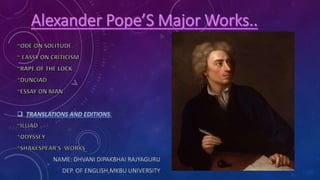
• One of the best poet and satirist of the English Augustan period, the only child to Alexander and Edith
Pope Alexander Pope born in May 21, 1688 in London,and died in England on May 30, 1744(Twickenham,
near London)
• Pope’s father, a wholesale linen merchant, retired from business in the year of his son’s birth and in 1700
went to live at Binfield in Windsor Forest. The Popes were Roman Catholics, and at Binfield they came to
know several neighbouring Catholic families who were to play an important part in the poet’s life.
• Pope’s religion procured him some lifelong friends, notably the wealthy squire John Caryll (who persuaded
him to write The Rape of the Lock)and Martha Blount, to whom Pope addressed some of the most
memorable of his poems and to whom he bequeathed most of his property.
“As yet a child,nor yet a fool to fame,
I lisped in numbers,for the numbers came”
• He was self educated,eagerly reading Latin, Greek, French, and Italian and read widely and discovered
Homer at the age of Six and an incessant scribbler, turning out verse upon verse in imitation of the poets
he read. The best of these early writings are the “Ode on Solitude” and a paraphrase of ST. Thomas, both
of which he claimed to have written at age 12.
• Described by his biographer,John Spence,as “a child of particularly sweet temper” and with a voice
somelodius as to to be nicknamed the “little nightingale”.
1. POPE’S WORKS:
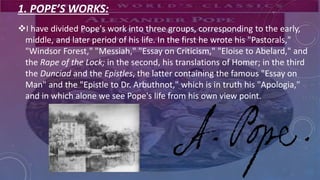
I have divided Pope's work into three groups, corresponding to the early,
middle, and later period of his life. In the first he wrote his "Pastorals,"
"Windsor Forest," "Messiah," "Essay on Criticism," "Eloise to Abelard," and
the Rape of the Lock; in the second, his translations of Homer; in the third
the Dunciad and the Epistles, the latter containing the famous "Essay on
Man" and the "Epistle to Dr. Arbuthnot," which is in truth his "Apologia,"
and in which alone we see Pope's life from his own view point.
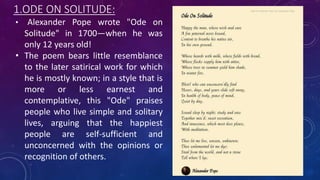
1.ODE ON SOLITUDE:
• Alexander Pope wrote "Ode on
Solitude" in 1700—when he was
only 12 years old!
• The poem bears little resemblance
to the later satirical work for which
he is mostly known; in a style that is
more or less earnest and
contemplative, this "Ode" praises
people who live simple and solitary
lives, arguing that the happiest
people are self-sufficient and
unconcerned with the opinions or
recognition of others.
2. ESSAY ON CRITICISM:
• Pope's 'Essay on Criticism' is broken into three different parts. The first part opens
by describing the ways literary critics can actually cause harm. Pope argues that
critics must be both careful and humble when critiquing a piece of literature, for the
writing of bad criticism actually hurts poetry more than the writing of bad poetry
does. Pope points out that each critic has his or her own opinion, and, if applied
incorrectly, a critic can actually censure a talented writer.
• In the second part, Pope describes some of the ways that critics develop bad
judgment, the chief of which is pride. The key to avoiding this is to know your own
faults and limitations. Moreover, critics must study well and focus on conventions
passed down from the masters of poetry.
• In the third part of the poem, Pope offers some wisdom that critics should follow.
Once again, Pope emphasizes the importance of humility and studying deeply,
particularly studying those poets and critics who truly understand poetry and follow
nature. Pope then reflects on the ups and downs of literature and literary critics
since Greek culture, explaining how the understanding produced by the Greeks and
Romans was lost and is only beginning to be appreciated again.
2.RAPE OF THE LOCK:
• The poem is a mock-epic that satirizes the upper-class in London at the time.The story focuses on the
central character, Belinda, whose lock of hair is cut off at a social gathering. Although trivial to most,
Belinda is outraged that her lock of hair has been cut by the Baron. In the Rape of the Lock, Pope uses
Belinda and the Baron to mock two of his acquaintances, Arabella Fermor, and Lord Petre. The poem
follows the events of the night, leading up to Belinda’s “horrific” loss.
• Pope wrote The Rape of the Lock in response to a request made my his friend John Caryll, a prominent
Roman Catholic of the time. Caryll explained that his friend, Lord Petre, had cut off a lock of Arabella
Fermor’s hair. Ever since the incident, the families had been feuding. In order to make light of the
situation, Pope wrote The Rape of the Lock.
3.DUNCIAD:
• The Dunciad, poem by Alexander Pope, first published anonymously in three books in 1728;
by 1743, when it appeared in its final form, it had grown to four books. Written largely in
iambic pentameter, the poem is a masterpiece of mock-heroic verse.
• After Pope had edited the works of William Shakespeare to adapt them to 18th-century
tastes, the scholar Lewis Theobald attacked him in Shakespeare Restored (1726).
• Pope responded in 1728 with the first version of his Dunciad, in which Theobald appears as
Tibbald, favourite son of the Goddess of Dullness (Dulness), a suitable hero for what Pope
considered the reign of pedantry. A year later Pope published The Dunciad Variorum, in which
he expanded the poem and added elaborate false footnotes, appendices, errata, and
prefaces, as if the Dunciad itself had fallen into the hands of an artless pedant.
• In 1742 Pope published The New Dunciad, intended as the Dunciad’s fourth book; in it the
empire of the Goddess of Dullness has become universal.
4.ESSAY ON MAN:
• The "Essay" is the best known and the most quoted of all Pope's works.
Except in form it is not poetry, and when one considers it as an essay and
reduces it to plain prose.The purpose of the essay is, in Pope's words, to
"vindicate the ways of God to Man"; and as there are no unanswered
problems in Pope's philosophy, the vindication is perfectly accomplished in
four poetical epistles, concerning man's relations to the universe, to himself,
to society, and to happiness. The final result is summed up in a few well-
known lines:
“All nature is but art, unknown to thee;
All chance, direction which thou canst not see;
POPE’S TRANSLATION:
The troops exulting sat in order round,
And beaming fires illumined all the ground.
As when the moon, refulgent lamp of night,
O'er Heaven's clear azure spreads her sacred light,.
• The fame of Pope's Iliad, which was financially the most successful of his
books, was due to the fact that he interpreted Homer in the elegant,
artificial language of his own age. Not only do his words follow literary
fashions but even the Homeric characters lose their strength and become
fashionable men of the court.
• Pope translated the entire Iliad and half of the Odyssey; and the latter
work was finished by two Cambridge scholars, Elijah Fenton and William
Broome, who imitated the mechanical couplets so perfectly that it is
difficult to distinguish their work from that of the greatest poet of the age.
CONCLUSION:
• The Romantic movement that rose to prominence in early 19th-century
England was more ambivalent about his work. Though Lord Byron
identified Pope as one of his chief influences – believing his own scathing
satire of contemporary English literature English Bards and Scotch
Reviewers to be a continuance of Pope's tradition – William Wordsworth
found Pope's style too decadent to represent the human condition.
• Pope's reputation revived in the 20th century. His work was full of
references to the people and places of his time, which aided people's
understanding of the past. The post-war period stressed the power of
Pope's poetry, recognising that Pope's immersion in Christian and Biblical
culture lent depth to his poetry. For example, Maynard Mack, in the late
20th-century, argued that Pope's moral vision demanded as much
respect as his technical excellence. Between 1953 and 1967 the definitive
Twickenham edition of Pope's poems appeared in ten volumes, including
an index volume.
REFERENCES:
• ENGLISH LITERATURE : WILLIAM J LONG
• https://www.google.co.in/url?sa=t&rct=j&q=&esrc=s&source=web&cd=&cad=r
ja&uact=8&ved=2ahUKEwimx5ScidPzAhXpxTgGHRXgCqcQFnoECAQQAQ&url=h
ttps%3A%2F%2Fwww.britannica.com%2Fbiography%2FAlexander-Pope-
English-author&usg=AOvVaw0BtZizadkF2Hj9wiREDN3_
• https://www.google.co.in/url?sa=t&rct=j&q=&esrc=s&source=web&cd=&ved=
2ahUKEwimx5ScidPzAhXpxTgGHRXgCqcQFnoECCIQAQ&url=https%3A%2F%2Fp
oets.org%2Fpoet%2Falexander-
pope&usg=AOvVaw1sKB88RQwwte6x_X0bXtMM
• https://www.poetryfoundation.org/poets/alexander-pope
• https://babel.hathitrust.org/cgi/pt?id=mdp.39015030979424;view=1up;seq=5
2
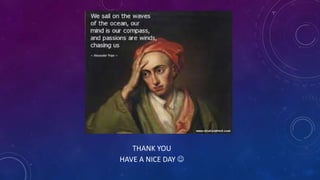
THANK YOU
HAVE A NICE DAY 

Alexander pope

  • 2.
     POPE’S LIFEIN BRIEF: • One of the best poet and satirist of the English Augustan period, the only child to Alexander and Edith Pope Alexander Pope born in May 21, 1688 in London,and died in England on May 30, 1744(Twickenham, near London) • Pope’s father, a wholesale linen merchant, retired from business in the year of his son’s birth and in 1700 went to live at Binfield in Windsor Forest. The Popes were Roman Catholics, and at Binfield they came to know several neighbouring Catholic families who were to play an important part in the poet’s life. • Pope’s religion procured him some lifelong friends, notably the wealthy squire John Caryll (who persuaded him to write The Rape of the Lock)and Martha Blount, to whom Pope addressed some of the most memorable of his poems and to whom he bequeathed most of his property. “As yet a child,nor yet a fool to fame, I lisped in numbers,for the numbers came” • He was self educated,eagerly reading Latin, Greek, French, and Italian and read widely and discovered Homer at the age of Six and an incessant scribbler, turning out verse upon verse in imitation of the poets he read. The best of these early writings are the “Ode on Solitude” and a paraphrase of ST. Thomas, both of which he claimed to have written at age 12. • Described by his biographer,John Spence,as “a child of particularly sweet temper” and with a voice somelodius as to to be nicknamed the “little nightingale”.
  • 3.
    1. POPE’S WORKS: Ihave divided Pope's work into three groups, corresponding to the early, middle, and later period of his life. In the first he wrote his "Pastorals," "Windsor Forest," "Messiah," "Essay on Criticism," "Eloise to Abelard," and the Rape of the Lock; in the second, his translations of Homer; in the third the Dunciad and the Epistles, the latter containing the famous "Essay on Man" and the "Epistle to Dr. Arbuthnot," which is in truth his "Apologia," and in which alone we see Pope's life from his own view point.
  • 4.
    1.ODE ON SOLITUDE: •Alexander Pope wrote "Ode on Solitude" in 1700—when he was only 12 years old! • The poem bears little resemblance to the later satirical work for which he is mostly known; in a style that is more or less earnest and contemplative, this "Ode" praises people who live simple and solitary lives, arguing that the happiest people are self-sufficient and unconcerned with the opinions or recognition of others.
  • 5.
    2. ESSAY ONCRITICISM: • Pope's 'Essay on Criticism' is broken into three different parts. The first part opens by describing the ways literary critics can actually cause harm. Pope argues that critics must be both careful and humble when critiquing a piece of literature, for the writing of bad criticism actually hurts poetry more than the writing of bad poetry does. Pope points out that each critic has his or her own opinion, and, if applied incorrectly, a critic can actually censure a talented writer. • In the second part, Pope describes some of the ways that critics develop bad judgment, the chief of which is pride. The key to avoiding this is to know your own faults and limitations. Moreover, critics must study well and focus on conventions passed down from the masters of poetry. • In the third part of the poem, Pope offers some wisdom that critics should follow. Once again, Pope emphasizes the importance of humility and studying deeply, particularly studying those poets and critics who truly understand poetry and follow nature. Pope then reflects on the ups and downs of literature and literary critics since Greek culture, explaining how the understanding produced by the Greeks and Romans was lost and is only beginning to be appreciated again.
  • 6.
    2.RAPE OF THELOCK: • The poem is a mock-epic that satirizes the upper-class in London at the time.The story focuses on the central character, Belinda, whose lock of hair is cut off at a social gathering. Although trivial to most, Belinda is outraged that her lock of hair has been cut by the Baron. In the Rape of the Lock, Pope uses Belinda and the Baron to mock two of his acquaintances, Arabella Fermor, and Lord Petre. The poem follows the events of the night, leading up to Belinda’s “horrific” loss. • Pope wrote The Rape of the Lock in response to a request made my his friend John Caryll, a prominent Roman Catholic of the time. Caryll explained that his friend, Lord Petre, had cut off a lock of Arabella Fermor’s hair. Ever since the incident, the families had been feuding. In order to make light of the situation, Pope wrote The Rape of the Lock.
  • 8.
    3.DUNCIAD: • The Dunciad,poem by Alexander Pope, first published anonymously in three books in 1728; by 1743, when it appeared in its final form, it had grown to four books. Written largely in iambic pentameter, the poem is a masterpiece of mock-heroic verse. • After Pope had edited the works of William Shakespeare to adapt them to 18th-century tastes, the scholar Lewis Theobald attacked him in Shakespeare Restored (1726). • Pope responded in 1728 with the first version of his Dunciad, in which Theobald appears as Tibbald, favourite son of the Goddess of Dullness (Dulness), a suitable hero for what Pope considered the reign of pedantry. A year later Pope published The Dunciad Variorum, in which he expanded the poem and added elaborate false footnotes, appendices, errata, and prefaces, as if the Dunciad itself had fallen into the hands of an artless pedant. • In 1742 Pope published The New Dunciad, intended as the Dunciad’s fourth book; in it the empire of the Goddess of Dullness has become universal.
  • 9.
    4.ESSAY ON MAN: •The "Essay" is the best known and the most quoted of all Pope's works. Except in form it is not poetry, and when one considers it as an essay and reduces it to plain prose.The purpose of the essay is, in Pope's words, to "vindicate the ways of God to Man"; and as there are no unanswered problems in Pope's philosophy, the vindication is perfectly accomplished in four poetical epistles, concerning man's relations to the universe, to himself, to society, and to happiness. The final result is summed up in a few well- known lines: “All nature is but art, unknown to thee; All chance, direction which thou canst not see;
  • 10.
    POPE’S TRANSLATION: The troopsexulting sat in order round, And beaming fires illumined all the ground. As when the moon, refulgent lamp of night, O'er Heaven's clear azure spreads her sacred light,. • The fame of Pope's Iliad, which was financially the most successful of his books, was due to the fact that he interpreted Homer in the elegant, artificial language of his own age. Not only do his words follow literary fashions but even the Homeric characters lose their strength and become fashionable men of the court. • Pope translated the entire Iliad and half of the Odyssey; and the latter work was finished by two Cambridge scholars, Elijah Fenton and William Broome, who imitated the mechanical couplets so perfectly that it is difficult to distinguish their work from that of the greatest poet of the age.
  • 11.
    CONCLUSION: • The Romanticmovement that rose to prominence in early 19th-century England was more ambivalent about his work. Though Lord Byron identified Pope as one of his chief influences – believing his own scathing satire of contemporary English literature English Bards and Scotch Reviewers to be a continuance of Pope's tradition – William Wordsworth found Pope's style too decadent to represent the human condition. • Pope's reputation revived in the 20th century. His work was full of references to the people and places of his time, which aided people's understanding of the past. The post-war period stressed the power of Pope's poetry, recognising that Pope's immersion in Christian and Biblical culture lent depth to his poetry. For example, Maynard Mack, in the late 20th-century, argued that Pope's moral vision demanded as much respect as his technical excellence. Between 1953 and 1967 the definitive Twickenham edition of Pope's poems appeared in ten volumes, including an index volume.
  • 12.
    REFERENCES: • ENGLISH LITERATURE: WILLIAM J LONG • https://www.google.co.in/url?sa=t&rct=j&q=&esrc=s&source=web&cd=&cad=r ja&uact=8&ved=2ahUKEwimx5ScidPzAhXpxTgGHRXgCqcQFnoECAQQAQ&url=h ttps%3A%2F%2Fwww.britannica.com%2Fbiography%2FAlexander-Pope- English-author&usg=AOvVaw0BtZizadkF2Hj9wiREDN3_ • https://www.google.co.in/url?sa=t&rct=j&q=&esrc=s&source=web&cd=&ved= 2ahUKEwimx5ScidPzAhXpxTgGHRXgCqcQFnoECCIQAQ&url=https%3A%2F%2Fp oets.org%2Fpoet%2Falexander- pope&usg=AOvVaw1sKB88RQwwte6x_X0bXtMM • https://www.poetryfoundation.org/poets/alexander-pope • https://babel.hathitrust.org/cgi/pt?id=mdp.39015030979424;view=1up;seq=5 2
  • 13.
    THANK YOU HAVE ANICE DAY 