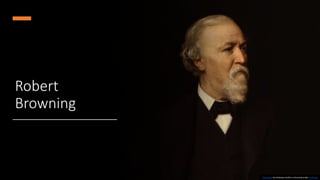
Robert
Browning
This Photo by Unknown Author is licensed under CC BY-SA
• Prepared by: Nilay Rathod
• MA Sem: 1
• Paper 4: Victorian Literature
• Roll No: 29
• Enrollment No: 4069206420210030
• Submitted to: Department of English
• Maharaja Krishnakumarsinhji Bhavnagar University
Early Life
• His mother, to whom he was close, was a talented musician.
• His younger sister, Sarianna, also gifted, became her brother's
companion in his later years, after the death of his wife in 1861.
• By the age of 12, Browning had written a book of poetry, which he later
destroyed for want of a publisher.
• Because of his dislike of school, he was educated at home, using the
resources of his father’s library.
• By 14 he was fluent in French, Greek, Italian and Latin.
• At 16, he studied Greek at University College London, but left after
his first year.
• He had inherited substantial musical ability through his mother
and composed arrangements of various songs.
• He refused a formal career and ignored his parents.
• e stayed at home until the age of 34, financially dependent on his
family until his marriage.
Marriage
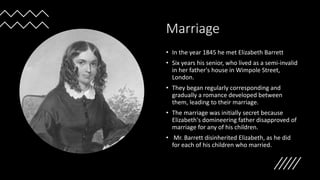
• In the year 1845 he met Elizabeth Barrett
• Six years his senior, who lived as a semi-invalid
in her father's house in Wimpole Street,
London.
• They began regularly corresponding and
gradually a romance developed between
them, leading to their marriage.
• The marriage was initially secret because
Elizabeth's domineering father disapproved of
marriage for any of his children.
• Mr. Barrett disinherited Elizabeth, as he did
for each of his children who married.
Literary
Career
• Browning’s first work, “Pauline: a
Fragment of a Confession” was
published anonymously in 1833.
• Originally Browning considered Pauline
as the first of a series written by
different aspects of himself, but he soon
abandoned this idea.
• It received modest reviews, but it
introduced him as a poet in literary
circles.
• In 1035 he produced “Paracelsus”
followed by “Sordello” in 1940.
Criticism on “Pauline: a
Fragment of a confession”
• In 1833, John Stuart Mill criticized Browning’s very first poem, Pauline: A
Fragment of a Confession.
• He claimed that it exposed the author’s “intense and morbid self-
consciousness” (qtd. in Starzyk 16).
• This criticism affected Browning’s writings throughout the middle of his
career by provoking him.
• This anxiety led Browning to try to distance himself from his poetry, but
his “intense and morbid self-consciousness” still made its way through
to the reader.
• Besides poetry, he tried his skills in playwriting and presented “Strafford” in
1837 and “Bells and Pomegranate” in 1841.
• These attempts did not bring him success.
• In 1855 his wife inspired him to publish his collections.
• This brought commercial and critical success in his writing career.
• In 1869, his “Dramatis Personae” and “Ring and the Book” earned him a spot in
the circle of Victorian poets.
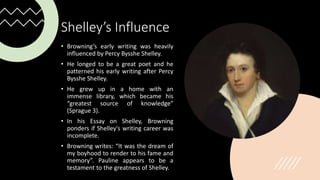
Shelley’s Influence
• Browning’s early writing was heavily
influenced by Percy Bysshe Shelley.
• He longed to be a great poet and he
patterned his early writing after Percy
Bysshe Shelley.
• He grew up in a home with an
immense library, which became his
“greatest source of knowledge”
(Sprague 3).
• In his Essay on Shelley, Browning
ponders if Shelley's writing career was
incomplete.
• Browning writes: “It was the dream of
my boyhood to render to his fame and
memory”. Pauline appears to be a
testament to the greatness of Shelley.
His style
• Robert had established his career first as a poet and then as a
playwright.
• His works won global recognition marked by allusive imagery, symbolic
structures, dramatic monologue, a blend of dark humor and Irony.
• Robert successfully used dramatic monologue techniques which enabled
the readers to see an event using the character’s eyes.
• he explored the beauty of the real-world using artistic techniques in his
poems, “Fra Lippo Lippi” and “Pictor Ignoyus”. The recurring themes in
most of his poems are loss, love, the relationship between arts and
mortality, politics, religion, and society.
Use of
Dramatic
Monologue
• Robert Browning who is praised for
his handling of the dramatic
monologue is a dramatic,
philosophical and metaphysical
poet.
• He is the most ambitious and
successful writer of the dramatic
monologues in English.
• His super creation “Men and
Women” contains 50 dramatic
monologues which are written in
blank verse.
What Is Dramatic
Monologue?
• The poem which has a speaker and
silent listener, or listeners may be
called Dramatic Monologue. The
speaker reveals his thoughts in
front of silent listeners. The listener
remains silent all through the
poem but infers his presence from
what the speaker says. The
speaker’s utterance is a response
to an occasion or event of crucial
importance in his life.
Examples of
Dramatic
Monologue
• Browning’s brief dramatic monologues
include “Soliloquy of the Spanish
Cloister,” “The Laboratory” and
“Porphyria’s Lover.” Several important
longer dramatic monologues, which
appeared in the poet’s collection Men
and Women are “Fra Lippo Lippi,”
“Bishop Blougram’s Apology,” and
“Andrea del Sarto.”
• His crowning achievement in the style
are the dramatic monologues he
wrote for his acknowledged
masterwork The Ring and the Book,
published in four installments in 1868-
1869.
His Impact on Future
• His distinctive writing approach and unique way of expression made
him stand among the best Victorian poets.
• His thoughtful ideas influenced many great poets and writers
including Robert Frost, Ezra Pound, and T.S. Eliot. He successfully
documented his ideas and feelings in his writings that even today
writers try to imitate his unique style, considering him a beacon for
writing plays and poetry.
Best Poems
• “My Last Duchess”,
• “The Pied Piper of Hamelin”,
• “Porphyria’s Lover”,
• “Hilde Roland to the Dark Tower”,
• “The Lost Leader”,
• “Meeting at Night”,
• “Fra Lippo Lippi”,
• “The Laboratory.”
Other Works
• Besides poetry, he tried his
hands on plays.
• Some of them include
“Colombe’s Birthday”
• “King Victor and King Charles”
• “Pippa Passes”
• “In a Balcony”
• Browning, Robert. Essay on Shelley. Ed. Richard Garnett. London: De
La More Press, 1903. Print.
• Sprague, Rosemary. Poems of Robert Browning. New York: Thomas Y.
Crowell, 1964. Print.
• Starzyk, Lawrence J. “Browning’s ‘Childe Roland’: The Visionary
Poetic.” The Victorian Newsletter. 108 (2005): 14-21. Print

Robert Browning- Victorian Poet

  • 1.
    Robert Browning This Photo byUnknown Author is licensed under CC BY-SA
  • 2.
    • Prepared by:Nilay Rathod • MA Sem: 1 • Paper 4: Victorian Literature • Roll No: 29 • Enrollment No: 4069206420210030 • Submitted to: Department of English • Maharaja Krishnakumarsinhji Bhavnagar University
  • 3.
  • 4.
    • His mother,to whom he was close, was a talented musician. • His younger sister, Sarianna, also gifted, became her brother's companion in his later years, after the death of his wife in 1861. • By the age of 12, Browning had written a book of poetry, which he later destroyed for want of a publisher. • Because of his dislike of school, he was educated at home, using the resources of his father’s library. • By 14 he was fluent in French, Greek, Italian and Latin.
  • 5.
    • At 16,he studied Greek at University College London, but left after his first year. • He had inherited substantial musical ability through his mother and composed arrangements of various songs. • He refused a formal career and ignored his parents. • e stayed at home until the age of 34, financially dependent on his family until his marriage.
  • 6.
    Marriage • In theyear 1845 he met Elizabeth Barrett • Six years his senior, who lived as a semi-invalid in her father's house in Wimpole Street, London. • They began regularly corresponding and gradually a romance developed between them, leading to their marriage. • The marriage was initially secret because Elizabeth's domineering father disapproved of marriage for any of his children. • Mr. Barrett disinherited Elizabeth, as he did for each of his children who married.
  • 7.
    Literary Career • Browning’s firstwork, “Pauline: a Fragment of a Confession” was published anonymously in 1833. • Originally Browning considered Pauline as the first of a series written by different aspects of himself, but he soon abandoned this idea. • It received modest reviews, but it introduced him as a poet in literary circles. • In 1035 he produced “Paracelsus” followed by “Sordello” in 1940.
  • 8.
    Criticism on “Pauline:a Fragment of a confession” • In 1833, John Stuart Mill criticized Browning’s very first poem, Pauline: A Fragment of a Confession. • He claimed that it exposed the author’s “intense and morbid self- consciousness” (qtd. in Starzyk 16). • This criticism affected Browning’s writings throughout the middle of his career by provoking him. • This anxiety led Browning to try to distance himself from his poetry, but his “intense and morbid self-consciousness” still made its way through to the reader.
  • 9.
    • Besides poetry,he tried his skills in playwriting and presented “Strafford” in 1837 and “Bells and Pomegranate” in 1841. • These attempts did not bring him success. • In 1855 his wife inspired him to publish his collections. • This brought commercial and critical success in his writing career. • In 1869, his “Dramatis Personae” and “Ring and the Book” earned him a spot in the circle of Victorian poets.
  • 10.
    Shelley’s Influence • Browning’searly writing was heavily influenced by Percy Bysshe Shelley. • He longed to be a great poet and he patterned his early writing after Percy Bysshe Shelley. • He grew up in a home with an immense library, which became his “greatest source of knowledge” (Sprague 3). • In his Essay on Shelley, Browning ponders if Shelley's writing career was incomplete. • Browning writes: “It was the dream of my boyhood to render to his fame and memory”. Pauline appears to be a testament to the greatness of Shelley.
  • 11.
    His style • Roberthad established his career first as a poet and then as a playwright. • His works won global recognition marked by allusive imagery, symbolic structures, dramatic monologue, a blend of dark humor and Irony. • Robert successfully used dramatic monologue techniques which enabled the readers to see an event using the character’s eyes. • he explored the beauty of the real-world using artistic techniques in his poems, “Fra Lippo Lippi” and “Pictor Ignoyus”. The recurring themes in most of his poems are loss, love, the relationship between arts and mortality, politics, religion, and society.
  • 12.
    Use of Dramatic Monologue • RobertBrowning who is praised for his handling of the dramatic monologue is a dramatic, philosophical and metaphysical poet. • He is the most ambitious and successful writer of the dramatic monologues in English. • His super creation “Men and Women” contains 50 dramatic monologues which are written in blank verse.
  • 13.
    What Is Dramatic Monologue? •The poem which has a speaker and silent listener, or listeners may be called Dramatic Monologue. The speaker reveals his thoughts in front of silent listeners. The listener remains silent all through the poem but infers his presence from what the speaker says. The speaker’s utterance is a response to an occasion or event of crucial importance in his life.
  • 14.
    Examples of Dramatic Monologue • Browning’sbrief dramatic monologues include “Soliloquy of the Spanish Cloister,” “The Laboratory” and “Porphyria’s Lover.” Several important longer dramatic monologues, which appeared in the poet’s collection Men and Women are “Fra Lippo Lippi,” “Bishop Blougram’s Apology,” and “Andrea del Sarto.” • His crowning achievement in the style are the dramatic monologues he wrote for his acknowledged masterwork The Ring and the Book, published in four installments in 1868- 1869.
  • 15.
    His Impact onFuture • His distinctive writing approach and unique way of expression made him stand among the best Victorian poets. • His thoughtful ideas influenced many great poets and writers including Robert Frost, Ezra Pound, and T.S. Eliot. He successfully documented his ideas and feelings in his writings that even today writers try to imitate his unique style, considering him a beacon for writing plays and poetry.
  • 16.
    Best Poems • “MyLast Duchess”, • “The Pied Piper of Hamelin”, • “Porphyria’s Lover”, • “Hilde Roland to the Dark Tower”, • “The Lost Leader”, • “Meeting at Night”, • “Fra Lippo Lippi”, • “The Laboratory.”
  • 17.
    Other Works • Besidespoetry, he tried his hands on plays. • Some of them include “Colombe’s Birthday” • “King Victor and King Charles” • “Pippa Passes” • “In a Balcony”
  • 18.
    • Browning, Robert.Essay on Shelley. Ed. Richard Garnett. London: De La More Press, 1903. Print. • Sprague, Rosemary. Poems of Robert Browning. New York: Thomas Y. Crowell, 1964. Print. • Starzyk, Lawrence J. “Browning’s ‘Childe Roland’: The Visionary Poetic.” The Victorian Newsletter. 108 (2005): 14-21. Print

Editor's Notes

  • #9 What Mill meant by this was that he thought Browning was self-obsessed and depressed.