Chemistry
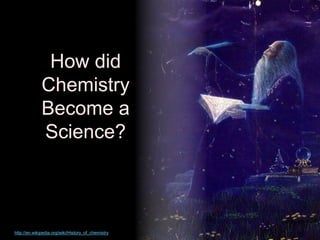
How did
Chemistry
Become a
Science?
http://en.wikipedia.org/wiki/History_of_chemistry
Alchemy vs. Chemistry
The Alchemist
The Alchemist’s Dream
Zinc Pennies
Alchemy vs. Chemistry
Pure Science
Applied Science
Aluminum Mining
Corning Glass
Fertilizers (5-15-10)
Areas of Chemistry
Stereotypes of Chemists
A Career in Chemistry
Forensic Scientist
The Scope of Chemistry
Starting Salaries
Alchemy
The Greeks called this “chemia,” after the
Egyptian word “Chem,” which also meant
black.
Chem was the Egyptians’ name for their
own country.
Some people thought that chemia meant
“black magic,” since some of the
processes the Egyptians were using
seemed like magic.
Alchemy
When the Arabs later conquered Egypt,
they added the prefix “al” which means
“the.”
So it became “al chemia”
And later in English, it was called
alchemy. And that was appropriate
because for a while, alchemy was as
much phoney-baloney magic as it was
real science.
Alchemy
The ancient Greeks were thinkers.
They talked the talk but didn’t walk
the walk.
The ancient Egyptians, on the other
hand, were a practical people and
invented a lot of things. They
made the first glass, and dyes and
medicines, for example.
The
Alchemist
Frankly, I’d be satisfied
if I could turn gold
into lead!
Alchemy was the search for the philosophers stone,
a liquid that would change cheap metals into gold
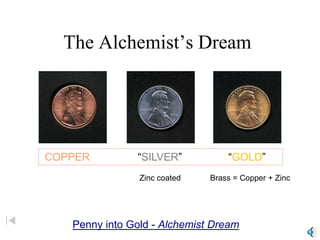
The Alchemist’s Dream
COPPER “SILVER” “GOLD”
Zinc coated Brass = Copper + Zinc
Penny into Gold - Alchemist Dream
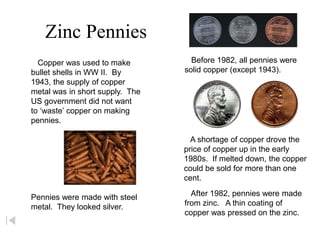
Copper was used to make
bullet shells in WW II. By
1943, the supply of copper
metal was in short supply. The
US government did not want
to ‘waste’ copper on making
pennies.
Pennies were made with steel
metal. They looked silver.
Zinc Pennies
Before 1982, all pennies were
solid copper (except 1943).
After 1982, pennies were made
from zinc. A thin coating of
copper was pressed on the zinc.
A shortage of copper drove the
price of copper up in the early
1980s. If melted down, the copper
could be sold for more than one
cent.
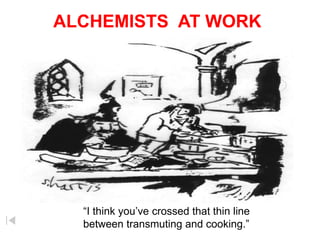
“I think you’ve crossed that thin line
between transmuting and cooking.”
ALCHEMISTS AT WORK
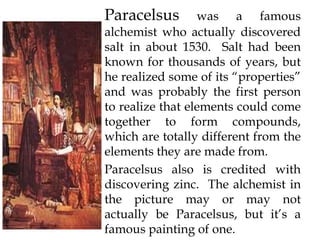
Paracelsus was a famous
alchemist who actually discovered
salt in about 1530. Salt had been
known for thousands of years, but
he realized some of its “properties”
and was probably the first person
to realize that elements could come
together to form compounds,
which are totally different from the
elements they are made from.
Paracelsus also is credited with
discovering zinc. The alchemist in
the picture may or may not
actually be Paracelsus, but it’s a
famous painting of one.
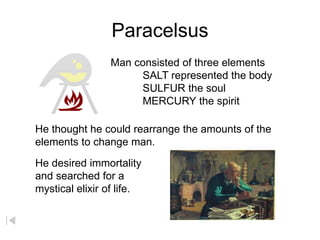
Paracelsus
Man consisted of three elements
SALT represented the body
SULFUR the soul
MERCURY the spirit
He thought he could rearrange the amounts of the
elements to change man.
He desired immortality
and searched for a
mystical elixir of life.
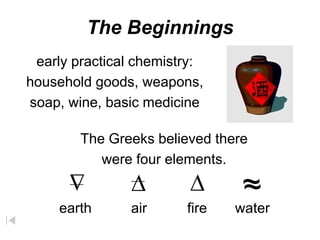
The Beginnings
The Greeks believed there
were four elements.
early practical chemistry:
household goods, weapons,
soap, wine, basic medicine
earth air fire water
D ~
~
D
___
D
___
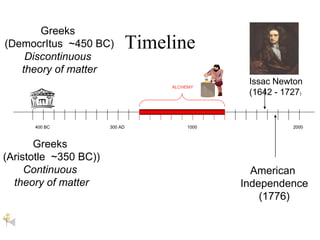
Timeline
2000
1000
300 AD
American
Independence
(1776)
Issac Newton
(1642 - 1727)
400 BC
Greeks
(DemocrItus ~450 BC)
Discontinuous
theory of matter
ALCHEMY
Greeks
(Aristotle ~350 BC))
Continuous
theory of matter
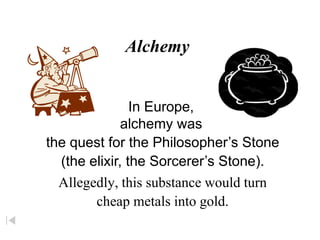
Alchemy
Allegedly, this substance would turn
cheap metals into gold.
In Europe,
alchemy was
the quest for the Philosopher’s Stone
(the elixir, the Sorcerer’s Stone).
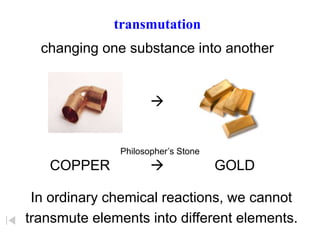
transmutation
In ordinary chemical reactions, we cannot
transmute elements into different elements.
changing one substance into another
COPPER GOLD


Philosopher’s Stone
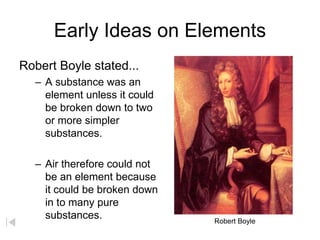
Early Ideas on Elements
Robert Boyle stated...
– A substance was an
element unless it could
be broken down to two
or more simpler
substances.
– Air therefore could not
be an element because
it could be broken down
in to many pure
substances. Robert Boyle
Alchemy
• After that 'chemistry' was
ruled by alchemy.
• They believed that could
take any cheap metals and
turn them into gold.
• Alchemists were almost
like magicians.
– elixirs, physical immortality
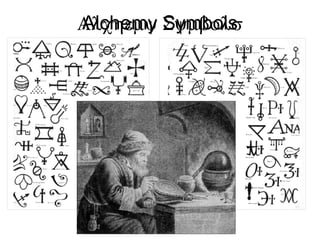
Alchemy Symbols
Alchemy Symbols
Alchemy
. . . . .
. . . .
. . .
. .
.
GOLD SILVER COPPER IRON SAND
Alchemical symbols for substances…
transmutation: changing one substance into another
In ordinary chemistry, we cannot transmute elements.
D
GOLD SILVER COPPER IRON
. . . . .
. . . .
. . .
. .
.
SAND
Alchemy (~500 – 1300 A.D.)
Alchemical symbols for substances…
transmutation: changing one substance into another
the quest for the
Philosopher’s Stone
It was supposed to change cheap metals into gold.
In ordinary chemistry, we cannot transmute elements.
Contributions of alchemists: lab apparatus / procedures
how to make some alloys
properties of some elements
The Alchemist, by David Teniers
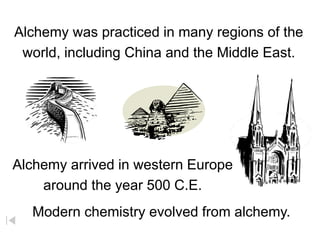
Alchemy was practiced in many regions of the
world, including China and the Middle East.
Alchemy arrived in western Europe
around the year 500 C.E.
Modern chemistry evolved from alchemy.
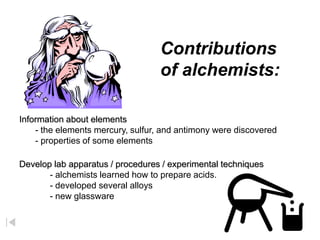
Contributions
of alchemists:
Information about elements
- the elements mercury, sulfur, and antimony were discovered
- properties of some elements
Develop lab apparatus / procedures / experimental techniques
- alchemists learned how to prepare acids.
- developed several alloys
- new glassware
Alchemy vs. Chemistry
Alike Different
Chemistry
Different
Topic Topic
Alchemy

Alchemy PowerPoint Presentation - Chemistry

  • 1.
  • 2.
  • 3.
    Alchemy vs. Chemistry TheAlchemist The Alchemist’s Dream Zinc Pennies Alchemy vs. Chemistry Pure Science Applied Science Aluminum Mining Corning Glass Fertilizers (5-15-10) Areas of Chemistry Stereotypes of Chemists A Career in Chemistry Forensic Scientist The Scope of Chemistry Starting Salaries
  • 4.
    Alchemy The Greeks calledthis “chemia,” after the Egyptian word “Chem,” which also meant black. Chem was the Egyptians’ name for their own country. Some people thought that chemia meant “black magic,” since some of the processes the Egyptians were using seemed like magic.
  • 5.
    Alchemy When the Arabslater conquered Egypt, they added the prefix “al” which means “the.” So it became “al chemia” And later in English, it was called alchemy. And that was appropriate because for a while, alchemy was as much phoney-baloney magic as it was real science.
  • 6.
    Alchemy The ancient Greekswere thinkers. They talked the talk but didn’t walk the walk. The ancient Egyptians, on the other hand, were a practical people and invented a lot of things. They made the first glass, and dyes and medicines, for example.
  • 7.
    The Alchemist Frankly, I’d besatisfied if I could turn gold into lead! Alchemy was the search for the philosophers stone, a liquid that would change cheap metals into gold
  • 8.
    The Alchemist’s Dream COPPER“SILVER” “GOLD” Zinc coated Brass = Copper + Zinc Penny into Gold - Alchemist Dream
  • 9.
    Copper was usedto make bullet shells in WW II. By 1943, the supply of copper metal was in short supply. The US government did not want to ‘waste’ copper on making pennies. Pennies were made with steel metal. They looked silver. Zinc Pennies Before 1982, all pennies were solid copper (except 1943). After 1982, pennies were made from zinc. A thin coating of copper was pressed on the zinc. A shortage of copper drove the price of copper up in the early 1980s. If melted down, the copper could be sold for more than one cent.
  • 10.
    “I think you’vecrossed that thin line between transmuting and cooking.” ALCHEMISTS AT WORK
  • 11.
    Paracelsus was afamous alchemist who actually discovered salt in about 1530. Salt had been known for thousands of years, but he realized some of its “properties” and was probably the first person to realize that elements could come together to form compounds, which are totally different from the elements they are made from. Paracelsus also is credited with discovering zinc. The alchemist in the picture may or may not actually be Paracelsus, but it’s a famous painting of one.
  • 12.
    Paracelsus Man consisted ofthree elements SALT represented the body SULFUR the soul MERCURY the spirit He thought he could rearrange the amounts of the elements to change man. He desired immortality and searched for a mystical elixir of life.
  • 13.
    The Beginnings The Greeksbelieved there were four elements. early practical chemistry: household goods, weapons, soap, wine, basic medicine earth air fire water D ~ ~ D ___ D ___
  • 14.
    Timeline 2000 1000 300 AD American Independence (1776) Issac Newton (1642- 1727) 400 BC Greeks (DemocrItus ~450 BC) Discontinuous theory of matter ALCHEMY Greeks (Aristotle ~350 BC)) Continuous theory of matter
  • 15.
    Alchemy Allegedly, this substancewould turn cheap metals into gold. In Europe, alchemy was the quest for the Philosopher’s Stone (the elixir, the Sorcerer’s Stone).
  • 16.
    transmutation In ordinary chemicalreactions, we cannot transmute elements into different elements. changing one substance into another COPPER GOLD   Philosopher’s Stone
  • 17.
    Early Ideas onElements Robert Boyle stated... – A substance was an element unless it could be broken down to two or more simpler substances. – Air therefore could not be an element because it could be broken down in to many pure substances. Robert Boyle
  • 18.
    Alchemy • After that'chemistry' was ruled by alchemy. • They believed that could take any cheap metals and turn them into gold. • Alchemists were almost like magicians. – elixirs, physical immortality
  • 19.
  • 20.
    Alchemy . . .. . . . . . . . . . . . GOLD SILVER COPPER IRON SAND Alchemical symbols for substances… transmutation: changing one substance into another In ordinary chemistry, we cannot transmute elements. D
  • 21.
    GOLD SILVER COPPERIRON . . . . . . . . . . . . . . . SAND Alchemy (~500 – 1300 A.D.) Alchemical symbols for substances… transmutation: changing one substance into another the quest for the Philosopher’s Stone It was supposed to change cheap metals into gold. In ordinary chemistry, we cannot transmute elements. Contributions of alchemists: lab apparatus / procedures how to make some alloys properties of some elements The Alchemist, by David Teniers
  • 22.
    Alchemy was practicedin many regions of the world, including China and the Middle East. Alchemy arrived in western Europe around the year 500 C.E. Modern chemistry evolved from alchemy.
  • 23.
    Contributions of alchemists: Information aboutelements - the elements mercury, sulfur, and antimony were discovered - properties of some elements Develop lab apparatus / procedures / experimental techniques - alchemists learned how to prepare acids. - developed several alloys - new glassware
  • 24.
    Alchemy vs. Chemistry AlikeDifferent Chemistry Different Topic Topic Alchemy