ATOMS AND
ELEMENTS
Colegio de Sta. Ana de Victorias, Inc. – Senior High School
Osmena Ave., Victorias City Negros Occidental
Physical Science
UNIT 2: How the idea of the atom, along
with the idea of the elements evolved
Prepared By: Lord William B. Pacurib, LPT
TABLE OF CONTENTS
1. How the concept of the atom evolved from
Ancient Greek to the present
2. How the concept of the element evolved
from Ancient Greek to the present
Colegio de Sta. Ana de Victorias, Inc. – Integrated School
Bringing Quality Education Closer
OBJECTIVES
1. Describe the ideas of the Ancient Greeks on the atom (S11/12PS-IIIa-b-5)
2. Describe the ideas of the Ancient Greeks on the elements (S11/12PS-IIIa-b-
6)
3. Describe the contributions of the alchemists to the science of chemistry
(S11/12PS-IIIb-7)
4. Point out the main ideas in the discovery of the structure of the atom and its
subatomic particles (S11/12PS-IIIb-8)
5. Cite the contributions of J.J. Thomson, Ernest Rutherford, Henry Moseley,
and Niels Bohr to the understanding of the structure of the atom (S11/12PS-
IIIb-9)
Colegio de Sta. Ana de Victorias, Inc. – Integrated School
Bringing Quality Education Closer
OBJECTIVES
6. Describe the nuclear model of the atom and the location of its major
components (protons, neutrons, and electrons) (S11/12PS-IIIb-10)
7. Explain how the concept of atomic number led to the synthesis of new
elements in the laboratory (S11/12PS-IIIb-11)
8. Write the nuclear reactions involved in the synthesis of new elements
(S11/12PS-IIIb-12)
9. Cite the contribution of John Dalton toward the understanding of the concept
of the chemical elements (S11/12PS-IIIc-13)
10. Explain how Dalton’s theory contributed to the discovery of other elements
(S11/12PS-IIIc-14)
Colegio de Sta. Ana de Victorias, Inc. – Integrated School
Bringing Quality Education Closer
THE GREEK CONCEPTION OF THE ATOM
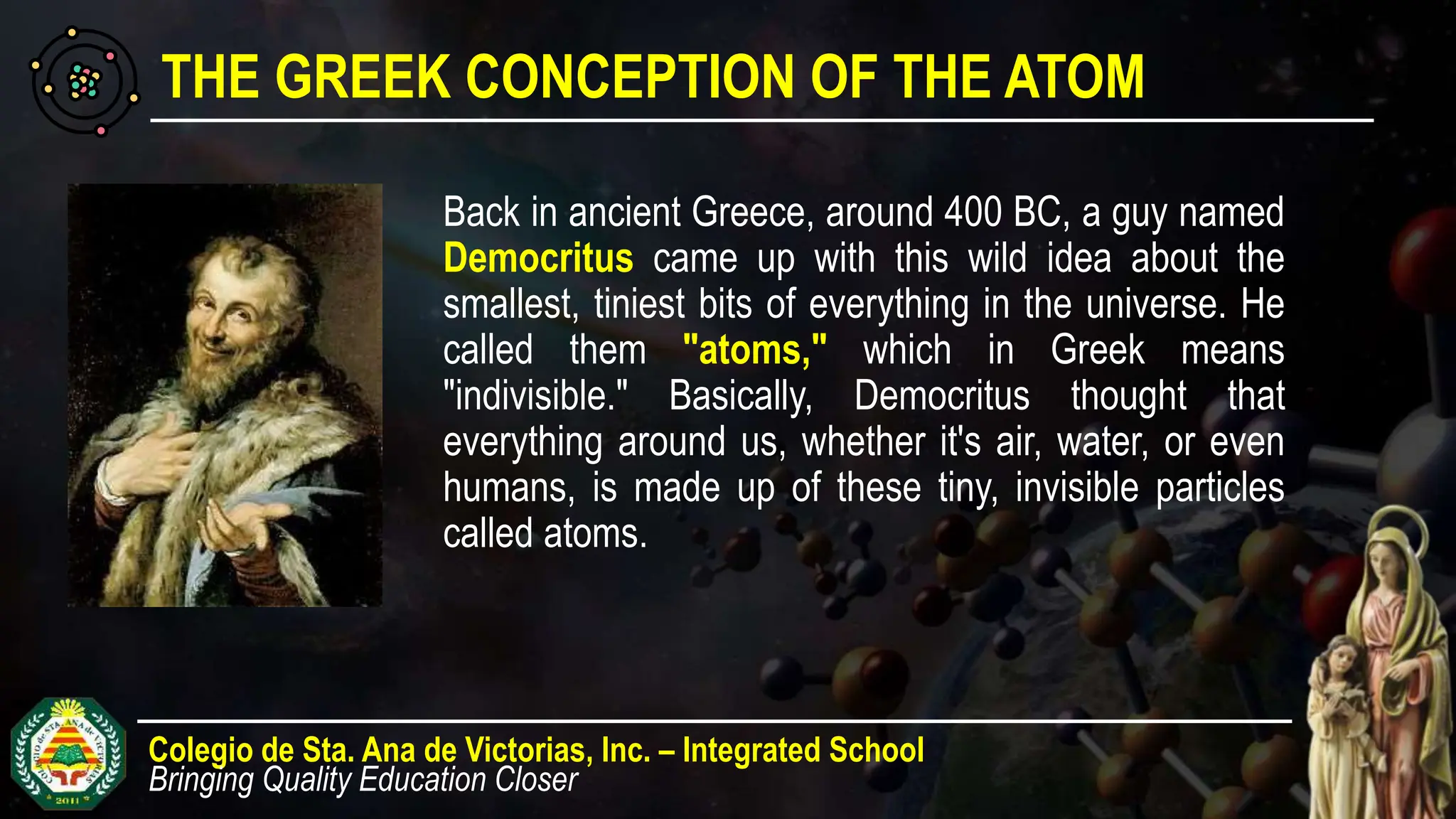
Back in ancient Greece, around 400 BC, a guy named
Democritus came up with this wild idea about the
smallest, tiniest bits of everything in the universe. He
called them "atoms," which in Greek means
"indivisible." Basically, Democritus thought that
everything around us, whether it's air, water, or even
humans, is made up of these tiny, invisible particles
called atoms.
Colegio de Sta. Ana de Victorias, Inc. – Integrated School
Bringing Quality Education Closer
THE GREEK CONCEPTION OF THE ELEMENTS
Earth: They believed earth was heavy and solid, making up things like rocks and
dirt.
Water: Water was seen as wet and fluid, forming lakes, rivers, and seas.
Air: Air was light and invisible, filling up the space around us.
Fire: Fire was hot and transformative, seen in flames and as a source of energy.
Colegio de Sta. Ana de Victorias, Inc. – Integrated School
Bringing Quality Education Closer
The Ancient Greeks had also an idea about everything being made up of four basic
elements. They thought that these elements were the building blocks of everything in
the universe.
CONTRIBUTION OF ALCHEMY TO CHEMISTRY
Alchemy was a blend of science, philosophy,
and mysticism practiced mainly during the
Middle Ages. Alchemists sought to transform
base metals (like lead) into noble metals (like
gold), discover a universal cure for diseases, and
find the elixir of life for immortality.
Colegio de Sta. Ana de Victorias, Inc. – Integrated School
Bringing Quality Education Closer
What is Alchemy?
CONTRIBUTION OF ALCHEMY TO CHEMISTRY
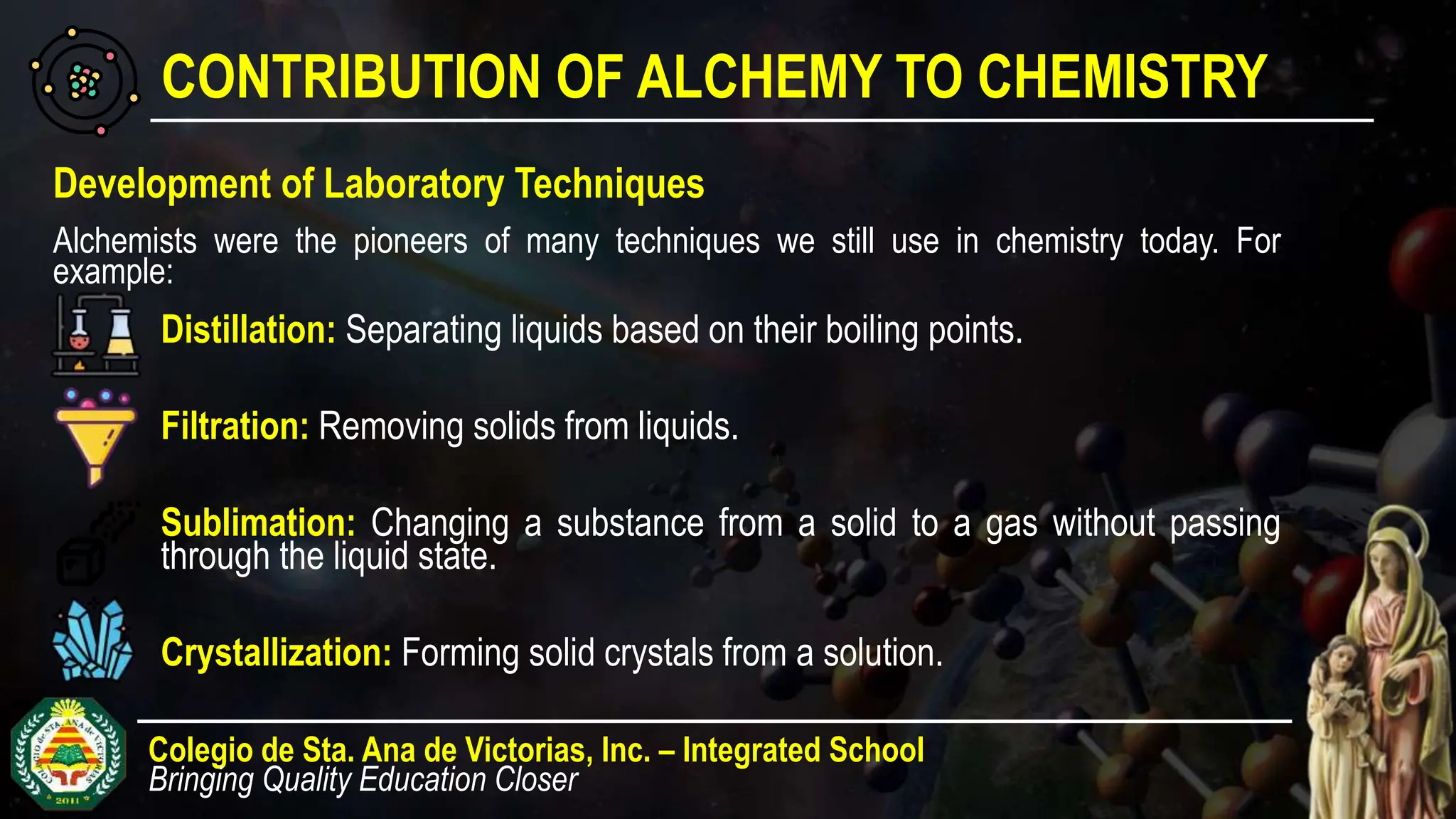
Alchemists were the pioneers of many techniques we still use in chemistry today. For
example:
Colegio de Sta. Ana de Victorias, Inc. – Integrated School
Bringing Quality Education Closer
Development of Laboratory Techniques
Distillation: Separating liquids based on their boiling points.
Filtration: Removing solids from liquids.
Sublimation: Changing a substance from a solid to a gas without passing
through the liquid state.
Crystallization: Forming solid crystals from a solution.
CONTRIBUTION OF ALCHEMY TO CHEMISTRY
Alchemists discovered many substances that are now common in chemistry, such as:
Colegio de Sta. Ana de Victorias, Inc. – Integrated School
Bringing Quality Education Closer
Discovery of Substances
Acids: Strong liquids that can dissolve metals (like sulfuric acid).
Bases: Substances that can neutralize acids (like lye).
Alcohols: Like ethanol, used in drinks and as a solvent.
CONTRIBUTION OF ALCHEMY TO CHEMISTRY
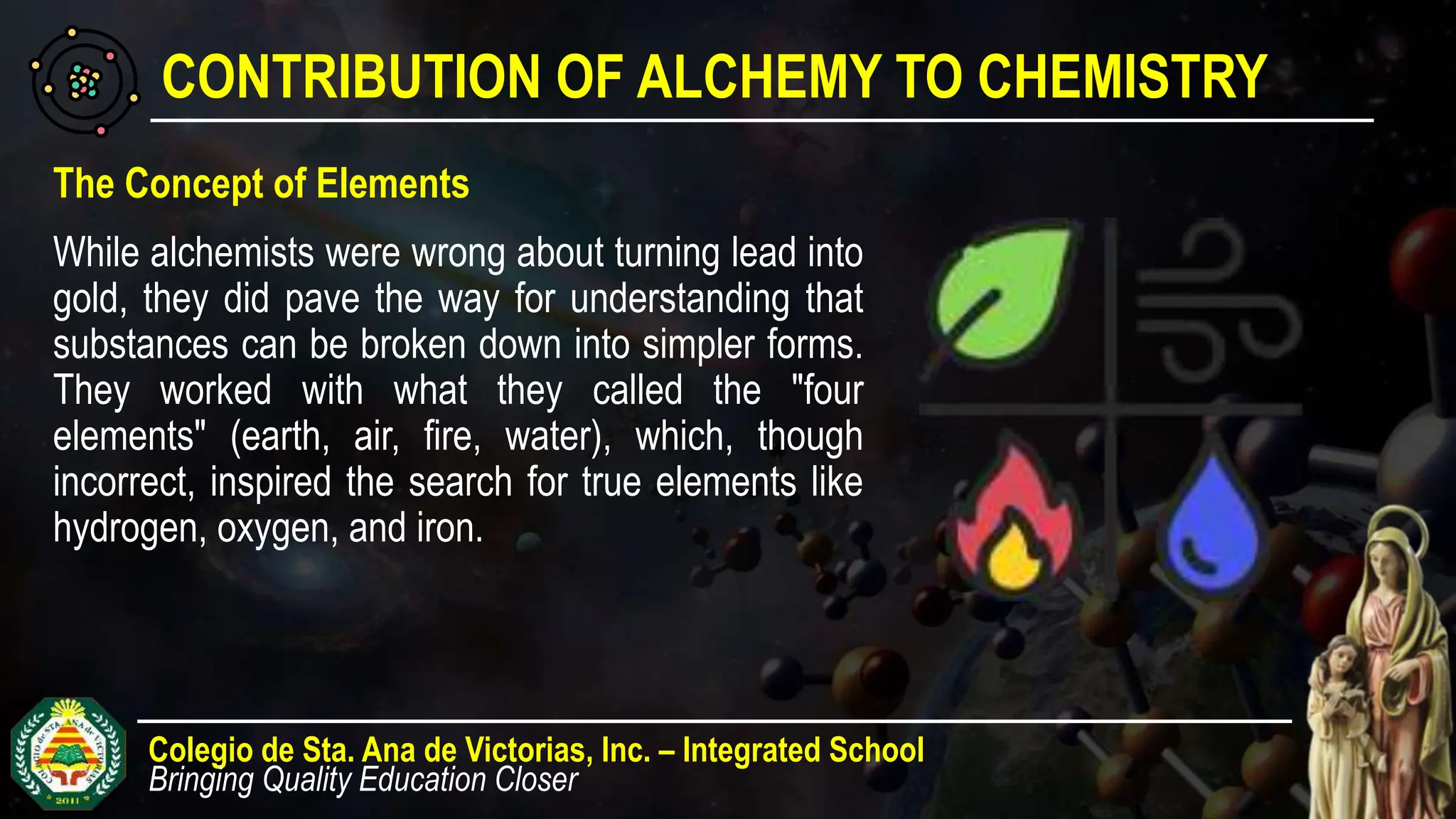
While alchemists were wrong about turning lead into
gold, they did pave the way for understanding that
substances can be broken down into simpler forms.
They worked with what they called the "four
elements" (earth, air, fire, water), which, though
incorrect, inspired the search for true elements like
hydrogen, oxygen, and iron.
Colegio de Sta. Ana de Victorias, Inc. – Integrated School
Bringing Quality Education Closer
The Concept of Elements
CONTRIBUTION OF ALCHEMY TO CHEMISTRY
While alchemists were wrong about turning lead into
gold, they did pave the way for understanding that
substances can be broken down into simpler forms.
They worked with what they called the "four
elements" (earth, air, fire, water), which, though
incorrect, inspired the search for true elements like
hydrogen, oxygen, and iron.
Colegio de Sta. Ana de Victorias, Inc. – Integrated School
Bringing Quality Education Closer
The Concept of Elements
CONTRIBUTION OF ALCHEMY TO CHEMISTRY
Alchemists were among the first to use systematic
experiments to test their theories. This approach is
the bedrock of the scientific method used in
chemistry and other sciences today.
Colegio de Sta. Ana de Victorias, Inc. – Integrated School
Bringing Quality Education Closer
Experimental Approach
Philosophical Influence
Alchemy wasn't just about experiments. It was also
about understanding the nature of matter and
transformation. This philosophical thinking led to the
idea that substances are made of atoms and molecules,
a fundamental concept in modern chemistry.
CONTRIBUTION OF ALCHEMY TO CHEMISTRY
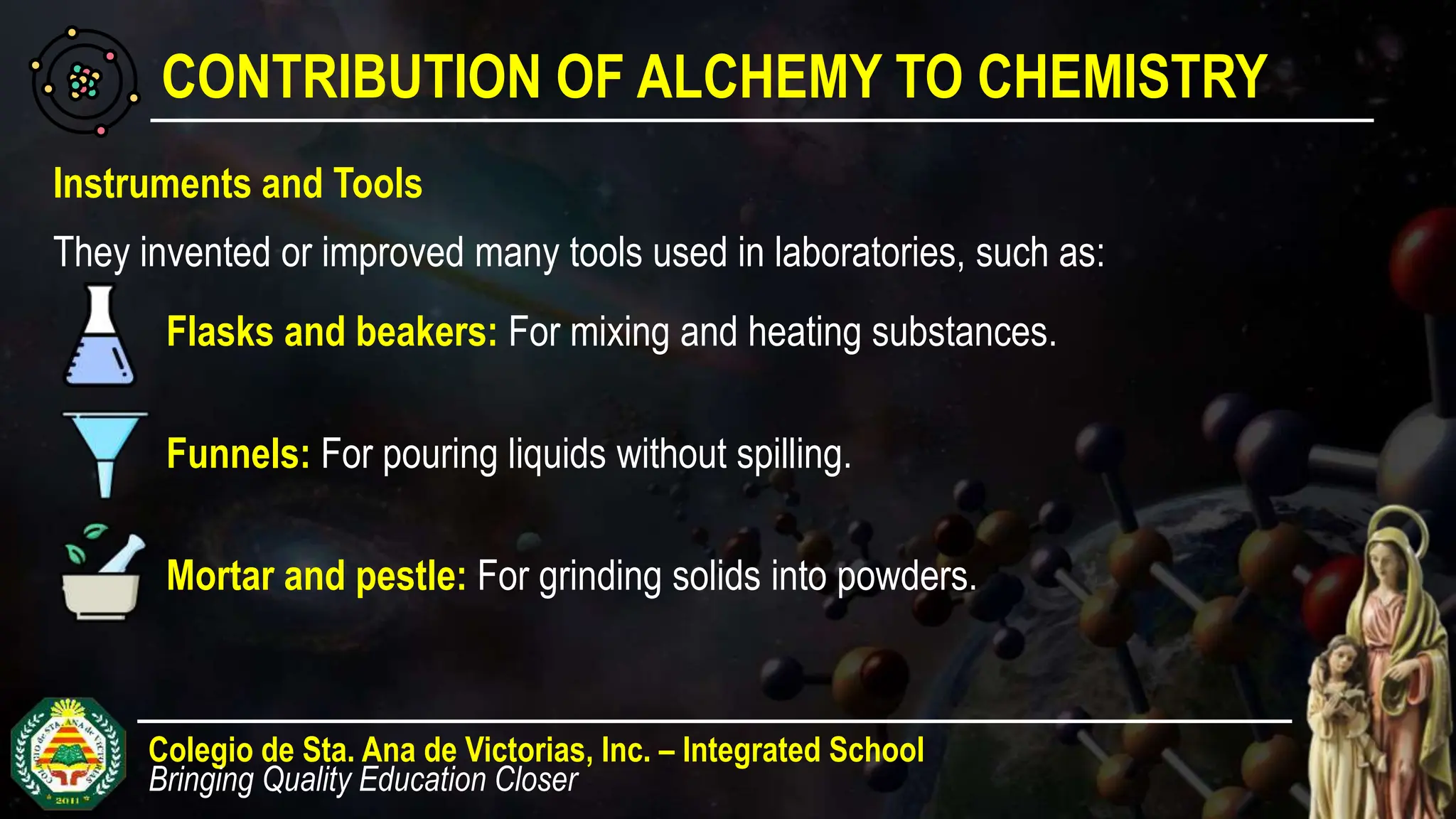
They invented or improved many tools used in laboratories, such as:
Colegio de Sta. Ana de Victorias, Inc. – Integrated School
Bringing Quality Education Closer
Instruments and Tools
Flasks and beakers: For mixing and heating substances.
Funnels: For pouring liquids without spilling.
Mortar and pestle: For grinding solids into powders.
MODELS OF THE ATOM
Main Idea: The modern quantum model describes that
electrons don't orbit the nucleus in fixed paths but are
found in "clouds" where they are likely to be.
Simple Explanation: The idea now is that the
electrons are not on fixed shelves but are buzzing
around in a cloud around the core, and you can only
guess where they might be at any given time.
Colegio de Sta. Ana de Victorias, Inc. – Integrated School
Bringing Quality Education Closer
The Modern Quantum Model

ATOMS AND ELEMENTS - PHYSICAL SCIENCE (PPT)

  • 1.
    ATOMS AND ELEMENTS Colegio deSta. Ana de Victorias, Inc. – Senior High School Osmena Ave., Victorias City Negros Occidental Physical Science UNIT 2: How the idea of the atom, along with the idea of the elements evolved Prepared By: Lord William B. Pacurib, LPT
  • 2.
    TABLE OF CONTENTS 1.How the concept of the atom evolved from Ancient Greek to the present 2. How the concept of the element evolved from Ancient Greek to the present Colegio de Sta. Ana de Victorias, Inc. – Integrated School Bringing Quality Education Closer
  • 3.
    OBJECTIVES 1. Describe theideas of the Ancient Greeks on the atom (S11/12PS-IIIa-b-5) 2. Describe the ideas of the Ancient Greeks on the elements (S11/12PS-IIIa-b- 6) 3. Describe the contributions of the alchemists to the science of chemistry (S11/12PS-IIIb-7) 4. Point out the main ideas in the discovery of the structure of the atom and its subatomic particles (S11/12PS-IIIb-8) 5. Cite the contributions of J.J. Thomson, Ernest Rutherford, Henry Moseley, and Niels Bohr to the understanding of the structure of the atom (S11/12PS- IIIb-9) Colegio de Sta. Ana de Victorias, Inc. – Integrated School Bringing Quality Education Closer
  • 4.
    OBJECTIVES 6. Describe thenuclear model of the atom and the location of its major components (protons, neutrons, and electrons) (S11/12PS-IIIb-10) 7. Explain how the concept of atomic number led to the synthesis of new elements in the laboratory (S11/12PS-IIIb-11) 8. Write the nuclear reactions involved in the synthesis of new elements (S11/12PS-IIIb-12) 9. Cite the contribution of John Dalton toward the understanding of the concept of the chemical elements (S11/12PS-IIIc-13) 10. Explain how Dalton’s theory contributed to the discovery of other elements (S11/12PS-IIIc-14) Colegio de Sta. Ana de Victorias, Inc. – Integrated School Bringing Quality Education Closer
  • 5.
    THE GREEK CONCEPTIONOF THE ATOM Back in ancient Greece, around 400 BC, a guy named Democritus came up with this wild idea about the smallest, tiniest bits of everything in the universe. He called them "atoms," which in Greek means "indivisible." Basically, Democritus thought that everything around us, whether it's air, water, or even humans, is made up of these tiny, invisible particles called atoms. Colegio de Sta. Ana de Victorias, Inc. – Integrated School Bringing Quality Education Closer
  • 6.
    THE GREEK CONCEPTIONOF THE ELEMENTS Earth: They believed earth was heavy and solid, making up things like rocks and dirt. Water: Water was seen as wet and fluid, forming lakes, rivers, and seas. Air: Air was light and invisible, filling up the space around us. Fire: Fire was hot and transformative, seen in flames and as a source of energy. Colegio de Sta. Ana de Victorias, Inc. – Integrated School Bringing Quality Education Closer The Ancient Greeks had also an idea about everything being made up of four basic elements. They thought that these elements were the building blocks of everything in the universe.
  • 7.
    CONTRIBUTION OF ALCHEMYTO CHEMISTRY Alchemy was a blend of science, philosophy, and mysticism practiced mainly during the Middle Ages. Alchemists sought to transform base metals (like lead) into noble metals (like gold), discover a universal cure for diseases, and find the elixir of life for immortality. Colegio de Sta. Ana de Victorias, Inc. – Integrated School Bringing Quality Education Closer What is Alchemy?
  • 8.
    CONTRIBUTION OF ALCHEMYTO CHEMISTRY Alchemists were the pioneers of many techniques we still use in chemistry today. For example: Colegio de Sta. Ana de Victorias, Inc. – Integrated School Bringing Quality Education Closer Development of Laboratory Techniques Distillation: Separating liquids based on their boiling points. Filtration: Removing solids from liquids. Sublimation: Changing a substance from a solid to a gas without passing through the liquid state. Crystallization: Forming solid crystals from a solution.
  • 9.
    CONTRIBUTION OF ALCHEMYTO CHEMISTRY Alchemists discovered many substances that are now common in chemistry, such as: Colegio de Sta. Ana de Victorias, Inc. – Integrated School Bringing Quality Education Closer Discovery of Substances Acids: Strong liquids that can dissolve metals (like sulfuric acid). Bases: Substances that can neutralize acids (like lye). Alcohols: Like ethanol, used in drinks and as a solvent.
  • 10.
    CONTRIBUTION OF ALCHEMYTO CHEMISTRY While alchemists were wrong about turning lead into gold, they did pave the way for understanding that substances can be broken down into simpler forms. They worked with what they called the "four elements" (earth, air, fire, water), which, though incorrect, inspired the search for true elements like hydrogen, oxygen, and iron. Colegio de Sta. Ana de Victorias, Inc. – Integrated School Bringing Quality Education Closer The Concept of Elements
  • 11.
    CONTRIBUTION OF ALCHEMYTO CHEMISTRY While alchemists were wrong about turning lead into gold, they did pave the way for understanding that substances can be broken down into simpler forms. They worked with what they called the "four elements" (earth, air, fire, water), which, though incorrect, inspired the search for true elements like hydrogen, oxygen, and iron. Colegio de Sta. Ana de Victorias, Inc. – Integrated School Bringing Quality Education Closer The Concept of Elements
  • 12.
    CONTRIBUTION OF ALCHEMYTO CHEMISTRY Alchemists were among the first to use systematic experiments to test their theories. This approach is the bedrock of the scientific method used in chemistry and other sciences today. Colegio de Sta. Ana de Victorias, Inc. – Integrated School Bringing Quality Education Closer Experimental Approach Philosophical Influence Alchemy wasn't just about experiments. It was also about understanding the nature of matter and transformation. This philosophical thinking led to the idea that substances are made of atoms and molecules, a fundamental concept in modern chemistry.
  • 13.
    CONTRIBUTION OF ALCHEMYTO CHEMISTRY They invented or improved many tools used in laboratories, such as: Colegio de Sta. Ana de Victorias, Inc. – Integrated School Bringing Quality Education Closer Instruments and Tools Flasks and beakers: For mixing and heating substances. Funnels: For pouring liquids without spilling. Mortar and pestle: For grinding solids into powders.
  • 14.
    MODELS OF THEATOM Main Idea: The modern quantum model describes that electrons don't orbit the nucleus in fixed paths but are found in "clouds" where they are likely to be. Simple Explanation: The idea now is that the electrons are not on fixed shelves but are buzzing around in a cloud around the core, and you can only guess where they might be at any given time. Colegio de Sta. Ana de Victorias, Inc. – Integrated School Bringing Quality Education Closer The Modern Quantum Model