Chemistry Chapter 1 What is Chemistry?
What is CHEMISTRY? Science Research/ Experiments Medicine Chemicals Farming/ Fertilizers
Why study CHEMISTRY? To help examine the world around us Career opportunities To be an informed citizen
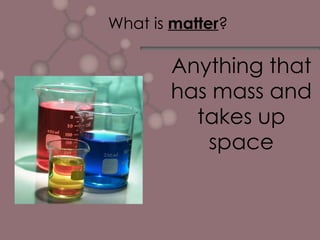
What is  matter ? Anything that has mass and takes up space
Chemistry  The study of the  composition of matter and the changes it undergoes Deals with both living and non-living States of matter:  solid, liquid, gas Changes of state:  melt, freeze, condense
Types of Chemistry  Organic Inorganic Biochemistry Analytical Physical
Types, defined Organic –  study of carbon containing chemicals Inorganic –  study of chemicals that do not contain carbon Biochemistry –  study of the processes that take place in organisms  Analytical –  study of the composition of matter Physical –  study of the mechanism, rate and energy transfer that occurs when matter undergoes a change
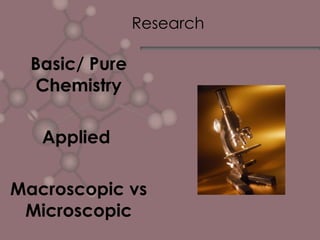
Research Basic/ Pure Chemistry Applied  Macroscopic vs Microscopic
Research, defined Basic/ Pure Chemistry –  pursuit of knowledge for its own sake Applied –  research directed toward a practical goal/ use/ application;  technology & money Macroscopic vs Microscopic
How are we affected by CHEMISTRY? Energy Kinetic vs Potential Medicine Agriculture Agriculture Environment
Alchemy WHO? Original chemists 400 BCE - China and India 8 th  century CE – Spain and Europe WHAT? Mystical Practical
Alchemy  Mystical Alchemy Focused on changing common metals into the perfect metal of gold WHY? Practical Alchemy Developed techniques for working with glass, metals, dyes Developed processes for separating mixtures and purifying substances Designed equipment – beakers, funnels, flasks
Past Alchemy 1500-1600 England Moved away from alchemy to explaining through experimental evidence Lavoisier Father of modern chemistry French, late 1700’s Changed chemistry from a science of observation to a science of measurement
Scientific Method Logical, systematic approach Steps:  Identify the problem Make observations Make hypothesis Experiment/ test hypothesis Analyze results Develop theories What is a hypothesis? What do we do if out idea is incorrect? Why? Why do we repeat experiments?
Scientific Method Hypothesis educated guess,  proposed  explanation for an observation Independent Variable Variable you change/ manipulate Dependent variable Variable that we observe, responds to changes Theory Well-tested explanation  for a set of observations, after an experiment has been repeated numerous times with the same results Law Summary  of the results of many observations and experiments A law does not try to explain the relationship it describes, that is the job of a theory
Problem Solving  Analyze Identify the given and unknown Make a plan Calculate Do the math Evaluate Does you answer make sense? Are your units correct?
Think About… How can a theory change? Why is collaboration so important? What is a practical use of collaboration? How do scientists collaborate? Why should you estimate an answer when problem solving?

Honor Chemistry 1

  • 1.
    Chemistry Chapter 1What is Chemistry?
  • 2.
    What is CHEMISTRY?Science Research/ Experiments Medicine Chemicals Farming/ Fertilizers
  • 3.
    Why study CHEMISTRY?To help examine the world around us Career opportunities To be an informed citizen
  • 4.
    What is matter ? Anything that has mass and takes up space
  • 5.
    Chemistry Thestudy of the composition of matter and the changes it undergoes Deals with both living and non-living States of matter: solid, liquid, gas Changes of state: melt, freeze, condense
  • 6.
    Types of Chemistry Organic Inorganic Biochemistry Analytical Physical
  • 7.
    Types, defined Organic– study of carbon containing chemicals Inorganic – study of chemicals that do not contain carbon Biochemistry – study of the processes that take place in organisms Analytical – study of the composition of matter Physical – study of the mechanism, rate and energy transfer that occurs when matter undergoes a change
  • 8.
    Research Basic/ PureChemistry Applied Macroscopic vs Microscopic
  • 9.
    Research, defined Basic/Pure Chemistry – pursuit of knowledge for its own sake Applied – research directed toward a practical goal/ use/ application; technology & money Macroscopic vs Microscopic
  • 10.
    How are weaffected by CHEMISTRY? Energy Kinetic vs Potential Medicine Agriculture Agriculture Environment
  • 11.
    Alchemy WHO? Originalchemists 400 BCE - China and India 8 th century CE – Spain and Europe WHAT? Mystical Practical
  • 12.
    Alchemy MysticalAlchemy Focused on changing common metals into the perfect metal of gold WHY? Practical Alchemy Developed techniques for working with glass, metals, dyes Developed processes for separating mixtures and purifying substances Designed equipment – beakers, funnels, flasks
  • 13.
    Past Alchemy 1500-1600England Moved away from alchemy to explaining through experimental evidence Lavoisier Father of modern chemistry French, late 1700’s Changed chemistry from a science of observation to a science of measurement
  • 14.
    Scientific Method Logical,systematic approach Steps: Identify the problem Make observations Make hypothesis Experiment/ test hypothesis Analyze results Develop theories What is a hypothesis? What do we do if out idea is incorrect? Why? Why do we repeat experiments?
  • 15.
    Scientific Method Hypothesiseducated guess, proposed explanation for an observation Independent Variable Variable you change/ manipulate Dependent variable Variable that we observe, responds to changes Theory Well-tested explanation for a set of observations, after an experiment has been repeated numerous times with the same results Law Summary of the results of many observations and experiments A law does not try to explain the relationship it describes, that is the job of a theory
  • 16.
    Problem Solving Analyze Identify the given and unknown Make a plan Calculate Do the math Evaluate Does you answer make sense? Are your units correct?
  • 17.
    Think About… Howcan a theory change? Why is collaboration so important? What is a practical use of collaboration? How do scientists collaborate? Why should you estimate an answer when problem solving?