Medieval Castles, Medieval Life, and Alchemy By: Jessica Crutchfield And Madeline Geary P.6
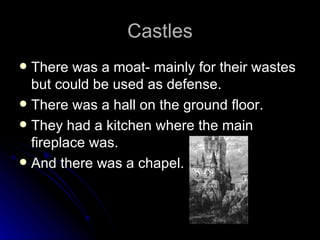
Castles There was a moat- mainly for their wastes but could be used as defense. There was a hall on the ground floor. They had a kitchen where the main fireplace was. And there was a chapel.
Castle Life in General Castle life was mainly uncomfortable. It was also gloomy. However luckily it was safe.
Castle Life in General There was no central heating. However, even during warm months the castle would stay cool. When they did take baths they were taken in a wooden tub.
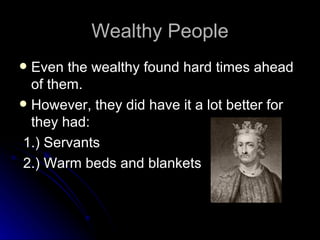
Wealthy People Even the wealthy found hard times ahead of them. However, they did have it a lot better for they had: 1.) Servants 2.) Warm beds and blankets
Wealthy People cont. 3.) Tapestries hanging on the wall to block the wind The servants were always up before the wealthy making the meals and cleaning their house.
Women and Children A lot of the time the men would become wealthy from the women’s dowry. The lady was expected to dress elegantly. They also have servants to help them dress. The children of the rich were mostly taken care of by the servants. They were also placed in school.
Time of War Since the Castles were made of stone and they were tall; they were almost indestructible. The moat was also a good defense in war time.
Alchemy Very early form of chemistry. The origin of Alchemy is still unknown today. The original goal of Alchemy was the transmuting of elements (changing one element into another).
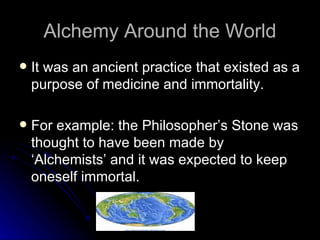
Alchemy Around the World It was an ancient practice that existed as a purpose of medicine and immortality. For example: the Philosopher’s Stone was thought to have been made by ‘Alchemists’ and it was expected to keep oneself immortal.
Alchemy Around the World pt 2 Essentially such ideas of immortality or practices of medicine branched out around the world. Such places were: China, Arabia, Greece, Egypt, and Persia.
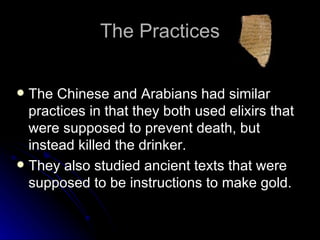
The Practices The Chinese and Arabians had similar practices in that they both used elixirs that were supposed to prevent death, but instead killed the drinker. They also studied ancient texts that were supposed to be instructions to make gold.
The Practices Pt 2 The Greeks and Egyptians also emphasized their interest by searching for a ‘magical’ ingredient, powder, which they called Xerion.  Later on, a scientist by the name of Isaac Newton took alchemy to a new level, calling it Chemistry.
Alchemy to Chemistry Newton conducted alchemical experiments, which laid the foundation for the study of chemistry. Not only did this systematize and classify knowledge of elements and chemicals, it also led way towards a number of new discoveries.
Origins Other than alchemic studies being around the Middle East and Europe, it also exists today in the modern world in laboratories nationwide. And although it’s origin is still unknown it has been around since Fourth Century B.C.E.
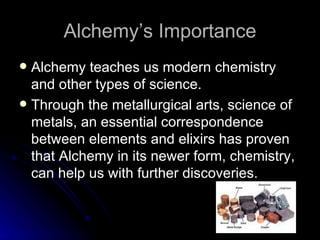
Alchemy’s Importance Alchemy teaches us modern chemistry and other types of science.  Through the metallurgical arts, science of metals, an essential correspondence between elements and elixirs has proven that Alchemy in its newer form, chemistry, can help us with further discoveries.
Cited Page Answers  com, 2009. Web. 4 Dec. 2009. <http://wiki.answers.com/Q/What_was_castle_life_like_during_medieval_times>.  Hull, Lise. Castles of Britian com, 1995. Web. 4 Dec. 2009. <http://www.castles-of-britain.com/index.htm>. Gies, Joseph, and Frances Gies. castle wales com, 1974. Web. 4 Dec. 2009. <http://www.castlewales.com/life.html>. Blackwood, Gary L.  Life in a Medieval Castle . San Diego: Lucent Books, 2000. Print. Hatzigeorgiou, Karen J.  Karen's Whimsy   Life in a Medieval Castle . com, 2009. Web. 7 Dec. 2009. <http://karenswhimsy.com/>. Newton, David E. “Alchemy.” Gale Encyclopedia of Science. Ed. K. Lee Lerner and Brenda Wilmoth Lerner. 4 th  ed. Detroit: Gale Group,2008. Student Resources Center Gold. Gale. Colony High school. 7 Dec. 2009 http://find.galegroup.com/srcx/infomark.do?&contentSet=GSRC&type=retrieve&tabID=T001&prodId=SRC-1&docId=EJ2644040057&source=gale&srcprod=SRCG&userGroupName=onta38245&version=1. Graham.  The Priory School Science  sch.uk, 2009. Web. 7 Dec. 2009. <http://www.priorycofe.surrey.sch.uk/information.htm>.

Pp[1]

  • 1.
    Medieval Castles, MedievalLife, and Alchemy By: Jessica Crutchfield And Madeline Geary P.6
  • 2.
    Castles There wasa moat- mainly for their wastes but could be used as defense. There was a hall on the ground floor. They had a kitchen where the main fireplace was. And there was a chapel.
  • 3.
    Castle Life inGeneral Castle life was mainly uncomfortable. It was also gloomy. However luckily it was safe.
  • 4.
    Castle Life inGeneral There was no central heating. However, even during warm months the castle would stay cool. When they did take baths they were taken in a wooden tub.
  • 5.
    Wealthy People Eventhe wealthy found hard times ahead of them. However, they did have it a lot better for they had: 1.) Servants 2.) Warm beds and blankets
  • 6.
    Wealthy People cont.3.) Tapestries hanging on the wall to block the wind The servants were always up before the wealthy making the meals and cleaning their house.
  • 7.
    Women and ChildrenA lot of the time the men would become wealthy from the women’s dowry. The lady was expected to dress elegantly. They also have servants to help them dress. The children of the rich were mostly taken care of by the servants. They were also placed in school.
  • 8.
    Time of WarSince the Castles were made of stone and they were tall; they were almost indestructible. The moat was also a good defense in war time.
  • 9.
    Alchemy Very earlyform of chemistry. The origin of Alchemy is still unknown today. The original goal of Alchemy was the transmuting of elements (changing one element into another).
  • 10.
    Alchemy Around theWorld It was an ancient practice that existed as a purpose of medicine and immortality. For example: the Philosopher’s Stone was thought to have been made by ‘Alchemists’ and it was expected to keep oneself immortal.
  • 11.
    Alchemy Around theWorld pt 2 Essentially such ideas of immortality or practices of medicine branched out around the world. Such places were: China, Arabia, Greece, Egypt, and Persia.
  • 12.
    The Practices TheChinese and Arabians had similar practices in that they both used elixirs that were supposed to prevent death, but instead killed the drinker. They also studied ancient texts that were supposed to be instructions to make gold.
  • 13.
    The Practices Pt2 The Greeks and Egyptians also emphasized their interest by searching for a ‘magical’ ingredient, powder, which they called Xerion. Later on, a scientist by the name of Isaac Newton took alchemy to a new level, calling it Chemistry.
  • 14.
    Alchemy to ChemistryNewton conducted alchemical experiments, which laid the foundation for the study of chemistry. Not only did this systematize and classify knowledge of elements and chemicals, it also led way towards a number of new discoveries.
  • 15.
    Origins Other thanalchemic studies being around the Middle East and Europe, it also exists today in the modern world in laboratories nationwide. And although it’s origin is still unknown it has been around since Fourth Century B.C.E.
  • 16.
    Alchemy’s Importance Alchemyteaches us modern chemistry and other types of science. Through the metallurgical arts, science of metals, an essential correspondence between elements and elixirs has proven that Alchemy in its newer form, chemistry, can help us with further discoveries.
  • 17.
    Cited Page Answers com, 2009. Web. 4 Dec. 2009. <http://wiki.answers.com/Q/What_was_castle_life_like_during_medieval_times>. Hull, Lise. Castles of Britian com, 1995. Web. 4 Dec. 2009. <http://www.castles-of-britain.com/index.htm>. Gies, Joseph, and Frances Gies. castle wales com, 1974. Web. 4 Dec. 2009. <http://www.castlewales.com/life.html>. Blackwood, Gary L. Life in a Medieval Castle . San Diego: Lucent Books, 2000. Print. Hatzigeorgiou, Karen J. Karen's Whimsy Life in a Medieval Castle . com, 2009. Web. 7 Dec. 2009. <http://karenswhimsy.com/>. Newton, David E. “Alchemy.” Gale Encyclopedia of Science. Ed. K. Lee Lerner and Brenda Wilmoth Lerner. 4 th ed. Detroit: Gale Group,2008. Student Resources Center Gold. Gale. Colony High school. 7 Dec. 2009 http://find.galegroup.com/srcx/infomark.do?&contentSet=GSRC&type=retrieve&tabID=T001&prodId=SRC-1&docId=EJ2644040057&source=gale&srcprod=SRCG&userGroupName=onta38245&version=1. Graham. The Priory School Science sch.uk, 2009. Web. 7 Dec. 2009. <http://www.priorycofe.surrey.sch.uk/information.htm>.