By: Janine Rumbaoa
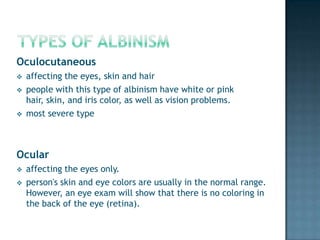
 called achromia,
achromasia, or achromatosis


 is a congenital disorder
characterized by the
complete or partial absence
of pigment in the skin, hair
and eyes due to absence or
defect of tyrosinase, a
copper-containing enzyme
involved in the production of
melanin
Albinism results from inheritance of recessive gene alleles and
is known to affect all vertebrates, including humans.


ALBINO- organism with complete absence of melanin


ALBINOID- an organism with only a diminished amount of
melanin


Albinism is associated with a number of vision defects, such as
photophobia, nystagmus and astigmatism. Lack of skin
pigmentation makes for more susceptibility to sunburn and
skin cancers.
Oculocutaneous
   affecting the eyes, skin and hair
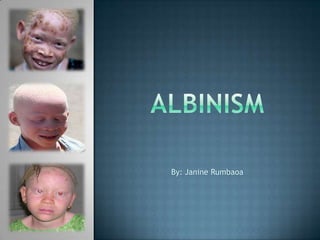
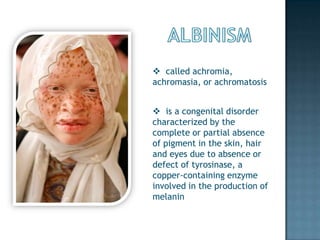
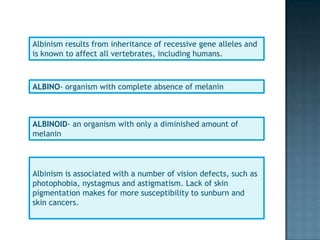
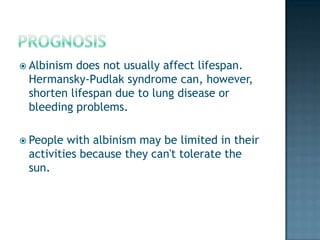
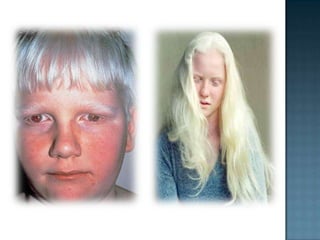
   people with this type of albinism have white or pink
    hair, skin, and iris color, as well as vision problems.
   most severe type


Ocular
   affecting the eyes only.
   person's skin and eye colors are usually in the normal range.
    However, an eye exam will show that there is no coloring in
    the back of the eye (retina).
Hermansky-Pudlak syndrome (HPS)

   is a form of albinism caused by a single gene. It can occur
    with a bleeding disorder, as well as with lung and bowel
    diseases.

   causes scarring of the lungs, or fibrosis, creating breathing
    difficulty and fatigue and leading to lung disease.

   HPS interferes with platelet formation, making it difficult
    for cuts and wounds to heal. Many albinos bruise easily,
    have frequent nosebleeds, and or experience gum bleeding
    while brushing their teeth. HPS in women causes excessive
    bleeding during labor and monthly menstrual cycles.
Chediak-Higashi Syndrome
   of coloring all over the skin, but not complete


Tuberous Sclerosis
   small areas without skin coloring


Waardenburg Syndrome
   often a lock of hair that grows on the forehead, or no
    coloring in one or both irises
A person with albinism will have one of the
  following symptoms:
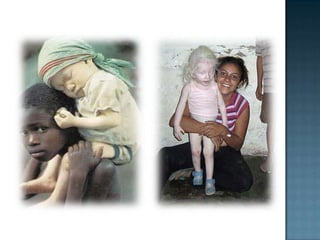
   Absence of color in the hair, skin, or iris of the eye
   Lighter than normal skin and hair
   Patchy


Many forms of albinism are associated with the
 following symptoms:
   Crossed eyes (strabismus)
   Light sensitivity (photophobia)
   Rapid eye movements (nystagmus)
   Vision problems, or functional blindness
   Genetic testing
    Electroretinogram test


 Reduce sunburn risk by avoiding the sun, using sunscreen, and
covering up completely with clothing when exposed to the sun.

 Sunscreen should have a high sun protection factor (SPF).

 Sunglasses (UV protected) may relieve light sensitivity.

 Glasses are often prescribed to correct vision problems and eye
position. Eye muscle surgery is sometimes recommended to
correct abnormal eye movements (nystagmus).
 Albinismdoes not usually affect lifespan.
 Hermansky-Pudlak syndrome can, however,
 shorten lifespan due to lung disease or
 bleeding problems.

 People with albinism may be limited in their
 activities because they can't tolerate the
 sun.
Albinism
Albinism
Albinism

Albinism

  • 1.
  • 2.
     called achromia, achromasia,or achromatosis  is a congenital disorder characterized by the complete or partial absence of pigment in the skin, hair and eyes due to absence or defect of tyrosinase, a copper-containing enzyme involved in the production of melanin
  • 3.
    Albinism results frominheritance of recessive gene alleles and is known to affect all vertebrates, including humans. ALBINO- organism with complete absence of melanin ALBINOID- an organism with only a diminished amount of melanin Albinism is associated with a number of vision defects, such as photophobia, nystagmus and astigmatism. Lack of skin pigmentation makes for more susceptibility to sunburn and skin cancers.
  • 4.
    Oculocutaneous  affecting the eyes, skin and hair  people with this type of albinism have white or pink hair, skin, and iris color, as well as vision problems.  most severe type Ocular  affecting the eyes only.  person's skin and eye colors are usually in the normal range. However, an eye exam will show that there is no coloring in the back of the eye (retina).
  • 5.
    Hermansky-Pudlak syndrome (HPS)  is a form of albinism caused by a single gene. It can occur with a bleeding disorder, as well as with lung and bowel diseases.  causes scarring of the lungs, or fibrosis, creating breathing difficulty and fatigue and leading to lung disease.  HPS interferes with platelet formation, making it difficult for cuts and wounds to heal. Many albinos bruise easily, have frequent nosebleeds, and or experience gum bleeding while brushing their teeth. HPS in women causes excessive bleeding during labor and monthly menstrual cycles.
  • 6.
    Chediak-Higashi Syndrome  of coloring all over the skin, but not complete Tuberous Sclerosis  small areas without skin coloring Waardenburg Syndrome  often a lock of hair that grows on the forehead, or no coloring in one or both irises
  • 7.
    A person withalbinism will have one of the following symptoms:  Absence of color in the hair, skin, or iris of the eye  Lighter than normal skin and hair  Patchy Many forms of albinism are associated with the following symptoms:  Crossed eyes (strabismus)  Light sensitivity (photophobia)  Rapid eye movements (nystagmus)  Vision problems, or functional blindness
  • 8.
    Genetic testing  Electroretinogram test  Reduce sunburn risk by avoiding the sun, using sunscreen, and covering up completely with clothing when exposed to the sun.  Sunscreen should have a high sun protection factor (SPF).  Sunglasses (UV protected) may relieve light sensitivity.  Glasses are often prescribed to correct vision problems and eye position. Eye muscle surgery is sometimes recommended to correct abnormal eye movements (nystagmus).
  • 9.
     Albinismdoes notusually affect lifespan. Hermansky-Pudlak syndrome can, however, shorten lifespan due to lung disease or bleeding problems.  People with albinism may be limited in their activities because they can't tolerate the sun.