 María Alejandra López Arévalo
 Juan Daniel López Franco
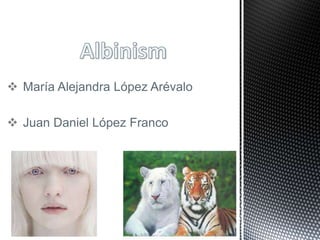
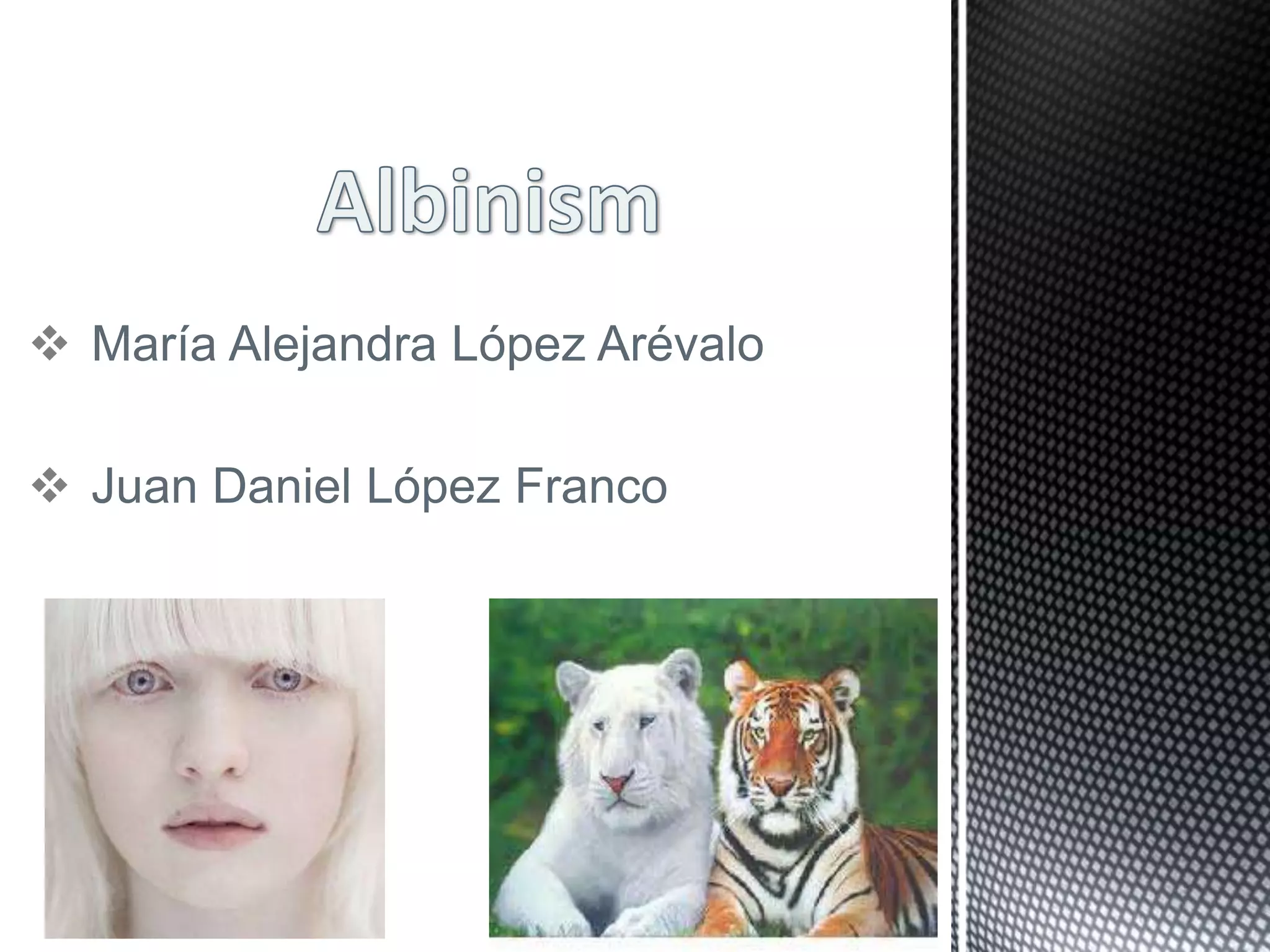
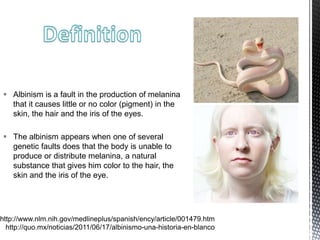
 Albinism is a fault in the production of melanina
that it causes little or no color (pigment) in the
skin, the hair and the iris of the eyes.
 The albinism appears when one of several
genetic faults does that the body is unable to
produce or distribute melanina, a natural
substance that gives him color to the hair, the
skin and the iris of the eye.
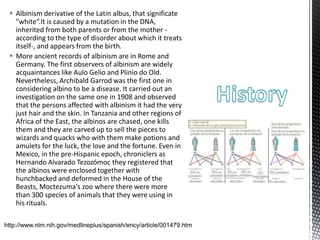
 Albinism derivative of the Latin albus, that significate
"white“.It is caused by a mutation in the DNA,
inherited from both parents or from the mother -
according to the type of disorder about which it treats
itself-, and appears from the birth.
 More ancient records of albinism are in Rome and
Germany. The first observers of albinism are widely
acquaintances like Aulo Gelio and Plinio do Old.
Nevertheless, Archibald Garrod was the first one in
considering albino to be a disease. It carried out an
investigation on the same one in 1908 and observed
that the persons affected with albinism it had the very
just hair and the skin. In Tanzania and other regions of
Africa of the East, the albinos are chased, one kills
them and they are carved up to sell the pieces to
wizards and quacks who with them make potions and
amulets for the luck, the love and the fortune. Even in
Mexico, in the pre-Hispanic epoch, chroniclers as
Hernando Alvarado Tezozómoc they registered that
the albinos were enclosed together with
hunchbacked and deformed in the House of the
Beasts, Moctezuma's zoo where there were more
than 300 species of animals that they were using in
his rituals.
 A person with albinism will have one of the following symptoms:
 Absence of color in the hair, the skin or the iris of the eye.
 Skin and clearer hair of normal.
 Absence of color in the skin by patches.
 Many forms of albinism are associated with the following symptoms:
 Cross-eyed Eyes (strabismus).
 Sensibility to the light (photophobia).
 Ocular rapid Movements (nistagmo).
 Problems of vision or functional blindness.
 The albinism is a universal
affection that can affect both the
man and the woman, even it is
very frequent in rates, mice,
rabbits, horses, porks, etc. There
are authors who speak about an
albino for every 20 000
inhabitants. A major frequency is
observed in consanguineous
marriages (about 20 per cent they
are prime brothers).
 Doctors also can diagnose the
affection with base in the
appearance of the skin, the hair
and the eyes. Likewise, an
ophthalmologist must carry out an
electrorretinografía, which can
reveal visual problems related to
the albinism. An examination of
provoked visual potentials can be
very useful when the diagnosis is
uncertain.
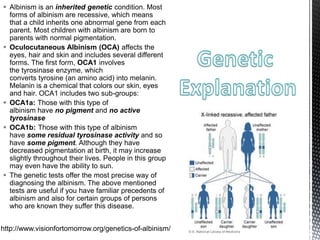
 Albinism is an inherited genetic condition. Most
forms of albinism are recessive, which means
that a child inherits one abnormal gene from each
parent. Most children with albinism are born to
parents with normal pigmentation.
 Oculocutaneous Albinism (OCA) affects the
eyes, hair and skin and includes several different
forms. The first form, OCA1 involves
the tyrosinase enzyme, which
converts tyrosine (an amino acid) into melanin.
Melanin is a chemical that colors our skin, eyes
and hair. OCA1 includes two sub-groups:
 OCA1a: Those with this type of
albinism have no pigment and no active
tyrosinase
 OCA1b: Those with this type of albinism
have some residual tyrosinase activity and so
have some pigment. Although they have
decreased pigmentation at birth, it may increase
slightly throughout their lives. People in this group
may even have the ability to sun.
 The genetic tests offer the most precise way of
diagnosing the albinism. The above mentioned
tests are useful if you have familiar precedents of
albinism and also for certain groups of persons
who are known they suffer this disease.
 The aim of the treatment is to relieve
the symptoms and depends on the
gravity of the disorder. The treatment
implies protecting the skin and the eyes
of the Sun: To reduce the risk of
suffering solar burns, avoiding the Sun,
using solar protectors and being
covered completely with clothes on
having be exposed to the Sun. The solar
protectors must have a high factor of
solar protection (FPS). The sunglasses
(protected against radiation UV) can
relieve the sensibility to the light. The
glasses often are prescribed to correct
the problems of vision and of position
of the eyes. Often, there is
recommended the surgery of the ocular
muscles to correct ocular abnormal
movements (nistagmo).

Albinism

  • 1.
     María AlejandraLópez Arévalo  Juan Daniel López Franco
  • 2.
     Albinism isa fault in the production of melanina that it causes little or no color (pigment) in the skin, the hair and the iris of the eyes.  The albinism appears when one of several genetic faults does that the body is unable to produce or distribute melanina, a natural substance that gives him color to the hair, the skin and the iris of the eye.
  • 3.
     Albinism derivativeof the Latin albus, that significate "white“.It is caused by a mutation in the DNA, inherited from both parents or from the mother - according to the type of disorder about which it treats itself-, and appears from the birth.  More ancient records of albinism are in Rome and Germany. The first observers of albinism are widely acquaintances like Aulo Gelio and Plinio do Old. Nevertheless, Archibald Garrod was the first one in considering albino to be a disease. It carried out an investigation on the same one in 1908 and observed that the persons affected with albinism it had the very just hair and the skin. In Tanzania and other regions of Africa of the East, the albinos are chased, one kills them and they are carved up to sell the pieces to wizards and quacks who with them make potions and amulets for the luck, the love and the fortune. Even in Mexico, in the pre-Hispanic epoch, chroniclers as Hernando Alvarado Tezozómoc they registered that the albinos were enclosed together with hunchbacked and deformed in the House of the Beasts, Moctezuma's zoo where there were more than 300 species of animals that they were using in his rituals.
  • 4.
     A personwith albinism will have one of the following symptoms:  Absence of color in the hair, the skin or the iris of the eye.  Skin and clearer hair of normal.  Absence of color in the skin by patches.  Many forms of albinism are associated with the following symptoms:  Cross-eyed Eyes (strabismus).  Sensibility to the light (photophobia).  Ocular rapid Movements (nistagmo).  Problems of vision or functional blindness.
  • 5.
     The albinismis a universal affection that can affect both the man and the woman, even it is very frequent in rates, mice, rabbits, horses, porks, etc. There are authors who speak about an albino for every 20 000 inhabitants. A major frequency is observed in consanguineous marriages (about 20 per cent they are prime brothers).  Doctors also can diagnose the affection with base in the appearance of the skin, the hair and the eyes. Likewise, an ophthalmologist must carry out an electrorretinografía, which can reveal visual problems related to the albinism. An examination of provoked visual potentials can be very useful when the diagnosis is uncertain.
  • 6.
     Albinism isan inherited genetic condition. Most forms of albinism are recessive, which means that a child inherits one abnormal gene from each parent. Most children with albinism are born to parents with normal pigmentation.  Oculocutaneous Albinism (OCA) affects the eyes, hair and skin and includes several different forms. The first form, OCA1 involves the tyrosinase enzyme, which converts tyrosine (an amino acid) into melanin. Melanin is a chemical that colors our skin, eyes and hair. OCA1 includes two sub-groups:  OCA1a: Those with this type of albinism have no pigment and no active tyrosinase  OCA1b: Those with this type of albinism have some residual tyrosinase activity and so have some pigment. Although they have decreased pigmentation at birth, it may increase slightly throughout their lives. People in this group may even have the ability to sun.  The genetic tests offer the most precise way of diagnosing the albinism. The above mentioned tests are useful if you have familiar precedents of albinism and also for certain groups of persons who are known they suffer this disease.
  • 7.
     The aimof the treatment is to relieve the symptoms and depends on the gravity of the disorder. The treatment implies protecting the skin and the eyes of the Sun: To reduce the risk of suffering solar burns, avoiding the Sun, using solar protectors and being covered completely with clothes on having be exposed to the Sun. The solar protectors must have a high factor of solar protection (FPS). The sunglasses (protected against radiation UV) can relieve the sensibility to the light. The glasses often are prescribed to correct the problems of vision and of position of the eyes. Often, there is recommended the surgery of the ocular muscles to correct ocular abnormal movements (nistagmo).