ALBERT BANDURA AND
SOCIAL LEARNING
THEORY
Presentation by;
AMAL JITH N.K
15386040
2nd MA Mass communication
INTRODUCTION
 Social learning theory emphasizes
on the importance of observing
and modelling the behaviours,
attitudes and emotional reactions
of others.
 Social learning theory focuses on
the learning that occurs within a
social context.
 He stressed the importance of
observational learning, imitation
and modeling.
ALBERT BANDURA
“..most learning is gained by people’s perception and thinking about
what they experience. They learn by copying the examples of others
around them.”
- Albert Bandura
 Born on December 4, 1925
 Canadian, American
 Studied at University of British
Columbia and University of Lowa.
 Researched and taught at Stanford
University
 Elected president of American
Psychological Association in 1974
 Famous for research on social
learning theories.
BASIC SOCIAL LEARNING
CONCEPTS
 Observational Learning - People can learn through
observation
 Intrinsic Reinforcement – Mental states are important
for learning
 The Modeling Process – Learning does not lead to a
change in behaviour.
OBSERVATIONAL LEARNING
 A live model: Involves an actual individual demonstrating
or acting out a behavior.
 A verbal instructional model: Involves descriptions and
explanations of a behavior.
 A symbolic model: Which involves real or fictional
characters displaying behaviors in books, films,
television programs, or online media.
INTRINSIC REINFORCEMENT
 Intrinsic reinforcement is a form of internal reward, such
as pride, satisfaction and a sense of accomplishment
THE MODELING PROCESS
 Not all observed behaviors are effectively learned.
Factors involving both the model and the learner can play
a role in whether social learning is successful.
 The following steps are involved in the observational
learning and modeling process:
 Attention
 Retention
 Motor reproduction
 Motivation
ATTENTION
RETENTION
REPRODUCTION
MOTIVATION
PRINCIPLES OF SOCIAL
LEARNING THEORY
 People can learn by observing the behaviour of others
and the outcomes of those behaviors.
 Learning can occur without a change in behavior.
 Cognition plays a role in learning.
SOCIAL LEARNING PERSPECTIVE
OF REINFORCEMENT AND
PUNISHMENT
1) SLT proposes that both reinforcement and punishment have
indirect effects on learning. They are not the sole or main
cause.
2) Reinforcement and punishment influence the extent to which
an individual exhibits a behaviour that has been learned.
3) The expectation of reinforcement influences cognitive
processes that promote learning. Therefore attention pays a
critical role in learning. And attention is influenced by the
expectation of reinforcement.
COGNITIVE FACTORS IN
SOCIAL LEARNING
 Learning without performance
 Cognitive processing during learning
 Expectations
 Reciprocal causation
 Modeling
RESEARCH
EXPERIMENTS
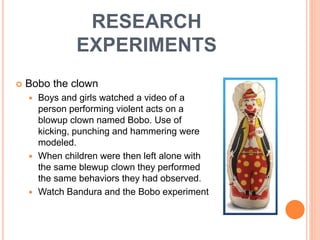
 Bobo the clown
 Boys and girls watched a video of a
person performing violent acts on a
blowup clown named Bobo. Use of
kicking, punching and hammering were
modeled.
 When children were then left alone with
the same blewup clown they performed
the same behaviors they had observed.
 Watch Bandura and the Bobo experiment
STILL IMAGES FROM BOBO
EXPERIMENT
VIDEO
The brain: a secret history- emotions; Bobo doll
experiment
https://youtu.be/zerCK0lRjp8
THERE ARE THREE CORE
CONCEPTS OF THE SOCIAL
LEARNING THEORY
 People can learn through observation
 Internal mental state is essential in the learning process
 Learning does not necessarily lead to change in behavior
WHAT DO TEACHER DO
UNDER THIS THEORY?
 To promote effective modeling a teacher must take sure
that the four essential conditions exist; attention,
retention, motor reproduction and motivation.
 Teachers must model appropriate behaviors and take
care that they do not model inappropriate behaviors.
 Teachers should help students set realistic expectations
for their academic accomplishments.
WHAT DO STUDENTS DO
UNDER THIS THEORY?
 Students often learn a great deal simply by observing
other people.
 Students must believe that they are capable of
accomplishing school tasks.
 Students should closely observe appropriate behaviors
and learn from them.
APPLYING BANDURA’S
THEORY IN THE CLASSROOM
 Carefully select audiovisuals that are to be used in the
classroom.
 Create a sense of collective-efficacy by emphasizing team
work.
 Set goals for students to accomplish, have them keep a
record of these accomplishments. Once a month take the
record out and celebrate their hard work.
 Incorporate technology by putting the students challenges
and accomplishments online on the class website so they
can show their friends and family.
THANK YOU 

Albert Bandura.pdf

  • 1.
    ALBERT BANDURA AND SOCIALLEARNING THEORY Presentation by; AMAL JITH N.K 15386040 2nd MA Mass communication
  • 2.
    INTRODUCTION  Social learningtheory emphasizes on the importance of observing and modelling the behaviours, attitudes and emotional reactions of others.  Social learning theory focuses on the learning that occurs within a social context.  He stressed the importance of observational learning, imitation and modeling.
  • 3.
    ALBERT BANDURA “..most learningis gained by people’s perception and thinking about what they experience. They learn by copying the examples of others around them.” - Albert Bandura  Born on December 4, 1925  Canadian, American  Studied at University of British Columbia and University of Lowa.  Researched and taught at Stanford University  Elected president of American Psychological Association in 1974  Famous for research on social learning theories.
  • 4.
    BASIC SOCIAL LEARNING CONCEPTS Observational Learning - People can learn through observation  Intrinsic Reinforcement – Mental states are important for learning  The Modeling Process – Learning does not lead to a change in behaviour.
  • 5.
    OBSERVATIONAL LEARNING  Alive model: Involves an actual individual demonstrating or acting out a behavior.  A verbal instructional model: Involves descriptions and explanations of a behavior.  A symbolic model: Which involves real or fictional characters displaying behaviors in books, films, television programs, or online media.
  • 6.
    INTRINSIC REINFORCEMENT  Intrinsicreinforcement is a form of internal reward, such as pride, satisfaction and a sense of accomplishment
  • 7.
    THE MODELING PROCESS Not all observed behaviors are effectively learned. Factors involving both the model and the learner can play a role in whether social learning is successful.  The following steps are involved in the observational learning and modeling process:  Attention  Retention  Motor reproduction  Motivation
  • 8.
  • 9.
  • 10.
  • 11.
  • 12.
    PRINCIPLES OF SOCIAL LEARNINGTHEORY  People can learn by observing the behaviour of others and the outcomes of those behaviors.  Learning can occur without a change in behavior.  Cognition plays a role in learning.
  • 13.
    SOCIAL LEARNING PERSPECTIVE OFREINFORCEMENT AND PUNISHMENT 1) SLT proposes that both reinforcement and punishment have indirect effects on learning. They are not the sole or main cause. 2) Reinforcement and punishment influence the extent to which an individual exhibits a behaviour that has been learned. 3) The expectation of reinforcement influences cognitive processes that promote learning. Therefore attention pays a critical role in learning. And attention is influenced by the expectation of reinforcement.
  • 14.
    COGNITIVE FACTORS IN SOCIALLEARNING  Learning without performance  Cognitive processing during learning  Expectations  Reciprocal causation  Modeling
  • 15.
    RESEARCH EXPERIMENTS  Bobo theclown  Boys and girls watched a video of a person performing violent acts on a blowup clown named Bobo. Use of kicking, punching and hammering were modeled.  When children were then left alone with the same blewup clown they performed the same behaviors they had observed.  Watch Bandura and the Bobo experiment
  • 16.
    STILL IMAGES FROMBOBO EXPERIMENT
  • 17.
    VIDEO The brain: asecret history- emotions; Bobo doll experiment https://youtu.be/zerCK0lRjp8
  • 18.
    THERE ARE THREECORE CONCEPTS OF THE SOCIAL LEARNING THEORY  People can learn through observation  Internal mental state is essential in the learning process  Learning does not necessarily lead to change in behavior
  • 19.
    WHAT DO TEACHERDO UNDER THIS THEORY?  To promote effective modeling a teacher must take sure that the four essential conditions exist; attention, retention, motor reproduction and motivation.  Teachers must model appropriate behaviors and take care that they do not model inappropriate behaviors.  Teachers should help students set realistic expectations for their academic accomplishments.
  • 20.
    WHAT DO STUDENTSDO UNDER THIS THEORY?  Students often learn a great deal simply by observing other people.  Students must believe that they are capable of accomplishing school tasks.  Students should closely observe appropriate behaviors and learn from them.
  • 21.
    APPLYING BANDURA’S THEORY INTHE CLASSROOM  Carefully select audiovisuals that are to be used in the classroom.  Create a sense of collective-efficacy by emphasizing team work.  Set goals for students to accomplish, have them keep a record of these accomplishments. Once a month take the record out and celebrate their hard work.  Incorporate technology by putting the students challenges and accomplishments online on the class website so they can show their friends and family.
  • 22.