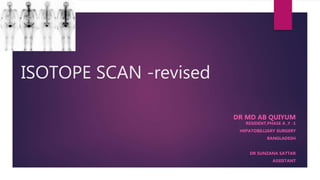
ISOTOPE SCAN -revised
DR MD AB QUIYUM
RESIDENT,PHASE A ,Y -1
HEPATOBILLIARY SURGERY
BANGLADESH
DR SUNZANA SATTAR
ASSISTANT
Contents
 History
 Isotope, radioisotope,isotope scan
 Isotope used in medicine
 Principle of radionuclide scan
 Gamma camera
 Ideal radioisotope
 Indication and potential side effect
 How it perform?
 Some example of scanning(bone,thyroid,kidney)
 Future aspect
History
 Medical historian…….difficult
 Artificial radioactivity ..1934 corie
 Medicine use ,,,1946
 Goerge hevesy (Germany)..rat…tracer principle
 Jown Lawrence ..father ..P-32..Leukamia
 1946..radioiodine ,,,thyroid malignancy
 1937..Tc ..pirie and Serge ..43 ..periodic table
 1960…generator system
 1970..most organ visualized
 1971…as faculty
 1950…pet/spect..2011
ISOTOPE
 Isotopes are variants of a particular chemical element which differ in
neutron number.
RADIOACTIVE ISOTOPE
ALSO called radioisotope, radionuclide, or radioactive nuclide,
An isotope having an unstable nucleus that decomposes
spontaneously by emission of a nuclear electron or helium
nucleus and radiation in the form of alpha, beta, and gamma
rays thus achieving a stable nuclear composition.
ISOTOPE USED IN MEDICAL PRACTICE
Radionuclide scan
 A radionuclide scan is a way of imaging bones, organs and other parts of the
body by using a small dose of a radioactive chemical.
 There are different types of radionuclide chemical.
 The one used depends on which organ or part of the body is to be scanned.
Principle
 Administration
 Distribution
 Emission
 Detection
 Image formation
continue…
 There are different types of radionuclides. Different ones tend to collect or
concentrate in different organs or tissues.
 The radionuclide used depends on which part of the body is to be scanned.
 For example, if radioactive iodine is injected into a vein it is quickly taken up into
the tissues of the thyroid gland. So, it is used to scan the thyroid gland.
 Cells which are most 'active' in the target tissue or organ will take up more of the
radionuclide. So, active parts of the tissue will emit more gamma rays than
less active or inactive parts.
Cont..
 For example, areas of the target organ or tissue
 which emit lots of gamma rays may be shown as red spots
('hot spots')
 Areas which emit low levels of gamma rays may be shown as
blue ('cold spots'). Various
 other colours may be used for 'in between' levels of gamma
rays emitted
.
Isotope used in scanning
 Tc -99m
 i-131
 TI-201
 Ga-67
 In -111
IDEAL RADIO ISOTOPE
 Availabe
 Low cost
 Pure gamma emitter
 Optimal gamma energy (100-200 kev)
 Optimal physical half life
 Safe
 Chemically active
 Tc-99m is the most ideal agent
WHY -TECHNETIUM
 1. it’s a gamma emitter.
 2.short half life (6.5 h) ,limited radio active exposure
 3.readily attached to a variety of different substances that are
concentrated in different organ.
 4.easily produced as and when required on site
 Technetium -99m generator is a device used to extract the isotope
from a source of decaying molybdenum -99
Gamma camera
 Mechanism….. Emission

 Photon
 Light
 voltage
 Image reconstruction
Cont….
******Types of gamma
camera…..
INDICATION OF SCAN
 1.bone scan,bone mineral density
 2.GI bleeding studies
 3.hepatobiliary imaging
 4.cardiac imaging
 Other….
 1,Lung scan
 2.KUB
 3.ONCOLOGY (SPECT AND PET)
 check the structure and function of tissues or organs, such
as the brain, thyroid, lungs, heart, liver, spleen, kidney and
bone
 detect disease in organs or bones
 find tumours, especially in the bones and thyroid
 determine the stage (how far cancer has spread and if it is
present in other organs and tissues)
 find out if cancer treatment is working
POTENTIAL ADVERSE EFFECT
 The dose of x-rays or radioactive materials used in nuclear medicine imaging can vary widely.
 Dose depends on the type of procedure and body part being examined.
 In general, the dose of radiopharmaceutical given is small and people are exposed to low levels of
radiation during the test
The potential health risks from radiation exposure are low compared with the potential benefits. There are
no known long-term adverse effects from such low-dose exposure.
 Some potential side effects
 Bleeding, soreness or swelling may develop at the injection site.
 Allergic reactions
Advantages
 1.Target tissue function is investigated.
 2.computer analysis and enhancement of result are available.
 3.all similar target tissue can be examined during one investigation
Disadvantage
 1. Poor image resolution –only minimal information of target tissue
is obtained
 2. the radiation dose to the whole body can be relatively high
 3. image are not usually disease specific
 4. Difficult to localize exact anatomical site of source of emission
 5. facilities are not widely available.
HOW performed ?
 Preparation……
 Before scan…..
 During scan…position
 tracer administration
 After scan….drink fluid
frequent voiding
 Pregnant…
 Children…..
CHILDRENS
 Sometimes special preparation is needed for nuclear medicine imaging.
 fast for 2–12 hours before the test if the stomach is being examined.
 drink plenty of water before a scan of the kidneys.
 A catheter
 Toys/blanket/story/cargiver/parents
 Most studies involve an intravenous injection of the radioactive isotope.
 A cream may be used to numb the area.
 Explain to children that they will feel:
 a sharp prick when the needle is inserted
 slight pressure or tugging when the radioactive isotope is injected
BONE SCAN
THYROID SCAN
 used to diagnose:
 lumps, nodules (cysts), or other
growths
 inflammation, or swelling
 an overactive thyroid
 an underactive thyroid
 goiter
 thyroid cancer
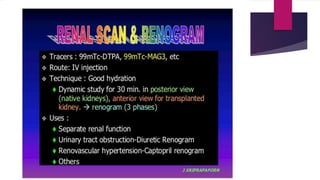
ISOTOPE RENOGRAM
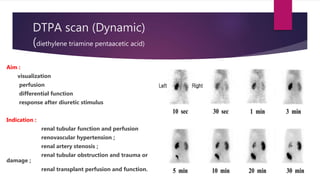
DTPA scan (Dynamic)
(diethylene triamine pentaacetic acid)
Aim :
visualization
perfusion
differential function
response after diuretic stimulus
Indication :
renal tubular function and perfusion
renovascular hypertension ;
renal artery stenosis ;
renal tubular obstruction and trauma or
damage ;
renal transplant perfusion and function.
Tc-MAG 3
(mercapto acetyle tri glycine)
 Alternate…….
 Better….visualization, differential function, response to diuretic
 Particularly to ….young and pt with compromised renal function
 Difference…
 protein bound
 extraction rate
 secreted or filtered
 parenchyma and collecting system
DMSA (static)
dimercaptosuccinic acid
 Indication :
 detection and/or evaluation of a renal scar,
 the small or absent kidney (renal agenesis),
 an occult duplex system, certain renal masses,
 systemic hypertension or suspected vasculitis.
FUTURE
 PET
 SPECT
 Positron emission tomography (PET)[1] is a nuclear medicine, functional imaging
technique that is used to observe metabolic processes in the body
 The system detects pairs of gamma rays emitted indirectly by a positron-emitting
radionuclide (tracer), which is introduced into the body on a biologically active
molecule. Three-dimensional images of tracer concentration within the body are
then constructed by computer analys
 A SPECT scan is a type of nuclear imaging test, which means it uses a
radioactive substance and a special camera to create 3-D pictures.
OTHERS
THANK YOU ALL

A.isotope final

  • 1.
    ISOTOPE SCAN -revised DRMD AB QUIYUM RESIDENT,PHASE A ,Y -1 HEPATOBILLIARY SURGERY BANGLADESH DR SUNZANA SATTAR ASSISTANT
  • 2.
    Contents  History  Isotope,radioisotope,isotope scan  Isotope used in medicine  Principle of radionuclide scan  Gamma camera  Ideal radioisotope  Indication and potential side effect  How it perform?  Some example of scanning(bone,thyroid,kidney)  Future aspect
  • 3.
    History  Medical historian…….difficult Artificial radioactivity ..1934 corie  Medicine use ,,,1946  Goerge hevesy (Germany)..rat…tracer principle  Jown Lawrence ..father ..P-32..Leukamia  1946..radioiodine ,,,thyroid malignancy  1937..Tc ..pirie and Serge ..43 ..periodic table  1960…generator system  1970..most organ visualized  1971…as faculty  1950…pet/spect..2011
  • 4.
    ISOTOPE  Isotopes arevariants of a particular chemical element which differ in neutron number.
  • 5.
    RADIOACTIVE ISOTOPE ALSO calledradioisotope, radionuclide, or radioactive nuclide, An isotope having an unstable nucleus that decomposes spontaneously by emission of a nuclear electron or helium nucleus and radiation in the form of alpha, beta, and gamma rays thus achieving a stable nuclear composition.
  • 6.
    ISOTOPE USED INMEDICAL PRACTICE
  • 7.
    Radionuclide scan  Aradionuclide scan is a way of imaging bones, organs and other parts of the body by using a small dose of a radioactive chemical.  There are different types of radionuclide chemical.  The one used depends on which organ or part of the body is to be scanned.
  • 8.
    Principle  Administration  Distribution Emission  Detection  Image formation
  • 9.
    continue…  There aredifferent types of radionuclides. Different ones tend to collect or concentrate in different organs or tissues.  The radionuclide used depends on which part of the body is to be scanned.  For example, if radioactive iodine is injected into a vein it is quickly taken up into the tissues of the thyroid gland. So, it is used to scan the thyroid gland.  Cells which are most 'active' in the target tissue or organ will take up more of the radionuclide. So, active parts of the tissue will emit more gamma rays than less active or inactive parts.
  • 10.
    Cont..  For example,areas of the target organ or tissue  which emit lots of gamma rays may be shown as red spots ('hot spots')  Areas which emit low levels of gamma rays may be shown as blue ('cold spots'). Various  other colours may be used for 'in between' levels of gamma rays emitted .
  • 11.
    Isotope used inscanning  Tc -99m  i-131  TI-201  Ga-67  In -111
  • 12.
    IDEAL RADIO ISOTOPE Availabe  Low cost  Pure gamma emitter  Optimal gamma energy (100-200 kev)  Optimal physical half life  Safe  Chemically active  Tc-99m is the most ideal agent
  • 13.
    WHY -TECHNETIUM  1.it’s a gamma emitter.  2.short half life (6.5 h) ,limited radio active exposure  3.readily attached to a variety of different substances that are concentrated in different organ.  4.easily produced as and when required on site  Technetium -99m generator is a device used to extract the isotope from a source of decaying molybdenum -99
  • 14.
    Gamma camera  Mechanism…..Emission   Photon  Light  voltage  Image reconstruction
  • 15.
  • 16.
    INDICATION OF SCAN 1.bone scan,bone mineral density  2.GI bleeding studies  3.hepatobiliary imaging  4.cardiac imaging  Other….  1,Lung scan  2.KUB  3.ONCOLOGY (SPECT AND PET)  check the structure and function of tissues or organs, such as the brain, thyroid, lungs, heart, liver, spleen, kidney and bone  detect disease in organs or bones  find tumours, especially in the bones and thyroid  determine the stage (how far cancer has spread and if it is present in other organs and tissues)  find out if cancer treatment is working
  • 17.
    POTENTIAL ADVERSE EFFECT The dose of x-rays or radioactive materials used in nuclear medicine imaging can vary widely.  Dose depends on the type of procedure and body part being examined.  In general, the dose of radiopharmaceutical given is small and people are exposed to low levels of radiation during the test The potential health risks from radiation exposure are low compared with the potential benefits. There are no known long-term adverse effects from such low-dose exposure.  Some potential side effects  Bleeding, soreness or swelling may develop at the injection site.  Allergic reactions
  • 18.
    Advantages  1.Target tissuefunction is investigated.  2.computer analysis and enhancement of result are available.  3.all similar target tissue can be examined during one investigation
  • 19.
    Disadvantage  1. Poorimage resolution –only minimal information of target tissue is obtained  2. the radiation dose to the whole body can be relatively high  3. image are not usually disease specific  4. Difficult to localize exact anatomical site of source of emission  5. facilities are not widely available.
  • 20.
    HOW performed ? Preparation……  Before scan…..  During scan…position  tracer administration  After scan….drink fluid frequent voiding  Pregnant…  Children…..
  • 21.
    CHILDRENS  Sometimes specialpreparation is needed for nuclear medicine imaging.  fast for 2–12 hours before the test if the stomach is being examined.  drink plenty of water before a scan of the kidneys.  A catheter  Toys/blanket/story/cargiver/parents  Most studies involve an intravenous injection of the radioactive isotope.  A cream may be used to numb the area.  Explain to children that they will feel:  a sharp prick when the needle is inserted  slight pressure or tugging when the radioactive isotope is injected
  • 25.
  • 26.
    THYROID SCAN  usedto diagnose:  lumps, nodules (cysts), or other growths  inflammation, or swelling  an overactive thyroid  an underactive thyroid  goiter  thyroid cancer
  • 27.
  • 29.
    DTPA scan (Dynamic) (diethylenetriamine pentaacetic acid) Aim : visualization perfusion differential function response after diuretic stimulus Indication : renal tubular function and perfusion renovascular hypertension ; renal artery stenosis ; renal tubular obstruction and trauma or damage ; renal transplant perfusion and function.
  • 30.
    Tc-MAG 3 (mercapto acetyletri glycine)  Alternate…….  Better….visualization, differential function, response to diuretic  Particularly to ….young and pt with compromised renal function  Difference…  protein bound  extraction rate  secreted or filtered  parenchyma and collecting system
  • 31.
    DMSA (static) dimercaptosuccinic acid Indication :  detection and/or evaluation of a renal scar,  the small or absent kidney (renal agenesis),  an occult duplex system, certain renal masses,  systemic hypertension or suspected vasculitis.
  • 38.
    FUTURE  PET  SPECT Positron emission tomography (PET)[1] is a nuclear medicine, functional imaging technique that is used to observe metabolic processes in the body  The system detects pairs of gamma rays emitted indirectly by a positron-emitting radionuclide (tracer), which is introduced into the body on a biologically active molecule. Three-dimensional images of tracer concentration within the body are then constructed by computer analys
  • 39.
     A SPECTscan is a type of nuclear imaging test, which means it uses a radioactive substance and a special camera to create 3-D pictures.
  • 40.
  • 41.