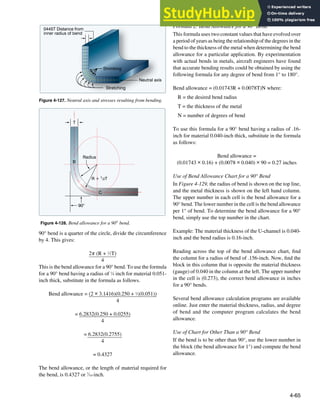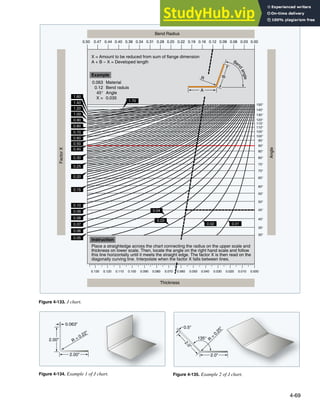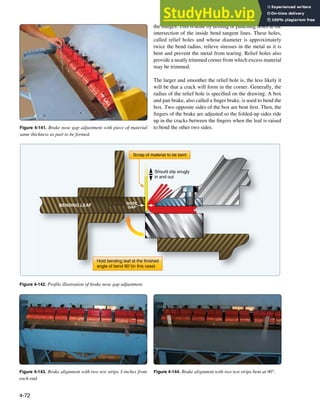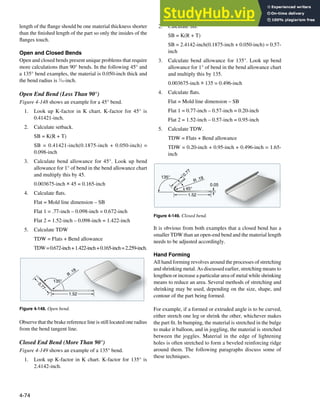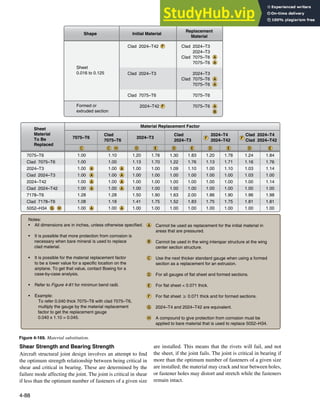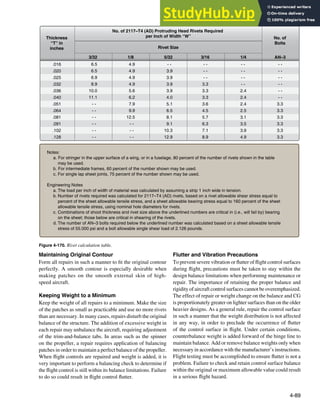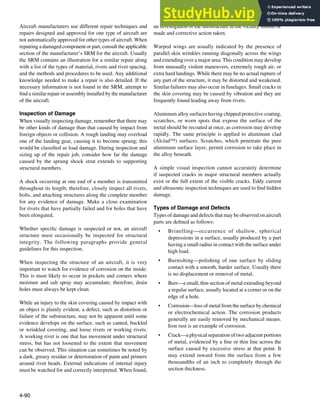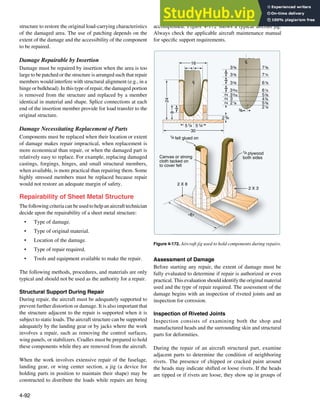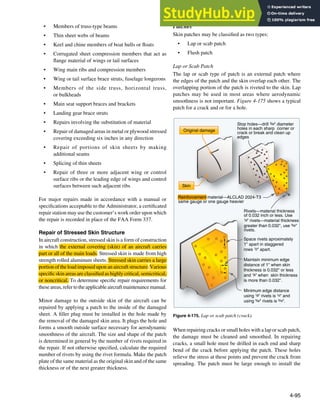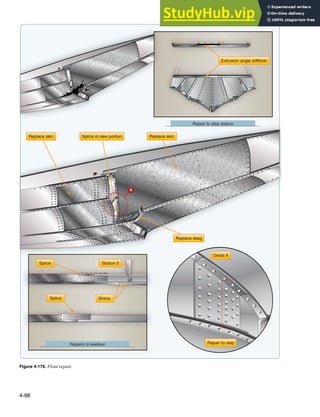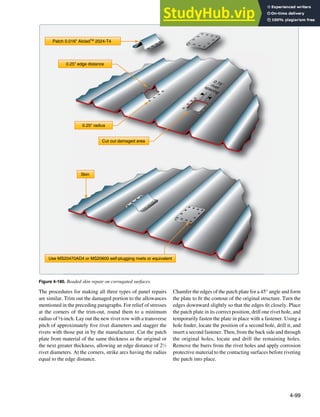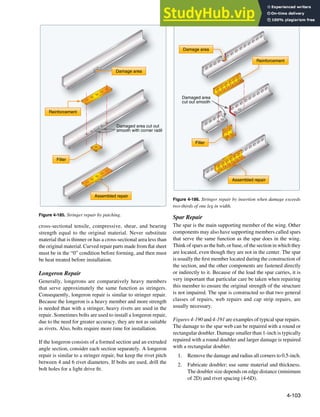
4-1
Aircraft Metal Structural Repair
The satisfactory performance of an aircraft requires
continuous maintenance of aircraft structural integrity. It is
important that metal structural repairs be made according
to the best available techniques because improper repair
techniques can pose an immediate or potential danger. The
reliability of an aircraft depends on the quality of the design,
as well as the workmanship used in making the repairs. The
design of an aircraft metal structural repair is complicated
by the requirement that an aircraft be as light as possible. If
weight were not a critical factor, repairs could be made with
a large margin of safety. In actual practice, repairs must be
strong enough to carry all of the loads with the required factor
of safety, but they must not have too much extra strength. For
example, a joint that is too weak cannot be tolerated, but a
joint that is too strong can create stress risers that may cause
cracks in other locations.
As discussed in Chapter 3, Aircraft Fabric Covering, sheet
metal aircraft construction dominates modern aviation.
Generally, sheet metal made of aluminum alloys is used in
airframe sections that serve as both the structure and outer
aircraft covering, with the metal parts joined with rivets or
other types of fasteners. Sheet metal is used extensively in
many types of aircraft from airliners to single engine airplanes,
but it may also appear as part of a composite airplane, such
as in an instrument panel. Sheet metal is obtained by rolling
metal into lat sheets of various thicknesses ranging from thin
(leaf) to plate (pieces thicker than 6 mm or 0.25 inch). The
thickness of sheet metal, called gauge, ranges from 8 to 30
with the higher gauge denoting thinner metal. Sheet metal
can be cut and bent into a variety of shapes.
Aircraft Metal Structural Repair
Chapter 4
4-2
Damage to metal aircraft structures is often caused by
corrosion, erosion, normal stress, and accidents and mishaps.
Sometimes aircraft structure modiications require extensive
structural rework. For example, the installation of winglets
on aircraft not only replaces a wing tip with a winglet, but
also requires extensive reinforcing of the wing structure to
carry additional stresses.
Numerous and varied methods of repairing metal structural
portions of an aircraft exist, but no set of speciic repair
patterns applies in all cases. The problem of repairing a
damaged section is usually solved by duplicating the original
part in strength, kind of material, and dimensions. To make a
structural repair, the aircraft technician needs a good working
knowledge of sheet metal forming methods and techniques. In
general, forming means changing the shape by bending and
forming solid metal. In the case of aluminum, this is usually
done at room temperature. All repair parts are shaped to it in
place before they are attached to the aircraft or component.
Forming may be a very simple operation, such as making
a single bend or a single curve, or it may be a complex
operation, requiring a compound curvature. Before forming
a part, the aircraft technician must give some thought to
the complexity of the bends, the material type, the material
thickness, the material temper, and the size of the part being
fabricated. In most cases, these factors determine which
forming method to use. Types of forming discussed in this
chapter include bending, brake forming, stretch forming, roll
forming, and spinning. The aircraft technician also needs
a working knowledge of the proper use of the tools and
equipment used in forming metal.
In addition to forming techniques, this chapter introduces
the airframe technician to the tools used in sheet metal
construction and repair, structural fasteners and their
installation, how to inspect, classify, and assess metal
structural damage, common repair practices, and types of
repairs.
The repairs discussed in this chapter are typical of those used
in aircraft maintenance and are included to introduce some of
the operations involved. For exact information about speciic
repairs, consult the manufacturer’s maintenance or structural
repair manuals (SRM). General repair instructions are also
discussed in Advisory Circular (AC) 43.13.1, Acceptable
Methods, Techniques, and Practices—Aircraft Inspection
and Repair.
Stresses in Structural Members
An aircraft structure must be designed so that it accepts all of
the stresses imposed upon it by the light and ground loads
without any permanent deformation. Any repair made must
accept the stresses, carry them across the repair, and then
transfer them back into the original structure. These stresses
are considered as lowing through the structure, so there
must be a continuous path for them, with no abrupt changes
in cross-sectional areas along the way. Abrupt changes in
cross-sectional areas of aircraft structure that are subject to
cycle loading or stresses result in a stress concentration that
may induce fatigue cracking and eventual failure. A scratch or
gouge in the surface of a highly stressed piece of metal causes
a stress concentration at the point of damage and could lead
to failure of the part. Forces acting on an aircraft, whether it
is on the ground or in light, introduce pulling, pushing, or
twisting forces within the various members of the aircraft
structure. While the aircraft is on the ground, the weight of
the wings, fuselage, engines, and empennage causes forces
to act downward on the wing and stabilizer tips, along the
spars and stringers, and on the bulkheads and formers. These
forces are passed from member to member causing bending,
twisting, pulling, compression, and shearing forces.
As the aircraft takes off, most of the forces in the fuselage
continue to act in the same direction; because of the motion
of the aircraft, they increase in intensity. The forces on the
wingtips and the wing surfaces, however, reverse direction;
instead of being downward forces of weight, they become
upward forces of lift. The forces of lift are exerted irst
against the skin and stringers, then are passed on to the ribs,
and inally are transmitted through the spars to be distributed
through the fuselage. The wings bend upward at their ends
and may lutter slightly during light. This wing bending
cannot be ignored by the manufacturer in the original design
and construction and cannot be ignored during maintenance.
It is surprising how an aircraft structure composed of
structural members and skin rigidly riveted or bolted together,
such as a wing, can bend or act so much like a leaf spring.
The six types of stress in an aircraft are described as tension,
compression, shear, bearing, bending, and torsion (or
twisting). The irst four are commonly called basic stresses;
the last two, combination stresses. Stresses usually act in
combinations rather than singly. [Figure 4-1]
Tension
Tension is the stress that resists a force that tends to pull apart.
The engine pulls the aircraft forward, but air resistance tries
to hold it back. The result is tension, which tends to stretch
the aircraft. The tensile strength of a material is measured in
pounds per square inch (psi) and is calculated by dividing
the load (in pounds) required to pull the material apart by its
cross-sectional area (in square inches).
The strength of a member in tension is determined on
the basis of its gross area (or total area), but calculations
4-3
Figure 4-1. Stresses in aircraft structures.
Compression
Tension
E. Bending
A. Tension
B. Compression
C. Torsion
D. Shear
Figure 4-2. Bearing stress.
Rivets
Top sheet is bearing against
the bottom sheet. Fasteners
are pressing top sheet against
bottom bearing
The force that
tries to pull the
two sheets apart
Bearing
stress
involving tension must take into consideration the net area of
the member. Net area is deined as the gross area minus that
removed by drilling holes or by making other changes in the
section. Placing rivets or bolts in holes makes no appreciable
difference in added strength, as the rivets or bolts will not
transfer tensional loads across holes in which they are inserted.
Compression
Compression, the stress that resists a crushing force, tends to
shorten or squeeze aircraft parts. The compressive strength of
a material is also measured in psi. Under a compressive load,
an undrilled member is stronger than an identical member
with holes drilled through it. However, if a plug of equivalent
or stronger material is itted tightly in a drilled member, it
transfers compressive loads across the hole, and the member
carries approximately as large a load as if the hole were not
there. Thus, for compressive loads, the gross or total area may
be used in determining the stress in a member if all holes are
tightly plugged with equivalent or stronger material.
Shear
Shear is the stress that resists the force tending to cause one
layer of a material to slide over an adjacent layer. Two riveted
plates in tension subject the rivets to a shearing force. Usually,
the shear strength of a material is either equal to or less than
its tensile or compressive strength. Shear stress concerns the
aviation technician chiely from the standpoint of the rivet
and bolt applications, particularly when attaching sheet metal,
because if a rivet used in a shear application gives way, the
riveted or bolted parts are pushed sideways.
Bearing
Bearing stress resists the force that the rivet or bolt places
on the hole. As a rule, the strength of the fastener should be
such that its total shear strength is approximately equal to
the total bearing strength of the sheet material. [Figure 4-2]
Torsion
Torsion is the stress that produces twisting. While moving
the aircraft forward, the engine also tends to twist it to one
side, but other aircraft components hold it on course. Thus,
torsion is created. The torsional strength of a material is its
resistance to twisting or torque (twisting stress). The stresses
arising from this action are shear stresses caused by the
rotation of adjacent planes past each other around a common
4-4
Figure 4-3. Scales.
1 2 3 4 5 6 7 8 9
1 2 3 4 6 7 8 9
8 16 24 32 40 48 56
4 8 12 16 20 24 28
28 4
56 8
1
9
1 2 3 4 5 6 7 8 9
4 8 12 16 20 24 28
4 8 12 16 20 24 28 4 8 12 16 20 24 28
8 16 24 32 40 48 56
8 16 24 32 40 48 56 8 16 24 32 40 48 56
1 2 3 4 5 6 7 8 9 1 2 3 4 5 6 7 8 9
1 2 3 4 6 7 8 9
5
1 2 3 4 6 7 8 9
5
1 2 3 4 6 7 8 9
5
9 1
5
10 THS
100 THS
32 MOS
64 THS
3
3
2
1 2 5
5
4
1
1 2 3 4 5
4
8 THS
16 THS
reference axis at right angles to these planes. This action may
be illustrated by a rod ixed solidly at one end and twisted
by a weight placed on a lever arm at the other, producing the
equivalent of two equal and opposite forces acting on the rod
at some distance from each other. A shearing action is set up
all along the rod, with the center line of the rod representing
the neutral axis.
Bending
Bending (or beam stress) is a combination of compression
and tension. The rod in Figure 4-1E has been shortened
(compressed) on the inside of the bend and stretched on
the outside of the bend. Note that the bending stress causes
a tensile stress to act on the upper half of the beam and a
compressive stress on the lower half. These stresses act in
opposition on the two sides of the center line of the member,
which is called the neutral axis. Since these forces acting in
opposite directions are next to each other at the neutral axis,
the greatest shear stress occurs along this line, and none exists
at the extreme upper or lower surfaces of the beam.
Tools for Sheet Metal Construction and
Repair
Without modern metalworking tools and machines, the
job of the airframe technician would be more dificult and
tiresome, and the time required to inish a task would be
much greater. These specialized tools and machines help the
airframe technician construct or repair sheet metal in a faster,
simpler, and better manner than possible in the past. Powered
by human muscle, electricity, or compressed air, these tools
are used to lay out, mark, cut, sand, or drill sheet metal.
Layout Tools
Before itting repair parts into an aircraft structure, the new
sections must be measured and marked, or laid out to the
dimensions needed to make the repair part. Tools utilized
for this process are discussed in this section.
Scales
Scales are available in various lengths, with the 6-inch and
12-inch scales being the most common and affordable. A
scale with fractions on one side and decimals on the other side
is very useful. To obtain an accurate measurement, measure
with the scale held on edge from the 1-inch mark instead of
the end. Use the graduation marks on the side to set a divider
or compass. [Figure 4-3]
Combination Square
A combination square consists of a steel scale with three
heads that can be moved to any position on the scale and
locked in place. The three heads are a stock head that
measures 90° and 45° angles, a protractor head that can
measure any angle between the head and the blade, and a
center head that uses one side of the blade as the bisector of
a 90° angle. The center of a shaft can be found by using the
center head. Place the end of the shaft in the V of the head
and scribe a line along the edge of the scale. Rotate the head
about 90° and scribe another line along the edge of the scale.
The two lines will cross at the center of the shaft. [Figure 4-4]
Dividers
Dividers are used to transfer a measurement from a device
to a scale to determine its value. Place the sharp points at
the locations from which the measurement is to be taken.
Then, place the points on a steel machinist’s scale, but put
one of the points on the 1-inch mark and measure from there.
[Figure 4-5]
Rivet Spacers
A rivet spacer is used to make a quick and accurate rivet
pattern layout on a sheet. On the rivet spacer, there are
alignment marks for 1
⁄2-inch, 3
⁄4-inch, 1-inch and 2-inch rivet
spacing. [Figure 4-6]
Marking Tools
Pens
Fiber-tipped pens are the preferred method of marking
lines and hole locations directly on aluminum, because the
graphite in a No. 2 pencil can cause corrosion when used on
4-5
Figure 4-4. Combination square.
11
2
0
180
90
3 4 5 8 9 10
Scriber
Level
Stock head Protractor head Center head
Figure 4-5. Divider.
Figure 4-6. Rivet spacer.
Figure 4-7. Scribe.
aluminum. Make the layout on the protective membrane if it
is still on the material, or mark directly on the material with
a iber-tipped pen, such as a ine-point Sharpie®, or cover
the material with masking tape and then mark on the tape.
Scribes
A scribe is a pointed instrument used to mark or score metal
to show where it is to be cut. A scribe should only be used
when marks will be removed by drilling or cutting because
it makes scratches that weaken the material and could cause
corrosion. [Figure 4-7]
Punches
Punches are usually made of carbon steel that has been
hardened and tempered. Generally classiied as solid or
hollow, punches are designed according to their intended
use. A solid punch is a steel rod with various shapes at the
end for different uses. For example, it is used to drive bolts
out of holes, loosen frozen or tight pins and keys, knock out
rivets, pierce holes in a material, etc. The hollow punch is
sharp edged and used most often for cutting out blanks. Solid
punches vary in both size and point design, while hollow
punches vary in size.
4-6
Figure 4-8. Prick punch.
Figure 4-9. Center punch.
Figure 4-10. Automatic center punch.
Figure 4-11. Transfer punch.
Transfer punch
Use old skin as template
New skin
Prick Punch
A prick punch is primarily used during layout to place
reference marks on metal because it produces a small
indentation. [Figure 4-8] After layout is finished, the
indentation is enlarged with a center punch to allow for
drilling. The prick punch can also be used to transfer
dimensions from a paper pattern directly onto the metal.
Take the following precautions when using a prick punch:
• Never strike a prick punch a heavy blow with a
hammer because it could bend the punch or cause
excessive damage to the item being worked.
• Do not use a prick punch to remove objects from holes
because the point of the punch spreads the object and
causes it to bind even more.
Center Punch
A center punch is used to make indentations in metal as an
aid in drilling. [Figure 4-9] These indentations help the drill,
which has a tendency to wander on a lat surface, stay on
the mark as it goes through the metal. The traditional center
punch is used with a hammer, has a heavier body than the
prick punch, and has a point ground to an angle of about 60°.
Take the following precautions when using a center punch:
• Never strike the center punch with enough force to
dimple the item around the indentation or cause the
metal to protrude through the other side of the sheet.
• Do not use a center punch to remove objects from holes
because the point of the punch spreads the object and
causes it to bind even more.
Automatic Center Punch
The automatic center punch performs the same function as an
ordinary center punch, but uses a spring tension mechanism
to create a force hard enough to make an indentation without
the need for a hammer. The mechanism automatically strikes
a blow of the required force when placed where needed and
pressed. This punch has an adjustable cap for regulating
the stroke; the point can be removed for replacement or
sharpening. Never strike an automatic center punch with a
hammer. [Figure 4-10]
Transfer Punch
A transfer punch uses a template or existing holes in the
structure to mark the locations of new holes. The punch is
centered in the old hole over the new sheet and lightly tapped
with a mallet. The result should be a mark that serves to locate
the hole in the new sheet. [Figure 4-11]
Drive Punch
The drive punch is made with a lat face instead of a point
because it is used to drive out damaged rivets, pins, and
bolts that sometimes bind in holes. The size of the punch
is determined by the width of the face, usually 1
⁄8-inch to
1
⁄4-inch. [Figure 4-12]
4-7
Figure 4-13. Pin punch.
Figure 4-12. Drive punch.
Figure 4-14. Chassis punch.
Figure 4-15. Awl.
Figure 4-16. Awl usage.
4
5
6
1
2
3
7
8
9
1
0
1
1
1
2
Pin Punch
The pin punch typically has a straight shank characterized
by a hexagonal body. Pin punch points are sized in 1
⁄32-inch
increments of an inch and range from 1
⁄16-inch to 3
⁄8-inch in
diameter. The usual method for driving out a pin or bolt is
to start working it out with a drive punch until the shank of
the punch is touching the sides of the hole. Then use a pin
punch to drive the pin or bolt the rest of the way out of the
hole. [Figure 4-13]
Chassis Punch
A chassis punch is used to make holes in sheet metal parts for
the installation of instruments and other avionics appliance,
as well as lightening holes in ribs and spars. Sized in 1
⁄16 of
an inch, they are available in sizes from 1
⁄2 inch to 3 inches.
[Figure 4-14]
Awl
A pointed tool for marking surfaces or for punching small
holes, an awl is used in aircraft maintenance to place scribe
marks on metal and plastic surfaces and to align holes, such
as in the installation of a deicer boot. [Figure 4-15]
Procedures for one use of an awl:
1. Place the metal to be scribed on a lat surface. Place
a ruler or straightedge on the guide marks already
measured and placed on the metal.
2. Remove the protective cover from the awl.
3. Hold the straightedge irmly. Hold the awl, as shown
in Figure 4-16, and scribe a line along the straightedge.
4. Replace the protective cover on the awl.
4-8
Figure 4-17. Hole duplicator.
New skin
Old skin
Angle
Figure 4-18. Kett saw.
Figure 4-19. Pneumatic circular saw.
Hole Duplicator
Available in a variety of sizes and styles, hole duplicators,
or hole inders, utilize the old covering as a template to
locate and match existing holes in the structure. Holes in
a replacement sheet or in a patch must be drilled to match
existing holes in the structure and the hole duplicator
simpliies this process. Figure 4-17 illustrates one type of
hole duplicator. The peg on the bottom leg of the duplicator
its into the existing rivet hole. To make the hole in the
replacement sheet or patch, drill through the bushing on the
top leg. If the duplicator is properly made, holes drilled in
this manner are in perfect alignment. A separate duplicator
must be used for each diameter of rivet.
Cutting Tools
Powered and nonpowered metal cutting tools available to the
aviation technician include various types of saws, nibblers,
shears, sanders, notchers, and grinders.
Circular-Cutting Saws
The circular cutting saw cuts with a toothed, steel disk that
rotates at high speed. Handheld or table mounted and powered
by compressed air, this power saw cuts metal or wood. To
prevent the saw from grabbing the metal, keep a irm grip
on the saw handle at all times. Check the blade carefully for
cracks prior to installation because a cracked blade can ly
apart during use, possibly causing serious injury.
Kett Saw
The Kett saw is an electrically operated, portable circular
cuttingsawthatusesbladesofvariousdiameters.[Figure4-18]
Since the head of this saw can be turned to any desired angle,
it is useful for removing damaged sections on a stringer. The
advantages of a Kett saw include:
1. Can cut metal up to 3
⁄16-inch in thickness.
2. No starting hole is required.
3. A cut can be started anywhere on a sheet of metal.
4. Can cut an inside or outside radius.
Pneumatic Circular Cutting Saw
The pneumatic circular cutting saw, useful for cutting out
damage, is similar to the Kett saw. [Figure 4-19]
4-9
Figure 4-20. Reciprocating saw.
Figure 4-21. Die grinder and cut-off wheel.
Figure 4-22. Nibbler.
Figure 4-23. Power squaring shear.
Nibblers
Usually powered by compressed air, the nibbler is another
tool for cutting sheet metal. Portable nibblers utilize a high
speed blanking action (the lower die moves up and down and
meets the upper stationary die) to cut the metal. [Figure 4-22]
The shape of the lower die cuts out small pieces of metal
approximately 1
⁄16 inch wide.
The cutting speed of the nibbler is controlled by the thickness
of the metal being cut. Nibblers satisfactorily cut through
sheets of metal with a maximum thickness of 1
⁄16 inch. Too
much force applied to the metal during the cutting operation
clogs the dies (shaped metal), causing them to fail or the motor
to overheat. Both electric and hand nibblers are available.
Shop Tools
Due to size, weight, and/or power source, shop tools are
usually in a ixed location, and the airframe part to be
constructed or repaired is brought to the tool.
Squaring Shear
The squaring shear provides the airframe technician with
a convenient means of cutting and squaring sheet metal.
Available as a manual, hydraulic, or pneumatic model,
this shear consists of a stationary lower blade attached to
a bed and a movable upper blade attached to a crosshead.
[Figure 4-23]
Reciprocating Saw
The versatile reciprocating saw achieves cutting action
through a push and pull (reciprocating) motion of the blade.
This saw can be used right sideup or upside down, a feature
that makes it handier than the circular saw for working in tight
or awkward spots. A variety of blade types are available for
reciprocating saws; blades with iner teeth are used for cutting
through metal. The portable, air-powered reciprocating saw
uses a standard hacksaw blade and can cut a 360° circle or
a square or rectangular hole. Unsuited for ine precision
work, this saw is more dificult to control than the pneumatic
circular cutting saw. A reciprocating saw should be used in
such a way that at least two teeth of the saw blade are cutting
at all times. Avoid applying too much downward pressure on
the saw handle because the blade may break. [Figure 4-20]
Cut-off Wheel
A cut-off wheel is a thin abrasive disc driven by a high-speed
pneumatic die-grinder and used to cut out damage on aircraft
skin and stringers. The wheels come in different thicknesses
and sizes. [Figure 4-21]
4-10
Figure 4-24. Foot-operated squaring shear.
Figure 4-25. Throatless shears.
A hand lever operates the cutting blade which is the top blade.
Throatless shears made by the Beverly Shear Manufacturing
Corporation, called BeverlyTM shears, are often used.
Scroll Shears
Scroll shears are used for cutting irregular lines on the
inside of a sheet without cutting through to the edge.
[Figure 4-26] The upper cutting blade is stationary while
the lower blade is movable. A handle connected to the lower
blade operates the machine.
Rotary Punch Press
Used in the airframe repair shop to punch holes in metal
parts, the rotary punch can cut radii in corners, make washers,
and perform many other jobs where holes are required.
[Figure 4-27] The machine is composed of two cylindrical
turrets, one mounted over the other and supported by the
frame, with both turrets synchronized to rotate together.
Index pins, which ensure correct alignment at all times, may
be released from their locking position by rotating a lever
on the right side of the machine. This action withdraws the
index pins from the tapered holes and allows an operator to
turn the turrets to any size punch desired.
Two squaring fences, consisting of thick strips of metal used
for squaring metal sheets, are placed on the bed. One squaring
fence is placed on the right side and one on the left to form a
90° angle with the blades. A scale graduated in fractions of
an inch is scribed on the bed for ease in placement.
To make a cut with a foot shear, move the upper blade down
by placing the foot on the treadle and pushing downward.
Once the metal is cut and foot pressure removed, a spring
raises the blade and treadle. Hydraulic or pneumatic models
utilize remote foot pedals to ensure operator safety.
The squaring shear performs three distinctly different
operations:
1. Cutting to a line
2. Squaring
3. Multiple cutting to a speciic size
When cutting to a line, place the sheet on the bed of the shears
in front of the cutting blade with the cutting line even with
the cutting edge of the bed. To cut the sheet with a foot shear,
step on the treadle while holding the sheet securely in place.
Squaring requires several steps. First, one end of the sheet
is squared with an edge (the squaring fence is usually used
on the edge). Then, the remaining edges are squared by
holding one squared end of the sheet against the squaring
fence and making the cut, one edge at a time, until all edges
have been squared.
When several pieces must be cut to the same dimensions, use
the backstop, located on the back of the cutting edge on most
squaring shears. The supporting rods are graduated in fractions
of an inch and the gauge bar may be set at any point on the rods.
Set the gauge bar the desired distance from the cutting blade
of the shears and push each piece to be cut against the gauge
bar. All the pieces can then be cut to the same dimensions
without measuring and marking each one separately.
Foot-operated shears have a maximum metal cutting capacity
of 0.063 inch of aluminum alloy. Use powered squaring
shears for cutting thicker metals. [Figure 4-24]
Throatless Shear
Airframe technicians use the throatless shear to cut aluminum
sheets up to 0.063 inches. This shear takes its name from the
fact that metal can be freely moved around the cutting blade
during cutting because the shear lacks a “throat” down which
metal must be fed. [Figure 4-25] This feature allows great
lexibility in what shapes can be cut because the metal can
be turned to any angle for straight, curved, and irregular cuts.
Also, a sheet of any length can be cut.
4-11
Figure 4-26. Scroll shears.
Figure 4-27. Rotary punch press.
Figure 4-29. Combination disk and belt sander.
Figure 4-28. Band saw.
When rotating the turret to change punches, release the
index lever when the desired die is within 1 inch of the ram,
and continue to rotate the turret slowly until the top of the
punch holder slides into the grooved end of the ram. The
tapered index locking pins will then seat themselves in the
holes provided and, at the same time, release the mechanical
locking device, which prevents punching until the turrets
are aligned.
To operate the machine, place the metal to be worked between
the die and punch. Pull the lever on the top of the machine
toward the operator, actuating the pinion shaft, gear segment,
toggle link, and the ram, forcing the punch through the metal.
When the lever is returned to its original position, the metal
is removed from the punch.
The diameter of the punch is stamped on the front of each
die holder. Each punch has a point in its center that is
placed in the center punch mark to punch the hole in the
correct location.
Band Saw
A band saw consists of a toothed metal band coupled to,
and continuously driven around, the circumferences of two
wheels. It is used to cut aluminum, steel, and composite parts.
[Figure 4-28] The speed of the band saw and the type and
style of the blade depends on the material to be cut. Band
saws are often designated to cut one type of material, and
if a different material is to be cut, the blade is changed. The
speed is controllable and the cutting platform can be tilted
to cut angled pieces.
Disk Sander
Disk sanders have a powered abrasive-covered disk or belt
and are used for smoothing or polishing surfaces. The sander
unit uses abrasive paper of different grits to trim metal parts.
It is much quicker to use a disk sander than to ile a part to
the correct dimension. The combination disk and belt sander
has a vertical belt sander coupled with a disk sander and is
often used in a metal shop. [Figure 4-29]
Belt Sander
The belt sander uses an endless abrasive belt driven by an
electric motor to sand down metal parts much like the disk
sander unit. The abrasive paper used on the belt comes in
different degrees of grit or coarseness. The belt sander is
4-12
Figure 4-31. Notcher.
Figure 4-32. Power notcher.
Figure 4-33. Grinder.
Tool rest
Figure 4-30. Belt sander.
available as a vertical or horizontal unit. The tension and
tracking of the abrasive belt can be adjusted so the belt runs
in the middle. [Figure 4-30]
Notcher
The notcher is used to cut out metal parts, with some
machines capable of shearing, squaring, and trimming
metal. [Figure 4-31] The notcher consists of a top and
bottom die and most often cuts at a 90° angle, although some
machines can cut metal into angles up to 180°. Notchers
are available in manual and pneumatic models able to cut
various thicknesses of mild steel and aluminum. This is an
excellent tool for quickly removing corners from sheet metal
parts. [Figure 4-32]
Wet or Dry Grinder
Grinding machines come in a variety of types and sizes,
depending upon the class of work for which they are to be
used. Dry and/or wet grinders are found in airframe repair
shops. Grinders can be bench or pedestal mounted. A dry
grinder usually has a grinding wheel on each end of a shaft
that runs through an electric motor or a pulley operated by a
belt. The wet grinder has a pump to supply a low of water
on a single grinding wheel. The water acts as a lubricant for
faster grinding while it continuously cools the edge of the
metal, reducing the heat produced by material being ground
against the wheel. It also washes away any bits of metal or
abrasive removed during the grinding operation. The water
returns to a tank and can be re-used.
Grinders are used to sharpen knives, tools, and blades as
well as grinding steel, metal objects, drill bits, and tools.
Figure 4-33 illustrates a common type bench grinder
found in most airframe repair shops. It can be used to
dress mushroomed heads on chisels and points on chisels,
screwdrivers, and drills, as well as for removing excess metal
from work and smoothing metal surfaces.
4-13
Figure 4-34. Straight snips.
Figure 4-35. Aviation snips.
The bench grinder is generally equipped with one medium-
grit and one ine-grit abrasive wheel. The medium-grit wheel
is usually used for rough grinding where a considerable
quantity of material is to be removed or where a smooth inish
is unimportant. The ine-grit wheel is used for sharpening
tools and grinding to close limits. It removes metal more
slowly, gives the work a smooth inish, and does not generate
enough heat to anneal the edges of cutting tools.
Before using any type of grinder, ensure that the abrasive
wheels are irmly held on the spindles by the lange nuts.
An abrasive wheel that comes off or becomes loose could
seriously injure the operator in addition to ruining the grinder.
A loose tool rest could cause the tool or piece of work to be
“grabbed” by the abrasive wheel and cause the operator’s
hand to come in contact with the wheel, possibly resulting
in severe wounds.
Always wear goggles when using a grinder, even if eyeshields
are attached to the grinder. Goggles should it irmly against
the face and nose. This is the only way to protect the eyes
from the ine pieces of steel. Goggles that do not it properly
should be exchanged for ones that do it. Be sure to check
the abrasive wheel for cracks before using the grinder. A
cracked abrasive wheel is likely to ly apart when turning at
high speeds. Never use a grinder unless it is equipped with
wheel guards that are irmly in place.
Grinding Wheels
A grinding wheel is made of a bonded abrasive and provides
an eficient way to cut, shape, and inish metals. Available in
a wide variety of sizes and numerous shapes, grinding wheels
are also used to sharpen knives, drill bits, and many other
tools, or to clean and prepare surfaces for painting or plating.
Grinding wheels are removable and a polishing or bufing
wheel can be substituted for the abrasive wheel. Silicon
carbide and aluminum oxide are the kinds of abrasives used
in most grinding wheels. Silicon carbide is the cutting agent
for grinding hard, brittle material, such as cast iron. It is
also used in grinding aluminum, brass, bronze, and copper.
Aluminum oxide is the cutting agent for grinding steel and
other metals of high tensile strength.
Hand Cutting Tools
Many types of hand cutting tools are available to cut light
gauge sheet metal. Four cutting tools commonly found in the
air frame repair shop are straight hand snips, aviation snips,
iles, and burring tools.
Straight Snips
Straight snips, or sheet metal shears, have straight
blades with cutting edges sharpened to an 85° angle.
[Figure 4-34] Available in sizes ranging from 6 to 14 inches,
they cut aluminum up to 1
⁄16 of an inch. Straight snips can be
used for straight cutting and large curves, but aviation snips
are better for cutting circles or arcs.
Aviation Snips
Aviation snips are used to cut holes, curved parts, round
patches, and doublers (a piece of metal placed under a part
to make it stiffer) in sheet metal. Aviation snips have colored
handles to identify the direction of the cuts: yellow aviation
snips cut straight, green aviation snips curve right, and red
aviation snips curve left. [Figure 4-35]
Files
The ile is an important but often overlooked tool used to
shape metal by cutting and abrasion. Files have ive distinct
properties: length, contour, the form in cross section, the
kind of teeth, and the ineness of the teeth. Many different
types of iles are available and the sizes range from 3 to 18
inches. [Figure 4-36]
4-14
Figure 4-37. Die grinder.
Figure 4-38. Burring tools.
Figure 4-36. Files.
The portion of the ile on which the teeth are cut is called the
face. The tapered end that its into the handle is called the tang.
The part of the ile where the tang begins is the heel. The length
of a ile is the distance from the point or tip to the heel and
does not include the tang. The teeth of the ile do the cutting.
These teeth are set at an angle across the face of the ile. A
ile with a single row of parallel teeth is called a single-cut
ile. The teeth are cut at an angle of 65°–85° to the centerline,
depending on the intended use of the ile. Files that have one
row of teeth crossing another row in a crisscross pattern are
called double-cut iles. The angle of the irst set usually is
40°–50° and that of the crossing teeth 70°–80°. Crisscrossing
produces a surface that has a very large number of little teeth
that slant toward the tip of the ile. Each little tooth looks like
an end of a diamond point cold chisel.
Files are graded according to the tooth spacing; a coarse ile
has a small number of large teeth, and a smooth ile has a large
number of ine teeth. The coarser the teeth, the more metal is
removed on each stroke of the ile. The terms used to indicate
the coarseness or ineness of a ile are rough, coarse, bastard,
second cut, smooth, and dead smooth, and the ile may be
either single cut or double cut. Files are further classiied
according to their shape. Some of the more common types
are: lat, triangle, square, half round, and round.
There are several iling techniques. The most common is to
remove rough edges and slivers from the inished part before
it is installed. Crossiling is a method used for iling the
edges of metal parts that must it tightly together. Crossiling
involves clamping the metal between two strips of wood
and iling the edge of the metal down to a preset line. Draw
iling is used when larger surfaces need to be smoothed and
squared. It is done by drawing the ile over the entire surface
of the work.
To protect the teeth of a ile, iles should be stored separately
in a plastic wrap or hung by their handles. Files kept in a
toolbox should be wrapped in waxed paper to prevent rust
from forming on the teeth. File teeth can be cleaned with a
ile card.
Die Grinder
A die grinder is a handheld tool that turns a mounted
cutoff wheel, rotary ile, or sanding disk at high speed.
[Figure 4-37] Usually powered by compressed air, electric
die grinders are also used. Pneumatic die grinders run at
12,000 to 20,000 revolutions per minute (rpm) with the
rotational speed controlled by the operator who uses a hand-
or foot-operated throttle to vary the volume of compressed
air. Available in straight, 45°, and 90° models, the die
grinder is excellent for weld breaking, smoothing sharp
edges, deburring, porting, and general high-speed polishing,
grinding, and cutting.
Burring Tool
This type of tool is used to remove a burr from an edge of a
sheet or to deburr a hole. [Figure 4-38]
Hole Drilling
Drilling holes is a common operation in the airframe repair
shop. Once the fundamentals of drills and their uses are
learned, drilling holes for rivets and bolts on light metal is
not dificult. While a small portable power drill is usually
the most practical tool for this common operation in airframe
metalwork, sometimes a drill press may prove to be the better
piece of equipment for the job.
4-15
Figure 4-39. Drill motors.
Figure 4-41. Nutplate drill.
Figure 4-40. Angle drill motors.
Portable Power Drills
Portable power drills operate by electricity or compressed air.
Pneumatic drill motors are recommended for use on repairs
around lammable materials where potential sparks from an
electric drill motor might become a ire hazard.
When using the portable power drill, hold it irmly with both
hands. Before drilling, be sure to place a backup block of
wood under the hole to be drilled to add support to the metal
structure. The drill bit should be inserted in the chuck and
tested for trueness or vibration. This may be visibly checked
by running the motor freely. A drill bit that wobbles or is
slightly bent should not be used since such a condition causes
enlarged holes. The drill should always be held at right angles
to the work regardless of the position or curvatures. Tilting
the drill at any time when drilling into or withdrawing from
the material may cause elongation (egg shape) of the hole.
When drilling through sheet metal, small burrs are formed
around the edge of the hole. Burrs must be removed to allow
rivets or bolts to it snugly and to prevent scratching. Burrs
may be removed with a bearing scraper, a countersink, or
a drill bit larger than the hole. If a drill bit or countersink
is used, it should be rotated by hand. Always wear safety
goggles while drilling.
Pneumatic Drill Motors
Pneumatic drill motors are the most common type of drill
motor for aircraft repair work. [Figure 4-39] They are light
weight and have suficient power and good speed control.
Drill motors are available in many different sizes and models.
Most drill motors used for aircraft sheet metal work are rated
at 3,000 rpm, but if drilling deep holes or drilling in hard
materials, such as corrosion resistant steel or titanium, a drill
motor with more torque and lower rpm should be selected to
prevent damage to tools and materials.
Right Angle and 45° Drill Motors
Right angle and 45° drill motors are used for positions that are
not accessible with a pistol grip drill motor. Most right angle
drill motors use threaded drill bits that are available in several
lengths. Heavy-duty right angle drills are equipped with a
chuck similar to the pistol grip drill motor. [Figure 4-40]
Two Hole
Special drill motors that drill two holes at the same time are
used for the installation of nutplates. By drilling two holes
at the same time, the distance between the holes is ixed and
the holes line up perfectly with the holes in the nutplate.
[Figure 4-41]
Drill Press
The drill press is a precision machine used for drilling holes
that require a high degree of accuracy. It serves as an accurate
means of locating and maintaining the direction of a hole that
is to be drilled and provides the operator with a feed lever
that makes the task of feeding the drill into the work easier.
The upright drill press is the most common of the variety of
drill presses available. [Figure 4-42]
4-16
Figure 4-42. Drill press.
When using a drill press, the height of the drill press table is
adjusted to accommodate the height of the part to be drilled.
When the height of the part is greater than the distance
between the drill and the table, the table is lowered. When
the height of the part is less than the distance between the
drill and the table, the table is raised.
After the table is properly adjusted, the part is placed on the
table and the drill is brought down to aid in positioning the
metal so that the hole to be drilled is directly beneath the point
of the drill. The part is then clamped to the drill press table to
prevent it from slipping during the drilling operation. Parts
not properly clamped may bind on the drill and start spinning,
causing serious cuts on the operator’s arms or body, or loss
of ingers or hands. Always make sure the part to be drilled
is properly clamped to the drill press table before starting
the drilling operation.
The degree of accuracy that it is possible to attain when using
the drill press depends to a certain extent on the condition of
the spindle hole, sleeves, and drill shank. Therefore, special
care must be exercised to keep these parts clean and free from
nicks, dents, and warpage. Always be sure that the sleeve is
securely pressed into the spindle hole. Never insert a broken
drill in a sleeve or spindle hole. Be careful never to use the
sleeve-clamping vise to remove a drill since this may cause
the sleeve to warp.
The drill speed on a drill press is adjustable. Always select the
optimum drill speed for the material to be drilled. Technically,
the speed of a drill bit means its speed at the circumference,
in surface feet per minute (sfm). The recommended speed for
drilling aluminum alloy is from 200 to 300 sfm, and for mild
steel is 30 to 50 sfm. In practice, this must be converted into
rpm for each size drill. Machinist and mechanic handbooks
include drill rpm charts or drill rpm may be computed by
use of the formula:
CS × 4
= rpm
D
CS = The recommended cutting speed in sfm
D = The diameter of the drill bit in inches
Example: At what rpm should a 1
⁄8-inch drill turn to drill
aluminum at 300 sfm?
Drill Extensions and Adapters
When access to a place where drilling is difficult or
impossible with a straight drill motor, various types of drill
extensions and adapters are used.
Extension Drill Bits
Extension drill bits are widely used for drilling holes in
locations that require reaching through small openings or
past projections. These drill bits, which come in 6- to 12-
inch lengths, are high speed with spring-tempered shanks.
Extension drill bits are ground to a special notched point,
which reduces end thrust to a minimum. When using
extension drill bits always:
1. Select the shortest drill bit that will do the job. It is
easier to control.
2. Check the drill bit for straightness. A bent drill bit
makes an oversized hole and may whip, making it
dificult to control.
3. Keep the drill bit under control. Extension drills
smaller than 1
⁄4-inch must be supported by a drill
guard made from a piece of tubing or spring to prevent
whipping.
Straight Extension
A straight extension for a drill can be made from an ordinary
piece of drill rod. The drill bit is attached to the drill rod by
shrink itting, brazing, or silver soldering.
Angle Adapters
Angle adapters can be attached to an electric or pneumatic
drill when the location of the hole is inaccessible to a straight
drill. Angle adapters have an extended shank fastened to
the chuck of the drill. The drill is held in one hand and the
adapter in the other to prevent the adapter from spinning
around the drill chuck.
Snake Attachment
The snake attachment is a lexible extension used for drilling
in places inaccessible to ordinary drills. Available for electric
and pneumatic drill motors, its lexibility permits drilling
around obstructions with minimum effort. [Figure 4-43]
4-17
Figure 4-43. Snake attachment.
Figure 4-44. Parts of a drill.
Figure 4-45. Types of drill bits.
Notched point chisel edge
Flute Cutting lips
Land
Body
Shank
HSS
HSS
HSS
HSS
HSS
HSS
HSS
HSS
HSS
HSS
HSS
HSS
HSS
HSS
HSS
HSS
HSS
HSS
HSS
HSS
HSS
HSS
v
v
v
v
v
/
/
/
/
/
/
/
/
High speed steel, short shank
High speed steel, standard length (jobbers length)
Step drill
Cobalt vanadium alloy, standard length
Figure 4-46. Twist drill bits.
Types of Drill Bits
A wide variety of drill bits including specialty bits for speciic
jobs are available. Figure 4-44 illustrates the parts of the
drill bit and Figure 4-45 shows some commonly used drill
bits. High speed steel (HSS) drill bits come in short shank or
standard length, sometimes called jobbers length. HSS drill
bits can withstand temperatures nearing the critical range of
1,400 °F (dark cherry red) without losing their hardness. The
industry standard for drilling metal (aluminum, steel, etc.),
these drill bits stay sharper longer.
Step Drill Bits
Typically, the procedure for drilling holes larger than 3
⁄16
inch in sheet metal is to drill a pilot hole with a No. 40 or
No. 30 drill bit and then to oversize with a larger drill bit to
the correct size. The step drill combines these two functions
into one step. The step drill bit consists of a smaller pilot
drill point that drills the initial small hole. When the drill bit
is advanced further into the material, the second step of the
drill bit enlarges the hole to the desired size.
Step drill bits are designed to drill round holes in most metals,
plastic, and wood. Commonly used in general construction
and plumbing, they work best on softer materials, such as
plywood, but can be used on very thin sheet metal. Step drill
bits can also be used to deburr holes left by other bits.
Cobalt Alloy Drill Bits
Cobalt alloy drill bits are designed for hard, tough metals like
corrosion-resistant steel and titanium. It is important for the
aircraft technician to note the difference between HSS and
cobalt, because HSS drill bits wear out quickly when drilling
titanium or stainless. Cobalt drill bits are excellent for drilling
titanium or stainless steel, but do not produce a quality hole
in aluminum alloys. Cobalt drill bits can be recognized by
thicker webs and a taper at the end of the drill shank.
Twist Drill Bits
Easily the most popular drill bit type, the twist drill bit has
spiral grooves or lutes running along its working length.
[Figure 4-46] This drill bit comes in a single-luted, two-
luted, three-luted, and four-luted styles. Single-luted and
two-luted drill bits (most commonly available) are used for
originating holes. Three-luted and four-luted drill bits are
used interchangeably to enlarge existing holes. Twist drill
bits are available in a wide choice of tooling materials and
lengths with the variations targeting speciic projects.
4-18
80
79
1/54
78
77
76
75
74
73
72
71
70
69
68
1/32
67
66
65
64
63
62
61
60
59
58
57
56
3/64
55
54
53
1/16
52
51
50
49
48
5/64
47
46
45
44
43
42
3/32
41
40
39
38
37
36
7/64
35
34
33
32
31
1/8
30
29
28
9/64
27
26
25
24
23
5/32
22
21
20
19
18
11/64
17
16
15
14
13
3/16
12
11
10
9
8
7
13/64
6
5
4
3
7/32
2
1
A
15/64
B
C
D
1/4
E
F
G
17/64
H
I
J
K
9/32
L
M
19/64
N
5/16
O
P
21/64
Q
R
11/32
S
T
23/64
U
3/8
V
W
25/64
X
Y
13/32
Z
27/64
7/16
29/64
15/32
31/64
1/2
33/64
17/32
35/64
9/16
37/64
19/32
39/84
5/8
41/64
21/32
43/64
11/16
45/64
23/32
47/64
3/4
49/64
25/32
51/64
13/16
53/64
27/32
55/64
7/8
57/64
29/32
59/64
15/16
61/64
31/32
63/64
1
.0135
.0145
.0156
.0160
.0180
.0200
.0210
.0225
.0240
.0250
.0260
.0280
.0293
.0310
.0312
.0320
.0330
.0350
.0360
.0370
.0380
.0390
.0400
.0410
.0420
.0430
.0465
.0468
.0520
.0550
.0595
.0625
.0635
.0670
.0700
.0730
.0760
.0781
.0785
.0810
.0820
.0860
.0890
.0935
.0937
.0960
.0980
.0995
.1015
.1040
.1065
.1093
.1100
.1110
.1130
.1160
.1200
.1250
.1285
.1360
.1405
.1406
.1440
.1470
.1495
.1520
.1540
.1562
.1570
.1590
.1610
.1660
.1695
.1718
.1730
.1770
.1800
.1820
.1850
.1875
.1890
.1910
.1935
.1960
.1990
.2010
.2031
.2040
.2055
.2090
.2130
.2187
.2210
.2280
.2340
.2343
.2380
.2420
.2460
.2500
.2500
.2570
.2610
.2656
.2660
.2720
.2770
.2810
.2812
.2900
.2950
.2968
.3020
.3125
.3160
.3230
.3281
.3320
.3390
.3437
.3480
.3580
.3593
.3680
.3750
.3770
.3860
.3906
.3970
.4040
.4062
.4130
.4219
.4375
.4531
.4687
.4844
.5000
.5156
.5312
.5469
.5625
.5781
.5937
.6094
.6250
.6406
.6562
.6719
.6875
.7031
.7187
.7344
.7500
.7656
.7812
.7969
.8125
.8281
.8437
.8594
.8750
.8906
.9062
.9219
.9375
.9531
.9687
.9844
Drill
Size
Drill
Size
Drill
Size
Drill
Size
Drill
Size
Decimal
(Inches)
Decimal
(Inches)
Decimal
(Inches)
Decimal
(Inches)
Decimal
(Inches)
1.0000
Figure 4-47. Drill sizes and decimal equivalents.
The standard twist drill bits used for drilling aluminum are
made from HSS and have a 135° split point. Drill bits for
titanium are made from cobalt vanadium for increased wear
resistance.
Drill Bit Sizes
Drill diameters are grouped by three size standards: number,
letter, and fractional. The decimal equivalents of standard
drill are shown in Figure 4-47.
Drill Lubrication
Normal drilling of sheet material does not require lubrication,
but lubrication should be provided for all deeper drilling.
Lubricants serve to assist in chip removal, which prolongs
drill life and ensures a good inish and dimensional accuracy
of the hole. It does not prevent overheating. The use of a
lubricant is always a good practice when drilling castings,
forgings, or heavy gauge stock. A good lubricant should be
thin enough to help in chip removal but thick enough to stick
to the drill. For aluminum, titanium, and corrosion-resistant
steel, a cetyl alcohol based lubricant is the most satisfactory.
Cetyl alcohol is a nontoxic fatty alcohol chemical produced in
liquid, paste, and solid forms. The solid stick and block forms
quickly liquefy at drilling temperatures. For steel, sulfurized
mineral cutting oil is superior. Sulfur has an afinity for steel,
which aids in holding the cutting oil in place. In the case of
4-19
Figure 4-48. Reamers.
1
2
3
Figure 4-49. Drill stop.
HSS
HSS
HSS
HSS
HSS
HSS
HSS
HSS
SS
Figure 4-50. Drill bushings.
Arm-type bushing holder
Bushing holder
Figure 4-51. Bushing holder.
deep drilling, the drill should be withdrawn at intervals to
relieve chip packing and to ensure the lubricant reaches the
point. As a general rule, if the drill is large or the material
hard, use a lubricant.
Reamers
Reamers, used for enlarging holes and inishing them smooth
to a required size, are made in many styles. They can be
straight or tapered, solid or expansive, and come with straight
or helical lutes. Figure 4-48 illustrates three types of reamers:
1. Three or four luted production bullet reamers are
customarily used where a iner inish and/or size is
needed than can be achieved with a standard drill bit.
2. Standard or straight reamer.
3. Piloted reamer, with the end reduced to provide
accurate alignment.
The cylindrical parts of most straight reamers are not cutting
edges, but merely grooves cut for the full length of the reamer
body. These grooves provide a way for chips to escape and
a channel for lubricant to reach the cutting edge. Actual
cutting is done on the end of the reamer. The cutting edges
are normally ground to a bevel of 45° ± 5°.
Reamer lutes are not designed to remove chips like a drill.
Do not attempt to withdraw a reamer by turning it in the
reverse direction because chips can be forced into the surface,
scarring the hole.
Drill Stops
A spring drill stop is a wise investment. [Figure 4-49]
Properly adjusted, it can prevent excessive drill penetration
that might damage underlying structure or injure personnel
and prevent the drill chuck from marring the surface. Drill
stops can be made from tubing, iber rod, or hard rubber.
Drill Bushings and Guides
There are several types of tools available that aid in holding
the drill perpendicular to the part. They consist of a hardened
bushing anchored in a holder. [Figure 4-50]
Drill bushing types:
1. Tube—hand-held in an existing hole
2. Commercial—twist lock
3. Commercial—threaded
Drill Bushing Holder Types
There are four types of drill bushing holder:
1. Standard—ine for drilling lat stock or tubing/rod;
uses insert-type bushings.
2. Egg cup—improvement on standard tripod base;
allows drilling on both flat and curved material;
interchangeable bushings allows flexibility.
[Figure 4-51]
3. Plate—used primarily for interchangeable production
components; uses commercial bushings and self-
feeding drills.
4-20
Figure 4-53. Drilling large holes.
Figure 4-52. Drilled sheet metal.
4. Arm—used when drilling critical structure;
can be locked in position; uses interchangeable
commercial bushings.
Hole Drilling Techniques
Precise location of drilled holes is sometimes required.
When locating holes to close tolerances, accurately located
punch marks need to be made. If a punch mark is too small,
the chisel edge of the drill bit may bridge it and “walk off”
the exact location before starting. If the punch mark is too
heavy, it may deform the metal and/or result in a local strain
hardening where the drill bit is to start cutting. The best size
for a punch mark is about the width of the chisel edge of the
drill bit to be used. This holds the drill point in place while
starting. The procedure that ensures accurate holes follows:
[Figure 4-52]
1. Measure and lay out the drill locations carefully and
mark with crossed lines.
NOTE: The chisel edge is the least eficient operating
surface element of the twist drill bit because it does
not cut, but actually squeezes or extrudes the work
material.
2. Use a sharp prick punch or spring-loaded center punch
and magnifying glass to further mark the holes.
3. Seat a properly ground center punch (120°–135°) in
the prick punch mark and, holding the center punch
perpendicular to the surface, strike a irm square blow
with a hammer.
4. Mark each hole with a small drill bit (1
⁄16-inch
recommended) to check and adjust the location prior
to pilot drilling.
5. For holes 3
⁄16-inch and larger, pilot drilling is
recommended. Select a drill bit equal to the width of
the chisel edge of the inal drill bit size. Avoid using
a pilot drill bit that is too large because it would
cause the corners and cutting lips of the inal drill bit
to be dulled, burned, or chipped. It also contributes
to chattering and drill motor stalling. Pilot drill at
each mark.
6. Place the drill point at the center of the crossed lines,
perpendicular to the surface, and, with light pressure,
start drilling slowly. Stop drilling after a few turns and
check to see if the drill bit is starting on the mark. It
should be; if not, it is necessary to walk the hole a little
by pointing the drill in the direction it should go, and
rotating it carefully and intermittently until properly
lined up.
7. Enlarge each pilot drilled hole to inal size.
Drilling Large Holes
The following technique can be used to drill larger holes.
Special tooling has been developed to drill large holes to
precise tolerances. [Figure 4-53]
1. Pilot drill using a drill bushing. Bushings are sized for
1
⁄8, 3
⁄16, or 1
⁄4 drill bits.
2. Step drill bits are used to step the hole to approximately
1
⁄64-inch smaller than the inal hole size. The aligning
step diameter matches the pilot drill bit size.
3. Finish ream to size using a step reamer. The aligning
step diameter matches the core drill bit size. Reamers
should be available for both clearance and interference
it hole sizes.
NOTE: Holes can also be enlarged by using a series
of step reamers.
Chip Chasers
The chip chaser is designed to remove chips and burrs lodged
between sheets of metal after drilling holes for riveting.
[Figure 4-54] Chip chasers have a plastic molded handle
and a lexible steel blade with a hook in the end.
4-21
Figure 4-54. Chip chaser.
Figure 4-55. Hammer and mallet forming.
Figure 4-56. Bar folder.
Forming Tools
Sheet metal forming dates back to the days of the blacksmith
who used a hammer and hot oven to mold metal into the
desired form. Today’s aircraft technician relies on a wide
variety of powered and hand-operated tools to precisely bend
and fold sheet metal to achieve the perfect shape. Forming
tools include straight line machines, such as the bar folder and
press brake, as well as rotary machines, such as the slip roll
former. Forming sheet metal requires a variety of tools and
equipment (both powered and manual), such as the piccolo
former, shrinking and stretching tools, form blocks, and
specialized hammers and mallets. [Figure 4-55]
Tempered sheet stock is used in forming operations whenever
possible in typical repairs. Forming that is performed in the
tempered condition, usually at room temperature, is known
as cold-forming. Cold forming eliminates heat treatment and
the straightening and checking operations required to remove
the warp and twist caused by the heat treating process. Cold-
formed sheet metal experiences a phenomenon known as
spring-back, which causes the worked piece to spring back
slightly when the deforming force is removed. If the material
shows signs of cracking during cold forming over small radii,
the material should be formed in the annealed condition.
Annealing, the process of toughening steel by gradually
heating and cooling it, removes the temper from metal,
making it softer and easier to form. Parts containing small
radii or compound curvatures must be formed in the annealed
condition. After forming, the part is heat treated to a tempered
condition before use on the aircraft.
Construction of interchangeable structural and nonstructural
parts is achieved by forming lat sheet stock to make channel,
angle, zee, and hat section members. Before a sheet metal part
is formed, a lat pattern is made to show how much material
is required in the bend areas, at what point the sheet must be
inserted into the forming tool, or where bend lines are located.
Determination of bend lines and bend allowances is discussed
in greater detail in the section on layout and forming.
Bar Folding Machine
The bar folder is designed for use in making bends or folds
along edges of sheets. [Figure 4-56] This machine is best
suited for folding small hems, langes, seams, and edges to
be wired. Most bar folders have a capacity for metal up to 22
gauge in thickness and 42 inches in length. Before using the
bar folder, several adjustments must be made for thickness of
material, width of fold, sharpness of fold, and angle of fold.
The adjustment for thickness of material is made by adjusting
the screws at each end of the folder. As this adjustment is
made, place a piece of metal of the desired thickness in the
folder and raise the operating handle until the small roller
rests on the cam. Hold the folding blade in this position and
adjust the setscrews until the metal is clamped securely and
evenly the full length of the folding blade. After the folder
has been adjusted, test each end of the machine separately
with a small piece of metal by actually folding it.
4-22
Figure 4-57. Cornice brake.
Clamping fingers
Figure 4-58. Box and pan brake.
The bending capacity of a cornice brake is determined by the
manufacturer. Standard capacities of this machine are from
12- to 22-gauge sheet metal, and bending lengths are from 3
to 12 feet. The bending capacity of the brake is determined by
the bending edge thickness of the various bending leaf bars.
Most metals have a tendency to return to their normal
shape—a characteristic known as spring-back. If the cornice
brake is set for a 90° bend, the metal bent probably forms
an angle of about 87° to 88°. Therefore, if a bend of 90° is
desired, set the cornice brake to bend an angle of about 93°
to allow for spring-back.
Box and Pan Brake (Finger Brake)
The box and pan brake, often called the inger brake because
it is equipped with a series of steel ingers of varying widths,
lacks the solid upper jaw of the cornice brake. [Figure 4-58]
The box and pan brake can be used to do everything that the
cornice brake can do, as well as several things the cornice
brake cannot do.
The box and pan brake is used to form boxes, pans, and
other similar shaped objects. If these shapes were formed
on a cornice brake, part of the bend on one side of the box
would have to be straightened in order to make the last bend.
With a inger brake, simply remove the ingers that are in the
way and use only the ingers required to make the bend. The
ingers are secured to the upper leaf by thumbscrews. All the
ingers not removed for an operation must be securely seated
and irmly tightened before the brake is used. The radius of
the nose on the clamping ingers is usually rather small and
frequently requires nose radius shims to be custom made for
the total length of the bend.
Press Brake
Since most cornice brakes and box and pan brakes are limited
to a maximum forming capacity of approximately 0.090
inch annealed aluminum, 0.063-inch 7075T6, or 0.063-inch
stainless steel, operations that require the forming of thicker
There are two positive stops on the folder, one for 45° folds
or bends and the other for 90° folds or bends. A collar is
provided that can be adjusted to any degree of bend within
the capacity of the machine.
For forming angles of 45° or 90°, the appropriate stop is
moved into place. This allows the handle to be moved
forward to the correct angle. For forming other angles, the
adjustable collar is used. This is accomplished by loosening
the setscrew and setting the stop at the desired angle. After
setting the stop, tighten the setscrew and complete the bend.
To make the fold, adjust the machine correctly and then insert
the metal. The metal goes between the folding blade and the
jaw. Hold the metal irmly against the gauge and pull the
operating handle toward the body. As the handle is brought
forward, the jaw automatically raises and holds the metal until
the desired fold is made. When the handle is returned to its
original position, the jaw and blade return to their original
positions and release the metal.
Cornice Brake
A brake is similar to a bar folder because it is also used for
turning or bending the edges of sheet metal. The cornice brake
is more useful than the bar folder because its design allows
the sheet metal to be folded or formed to pass through the
jaws from front to rear without obstruction. [Figure 4-57] In
contrast, the bar folder can form a bend or edge only as wide
as the depth of its jaws. Thus, any bend formed on a bar folder
can also be made on the cornice brake.
In making ordinary bends with the cornice brake, the sheet
is placed on the bed with the sight line (mark indicating line
of bend) directly under the edge of the clamping bar. The
clamping bar is then brought down to hold the sheet irmly
in place. The stop at the right side of the brake is set for the
proper angle or amount of bend and the bending leaf is raised
until it strikes the stop. If other bends are to be made, the
clamping bar is lifted and the sheet is moved to the correct
position for bending.
4-23
Figure 4-59. Press brake.
Operating handle
Housing
Grooves
Upper front roll
Lower front roll
Base
Grooves
Figure 4-60. Slip roll former.
and more complex parts use a press brake. [Figure 4-59]
The press brake is the most common machine tool used to
bend sheet metal and applies force via mechanical and/or
hydraulic components to shape the sheet metal between the
punch and die. Narrow U-channels (especially with long legs)
and hat channel stringers can be formed on the press brake
by using special gooseneck or offset dies. Special urethane
lower dies are useful for forming channels and stringers.
Power press brakes can be set up with back stops (some are
computer controlled) for high volume production. Press brake
operations are usually done manually and require skill and
knowledge of safe use.
Slip Roll Former
With the exception of the brake, the slip roll is probably
used more than any other machine in the shop. [Figure 4-60]
This machine is used to form sheets into cylinders or other
straight curved surfaces. It consists of right and left end
frames with three solid rolls mounted in between. Gears,
which are operated by either a hand crank or a power drive,
connect the two gripping rolls. These rolls can be adjusted to
the thickness of the metal by using the two adjusting screws
located on the bottom of each frame. The two most common
of these forming machines are the slip roll former and the
rotary former. Available in various sizes and capabilities,
these machines come in manual or powered versions.
The slip roll former in Figure 4-60 is manually operated and
consists of three rolls, two housings, a base, and a handle.
The handle turns the two front rolls through a system of gears
enclosed in the housing. The front rolls serve as feeding, or
gripping, rolls. The rear roll gives the proper curvature to
the work. When the metal is started into the machine, the
rolls grip the metal and carry it to the rear roll, which curves
it. The desired radius of a bend is obtained by the rear roll.
The bend radius of the part can be checked as the forming
operation progresses by using a circle board or radius gauge.
The gauges can be made by cutting a piece of material to
4-24
the required inished radius and comparing it to the radius
being formed by the rolling operation. On some material,
the forming operation must be performed by passing the
material through the rolls several times with progressive
settings on the forming roll. On most machines, the top roll
can be released on one end, permitting the formed sheet to
be removed from the machine without distortion.
The front and rear rolls are grooved to permit forming of
objects that have wired edges. The upper roll is equipped with
a release that permits easy removal of the metal after it has
been formed. When using the slip roll former, the lower front
roll must be raised or lowered before inserting the sheet of
metal. If the object has a folded edge, there must be enough
clearance between the rolls to prevent lattening the fold. If
a metal requiring special care (such as aluminum) is being
formed, the rolls must be clean and free of imperfections.
The rear roll must be adjusted to give the proper curvature
to the part being formed. There are no gauges that indicate
settings for a speciic diameter; therefore, trial and error
settings must be used to obtain the desired curvature. The
metal should be inserted between the rolls from the front of
the machine. Start the metal between the rolls by rotating the
operating handle in a clockwise direction. A starting edge is
formed by holding the operating handle irmly with the right
hand and raising the metal with the left hand. The bend of
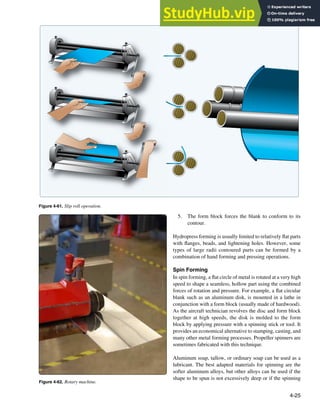
the starting edge is determined by the diameter of the part
being formed. If the edge of the part is to be lat or nearly
lat, a starting edge should not be formed.
Ensure that ingers and loose clothing are clear of the rolls
before the actual forming operation is started. Rotate the
operating handle until the metal is partially through the rolls
and change the left hand from the front edge of the sheet to the
upper edge of the sheet. Then, roll the remainder of the sheet
through the machine. If the desired curvature is not obtained,
return the metal to its starting position by rotating the handle
counterclockwise. Raise or lower the rear roll and roll the
metal through the rolls again. Repeat this procedure until
the desired curvature is obtained, then release the upper roll
and remove the metal. If the part to be formed has a tapered
shape, the rear roll should be set so that the rolls are closer
together on one end than on the opposite end. The amount
of adjustment must be determined by experimentation. If the
job being formed has a wired edge, the distance between the
upper and lower rolls and the distance between the lower front
roll and the rear roll should be slightly greater at the wired
end than at the opposite end. [Figure 4-61]
Rotary Machine
The rotary machine is used on cylindrical and lat sheet
metal to shape the edge or to form a bead along the edge.
[Figure 4-62] Various shaped rolls can be installed on the
rotary machine to perform these operations. The rotary
machine works best with thinner annealed materials.
Stretch Forming
In the process of stretch forming, a sheet of metal is shaped
by stretching it over a formed block to just beyond the elastic
limit where permanent set takes place with a minimum
amount of spring-back. To stretch the metal, the sheet is
rigidly clamped at two opposite edges in ixed vises. Then, the
metal is stretched by moving a ram that carries the form block
against the sheet with the pressure from the ram causing the
material to stretch and wrap to the contour of the form block.
Stretch forming is normally restricted to relatively large
parts with large radii of curvature and shallow depth, such as
contoured skin. Uniform contoured parts produced at a faster
speed give stretch forming an advantage over hand formed
parts. Also, the condition of the material is more uniform
than that obtained by hand forming.
Drop Hammer
The drop hammer forming process produces shapes by the
progressive deformation of sheet metal in matched dies under
the repetitive blows of a gravity-drop hammer or a power-
drop hammer. The conigurations most commonly formed
by the process include shallow, smoothly contoured double-
curvature parts, shallow-beaded parts, and parts with irregular
and comparatively deep recesses. Small quantities of cup-
shaped and box-shaped parts, curved sections, and contoured
langed parts are also formed. Drop hammer forming is not a
precision forming method and cannot provide tolerances as
close as 0.03-inch to 0.06-inch. Nevertheless, the process is
often used for sheet metal parts, such as aircraft components,
that undergo frequent design changes, or for which there is
a short run expectancy.
Hydropress Forming
The rubber pad hydropress can be utilized to form many
varieties of parts from aluminum and its alloys with relative
ease. Phenolic, masonite, kirksite, and some types of hard
setting moulding plastic have been used successfully as form
blocks to press sheet metal parts, such as ribs, spars, fans,
etc. To perform a press forming operation:
1. Cut a sheet metal blank to size and deburr edges.
2. Set the form block (normally male) on the lower
press platen.
3. Place the prepared sheet metal blank (with locating
pins to prevent shifting of the blank when the pressure
is applied).
4. Lower or close the rubber pad-illed press head over
the form block and the rubber envelope.
4-25
Figure 4-61. Slip roll operation.
Figure 4-62. Rotary machine.
5. The form block forces the blank to conform to its
contour.
Hydropress forming is usually limited to relatively lat parts
with langes, beads, and lightening holes. However, some
types of large radii contoured parts can be formed by a
combination of hand forming and pressing operations.
Spin Forming
In spin forming, a lat circle of metal is rotated at a very high
speed to shape a seamless, hollow part using the combined
forces of rotation and pressure. For example, a lat circular
blank such as an aluminum disk, is mounted in a lathe in
conjunction with a form block (usually made of hardwood).
As the aircraft technician revolves the disc and form block
together at high speeds, the disk is molded to the form
block by applying pressure with a spinning stick or tool. It
provides an economical alternative to stamping, casting, and
many other metal forming processes. Propeller spinners are
sometimes fabricated with this technique.
Aluminum soap, tallow, or ordinary soap can be used as a
lubricant. The best adapted materials for spinning are the
softer aluminum alloys, but other alloys can be used if the
shape to be spun is not excessively deep or if the spinning
4-26
Figure 4-63. Spin forming.
Figure 4-64. English wheel.
Figure 4-65. Piccolo former.
is done in stages utilizing intermediate annealing to remove
the effect of strain hardening that results from the spinning
operation. Hot forming is used in some instances when
spinning thicker and harder alloys. [Figure 4-63]
Forming With an English Wheel
The English wheel, a popular type of metal forming tool
used to create double curves in metal, has two steel wheels
between which metal is formed. [Figure 4-64] Keep in mind
that the English wheel is primarily a stretching machine, so
it stretches and thins the metal before forming it into the
desired shape. Thus, the operator must be careful not to
over-stretch the metal.
To use the English wheel, place a piece of sheet metal
between the wheels (one above and one below the metal).
Then, roll the wheels against one another under a pre-adjusted
pressure setting. Steel or aluminum can be shaped by pushing
the metal back and forth between the wheels. Very little
pressure is needed to shape the panel, which is stretched or
raised to the desired shape. It is important to work slowly and
gradually curve the metal into the desired shape. Monitor the
curvature with frequent references to the template.
The English wheel is used for shaping low crowns on large
panels and polishing or planishing (to smooth the surface of a
metal by rolling or hammering it) parts that have been formed
with power hammers or hammer and shot bag.
Piccolo Former
The piccolo former is used for cold forming and rolling
sheet metal and other profile sections (extrusions).
[Figure 4-65] The position of the ram is adjustable in
height by means of either a handwheel or a foot pedal that
permits control of the working pressure. Be sure to utilize
the adjusting ring situated in the machine head to control the
maximum working pressure. The forming tools are located in
the moving ram and the lower tool holder. Depending on the
variety of forming tools included, the operator can perform
such procedures as forming edges, bending proiles, removing
wrinkles, spot shrinking to remove buckles and dents, or
expanding dome sheet metal. Available in either iberglass
(to prevent marring the surface) or steel (for working harder
materials) faces, the tools are the quick-change type.
Shrinking and Stretching Tools
Shrinking Tools
Shrinking dies repeatedly clamp down on the metal, then shift
inward. [Figure 4-66] This compresses the material between
the dies, which actually slightly increases the thickness of
the metal. Strain hardening takes place during this process,
so it is best to set the working pressure high enough to
complete the shape rather quickly (eight passes could be
considered excessive).
4-27
Figure 4-66. Shrinking and stretching tools.
Figure 4-67. Hand-operated shrinker and stretcher unit.
CAUTION: Avoid striking a die on the radius itself when
forming a curved lange. This damages the metal in the radius
and decreases the angle of bend.
Stretching Tools
Stretching dies repeatedly clamp down on the surface and
then shift outward. This stretches the metal between the dies,
which decreases the thickness in the stretched area. Striking
the same point too many times weakens and eventually cracks
the part. It is advantageous to deburr or even polish the edges
of a lange that must undergo even moderate stretching to
avoid crack formation. Forming langes with existing holes
causes the holes to distort and possibly crack or substantially
weaken the lange.
Manual Foot-Operated Sheet Metal Shrinker
The manual foot-operated sheet metal shrinker operates very
similarly to the Piccolo former though it only has two primary
functions: shrinking and stretching. The only dies available
are steel faced and therefore tend to mar the surface of the
metal. When used on aluminum, it is necessary to gently
blend out the surface irregularities (primarily in the cladding),
then treat and paint the part.
Since this is a manual machine, it relies on leg power, as the
operator repeatedly steps on the foot pedal. The more force
is applied, the more stresses are concentrated at that single
point. It yields a better part with a series of smaller stretches
(or shrinks) than with a few intense ones. Squeezing the dies
over the radius damages the metal and lattens out some of
the bend. It may be useful to tape a thick piece of plastic or
micarta to the opposite leg to shim the radius of the angle
away from the clamping area of the dies.
NOTE: Watch the part change shape while slowly applying
pressure. A number of small stretches works more effectively
than one large one. If applying too much pressure, the metal
has the tendency to buckle.
Hand-Operated Shrinker and Stretcher
The hand-operated shrinker and structure is similar to the
manual foot-operated unit, except a handle is used to apply
force to shrinking and stretching blocks. The dies are all
metal and leave marks on aluminum that need to be blended
out after the shrinking or stretching operation. [Figure 4-67]
Dollies and Stakes
Sheet metal is often formed or inished (planished) over
anvils, available in a variety of shapes and sizes, called
dollies and stakes. These are used for forming small, odd-
shaped parts, or for putting on inishing touches for which
a large machine may not be suited. Dollies are meant to be
held in the hand, whereas stakes are designed to be supported
by a lat cast iron bench plate fastened to the workbench.
[Figure 4-68]
Most stakes have machined, polished surfaces that have been
hardened. Use of stakes to back up material when chiseling,
or when using any similar cutting tool, defaces the surface
of the stake and makes it useless for inish work.
Hardwood Form Blocks
Hardwood form blocks can be constructed to duplicate
practically any aircraft structural or nonstructural part. The
wooden block or form is shaped to the exact dimensions and
contour of the part to be formed.
V-Blocks
V-blocks made of hardwood are widely used in airframe
metalwork for shrinking and stretching metal, particularly
angles and langes. The size of the block depends on the work
being done and on personal preference. Although any type
of hardwood is suitable, maple and ash are recommended for
best results when working with aluminum alloys.
4-28
Figure 4-68. Dollies and stakes.
Figure 4-69. Sheet metal mallet and hammers.
Shrinking Blocks
A shrinking block consists of two metal blocks and some
device for clamping them together. One block forms the
base and the other is cut away to provide space where the
crimped material can be hammered. The legs of the upper
jaw clamp the material to the base block on each side of
the crimp to prevent the material from creeping away, but
remains stationary while the crimp is hammered lat (being
shrunk). This type of crimping block is designed to be held
in a bench vise.
Shrinking blocks can be made to it any speciic need. The
basic form and principle remain the same, even though the
blocks may vary considerably in size and shape.
Sandbags
A sandbag is generally used as a support during the bumping
process. A serviceable bag can be made by sewing heavy
canvas or soft leather to form a bag of the desired size, and
illing it with sand which has been sifted through a ine
mesh screen.
Before illing canvas bags with sand, use a brush to coat the
inside of the bag with softened parafin or beeswax, which
forms a sealing layer and prevents the sand from working
through the pores of the canvas. Bags can also be illed with
shot as an alternative to sand.
Sheet Metal Hammers and Mallets
The sheet metal hammer and the mallet are metal fabrication
hand tools used for bending and forming sheet metal without
marring or indenting the metal. The hammer head is usually
made of high carbon, heat-treated steel, while the head of the
mallet, which is usually larger than that of the hammer, is
made of rubber, plastic, wood, or leather. In combination with
a sandbag, V-blocks, and dies, sheet metal body hammers
and mallets are used to form annealed metal. [Figure 4-69]
Sheet Metal Holding Devices
In order to work with sheet metal during the fabrication
process, the aviation technician uses a variety of holding
devices, such as clamps, vises, and fasteners to hold the
work together. The type of operation being performed and
the type of metal being used determine what type of the
holding device is needed.
Clamps and Vises
Clamps and vises hold materials in place when it is not
possible to handle a tool and the workpiece at the same
time. A clamp is a fastening device with movable jaws that
has opposing, often adjustable, sides or parts. An essential
fastening device, it holds objects tightly together to prevent
movement or separation. Clamps can be either temporary
or permanent. Temporary clamps, such as the carriage
clamp (commonly called the C-clamp), are used to position
components while ixing them together.
C-Clamps
The C-clamp is shaped like a large C and has three main
parts: threaded screw, jaw, and swivel head. [Figure 4-70]
4-29
Figure 4-70. C-clamps. Figure 4-71. A utility vise with swivel base and anvil.
Figure 4-72. Cleco and Cleco plier.
The swivel plate or lat end of the screw prevents the end from
turning directly against the material being clamped. C-clamp
size is measured by the dimension of the largest object the
frame can accommodate with the screw fully extended.
The distance from the center line of the screw to the inside
edge of the frame or the depth of throat is also an important
consideration when using this clamp. C-clamps vary in size
from two inches upward. Since C-clamps can leave marks
on aluminum, protect the aircraft covering with masking tape
at the places where the C-clamp is used.
Vises
Vises are another clamping device that hold the workpiece
in place and allow work to be done on it with tools such as
saws and drills. The vise consists of two ixed or adjustable
jaws that are opened or closed by a screw or a lever. The size
of a vise is measured by both the jaw width and the capacity
of the vise when the jaws are fully open. Vises also depend
on a screw to apply pressure, but their textured jaws enhance
gripping ability beyond that of a clamp.
Two of the most commonly used vises are the machinist’s
vise and the utility vise. [Figure 4-71] The machinist’s
vise has lat jaws and usually a swivel base, whereas the
utility bench vise has scored, removable jaws and an anvil-
faced back jaw. This vise holds heavier material than the
machinist’s vise and also grips pipe or rod irmly. The back
jaw can be used as an anvil if the work being done is light.
To avoid marring metal in the vise jaws, add some type of
padding, such as a ready-made rubber jaw pad.
Reusable Sheet Metal Fasteners
Reusable sheet metal fasteners temporarily hold drilled sheet
metal parts accurately in position for riveting or drilling. If
sheet metal parts are not held tightly together, they separate
while being riveted or drilled. The Cleco (also spelled Cleko)
fastener is the most commonly used sheet metal holder.
[Figure 4-72]
Cleco Fasteners
The Cleco fastener consists of a steel cylinder body with a
plunger on the top, a spring, a pair of step-cut locks, and a
spreader bar. These fasteners come in six different sizes: 3
⁄32,
1
⁄8, 5
⁄32, 3
⁄16, 1
⁄4, and 3
⁄8-inch in diameter with the size stamped on
the fastener. Color coding allows for easy size recognition. A
special type of plier its the six different sizes. When installed
correctly, the reusable Cleco fastener keeps the holes in the
separate sheets aligned.
4-30
Figure 4-73. Hex nut fastener.
Hex Nut and Wing Nut Temporary Sheet Fasteners
Hex nut and wing nut fasteners are used to temporarily fasten
sheets of metal when higher clamp up pressure is required.
[Figure 4-73] Hex nut fasteners provide up to 300 pounds
of clamping force with the advantage of quick installation
and removal with a hex nut runner. Wing nut sheet metal
fasteners, characterized by wing shaped protrusions, not only
provide a consistent clamping force from 0 to 300 pounds, but
the aircraft technician can turn and tighten these fasteners by
hand. Cleco hex nut fasteners are identical to Cleco wing nut
fasteners, but the Cleco hex nut can be used with pneumatic
Cleco installers.
Aluminum Alloys
Aluminum alloys are the most frequently encountered type
of sheet metal in aircraft repair. AC 43.13.1 Chapter 4, Metal
Structure, Welding, and Brazing: Identiication of Metals
(as revised) provides an in-depth discussion of all metal
types. This section describes the aluminum alloys used in the
forming processes discussed in the remainder of the chapter.
In its pure state, aluminum is lightweight, lustrous, and
corrosion resistant. The thermal conductivity of aluminum
is very high. It is ductile, malleable, and nonmagnetic. When
combined with various percentages of other metals (generally
copper, manganese, and magnesium), aluminum alloys that
are used in aircraft construction are formed. Aluminum
alloys are lightweight and strong. They do not possess the
corrosion resistance of pure aluminum and are usually treated
to prevent deterioration. Alclad™ aluminum is an aluminum
alloy with a protective cladding of aluminum to improve its
corrosion resistance.
To provide a visual means for identifying the various
grades of aluminum and aluminum alloys, aluminum stock
is usually marked with symbols such as a Government
Speciication Number, the temper or condition furnished,
or the commercial code marking. Plate and sheet are usually
marked with speciication numbers or code markings in
rows approximately ive inches apart. Tubes, bars, rods,
and extruded shapes are marked with speciication numbers
or code markings at intervals of three to ive feet along the
length of each piece.
The commercial code marking consists of a number
that identifies the particular composition of the alloy.
Additionally, letter suffixes designate the basic temper
designations and subdivisions of aluminum alloys.
The aluminum and various aluminum alloys used in aircraft
repair and construction are as follows:
• Aluminum designated by the symbol 1100 is used
where strength is not an important factor, but where
weight economy and corrosion resistance are desired.
This aluminum is used for fuel tanks, cowlings, and oil
tanks. It is also used for repairing wingtips and tanks.
This material is weldable.
• Alloy 3003 is similar to 1100 and is generally used
for the same purposes. It contains a small percentage
of magnesium and is stronger and harder than
1100 aluminum.
• Alloy 2014 is used for heavy-duty forgings, plates,
extrusions for aircraft ittings, wheels, and major
structural components. This alloy is often used for
applications requiring high strength and hardness, as
well as for service at elevated temperatures.
• Alloy 2017 is used for rivets. This material is now in
limited use.
• Alloy 2024, with or without Alclad™ coating, is
used for aircraft structures, rivets, hardware, machine
screw products, and other miscellaneous structural
applications. In addition, this alloy is commonly
used for heat-treated parts, airfoil and fuselage skins,
extrusions, and ittings.
• Alloy 2025 is used extensively for propeller blades.
• Alloy 2219 is used for fuel tanks, aircraft skin, and
structural components. This material has high fracture
toughness and is readily weldable. Alloy 2219 is also
highly resistant to stress corrosion cracking.
• Alloy 5052 is used where good workability, very
good corrosion resistance, high fatigue strength,
weldability, and moderate static strength are desired.
This alloy is used for fuel, hydraulic, and oil lines.
• Alloy 5056 is used for making rivets and cable
sheeting and in applications where aluminum comes
into contact with magnesium alloys. Alloy 5056
is generally resistant to the most common forms
of corrosion.
4-31
Countersunk head Universal head
Figure 4-74. Solid shank rivet styles.
• Cast aluminum alloys are used for cylinder
heads, crankcases, fuel injectors, carburetors, and
landing wheels.
• Various alloys, including 3003, 5052, and 1100
aluminum, are hardened by cold working rather than
by heat treatment. Other alloys, including 2017 and
2024, are hardened by heat treatment, cold working,
or a combination of the two. Various casting alloys
are hardened by heat treatment.
• Alloy 6061 is generally weldable by all commercial
procedures and methods. It also maintains acceptable
toughness in many cryogenic applications. Alloy 6061
is easily extruded and is commonly used for hydraulic
and pneumatic tubing.
• Although higher in strength than 2024, alloy 7075
has a lower fracture toughness and is generally used
in tension applications where fatigue is not critical.
The T6 temper of 7075 should be avoided in corrosive
environments. However, the T7351 temper of 7075
has excellent stress corrosion resistance and better
fracture toughness than the T6 temper. The T76 temper
is often used to improve the resistance of 7075 to
exfoliate corrosion.
Structural Fasteners
Structural fasteners, used to join sheet metal structures
securely, come in thousands of shapes and sizes with many
of them specialized and speciic to certain aircraft. Since
some structural fasteners are common to all aircraft, this
section focuses on the more frequently used fasteners. For
the purposes of this discussion, fasteners are divided into two
main groups: solid shank rivets and special purpose fasteners
that include blind rivets.
Solid Shank Rivet
The solid shank rivet is the most common type of rivet used
in aircraft construction. Used to join aircraft structures, solid
shank rivets are one of the oldest and most reliable types of
fastener. Widely used in the aircraft manufacturing industry,
solid shank rivets are relatively low-cost, permanently
installed fasteners. They are faster to install than bolts
and nuts since they adapt well to automatic, high-speed
installation tools. Rivets should not be used in thick materials
or in tensile applications, as their tensile strengths are quite
low relative to their shear strength. The longer the total grip
length (the total thickness of sheets being joined), the more
dificult it becomes to lock the rivet.
Riveted joints are neither airtight nor watertight unless special
seals or coatings are used. Since rivets are permanently
installed, they must be removed by drilling them out, a
laborious task.
Description
Before installation, the rivet consists of a smooth cylindrical
shaft with a factory head on one end. The opposite end is
called the bucktail. To secure two or more pieces of sheet
metal together, the rivet is placed into a hole cut just a bit
larger in diameter than the rivet itself. Once placed in this
predrilled hole, the bucktail is upset or deformed by any of
several methods from hand-held hammers to pneumatically
driven squeezing tools. This action causes the rivet to expand
about 11
⁄2 times the original shaft diameter, forming a second
head that irmly holds the material in place.
Rivet Head Shape
Solid rivets are available in several head shapes, but the
universal and the 100° countersunk head are the most
commonly used in aircraft structures. Universal head rivets
were developed speciically for the aircraft industry and
designed as a replacement for both the round and brazier head
rivets. These rivets replaced all protruding head rivets and are
used primarily where the protruding head has no aerodynamic
signiicant. They have a lat area on the head, a head diameter
twice the shank diameter, and a head height approximately
42.5 percent of the shank diameter. [Figure 4-74]
The countersunk head angle can vary from 60° to 120°, but
the 100° has been adopted as standard because this head style
provides the best possible compromise between tension/
shear strength and lushness requirements. This rivet is used
where lushness is required because the rivet is lat-topped
and undercut to allow the head to it into a countersunk or
dimpled hole. The countersunk rivet is primarily intended
for use when aerodynamics smoothness is critical, such as
on the external surface of a high-speed aircraft.
Typically, rivets are fabricated from aluminum alloys, such
as 2017-T4, 2024-T4, 2117-T4, 7050, and 5056. Titanium,
nickel-based alloys, such as Monel® (corrosion-resistant
steel), mild steel or iron, and copper rivets are also used for
rivets in certain cases.
4-32
Length in sixteenths of
an inch
Diameter in thirty-seconds
of an inch
Material or alloy (2117-T4)
Head shape (countersunk)
Specification
(Military standard)
MS 20 426 AD 5 - 8
Figure 4-75. Rivet head shapes and their identifying code numbers.
Rivets are available in a wide variety of alloys, head shapes,
and sizes and have a wide variety of uses in aircraft structure.
Rivets that are satisfactory for one part of the aircraft are often
unsatisfactory for another part. Therefore, it is important
that an aircraft technician know the strength and driving
properties of the various types of rivets and how to identify
them, as well as how to drive or install them.
Solid rivets are classiied by their head shape, by the material
from which they are manufactured, and by their size.
Identiication codes used are derived from a combination
of the Military Standard (MS) and National Aerospace
Standard (NAS) systems, as well as an older classiication
system known as AN for Army/Navy. For example, the preix
MS identiies hardware that conforms to written military
standards. A letter or letters following the head-shaped code
identify the material or alloy from which the rivet was made.
The alloy code is followed by two numbers separated by a
dash. The irst number is the numerator of a fraction, which
speciies the shank diameter in thirty-seconds of an inch. The
second number is the numerator of a fraction in sixteenths of
an inch and identiies the length of the rivet. Rivet head shapes
and their identifying code numbers are shown in Figure 4-75.
The most frequently used repair rivet is the AD rivet because
it can be installed in the received condition. Some rivet alloys,
such as DD rivets (alloy 2024-T4), are too hard to drive in the
received condition and must be annealed before they can be
installed. Typically, these rivets are annealed and stored in
a freezer to retard hardening, which has led to the nickname
“ice box rivets.” They are removed from the freezer just prior
to use. Most DD rivets have been replaced by E-type rivets
which can be installed in the received condition.
The head type, size, and strength required in a rivet are
governed by such factors as the kind of forces present at the
point riveted, the kind and thickness of the material to be
riveted, and the location of the part on the aircraft. The type
of head needed for a particular job is determined by where
it is to be installed. Countersunk head rivets should be used
where a smooth aerodynamic surface is required. Universal
head rivets may be used in most other areas.
The size (or diameter) of the selected rivet shank should
correspond in general to the thickness of the material being
riveted. If an excessively large rivet is used in a thin material,
the force necessary to drive the rivet properly causes an
undesirable bulging around the rivet head. On the other hand,
if an excessively small rivet diameter is selected for thick
material, the shear strength of the rivet is not great enough
to carry the load of the joint. As a general rule, the rivet
diameter should be at least two and a half to three times the
thickness of the thicker sheet. Rivets most commonly chosen
in the assembly and repair of aircraft range from 3
⁄32-inch
to 3
⁄8-inch in diameter. Ordinarily, rivets smaller than 3
⁄32-
inch in diameter are never used on any structural parts that
carry stresses.
The proper sized rivets to use for any repair can also
be determined by referring to the rivets (used by the
manufacturer) in the next parallel row inboard on the wing
or forward on the fuselage. Another method of determining
the size of rivets to be used is to multiply the skin’s thickness
by 3 and use the next larger size rivet corresponding to that
igure. For example, if the skin is 0.040 inch thick, multiply
0.040 inch by 3 to get 0.120 inch and use the next larger size
of rivet, 1
⁄8-inch (0.125 inch).
When rivets are to pass completely through tubular members,
select a rivet diameter equivalent to at least 1
⁄8 the outside
diameter of the tube. If one tube sleeves or its over another,
take the outside diameter of the outside tube and use one-
eighth of that distance as the minimum rivet diameter. A good
practice is to calculate the minimum rivet diameter and then
use the next larger size rivet.
Whenever possible, select rivets of the same alloy number
as the material being riveted. For example, use 1100 and
3003 rivets on parts fabricated from 1100 and 3003 alloys,
and 2117-1 and 2017-T rivets on parts fabricated from 2017
and 2024 alloys.
The size of the formed head is the visual standard of a proper
rivet installation. The minimum and maximum sizes, as well
as the ideal size, are shown in Figure 4-76.
Installation of Rivets
Repair Layout
Repair layout involves determining the number of rivets
required, the proper size and style of rivets to be used, their
material, temper condition and strength, the size of the holes,
4-33
1.25 d 1.5 d
1.33 d 1.5 d
1.66 d
.66 d .5 d .33 d
1.25 d 1.4 d 1.5 d
.66 d .6 d .5 d
1.25 d 1.33 d
Minimum Maximum
Preferred
Minimum Maximum
Preferred
Driven Rivet Standards
A, AD, B, DD Rivets
D, E, (KE), M Rivets
Formed
head
dimension
Formed
head
dimension
Predrive
protrusion
Predrive
protrusion
Figure 4-76. Rivet formed head dimensions.
Standard Rivet Alloy Code Markings
Alloy code—A
Alloy—1100 or 3003 aluminum
Head marking—None
Shear strength—10 KSI
Nonstructural uses only
Alloy code—B
Alloy—5056 aluminum
Head marking—raised cross
Shear strength—28 KSI
Alloy code—AD
Alloy—2117 aluminum
Head marking—Dimple
Shear strength—30 KSI
Alloy code—D
Alloy—2017 aluminum
Head marking—Raised dot
Shear strength—38 KSI
38 KSI When driven as received
34 KSI When re-heat treated
Alloy code—DD
Alloy—2024 aluminum
Head marking—Two bars (raised)
Shear strength—41 KSI
Must be driven in “W” condition
(Ice-Box)
Alloy code—E
Alloy—7050 aluminum
Head marking—raised circle
Shear strength—54 KSI
Alloy code—E, [KE*] *Boeing code
Alloy—2017 aluminum
Head marking—Raised ring
Shear strength—43 KSI
Replacement for DD rivet
to be driven in “T” condition
Head marking—None
Shear strength—10 KSI
N t t l l
Head marking—raised circ
Shear strength—54 KSI
Head marking—Raised dot
Shear strength—38 KSI
38 KSI When driven as received
Head marking—Dimple
Shear strength—30 KSI
Head marking—Raised ring
Shear strength—43 KSI
Replacement for DD rivet
Head marking—Two bars (raised
Shear strength—41 KSI
Must be driven in “W” condition
Head marking—raised cross
Shear strength—28 KSI
l
cle
Figure 4-77. Rivet allow strength.
the distances between the holes, and the distance between the
holes and the edges of the patch. Distances are measured in
terms of rivet diameter.
Rivet Length
To determine the total length of a rivet to be installed, the
combined thickness of the materials to be joined must irst
be known. This measurement is known as the grip length.
The total length of the rivet equals the grip length plus the
amount of rivet shank needed to form a proper shop head.
The latter equals one and a half times the diameter of the rivet
shank. Where A is total rivet length, B is grip length, and
C is the length of the material needed to form a shop head,
this formula can be represented as A = B + C. [Figure 4-76]
Rivet Strength
For structural applications, the strength of the replacement
rivets is of primary importance. [Figure 4-77] Rivets made
of material that is lower in strength should not be used as
replacements unless the shortfall is made up by using a larger
rivet. For example, a rivet of 2024-T4 aluminum alloy should
not be replaced with one of 2117-T4 or 2017-T4 aluminum
alloy unless the next larger size is used.
The 2117-T rivet is used for general repair work, since it
requires no heat treatment, is fairly soft and strong, and is
highly corrosion resistant when used with most types of
alloys. Always consult the maintenance manual for correct
4-34
Rivet Spacing
6D Distance Between
Rows 6D
Rivet Spacing
4D Distance Between
Rows 4D
Rivet Spacing
6D Distance Between
Rows 3D
Figure 4-78. Acceptable rivet patterns.
Figure 4-79. Minimum edge distance.
2 D
2½ D
2 D + 1/16˝
2½ D + 1/16˝
Protruding head rivets
Countersunk rivets
Edge Distance/Edge
Margin
Minimum Edge
Distance
Preferred Edge
Distance
Section A-A
Section A A
E E
D
D
Incorrect - too close to edge
E = 1½D
Correct E = 2D
A A
Resultant crack Safe
rivet type and material. The type of rivet head to select for
a particular repair job can be determined by referring to the
type used within the surrounding area by the manufacturer.
A general rule to follow on a lush-riveted aircraft is to apply
lush rivets on the upper surface of the wing and stabilizers, on
the lower leading edge back to the spar, and on the fuselage
back to the high point of the wing. Use universal head rivets
in all other surface areas. Whenever possible, select rivets of
the same alloy number as the material being riveted.
Stresses Applied to Rivets
Shear is one of the two stresses applied to rivets. The shear
strength is the amount of force required to cut a rivet that
holds two or more sheets of material together. If the rivet
holds two parts, it is under single shear; if it holds three
sheets or parts, it is under double shear. To determine the
shear strength, the diameter of the rivet to be used must be
found by multiplying the thickness of the skin material by 3.
For example, a material thickness of 0.040 inch multiplied by
3 equals 0.120 inch. In this case, the rivet diameter selected
would be 1
⁄8 (0.125) inch.
Tension is the other stress applied to rivets. The resistance to
tension is called bearing strength and is the amount of tension
required to pull a rivet through the edge of two sheets riveted
together or to elongate the hole.
Rivet Spacing
Rivet spacing is measured between the centerlines of rivets
in the same row. The minimum spacing between protruding
head rivets shall not be less than 31
⁄2 times the rivet diameter.
The minimum spacing between lush head rivets shall not be
less than 4 times the diameter of the rivet. These dimensions
may be used as the minimum spacing except when speciied
differently in a speciic repair procedure or when replacing
existing rivets.
On most repairs, the general practice is to use the same rivet
spacing and edge distance (distance from the center of the
hole to the edge of the material) that the manufacturer used in
the area surrounding the damage. The SRM for the particular
aircraft may also be consulted. Aside from this fundamental
rule, there is no speciic set of rules that governs spacing
of rivets in all cases. However, there are certain minimum
requirements that must be observed.
• When possible, rivet edge distance, rivet spacing, and
distance between rows should be the same as that of
the original installation.
• When new sections are to be added, the edge distance
measured from the center of the rivet should never be
less than 2 times the diameter of the shank; the distance
between rivets or pitch should be at least 3 times the
diameter; and the distance between rivet rows should
never be less than 21
⁄2 times the diameter.
Figure 4-78 illustrates acceptable ways of laying out a rivet
pattern for a repair.
Edge Distance
Edgedistance,alsocallededgemarginbysomemanufacturers,
is the distance from the center of the irst rivet to the edge
of the sheet. It should not be less than 2 or more than 4 rivet
diameters and the recommended edge distance is about 21
⁄2
rivet diameters. The minimum edge distance for universal
rivets is 2 times the diameter of the rivet; the minimum edge
distance for countersunk rivets is 21
⁄2 times the diameter of the
rivet. If rivets are placed too close to the edge of the sheet,
the sheet may crack or pull away from the rivets. If they are
spaced too far from the edge, the sheet is likely to turn up at
the edges. [Figure 4-79]
4-35
3D + 1/16"
4D + 1/16"
3/1/2D + 1/16"
4/1/2D + 1/16"
1 and 3 rows protruding head rivet layout
2 row protruding head rivet layout
1 and 3 rows countersunk head rivet layout
2 row countersunk head rivet layout
3D
4D
3/1/2D
4/1/2D
Rivet Spacing Preferred Spacing
Minimum Spacing
Figure 4-80. Rivet spacing.
Rivet pitch
(6 to 8 diameters)
Edge distance
(2 to 21/2 diameters)
Transverse pitch (75 percent of rivet pitch)
Single-row layout
Two-row layout
Three-row layout
Figure 4-81. Rivet layout.
It is good practice to lay out the rivets a little further from the
edge so that the rivet holes can be oversized without violating
the edge distance minimums. Add 1
⁄16-inch to the minimum
edge distance or determine the edge distance using the next
size of rivet diameter.
Two methods for obtaining edge distance:
• The rivet diameter of a protruding head rivet is 3
⁄32-
inch. Multiply 2 times 3
⁄32-inch to obtain the minimum
edge distance, 3
⁄16-inch, add 1
⁄16-inch to yield the
preferred edge distance of 1
⁄4-inch.
• The rivet diameter of a protruding head rivet is 3
⁄32-inch.
Select the next size of rivet, which is 1
⁄8-inch. Calculate
the edge distance by multiplying 2 times 1
⁄8-inch to get
1
⁄4-inch.
Rivet Pitch
Rivet pitch is the distance between the centers of neighboring
rivets in the same row. The smallest allowable rivet pitch is 3
rivet diameters. The average rivet pitch usually ranges from
4 to 6 rivet diameters, although in some instances rivet pitch
could be as large as 10 rivet diameters. Rivet spacing on parts
that are subjected to bending moments is often closer to the
minimum spacing to prevent buckling of the skin between
the rivets. The minimum pitch also depends on the number of
rows of rivets. One-and three-row layouts have a minimum
pitch of 3 rivet diameters, a two-row layout has a minimum
pitch of 4 rivet diameters. The pitch for countersunk rivets
is larger than for universal head rivets. If the rivet spacing
is made at least 1
⁄16-inch larger than the minimum, the rivet
hole can be oversized without violating the minimum rivet
spacing requirement. [Figure 4-80]
Transverse Pitch
Transverse pitch is the perpendicular distance between rivet
rows. It is usually 75 percent of the rivet pitch. The smallest
allowable transverse pitch is 21
⁄2 rivet diameters. The smallest
allowable transverse pitch is 21
⁄2 rivet diameters. Rivet pitch
and transverse pitch often have the same dimension and are
simply called rivet spacing.
Rivet Layout Example
The general rules for rivet spacing, as it is applied to a
straight-row layout, are quite simple. In a one-row layout,
ind the edge distance at each end of the row and then lay
off the rivet pitch (distance between rivets), as shown in
Figure 4-81. In a two-row layout, lay off the irst row, place
the second row a distance equal to the transverse pitch from
the irst row, and then lay off rivet spots in the second row
so that they fall midway between those in the irst row. In
the three-row layout, irst lay off the irst and third rows, then
use a straightedge to determine the second row rivet spots.
When splicing a damaged tube, and the rivets pass completely
through the tube, space the rivets four to seven rivet diameters
apart if adjacent rivets are at right angles to each other, and
space them ive to seven rivet diameters apart if the rivets
are parallel to each other. The irst rivet on each side of the
joint should be no less than 21
⁄2 rivet diameters from the end
of the sleeve.
4-36
Figure 4-82. Rivet cutters.
Figure 4-83. Bucking bars.
Rivet Installation Tools
The various tools needed in the normal course of driving
and upsetting rivets include drills, reamers, rivet cutters or
nippers, bucking bars, riveting hammers, draw sets, dimpling
dies or other types of countersinking equipment, rivet guns,
and squeeze riveters. C-clamps, vises, and other fasteners
used to hold sheets together when riveting were discussed
earlier in the chapter. Other tools and equipment needed in the
installation of rivets are discussed in the following paragraphs.
Hand Tools
A variety of hand tools are used in the normal course of
driving and upsetting rivets. They include rivet cutters,
bucking bars, hand riveters, countersinks, and dimpling tools.
Rivet Cutter
The rivet cutter is used to trim rivets when rivets of the
required length are unavailable. [Figure 4-82] To use the
rotary rivet cutter, insert the rivet in the correct hole, place the
required number of shims under the rivet head, and squeeze
the cutter as if it were a pair of pliers. Rotation of the disks
cuts the rivet to give the right length, which is determined
by the number of shims inserted under the head. When using
a large rivet cutter, place it in a vise, insert the rivet in the
proper hole, and cut by pulling the handle, which shears off
the rivet. If regular rivet cutters are not available, diagonal
cutting pliers can be used as a substitute cutter.
Bucking Bar
The bucking bar, sometimes called a dolly, bucking
iron, or bucking block, is a heavy chunk of steel whose
countervibration during installation contributes to proper
rivet installation. They come in a variety of shapes and sizes,
and their weights ranges from a few ounces to 8 or 10 pounds,
depending upon the nature of the work. Bucking bars are
most often made from low-carbon steel that has been case
hardened or alloy bar stock. Those made of better grades of
steel last longer and require less reconditioning.
Bucking faces must be hard enough to resist indentation and
remain smooth, but not hard enough to shatter. Sometimes,
the more complicated bars must be forged or built up by
welding. The bar usually has a concave face to conform to the
shape of the shop head to be made. When selecting a bucking
bar, the irst consideration is shape. [Figure 4-83] If the bar
does not have the correct shape, it deforms the rivet head;
if the bar is too light, it does not give the necessary bucking
weight, and the material may become bulged toward the shop
head. If the bar is too heavy, its weight and the bucking force
may cause the material to bulge away from the shop head.
This tool is used by holding it against the shank end of a rivet
while the shop head is being formed. Always hold the face
of the bucking bar at right angles to the rivet shank. Failure
to do so causes the rivet shank to bend with the irst blows
of the rivet gun and causes the material to become marred
with the inal blows. The bucker must hold the bucking bar
in place until the rivet is completely driven. If the bucking
bar is removed while the gun is in operation, the rivet set
may be driven through the material. Allow the weight of the
bucking bar to do most of the work and do not bear down
too heavily on the shank of the rivet. The operator’s hands
merely guide the bar and supply the necessary tension and
rebound action. Coordinated bucking allows the bucking bar
to vibrate in unison with the gun set. With experience, a high
degree of skill can be developed.
Defective rivet heads can be caused by lack of proper
vibrating action, the use of a bucking bar that is too light or
too heavy, and failure to hold the bucking bar at right angles
to the rivet. The bars must be kept clean, smooth, and well
polished. Their edges should be slightly rounded to prevent
marring the material surrounding the riveting operation.
Hand Rivet Set
A hand rivet set is a tool equipped with a die for driving a
particular type rivet. Rivet sets are available to it every size
4-37
100°
82°
Figure 4-84. Countersinks.
Pilot
Cutter
Micro-sleeve Skirt
Locking ring
Figure 4-85. Microstop countersink.
Figure 4-86. Rivet guns.
and shape of rivet head. The ordinary set is made of 1
⁄2-inch
carbon tool steel about 6 inches in length and is knurled
to prevent slipping in the hand. Only the face of the set is
hardened and polished.
Sets for universal rivets are recessed (or cupped) to it the
rivet head. In selecting the correct set, be sure it provides the
proper clearance between the set and the sides of the rivet
head and between the surfaces of the metal and the set. Flush
or lat sets are used for countersunk and lathead rivets. To
seat lush rivets properly, be sure that the lush sets are at
least 1 inch in diameter.
Special draw sets are used to draw up the sheets to eliminate
any opening between them before the rivet is bucked. Each
draw set has a hole 1
⁄32-inch larger than the diameter of the
rivet shank for which it is made. Occasionally, the draw set
and rivet header are incorporated into one tool. The header
part consists of a hole shallow enough for the set to expand
the rivet and head when struck with a hammer.
Countersinking Tool
The countersink is a tool that cuts a cone-shaped depression
around the rivet hole to allow the rivet to set lush with
the surface of the skin. Countersinks are made with angles
to correspond with the various angles of countersunk
rivet heads. The standard countersink has a 100º angle,
as shown in Figure 4-84. Special microstop countersinks
(commonly called stop countersinks) are available that can
be adjusted to any desired depth and have cutters to allow
interchangeable holes with various countersunk angles to
be made. [Figure 4-85] Some stop countersinks also have
a micrometer set mechanism, in 0.001-inch increments, for
adjusting their cutting depths.
Dimpling Dies
Dimpling is done with a male and female die (punch and die
set). The male die has a guide the size of the rivet hole and
with the same degree of countersink as the rivet. The female
die has a hole with a corresponding degree of countersink
into which the male guide its.
Power Tools
The most common power tools used in riveting are the
pneumatic rivet gun, rivet squeezers, and the microshaver.
Pneumatic Rivet Gun
The pneumatic rivet gun is the most common rivet
upsetting tool used in airframe repair work. It is available
in many sizes and types. [Figure 4-86] The manufacturer’s
recommended capacity for each gun is usually stamped on
the barrel. Pneumatic guns operate on air pressure of 90
to 100 pounds per square inch and are used in conjunction
with interchangeable rivet sets. Each set is designed to it
the speciic type of rivet and the location of the work. The
shank of the set is designed to it into the rivet gun. An air-
driven hammer inside the barrel of the gun supplies force to
buck the rivet.
Slow hitting rivet guns that strike from 900 to 2,500 blows
per minute are the most common type. [Figure 4-87] These
blows are slow enough to be easily controlled and heavy
enough to do the job. These guns are sized by the largest rivet
size continuously driven with size often based on the Chicago
Pneumatic Company’s old “X” series. A 4X gun (dash 8 or 1
⁄4
rivet) is used for normal work. The less powerful 3X gun is
used for smaller rivets in thinner structure. 7X guns are used
for large rivets in thicker structures. A rivet gun should upset
4-38
Movement of air during forward stroke
Movement of air during rearward stroke
Blank rivet set
Beehive spring set retainer
Piston Set sleeve
Cylinder
Exhaust deflector
Sliding valve
Throttle, trigger
Throttle lever
Throttle valve
Air path
Throttle tube
Bushing
Regulator adjustment screw
Figure 4-87. Components of a rivet gun.
a rivet in 1 to 3 seconds. With practice, an aircraft technician
learns the length of time needed to hold down the trigger.
A rivet gun with the correct header (rivet set) must be held
snugly against the rivet head and perpendicular to the surface
while a bucking bar of the proper weight is held against the
opposite end. The force of the gun must be absorbed by the
bucking bar and not the structure being riveted. When the
gun is triggered, the rivet is driven.
Always make sure the correct rivet header and the retaining
spring are installed. Test the rivet gun on a piece of wood
and adjust the air valve to a setting that is comfortable for
the operator. The driving force of the rivet gun is adjusted by
a needle valve on the handle. Adjustments should never be
tested against anything harder than a wooden block to avoid
header damage. If the adjustment fails to provide the best
driving force, a different sized gun is needed. A gun that is
too powerful is hard to control and may damage the work.
On the other hand, if the gun is too light, it may work harden
the rivet before the head can be fully formed.
The riveting action should start slowly and be one continued
burst. If the riveting starts too fast, the rivet header might
slip off the rivet and damage the rivet (smiley) or damage
the skin (eyebrow). Try to drive the rivets within 3 seconds,
because the rivet will work harden if the driving process
takes too long. The dynamic of the driving process has the
gun hitting, or vibrating, the rivet and material, which causes
the bar to bounce, or countervibrate. These opposing blows
(low frequency vibrations) squeeze the rivet, causing it to
swell and then form the upset head.
Some precautions to be observed when using a rivet gun are:
1. Never point a rivet gun at anyone at any time. A rivet
gun should be used for one purpose only: to drive or
install rivets.
2. Never depress the trigger mechanism unless the set is
held tightly against a block of wood or a rivet.
3. Always disconnect the air hose from the rivet gun
when it is not in use for any appreciable length of time.
4-39
Figure 4-88. Rivet headers.
Figure 4-89. Microshaver.
While traditional tooling has changed little in the past 60
years, signiicant changes have been made in rivet gun
ergonomics. Reduced vibration rivet guns and bucking bars
have been developed to reduce the incidence of carpal tunnel
syndrome and enhance operator comfort.
Rivet Sets/Headers
Pneumatic guns are used in conjunction with interchangeable
rivet sets or headers. Each is designed to it the type of rivet
and location of the work. The shank of the rivet header is
designed to it into the rivet gun. An appropriate header must
be a correct match for the rivet being driven. The working
face of a header should be properly designed and smoothly
polished. They are made of forged steel, heat treated to be
tough but not too brittle. Flush headers come in various sizes.
Smaller ones concentrate the driving force in a small area for
maximum eficiency. Larger ones spread the driving force
over a larger area and are used for the riveting of thin skins.
Nonlush headers should it to contact about the center two-
thirds of the rivet head. They must be shallow enough to allow
slight upsetting of the head in driving and some misalignment
without eyebrowing the riveted surface. Care must be taken to
match the size of the rivet. A header that is too small marks
the rivet; while one too large marks the material.
Rivetheadersaremadeinavarietyofstyles.[Figure4-88]The
short, straight header is best when the gun can be brought
close to the work. Offset headers may be used to reach rivets
in obstructed places. Long headers are sometimes necessary
when the gun cannot be brought close to the work due to
structural interference. Rivet headers should be kept clean.
Compression Riveting
Compression riveting (squeezing) is of limited value because
this method of riveting can be used only over the edges of
sheets or assemblies where conditions permit, and where the
reach of the rivet squeezer is deep enough. The three types
of rivet squeezers—hand, pneumatic, and pneudraulic—
operate on the same principles. In the hand rivet squeezer,
compression is supplied by hand pressure; in the pneumatic
rivet squeezer, by air pressure; and in the pneudraulic,
by a combination of air and hydraulic pressure. One jaw
is stationary and serves as a bucking bar, the other jaw is
movable and does the upsetting. Riveting with a squeezer is
a quick method and requires only one operator.
These riveters are equipped with either a C-yoke or an
alligator yoke in various sizes to accommodate any size of
rivet. The working capacity of a yoke is measured by its gap
and its reach. The gap is the distance between the movable
jaw and the stationary jaw; the reach is the inside length
of the throat measured from the center of the end sets. End
sets for rivet squeezers serve the same purpose as rivet sets
for pneumatic rivet guns and are available with the same
type heads, which are interchangeable to suit any type of
rivet head. One part of each set is inserted in the stationary
jaw, while the other part is placed in the movable jaws.
The manufactured head end set is placed on the stationary
jaw whenever possible. During some operations, it may be
necessary to reverse the end sets, placing the manufactured
head end set on the movable jaw.
Microshavers
A microshaver is used if the smoothness of the material (such
as skin) requires that all countersunk rivets be driven within
a speciic tolerance. [Figure 4-89] This tool has a cutter, a
stop, and two legs or stabilizers. The cutting portion of the
microshaver is inside the stop. The depth of the cut can be
adjusted by pulling outward on the stop and turning it in
either direction (clockwise for deeper cuts). The marks on
4-40
3/32 (0.0937)
1/8 (0.125)
5/32 (0.1562)
3/16 (0.1875)
1/4 (0.250)
#40 (0.098)
#30 (0.1285)
#21 (0.159)
#11 (0.191)
F (0.257)
3/32
1/8
5/32
3/16
1/4
Rivet Diameter (in)
Drill Size
Pilot Final
Figure 4-90. Drill sizes for standard rivets.
the stop permit adjustments of 0.001 inch. If the microshaver
is adjusted and held correctly, it can cut the head of a
countersunk rivet to within 0.002 inch without damaging
the surrounding material.
Adjustments should always be made irst on scrap material.
When correctly adjusted, the microshaver leaves a small
round dot about the size of a pinhead on the microshaved
rivet. It may occasionally be necessary to shave rivets,
normally restricted to MS20426 head rivets, after driving
to obtain the required lushness. Shear head rivets should
never be shaved.
Riveting Procedure
The riveting procedure consists of transferring and preparing
the hole, drilling, and driving the rivets.
Hole Transfer
Accomplish transfer of holes from a drilled part to another
part by placing the second part over irst and using established
holes as a guide. Using an alternate method, scribe hole
location through from drilled part onto part to be drilled,
spot with a center punch, and drill.
Hole Preparation
It is very important that the rivet hole be of the correct size
and shape and free from burrs. If the hole is too small, the
protective coating is scratched from the rivet when the rivet
is driven through the hole. If the hole is too large, the rivet
does not ill the hole completely. When it is bucked, the joint
does not develop its full strength, and structural failure may
occur at that spot.
If countersinking is required, consider the thickness of the
metal and adopt the countersinking method recommended for
that thickness. If dimpling is required, keep hammer blows
or dimpling pressures to a minimum so that no undue work
hardening occurs in the surrounding area.
Drilling
Rivet holes in repair may be drilled with either a light
power drill or a hand drill. The standard shank twist drill is
most commonly used. Drill bit sizes for rivet holes should
be the smallest size that permits easy insertion of the rivet,
approximately 0.003-inch greater than the largest tolerance
of the shank diameter. The recommended clearance drill bits
for the common rivet diameters are shown in Figure 4-90.
Hole sizes for other fasteners are normally found on work
documents, prints, or in manuals.
Before drilling, center punch all rivet locations. The center
punch mark should be large enough to prevent the drill from
slipping out of position, yet it must not dent the surface
surrounding the center punch mark. Place a bucking bar
behind the metal during punching to help prevent denting.
To make a rivet hole the correct size, irst drill a slightly
undersized hole (pilot hole). Ream the pilot hole with a twist
drill of the appropriate size to obtain the required dimension.
To drill, proceed as follows:
1. Ensure the drill bit is the correct size and shape.
2. Place the drill in the center-punched mark. When using
a power drill, rotate the bit a few turns before starting
the motor.
3. While drilling, always hold the drill at a 90º angle to
the work or the curvature of the material.
4. Avoid excessive pressure, let the drill bit do the
cutting, and never push the drill bit through stock.
5. Remove all burrs with a metal countersink or a ile.
6. Clean away all drill chips.
When holes are drilled through sheet metal, small burrs are
formed around the edge of the hole. This is especially true
when using a hand drill because the drill speed is slow and
there is a tendency to apply more pressure per drill revolution.
Remove all burrs with a burr remover or larger size drill bit
before riveting.
Driving the Rivet
Although riveting equipment can be either stationary or
portable, portable riveting equipment is the most common
type of riveting equipment used to drive solid shank rivets
in airframe repair work.
Before driving any rivets into the sheet metal parts, be sure
all holes line up perfectly, all shavings and burrs have been
removed, and the parts to be riveted are securely fastened
with temporary fasteners. Depending on the job, the riveting
process may require one or two people. In solo riveting, the
riveter holds a bucking bar with one hand and operates a
riveting gun with the other.
If the job requires two aircraft technicians, a shooter, or
gunner, and a bucker work together as a team to install rivets.
4-41
Preferred
countersinking
Permissible
countersinking
Unacceptable
countersinking
g
Figure 4-91. Countersinking dimensions.
An important component of team riveting is an eficient
signaling system that communicates the status of the riveting
process. This signaling system usually consists of tapping
the bucking bar against the work and is often called the tap
code. One tap may mean not fully seated, hit it again, while
two taps may mean good rivet, and three taps may mean bad
rivet, remove and drive another. Radio sets are also available
for communication between the technicians.
Once the rivet is installed, there should be no evidence of
rotation of rivets or looseness of riveted parts. After the
trimming operation, examine for tightness. Apply a force
of 10 pounds to the trimmed stem. A tight stem is one
indication of an acceptable rivet installation. Any degree of
looseness indicates an oversize hole and requires replacement
of the rivet with an oversize shank diameter rivet. A rivet
installation is assumed satisfactory when the rivet head is
seated snugly against the item to be retained (0.005-inch
feeler gauge should not go under rivet head for more than
one-half the circumference) and the stem is proved tight.
Countersunk Rivets
An improperly made countersink reduces the strength of a
lush-riveted joint and may even cause failure of the sheet or
the rivet head. The two methods of countersinking commonly
used for lush riveting in aircraft construction and repair are:
• Machine or drill countersinking.
• Dimpling or press countersinking.
The proper method for any particular application depends on
the thickness of the parts to be riveted, the height and angle
of the countersunk head, the tools available, and accessibility.
Countersinking
When using countersunk rivets, it is necessary to make a
conical recess in the skin for the head. The type of countersink
required depends upon the relation of the thickness of the
sheets to the depth of the rivet head. Use the proper degree
and diameter countersink and cut only deep enough for the
rivet head and metal to form a lush surface.
Countersinking is an important factor in the design of fastener
patterns, as the removal of material in the countersinking
process necessitates an increase in the number of fasteners to
assure the required load-transfer strength. If countersinking
is done on metal below a certain thickness, a knife edge with
less than the minimum bearing surface or actual enlarging of
the hole may result. The edge distance required when using
countersunk fasteners is greater than when universal head
fasteners are used.
The general rule for countersinking and flush fastener
installation procedures has been reevaluated in recent years
because countersunk holes have been responsible for fatigue
cracks in aircraft pressurized skin. In the past, the general rule
forcountersinkingheldthatthefastenerheadmustbecontained
within the outer sheet. A combination of countersinks too deep
(creating a knife edge), number of pressurization cycles,
fatigue, deterioration of bonding materials, and working
fasteners caused a high stress concentration that resulted in
skin cracks and fastener failures. In primary structure and
pressurized skin repairs, some manufacturers are currently
recommending the countersink depth be no more than 2
⁄3 the
outer sheet thickness or down to 0.020-inch minimum fastener
shank depth, whichever is greater. Dimple the skin if it is too
thin for machine countersinking. [Figure 4-91]
Keep the rivet high before driving to ensure the force of
riveting is applied to the rivet and not to the skin. If the rivet
is driven while it is lush or too deep, the surrounding skin
is work hardened.
Countersinking Tools
While there are many types of countersink tools, the most
commonly used has an included angle of 100°. Sometimes
types of 82° or 120° are used to form countersunk wells.
[Figure 4-84] A six-fluted countersink works best in
aluminum. There are also four- and three-luted countersinks,
4-42
Figure 4-92. Single-flute countersink.
Figure 4-93. Hand squeezers.
but those are harder to control from a chatter standpoint. A
single-lute type, such as those manufactured by the Weldon
Tool Company®, works best for corrosion-resistant steel.
[Figure 4-92]
The microstop countersink is the preferred countersinking
tool. [Figure 4-85] It has an adjustable-sleeve cage that
functions as a limit stop and holds the revolving countersink
in a vertical position. Its threaded and replaceable cutters may
have either a removable or an integral pilot that keeps the
cutter centered in the hole. The pilot should be approximately
0.002-inch smaller than the hole size. It is recommended
to test adjustments on a piece of scrap material before
countersinking repair or replacement parts.
Freehand countersinking is needed where a microstop
countersink cannot it. This method should be practiced on
scrap material to develop the required skill. Holding the
drill motor steady and perpendicular is as critical during this
operation as when drilling.
Chattering is the most common problem encountered when
countersinking. Some precautions that may eliminate or
minimize chatter include:
• Use sharp tooling.
• Use a slow speed and steady irm pressure.
• Use a piloted countersink with a pilot approximately
0.002-inch smaller than the hole.
• Use back-up material to hold the pilot steady when
countersinking thin sheet material.
• Use a cutter with a different number of lutes.
• Pilot drill an undersized hole, countersink, and then
enlarge the hole to inal size.
Dimpling
Dimpling is the process of making an indentation or a
dimple around a rivet hole to make the top of the head
of a countersunk rivet lush with the surface of the metal.
Dimpling is done with a male and female die, or forms, often
called punch and die set. The male die has a guide the size of
the rivet hole and is beveled to correspond to the degree of
countersink of the rivet head. The female die has a hole into
which the male guide its and is beveled to a corresponding
degree of countersink.
When dimpling, rest the female die on a solid surface. Then,
place the material to be dimpled on the female die. Insert the
male die in the hole to be dimpled and, with a hammer, strike
the male die until the dimple is formed. Two or three solid
hammer blows should be suficient. A separate set of dies is
necessary for each size of rivet and shape of rivet head. An
alternate method is to use a countersunk head rivet instead
of the regular male punch die, and a draw set instead of the
female die, and hammer the rivet until the dimple is formed.
Dimpling dies for light work can be used in portable
pneumatic or hand squeezers. [Figure 4-93] If the dies are
4-43
Figure 4-94. Table riveter.
1 2 3
2
Gun draw tool Flat gun die
Bucking bar
Male die
Female die
Hole
Dimpled hole
Figure 4-95. Dimpling techniques.
used with a squeezer, they must be adjusted accurately to the
thickness of the sheet being dimpled. A table riveter is also
used for dimpling thin skin material and installing rivets.
[Figure 4-94]
Coin Dimpling
The coin dimpling, or coin pressing, method uses a
countersink rivet as the male dimpling die. Place the female
die in the usual position and back it with a bucking bar. Place
the rivet of the required type into the hole and strike the rivet
with a pneumatic riveting hammer. Coin dimpling should
be used only when the regular male die is broken or not
available. Coin pressing has the distinct disadvantage of the
rivet hole needing to be drilled to correct rivet size before the
dimpling operation is accomplished. Since the metal stretches
during the dimpling operation, the hole becomes enlarged and
the rivet must be swelled slightly before driving to produce
a close it. Because the rivet head causes slight distortions in
the recess, and these are characteristic only to that particular
rivet head, it is wise to drive the same rivet that was used as
the male die during the dimpling process. Do not substitute
another rivet, either of the same size or a size larger.
Radius Dimpling
Radius dimpling uses special die sets that have a radius
and are often used with stationary or portable squeezers.
Dimpling removes no metal and, due to the nestling effect,
gives a stronger joint than the non-lush type. A dimpled joint
reduces the shear loading on the rivet and places more load
on the riveted sheets.
NOTE: Dimpling is also done for lush bolts and other
lush fasteners.
Dimpling is required for sheets that are thinner than the
minimum speciied thickness for countersinking. However,
dimpling is not limited to thin materials. Heavier parts may
be dimpled without cracking by specialized hot dimpling
equipment. The temper of the material, rivet size, and
available equipment are all factors to be considered in
dimpling. [Figure 4-95]
Hot Dimpling
Hot dimpling is the process that uses heated dimpling dies to
ensure the metal lows better during the dimpling process. Hot
dimpling is often performed with large stationary equipment
available in a sheet metal shop. The metal being used is
an important factor because each metal presents different
dimpling problems. For example, 2024-T3 aluminum alloy
can be satisfactorily dimpled either hot or cold, but may crack
in the vicinity of the dimple after cold dimpling because of
hard spots in the metal. Hot dimpling prevents such cracking.
7075-T6 aluminum alloys are always hot dimpled.
Magnesium alloys also must be hot dimpled because, like
7075-T6, they have low formability qualities. Titanium is
another metal that must be hot dimpled because it is tough
and resists forming. The same temperature and dwell time
used to hot dimple 7075-T6 is used for titanium.
100° Combination Predimple and Countersink Method
Metals of different thicknesses are sometimes joined
by a combination of dimpling and countersinking.
[Figure 4-96] A countersink well made to receive a dimple
is called a subcountersink. These are most often seen where
a thin web is attached to heavy structure. It is also used on
thin gap seals, wear strips, and repairs for worn countersinks.
4-44
This top sheet is dimpled
Thick bottom material is countersunk
Figure 4-96. Predimple and countersink method.
Top
view
Side
view
Bottom
view
Si
Top
view
w
Bottom
v
v
iew
A. Driven correctly B. Unsteady tool C. Driven excessively D. Separation of sheets E. Unsteady rivet set F. Excessive shank length
Imperfection Cause Remedy Action
None
Cut head
Excessively flat head,
resultant head cracks
Sheet separation
Sloping head
Buckled shank
None
Improperly held tools
Excessive driving, too much pressure on
bucking bar
Work not held firmly together and rivet
shank swelled
a. Bucking bar not held firmly
b. Bucking bar permitted to slide and
bounce over the rivet
Improper rivet length, and E above
None
Hold riveting tools firmly against work
Improve riveting technique
Fasten work firmly together to prevent
slipping
Hold bucking bar firmly without too
much pressure
E above and rivet of proper length
None
Replace rivet
Replace rivet
Replace rivet
Replace rivet
Replace rivet
A
B
C
D
E
F
Damaged
head
Swelled shank
Sloping head Buckled shank
Cracks
Figure 4-97. Rivet defects.
common in 2024-T3. A rough hole or a dimple that
is too deep causes such cracks. A small tolerance is
usually allowed for radial cracks.
• Circumferential cracks—downward bending into the
draw die causes tension stresses in the upper portion
of the metal. Under some conditions, a crack may
be created that runs around the edge of the dimple.
Such cracks do not always show since they may be
underneath the cladding. When found, they are cause
for rejection. These cracks are most common in hot-
dimpled 7075 T6 aluminum alloy material. The usual
cause is insuficient dimpling heat.
Evaluating the Rivet
To obtain high structural eficiency in the manufacture and
repair of aircraft, an inspection must be made of all rivets
before the part is put in service. This inspection consists of
examining both the shop and manufactured heads and the
surrounding skin and structural parts for deformities. A scale
or rivet gauge can be used to check the condition of the upset
rivet head to see that it conforms to the proper requirements.
Deformities in the manufactured head can be detected by the
trained eye alone. [Figure 4-97]
Dimpling Inspection
To determine the quality of a dimple, it is necessary to make
a close visual inspection. Several features must be checked.
The rivet head should it lush and there should be a sharp
break from the surface into the dimple. The sharpness of the
break is affected by dimpling pressure and metal thickness.
Selected dimples should be checked by inserting a fastener to
make sure that the lushness requirements are met. Cracked
dimples are caused by poor dies, rough holes, or improper
heating. Two types of cracks may form during dimpling:
• Radial cracks—start at the edge and spread outward as
the metal within the dimple stretches. They are most
4-45
Some common causes of unsatisfactory riveting are improper
bucking, rivet set slipping off or being held at the wrong
angle, and rivet holes or rivets of the wrong size. Additional
causes for unsatisfactory riveting are countersunk rivets
not lush with the well, work not properly fastened together
during riveting, the presence of burrs, rivets too hard, too
much or too little driving, and rivets out of line.
Occasionally, during an aircraft structural repair, it is wise
to examine adjacent parts to determine the true condition
of neighboring rivets. In doing so, it may be necessary to
remove the paint. The presence of chipped or cracked paint
around the heads may indicate shifted or loose rivets. Look
for tipped or loose rivet heads. If the heads are tipped or if
rivets are loose, they show up in groups of several consecutive
rivets and probably tipped in the same direction. If heads that
appear to be tipped are not in groups and are not tipped in
the same direction, tipping may have occurred during some
previous installation.
Inspect rivets known to have been critically loaded, but
that show no visible distortion, by drilling off the head and
carefully punching out the shank. If, upon examination, the
shank appears joggled and the holes in the sheet misaligned,
the rivet has failed in shear. In that case, try to determine
what is causing the shearing stress and take the necessary
corrective action. Flush rivets that show head slippage within
the countersink or dimple, indicating either sheet bearing
failure or rivet shear failure, must be removed for inspection
and replacement.
Joggles in removed rivet shanks indicate partial shear failure.
Replace these rivets with the next larger size. Also, if the rivet
holes show elongation, replace the rivets with the next larger
size. Sheet failures such as tear-outs, cracks between rivets,
and the like usually indicate damaged rivets. The complete
repair of the joint may require replacement of the rivets with
the next larger size.
The general practice of replacing a rivet with the next larger
size (1
⁄32-inch greater diameter) is necessary to obtain the
proper joint strength of rivet and sheet when the original rivet
hole is enlarged. If the rivet in an elongated hole is replaced
by a rivet of the same size, its ability to carry its share of the
shear load is impaired and joint weakness results.
Removal of Rivets
When a rivet has to be replaced, remove it carefully to retain
the rivet hole’s original size and shape. If removed correctly,
the rivet does not need to be replaced with one of the next
larger size. Also, if the rivet is not removed properly, the
strength of the joint may be weakened and the replacement
of rivets made more dificult.
When removing a rivet, work on the manufactured head. It
is more symmetrical about the shank than the shop head, and
there is less chance of damaging the rivet hole or the material
around it. To remove rivets, use hand tools, a power drill, or
a combination of both.
The procedure for universal or protruding head rivet removal
is as follows:
1. File a lat area on the head of the rivet and center punch
the lat surface for drilling.
NOTE: On thin metal, back up the rivet on the upset
head when center punching to avoid depressing
the metal.
2. Use a drill bit one size smaller than the rivet shank to
drill out the rivet head.
NOTE: When using a power drill, set the drill on the
rivet and rotate the chuck several revolutions by hand
before turning on the power. This procedure helps the
drill cut a good starting spot and eliminates the chance
of the drill slipping off and tracking across the metal.
3. Drill the rivet to the depth of its head, while holding
the drill at a 90° angle. Do not drill too deeply, as the
rivet shank will then turn with the drill and tear the
surrounding metal.
NOTE: The rivet head often breaks away and climbs
the drill, which is a signal to withdraw the drill.
4. If the rivet head does not come loose of its own accord,
insert a drift punch into the hole and twist slightly to
either side until the head comes off.
5. Drive the remaining rivet shank out with a drift punch
slightly smaller than the shank diameter.
On thin metal or unsupported structures, support the sheet
with a bucking bar while driving out the shank. If the shank is
unusually tight after the rivet head is removed, drill the rivet
about two-thirds through the thickness of the material and then
drive the rest of it out with a drift punch. Figure 4-98 shows
the preferred procedure for removing universal rivets.
The procedure for the removal of countersunk rivets is the
same as described above except no iling is necessary. Be
careful to avoid elongation of the dimpled or the countersunk
holes. The rivet head should be drilled to approximately one-
half the thickness of the top sheet. The dimple in 2117–T
rivets usually eliminates the necessity of iling and center
punching the rivet head.
To remove a countersunk or lush head rivet, you must:
1. Select a drill about 0.003-inch smaller than the rivet
shank diameter.
4-46
1. File a flat area on manufactured head 2. Center punch flat
3. Drill through head using drill one
size smaller than rivet shank
4. Remove weakened head with
machine punch
5. Punch out rivet with machine punch
Rivet Removal
Remove rivets by drilling off the head and punching out the shank as illustrated.
1. File a flat area on the manufactured head of non-flush rivets.
2. Place a block of wood or a bucking bar under both flush and nonflush rivets when center punching the manufactured head.
3. Use a drill that is 1/32 (0.0312) inch smaller than the rivet shank to drill through the head of the rivet. Ensure the drilling
operation does not damage the skin or cut the sides of the rivet hole.
4. Insert a drift punch into the hole drilled in the rivet and tilt the punch to break off the rivet head.
5. Using a drift punch and hammer, drive out the rivet shank. Support the opposite side of the structure to prevent
structural damage.
Figure 4-98. Rivet removal.
2. Drill into the exact center of the rivet head to the
approximate depth of the head.
3. Remove the head by breaking it off. Use a punch as
a lever.
4. Punch out the shank. Use a suitable backup, preferably
wood (or equivalent), or a dedicated backup block. If
the shank does not come out easily, use a small drill
and drill through the shank. Be careful not to elongate
the hole.
Replacing Rivets
Replace rivets with those of the same size and strength
whenever possible. If the rivet hole becomes enlarged,
deformed, or otherwise damaged, drill or ream the hole for
the next larger size rivet. Do not replace a rivet with a type
having lower strength properties, unless the lower strength
is adequately compensated by an increase in size or a greater
number of rivets. It is acceptable to replace 2017 rivets of
3
⁄16-inch diameter or less, and 2024 rivets of 5
⁄32-inch diameter
or less with 2117 rivets for general repairs, provided the
replacement rivets are 1
⁄32-inch greater in diameter than the
rivets they replace.
National Advisory Committee for Aeronautics
(NACA) Method of Double Flush Riveting
A rivet installation technique known as the National Advisory
Committee for Aeronautics (NACA) method has primary
applications in fuel tank areas. [Figure 4-99] To make
4-47
Rivet factory head
Shop head formed in countersink
Figure 4-99. NACA riveting method.
.032
.040
.050
.063
.090
.141
.189
.236
.288
.400
3/32
1/8
5/32
3/16
1/4
Rivet Size Minimum Thickness Countersink Diameter
± .005
Figure 4-100. Material thickness minimums, in inches, for NACA
riveting method using 82° countersink.
Figure 4-101. Assorted fasteners.
a NACA rivet installation, the shank is upset into a 82°
countersink. In driving, the gun may be used on either the
head or shank side. The upsetting is started with light blows,
then the force increased and the gun or bar moved on the
shank end so as to form a head inside the countersink well. If
desired, the upset head may be shaved lush after driving. The
optimal strength is achieved by cutting the countersink well
to the dimensions given in Figure 4-100. Material thickness
minimums must be carefully adhered to.
Special Purpose Fasteners
Special purpose fasteners are designed for applications in
which fastener strength, ease of installation, or temperature
properties of the fastener require consideration. Solid shank
rivets have been the preferred construction method for metal
aircraft for many years because they ill up the hole, which
results in good load transfer, but they are not always ideal.
For example, the attachment of many nonstructural parts
(aircraft interior furnishings, looring, deicing boots, etc.) do
not need the full strength of solid shank rivets.
To install solid shank rivets, the aircraft technician must
have access to both sides of a riveted structure or structural
part. There are many places on an aircraft where this access
is impossible or where limited space does not permit the use
of a bucking bar. In these instances, it is not possible to use
solid shank rivets, and special fasteners have been designed
that can be bucked from the front. [Figure 4-101] There are
also areas of high loads, high fatigue, and bending on aircraft.
Although the shear loads of riveted joints are very good, the
tension, or clamp-up, loads are less than ideal.
Special purpose fasteners are sometimes lighter than solid
shank rivets, yet strong enough for their intended use. These
fasteners are manufactured by several corporations and
have unique characteristics that require special installation
tools, special installation procedures, and special removal
procedures. Because these fasteners are often inserted in
locations where one head, usually the shop head, cannot be
seen, they are called blind rivets or blind fasteners.
Typically, the locking characteristics of a blind rivet are not
as good as a driven rivet. Therefore, blind rivets are usually
not used when driven rivets can be installed. Blind rivets
shall not be used:
1. In luid-tight areas.
2. On aircraft in air intake areas where rivet parts may
be ingested by the engine.
3. On aircraft control surfaces, hinges, hinge brackets,
light control actuating systems, wing attachment
ittings, landing gear ittings, on loats or amphibian
hulls below the water level, or other heavily stressed
locations on the aircraft.
NOTE: For metal repairs to the airframe, the use of blind
rivets must be specifically authorized by the airframe
manufacturer or approved by a representative of the Federal
Aviation Administration (FAA).
Blind Rivets
The irst blind fasteners were introduced in 1940 by the
Cherry Rivet Company (now Cherry® Aerospace), and the
aviation industry quickly adopted them. The past decades
have seen a proliferation of blind fastening systems based on
the original concept, which consists of a tubular rivet with
a ixed head and a hollow sleeve. Inserted within the rivet’s
core is a stem that is enlarged or serrated on its exposed end
when activated by a pulling-type rivet gun. The lower end
of the stem extends beyond the inner sheet of metal. This
4-48
Figure 4-102. Friction-lock blind rivet.
portion contains a tapered joining portion and a blind head
that has a larger diameter than the stem or the sleeve of the
tubular rivet.
When the pulling force of the rivet gun forces the blind head
upward into the sleeve, its stem upsets or expands the lower
end of the sleeve into a tail. This presses the inner sheet
upward and closes any space that might have existed between
it and the outer sheet. Since the exposed head of the rivet is
held tightly against the outer sheet by the rivet gun, the sheets
of metal are clamped, or clinched, together.
NOTE: Fastener manufacturers use different terminology to
describe the parts of the blind rivet. The terms “mandrel,”
“spindle,” and “stem” are often used interchangeably. For
clarity, the word “stem” is used in this handbook and refers
to the piece that is inserted into the hollow sleeve.
Friction-Locked Blind Rivets
Standard self-plugging blind rivets consist of a hollow sleeve
and a stem with increased diameter in the plug section.
The blind head is formed as the stem is pulled into the
sleeve. Friction-locked blind rivets have a multiple-piece
construction and rely on friction to lock the stem to the
sleeve. As the stem is drawn up into the rivet shank, the
stem portion upsets the shank on the blind side, forming a
plug in the hollow center of the rivet. The excess portion of
the stem breaks off at a groove due to the continued pulling
action of the rivet gun. Metals used for these rivets are 2117-
T4 and 5056-F aluminum alloy. Monel® is used for special
applications.
Many friction-locked blind rivet center stems fall out due to
vibration, which greatly reduces its shear strength. To combat
that problem, most friction-lock blind rivets are replaced by
the mechanical-lock, or stem-lock, type of blind fasteners.
However, some types, such as the Cherry SPR® 3
⁄32-inch
Self-Plugging Rivet, are ideal for securing nutplates located
in inaccessible and hard-to-reach areas where bucking or
squeezing of solid rivets is unacceptable. [Figure 4-102]
Friction-lock blind rivets are less expensive than mechanical-
lock blind rivets and are sometimes used for nonstructural
applications. Inspection of friction-lock blind rivets is
visual. A more detailed discussion on how to inspect riveted
joints can be found in the section, General Repair Practices.
Removal of friction-lock blind rivets consists of punching out
the friction-lock stem and then treating it like any other rivet.
Mechanical-Lock Blind Rivets
The self-plugging, mechanical-lock blind rivet was developed
to prevent the problem of losing the center stem due to
vibration. This rivet has a device on the puller or rivet head
that locks the center stem into place when installed. Bulbed,
self-plugging, mechanically-locked blind rivets form a large,
blind head that provides higher strength in thin sheets when
installed. They may be used in applications where the blind
head is formed against a dimpled sheet.
Manufacturers such as Cherry® Aerospace (CherryMAX®,
CherryLOCK®, Cherry SST®) and Alcoa Fastening Systems
(Huck-Clinch®, HuckMax®, Unimatic®) make many
variations of this of blind rivet. While similar in design, the
tooling for these rivets is often not interchangeable.
The CherryMAX® Bulbed blind rivet is one of the earlier
types of mechanical-lock blind rivets developed. Their main
advantage is the ability to replace a solid shank rivet size
for size. The CherryMAX® Bulbed blind rivet consists of
four parts:
1. A fully serrated stem with break notch, shear ring, and
integral grip adjustment cone.
2. A driving anvil to ensure a visible mechanical lock
with each fastener installation.
3. A separate, visible, and inspectable locking collar that
mechanically locks the stem to the rivet sleeve.
4. A rivet sleeve with recess in the head to receive the
locking collar.
It is called a bulbed fastener due to its large blind side
bearing surface, developed during the installation process.
These rivets are used in thin sheet applications and for use
in materials that may be damaged by other types of blind
4-49
1 2 3 4
The CherryMAX®
rivet is
inserted into the prepared
hole. The pulling head
(installation tool) is slipped
over the rivet’s stem.
Applying a firm, steady
pressure, which seats the
rivet head, the installation
tool is then actuated.
The pulling head holds the
rivet sleeve in place as it
begins to pull the rivet stem
into the rivet sleeve. This
pulling action causes the
stem shear ring to upset the
rivet sleeve and form the
bulbed blind head.
The continued pulling action of
the installation tool causes the
stem shear ring to shear from
the main body of the stem as
the stem continues to move
through the rivet sleeve. This
action allows the fastener to
accommodate a minimum of
1/16" variation in structure
thickness. The locking collar
then contacts the driving anvil.
As the stem continues to be
pulled by the action of the
installation tool, the Safe-Lock
locking collar deforms into the
rivet sleeve head recess.
The safe-lock locking collar
fills the rivet sleeve head
recess, locking the stem and
rivet sleeve securely together.
Continued pulling by the
installation tool causes the
stem to fracture at the break
notch, providing a flush,
burr-free, inspectable
installation.
Figure 4-103. CherryMax® installation procedure.
rivets. This rivet features a safe-lock locking collar for more
reliable joint integrity. The rough end of the retained stem
in the center on the manufactured head must never be iled
smooth because it weakens the strength of the lockring, and
the center stem could fall out.
CherryMAX® bulbed rivets are available in three head styles:
universal, 100° countersunk, and 100° reduced shear head
styles. Their lengths are measured in increments of 1
⁄16 inch.
It is important to select a rivet with a length related to the
grip length of the metal being joined. This blind rivet can
be installed using either the Cherry® G750A or the newly
released Cherry® G800 hand riveters, or either the pneumatic-
hydraulic G704B or G747 CherryMAX® power tools. For
installation, please refer to Figure 4-103.
The CherryMAX® mechanical-lock blind rivet is popular
with general aviation repair shops because it features the
one tool concept to install three standard rivet diameters and
their oversize counterparts. [Figure 4-104] CherryMAX®
rivets are available in four nominal diameters: 1
⁄8, 5
⁄32, 3
⁄16, and
1
⁄4-inch and three oversized diameters and four head styles:
universal, 100° lush head, 120° lush head, and NAS1097
lush head. This rivet consists of a blind header, hollow rivet
shell, locking (foil) collar, driving anvil, and pulling stem
complete with wrapped locking collar. The rivet sleeve and
the driving washer blind bulbed header takes up the extended
shank and forms the bucktail.
The stem and rivet sleeve work as an assembly to provide
radial expansion and a large bearing footprint on the blind
side of the fastened surface. The lock collar ensures that the
stem and sleeve remain assembled during joint loading and
unloading. Rivet sleeves are made from 5056 aluminum,
Monel® and INCO 600. The stems are made from alloy
steel, CRES, and INCO® X-750. CherryMAX® rivets have
an ultimate shear strength ranging from 50 KSI to 75 KSI.
Removal of Mechanically Locked Blind Rivets
Mechanically locked blind rivets are a challenge to remove
because they are made from strong, hard metals. Lack of
access poses yet another problem for the aviation technician.
Designed for and used in dificult to reach locations means
there is often no access to the blind side of the rivet or any way
to provide support for the sheet metal surrounding the rivet’s
location when the aviation technician attempts removal.
The stem is mechanically locked by a small lock ring that
needs to be removed irst. Use a small center drill to provide
a guide for a larger drill on top of the rivet stem and drill
away the upper portion of the stem to destroy the lock. Try
to remove the lock ring or use a prick punch or center punch
to drive the stem down a little and remove the lock ring.
After the lock ring is removed, the stem can be driven out
with a drive punch. After the stem is removed, the rivet can
be drilled out in the same way as a solid rivet. If possible,
support the back side of the rivet with a backup block to
prevent damage to the aircraft skin.
4-50
Bulbed blind head
Pulling stem
Driving anvil
Rivet sleeve
Safe-lock locking collar
Figure 4-104. CherryMAX® rivet.
Pin Fastening Systems (High-Shear Fasteners)
A pin fastening system, or high-shear pin rivet, is a two-piece
fastener that consists of a threaded pin and a collar. The metal
collar is swaged onto the grooved end, effecting a irm tight
it. They are essentially threadless bolts.
High-shear rivets are installed with standard bucking bars
and pneumatic riveting hammers. They require the use
of a special gun set that incorporates collar swaging and
trimming and a discharge port through which excess collar
material is discharged. A separate size set is required for each
shank diameter.
Installation of High-Shear Fasteners
Prepare holes for pin rivets with the same care as for other
close tolerance rivets or bolts. At times, it may be necessary
to spot-face the area under the head of the pin to ensure the
head of the rivet its tightly against the material. The spot-
faced area should be 1
⁄16-inch larger in diameter than the
head diameter. Pin rivets may be driven from either end.
Procedures for driving a pin rivet from the collar end are:
1. Insert the rivet in the hole.
2. Place a bucking bar against the rivet head.
3. Slip the collar over the protruding rivet end.
4. Place previously selected rivet set and gun over the
collar. Align the gun until it is perpendicular to the
material.
5. Depress the trigger on the gun, applying pressure to
the rivet collar. This action causes the rivet collar to
swage into the groove on the rivet end.
6. Continue the driving action until the collar is properly
formed and excess collar material is trimmed off.
Procedures for driving a pin rivet from the head end are:
1. Insert the rivet in the hole.
2. Slip the collar over the protruding end of rivet.
3. Insert the correct size gun rivet set in a bucking bar
and place the set against the collar of the rivet.
4. Apply pressure against the rivet head with a lush rivet
set and pneumatic riveting hammer.
5. Continue applying pressure until the collar is formed
in the groove and excess collar material is trimmed
off.
Inspection
Pin rivets should be inspected on both sides of the material.
The head of the rivet should not be marred and should it
tightly against the material.
Removal of Pin Rivets
The conventional method of removing rivets by drilling off
the head may be utilized on either end of the pin rivet. Center
punching is recommended prior to applying drilling pressure.
In some cases, alternate methods may be needed:
• Grind a chisel edge on a small pin punch to a blade
width of 1
⁄8-inch. Place this tool at right angles to the
collar and drive with a hammer to split the collar down
one side. Repeat the operation on the opposite side.
Then, with the chisel blade, pry the collar from the
rivet. Tap the rivet out of the hole.
4-51
Figure 4-105. Hi-Lok®.
• Use a special hollow punch having one or more blades
placed to split the collar. Pry the collar from the groove
and tap out the rivet.
• Sharpen the cutting blades of a pair of nippers. Cut
the collar in two pieces or use nippers at right angles
to the rivet and cut through the small neck.
• A hollow-mill collar cutter can be used in a power hand
drill to cut away enough collar material to permit the
rivet to be tapped out of the work.
The high-shear pin rivet family includes fasteners, such as
the Hi-Lok®, Hi-Tigue®, and Hi-Lite® made by Hi-Shear
Corporation and the CherryBUCK® 95 KSI One-Piece Shear
Pin and Cherry E-Z Buck® Shear Pin made by Cherry®
Aerospace.
Hi-Lok® Fastening System
The threaded end of the Hi-Lok® two-piece fastener contains
a hexagonal shaped recess. [Figure 4-105] The hex tip of an
Allen wrench engages the recess to prevent rotation of the
pin while the collar is being installed. The pin is designed
in two basic head styles. For shear applications, the pin is
made in countersunk style and in a compact protruding head
style. For tension applications, the MS24694 countersunk and
regular protruding head styles are available.
The self-locking, threaded Hi-Lok® collar has an internal
counterbore at the base to accommodate variations in
material thickness. At the opposite end of the collar is a
wrenching device that is torqued by the driving tool until it
shears off during installation, leaving the lower portion of
the collar seated with the proper torque without additional
torque inspection. This shear-off point occurs when a
predetermined preload or clamp-up is attained in the fastener
during installation.
The advantages of Hi-Lok® two-piece fastener include its
light weight, high fatigue resistance, high strength, and its
inability to be overtorqued. The pins, made from alloy steel,
corrosion resistant steel, or titanium alloy, come in many
standard and oversized shank diameters. The collars are made
of aluminum alloy, corrosion resistant steel, or alloy steel.
The collars have wrenching lats, fracture point, threads, and
a recess. The wrenching lats are used to install the collar.
The fracture point has been designed to allow the wrenching
lats to shear when the proper torque has been reached. The
threads match the threads of the pins and have been formed
into an ellipse that is distorted to provide the locking action.
The recess serves as a built-in washer. This area contains a
portion of the shank and the transition area of the fastener.
The hole shall be prepared so that the maximum interference
it does not exceed 0.002-inch. This avoids build up of
excessive internal stresses in the work adjacent to the hole.
The Hi-Lok® pin has a slight radius under its head to increase
fatigue life. After drilling, deburr the edge of the hole to allow
the head to seat fully in the hole. The Hi-Lok® is installed in
interference it holes for aluminum structure and a clearance
it for steel, titanium, and composite materials.
Hi-Tigue® Fastening System
The Hi-Tigue® fastener offers all of the beneits of the Hi-
Lok® fastening system along with a unique bead design that
enhances the fatigue performance of the structure making
it ideal for situations that require a controlled interference
it. The Hi-Tigue® fastener assembly consists of a pin and
collar. These pin rivets have a radius at the transition area.
During installation in an interference it hole, the radius area
will “cold work” the hole. These fastening systems can be
easily confused, and visual reference should not be used for
identiication. Use part numbers to identify these fasteners.
Hi-Lite® Fastening System
The Hi-Lite® fastener is similar in design and principle to
the Hi-Lok® fastener, but the Hi-Lite® fastener has a shorter
transition area between the shank and the irst load-bearing
thread. Hi-Lite® has approximately one less thread. All Hi-
Lite® fasteners are made of titanium.
These differences reduce the weight of the Hi-Lite® fastener
without lessening the shear strength, but the Hi-Lite®
clamping forces are less than that of a Hi-Lok® fastener.
The Hi-Lite® collars are also different and thus are not
interchangeable with Hi-Lok® collars. Hi-Lite® fasteners can
be replaced with Hi-Lok® fasteners for most applications, but
Hi-Loks® cannot be replaced with Hi-Lites®.
4-52
Shear and tension
pull-type pins
Shear and tension
stump-type pins
Figure 4-106. Lockbolts.
2
4
6
8
10
12
14
16
18
20
22
24
26
28
30
32
34
36
38
40
42
44
46
48
2
4
6
8
10
12
14
16
18
20
22
24
26
28
30
32
34
36
38
40
42
44
46
48
2
4
6
8
10
12
14
16
18
20
22
24
26
28
30
32
34
36
38
40
42
44
46
INCH SCALE
GRIP SCALE
Figure 4-107. Lockbolt grip gauge.
CherryBUCK® 95 KSI One-Piece Shear Pin
The CherryBUCK® is a bimetallic, one-piece fastener that
combines a 95 KSI shear strength shank with a ductile,
titanium-columbium tail. Theses fasteners are functionally
interchangeable with comparable 6AI-4V titanium alloy
two-piece shear fasteners, but with a number of advantages.
Their one piece design means no foreign object damage
(FOD), it has a 600 °F allowable temperature, and a very
low backside proile.
Lockbolt Fastening Systems
Also pioneered in the 1940s, the lockbolt is a two-piece
fastener that combines the features of a high strength bolt and
a rivet with advantages over each. [Figure 4-106] In general,
a lockbolt is a nonexpanding fastener that has either a collar
swaged into annular locking groves on the pin shank or a type
of threaded collar to lock it in place. Available with either
countersunk or protruding heads, lockbolts are permanent
type fasteners assemblies and consist of a pin and a collar.
A lockbolt is similar to an ordinary rivet in that the locking
collar, or nut, is weak in tension and it is dificult to remove
once installed. Some of the lockbolts are similar to blind
rivets and can be completely installed from one side. Others
are fed into the workpiece with the manufactured head on the
far side. The installation is completed on the near side with
a gun similar to blind rivet gun. The lockbolt is easier and
more quickly installed than the conventional rivet or bolt and
eliminates the use of lockwashers, cotter pins, and special
nuts. The lockbolt is generally used in wing splice ittings,
landing gear ittings, fuel cell ittings, longerons, beams, skin
splice plates, and other major structural attachment.
Often called huckbolts, lockbolts are manufactured by
companies such as Cherry® Aerospace (Cherry® Lockbolt),
Alcoa Fastening Systems (Hucktite® Lockbolt System),
and SPS Technologies. Used primarily for heavily stressed
structures that require higher shear and clamp-up values than
can be obtained with rivets, the lockbolt and Hi-lok® are often
used for similar applications. Lockbolts are made in various
head styles, alloys, and inishes.
The lockbolt requires a pneumatic hammer or pull gun
for installation. Lockbolts have their own grip gauge
and an installation tool is required for their installation.
[Figure 4-107] When installed, the lockbolt is rigidly and
permanently locked in place. Three types of lockbolts are
commonly used: pull-type, stump-type, and blind-type.
The pull-type lockbolt is mainly used in aircraft and primary
and secondary structure. It is installed very rapidly and has
approximately one-half the weight of equivalent AN steel
bolts and nuts. A special pneumatic pull gun is required for
installation of this type lockbolt, which can be performed by
one operator since buckling is not required.
The stump-type lockbolt, although not having the extended
stem with pull grooves, is a companion fastener to the pull-
type lockbolt. It is used primarily where clearance does not
permit effective installation of the pull-type lockbolt. It is
driven with a standard pneumatic riveting hammer, with
a hammer set attached for swaging the collar into the pin
locking grooves, and a bucking bar.
The blind-type lockbolt comes as a complete unit or
assembly and has exceptional strength and sheet pull-together
characteristics. Blind-type lockbolts are used where only
one side of the work is accessible and generally where it is
dificult to drive a conventional rivet. This type lockbolt is
installed in a manner similar to the pull-type lockbolt.
The pins of pull- and stump-type lockbolts are made of
heat-treated alloy steel or high-strength aluminum alloy.
Companion collars are made of aluminum alloy or mild steel.
The blind-type lockbolt consists of a heat-treated alloy steel
pin, blind sleeve, iller sleeve, mild steel collar, and carbon
steel washer.
These fasteners are used in shear and tension applications.
The pull type is more common and can be installed by one
person. The stump type requires a two person installation.
An assembly tool is used to swage the collar onto the serrated
grooves in the pin and break the stem lush to the top of the
collar.
4-53
1 2 3 4
2 3 4
Continued force breaks the
pin and ejects the tail. Anvil
returns and disengages from
the swaged collar.
The initial pull draws the work
up tight and pulls that portion
of the shank under the head
into the hole.
Further pull swages the collar
into the locking grooves to
form a permanent lock.
Placed the pin in the hole
from the back side of the
work and slip the collar on.
The hold-off head must be
toward the gun. This allows
the gun to preload the pin
before swaging. Then apply
the gun; the chuck jaws
engage the pull grooves of
the projecting pintail. Hold
the gun loosely and pull the
trigger.
Figure 4-108. Lockbolt installation procedure.
5/32
3/16
1/4
5/16
3/8
Nominal
Fastener Diameter
Y Z
(Ref.)
R
Max.
T
Min.
.324/.161
.280/.208
.374/.295
.492/.404
.604/.507
.136
.164
.224
.268
.039
.253
.303
.400
.473
.576
.037
.039
.037
.110
.120
Lockbolt/Collar Acceptance Criteria
R
Z
T
Y
kbolt/Collar Acceptan
Figure 4-109. Lockbolt inspection.
The easiest way to differentiate between tension and shear
pins is the number of locking groves. Tension pins normally
have four locking grooves and shear pins have two locking
grooves. The installation tooling preloads the pin while
swaging the collar. The surplus end of the pin, called the
pintail, is then fractured.
Installation Procedure
Installation of lockbolts involves proper drilling. The hole
preparation for a lockbolt is similar to hole preparation for a
Hi-Lok®. An interference it is typically used for aluminum
and a clearance it is used for steel, titanium, and composite
materials. [Figure 4-108]
Lockbolt Inspection
After installation, a lockbolt needs to be inspected to
determine if installation is satisfactory. [Figure 4-109]
Inspect the lockbolt as follows:
1. The head must be irmly seated.
2. The collar must be tight against the material and have
the proper shape and size.
3. Pin protrusion must be within limits.
Lockbolt Removal
The best way to remove a lockbolt is to remove the collar and
drive out the pin. The collar can be removed with a special
collar cutter attached to a drill motor that mills off the collar
without damaging the skin. If this is not possible, a collar
splitter or small chisel can be used. Use a backup block on
the opposite side to prevent elongation of the hole.
The Eddie-Bolt® 2 Pin Fastening System
The Eddie-Bolt® 2 looks similar to the Hi-Lok®, but has ive
lutes, equally spaced along a portion of the pin thread area.
A companion threaded collar deforms into the lutes at a
predetermined torque and locks the collar in place. The collar
can be unscrewed using special tooling. This fastening system
can be used in either clearance or interference-it holes.
4-54
During the Maxibolt®
installation sequence, the Cherry®
shift washer collapses into itself, leaving a solid washer
that is easily retrieved.
Figure 4-110. Maxibolt® Blind Bolt System installation.
Blind Bolts
Bolts are threaded fasteners that support loads through pre-
drilled holes. Hex, close-tolerance, and internal wrenching
bolts are used in aircraft structural applications. Blind bolts
have a higher strength than blind rivets and are used for
joints that require high strength. Sometimes, these bolts can
be direct replacements for the Hi-Lok® and lockbolt. Many
of the new generation blind bolts are made from titanium
and rated at 90 KSI shear strength, which is twice as much
as most blind rivets.
Determining the correct length of the fastener is critical to
correct installation. The grip length of a bolt is the distance
from the underhead bearing surface to the irst thread. The
grip is the total thickness of material joined by the bolt.
Ideally, the grip length should be a few thousands of an inch
less than the actual grip to avoid bottoming the nut. Special
grip gauges are inserted in the hole to determine the length
of the blind bolt to be used. Every blind bolt system has its
own grip gauge and is not interchangeable with other blind
bolt or rivet systems.
Blind bolts are dificult to remove due to the hardness of
the core bolt. A special removal kit is available from the
manufacturer for removing each type of blind bolt. These kits
make it easier to remove the blind bolt without damaging the
hole and parent structure. Blind bolts are available in a pull
type and a drive type.
Pull-Type Blind Bolt
Several companies manufacture the pull-type of blind bolt
fastening systems. They may differ in some design aspects,
but in general they have a similar function. The pull-type uses
the drive nut concept and is composed of a nut, sleeve, and
a draw bolt. Frequently used blind bolt systems include but
are not limited to the Cherry Maxibolt® Blind Bolt system
and the HuckBolt® fasteners which includes the Ti-Matic®
Blind Bolt and the Unimatic® Advanced Bolt (UAB) blind
bolt systems.
Cherry Maxibolt® Blind Bolt System
The Cherry Maxibolt® blind bolt, available in alloy steel
and A-286 CRES materials, comes in four different nominal
and oversized head styles. [Figure 4-110] One tool and
pulling head installs all three diameters. The blind bolts
create a larger blind side footprint and they provide excellent
performance in thin sheet and nonmetallic applications. The
lush breaking stem eliminates shaving while the extended
grip range accommodates different application thicknesses.
Cherry Maxibolts® are primarily used in structures where
higher loads are required. The steel version is 112 KSI shear.
The A286 version is 95 KSI shear. The Cherry® G83, G84,
or G704 installation tools are required for installation.
Huck Blind Bolt System
The Huck Blind Bolt is a high strength vibration-resistant
fastener. [Figure 4-111] These bolts have been used
successfully in many critical areas, such as engine inlets and
leading edge applications. All fasteners are installed with a
combination of available hand, pneumatic, pneudraulic, or
hydraulic pull-type tools (no threads) for ease of installation.
Huck Blind Bolts can be installed on blind side angle
surfaces up to 5° without loss of performance. The stem is
mechanically locked to provide vibration-resistant FOD-free
installations. The locking collar is forced into a conical pocket
between stem and sleeve, creating high tensile capability. The
lock collar ills the sleeve lock pocket to prevent leakage or
corrosion pockets (crevice corrosion).
Flush head blind bolts are designed to install with a lush
stem break that often requires no trimming for aerodynamic
surfaces. The Huck Blind Bolt is available in high-strength
A286 CRES at 95KSI shear strength in 5
⁄32-inch through 3
⁄8-
4-55
1
Rivet inserted into clearance hole—tool is engaged.
2
Expander enters sleeve—upset starts to form.
3
Upset continues to form—lock starts to form.
4
Upset complete—lock completely formed.
5
Pin breaks flush, lock visible—installation complete.
inserted into clearance hole—tool is engaged
nder enters sleeve—upset starts to form.
continues to form—lock starts to form.
complete—lock completely formed.
ck visible—installation com
Lockring (visible after installation)
Expander
Break neck
Gold color = Nominal diameter
Silver color = Offset diameter
Drive anvil washer
Pull grooves
Retention splines
Figure 4-111. Huck blind bolt system.
Figure 4-112. Drive nut blind bolt.
Figure 4-113. Drive nut blind bolt installation tool.
inch diameters in 100° lush tension and protruding head.
Also available are shear lush heads in 3
⁄16-inch diameter.
A286 CRES Huck Blind Bolts are also available in 1
⁄64-inch
oversize diameters for repair applications.
Drive Nut-Type of Blind Bolt
Jo-bolts, Visu-lok®, Composi-Lok®, OSI Bolt®, and Radial-
Lok® fasteners use the drive nut concept and are composed of
a nut, sleeve, and a draw bolt. [Figure 4-112] These types of
blind bolts are used for high strength applications in metals
and composites when there is no access to the blind side.
Available in steel and titanium alloys, they are installed with
special tooling. Both powered and hand tooling is available.
During installation, the nut is held stationary while the core
bolt is rotated by the installation tooling. The rotation of the
core bolt draws the sleeve into the installed position and
continues to retain the sleeve for the life of the fastener. The
bolt has left hand threads and driving lats on the threaded
end. A break-off relief allows the driving portion of the
bolt to break off when the sleeve is properly seated. These
types of bolts are available in many different head styles,
including protruding head, 100° lush head, 130° lush head,
and hex head.
Use the grip gauge available for the type of fastener and
select the bolt grip after careful determination of the
material thickness. The grip of the bolt is critical for correct
installation. [Figure 4-113]
4-56
Figure 4-114. Rivet nut installation.
5/32
#12
#2
.155–.157
.189–.193
.221–.226
No. 4
No. 6
No. 8
Rivnut®
Size Drill Size Hole Tolerance
Figure 4-115. Recommended hole sizes for rivets and nuts.
Installation procedure:
1. Install the fastener into the hole, and place the
installation tooling over the screw (stem) and nut.
2. Apply torque to the screw with the installation tool
while keeping the drive nut stationary. The screw
continues to advance through the nut body causing
the sleeve to be drawn up over the tapered nose of
the nut. When the sleeve forms tightly against the
blind side of the structure, the screw fractures in the
break groove. The stem of Jo-bolts, Visu-lok®, and
Composi-Lok® II fasteners does not break off lush
with the head. A screw break-off shaver tool must be
used if a lush installation is required. The stem of the
newer Composi-Lok3® and OSI Bolt® break off lush.
Tapered Shank Bolt
Tapered shank bolts, such as the Taper-Lok®, are lightweight,
high strength shear or tension bolts. This bolt has a tapered
shank designed to provide an interference it upon installation.
Tapered shank bolts can be identiied by a round head (rather
than a screwdriver slot or wrench lats) and a threaded shank.
The Taper-Lok® is comprised of a tapered, conical-shank
fastener, installed into a precision tapered hole. The use of
tapered shank bolts is limited to special applications such as
high stress areas of fuel tanks. It is important that a tapered
bolt not be substituted for any other type of fastener in repairs.
It is equally as important not to substitute any other type of
fastener for a tapered bolt.
Tapered shank bolts look similar to Hi-Lok® bolts after
installation, but the tapered shank bolts do not have the hex
recess at the threaded end of the bolt. Tapered shank bolts
are installed in precision-reamed holes, with a controlled
interference it. The interference it compresses the material
around the hole that results in excellent load transfer, fatigue
resistance, and sealing. The collar used with the tapered shank
bolts has a captive washer, and no extra washers are required.
New tapered shank bolt installation or rework of tapered shank
bolt holes needs to be accomplished by trained personnel.
Properly installed, these bolts become tightly wedged and do
not turn while torque is applied to the nut.
Sleeve Bolts
Sleeve bolts are used for similar purposes as tapered shank
bolts, but are easier to install. Sleeve bolts, such as the two
piece SLEEVbolt®, consist of a tapered shank bolt in an
expandable sleeve. The sleeve is internally tapered and
externally straight. The sleeve bolt is installed in a standard
tolerance straight hole. During installation, the bolt is forced
into the sleeve. This action expands the sleeve which ills
the hole. It is easier to drill a straight tolerance hole than it
is to drill the tapered hole required for a tapered shank bolt.
Rivet Nut
The rivet nut is a blind installed, internally threaded rivet
invented in 1936 by the Goodrich Rubber Company for the
purpose of attaching a rubber aircraft wing deicer extrusion
to the leading edge of the wing. The original rivet nut is the
Rivnut® currently manufactured by Bollhoff Rivnut Inc. The
Rivnut® became widely used in the military and aerospace
markets because of its many design and assembly advantages.
Rivet nuts are used for the installation of fairings, trim, and
lightly loaded ittings that must be installed after an assembly
is completed. [Figure 4-114] Often used for parts that are
removed frequently, the rivet nut is available in two types:
countersunk or lat head. Installed by crimping from one side,
the rivet nut provides a threaded hole into which machine
screws can be installed. Where a lush it is required, the
countersink style can be used. Rivet nuts made of alloy steel
are used when increased tensile and shear strength is required.
Hole Preparation
Flat head rivet nuts require only the proper size of hole while
lush installation can be made into either countersunk or
dimpled skin. Metal thinner than the rivet nut head requires
a dimple. The rivet nut size is selected according to the
thickness of the parent material and the size of screw to be
used. The part number identiies the type of rivet nut and the
maximum grip length. Recommended hole sizes are shown
in Figure 4-115.
4-57
Figure 4-116. Rivetless pull-through nutplate.
Figure 4-117. Aircraft formed at a factory.
Correct installation requires good hole preparation, removal
of burrs, and holding the sheets in contact while heading.
Like any sheet metal fastener, a rivet nut should it snugly
into its hole.
Blind Fasteners (Nonstructural)
Pop Rivets
Common pull-type pop rivets, produced for non-aircraft-
related applications, are not approved for use on certiicated
aircraft structures or components. However, some homebuilt
noncertiicated aircraft use pull-type rivets for their structure.
These types of rivets are typically made of aluminum and
can be installed with hand tools.
Pull Through Nutplate Blind Rivet
Nutplate blind rivets are used where the high shear strength
of solid rivets is not required or if there is no access to install
a solid rivet. The 3
⁄32-inch diameter blind rivet is most often
used. The nut plate blind rivet is available with the pull-
through and self-plugging locked spindle. [Figure 4-116]
The new Cherry® Rivetless Nut Plate, which replaces
standard riveted nutplates, features a retainer that does not
require laring. This proprietary design eliminates the need for
two additional rivet holes, as well as reaming, counterboring,
and countersinking steps.
Forming Process
Before a part is attached to the aircraft during either
manufacture or repair, it has to be shaped to it into place.
This shaping process is called forming and may be a simple
process, such as making one or two holes for attaching; it may
be a complex process, such as making shapes with complex
curvatures. Forming, which tends to change the shape or
contour of a lat sheet or extruded shape, is accomplished
by either stretching or shrinking the material in a certain
area to produce curves, langes, and various irregular shapes.
Since the operation involves altering the shape of the stock
material, the amount of shrinking and stretching almost
entirely depends on the type of material used. Fully annealed
(heated and cooled) material can withstand considerably more
stretching and shrinking and can be formed at a much smaller
bend radius than when it is in any of the tempered conditions.
When aircraft parts are formed at the factory, they are
made on large presses or by drop hammers equipped with
dies of the correct shape. Factory engineers, who designate
speciications for the materials to be used to ensure the
inished part has the correct temper when it leaves the
machines, plan every part. Factory draftsmen prepare a layout
for each part. [Figure 4-117]
Forming processes used on the flight line and those
practiced in the maintenance or repair shop cannot duplicate
a manufacturer’s resources, but similar techniques of
factory metal working can be applied in the handcrafting of
repair parts.
Forming usually involves the use of extremely light-gauge
alloys of a delicate nature that can be readily made useless by
coarse and careless workmanship. A formed part may seem
outwardly perfect, yet a wrong step in the forming procedure
may leave the part in a strained condition. Such a defect may
hasten fatigue or may cause sudden structural failure.
Of all the aircraft metals, pure aluminum is the most easily
formed. In aluminum alloys, ease of forming varies with
the temper condition. Since modern aircraft are constructed
chiely of aluminum and aluminum alloys, this section deals
with the procedures for forming aluminum or aluminum alloy
parts with a brief discussion of working with stainless steel,
magnesium, and titanium.
Most parts can be formed without annealing the metal,
but if extensive forming operations, such as deep draws
4-58
Figure 4-118. Stretch forming metal.
Figure 4-119. Shrink forming metal.
(large folds) or complex curves, are planned, the metal
should be in the dead soft or annealed condition. During
the forming of some complex parts, operations may need
to be stopped and the metal annealed before the process
can be continued or completed. For example, alloy 2024
in the “0” condition can be formed into almost any shape
by the common forming operations, but it must be heat
treated afterward.
Forming Operations and Terms
Forming requires either stretching or shrinking the metal, or
sometimes doing both. Other processes used to form metal
include bumping, crimping, and folding.
Stretching
Stretching metal is achieved by hammering or rolling metal
under pressure. For example, hammering a lat piece of metal
causes the material in the hammered area to become thinner in
that area. Since the amount of metal has not been decreased,
the metal has been stretched. The stretching process thins,
elongates, and curves sheet metal. It is critical to ensure the
metal is not stretched too much, making it too thin, because
sheet metal does not rebound easily. [Figure 4-118]
Stretching one portion of a piece of metal affects the
surrounding material, especially in the case of formed and
extruded angles. For example, hammering the metal in the
horizontal lange of the angle strip over a metal block causes
its length to increase (stretched), making that section longer
than the section near the bend. To allow for this difference in
length, the vertical lange, which tends to keep the material
near the bend from stretching, would be forced to curve away
from the greater length.
Shrinking
Shrinking metal is much more dificult than stretching it.
During the shrinking process, metal is forced or compressed
into a smaller area. This process is used when the length of
a piece of metal, especially on the inside of a bend, is to be
reduced. Sheet metal can be shrunk in by hammering on a
V-block or by crimping and then using a shrinking block.
To curve the formed angle by the V-block method, place the
angle on the V-block and gently hammer downward against
the upper edge directly over the ”V.” While hammering,
move the angle back and forth across the V-block to compress
the material along the upper edge. Compression of the
material along the upper edge of the vertical lange will cause
the formed angle to take on a curved shape. The material in
the horizontal lange will merely bend down at the center, and
the length of that lange will remain the same. [Figure 4-119]
To make a sharp curve or a sharply bent langed angle,
crimping and a shrinking block can be used. In this process,
crimps are placed in the one lange, and then by hammering
the metal on a shrinking block, the crimps are driven, or
shrunk, one at a time.
Coldshrinkingrequiresthecombinationofahardsurface,such
as wood or steel, and a soft mallet or hammer because a steel
hammer over a hard surface stretches the metal, as opposed to
shrinking it. The larger the mallet face is, the better.
4-59
Figure 4-120. Crimping metal.
Radius (R)
Leg
Setback (90° bend) R + 1
Base measurement
Mold point
Bend allowance (BA)
Mold line (ML) F L A T
F
L
A
T
Thickness (T)
Bend tangent line (BL)
FLANGE
Bend tangent
line dimension
(BTLD)
MLD
BTLD
MLD
R
T
SB
SB
Mold point
A
B
C
Figure 4-121. Bend allowance terminology.
Bumping
Bumping involves shaping or forming malleable metal by
hammering or tapping—usually with a rubber, plastic, or
rawhide mallet. During this process, the metal is supported by
a dolly, a sandbag, or a die. Each contains a depression into
which hammered portions of the metal can sink. Bumping
can be done by hand or by machine.
Crimping
Crimping is folding, pleating, or corrugating a piece of sheet
metal in a way that shortens it or turning down a lange on
a seam. It is often used to make one end of a piece of stove
pipe slightly smaller so that one section may be slipped into
another. Crimping one side of a straight piece of angle iron
with crimping pliers causes it to curve. [Figure 4-120]
Folding Sheet Metal
Folding sheet metal is to make a bend or crease in sheets,
plates, or leaves. Folds are usually thought of as sharp,
angular bends and are generally made on folding machines
such as the box and pan brake discussed earlier in this chapter.
Layout and Forming
Terminology
The following terms are commonly used in sheet metal
forming and flat pattern layout. Familiarity with these
terms aids in understanding how bend calculations are used
in a bending operation. Figure 4-121 illustrates most of
these terms.
Base measurement—the outside dimensions of a formed part.
Base measurement is given on the drawing or blueprint or
may be obtained from the original part.
Leg—the longer part of a formed angle.
Flange—the shorter part of a formed angle—the opposite of
leg. If each side of the angle is the same length, then each
is known as a leg.
Grain of the metal—natural grain of the material is formed
as the sheet is rolled from molten ingot. Bend lines should be
made to lie at a 90˚ angle to the grain of the metal if possible.
Bend allowance (BA)—refers to the curved section of
metal within the bend (the portion of metal that is curved in
bending). The bend allowance may be considered as being
the length of the curved portion of the neutral line.
4-60
Neutral line
Figure 4-122. Neutral line.
Bend radius—the arc is formed when sheet metal is bent. This
arc is called the bend radius. The bend radius is measured
from a radius center to the inside surface of the metal. The
minimum bend radius depends on the temper, thickness, and
type of material. Always use a Minimum Bend Radius Table
to determine the minimum bend radius for the alloy that is
going to be used. Minimum bend radius charts can be found
in manufacturer’s maintenance manuals.
Bend tangent line (BL)—the location at which the metal starts
to bend and the line at which the metal stops curving. All the
space between the band tangent lines is the bend allowance.
Neutral axis—an imaginary line that has the same length
after bending as it had before bending. [Figure 4-122] After
bending, the bend area is 10 to 15 percent thinner than before
bending. This thinning of the bend area moves the neutral
line of the metal in towards the radius center. For calculation
purposes, it is often assumed that the neutral axis is located
at the center of the material, although the neutral axis is not
exactly in the center of the material. However, the amount
of error incurred is so slight that, for most work, assuming
it is at the center is satisfactory.
Mold line (ML)—an extension of the lat side of a part
beyond the radius.
Mold line dimension (MLD)—the dimension of a part made
by the intersection of mold lines. It is the dimension the part
would have if its corners had no radius.
Mold point—the point of intersection of the mold lines. The
mold point would be the outside corner of the part if there
were no radius.
K-Factor—the percentage of the material thickness where
there is no stretching or compressing of the material, such as
the neutral axis. This percentage has been calculated and is
one of 179 numbers on the K chart corresponding to one of
the angles between 0° and 180° to which metal can be bent.
[Figure 4-123] Whenever metal is to be bent to any angle
other than 90° (K-factor of 90° equal to 1), the corresponding
K-factor number is selected from the chart and is multiplied
by the sum of the radius (R) and the thickness (T) of the metal.
The product is the amount of setback (see next paragraph)
for the bend. If no K chart is available, the K-factor can be
calculated with a calculator by using the following formula:
the K value is the tangent of one-half the bend angle.
Setback (SB)—the distance the jaws of a brake must be
setback from the mold line to form a bend. In a 90° bend,
SB = R + T (radius of the bend plus thickness of the metal).
The setback dimension must be determined prior to making
the bend because setback is used in determining the location
of the beginning bend tangent line. When a part has more
than one bend, setback must be subtracted for each bend. The
majority of bends in sheet metal are 90° bends. The K-factor
must be used for all bends that are smaller or larger than 90°.
SB = K(R+T)
Sight line—also called the bend or brake line, it is the layout
line on the metal being formed that is set even with the nose
of the brake and serves as a guide in bending the work.
Flat—that portion of a part that is not included in the bend. It
is equal to the base measurement (MLD) minus the setback.
Flat = MLD – SB
Closed angle—an angle that is less than 90° when measured
between legs, or more than 90° when the amount of bend is
measured.
Open angle—an angle that is more than 90° when measured
between legs, or less than 90° when the amount of bend is
measured.
Total developed width (TDW)—the width of material
measured around the bends from edge to edge. Finding the
TDW is necessary to determine the size of material to be
cut. The TDW is less than the sum of mold line dimensions
since the metal is bent on a radius and not to a square corner
as mold line dimensions indicate.
Layout or Flat Pattern Development
To prevent any waste of material and to get a greater degree
of accuracy in the inished part, it is wise to make a layout
or lat pattern of a part before forming it. Construction of
interchangeable structural and nonstructural parts is achieved
by forming lat sheet stock to make channel, angle, zee, or
hat section members. Before a sheet metal part is formed,
make a lat pattern to show how much material is required
4-61
1
2
3
4
5
6
7
8
9
10
11
12
13
14
15
16
17
18
19
20
21
22
23
24
25
26
27
28
29
30
31
32
33
34
35
36
37
38
39
40
41
42
43
44
45
46
47
48
49
50
51
52
53
54
55
56
57
58
59
60
61
62
63
64
65
66
67
68
69
70
71
72
73
74
75
76
77
78
79
80
81
82
83
84
85
86
87
88
89
90
91
92
93
94
95
96
97
98
99
100
101
102
103
104
105
106
107
108
109
110
111
112
113
114
115
116
117
118
119
120
121
122
123
124
125
126
127
128
129
130
131
132
133
134
135
136
137
138
139
140
141
142
143
144
145
146
147
148
149
150
151
152
153
154
155
156
157
158
159
160
161
162
163
164
165
166
167
168
169
170
171
172
173
174
175
176
177
178
179
180
0.0087
0.0174
0.0261
0.0349
0.0436
0.0524
0.0611
0.0699
0.0787
0.0874
0.0963
0.1051
0.1139
0.1228
0.1316
0.1405
0.1494
0.1583
0.1673
0.1763
0.1853
0.1943
0.2034
0.2125
0.2216
0.2308
0.2400
0.2493
0.2586
0.2679
0.2773
0.2867
0.2962
0.3057
0.3153
0.3249
0.3346
0.3443
0.3541
0.3639
0.3738
0.3838
0.3939
0.4040
0.4142
0.4244
0.4348
0.4452
0.4557
0.4663
0.4769
0.4877
0.4985
0.5095
0.5205
0.5317
0.5429
0.5543
0.5657
0.5773
0.5890
0.6008
0.6128
0.6248
0.6370
0.6494
0.6618
0.6745
0.6872
0.7002
0.7132
0.7265
0.7399
0.7535
0.7673
0.7812
0.7954
0.8097
0.8243
0.8391
0.8540
0.8692
0.8847
0.9004
0.9163
0.9324
0.9489
0.9656
0.9827
1.000
1.017
1.035
1.053
1.072
1.091
1.110
1.130
1.150
1.170
1.191
1.213
1.234
1.257
1.279
1.303
1.327
1.351
1.376
1.401
1.428
1.455
1.482
1.510
1.539
1.569
1.600
1.631
1.664
1.697
1.732
1.767
1.804
1.841
1.880
1.921
1.962
2.005
2.050
2.096
2.144
2.194
2.246
2.299
2.355
2.414
2.475
2.538
2.605
2.674
2.747
2.823
2.904
2.988
3.077
114.59
3.171
3.270
3.375
3.487
3.605
3.732
3.866
4.010
4.165
4.331
4.510
4.704
4.915
5.144
5.399
5.671
5.975
6.313
6.691
7.115
7.595
8.144
8.776
9.514
10.38
11.43
12.70
14.30
16.35
19.08
22.90
26.63
38.18
57.29
Inf.
Degree Degree Degree Degree Degree
K K K K
K
Figure 4-123. K-factor.
in the bend areas, at what point the sheet must be inserted
into the forming tool, or where bend lines are located. Bend
lines must be determined to develop a lat pattern for sheet
metal forming.
When forming straight angle bends, correct allowances
must be made for setback and bend allowance. If shrinking
or stretching processes are to be used, allowances must be
made so that the part can be turned out with a minimum
amount of forming.
Making Straight Line Bends
When forming straight bends, the thickness of the material,
its alloy composition, and its temper condition must be
considered. Generally speaking, the thinner the material is,
the more sharply it can be bent (the smaller the radius of
bend), and the softer the material is, the sharper the bend
is. Other factors that must be considered when making
straight line bends are bend allowance, setback, and brake or
sight line.
4-62
Isometric view
Scale: 3:2
.04
R=.16
2.0
1.0
R
R=.16
2 0
2.0
Left view
Scale: 3:2
04
.04
Figure 4-124. U-channel example.
The radius of bend of a sheet of material is the radius of the
bend as measured on the inside of the curved material. The
minimum radius of bend of a sheet of material is the sharpest
curve, or bend, to which the sheet can be bent without
critically weakening the metal at the bend. If the radius of
bend is too small, stresses and strains weaken the metal and
may result in cracking.
A minimum radius of bend is speciied for each type of
aircraft sheet metal. The minimum bend radius is affected
by the kind of material, thickness of the material, and temper
condition of the material. Annealed sheet can be bent to a
radius approximately equal to its thickness. Stainless steel and
2024-T3 aluminum alloy require a fairly large bend radius.
Bending a U-Channel
To understand the process of making a sheet metal layout,
the steps for determining the layout of a sample U-channel
will be discussed. [Figure 4-124] When using bend
allowance calculations, the following steps for inding the
total developed length can be computed with formulas,
charts, or computer-aided design (CAD) and computer-aided
manufacturing (CAM) software packages. This channel is
made of 0.040-inch 2024-T3 aluminum alloy.
Step 1: Determine the Correct Bend Radius
Minimum bend radius charts are found in manufacturers’
maintenance manuals. A radius that is too sharp cracks the
material during the bending process. Typically, the drawing
indicates the radius to use, but it is a good practice to double
check. For this layout example, use the minimum radius
chart in Figure 4-125 to choose the correct bend radius for
the alloy, temper, and the metal thickness. For 0.040, 2024-
T3 the minimum allowable radius is 0.16-inch or 5
⁄32-inch.
Step 2: Find the Setback
The setback can be calculated with a formula or can be found
in a setback chart available in aircraft maintenance manuals
or Source, Maintenance, and Recoverability books (SMRs).
[Figure 4-126]
Using a Formula to Calculate the Setback
SB = setback
K = K-factor (K is 1 for 90° bends)
R = inside radius of the bend
T = material thickness
Since all of the angles in this example are 90° angles, the
setback is calculated as follows:
SB = K(R+T) = 0.2 inches
NOTE: K = 1 for a 90° bend. For other than a 90° bend, use
a K-factor chart.
Using a Setback Chart to Find the Setback
The setback chart is a quick way to ind the setback and is
useful for open and closed bends, because there is no need
to calculate or ind the K-factor. Several software packages
and online calculators are available to calculate the setback.
These programs are often used with CAD/CAM programs.
[Figure 4-126]
• Enter chart at the bottom on the appropriate scale with
the sum of the radius and material thickness.
• Read up to the bend angle.
• Find the setback from corresponding scale on the left.
Example:
• Material thickness is 0.063-inch.
• Bend angle is 135°.
• R + T = 0.183-inch.
Find 0.183 at the bottom of the graph. It is found in the
middle scale.
• Read up to a bend angle of 135°.
• Locate the setback at the left hand side of the graph
in the middle scale (0.435-inch). [Figure 4-126]
Step 3: Find the Length of the Flat Line Dimension
The lat line dimension can be found using the formula:
Flat = MLD – SB
MLD = mold line dimension
SB = setback
The lats, or lat portions of the U-channel, are equal to the
mold line dimension minus the setback for each of the sides,
and the mold line length minus two setbacks for the center
lat. Two setbacks need to be subtracted from the center lat
because this lat has a bend on either side.
4-63
.012
.016
.020
.025
.032
.040
.050
.063
.071
.080
.090
.100
.125
.160
.190
.250
.312
.375
.03
.03
.03
.03
.03
.06
.06
.09
.12
.16
.19
.22
.25
.31
.38
.62
1.25
1.38
.03
.03
.12
.16
.19
.22
.25
.31
.38
.44
.50
.62
.88
1.25
1.38
2.00
2.50
2.50
.06
.09
.09
.09
.12
.16
.19
.25
.31
.38
.44
.50
.62
.75
1.00
1.25
1.50
1.88
.03
.03
.03
.03
.03
.06
.06
.06
.09
.09
.09
.12
.12
.16
.19
.31
.44
.44
.03
.03
.03
.06
.06
.09
.12
.16
.16
.19
.22
.25
.31
.44
.56
.75
1.38
1.50
.06
.09
.09
.12
.12
.16
.19
.22
.25
.31
.38
.44
.50
.75
1.00
1.25
1.50
1.88
Thickness
CHART 204
MINIMUM BEND RADIUS FOR ALUMINUM ALLOYS
Bend radius is designated to the inside of the bend. All dimensions are in inches.
7178-0
2024-0
5052-H34
6061-T4
7075-0
7075-T6 2024-T6
5052-0
6061-0
5052-H32
6061-T6 2024-T3
2024-T4
Figure 4-125. Minimum bend radius (from the Raytheon Aircraft Structural Inspection and Repair Manual).
The lat dimension for the sample U-channel is calculated in
the following manner:
Flat dimension = MLD – SB
Flat 1 = 1.00-inch – 0.2-inch = 0.8-inch
Flat 2 = 2.00-inch – (2 × 0.2-inch) = 1.6-inch
Flat 3 = 1.00-inch – 0.2-inch = 0.8-inch
Step 4: Find the Bend Allowance
When making a bend or fold in a piece of metal, the bend
allowance or length of material required for the bend must be
calculated. Bend allowance depends on four factors: degree
of bend, radius of the bend, thickness of the metal, and type
of metal used.
The radius of the bend is generally proportional to the
thickness of the material. Furthermore, the sharper the radius
of bend, the less the material that is needed for the bend. The
type of material is also important. If the material is soft, it
can be bent very sharply; but if it is hard, the radius of bend
is greater, and the bend allowance is greater. The degree
of bend affects the overall length of the metal, whereas the
thickness inluences the radius of bend.
Bending a piece of metal compresses the material on the
inside of the curve and stretches the material on the outside
of the curve. However, at some distance between these
two extremes lies a space which is not affected by either
force. This is known as the neutral line or neutral axis and
occurs at a distance approximately 0.445 times the metal
thickness (0.445 × T) from the inside of the radius of the
bend. [Figure 4-127]
The length of this neutral axis must be determined so that
suficient material can be provided for the bend. This is called
the bend allowance. This amount must be added to the overall
length of the layout pattern to ensure adequate material for
the bend. To save time in calculation of the bend allowance,
formulas and charts for various angles, radii of bends,
material thicknesses, and other factors have been developed.
Formula 1: Bend Allowance for a 90° Bend
To the radius of bend (R) add 1
⁄2 the thickness of the metal
(1
⁄2T). This gives R + 1
⁄2T, or the radius of the circle of the
neutral axis. [Figure 4-128] Compute the circumference
of this circle by multiplying the radius of the neutral line
(R + 1
⁄2T) by 2π (NOTE: π = 3.1416): 2π (R + 1
⁄2T). Since a
4-64
Setback
Distance
(SB)
Setback
Distance
(SB)
Bend
Angle
(BA)
Bend
Angle
(BA)
Bend Angle (BA)
Bend Angle (BA)
Thickness (T) + Radius (R)
Flat Pattern Setback Graph
170° 160° 150° 140° 135° 130° 120°
0.50 1.0 1.5 2.0 2.5 3.0 3.5
0.02 0.04 0.06 0.08 0.10 0.12 0.14
0.10 0.183 0.20 0.30 0.40 0.50 0.60 0.70
110°
100°
90°
80°
70°
60°
50°
45°
40°
30°
20°
10°
0.02
0.04
0.06
0.08
0.10
0.12
0.14
0.16
0.18
2.0
0.50
1.0
1.5
2.0
2.5
3.0
3.5
4.0
4.5
5.0
0.10
0.20
0.30
0.40
0.453
0.50
0.60
0.70
0.80
0.90
1.0
SB = DIstance from mold line to bend line
BA = Line to bend line
BA = Bend angle
R = Bend radius
T = Thickness
1. Enter chart at bottom on appropriate scale using sum T + R
2. Read up to bend angle
3. Determine setback from corresponding scale on left
Example:
T (0.063) + R (0.12) = 0.183
BA = 135°
Setback = 0.453
Outside
mold line
Set-
back
(SB)
Bend
line
R
T
BA
Bend line
Set-
back
(SB)
Bend
line
R
T
T
ne
Figure 4-126. Setback chart.
4-65
Neutral axis
Shrinking
Stretching
0445T Distance from
inner radius of bend
Figure 4-127. Neutral axis and stresses resulting from bending.
90°
R + 1/2T
Radius
T
B
C
Figure 4-128. Bend allowance for a 90° bend.
90° bend is a quarter of the circle, divide the circumference
by 4. This gives:
2π (R + 1
⁄2T)
4
This is the bend allowance for a 90° bend. To use the formula
for a 90° bend having a radius of 1
⁄4 inch for material 0.051-
inch thick, substitute in the formula as follows.
Bend allowance = (2 × 3.1416)(0.250 + 1
⁄2(0.051))
4
= 6.2832(0.250 + 0.0255)
4
= 6.2832(0.2755)
4
= 0.4327
The bend allowance, or the length of material required for
the bend, is 0.4327 or 7
⁄16-inch.
Formula 2: Bend Allowance for a 90° Bend
This formula uses two constant values that have evolved over
a period of years as being the relationship of the degrees in the
bend to the thickness of the metal when determining the bend
allowance for a particular application. By experimentation
with actual bends in metals, aircraft engineers have found
that accurate bending results could be obtained by using the
following formula for any degree of bend from 1° to 180°.
Bend allowance = (0.01743R + 0.0078T)N where:
R = the desired bend radius
T = the thickness of the metal
N = number of degrees of bend
To use this formula for a 90° bend having a radius of .16-
inch for material 0.040-inch thick, substitute in the formula
as follows:
Bend allowance =
(0.01743 × 0.16) + (0.0078 × 0.040) × 90 = 0.27 inches
Use of Bend Allowance Chart for a 90° Bend
In Figure 4-129, the radius of bend is shown on the top line,
and the metal thickness is shown on the left hand column.
The upper number in each cell is the bend allowance for a
90° bend. The lower number in the cell is the bend allowance
per 1° of bend. To determine the bend allowance for a 90°
bend, simply use the top number in the chart.
Example: The material thickness of the U-channel is 0.040-
inch and the bend radius is 0.16-inch.
Reading across the top of the bend allowance chart, ind
the column for a radius of bend of .156-inch. Now, ind the
block in this column that is opposite the material thickness
(gauge) of 0.040 in the column at the left. The upper number
in the cell is (0.273), the correct bend allowance in inches
for a 90° bends.
Several bend allowance calculation programs are available
online. Just enter the material thickness, radius, and degree
of bend and the computer program calculates the bend
allowance.
Use of Chart for Other Than a 90° Bend
If the bend is to be other than 90°, use the lower number in
the block (the bend allowance for 1°) and compute the bend
allowance.
4-66
.020
.025
.028
.032
.038
.040
.051
.064
.072
.078
.081
.091
.094
.102
.109
.125
.156
.188
.250
.062
.000693
.066
.000736
.068
.000759
.071
.000787
.075
.00837
.077
.000853
.113
.001251
.116
.001294
.119
.001318
.121
.001345
.126
.001396
.127
.001411
.134
.001413
.144
.001595
.161
.001792
.165
.001835
.167
.001859
.170
.001886
.174
.001937
.176
.001952
.183
.002034
.192
.002136
.198
.002202
.202
.002249
.204
.002272
.212
.002350
.214
.002374
.210
.002333
.214
.002376
.216
.002400
.218
.002427
.223
.002478
.224
.002493
.232
.002575
.241
.002676
.247
.002743
.251
.002790
.253
.002813
.260
.002891
.262
.002914
.268
.002977
.273
.003031
.284
.003156
.259
.002874
.263
.002917
.265
.002941
.267
.002968
.272
.003019
.273
.003034
.280
.003116
.290
.003218
.296
.003284
.300
.003331
.302
.003354
.309
.003432
.311
.003455
.317
.003518
.321
.003572
.333
.003697
.355
.003939
.309
.003433
.313
.003476
.315
.003499
.317
.003526
.322
.003577
.323
.003593
.331
.003675
.340
.003776
.436
.003842
.350
.003889
.352
.003912
.359
.003990
.361
.004014
.367
.004076
.372
.004131
.383
.004256
.405
.004497
.417
.004747
.358
.003974
.362
.004017
.364
.004040
.366
.004067
.371
.004118
.372
.004134
.379
.004215
.389
.004317
.394
.004283
.399
.004430
.401
.004453
.408
.004531
.410
.004555
.416
.004617
.420
.004672
.432
.004797
.453
.005038
.476
.005288
.406
.004515
.410
.004558
.412
.004581
.415
.004608
.419
.004659
.421
.004675
.428
.004756
.437
.004858
.443
.004924
.447
.004963
.449
.004969
.456
.005072
.459
.005096
.464
.005158
.469
.005213
.480
.005338
.502
.005579
.525
.005829
.568
.006313
.455
.005056
.459
.005098
.461
.005122
.463
.005149
.468
.005200
.469
.005215
.477
.005297
.486
.005399
.492
.005465
.496
.005512
.498
.005535
.505
.005613
.507
.005637
.513
.005699
.518
.005754
.529
.005678
.551
.006120
.573
.006370
.617
.006853
.505
.005614
.509
.005657
.511
.005680
.514
.005708
.518
.005758
.520
.005774
.527
.005855
.536
.005957
.542
.006023
.546
.006070
.548
.006094
.555
.006172
.558
.006195
.563
.006257
.568
.006312
.579
.006437
.601
.006679
.624
.006928
.667
.007412
.554
.006155
.558
.006198
.560
.006221
.562
.006249
.567
.006299
.568
.006315
.576
.006397
.585
.006498
.591
.006564
.595
.006611
.598
.006635
.604
.006713
.606
.006736
.612
.006798
.617
.006853
.628
.006978
.650
.007220
.672
.007469
.716
.007953
.603
.006695
.607
.006739
.609
.006762
.611
.006789
.616
.006840
.617
.006856
.624
.006934
.634
.007039
.639
.007105
.644
.007152
.646
.007176
.653
.007254
.655
.007277
.661
.007339
.665
.008394
.677
.007519
.698
.007761
.721
.008010
.764
.008494
.702
.007795
.705
.007838
.708
.007862
.710
.007889
.715
.007940
.716
.007955
.723
.008037
.732
.008138
.738
.008205
.745
.008252
.745
.008275
.752
.008353
.754
.008376
.760
.008439
.764
.008493
.776
.008618
.797
.008860
.820
.009109
.863
.009593
.799
.008877
.803
.008920
.805
.007862
.807
.008971
.812
.009021
.813
.009037
.821
.009119
.830
.009220
836
.009287
.840
.009333
.842
.009357
.849
.009435
.851
.009458
.857
.009521
.862
.009575
.873
.009700
.895
.009942
.917
.010191
.961
.010675
RADIUS OF BEND, IN INCHES
Metal Thickness
1/16 .063 1/8 .125 3/16 .188 1/4 .250
1/32 .031 3/32 .094 7/32 .219 9/32 .281 5/16 .313 11/32 .344 3/8 .375 7/16 .438 1/2 .500
5/32 .156
Figure 4-129. Bend allowance.
1.98
1
.
1
3
0.04
R
=
0.16"
120°
Figure 4-130. Bend allowance for bends less than 90°.
Example:
The L-bracket shown in Figure 4-130 is made from 2024-T3
aluminum alloy and the bend is 60° from lat. Note that the
bend angle in the igure indicates 120°, but that is the number
of degrees between the two langes and not the bend angle
from lat. To ind the correct bend angle, use the following
formula:
Bend Angle = 180° – Angle between langes
4-67
0.80 0.80
1.60
0.27 0.27
Bend
allowance
Flat
1
Flat 2
Flat
3
Bend
allowance
Figure 4-131. Flat pattern layout.
The actual bend is 60°. To ind the correct bend radius for a
60° bend of material 0.040-inches thick, use the following
procedure.
1. Go to the left side of the table and ind 0.040-inch.
2. Go to the right and locate the bend radius of 0.16-inch
(0.156-inch).
3. Note the bottom number in the block (0.003034).
4. Multiply this number by the bend angle:
0.003034 × 60 = 0.18204
Step 5: Find the Total Developed Width of the Material
The total developed width (TDW) can be calculated when
the dimensions of the lats and the bend allowance are found.
The following formula is used to calculate TDW:
TDW = Flats + (bend allowance × number of bends)
For the U-channel example, this gives:
TDW = Flat 1 + Flat 2 + Flat 3 + (2 × BA)
TDW = 0.8 + 1.6 + 0.8 + (2 × 0.27)
TDW = 3.74-inches
Note that the amount of metal needed to make the channel
is less than the dimensions of the outside of the channel
(total of mold line dimensions is 4 inches). This is because
the metal follows the radius of the bend rather than going
from mold line to mold line. It is good practice to check
that the calculated TDW is smaller than the total mold line
dimensions. If the calculated TDW is larger than the mold
line dimensions, the math was incorrect.
Step 6: Flat Pattern Lay Out
After a lat pattern layout of all relevant information is made,
the material can be cut to the correct size, and the bend tangent
lines can be drawn on the material. [Figure 4-131]
Step 7: Draw the Sight Lines on the Flat Pattern
The pattern laid out in Figure 4-131 is complete, except
for a sight line that needs to be drawn to help position
the bend tangent line directly at the point where the bend
should start. Draw a line inside the bend allowance area that
is one bend radius away from the bend tangent line that is
placed under the brake nose bar. Put the metal in the brake
under the clamp and adjust the position of the metal until
the sight line is directly below the edge of the radius bar.
[Figure 4-132] Now, clamp the brake on the metal and raise
the leaf to make the bend. The bend begins exactly on the
bend tangent line.
NOTE: A common mistake is to draw the sight line in the
middle of the bend allowance area, instead of one radius
away from the bend tangent line that is placed under the
brake nose bar.
Using a J-Chart To Calculate Total Developed
Width
The J-chart, often found in the SRM, can be used to determine
bend deduction or setback and the TDW of a lat pattern
layout when the inside bend radius, bend angle, and material
thickness are known. [Figure 4-133] While not as accurate as
the traditional layout method, the J-chart provides suficient
information for most applications. The J-chart does not
require dificult calculations or memorized formulas because
the required information can be found in the repair drawing
or can be measured with simple measuring tools.
When using the J-chart, it is helpful to know whether the
angle is open (greater than 90°) or closed (less than 90°)
because the lower half of the J-chart is for open angles and
the upper half is for closed angles.
How To Find the Total Developed Width Using a
J-Chart
• Place a straightedge across the chart and connect the
bend radius on the top scale with the material thickness
on the bottom scale. [Figure 4-133]
• Locate the angle on the right hand scale and follow
this line horizontally until it meets the straight edge.
• The factor X (bend deduction) is then read on the
diagonally curving line.
• Interpolate when the X factor falls between lines.
4-68
B
e
n
d
t
a
n
g
e
n
t
l
i
n
e
s
Brake
Sight line
The sight line is located one
radius inside the bend tangent
line that is placed in the brake. Bend tangent lines
Sight line looking straight
down the nose radius bar
Brake
nose
Figure 4-132. Sight line.
• Add up the mold line dimensions and subtract the X
factor to ind the TDW.
Example 1
Bend radius = 0.22-inch
Material thickness = 0.063-inch
Bend angle = 90º
ML 1 = 2.00/ML 2 = 2.00
Use a straightedge to connect the bend radius (0.22-inch) at
the top of the graph with the material thickness at the bottom
(0.063-inch). Locate the 90° angle on the right hand scale and
follow this line horizontally until it meets the straightedge.
Follow the curved line to the left and ind 0.17 at the left side.
The X factor in the drawing is 0.17-inch. [Figure 4-134]
Total developed width =
(Mold line 1 + Mold line 2) – X factor
Total developed width = (2 + 2) – .17 = 3.83-inches
Example 2
Bend radius = 0.25-inch
Material thickness = 0.050-inch
Bend angle = 45º
ML 1 = 2.00/ML 2 = 2.00
Figure 4-135 illustrates a 135° angle, but this is the angle
between the two legs. The actual bend from lat position is
45° (180 – 135 = 45). Use a straightedge to connect the bend
radius (0.25-inch) at the top of the graph with the material
thickness at the bottom (.050-inch). Locate the 45° angle on
the right hand scale and follow this line horizontally until
it meets the straight edge. Follow the curved line to the left
and ind 0.035 at the left side. The X factor in the drawing
is 0.035 inch.
Total developed width =
(Mold line 1 + Mold line 2) – X factor
Total developed width = (2 + 2) – .035 = 3.965-inch
Using a Sheet Metal Brake to Fold Metal
The brake set up for box and pan brakes and cornice brakes
is identical. [Figure 4-136] A proper set up of the sheet
metal brake is necessary because accurate bending of sheet
metal depends on the thickness and temper of the material
to be formed and the required radius of the part. Any time a
different thickness of sheet metal needs to be formed or when
a different radius is required to form the part, the operator
needs to adjust the sheet metal brake before the brake is
used to form the part. For this example, an L-channel made
from 2024 –T3 aluminum alloy that is 0.032-inch thick will
be bent.
Step 1: Adjustment of Bend Radius
The bend radius necessary to bend a part can be found in
the part drawings, but if it is not mentioned in the drawing,
consult the SRM for a minimum bend radius chart. This
chart lists the smallest radius allowable for each thickness
and temper of metal that is normally used. To bend tighter
than this radius would jeopardize the integrity of the part.
Stresses left in the area of the bend may cause it to fail while
in service, even if it does not crack while bending it.
The brake radius bars of a sheet metal brake can be replaced
with another brake radius bar with a different diameter.
[Figure 4-137] For example, a 0.032-inch 2024-T3 L channel
needs to be bent with a radius of 1
⁄8-inch and a radius bar with
a 1
⁄8-inch radius must be installed. If different brake radius
bars are not available, and the installed brake radius bar is
4-69
Instruction
Place a straightedge across the chart connecting the radius on the upper scale and
thickness on lower scale. Then, locate the angle on the right hand scale and follow
this line horizontally until it meets the straight edge. The factor X is then read on the
diagonally curving line. Interpolate when the factor X falls between lines.
Bend Radius
Thickness
Angle
Factor
X
X = Amount to be reduced from sum of flange dimension
A + B − X = Developed length
Example
0.063 Material
0.12 Bend raduis
45° Angle
X = 0.035
0.50 0.47 0.44 0.40 0.38 0.34 0.31 0.28 0.25 0.22 0.19 0.16 0.12 0.09 0.06 0.03 0.00
0.130 0.120 0.110 0.100 0.090 0.080 0.070 0.060 0.050 0.040 0.030 0.020 0.010 0.000
150°
140°
130°
120°
115°
110°
105°
100°
95°
90°
85°
80°
75°
70°
65°
60°
55°
50°
45°
40°
35°
30°
A
B
R
Ben
d
a
n
g
l
e
1.00
1.20
1.40
1.60
0.90
0.80
0.70
0.05
0.15
0.20
0.25
0.30
0.40
0.50
0.60
0.06
0.07
0.08
0.09
0.10
1.70
0.04
0.03
0.02 0.01
Figure 4-133. J chart.
2.00"
0.063"
R
= 0.22"
2.00"
2.0"
0.5"
R
=
0.25"
135°
2
.
0
"
Figure 4-134. Example 1 of J chart. Figure 4-135. Example 2 of J chart.
4-70
UPPER JAW
BED
LOWER JAW
BENDING
LEAF
NOSE RADIUS
BAR
Each of these nose radius shims
is 0.063 inch thick, which gives
radius choices of 1/8", 3/16", and 1/4"
This radius shim builds radius
to precisely 1/16"R
Figure 4-138. Nose radius shims may be used when the brake radius bar is smaller than required.
Figure 4-137. Interchangeable brake radius bars.
Figure 4-136. Brake radius nosepiece adjustment.
smaller than required for the part, it is necessary to bend
some nose radius shims. [Figure 4-138]
If the radius is so small that it tends to crack annealed
aluminum, mild steel is a good choice of material.
Experimentation with a small piece of scrap material is
necessary to manufacture a thickness that increases the radius
to precisely 1
⁄16-inch or 1
⁄8-inch. Use radius and illet gauges
to check this dimension. From this point on, each additional
shim is added to the radius before it. [Figure 4-139]
Example: If the original nose was 1
⁄16-inch and a piece of .063-
inch material (1
⁄16-inch) was bent around it, the new outside
radius is 1
⁄8-inch. If another .063-inch layer (1
⁄16-inch) is added,
it is now a 3
⁄16-inch radius. If a piece of .032-inch (1
⁄32-inch)
instead of .063-inch material (1
⁄16-inch) is bent around the
1
⁄8-inch radius, a 5
⁄32-inch radius results.
Step 2: Adjusting Clamping Pressure
The next step is setting clamping pressure. Slide a piece of
the material with the same thickness as the part to be bent
under the brake radius piece. Pull the clamping lever toward
the operator to test the pressure. This is an over center type
clamp and, when properly set, will not feel springy or spongy
when pulled to its fully clamped position. The operator must
be able to pull this lever over center with a irm pull and have
it bump its limiting stops. On some brakes, this adjustment
has to be made on both sides of the brake.
4-71
Pull forward to clamp (no sponginess
felt when evenly set on BOTH sides)
Note: Bending leaf counterbalance omitted for clarity
Limiting stop
Nut to adjust clamping pressure
Lifting nut
Radius shims
Material to be bent
Figure 4-139. General brake overview including radius shims.
Clamping pressure
adjustment nut
Brake nose gap
adjustment knob
Figure 4-140. Adjust clamping pressure with the clamping pressure
nut.
Place test strips on the table 3-inch from each end and one
in the center between the bed and the clamp, adjust clamp
pressure until it is tight enough to prevent the work pieces
from slipping while bending. The clamping pressure can
be adjusted with the clamping pressure nut. [Figure 4-140]
Step 3: Adjusting the Nose Gap
Adjust the nose gap by turning the large brake nose gap
adjustment knobs at the rear of the upper jaw to achieve
its proper alignment. [Figure 4-140] The perfect setting
is obtained when the bending leaf is held up to the angle
of the inished bend and there is one material thickness
between the bending leaf and the nose radius piece. Using
a piece of material the thickness of the part to be bent as a
feeler gauge can help achieve a high degree of accuracy.
[Figures 4-141 and 4-142] It is essential this nose gap be
perfect, even across the length of the part to be bent. Check
by clamping two test strips between the bed and the clamp
3-inch from each end of the brake. [Figure 4-143] Bend 90°
[Figure 4-144], remove test strips, and place one on top of
the other; they should match. [Figure 4-145] If they do not
match, adjust the end with the sharper bend back slightly.
Folding a Box
A box can be formed the same way as the U-channel
described on in the previous paragraphs, but when a sheet
metal part has intersecting bend radii, it is necessary to
remove material to make room for the material contained in
4-72
Should slip snugly
in and out
BENDING LEAF NOSE
GAP
Hold bending leaf at the finished
angle of bend 90°(in this case)
Scrap of material to be bent
Figure 4-142. Profile illustration of brake nose gap adjustment.
Figure 4-143. Brake alignment with two test strips 3-inches from
each end.
Figure 4-144. Brake alignment with two test strips bent at 90°.
Figure 4-141. Brake nose gap adjustment with piece of material
same thickness as part to be formed.
the langes. This is done by drilling or punching holes at the
intersection of the inside bend tangent lines. These holes,
called relief holes and whose diameter is approximately
twice the bend radius, relieve stresses in the metal as it is
bent and prevent the metal from tearing. Relief holes also
provide a neatly trimmed corner from which excess material
may be trimmed.
The larger and smoother the relief hole is, the less likely it
will be that a crack will form in the corner. Generally, the
radius of the relief hole is speciied on the drawing. A box
and pan brake, also called a inger brake, is used to bend the
box. Two opposite sides of the box are bent irst. Then, the
ingers of the brake are adjusted so the folded-up sides ride
up in the cracks between the ingers when the leaf is raised
to bend the other two sides.
4-73
Figure 4-145. Brake alignment by comparing test strips.
2"
Flat
Flat Flat
Area of bend (BA)
Area
of
bend
(BA)
1"
2"
Bend relief radius
Intersection of
inside bend
tangent lines
Figure 4-146. Relief hole location.
11⁄16
1 11⁄16
11
⁄
16
7⁄16
7
⁄
16
2 13⁄16
2
1
2
13
⁄
16
Notice overlapping mold lines (by 1 MG)
R = 0.250 (1⁄4)
T = 0.063 (1⁄16)
SB = 0.313 (5⁄16)
BA = 0.437 (7⁄16)
MG = 0.191 (3⁄16)
Normal trim
tangent to radius
If necessary for
flanges to touch
If 5⁄16 R is required,
punch 5⁄8 hole
Figure 4-147. Relief hole layout.
The size of relief holes varies with thickness of the material.
They should be no less than 1
⁄8-inch in diameter for aluminum
alloy sheet stock up to and including 0.064-inch thick, or
3
⁄160-inch in diameter for stock ranging from 0.072-inch
to 0.128-inch thickness. The most common method of
determining the diameter of a relief hole is to use the radius
of bend for this dimension, provided it is not less than the
minimum allowance (1
⁄8-inch).
Relief Hole Location
Relief holes must touch the intersection of the inside bend
tangent lines. To allow for possible error in bending, make
the relief holes extend 1
⁄32-inch to 1
⁄16-inch behind the inside
bend tangent lines. It is good practice to use the intersection
of these lines as the center for the holes. The line on the inside
of the curve is cut at an angle toward the relief holes to allow
for the stretching of the inside lange.
The positioning of the relief hole is important. [Figure 4-146]
It should be located so its outer perimeter touches the
intersection of the inside bend tangent lines. This keeps any
material from interfering with the bend allowance area of the
other bend. If these bend allowance areas intersected with
each other, there would be substantial compressive stresses
that would accumulate in that corner while bending. This
could cause the part to crack while bending.
Layout Method
Lay out the basic part using traditional layout procedures.
This determines the width of the lats and the bend allowance.
It is the intersection of the inside bend tangent lines that index
the bend relief hole position. Bisect these intersected lines
and move outward the distance of the radius of the hole on
this line. This is the center of the hole. Drill at this point and
inish by trimming off the remainder of the corner material.
The trim out is often tangent to the radius and perpendicular
to the edge. [Figure 4-147] This leaves an open corner. If the
corner must be closed, or a slightly longer lange is necessary,
then trim out accordingly. If the corner is to be welded, it
is necessary to have touching langes at the corners. The
4-74
135°
1.52
R
.19
0
.
7
7
Figure 4-148. Open bend.
1.52
R .19
45°
135° 0.77
0.05
Figure 4-149. Closed bend.
length of the lange should be one material thickness shorter
than the inished length of the part so only the insides of the
langes touch.
Open and Closed Bends
Open and closed bends present unique problems that require
more calculations than 90° bends. In the following 45° and
a 135° bend examples, the material is 0.050-inch thick and
the bend radius is 3
⁄16-inch.
Open End Bend (Less Than 90°)
Figure 4-148 shows an example for a 45° bend.
1. Look up K-factor in K chart. K-factor for 45° is
0.41421-inch.
2. Calculate setback.
SB = K(R + T)
SB = 0.41421-inch(0.1875-inch + 0.050-inch) =
0.098-inch
3. Calculate bend allowance for 45°. Look up bend
allowance for 1° of bend in the bend allowance chart
and multiply this by 45.
0.003675-inch × 45 = 0.165-inch
4. Calculate lats.
Flat = Mold line dimension – SB
Flat 1 = .77-inch – 0.098-inch = 0.672-inch
Flat 2 = 1.52-inch – 0.098-inch = 1.422-inch
5. Calculate TDW
TDW = Flats + Bend allowance
TDW=0.672-inch+1.422-inch+0.165-inch=2.259-inch.
Observe that the brake reference line is still located one radius
from the bend tangent line.
Closed End Bend (More Than 90°)
Figure 4-149 shows an example of a 135° bend.
1. Look up K-factor in K chart. K-factor for 135° is
2.4142-inch.
2. Calculate SB.
SB = K(R + T)
SB = 2.4142-inch(0.1875-inch + 0.050-inch) = 0.57-
inch
3. Calculate bend allowance for 135°. Look up bend
allowance for 1° of bend in the bend allowance chart
and multiply this by 135.
0.003675-inch × 135 = 0.496-inch
4. Calculate lats.
Flat = Mold line dimension – SB
Flat 1 = 0.77-inch – 0.57-inch = 0.20-inch
Flat 2 = 1.52-inch – 0.57-inch = 0.95-inch
5. Calculate TDW.
TDW = Flats + Bend allowance
TDW = 0.20-inch + 0.95-inch + 0.496-inch = 1.65-
inch
It is obvious from both examples that a closed bend has a
smaller TDW than an open-end bend and the material length
needs to be adjusted accordingly.
Hand Forming
All hand forming revolves around the processes of stretching
and shrinking metal. As discussed earlier, stretching means to
lengthen or increase a particular area of metal while shrinking
means to reduce an area. Several methods of stretching and
shrinking may be used, depending on the size, shape, and
contour of the part being formed.
For example, if a formed or extruded angle is to be curved,
either stretch one leg or shrink the other, whichever makes
the part it. In bumping, the material is stretched in the bulge
to make it balloon, and in joggling, the material is stretched
between the joggles. Material in the edge of lightening
holes is often stretched to form a beveled reinforcing ridge
around them. The following paragraphs discuss some of
these techniques.
4-75
Figure 4-150. V-block forming.
Straight Line Bends
The cornice brake and bar folder are ordinarily used to make
straight bends. Whenever such machines are not available,
comparatively short sections can be bent by hand with the
aid of wooden or metal bending blocks.
After a blank has been laid out and cut to size, clamp it along
the bend line between two wooden forming blocks held in
a vise. The wooden forming blocks should have one edge
rounded as needed for the desired radius of bend. It should
also be curved slightly beyond 90° to allow for spring-back.
Bend the metal that protrudes beyond the bending block to
the desired angle by tapping lightly with a rubber, plastic,
or rawhide mallet. Start tapping at one end and work back
and forth along the edge to make a gradual and even bend.
Continue this process until the protruding metal is bent to the
desired angle against the forming block. Allow for spring-
back by driving the material slightly farther than the actual
bend. If a large amount of metal extends beyond the forming
blocks, maintain hand pressure against the protruding sheet
to prevent it from bouncing. Remove any irregularities by
holding a straight block of hardwood edgewise against the
bend and striking it with heavy blows of a mallet or hammer.
If the amount of metal protruding beyond the bending blocks
is small, make the entire bend by using the hardwood block
and hammer.
Formed or Extruded Angles
Both formed and extruded types of angles can be curved (not
bent sharply) by stretching or shrinking either of the langes.
Curving by stretching one lange is usually preferred since
the process requires only a V-block and a mallet and is easily
accomplished.
Stretching With V-Block Method
In the stretching method, place the lange to be stretched in
the groove of the V-block. [Figure 4-150] (If the lange is
to be shrunk, place the lange across the V-block.) Using a
round, soft-faced mallet, strike the lange directly over the
V portion with light, even blows while gradually forcing it
downward into the V.
Beginat one end of the lange and form the curve graduallyand
evenly by moving the strip slowly back and forth, distributing
the hammer blows at equal spaces on the lange. Hold the
strip irmly to keep it from bouncing when hammered. An
overly heavy blow buckles the metal, so keep moving the
lange across the V-block, but always lightly strike the spot
directly above the V.
Lay out a full-sized, accurate pattern on a sheet of paper or
plywood and periodically check the accuracy of the curve.
Comparing the angle with the pattern determines exactly
how the curve is progressing and just where it needs to be
increased or decreased. It is better to get the curve to conform
roughly to the desired shape before attempting to inish any
one portion, because the inishing or smoothing of the angle
may cause some other portion of the angle to change shape.
If any part of the angle strip is curved too much, reduce the
curve by reversing the angle strip on the V-block, placing the
bottom lange up, and striking it with light blows of the mallet.
Try to form the curve with a minimum amount of hammering,
for excessive hammering work-hardens the metal. Work-
hardening can be recognized by a lack of bending response or
by springiness in the metal. It can be recognized very readily
by an experienced worker. In some cases, the part may have
to be annealed during the curving operation. If so, be sure
to heat treat the part again before installing it on the aircraft.
Shrinking With V-Block and Shrinking Block Methods
Curving an extruded or formed angle strip by shrinking may
be accomplished by either the previously discussed V-block
method or the shrinking block method. While the V-block
is more satisfactory because it is faster, easier, and affects
the metal less, good results can be obtained by the shrinking
block method.
In the V-block method, place one lange of the angle strip
lat on the V-block with the other lange extending upward.
Using the process outlined in the stretching paragraphs, begin
at one end of the angle strip and work back and forth making
light blows. Strike the edge of the lange at a slight angle to
keep the vertical lange from bending outward.
4-76
Figure 4-151. Crimping a metal flange in order to form a curve.
Occasionally, check the curve for accuracy with the pattern.
If a sharp curve is made, the angle (cross section of the
formed angle) closes slightly. To avoid such closing of the
angle, clamp the angle strip to a hardwood board with the
hammered lange facing upward using small C-clamps. The
jaws of the C-clamps should be covered with masking tape.
If the angle has already closed, bring the lange back to the
correct angle with a few blows of a mallet or with the aid
of a small hardwood block. If any portion of the angle strip
is curved too much, reduce it by reversing the angle on the
V-block and hammering with a suitable mallet, as explained
in the previous paragraph on stretching. After obtaining the
proper curve, smooth the entire angle by planishing with a
soft-faced mallet.
If the curve in a formed angle is to be quite sharp or if the
langes of the angle are rather broad, the shrinking block
method is generally used. In this process, crimp the lange
that is to form the inside of the curve.
When making a crimp, hold the crimping pliers so that the
jaws are about 1
⁄8-inch apart. By rotating the wrist back and
forth, bring the upper jaw of the pliers into contact with the
lange, irst on one side and then on the other side of the
lower jaw. Complete the crimp by working a raised portion
into the lange, gradually increasing the twisting motion of
the pliers. Do not make the crimp too large because it will
be dificult to work out. The size of the crimp depends upon
the thickness and softness of the material, but usually about
1
⁄4-inch is suficient. Place several crimps spaced evenly along
the desired curve with enough space left between each crimp
so that jaws of the shrinking block can easily be attached.
After completing the crimping, place the crimped lange in
the shrinking block so that one crimp at a time is located
between the jaws. [Figure 4-151] Flatten each crimp with
light blows of a soft-faced mallet, starting at the apex (the
closed end) of the crimp and gradually working toward the
edge of the lange. Check the curve of the angle with the
pattern periodically during the forming process and again
after all the crimps have been worked out. If it is necessary to
increase the curve, add more crimps and repeat the process.
Space the additional crimps between the original ones so that
the metal does not become unduly work hardened at any one
point. If the curve needs to be increased or decreased slightly
at any point, use the V-block.
After obtaining the desired curve, planish the angle strip over
a stake or a wooden form.
Flanged Angles
The forming process for the following two langed angles
is slightly more complicated than the previously discussed
angles because the bend is shorter (not gradually curved) and
necessitates shrinking or stretching in a small or concentrated
area. If the lange is to point toward the inside of the bend, the
material must be shrunk. If it is to point toward the outside,
it must be stretched.
Shrinking
In forming a langed angle by shrinking, use wooden forming
blocks similar to those shown in Figure 4-152 and proceed
as follows:
1. Cut the metal to size, allowing for trimming after
forming. Determine the bend allowance for a 90° bend
and round the edge of the forming block accordingly.
2. Clamp the material in the form blocks as shown in
Figure 4-96, and bend the exposed lange against the
block. After bending, tap the blocks slightly. This
induces a setting process in the bend.
3. Using a soft-faced shrinking mallet, start hammering
near the center and work the lange down gradually
toward both ends. The lange tends to buckle at the
bend because the material is made to occupy less
space. Work the material into several small buckles
instead of one large one and work each buckle
out gradually by hammering lightly and gradually
compressing the material in each buckle. The use of
a small hardwood wedge block aids in working out
the buckles. [Figure 4-153]
4. Planish the lange after it is lattened against the form
block and remove small irregularities. If the form
blocks are made of hardwood, use a metal planishing
hammer. If the forms are made of metal, use a soft-
faced mallet. Trim the excess material away and ile
and polish.
4-77
Form blocks
Hardwood wedge block
Figure 4-152. Forming a flanged angle using forming blocks.
Figure 4-153. Shrinking.
Figure 4-154. Stretching a flanged angle.
Stretching
To form a langed angle by stretching, use the same forming
blocks, wooden wedge block, and mallet as used in the
shrinking process and proceed as follows:
1. Cut the material to size (allowing for trim), determine
bend allowance for a 90° bend, and round off the edge
of the block to conform to the desired radius of bend.
2. Clamp the material in the form blocks. [Figure 4-154]
3. Using a soft-faced stretching mallet, start hammering
near the ends and work the lange down smoothly
and gradually to prevent cracking and splitting.
Planish the flange and angle as described in the
previous procedure, and trim and smooth the edges,
if necessary.
Curved Flanged Parts
Curved langed parts are usually hand formed with a concave
lange, the inside edge, and a convex lange, the outside edge.
The concave flange is formed by stretching, while the
convex flange is formed by shrinking. Such parts are
shaped with the aid of hardwood or metal forming blocks.
[Figure 4-155] These blocks are made in pairs and are
designed specifically for the shape of the area being
formed. These blocks are made in pairs similar to those
used for straight angle bends and are identiied in the same
manner. They differ in that they are made speciically for
the particular part to be formed, they it each other exactly,
and they conform to the actual dimensions and contour of
the inished article.
The forming blocks may be equipped with small aligning
pins to help line up the blocks and to hold the metal in place
or they may be held together by C-clamps or a vise. They
also may be held together with bolts by drilling through form
4-78
Flange
Holes
Figure 4-156. Plain nose rib.
Figure 4-157. Nose rib with relief holes.
Figure 4-155. Forming blocks.
Crimps
Figure 4-158. Nose rib with crimps.
blocks and the metal, provided the holes do not affect the
strength of the inished part. The edges of the forming block
are rounded to give the correct radius of bend to the part, and
are undercut approximately 5° to allow for spring-back of the
metal. This undercut is especially important if the material
is hard or if the bend must be accurate.
The nose rib offers a good example of forming a curved
lange because it incorporates both stretching and shrinking
(by crimping). They usually have a concave lange, the
inside edge, and a convex lange, the outside edge. Note
the various types of forming represented in the following
igures. In the plain nose rib, only one large convex lange
is used. [Figure 4-156] Because of the great distance around
the part and the likelihood of buckles in forming, it is rather
dificult to form. The lange and the beaded (raised ridge
on sheet metal used to stiffen the piece) portion of this rib
provide suficient strength to make this a good type to use.
In Figure 4-157, the concave lange is dificult to form, but
the outside lange is broken up into smaller sections by relief
holes. In Figure 4-158, note that crimps are placed at equally
spaced intervals to absorb material and cause curving, while
also giving strength to the part.
In Figure 4-159, the nose rib is formed by crimping, beading,
putting in relief holes, and using a formed angle riveted on
each end. The beads and the formed angles supply strength
to the part. The basic steps in forming a curved lange follow:
[Figures 4-160 and 161]
1. Cut the material to size, allowing about 1
⁄4-inch excess
material for trim and drill holes for alignment pins.
2. Remove all burrs (jagged edges). This reduces the
possibility of the material cracking at the edges during
the forming process.
3. Locate and drill holes for alignment pins.
4-79
Figure 4-159. Nose rib using a combination of forms.
Figure 4-160. Forming a concave flange.
45°
Figure 4-161. Forming a convex flange.
4. Place the material between the form blocks and
clamp blocks tightly in a vise to prevent the material
from moving or shifting. Clamp the work as closely
as possible to the particular area being hammered to
prevent strain on the form blocks and to keep the metal
from slipping.
Concave Surfaces
Bend the lange on the concave curve irst. This practice
may keep the lange from splitting open or cracking when
the metal is stretched. Should this occur, a new piece must
be made. Using a plastic or rawhide mallet with a smooth,
slightly rounded face, start hammering at the extreme ends
of the part and continue toward the center of the bend. This
procedure permits some of the metal at the ends of the part
to be worked into the center of the curve where it is needed.
Continue hammering until the metal is gradually worked
down over the entire lange, lush with the form block. After
the lange is formed, trim off the excess material and check
the part for accuracy. [Figure 4-160]
Convex Surfaces
Convex surfaces are formed by shrinking the material over
a form block. [Figure 4-161] Using a wooden or plastic
shrinking mallet and a backup or wedge block, start at the
center of the curve and work toward both ends. Hammer the
lange down over the form, striking the metal with glancing
blows at an angle of approximately 45° and with a motion
that tends to pull the part away from the radius of the form
block. Stretch the metal around the radius bend and remove
the buckles gradually by hammering on a wedge block. Use
4-80
1
2
2
3
3
4
4
1
1
2
3
1
Templates for workingthe form block
Form block
Holddown plate
Finished part
Figure 4-162. Form block bumping.
the backup block to keep the edge of the lange as nearly
perpendicular to the form block as possible. The backup block
also lessens the possibility of buckles, splits, or cracks. Finally,
trim the langes of excess metal, planish, remove burrs, round
the corners (if any), and check the part for accuracy.
Forming by Bumping
As discussed earlier, bumping involves stretching the sheet
metal by bumping it into a form and making it balloon.
[Figure 4-162] Bumping can be done on a form block or
female die, or on a sandbag.
Either method requires only one form: a wooden block, a lead
die, or a sandbag. The blister, or streamlined cover plate, is
an example of a part made by the form block or die method
of bumping. Wing illets are an example of parts that are
usually formed by bumping on a sandbag.
Form Block or Die
The wooden block or lead die designed for form block
bumping must have the same dimensions and contour as the
outside of the blister. To provide enough bucking weight
and bearing surface for fastening the metal, the block or die
should be at least one inch larger in all dimensions than the
form requires.
Follow these procedures to create a form block:
1. Hollow the block out with tools, such as saws, chisels,
gouges, iles, and rasps.
2. Smooth and inish the block with sandpaper. The inside
of the form must be as smooth as possible, because the
slightest irregularity shows up on the inished part.
3. Prepare several templates (patterns of the cross-
section), as shown in Figure 4-162 so that the form
can be checked for accuracy.
4. Shape the contour of the form at points 1, 2, and 3.
5. Shape the areas between the template checkpoints to
conform the remaining contour to template 4. Shaping
of the form block requires particular care because
the more nearly accurate it is, the less time it takes to
produce a smooth, inished part.
After the form is prepared and checked, perform the bumping
as follows:
1. Cut a metal blank to size allowing an extra 1
⁄2 to 1-inch
to permit drawing.
2. Apply a thin coat of light oil to the block and the
aluminum to prevent galling (scraping on rough spots).
3. Clamp the material between the block and steel plate.
Ensure it is irmly supported yet it can slip a little
toward the inside of the form.
4. Clamp the bumping block in a bench vise. Use a soft-
faced rubber mallet, or a hardwood drive block with
a suitable mallet, to start the bumping near the edges
of the form.
5. Work the material down gradually from the edges
with light blows of the mallet. Remember, the purpose
of bumping is to work the material into shape by
4-81
Figure 4-163. Sandbag bumping.
stretching rather than forcing it into the form with
heavy blows. Always start bumping near the edge of
the form. Never start near the center of the blister.
6. Before removing the work from the form, smooth it
as much as possible by rubbing it with the rounded
end of either a maple block or a stretching mallet.
7. Remove the blister from the bumping block and trim
to size.
Sandbag Bumping
Sandbag bumping is one of the most dificult methods of
hand forming sheet metal because there is no exact forming
block to guide the operation. [Figure 4-163] In this method,
a depression is made into the sandbag to take the shape of
the hammered portion of the metal. The depression or pit has
a tendency to shift from the hammering, which necessitates
periodic readjustment during the bumping process. The
degree of shifting depends largely on the contour or shape
of the piece being formed, and whether glancing blows must
be struck to stretch, draw, or shrink the metal. When forming
by this method, prepare a contour template or some sort of
a pattern to serve as a working guide and to ensure accuracy
of the inished part. Make the pattern from ordinary kraft or
similar paper, folding it over the part to be duplicated. Cut the
paper cover at the points where it would have to be stretched
to it, and attach additional pieces of paper with masking tape
to cover the exposed portions. After completely covering the
part, trim the pattern to exact size.
Open the pattern and spread it out on the metal from which
the part is to be formed. Although the pattern does not lie lat,
it gives a fairly accurate idea of the approximate shape of the
metal to be cut, and the pieced-in sections indicate where the
metal is to be stretched. When the pattern has been placed on
the material, outline the part and the portions to be stretched
using a felt-tipped pen. Add at least 1-inch of excess metal
when cutting the material to size. Trim off the excess metal
after bumping the part into shape.
If the part to be formed is radially symmetrical, it is fairly
easy to shape since a simple contour template can be used as a
working guide. The procedure for bumping sheet metal parts
on a sandbag follows certain basic steps that can be applied
to any part, regardless of its contour or shape.
1. Lay out and cut the contour template to serve as a
working guide and to ensure accuracy of the inished
part. (This can be made of sheet metal, medium to
heavy cardboard, kraft paper, or thin plywood.)
2. Determine the amount of metal needed, lay it out, and
cut it to size, allowing at least 1
⁄2-inch in excess.
3. Place a sandbag on a solid foundation capable of
supporting heavy blows and make a pit in the bag with
a smooth-faced mallet. Analyze the part to determine
the correct radius the pit should have for the forming
operation. The pit changes shape with the hammering
it receives and must be readjusted accordingly.
4. Select a soft round-faced or bell-shaped mallet with
a contour slightly smaller than the contour desired on
the sheet metal part. Hold one edge of the metal in the
left hand and place the portion to be bumped near the
edge of the pit on the sandbag. Strike the metal with
light glancing blows.
5. Continue bumping toward the center, revolving the
metal, and working gradually inward until the desired
shape is obtained. Shape the entire part as a unit.
6. Check the part often for accuracy of shape during the
bumping process by applying the template. If wrinkles
form, work them out before they become too large.
7. Remove small dents and hammer marks with a suitable
stake and planishing hammer or with a hand dolly and
planishing hammer.
8. Finally, after bumping is completed, use a pair of
dividers to mark around the outside of the object. Trim
the edge and ile it smooth. Clean and polish the part.
Joggling
A joggle, often found at the intersection of stringers and
formers, is the offset formed on a part to allow clearance for
a sheet or another mating part. Use of the joggle maintains
the smooth surface of a joint or splice. The amount of offset
is usually small; therefore, the depth of the joggle is generally
speciied in thousandths of an inch. The thickness of the
material to be cleared governs the depth of the joggle. In
determining the necessary length of the joggle, allow an extra
1
⁄16-inch to give enough added clearance to assure a it between
the joggled, overlapped part. The distance between the two
bends of a joggle is called the allowance. This dimension is
normally called out on the drawing. However, a general rule of
thumb for iguring allowance is four times the thickness of the
4-82
Clamping device
Material being joggled
Joggle block
Joggle block
Wooden mallet
Bulge caused by forming joggle
STEP 1
Place material between joggle blocks and
squeeze in a vice or other clamping device.
STEP 2
Turn joggle blocks over in vice and flatten
bulge with wooden mallet.
Figure 4-164. Forming joggle using joggle blocks.
displacement of lat sheets. For 90° angles, it must be slightly
more due to the stress built up at the radius while joggling.
For extrusions, the allowance can be as much as 12 times the
material thickness, so, it is important to follow the drawing.
There are a number of different methods of forming
joggles. For example, if the joggle is to be made
on a straight flange or flat piece of metal, it can be
formed on a cornice break. To form the joggle, use the
following procedure:
1. Lay out the boundary lines of the joggle where the
bends are to occur on the sheet.
2. Insert the sheet in the brake and bend the metal up
approximately 20° to 30°.
3. Release the brake and remove the part.
4. Turn the part over and clamp it in the brake at the
second bend line.
5. Bend the part up until the correct height of the joggle
is attained.
6. Remove the part from the brake and check the joggle
for correct dimensions and clearance.
When a joggle is necessary on a curved part or a curved
lange, forming blocks or dies made of hardwood, steel,
or aluminum alloy may be used. The forming procedure
consists of placing the part to be joggled between the two
joggle blocks and squeezing them in a vice or some other
suitable clamping device. After the joggle is formed, the
joggle blocks are turned over in the vice and the bulge on
the opposite lange is lattened with a wooden or rawhide
mallet. [Figure 4-164]
Since hardwood is easily worked, dies made of hardwood are
satisfactory when the die is to be used only a few times. If
a number of similar joggles are to be produced, use steel or
aluminum alloy dies. Dies of aluminum alloy are preferred
since they are easier to fabricate than those of steel and wear
about as long. These dies are suficiently soft and resilient
to permit forming aluminum alloy parts on them without
marring, and nicks and scratches are easily removed from
their surfaces.
When using joggling dies for the irst time, test them for
accuracy on a piece of waste stock to avoid the possibility
of ruining already fabricated parts. Always keep the surfaces
of the blocks free from dirt, ilings, and the like, so that the
work is not marred. [Figure 4-165]
Lightening Holes
Lightening holes are cut in rib sections, fuselage frames, and
other structural parts to decrease weight. To avoid weakening
the member by removal of the material, langes are often
pressed around the holes to strengthen the area from which
the material was removed.
Lightening holes should never be cut in any structural part
unless authorized. The size of the lightening hole and the
width of the lange formed around the hole are determined by
design speciications. Margins of safety are considered in the
speciications so that the weight of the part can be decreased
and still retain the necessary strength. Lightening holes may
be cut with a hole saw, a punch, or a ly cutter. The edges
are iled smooth to prevent them from cracking or tearing.
4-83
Figure 4-165. Samples of joggled metal.
Figure 4-166. Lightening hole die set.
500
300
150
80–30
29–U
3/8
Drill Size Maximum RPM
Figure 4-167. Drill size and speed for drilling Inconel.
Flanging Lightening Holes
Form the lange by using a langing die, or hardwood or
metal form blocks. Flanging dies consist of two matching
parts: a female and a male die. For langing soft metal, dies
can be of hardwood, such as maple. For hard metal or for
more permanent use, they should be made of steel. The pilot
guide should be the same size as the hole to be langed, and
the shoulder should be the same width and angle as the
desired lange.
When langing lightening holes, place the material between
the mating parts of the die and form it by hammering or
squeezing the dies together in a vise or in an arbor press (a
small hand operated press). The dies work more smoothly
if they are coated with light machine oil. [Figure 4-166]
Working Stainless Steel
Corrosion-resistant-steel (CRES) sheet is used on some
parts of the aircraft when high strength is required. CRES
causes magnesium, aluminum, or cadmium to corrode when
it touches these metals. To isolate CRES from magnesium
and aluminum, apply a inish that gives protection between
their mating surfaces. It is important to use a bend radius
that is larger than the recommended minimum bend radius
to prevent cracking of the material in the bend area.
When working with stainless steel, make sure that the metal
does not become unduly scratched or marred. Also, take
special precautions when shearing, punching, or drilling this
metal. It takes about twice as much pressure to shear or punch
stainless steel as it does mild steel. Keep the shear or punch
and die adjusted very closely. Too much clearance permits
the metal to be drawn over the edge of the die and causes it
to become work hardened, resulting in excessive strain on
the machine. When drilling stainless steel, use an HSS drill
bit ground to an included angle of 135°. Keep the drill speed
about one-half that required for drilling mild steel, but never
exceed 750 rpm. Keep a uniform pressure on the drill so the
feed is constant at all times. Drill the material on a backing
plate, such as cast iron, which is hard enough to permit the
drill bit to cut completely through the stock without pushing
the metal away from the drill point. Spot the drill bit before
turning on the power and also make sure that pressure is
exerted when the power is turned on.
Working Inconel® Alloys 625 and 718
Inconel® refers to a family of nickel-chromium-iron super
alloys typically used in high-temperature applications.
Corrosion resistance and the ability to stay strong in high
temperatures led to the frequent use of these Inconel® alloys
in aircraft powerplant structures. Inconel® alloys 625 and 718
can be cold formed by standard procedures used for steel
and stainless steel.
Normal drilling into Inconel® alloys can break drill bits
sooner and cause damage to the edge of the hole when the
drill bit goes through the metal. If a hand drill is used to
drill Inconel® alloys 625 and 718, select a 135° cobalt drill
bit. When hand drilling, push hard on the drill, but stay at
a constant chip rate. For example, with a No. 30 hole, push
the drill with approximately 50 pounds of force. Use the
maximum drill rpm as illustrated in Figure 4-167. A cutting
luid is not necessary when hand drilling.
The following drilling procedures are recommended:
• Drill pilot holes in loose repair parts with power feed
equipment before preassembling them.
• Preassemble the repair parts and drill the pilot holes
in the mating structure.
4-84
• Enlarge the pilot holes to their completed hole
dimension.
When drilling Inconel®, autofeed-type drilling equipment
is preferred.
Working Magnesium
Warning: Keep magnesium particles away from sources of
ignition. Small particles of magnesium burn very easily.
In suficient concentration, these small particles can cause
an explosion. If water touches molten magnesium, a steam
explosion could occur. Extinguish magnesium ires with dry
talc, calcium carbonate, sand, or graphite. Apply the powder
on the burning metal to a depth of 1
⁄2-inch or more. Do not
use foam, water, carbon tetrachloride, or carbon dioxide.
Magnesium alloys must not touch methyl alcohol.
Magnesium is the world’s lightest structural metal. Like
many other metals, this silvery-white element is not used in
its pure state for stressed application. Instead, magnesium
is alloyed with certain other metals (aluminum, zinc,
zirconium, manganese, thorium, and rare earth metals) to
obtain the strong, lightweight alloys needed for structural
uses. When alloyed with these other metals, magnesium,
yields alloys with excellent properties and high strength-
to-weight ratios. Proper combination of these alloying
constituents provide alloys suitable for sand, permanent
mold and die castings, forging, extrusions, rolled sheet, and
plate with good properties at room temperature, as well as at
elevated temperatures.
Light weight is the best known characteristic of magnesium,
an important factor in aircraft design. In comparison,
aluminum weighs one and one half times more, iron and steel
weigh four times more, and copper and nickel alloys weigh
ive times more. Magnesium alloys can be cut, drilled, and
reamed with the same tools that are used on steel or brass,
but the cutting edges of the tool must be sharp. Type B rivets
(5056-F aluminum alloy) are used when riveting magnesium
alloy parts. Magnesium parts are often repaired with clad
2024-T3 aluminum alloy.
While magnesium alloys can usually be fabricated by methods
similar to those used on other metals, remember that many
of the details of shop practice cannot be applied. Magnesium
alloys are dificult to fabricate at room temperature; therefore,
most operations must be performed at high temperatures. This
requires preheating of the metal or dies, or both. Magnesium
alloy sheets may be cut by blade shears, blanking dies,
routers, or saws. Hand or circular saws are usually used
for cutting extrusions to length. Conventional shears and
nibblers should never be used for cutting magnesium alloy
sheet because they produce a rough, cracked edge.
Shearing and blanking of magnesium alloys require close
tool tolerances. A maximum clearance of 3 to 5 percent of
the sheet thickness is recommended. The top blade of the
shears should be ground with an included angle of 45° to 60º.
The shear angle on a punch should be from 2° to 3°, with a
1° clearance angle on the die. For blanking, the shear angle
on the die should be from 2° to 3° with a 1° clearance angle
on the punch. Hold-down pressures should be used when
possible. Cold shearing should not be accomplished on a
hard-rolled sheet thicker than 0.064-inch or annealed sheet
thicker than 1
⁄8-inch. Shaving is used to smooth the rough,
laky edges of a magnesium sheet that has been sheared. This
operation consists of removing approximately 1
⁄32-inch by a
second shearing.
Hot shearing is sometimes used to obtain an improved
sheared edge. This is necessary for heavy sheet and plate
stock. Annealed sheet may be heated to 600 °F, but hard-
rolled sheet must be held under 400 °F, depending on the
alloy used. Thermal expansion makes it necessary to allow for
shrinkage after cooling, which entails adding a small amount
of material to the cold metal dimensions before fabrication.
Sawing is the only method used in cutting plate stock more
than 1
⁄2-inch thick. Bandsaw raker-set blades of 4- to 6-tooth
pitch are recommended for cutting plate stock or heavy
extrusions. Small and medium extrusions are more easily
cut on a circular cutoff saw having six teeth per inch. Sheet
stock can be cut on handsaws having raker-set or straight-set
teeth with an 8-tooth pitch. Bandsaws should be equipped
with nonsparking blade guides to eliminate the danger of
sparks igniting the magnesium alloy ilings.
Cold working most magnesium alloys at room temperature
is very limited, because they work harden rapidly and do not
lend themselves to any severe cold forming. Some simple
bending operations may be performed on sheet material, but
the radius of bend must be at least 7 times the thickness of
the sheet for soft material and 12 times the thickness of the
sheet for hard material. A radius of 2 or 3 times the thickness
of the sheet can be used if the material is heated for the
forming operation.
Since wrought magnesium alloys tend to crack after they
are cold-worked, the best results are obtained if the metal is
heated to 450 °F before any forming operations are attempted.
Parts formed at the lower temperature range are stronger
because the higher temperature range has an annealing effect
on the metal.
The disadvantages of hot working magnesium are:
1. Heating the dies and the material is expensive
and troublesome.
4-85
2. There are problems in lubricating and handling
materials at these temperatures.
The advantages to hot working magnesium are:
1. It is more easily formed when hot than are other
metals.
2. Spring-backisreduced,resultingingreaterdimensional
accuracy.
When heating magnesium and its alloys, watch the
temperature carefully as the metal is easily burned.
Overheating also causes small molten pools to form within
the metal. In either case, the metal is ruined. To prevent
burning, magnesium must be protected with a sulfur dioxide
atmosphere while being heated.
Proper bending around a short radius requires the removal of
sharp corners and burrs near the bend line. Layouts should
be made with a carpenter’s soft pencil because any marring
of the surface may result in fatigue cracks.
Press brakes can be used for making bends with short radii.
Die and rubber methods should be used where bends are
to be made at right angles, which complicate the use of a
brake. Roll forming may be accomplished cold on equipment
designed for forming aluminum. The most common method
of forming and shallow drawing of magnesium is to use a
rubber pad as the female die. This rubber pad is held in an
inverted steel pan that is lowered by a hydraulic press ram.
The press exerts pressure on the metal and bends it to the
shape of the male die.
The machining characteristics of magnesium alloys are
excellent, making possible the use of maximum speeds of
the machine tools with heavy cuts and high feed rates. Power
requirements for machining magnesium alloys are about
one-sixth of those for mild steel.
Filings, shavings, and chips from machining operations
should be kept in covered metal containers because of the
danger of combustion. Do not use magnesium alloys in
liquid deicing and water injection systems or in the integral
fuel tank areas.
Working Titanium
Keep titanium particles away from sources of ignition.
Small particles of titanium burn very easily. In suficient
concentration, these small particles can cause an explosion.
If water touches molten titanium, a steam explosion could
occur. Extinguish titanium fires with dry talc, calcium
carbonate, sand, or graphite. Apply the powder on the burning
metal to a depth of 1
⁄2-inch or more. Do not use foam, water,
carbon tetrachloride, or carbon dioxide.
Description of Titanium
Titanium in its mineral state, is the fourth most abundant
structural metal in the earth’s crust. It is light weight,
nonmagnetic, strong, corrosion resistant, and ductile.
Titanium lies between the aluminum alloys and stainless
steel in modulus, density, and strength at intermediate
temperatures. Titanium is 30 percent stronger than steel,
but is nearly 50 percent lighter. It is 60 percent heavier than
aluminum, but twice as strong.
Titanium and its alloys are used chiely for parts that require
good corrosion resistance, moderate strength up to 600 °F
(315 °C), and light weight. Commercially pure titanium
sheet may be formed by hydropress, stretch press, brake
roll forming, drop hammer, or other similar operations. It is
more dificult to form than annealed stainless steel. Titanium
can also be worked by grinding, drilling, sawing, and the
types of working used on other metals. Titanium must be
isolated from magnesium, aluminum, or alloy steel because
galvanic corrosion or oxidation of the other metals occurs
upon contact.
Monel® rivets or standard close-tolerance steel fasteners
should be used when installing titanium parts. The alloy
sheet can be formed, to a limited extent, at room temperature.
The forming of titanium alloys is divided into three classes:
• Cold forming with no stress relief
• Cold forming with stress relief
• Elevated temperature forming (built-in stress relief)
Over 5 percent of all titanium in the United States is produced
in the form of the alloy Ti 6Al-4V, which is known as the
workhorse of the titanium industry. Used in aircraft turbine
engine components and aircraft structural components, Ti
6Al-4V is approximately 3 times stronger than pure titanium.
The most widely used titanium alloy, it is hard to form.
The following are procedures for cold forming titanium 6Al-
4V annealed with stress relief (room temperature forming):
1. It is important to use a minimum radius chart when
forming titanium because an excessively small radius
introduces excess stress to the bend area.
2. Stress relieves the part as follows: heat the part to
a temperature above 1,250 °F (677 °C), but below
1,450 °F (788 °C). Keep the part at this temperature
for more than 30 minutes but less than 10 hours.
3. A powerful press brake is required to form titanium
parts. Regular hand-operated box and pan brakes
cannot form titanium sheet material.
4-86
920 to 1830 rpm
460 to 920 rpm
230 to 460 rpm
0.0625
0.125
0.1875
Hole Size (inches) Drill Speed (rpm)
Figure 4-168. Hole size and drill speed for drilling titanium.
4. A power slip roller is often used if the repair patch
needs to be curved to it the contour of the aircraft.
Titanium can be dificult to drill, but standard high-speed
drill bits may be used if the bits are sharp, if suficient force
is applied, and if a low-speed drill motor is used. If the drill
bit is dull, or if it is allowed to ride in a partially drilled hole,
an overheated condition is created, making further drilling
extremely dificult. Therefore, keep holes as shallow as
possible; use short, sharp drill bits of approved design; and
lood the area with large amounts of cutting luid to facilitate
drilling or reaming.
When working titanium, it is recommended that you
use carbide or 8 percent cobalt drill bits, reamers, and
countersinks. Ensure the drill or reamer is rotating to prevent
scoring the side of the hole when removing either of them
from a hole. Use a hand drill only when positive-power-feed
drills are not available.
The following guidelines are used for drilling titanium:
• The largest diameter hole that can be drilled in a single
step is 0.1563-inch because a large force is required.
Larger diameter drill bits do not cut satisfactorily
when much force is used. Drill bits that do not cut
satisfactorily cause damage to the hole.
• Holes with a diameter of 0.1875-inch and larger can
be hand drilled if the operator:
- Starts with a hole with a diameter of 0.1563-inch
- Increases the diameter of the hole in 0.0313-inch
or 0.0625-inch increments.
• Cobalt vanadium drill bits last much longer than HSS
bits.
• The recommended drill motor rpm settings for hand
drilling titanium are listed in Figure 4-168.
• The life of a drill bit is shorter when drilling titanium
than when drilling steel. Do not use a blunt drill bit
or let a drill bit rub the surface of the metal and not
cut it. If one of these conditions occurs, the titanium
surface becomes work hardened, and it is very dificult
to start the drill again.
• When hand drilling two or more titanium parts at the
same time, clamp them together tightly. To clamp
them together, use temporary bolts, Cleco clamps, or
tooling clamps. Put the clamps around the area to drill
and as near the area as possible.
• When hand drilling thin or lexible parts, put a support
(such as a block of wood) behind the part.
• Titanium has a low thermal conductivity. When it
becomes hot, other metals become easily attached to
it. Particles of titanium often become welded to the
sharp edges of the drill bit if the drill speed is too high.
When drilling large plates or extrusions, use a water
soluble coolant or sulphurized oil.
NOTE: The intimate metal-to-metal contact in the metal
working process creates heat and friction that must be
reduced or the tools and the sheet metal used in the process
are quickly damaged and/or destroyed. Coolants, also called
cutting luids, are used to reduce the friction at the interface
of the tool and sheet metal by transferring heat away from the
tool and sheet metal. Thus, the use of cutting luids increases
productivity, extends tool life, and results in a higher quality
of workmanship.
Basic Principles of Sheet Metal Repair
Aircraft structural members are designed to perform a
speciic function or to serve a deinite purpose. The primary
objective of aircraft repair is to restore damaged parts to their
original condition. Very often, replacement is the only way
this can be done effectively. When repair of a damaged part
is possible, irst study the part carefully to fully understand
its purpose or function.
Strength may be the principal requirement in the repair of
certain structures, while others may need entirely different
qualities. For example, fuel tanks and loats must be protected
against leakage; cowlings, fairings, and similar parts must
have such properties as neat appearance, streamlined
shape, and accessibility. The function of any damaged part
must be carefully determined to ensure the repair meets
the requirements.
An inspection of the damage and accurate estimate of the type
of repair required are the most important steps in repairing
structural damage. The inspection includes an estimate of the
best type and shape of repair patch to use; the type, size, and
number of rivets needed; and the strength, thickness, and kind
of material required to make the repaired member no heavier
(or only slightly heavier) and just as strong as the original.
4-87
When investigating damage to an aircraft, it is necessary to
make an extensive inspection of the structure. When any
component or group of components has been damaged, it is
essential that both the damaged members and the attaching
structure be investigated, since the damaging force may have
been transmitted over a large area, sometimes quite remote
from the point of original damage. Wrinkled skin, elongated
or damaged bolt or rivet holes, or distortion of members
usually appears in the immediate area of such damage, and
any one of these conditions calls for a close inspection of
the adjacent area. Check all skin, dents, and wrinkles for any
cracks or abrasions.
Nondestructive inspection methods (NDI) are used as
required when inspecting damage. NDI methods serve as
tools of prevention that allow defects to be detected before
they develop into serious or hazardous failures. A trained
and experienced technician can detect laws or defects with
a high degree of accuracy and reliability. Some of the defects
found by NDI include corrosion, pitting, heat/stress cracks,
and discontinuity of metals.
When investigating damage, proceed as follows:
• Remove all dirt, grease, and paint from the damaged
and surrounding areas to determine the exact condition
of each rivet, bolt, and weld.
• Inspect skin for wrinkles throughout a large area.
• Check the operation of all movable parts in the area.
• Determine if repair would be the best procedure.
In any aircraft sheet metal repair, it is critical to:
• Maintain original strength,
• Maintain original contour, and
• Minimize weight.
Maintaining Original Strength
Certain fundamental rules must be observed if the original
strength of the structure is to be maintained.
Ensure that the cross-sectional area of a splice or patch is
at least equal to or greater than that of the damaged part.
Avoid abrupt changes in cross-sectional area. Eliminate
dangerous stress concentration by tapering splices. To
reduce the possibility of cracks starting from the corners of
cutouts, try to make cutouts either circular or oval in shape.
Where it is necessary to use a rectangular cutout, make the
radius of curvature at each corner no smaller than 1
⁄2-inch. If
the member is subjected to compression or bending loads,
the patch should be placed on the outside of the member to
obtain a higher resistance to such loads. If the patch cannot
be placed there, material one gauge thicker than the original
shall be used for the repair.
Replace buckled or bent members or reinforce them by
attaching a splice over the affected area. A buckled part of the
structure shall not be depended upon to carry its load again,
no matter how well the part may be strengthened.
The material used in all replacements or reinforcements must
be similar to that used in the original structure. If an alloy
weaker than the original must be substituted for it, a heavier
thickness must be used to give equivalent cross-sectional
strength. A material that is stronger, but thinner, cannot be
substituted for the original because one material can have
greater tensile strength but less compressive strength than
another, or vice versa. Also, the buckling and torsional strength
of many sheet metal and tubular parts depends primarily on the
thickness of the material rather than its allowable compressive
and shear strengths. The manufacturer’s SRM often indicates
what material can be used as a substitution and how much
thicker the material needs to be. Figure 4-169 is an example
of a substitution table found in an SRM.
Care must be taken when forming. Heat-treated and cold-
worked aluminum alloys stand very little bending without
cracking. On the other hand, soft alloys are easily formed,
but they are not strong enough for primary structure. Strong
alloys can be formed in their annealed (heated and allowed
to cool slowly) condition, and heat treated before assembling
to develop their strength.
The size of rivets for any repair can be determined by
referring to the rivets used by the manufacturer in the next
parallel rivet row inboard on the wing or forward on the
fuselage. Another method of determining the size of rivets to
be used is to multiply the thickness of the skin by three and
use the next larger size rivet corresponding to that igure. For
example, if the skin thickness is 0.040-inch, multiply 0.040-
inch by 3, which equals 0.120-inch; use the next larger size
rivet, 1
⁄8-inch (0.125-inch). The number of rivets to be used
for a repair can be found in tables in manufacturer’s SRMs or
in Advisory Circular (AC) 43.13-1 (as revised), Acceptable
Methods, Techniques, and Practices—Aircraft Inspection
and Repair. Figure 4-170 is a table from AC 43.13-1 that is
used to calculate the number of rivets required for a repair.
Extensive repairs that are made too strong can be as
undesirable as repairs weaker than the original structure. All
aircraft structure must lex slightly to withstand the forces
imposed during takeoff, light, and landing. If a repaired
area is too strong, excessive lexing occurs at the edge of
the completed repair, causing acceleration of metal fatigue.
4-88
Figure 4-169. Material substitution.
Clad 2024–T3
2024–T3
Clad 7075–T6
7075–T6
2024–T3
Clad 7075–T6
7075–T6
7075–T6
7075–T6
Clad 2024–T42
Clad 2024–T3
Clad 7075–T6
2024–T42
Sheet
0.016 to 0.125
Formed or
extruded section
Initial Material
Shape
Replacement
Material
1.00
1.00
1.00
1.00
1.00
1.00
1.28
1.08
1.00
1.10
1.00
1.00
1.00
1.00
1.00
1.28
1.18
1.00
1.83
1.76
1.10
1.00
1.00
1.00
2.00
1.83
1.00
1.20
1.13
1.00
1.00
1.00
1.00
1.86
1.75
1.00
1.20
1.13
1.00
1.00
1.00
1.00
1.50
1.41
1.00
1.24
1.16
1.03
1.03
1.00
1.00
1.96
1.81
1.00
1.84
1.76
1.14
1.00
1.14
1.00
1.98
1.81
1.00
1.78
1.71
1.10
1.00
1.00
1.00
1.90
1.75
1.00
1.78
1.70
1.00
1.00
1.00
1.00
1.90
1.75
1.00
1.30
1.22
1.09
1.00
1.00
1.00
1.63
1.52
1.00
7075–T6
Clad 7075–T6
2024–T3
Clad 2024–T3
2024–T42
Clad 2024–T42
7178–T6
Clad 7178–T6
5052–H34
Notes:
• All dimensions are in inches, unless otherwise specified.
• It is possible that more protection from corrosion is
necessary when bare mineral is used to replace
clad material.
• It is possible for the material replacement factor
to be a lower value for a specific location on the
airplane. To get that value, contact Boeing for a
case-by-case analysis.
• Refer to Figure 4-81 for minimun bend radii.
• Example:
To refer 0.040 thick 7075–T6 with clad 7075–T6,
multiply the gauge by the material replacement
factor to get the replacement gauge
0.040 x 1.10 = 0.045.
Cannot be used as replacement for the initial material in
areas that are pressured.
Cannot be used in the wing interspar structure at the wing
center section structure.
Use the next thicker standard gauge when using a formed
section as a replacement for an extrusion.
For all gauges of flat sheet and formed sections.
For flat sheet < 0.071 thick.
For flat sheet ≥ 0.071 thick and for formed sections.
2024–T4 and 2024–T42 are equivalent.
A compound to give protection from corrosion must be
applied to bare material that is used to replace 5052–H34.
Sheet
Material
To Be
Replaced
7075–T6 2024–T3
Clad
7075–T6
Clad
2024–T3
2024–T4
2024–T42
Clad 2024–T4
Clad 2024–T42
Material Replacement Factor
C
C
A
A
A
A
A
A
A
A
A
A
A
A
A
A
A
A
B
B
D
D
C H
H
H
G
G
E
E
D E D E
F F
F
F
F
D E
Shear Strength and Bearing Strength
Aircraft structural joint design involves an attempt to ind
the optimum strength relationship between being critical in
shear and critical in bearing. These are determined by the
failure mode affecting the joint. The joint is critical in shear
if less than the optimum number of fasteners of a given size
are installed. This means that the rivets will fail, and not
the sheet, if the joint fails. The joint is critical in bearing if
more than the optimum number of fasteners of a given size
are installed; the material may crack and tear between holes,
or fastener holes may distort and stretch while the fasteners
remain intact.
4-89
Figure 4-170. Rivet calculation table.
6.5
6.5
6.9
8.9
10.0
11.1
- -
- -
- -
- -
- -
- -
4.9
4.9
4.9
4.9
5.6
6.2
7.9
9.9
12.5
- -
- -
- -
- -
- -
- -
- -
- -
- -
3.3
3.3
3.3
3.3
3.3
3.3
- -
3.9
3.9
3.9
3.9
4.0
5.1
6.5
8.1
9.1
10.3
12.9
- -
- -
- -
3.3
3.3
3.3
3.6
4.5
5.7
6.3
7.1
8.9
- -
- -
- -
- -
2.4
2.4
2.4
2.5
3.1
3.5
3.9
4.9
.016
.020
.025
.032
.036
.040
.051
.064
.081
.091
.102
.128
Thickness
“T” in
inches
No. of
Bolts
No. of 2117–T4 (AD) Protruding Head Rivets Required
per Inch of Width “W”
Rivet Size
1/4
3/16
5/32
3/32 AN–3
1/8
Notes:
a. For stringer in the upper surface of a wing, or in a fuselage, 80 percent of the number of rivets shown in the table
may be used.
b. For intermediate frames, 60 percent of the number shown may be used.
c. For single lap sheet joints, 75 percent of the number shown may be used.
Engineering Notes
a. The load per inch of width of material was calculated by assuming a strip 1 inch wide in tension.
b. Number of rivets required was calculated for 2117–T4 (AD) rivets, based on a rivet allowable shear stress equal to
percent of the sheet allowable tensile stress, and a sheet allowable bearing stress equal to 160 percent of the sheet
allowable tensile stress, using nominal hole diameters for rivets.
c. Combinations of shoot thickness and rivet size above the underlined numbers are critical in (i.e., will fail by) bearing
on the sheet; those below are critical in shearing of the rivets.
d. The number of AN–3 bolts required below the underlined number was calculated based on a sheet allowable tensile
stress of 55.000 psi and a bolt allowable single shear load of 2.126 pounds.
Maintaining Original Contour
Form all repairs in such a manner to it the original contour
perfectly. A smooth contour is especially desirable when
making patches on the smooth external skin of high-
speed aircraft.
Keeping Weight to a Minimum
Keep the weight of all repairs to a minimum. Make the size
of the patches as small as practicable and use no more rivets
than are necessary. In many cases, repairs disturb the original
balance of the structure. The addition of excessive weight in
each repair may unbalance the aircraft, requiring adjustment
of the trim-and-balance tabs. In areas such as the spinner
on the propeller, a repair requires application of balancing
patches in order to maintain a perfect balance of the propeller.
When light controls are repaired and weight is added, it is
very important to perform a balancing check to determine if
the light control is still within its balance limitations. Failure
to do so could result in light control lutter.
Flutter and Vibration Precautions
To prevent severe vibration or lutter of light control surfaces
during light, precautions must be taken to stay within the
design balance limitations when performing maintenance or
repair. The importance of retaining the proper balance and
rigidity of aircraft control surfaces cannot be overemphasized.
The effect of repair or weight change on the balance and CG
is proportionately greater on lighter surfaces than on the older
heavier designs. As a general rule, repair the control surface
in such a manner that the weight distribution is not affected
in any way, in order to preclude the occurrence of lutter
of the control surface in light. Under certain conditions,
counterbalance weight is added forward of the hinge line to
maintain balance. Add or remove balance weights only when
necessary in accordance with the manufacturer’s instructions.
Flight testing must be accomplished to ensure lutter is not a
problem. Failure to check and retain control surface balance
within the original or maximum allowable value could result
in a serious light hazard.
4-90
Aircraft manufacturers use different repair techniques and
repairs designed and approved for one type of aircraft are
not automatically approved for other types of aircraft. When
repairing a damaged component or part, consult the applicable
section of the manufacturer’s SRM for the aircraft. Usually
the SRM contains an illustration for a similar repair along
with a list of the types of material, rivets and rivet spacing,
and the methods and procedures to be used. Any additional
knowledge needed to make a repair is also detailed. If the
necessary information is not found in the SRM, attempt to
ind a similar repair or assembly installed by the manufacturer
of the aircraft.
Inspection of Damage
When visually inspecting damage, remember that there may
be other kinds of damage than that caused by impact from
foreign objects or collision. A rough landing may overload
one of the landing gear, causing it to become sprung; this
would be classiied as load damage. During inspection and
sizing up of the repair job, consider how far the damage
caused by the sprung shock strut extends to supporting
structural members.
A shock occurring at one end of a member is transmitted
throughout its length; therefore, closely inspect all rivets,
bolts, and attaching structures along the complete member
for any evidence of damage. Make a close examination
for rivets that have partially failed and for holes that have
been elongated.
Whether speciic damage is suspected or not, an aircraft
structure must occasionally be inspected for structural
integrity. The following paragraphs provide general
guidelines for this inspection.
When inspecting the structure of an aircraft, it is very
important to watch for evidence of corrosion on the inside.
This is most likely to occur in pockets and corners where
moisture and salt spray may accumulate; therefore, drain
holes must always be kept clean.
While an injury to the skin covering caused by impact with
an object is plainly evident, a defect, such as distortion or
failure of the substructure, may not be apparent until some
evidence develops on the surface, such as canted, buckled
or wrinkled covering, and loose rivets or working rivets.
A working rivet is one that has movement under structural
stress, but has not loosened to the extent that movement
can be observed. This situation can sometimes be noted by
a dark, greasy residue or deterioration of paint and primers
around rivet heads. External indications of internal injury
must be watched for and correctly interpreted. When found,
an investigation of the substructure in the vicinity should be
made and corrective action taken.
Warped wings are usually indicated by the presence of
parallel skin wrinkles running diagonally across the wings
and extending over a major area. This condition may develop
from unusually violent maneuvers, extremely rough air, or
extra hard landings. While there may be no actual rupture of
any part of the structure, it may be distorted and weakened.
Similar failures may also occur in fuselages. Small cracks in
the skin covering may be caused by vibration and they are
frequently found leading away from rivets.
Aluminum alloy surfaces having chipped protective coating,
scratches, or worn spots that expose the surface of the
metal should be recoated at once, as corrosion may develop
rapidly. The same principle is applied to aluminum clad
(Alclad™) surfaces. Scratches, which penetrate the pure
aluminum surface layer, permit corrosion to take place in
the alloy beneath.
A simple visual inspection cannot accurately determine
if suspected cracks in major structural members actually
exist or the full extent of the visible cracks. Eddy current
and ultrasonic inspection techniques are used to ind hidden
damage.
Types of Damage and Defects
Types of damage and defects that may be observed on aircraft
parts are deined as follows:
• Brinelling—occurrence of shallow, spherical
depressions in a surface, usually produced by a part
having a small radius in contact with the surface under
high load.
• Burnishing—polishing of one surface by sliding
contact with a smooth, harder surface. Usually there
is no displacement or removal of metal.
• Burr—a small, thin section of metal extending beyond
a regular surface, usually located at a corner or on the
edge of a hole.
• Corrosion—loss of metal from the surface by chemical
or electrochemical action. The corrosion products
generally are easily removed by mechanical means.
Iron rust is an example of corrosion.
• Crack—a physical separation of two adjacent portions
of metal, evidenced by a ine or thin line across the
surface caused by excessive stress at that point. It
may extend inward from the surface from a few
thousandths of an inch to completely through the
section thickness.
4-91
Crack
Crack
Stop-drill cracks
Figure 4-171. Repair of cracks by stop-drilling.
• Cut—loss of metal, usually to an appreciable depth
over a relatively long and narrow area, by mechanical
means, as would occur with the use of a saw blade,
chisel, or sharp-edged stone striking a glancing blow.
• Dent—indentation in a metal surface produced by an
object striking with force. The surface surrounding
the indentation is usually slightly upset.
• Erosion—loss of metal from the surface by
mechanical action of foreign objects, such as grit or
ine sand. The eroded area is rough and may be lined
in the direction in which the foreign material moved
relative to the surface.
• Chattering—breakdown or deterioration of metal
surface by vibratory or chattering action. Although
chattering may give the general appearance of metal
loss or surface cracking, usually, neither has occurred.
• Galling—breakdown (or build-up) of metal surfaces
due to excessive friction between two parts having
relative motion. Particles of the softer metal are torn
loose and welded to the harder metal.
• Gouge—groove in, or breakdown of, a metal surface
from contact with foreign material under heavy
pressure. Usually it indicates metal loss but may be
largely the displacement of material.
• Inclusion—presence of foreign or extraneous material
wholly within a portion of metal. Such material is
introduced during the manufacture of rod, bar or
tubing by rolling or forging.
• Nick—local break or notch on an edge. Usually it
involves the displacement of metal rather than loss.
• Pitting—sharp, localized breakdown (small, deep
cavity) of metal surface, usually with deined edges.
• Scratch—slight tear or break in metal surface from
light, momentary contact by foreign material.
• Score—deeper (than scratch) tear or break in metal
surface from contact under pressure. May show
discoloration from temperature produced by friction.
• Stain—a change in color, locally causing a noticeably
different appearance from the surrounding area.
• Upsetting—a displacement of material beyond the
normal contour or surface (a local bulge or bump).
Usually it indicates no metal loss.
Classiication of Damage
Damages may be grouped into four general classes. In many
cases, the availabilities of repair materials and time are the
most important factors in determining if a part should be
repaired or replaced.
Negligible Damage
Negligible damage consists of visually apparent, surface
damage that do not affect the structural integrity of the
component involved. Negligible damage may be left as is or
may be corrected by a simple procedure without restricting
light. In both cases, some corrective action must be taken to
keep the damage from spreading. Negligible or minor damage
areas must be inspected frequently to ensure the damage does
not spread. Permissible limits for negligible damage vary
for different components of different aircraft and should be
carefully researched on an individual basis. Failure to ensure
that damages within the speciied limit of negligible damage
may result in insuficient structural strength of the affected
support member for critical light conditions.
Small dents, scratches, cracks, and holes that can be repaired
by smoothing, sanding, stop drilling, or hammering out, or
otherwise repaired without the use of additional materials,
fall in this classiication. [Figure 4-171]
Damage Repairable by Patching
Damage repairable by patching is any damage exceeding
negligible damage limits that can be repaired by installing
splice members to bridge the damaged portion of a structural
part. The splice members are designed to span the damaged
areas and to overlap the existing undamaged surrounding
structure. The splice or patch material used in internal riveted
and bolted repairs is normally the same type of material as
the damaged part, but one gauge heavier. In a patch repair,
iller plates of the same gauge and type of material as that in
the damaged component may be used for bearing purposes or
to return the damaged part to its original contour. Structural
fasteners are applied to members and the surrounding
4-92
30
1/4 felt glued on
1/4 plywood
both sides
2 X 3
Canvas or strong
cloth tacked on
to cover felt
2 X 8
4
8
24
16
30
51/4
51/4
23/4
C
L
C
L
4
4
4
2
2
2
3/8
35/8
35/8
35/8
21/8
39/16
35/16
3
75/8
71/4
67/8
55/8
21/8
61/4
55/8
43/4
Figure 4-172. Aircraft jig used to hold components during repairs.
structure to restore the original load-carrying characteristics
of the damaged area. The use of patching depends on the
extent of the damage and the accessibility of the component
to be repaired.
Damage Repairable by Insertion
Damage must be repaired by insertion when the area is too
large to be patched or the structure is arranged such that repair
members would interfere with structural alignment (e.g., in a
hinge or bulkhead). In this type of repair, the damaged portion
is removed from the structure and replaced by a member
identical in material and shape. Splice connections at each
end of the insertion member provide for load transfer to the
original structure.
Damage Necessitating Replacement of Parts
Components must be replaced when their location or extent
of damage makes repair impractical, when replacement is
more economical than repair, or when the damaged part is
relatively easy to replace. For example, replacing damaged
castings, forgings, hinges, and small structural members,
when available, is more practical than repairing them. Some
highly stressed members must be replaced because repair
would not restore an adequate margin of safety.
Repairability of Sheet Metal Structure
The following criteria can be used to help an aircraft technician
decide upon the repairability of a sheet metal structure:
• Type of damage.
• Type of original material.
• Location of the damage.
• Type of repair required.
• Tools and equipment available to make the repair.
The following methods, procedures, and materials are only
typical and should not be used as the authority for a repair.
Structural Support During Repair
During repair, the aircraft must be adequately supported to
prevent further distortion or damage. It is also important that
the structure adjacent to the repair is supported when it is
subject to static loads. The aircraft structure can be supported
adequately by the landing gear or by jacks where the work
involves a repair, such as removing the control surfaces,
wing panels, or stabilizers. Cradles must be prepared to hold
these components while they are removed from the aircraft.
When the work involves extensive repair of the fuselage,
landing gear, or wing center section, a jig (a device for
holding parts in position to maintain their shape) may be
constructed to distribute the loads while repairs are being
accomplished. Figure 4-172 shows a typical aircraft jig.
Always check the applicable aircraft maintenance manual
for speciic support requirements.
Assessment of Damage
Before starting any repair, the extent of damage must be
fully evaluated to determine if repair is authorized or even
practical. This evaluation should identify the original material
used and the type of repair required. The assessment of the
damage begins with an inspection of riveted joints and an
inspection for corrosion.
Inspection of Riveted Joints
Inspection consists of examining both the shop and
manufactured heads and the surrounding skin and structural
parts for deformities.
During the repair of an aircraft structural part, examine
adjacent parts to determine the condition of neighboring
rivets. The presence of chipped or cracked paint around
the heads may indicate shifted or loose rivets. If the heads
are tipped or if rivets are loose, they show up in groups of
4-93
Figure 4-173. Smoking rivet.
several consecutive rivets and are probably tipped in the same
direction. If heads that appear to be tipped are not in groups
and are not tipped in the same direction, tipping may have
occurred during some previous installation.
Inspect rivets that are known to have been critically loaded,
but that show no visible distortion, by drilling off the head and
carefully punching out the shank. If upon examination, the
shank appears joggled and the holes in the sheet misaligned,
the rivet has failed in shear. In that case, determine what
is causing the stress and take necessary corrective action.
Countersunk rivets that show head slippage within the
countersink or dimple, indicating either sheet bearing failure
or rivet shear failure, must be replaced.
Joggles in removed rivet shanks indicate partial shear failure.
Replace these rivets with the next larger size. Also, if the
rivet holes show elongation, replace the rivets with the next
larger size. Sheet failures, such as tearouts, cracks between
rivets, and the like, usually indicate damaged rivets, and the
complete repair of the joint may require replacement of the
rivets with the next larger size.
The presence of a black residue around the rivets is not an
indication of looseness, but it is an indication of movement
(fretting). The residue, which is aluminum oxide, is formed
by a small amount of relative motion between the rivet and
the adjacent surface. This is called fretting corrosion, or
smoking, because the aluminum dust quickly forms a dark,
dirty looking trail, like a smoke trail. Sometimes, the thinning
of the moving pieces can propagate a crack. If a rivet is
suspected of being defective, this residue may be removed
with a general purpose abrasive hand pad, such as those
manufactured by Scotch Brite™, and the surface inspected
for signs of pitting or cracking. Although the condition
indicates the component is under signiicant stress, it does
not necessarily precipitate cracking. [Figure 4-173]
Airframe cracking is not necessarily caused by defective
rivets. It is common practice in the industry to size rivet
patterns assuming one or more of the rivets is not effective.
This means that a loose rivet would not necessarily overload
adjacent rivets to the point of cracking.
Rivet head cracking are acceptable under the following
conditions:
• The depth of the crack is less than 1
⁄8 of the shank
diameter.
• The width of the crack is less than 1
⁄16 of the shank
diameter.
• The length of the crack is conined to an area
on the head within a circle having a maximum
diameter of 11
⁄4 times the shank diameter.
• Cracks should not intersect, which creates the
potential for the loss of a portion of a head.
Inspection for Corrosion
Corrosion is the gradual deterioration of metal due to a
chemical or electrochemical reaction with its environment.
The reaction can be triggered by the atmosphere, moisture,
or other agents. When inspecting the structure of an aircraft,
it is important to watch for evidence of corrosion on both the
outside and inside. Corrosion on the inside is most likely to
occur in pockets and corners where moisture and salt spray
may accumulate; therefore, drain holes must always be kept
clean. Also inspect the surrounding members for evidence
of corrosion.
Damage Removal
To prepare a damaged area for repair:
1. Remove all distorted skin and structure in
damaged area.
2. Remove damaged material so that the edges of the
completed repair match existing structure and aircraft
lines.
3. Round all square corners.
4. Smooth out any abrasions and/or dents.
5. Remove and incorporate into the new repair any
previous repairs joining the area of the new repair.
Repair Material Selection
The repair material must duplicate the strength of the original
structure. If an alloy weaker than the original material has
to be used, a heavier gauge must be used to give equivalent
cross-sectional strength. A lighter gauge material should not
be used even when using a stronger alloy.
Repair Parts Layout
All new sections fabricated for repairing or replacing
damaged parts in a given aircraft should be carefully laid
out to the dimensions listed in the applicable aircraft manual
before itting the parts into the structure.
4-94
Figure 4-174. FAA Form 337.
Rivet Selection
Normally, the rivet size and material should be the same as
the original rivets in the part being repaired. If a rivet hole has
been enlarged or deformed, the next larger size rivet must be
used after reworking the hole. When this is done, the proper
edge distance for the larger rivet must be maintained. Where
access to the inside of the structure is impossible and blind
rivets must be used in making the repair, always consult the
applicable aircraft maintenance manual for the recommended
type, size, spacing, and number of rivets needed to replace
either the original installed rivets or those that are required
for the type of repair being performed.
Rivet Spacing and Edge Distance
The rivet pattern for a repair must conform to instructions
in the applicable aircraft manual. The existing rivet pattern
is used whenever possible.
Corrosion Treatment
Prior to assembly of repair or replacement parts, make certain
that all existing corrosion has been removed in the area and
that the parts are properly insulated one from the other.
Approval of Repair
Once the need for an aircraft repair has been established, Title
14 of the Code of Federal Regulations (14 CFR) deines the
approval process. 14 CFR part 43, section 43.13(a) states that
each person performing maintenance, alteration, or preventive
maintenance on an aircraft, engine, propeller, or appliance
shall use the methods, techniques, and practices prescribed in
the current manufacturer’s maintenance manual or instructions
for continued airworthiness prepared by its manufacturer, or
other methods, techniques, or practices acceptable to the
Administrator. AC 43.13-1 contains methods, techniques, and
practices acceptable to the Administrator for the inspection
and repair of nonpressurized areas of civil aircraft, only when
there are no manufacturer repair or maintenance instructions.
This data generally pertains to minor repairs. The repairs
identiied in this AC may only be used as a basis for FAA
approval for major repairs. The repair data may also be used
as approved data, and the AC chapter, page, and paragraph
listed in block 8 of FAA Form 337 when:
a. The user has determined that it is appropriate to the
product being repaired;
b. It is directly applicable to the repair being made; and
c. It is not contrary to manufacturer’s data.
Engineering support from the aircraft manufacturer is
required for repair techniques and methods that are not
described in the aircraft maintenance manual or SRM.
FAA Form 337, Major Repair and Alteration, must be
completed for repairs to the following parts of an airframe and
repairs of the following types involving the strengthening,
reinforcing, splicing, and manufacturing of primary structural
members or their replacement, when replacement is by
fabrication, such as riveting or welding. [Figure 4-174]
• Box beams
• Monocoque or semimonocoque wings or
control surfaces
• Wing stringers or chord members
• Spars
• Spar langes
4-95
Original damage
Skin
Stop holes—drill 3/32" diameter
holes in each sharp corner or
crack or break and clean up
edges
Rivets—material thickness
of 0.032 inch or less. Use
1/8" rivets—material thickness
greater than 0.032", use 5/32"
rivets.
Space rivets aproximately
1" apart in staggered
rows 1/2" apart.
Maintain minimum edge
distance of 1" when skin
thickness is 0.032" or less
and 1/8" when skin thickness
is more than 0.032".
Minimum edge distance
using 1/8" rivets is 1/4" and
using 5/32" rivets is 5/16".
Reinforcement material—ALCLAD 2024-T3
same gauge or one gauge heavier
Figure 4-175. Lap or scab patch (crack).
• Members of truss-type beams
• Thin sheet webs of beams
• Keel and chine members of boat hulls or loats
• Corrugated sheet compression members that act as
lange material of wings or tail surfaces
• Wing main ribs and compression members
• Wing or tail surface brace struts, fuselage longerons
• Members of the side truss, horizontal truss,
or bulkheads
• Main seat support braces and brackets
• Landing gear brace struts
• Repairs involving the substitution of material
• Repair of damaged areas in metal or plywood stressed
covering exceeding six inches in any direction
• Repair of portions of skin sheets by making
additional seams
• Splicing of thin sheets
• Repair of three or more adjacent wing or control
surface ribs or the leading edge of wings and control
surfaces between such adjacent ribs
For major repairs made in accordance with a manual or
speciications acceptable to the Administrator, a certiicated
repair station may use the customer’s work order upon which
the repair is recorded in place of the FAA Form 337.
Repair of Stressed Skin Structure
In aircraft construction, stressed skin is a form of construction
in which the external covering (skin) of an aircraft carries
part or all of the main loads. Stressed skin is made from high
strength rolled aluminum sheets. Stressed skin carries a large
portion of the load imposed upon an aircraft structure. Various
speciic skin areas are classiied as highly critical, semicritical,
or noncritical. To determine speciic repair requirements for
theseareas,refertotheapplicableaircraftmaintenancemanual.
Minor damage to the outside skin of the aircraft can be
repaired by applying a patch to the inside of the damaged
sheet. A iller plug must be installed in the hole made by
the removal of the damaged skin area. It plugs the hole and
forms a smooth outside surface necessary for aerodynamic
smoothness of the aircraft. The size and shape of the patch
is determined in general by the number of rivets required in
the repair. If not otherwise speciied, calculate the required
number of rivets by using the rivet formula. Make the patch
plate of the same material as the original skin and of the same
thickness or of the next greater thickness.
Patches
Skin patches may be classiied as two types:
• Lap or scab patch
• Flush patch
Lap or Scab Patch
The lap or scab type of patch is an external patch where
the edges of the patch and the skin overlap each other. The
overlapping portion of the patch is riveted to the skin. Lap
patches may be used in most areas where aerodynamic
smoothness is not important. Figure 4-175 shows a typical
patch for a crack and or for a hole.
When repairing cracks or small holes with a lap or scab patch,
the damage must be cleaned and smoothed. In repairing
cracks, a small hole must be drilled in each end and sharp
bend of the crack before applying the patch. These holes
relieve the stress at these points and prevent the crack from
spreading. The patch must be large enough to install the
4-96
Neutral axis
5°
Rivet hole
Edge distance
Neutral axis
Edge distance
T
1/2 T
45°
Figure 4-176. Lap patch edge preparation.
Damage
Doubler
Filler
r
Doubler riveted in place
Filler riveted in place
Damaged area cut
to a smooth rectangle
with corner radil
Figure 4-177. Typical flush patch repair.
required number of rivets. It may be cut circular, square,
or rectangular. If it is cut square or rectangular, the corners
are rounded to a radius no smaller than 1
⁄4-inch. The edges
must be chamfered to an angle of 45° for 1
⁄2 the thickness
of the material, and bent down 5° over the edge distance
to seal the edges. This reduces the chance that the repair is
affected by the airlow over it. These dimensions are shown
in Figure 4-176.
Flush Patch
A lush patch is a iller patch that is lush to the skin when
applied it is supported by and riveted to a reinforcement
plate which is, in turn, riveted to the inside of the skin.
Figure 4-177 shows a typical lush patch repair. The doubler
is inserted through the opening and rotated until it slides in
place under the skin. The iller must be of the same gauge
and material as the original skin. The doubler should be of
material one gauge heavier than the skin.
Open and Closed Skin Area Repair
The factors that determine the methods to be used in
skin repair are accessibility to the damaged area and the
instructions found in the aircraft maintenance manual. The
skin on most areas of an aircraft is inaccessible for making
the repair from the inside and is known as closed skin.
Skin that is accessible from both sides is called open skin.
Usually, repairs to open skin can be made in the conventional
manner using standard rivets, but in repairing closed skin,
some type of special fastener must be used. The exact type
to be used depends on the type of repair being made and the
recommendations of the aircraft manufacturer.
Design of a Patch for a Nonpressurized Area
Damage to the aircraft skin in a non-pressurized area can be
repaired by a lush patch if a smooth skin surface is required or
by an external patch in noncritical areas. [Figure 4-178] The
irst step is to remove the damage. Cut the damage to a round,
oval, or rectangular shape. Round all corners of a rectangular
patch to a minimum radius of 0.5-inch. The minimum edge
distance used is 2 times the diameter and the rivet spacing
is typically between 4-6 times the diameter. The size of the
doubler depends on the edge distance and rivet spacing. The
doubler material is of the same material as the damaged skin,
but of one thickness greater than the damaged skin. The size
of the doubler depends on the edge distance and rivet spacing.
The insert is made of the same material and thickness as the
damaged skin. The size and type of rivets should be the same
as rivets used for similar joints on the aircraft. The SRM
indicates what size and type of rivets to use.
4-97
Insertion
Doubler
Skin
Insertion
Patch
Skin
Skin
Skin
Doubler
1/4 inch deep dent
Insertion patch method
Cover patch method
P
E
E
Figure 4-178. Repair patch for a non-pressurized area.
Typical Repairs for Aircraft Structures
This section describes typical repairs of the major structural
parts of an airplane. When repairing a damaged component
or part, consult the applicable section of the manufacturer’s
SRM for the aircraft. Normally, a similar repair is illustrated,
and the types of material, rivets, and rivet spacing and the
methods and procedures to be used are listed. Any additional
knowledge needed to make a repair is also detailed. If the
necessary information is not found in the SRM, attempt to
ind a similar repair or assembly installed by the manufacturer
of the aircraft.
Floats
To maintain the loat in an airworthy condition, periodic and
frequent inspections should be made because of the rapidity
of corrosion on metal parts, particularly when the aircraft is
operated in salt water. Inspection of loats and hulls involves
examination for damage due to corrosion, collision with
other objects, hard landings, and other conditions that may
lead to failure.
NOTE: Blind rivets should not be used on loats or amphibian
hulls below the water line.
Sheet-metal floats should be repaired using approved
practices; however, the seams between sections of sheet
metal should be waterproofed with suitable fabric and sealing
compound. A loat that has undergone hull repairs should be
tested by illing it with water and allowing it to stand for at
least 24 hours to see if any leaks develop. [Figure 4-179]
Corrugated Skin Repair
Some of the light controls of smaller general aviation aircraft
have beads in their skin panels. The beads give some stiffness
to the thin skin panels. The beads for the repair patch can be
formed with a rotary former or press brake. [Figure 4-180]
Replacement of a Panel
Damage to metal aircraft skin that exceeds repairable limits
requires replacement of the entire panel. [Figure 4-181] A
panel must also be replaced when there are too many previous
repairs in a given section or area.
In aircraft construction, a panel is any single sheet of metal
covering. A panel section is the part of a panel between
adjacent stringers and bulk heads. Where a section of skin
is damaged to such an extent that it is impossible to install
a standard skin repair, a special type of repair is necessary.
The particular type of repair required depends on whether the
damage is repairable outside the member, inside the member,
or to the edges of the panel.
Outside the Member
For damage that, after being trimmed, has 81
⁄2 rivet
diameters or more of material, extend the patch to include
the manufacturer’s row of rivets and add an extra row inside
the members.
Inside the Member
For damage that, after being trimmed, has less than 81
⁄2
manufacturer’s rivet diameters of material inside the
members, use a patch that extends over the members and an
extra row of rivets along the outside of the members.
Edges of the Panel
For damage that extends to the edge of a panel, use
only one row of rivets along the panel edge, unless the
manufacturer used more than one row. The repair procedure
for the other edges of the damage follows the previously
explained methods.
4-98
Replace skin Splice in new portion Replace skin
Replace skeg
Detail A
Repair to step
Repair to step station
Repairs to keelson
Splice
Station 5
Splice
Shims
Extrusion angle stiffener
A
Figure 4-179. Float repair.
4-99
Skin
Use MS20470AD4 or MS20600 self-plugging rivets or equivalent
0.25" edge distance
Patch 0.016" AlcladTM
2024-T4
0.75˝
rivet
spacing
0.25" radius
Cut out damaged area
Figure 4-180. Beaded skin repair on corrugated surfaces.
The procedures for making all three types of panel repairs
are similar. Trim out the damaged portion to the allowances
mentioned in the preceding paragraphs. For relief of stresses
at the corners of the trim-out, round them to a minimum
radius of ½-inch. Lay out the new rivet row with a transverse
pitch of approximately ive rivet diameters and stagger the
rivets with those put in by the manufacturer. Cut the patch
plate from material of the same thickness as the original or
the next greater thickness, allowing an edge distance of 21
⁄2
rivet diameters. At the corners, strike arcs having the radius
equal to the edge distance.
Chamfer the edges of the patch plate for a 45° angle and form
the plate to it the contour of the original structure. Turn the
edges downward slightly so that the edges it closely. Place
the patch plate in its correct position, drill one rivet hole, and
temporarily fasten the plate in place with a fastener. Using a
hole inder, locate the position of a second hole, drill it, and
insert a second fastener. Then, from the back side and through
the original holes, locate and drill the remaining holes.
Remove the burrs from the rivet holes and apply corrosion
protective material to the contacting surfaces before riveting
the patch into place.
4-100
Repair seam same as strongest
parallel adjacent seam.
Repair seam same as strongest
parallel adjacent seam. Use original
holes and add as needed.
Additional Rivets Trimmed hole
radiused corners
3/16" 5/32" 1/8"
Figure 4-181. Replacement of an entire panel.
Repair of Lightening Holes
As discussed earlier, lightening holes are cut in rib sections,
fuselage frames, and other structural parts to reduce the
weight of the part. The holes are langed to make the web
stiffer. Cracks can develop around langed lightening holes,
and these cracks need to be repaired with a repair plate.
The damaged area (crack) needs to be stop drilled or the
damage must be removed. The repair plate is made of the
same material and thickness as the damaged part. Rivets are
the same as in surrounding structure and the minimum edge
distance is 2 times the diameter and spacing is between four
to six times the diameter. Figure 4-182 illustrates a typical
lightening hole repair.
Repairs to a Pressurized Area
The skin of aircraft that are pressurized during light is highly
stressed. The pressurization cycles apply loads to the skin,
and the repairs to this type of structure requires more rivets
than a repair to a nonpressurized skin. [Figure 4-183]
1. Remove the damaged skin section.
2. Radius all corners to 0.5-inch.
3. Fabricate a doubler of the same type of material as,
but of one size greater thickness than, the skin. The
size of the doubler depends on the number of rows,
edge distance, and rivets spacing.
4. Fabricate an insert of the same material and same
thickness as the damaged skin. The skin to insert
clearance is typically 0.015-inch to 0.035-inch.
5. Drill the holes through the doubler, insertion, and
original skin.
6. Spread a thin layer of sealant on the doubler and secure
the doubler to the skin with Clecos.
7. Use the same type of fastener as in the surrounding
area, and install the doubler to the skin and the
insertion to the doubler. Dip all fasteners in the sealant
before installation.
Stringer Repair
The fuselage stringers extend from the nose of the aircraft
to the tail, and the wing stringers extend from the fuselage
to the wing tip. Surface control stringers usually extend the
4-101
A
A
View -
A A
Repair for crack on lightening hole flange
Stop drill ends of crack use #40 drill
Patch is same material and thickness as web
Repair for crack between lightening holes
Figure 4-182. Repair of lightening holes.
length of the control surface. The skin of the fuselage, wing,
or control surface is riveted to stringers.
Stringers may be damaged by vibration, corrosion, or
collision. Because stringers are made in many different
shapes, repair procedures differ. The repair may require the
use of preformed or extruded repair material, or it may require
material formed by the airframe technician. Some repairs may
need both kinds of repair material. When repairing a stringer,
irst determine the extent of the damage and remove the rivets
from the surrounding area. [Figure 4-184] Then, remove the
damaged area by using a hacksaw, keyhole saw, drill, or ile.
In most cases, a stringer repair requires the use of insert and
splice angle. When locating the splice angle on the stringer
during repair, be sure to consult the applicable structural
repair manual for the repair piece’s position. Some stringers
are repaired by placing the splice angle on the inside, whereas
others are repaired by placing it on the outside.
Extrusions and preformed materials are commonly used to
repair angles and insertions or illers. If repair angles and
illers must be formed from lat sheet stock, use the brake.
It may be necessary to use bend allowance and sight lines
when making the layout and bends for these formed parts.
For repairs to curved stringers, make the repair parts so that
they it the original contour.
Figure 4-185 shows a stringer repair by patching. This repair
is permissible when the damage does not exceed two-thirds
of the width of one leg and is not more than 12-inch long.
Damage exceeding these limits can be repaired by one of the
following methods.
Figure 4-186 illustrates repair by insertion where damage
exceeds two-thirds of the width of one leg and after a portion
of the stringer is removed. Figure 4-187 shows repair by
insertion when the damage affects only one stringer and
4-102
Insertion
Doubler
Skin
Insertion
Skin
Doubler
P
E
Sealer
Removed damage
Figure 4-183. Pressurized skin repair.
0.35"
0.35"
0.50"
-
A A
0.58"
0.58"
0.10" rad.
A
A
A
A
A
0.064" 245-T4 Alclad
TM
strip
Use AN470 or AN456 AD3 rivets
Stringer CS-14 and CS-15
0.04" 245-T4 Alclad
TM
If damage has been cut away from center section of stringer length,
both ends of new portion must be attached as shown below.
3.35"
3.35"
0.90"
0.90"
0.40"
0.90"
0.90" 0.20"
Original structure
Repair parts
Repair parts in
cross section
Figure 4-184. Stringer repair.
exceeds 12-inch in length. Figure 4-188 illustrates repair
by an insertion when damage affects more than one stringer.
Former or Bulkhead Repair
Bulkheads are the oval-shaped members of the fuselage
that give form to and maintain the shape of the structure.
Bulkheads or formers are often called forming rings,
body frames, circumferential rings, belt frames, and other
similar names. They are designed to carry concentrated
stressed loads.
There are various types of bulkheads. The most common type
is a curved channel formed from sheet stock with stiffeners
added. Others have a web made from sheet stock with
extruded angles riveted in place as stiffeners and langes.
Most of these members are made from aluminum alloy.
Corrosion-resistant steel formers are used in areas that are
exposed to high temperatures.
Bulkhead damages are classiied in the same manner as
other damages. Speciications for each type of damage are
established by the manufacturer and speciic information is
given in the maintenance manual or SRM for the aircraft.
Bulkheads are identiied with station numbers that are very
helpful in locating repair information. Figure 4-189 is an
example of a typical repair for a former, frame section, or
bulkhead repair.
1. Stop drill the crack ends with a No. 40 size drill.
2. Fabricate a doubler of the same material but one size
thicker than the part being repaired. The doubler
should be of a size large enough to accommodate 1
⁄8-
inch rivet holes spaced one inch apart, with a minimum
edge distance of 0.30-inch and 0.50-inch spacing
between staggered rows. [Figure 4-190]
3. Attach the doubler to the part with clamps and
drill holes.
4. Install rivets.
Most repairs to bulkheads are made from lat sheet stock if
spare parts are not available. When fabricating the repair from
lat sheet, remember the substitute material must provide
4-103
Damage area
Filler
Reinforcement
Damaged area cut out
smooth with corner radil
Assembled repair
Figure 4-185. Stringer repair by patching.
Damage area
Filler
Reinforcement
Rein
Damaged area
cut out smooth
Assembled repair
Figure 4-186. Stringer repair by insertion when damage exceeds
two-thirds of one leg in width.
cross-sectional tensile, compressive, shear, and bearing
strength equal to the original material. Never substitute
material that is thinner or has a cross-sectional area less than
the original material. Curved repair parts made from lat sheet
must be in the “0” condition before forming, and then must
be heat treated before installation.
Longeron Repair
Generally, longerons are comparatively heavy members
that serve approximately the same function as stringers.
Consequently, longeron repair is similar to stringer repair.
Because the longeron is a heavy member and more strength
is needed than with a stringer, heavy rivets are used in the
repair. Sometimes bolts are used to install a longeron repair,
due to the need for greater accuracy, they are not as suitable
as rivets. Also, bolts require more time for installation.
If the longeron consists of a formed section and an extruded
angle section, consider each section separately. A longeron
repair is similar to a stringer repair, but keep the rivet pitch
between 4 and 6 rivet diameters. If bolts are used, drill the
bolt holes for a light drive it.
Spar Repair
The spar is the main supporting member of the wing. Other
components may also have supporting members called spars
that serve the same function as the spar does in the wing.
Think of spars as the hub, or base, of the section in which they
are located, even though they are not in the center. The spar
is usually the irst member located during the construction of
the section, and the other components are fastened directly
or indirectly to it. Because of the load the spar carries, it is
very important that particular care be taken when repairing
this member to ensure the original strength of the structure
is not impaired. The spar is constructed so that two general
classes of repairs, web repairs and cap strip repairs, are
usually necessary.
Figures 4-190 and 4-191 are examples of typical spar repairs.
The damage to the spar web can be repaired with a round or
rectangular doubler. Damage smaller than 1-inch is typically
repaired with a round doubler and larger damage is repaired
with a rectangular doubler.
1. Remove the damage and radius all corners to 0.5-inch.
2. Fabricate doubler; use same material and thickness.
The doubler size depends on edge distance (minimum
of 2D) and rivet spacing (4-6D).
4-104
Damage area
Insertion
Splice angles
Splice an
Damaged area cut out smooth
Assembled repair
Figure 4-187. Stringer repair by insertion when damage affects
only one stringer.
Damage area
Reinforcements
Rib repaired
d
Damaged skin cut
back to smooth contour
with corner radii
Assembled repair
Stringer insertion
Damaged area cut
back so joints will
be staggered
Section A-A
Skin
Rib
Figure 4-188. Stringer repair by insertion when damage affects
more than one stringer.
3. Drill through the doubler and the original skin and
secure doubler with Clecos.
4. Install rivets.
Rib and Web Repair
Web repairs can be classiied into two types:
1. Those made to web sections considered critical, such
as those in the wing ribs.
2. Those considered less critical, such as those in
elevators, rudders, laps, and the like.
Web sections must be repaired in such a way that the original
strength of the member is restored. In the construction of
a member using a web, the web member is usually a light
gauge aluminum alloy sheet forming the principal depth of
the member. The web is bounded by heavy aluminum alloy
extrusions known as cap strips. These extrusions carry the
loads caused by bending and also provide a foundation for
attaching the skin. The web may be stiffened by stamped
beads, formed angles, or extruded sections riveted at regular
intervals along the web.
The stamped beads are a part of the web itself and are stamped
in when the web is made. Stiffeners help to withstand the
compressive loads exerted upon the critically stressed web
members. Often, ribs are formed by stamping the entire piece
from sheet stock. That is, the rib lacks a cap strip, but does
have a lange around the entire piece, plus lightening holes in
the web of the rib. Ribs may be formed with stamped beads
for stiffeners, or they may have extruded angles riveted on
the web for stiffeners.
4-105
Crack
Stop drill #40 drill hole
Crack
Doubler
Doubler
Bulkhead
Radius to rest in bulkhead
Bulkhead
1
.
5
"
m
i
n
i
m
u
m
1
.
5
"
m
i
n
i
m
u
m
OR
Radius to rest in bulkhead
Figure 4-189. Bulkhead repair.
Most damages involve two or more members, but only one
member may be damaged and need repairing. Generally,
if the web is damaged, cleaning out the damaged area and
installing a patch plate are all that is required.
The patch plate should be of suficient size to ensure room for
at least two rows of rivets around the perimeter of the damage
that includes proper edge distance, pitch, and transverse pitch
for the rivets. The patch plate should be of material having the
same thickness and composition as the original member. If
any forming is necessary when making the patch plate, such
as itting the contour of a lightening hole, use material in the
“0” condition and then heat treat it after forming.
Damage to ribs and webs, that require a repair larger than a
simple plate, probably needs a patch plate, splice plates, or
angles and an insertion. [Figure 4-192]
Leading Edge Repair
The leading edge is the front section of a wing, stabilizer, or
other airfoil. The purpose of the leading edge is to streamline
the forward section of the wings or control surfaces to
ensure effective airlow. The space within the leading edge
is sometimes used to store fuel. This space may also house
extra equipment, such as landing lights, plumbing lines, or
thermal anti-icing systems.
The construction of the leading edge section varies with the
type of aircraft. Generally, it consists of cap strips, nose ribs,
stringers, and skin. The cap strips are the main lengthwise
extrusions, and they stiffen the leading edges and furnish a
base for the nose ribs and skin. They also fasten the leading
edge to the front spar.
The nose ribs are stamped from aluminum alloy sheet or
machined parts. These ribs are U-shaped and may have
their web sections stiffened. Regardless of their design, their
purpose is to give contour to the leading edge. Stiffeners
are used to stiffen the leading edge and supply a base for
fastening the nose skin. When fastening the nose skin, use
only lush rivets.
Leading edges constructed with thermal anti-icing systems
consist of two layers of skin separated by a thin air space. The
inner skin, sometimes corrugated for strength, is perforated
to conduct the hot air to the nose skin for anti-icing purposes.
Damage can be caused by contact with other objects, namely,
pebbles, birds, and hail. However, the major cause of damage
is carelessness while the aircraft is on the ground.
A damaged leading edge usually involves several structural
parts. FOD probably involves the nose skin, nose ribs,
stringers, and possibly the cap strip. Damage involving all
of these members necessitates installing an access door to
make the repair possible. First, the damaged area has to be
removed and repair procedures established. The repair needs
insertions and splice pieces. If the damage is serious enough,
it may require repair of the cap strip and stringer, a new nose
rib, and a skin panel. When repairing a leading edge, follow
the procedures prescribed in the appropriate repair manual
for this type of repair. [Figure 4-193] Repairs to leading
edges are more dificult to accomplish than repairs to lat
and straight structures because the repair parts need to be
formed to it the existing structure.
Trailing Edge Repair
A trailing edge is the rearmost part of an airfoil found on
the wings, ailerons, rudders, elevators, and stabilizers. It is
4-106
A
A
2
1
3
Spar chord
Web
Fillet seal (typical) Seal heads (typical)
Make a laying surface seal refer to SRM 51-20-05
Web
3
0.050
0.070
Gap (typical)
2
1
2D
minumum
(typical)
Damage cutout 0.50R minimum all corners
AFT
B
B
Note: Use this repair at the
inboard end of the spar
when the damage is near
the upper or lower chord.
Figure 4-190. Wing spar repair.
usually a metal strip that forms the shape of the edge by tying
the ends of a rib section together and joining the upper and
lower skins. Trailing edges are not structural members, but
they are considered to be highly stressed in all cases.
Damage to a trailing edge may be limited to one point or
extended over the entire length between two or more rib
sections. Besides damage resulting from collision and
careless handling, corrosion damage is often present. Trailing
edges are particularly subject to corrosion because moisture
collects or is trapped in them.
Thoroughly inspect the damaged area before starting repairs,
and determine the extent of damage, the type of repair
required, and the manner in which the repair should be
performed. When making trailing edge repairs, remember
that the repaired area must have the same contour and be
made of material with the same composition and temper as
the original section. The repair must also be made to retain
the design characteristics of the airfoil. [Figure 4-194]
4-107
Same material and thickness
Upper flange
Spar web
Lower flange
Patch
Patch
Damage
Case A Case B
Figure 4-191. Wing spar repair.
Rib
Reinforcement plate
Original damaged web area
Clean holes smooth
Pick up rivets along flange—
add reinforcing rivets spaced
3/4" as shown, maintaining
21/2 times rivet diameter for
proper edge
Re
Cle
Pick up rivets along flange
add reinforcing rivets spaced
3/4
/
/ " as shown, maintaining
21/2
/
/ times rivet diameter for
proper edge
g flange—
Reinforcement
material—same as
original and of
same gauge or one
gauge heavier.
Reinforcement
material—same
original and of
same gauge or
gauge heavier.
If web stiffener is within 1/2"
of hole and is not damaged.
Drill out stiffener rivets.
After repair is made, rivet
stiffener at original location.
Add new stiffener if stiffener
is damaged.
ge heav
Figure 4-192. Wing rib repair.
4-108
0.63" to 0.94" spacing
two evenly staggered
rows at 0.55" minimum
pitch
Nose rib
Repair plate
0.50 R minimum (typical)
Rib access hole in nose beam
Nose beam
Doubler
0.35" minimum
edge margin
Figure 4-193. Leading edge repair.
Specialized Repairs
Figures 4-195 through 4-199 are examples of repairs for
various structural members. Speciic dimensions are not
included since the illustrations are intended to present the
basic design philosophy of general repairs rather than be
used as repair guidelines for actual structures. Remember to
consult the SRM for speciic aircraft to obtain the maximum
allowable damage that may be repaired and the suggested
method for accomplishing the repair.
Inspection Openings
If it is permitted by the applicable aircraft maintenance
manual, installation of a lush access door for inspection
purposes sometimes makes it easier to repair the internal
structure as well as damage to the skin in certain areas. This
installation consists of a doubler and a stressed cover plate.
A single row of nut plates is riveted to the doubler, and the
doubler is riveted to the skin with two staggered rows of
rivets. [Figure 4-200] The cover plate is then attached to the
doubler with machine screws.
4-109
0.38"
-
A A
2.80" minimum 2.80" minimum
3.0" minimum
3.0" minimum
11.60" min.
0.25"
4.8"
0.06" R
A
A
Use AN470 or AN456 AD3 or equivalent
Cherry self-plugging CR-163 rivets
D
a
m
a
g
e
d
p
o
r
t
i
o
n
c
u
t
-
a
w
a
y
6
.
0
0
"
m
a
x
i
m
u
m
Original structure
Repair parts
Repair parts in cross section
Patch to be 0.016" 24S-T4 ALCLAD
Filler strip 0.016" 24S-T4 ALCLAD
Replacement section of trailing edge strip
0.032" 24ST4 ALCLAD
nt
p
0.60" minimum
1.25"
0.8"
15°
0.60" minimum
0.70"
0.70"
0.70"
0.70"
0.40"
0.40"
5.00" maximum
0.9"
0.9"
0.9"
0.9"
Bottom skin
Figure 4-194. Trailing edge repair.
4-110
Remaining portions of existing member
Trimmed damage
Trimmed damage
Repair element
Repair element
Continuous line of
fasteners at uniform
spacing required full
length to join repair
element
Existing member
Continuous line of
fasteners at uniform
spacing required full
length or repair
element
The required quantity of fasteners used to install the repair element is equal on both sides of the trimmed damage.
Figure 4-195. C-channel repair.
4-111
C
C
C
C
C
C
Support or skin Support or skin
Support or skin
Doubler Doubler Doubler
Support or skin Support or skin
Support or skin
Insertion
Doubler
Z Section
P
E
P
Figure 4-196. Primary Z-section repair.
4-112
E
C
Existing channels
Angles
Skin
Angles
Insertion
P
Figure 4-197. U-channel repair.
4-113
Patch—thickness of channel
Channel
Trimmed area
Drill No. 30 (0.128")
Rivets
Finished Repair
R
Figure 4-198. Channel repair by patching.
Patch angle—thickness of channel
Channel
Trimmed area
Patch angle—thickness of channel
Drill No. 30 (0.128") 1/2" spacing (approximate)
Finished Repair
Rivets
Figure 4-199. Channel repair by insertion.
4-114
1/4" minimum
1" maximum
7"
Skin
Reinforcement (doubler) plate
Access hole cover—thickness of skin
Reinforcement material—Alclad
TM
2024-T3
same gauge or one gauge heavier
Rivets—material thickness of 0.040"
or less, use 1/8" rivets
Rivets—material thickness greater than
0.040" use 5/32" rivets
Access hole—clean, smooth, and round; length is minimum of 7" to
match the reinforcement doubler that is being installed.
Plate nut
Figure 4-200. Inspection hole.

Aircraft Metal Structural Repair.pdf

  • 1.
    4-1 Aircraft Metal StructuralRepair The satisfactory performance of an aircraft requires continuous maintenance of aircraft structural integrity. It is important that metal structural repairs be made according to the best available techniques because improper repair techniques can pose an immediate or potential danger. The reliability of an aircraft depends on the quality of the design, as well as the workmanship used in making the repairs. The design of an aircraft metal structural repair is complicated by the requirement that an aircraft be as light as possible. If weight were not a critical factor, repairs could be made with a large margin of safety. In actual practice, repairs must be strong enough to carry all of the loads with the required factor of safety, but they must not have too much extra strength. For example, a joint that is too weak cannot be tolerated, but a joint that is too strong can create stress risers that may cause cracks in other locations. As discussed in Chapter 3, Aircraft Fabric Covering, sheet metal aircraft construction dominates modern aviation. Generally, sheet metal made of aluminum alloys is used in airframe sections that serve as both the structure and outer aircraft covering, with the metal parts joined with rivets or other types of fasteners. Sheet metal is used extensively in many types of aircraft from airliners to single engine airplanes, but it may also appear as part of a composite airplane, such as in an instrument panel. Sheet metal is obtained by rolling metal into lat sheets of various thicknesses ranging from thin (leaf) to plate (pieces thicker than 6 mm or 0.25 inch). The thickness of sheet metal, called gauge, ranges from 8 to 30 with the higher gauge denoting thinner metal. Sheet metal can be cut and bent into a variety of shapes. Aircraft Metal Structural Repair Chapter 4
  • 2.
    4-2 Damage to metalaircraft structures is often caused by corrosion, erosion, normal stress, and accidents and mishaps. Sometimes aircraft structure modiications require extensive structural rework. For example, the installation of winglets on aircraft not only replaces a wing tip with a winglet, but also requires extensive reinforcing of the wing structure to carry additional stresses. Numerous and varied methods of repairing metal structural portions of an aircraft exist, but no set of speciic repair patterns applies in all cases. The problem of repairing a damaged section is usually solved by duplicating the original part in strength, kind of material, and dimensions. To make a structural repair, the aircraft technician needs a good working knowledge of sheet metal forming methods and techniques. In general, forming means changing the shape by bending and forming solid metal. In the case of aluminum, this is usually done at room temperature. All repair parts are shaped to it in place before they are attached to the aircraft or component. Forming may be a very simple operation, such as making a single bend or a single curve, or it may be a complex operation, requiring a compound curvature. Before forming a part, the aircraft technician must give some thought to the complexity of the bends, the material type, the material thickness, the material temper, and the size of the part being fabricated. In most cases, these factors determine which forming method to use. Types of forming discussed in this chapter include bending, brake forming, stretch forming, roll forming, and spinning. The aircraft technician also needs a working knowledge of the proper use of the tools and equipment used in forming metal. In addition to forming techniques, this chapter introduces the airframe technician to the tools used in sheet metal construction and repair, structural fasteners and their installation, how to inspect, classify, and assess metal structural damage, common repair practices, and types of repairs. The repairs discussed in this chapter are typical of those used in aircraft maintenance and are included to introduce some of the operations involved. For exact information about speciic repairs, consult the manufacturer’s maintenance or structural repair manuals (SRM). General repair instructions are also discussed in Advisory Circular (AC) 43.13.1, Acceptable Methods, Techniques, and Practices—Aircraft Inspection and Repair. Stresses in Structural Members An aircraft structure must be designed so that it accepts all of the stresses imposed upon it by the light and ground loads without any permanent deformation. Any repair made must accept the stresses, carry them across the repair, and then transfer them back into the original structure. These stresses are considered as lowing through the structure, so there must be a continuous path for them, with no abrupt changes in cross-sectional areas along the way. Abrupt changes in cross-sectional areas of aircraft structure that are subject to cycle loading or stresses result in a stress concentration that may induce fatigue cracking and eventual failure. A scratch or gouge in the surface of a highly stressed piece of metal causes a stress concentration at the point of damage and could lead to failure of the part. Forces acting on an aircraft, whether it is on the ground or in light, introduce pulling, pushing, or twisting forces within the various members of the aircraft structure. While the aircraft is on the ground, the weight of the wings, fuselage, engines, and empennage causes forces to act downward on the wing and stabilizer tips, along the spars and stringers, and on the bulkheads and formers. These forces are passed from member to member causing bending, twisting, pulling, compression, and shearing forces. As the aircraft takes off, most of the forces in the fuselage continue to act in the same direction; because of the motion of the aircraft, they increase in intensity. The forces on the wingtips and the wing surfaces, however, reverse direction; instead of being downward forces of weight, they become upward forces of lift. The forces of lift are exerted irst against the skin and stringers, then are passed on to the ribs, and inally are transmitted through the spars to be distributed through the fuselage. The wings bend upward at their ends and may lutter slightly during light. This wing bending cannot be ignored by the manufacturer in the original design and construction and cannot be ignored during maintenance. It is surprising how an aircraft structure composed of structural members and skin rigidly riveted or bolted together, such as a wing, can bend or act so much like a leaf spring. The six types of stress in an aircraft are described as tension, compression, shear, bearing, bending, and torsion (or twisting). The irst four are commonly called basic stresses; the last two, combination stresses. Stresses usually act in combinations rather than singly. [Figure 4-1] Tension Tension is the stress that resists a force that tends to pull apart. The engine pulls the aircraft forward, but air resistance tries to hold it back. The result is tension, which tends to stretch the aircraft. The tensile strength of a material is measured in pounds per square inch (psi) and is calculated by dividing the load (in pounds) required to pull the material apart by its cross-sectional area (in square inches). The strength of a member in tension is determined on the basis of its gross area (or total area), but calculations
  • 3.
    4-3 Figure 4-1. Stressesin aircraft structures. Compression Tension E. Bending A. Tension B. Compression C. Torsion D. Shear Figure 4-2. Bearing stress. Rivets Top sheet is bearing against the bottom sheet. Fasteners are pressing top sheet against bottom bearing The force that tries to pull the two sheets apart Bearing stress involving tension must take into consideration the net area of the member. Net area is deined as the gross area minus that removed by drilling holes or by making other changes in the section. Placing rivets or bolts in holes makes no appreciable difference in added strength, as the rivets or bolts will not transfer tensional loads across holes in which they are inserted. Compression Compression, the stress that resists a crushing force, tends to shorten or squeeze aircraft parts. The compressive strength of a material is also measured in psi. Under a compressive load, an undrilled member is stronger than an identical member with holes drilled through it. However, if a plug of equivalent or stronger material is itted tightly in a drilled member, it transfers compressive loads across the hole, and the member carries approximately as large a load as if the hole were not there. Thus, for compressive loads, the gross or total area may be used in determining the stress in a member if all holes are tightly plugged with equivalent or stronger material. Shear Shear is the stress that resists the force tending to cause one layer of a material to slide over an adjacent layer. Two riveted plates in tension subject the rivets to a shearing force. Usually, the shear strength of a material is either equal to or less than its tensile or compressive strength. Shear stress concerns the aviation technician chiely from the standpoint of the rivet and bolt applications, particularly when attaching sheet metal, because if a rivet used in a shear application gives way, the riveted or bolted parts are pushed sideways. Bearing Bearing stress resists the force that the rivet or bolt places on the hole. As a rule, the strength of the fastener should be such that its total shear strength is approximately equal to the total bearing strength of the sheet material. [Figure 4-2] Torsion Torsion is the stress that produces twisting. While moving the aircraft forward, the engine also tends to twist it to one side, but other aircraft components hold it on course. Thus, torsion is created. The torsional strength of a material is its resistance to twisting or torque (twisting stress). The stresses arising from this action are shear stresses caused by the rotation of adjacent planes past each other around a common
  • 4.
    4-4 Figure 4-3. Scales. 12 3 4 5 6 7 8 9 1 2 3 4 6 7 8 9 8 16 24 32 40 48 56 4 8 12 16 20 24 28 28 4 56 8 1 9 1 2 3 4 5 6 7 8 9 4 8 12 16 20 24 28 4 8 12 16 20 24 28 4 8 12 16 20 24 28 8 16 24 32 40 48 56 8 16 24 32 40 48 56 8 16 24 32 40 48 56 1 2 3 4 5 6 7 8 9 1 2 3 4 5 6 7 8 9 1 2 3 4 6 7 8 9 5 1 2 3 4 6 7 8 9 5 1 2 3 4 6 7 8 9 5 9 1 5 10 THS 100 THS 32 MOS 64 THS 3 3 2 1 2 5 5 4 1 1 2 3 4 5 4 8 THS 16 THS reference axis at right angles to these planes. This action may be illustrated by a rod ixed solidly at one end and twisted by a weight placed on a lever arm at the other, producing the equivalent of two equal and opposite forces acting on the rod at some distance from each other. A shearing action is set up all along the rod, with the center line of the rod representing the neutral axis. Bending Bending (or beam stress) is a combination of compression and tension. The rod in Figure 4-1E has been shortened (compressed) on the inside of the bend and stretched on the outside of the bend. Note that the bending stress causes a tensile stress to act on the upper half of the beam and a compressive stress on the lower half. These stresses act in opposition on the two sides of the center line of the member, which is called the neutral axis. Since these forces acting in opposite directions are next to each other at the neutral axis, the greatest shear stress occurs along this line, and none exists at the extreme upper or lower surfaces of the beam. Tools for Sheet Metal Construction and Repair Without modern metalworking tools and machines, the job of the airframe technician would be more dificult and tiresome, and the time required to inish a task would be much greater. These specialized tools and machines help the airframe technician construct or repair sheet metal in a faster, simpler, and better manner than possible in the past. Powered by human muscle, electricity, or compressed air, these tools are used to lay out, mark, cut, sand, or drill sheet metal. Layout Tools Before itting repair parts into an aircraft structure, the new sections must be measured and marked, or laid out to the dimensions needed to make the repair part. Tools utilized for this process are discussed in this section. Scales Scales are available in various lengths, with the 6-inch and 12-inch scales being the most common and affordable. A scale with fractions on one side and decimals on the other side is very useful. To obtain an accurate measurement, measure with the scale held on edge from the 1-inch mark instead of the end. Use the graduation marks on the side to set a divider or compass. [Figure 4-3] Combination Square A combination square consists of a steel scale with three heads that can be moved to any position on the scale and locked in place. The three heads are a stock head that measures 90° and 45° angles, a protractor head that can measure any angle between the head and the blade, and a center head that uses one side of the blade as the bisector of a 90° angle. The center of a shaft can be found by using the center head. Place the end of the shaft in the V of the head and scribe a line along the edge of the scale. Rotate the head about 90° and scribe another line along the edge of the scale. The two lines will cross at the center of the shaft. [Figure 4-4] Dividers Dividers are used to transfer a measurement from a device to a scale to determine its value. Place the sharp points at the locations from which the measurement is to be taken. Then, place the points on a steel machinist’s scale, but put one of the points on the 1-inch mark and measure from there. [Figure 4-5] Rivet Spacers A rivet spacer is used to make a quick and accurate rivet pattern layout on a sheet. On the rivet spacer, there are alignment marks for 1 ⁄2-inch, 3 ⁄4-inch, 1-inch and 2-inch rivet spacing. [Figure 4-6] Marking Tools Pens Fiber-tipped pens are the preferred method of marking lines and hole locations directly on aluminum, because the graphite in a No. 2 pencil can cause corrosion when used on
  • 5.
    4-5 Figure 4-4. Combinationsquare. 11 2 0 180 90 3 4 5 8 9 10 Scriber Level Stock head Protractor head Center head Figure 4-5. Divider. Figure 4-6. Rivet spacer. Figure 4-7. Scribe. aluminum. Make the layout on the protective membrane if it is still on the material, or mark directly on the material with a iber-tipped pen, such as a ine-point Sharpie®, or cover the material with masking tape and then mark on the tape. Scribes A scribe is a pointed instrument used to mark or score metal to show where it is to be cut. A scribe should only be used when marks will be removed by drilling or cutting because it makes scratches that weaken the material and could cause corrosion. [Figure 4-7] Punches Punches are usually made of carbon steel that has been hardened and tempered. Generally classiied as solid or hollow, punches are designed according to their intended use. A solid punch is a steel rod with various shapes at the end for different uses. For example, it is used to drive bolts out of holes, loosen frozen or tight pins and keys, knock out rivets, pierce holes in a material, etc. The hollow punch is sharp edged and used most often for cutting out blanks. Solid punches vary in both size and point design, while hollow punches vary in size.
  • 6.
    4-6 Figure 4-8. Prickpunch. Figure 4-9. Center punch. Figure 4-10. Automatic center punch. Figure 4-11. Transfer punch. Transfer punch Use old skin as template New skin Prick Punch A prick punch is primarily used during layout to place reference marks on metal because it produces a small indentation. [Figure 4-8] After layout is finished, the indentation is enlarged with a center punch to allow for drilling. The prick punch can also be used to transfer dimensions from a paper pattern directly onto the metal. Take the following precautions when using a prick punch: • Never strike a prick punch a heavy blow with a hammer because it could bend the punch or cause excessive damage to the item being worked. • Do not use a prick punch to remove objects from holes because the point of the punch spreads the object and causes it to bind even more. Center Punch A center punch is used to make indentations in metal as an aid in drilling. [Figure 4-9] These indentations help the drill, which has a tendency to wander on a lat surface, stay on the mark as it goes through the metal. The traditional center punch is used with a hammer, has a heavier body than the prick punch, and has a point ground to an angle of about 60°. Take the following precautions when using a center punch: • Never strike the center punch with enough force to dimple the item around the indentation or cause the metal to protrude through the other side of the sheet. • Do not use a center punch to remove objects from holes because the point of the punch spreads the object and causes it to bind even more. Automatic Center Punch The automatic center punch performs the same function as an ordinary center punch, but uses a spring tension mechanism to create a force hard enough to make an indentation without the need for a hammer. The mechanism automatically strikes a blow of the required force when placed where needed and pressed. This punch has an adjustable cap for regulating the stroke; the point can be removed for replacement or sharpening. Never strike an automatic center punch with a hammer. [Figure 4-10] Transfer Punch A transfer punch uses a template or existing holes in the structure to mark the locations of new holes. The punch is centered in the old hole over the new sheet and lightly tapped with a mallet. The result should be a mark that serves to locate the hole in the new sheet. [Figure 4-11] Drive Punch The drive punch is made with a lat face instead of a point because it is used to drive out damaged rivets, pins, and bolts that sometimes bind in holes. The size of the punch is determined by the width of the face, usually 1 ⁄8-inch to 1 ⁄4-inch. [Figure 4-12]
  • 7.
    4-7 Figure 4-13. Pinpunch. Figure 4-12. Drive punch. Figure 4-14. Chassis punch. Figure 4-15. Awl. Figure 4-16. Awl usage. 4 5 6 1 2 3 7 8 9 1 0 1 1 1 2 Pin Punch The pin punch typically has a straight shank characterized by a hexagonal body. Pin punch points are sized in 1 ⁄32-inch increments of an inch and range from 1 ⁄16-inch to 3 ⁄8-inch in diameter. The usual method for driving out a pin or bolt is to start working it out with a drive punch until the shank of the punch is touching the sides of the hole. Then use a pin punch to drive the pin or bolt the rest of the way out of the hole. [Figure 4-13] Chassis Punch A chassis punch is used to make holes in sheet metal parts for the installation of instruments and other avionics appliance, as well as lightening holes in ribs and spars. Sized in 1 ⁄16 of an inch, they are available in sizes from 1 ⁄2 inch to 3 inches. [Figure 4-14] Awl A pointed tool for marking surfaces or for punching small holes, an awl is used in aircraft maintenance to place scribe marks on metal and plastic surfaces and to align holes, such as in the installation of a deicer boot. [Figure 4-15] Procedures for one use of an awl: 1. Place the metal to be scribed on a lat surface. Place a ruler or straightedge on the guide marks already measured and placed on the metal. 2. Remove the protective cover from the awl. 3. Hold the straightedge irmly. Hold the awl, as shown in Figure 4-16, and scribe a line along the straightedge. 4. Replace the protective cover on the awl.
  • 8.
    4-8 Figure 4-17. Holeduplicator. New skin Old skin Angle Figure 4-18. Kett saw. Figure 4-19. Pneumatic circular saw. Hole Duplicator Available in a variety of sizes and styles, hole duplicators, or hole inders, utilize the old covering as a template to locate and match existing holes in the structure. Holes in a replacement sheet or in a patch must be drilled to match existing holes in the structure and the hole duplicator simpliies this process. Figure 4-17 illustrates one type of hole duplicator. The peg on the bottom leg of the duplicator its into the existing rivet hole. To make the hole in the replacement sheet or patch, drill through the bushing on the top leg. If the duplicator is properly made, holes drilled in this manner are in perfect alignment. A separate duplicator must be used for each diameter of rivet. Cutting Tools Powered and nonpowered metal cutting tools available to the aviation technician include various types of saws, nibblers, shears, sanders, notchers, and grinders. Circular-Cutting Saws The circular cutting saw cuts with a toothed, steel disk that rotates at high speed. Handheld or table mounted and powered by compressed air, this power saw cuts metal or wood. To prevent the saw from grabbing the metal, keep a irm grip on the saw handle at all times. Check the blade carefully for cracks prior to installation because a cracked blade can ly apart during use, possibly causing serious injury. Kett Saw The Kett saw is an electrically operated, portable circular cuttingsawthatusesbladesofvariousdiameters.[Figure4-18] Since the head of this saw can be turned to any desired angle, it is useful for removing damaged sections on a stringer. The advantages of a Kett saw include: 1. Can cut metal up to 3 ⁄16-inch in thickness. 2. No starting hole is required. 3. A cut can be started anywhere on a sheet of metal. 4. Can cut an inside or outside radius. Pneumatic Circular Cutting Saw The pneumatic circular cutting saw, useful for cutting out damage, is similar to the Kett saw. [Figure 4-19]
  • 9.
    4-9 Figure 4-20. Reciprocatingsaw. Figure 4-21. Die grinder and cut-off wheel. Figure 4-22. Nibbler. Figure 4-23. Power squaring shear. Nibblers Usually powered by compressed air, the nibbler is another tool for cutting sheet metal. Portable nibblers utilize a high speed blanking action (the lower die moves up and down and meets the upper stationary die) to cut the metal. [Figure 4-22] The shape of the lower die cuts out small pieces of metal approximately 1 ⁄16 inch wide. The cutting speed of the nibbler is controlled by the thickness of the metal being cut. Nibblers satisfactorily cut through sheets of metal with a maximum thickness of 1 ⁄16 inch. Too much force applied to the metal during the cutting operation clogs the dies (shaped metal), causing them to fail or the motor to overheat. Both electric and hand nibblers are available. Shop Tools Due to size, weight, and/or power source, shop tools are usually in a ixed location, and the airframe part to be constructed or repaired is brought to the tool. Squaring Shear The squaring shear provides the airframe technician with a convenient means of cutting and squaring sheet metal. Available as a manual, hydraulic, or pneumatic model, this shear consists of a stationary lower blade attached to a bed and a movable upper blade attached to a crosshead. [Figure 4-23] Reciprocating Saw The versatile reciprocating saw achieves cutting action through a push and pull (reciprocating) motion of the blade. This saw can be used right sideup or upside down, a feature that makes it handier than the circular saw for working in tight or awkward spots. A variety of blade types are available for reciprocating saws; blades with iner teeth are used for cutting through metal. The portable, air-powered reciprocating saw uses a standard hacksaw blade and can cut a 360° circle or a square or rectangular hole. Unsuited for ine precision work, this saw is more dificult to control than the pneumatic circular cutting saw. A reciprocating saw should be used in such a way that at least two teeth of the saw blade are cutting at all times. Avoid applying too much downward pressure on the saw handle because the blade may break. [Figure 4-20] Cut-off Wheel A cut-off wheel is a thin abrasive disc driven by a high-speed pneumatic die-grinder and used to cut out damage on aircraft skin and stringers. The wheels come in different thicknesses and sizes. [Figure 4-21]
  • 10.
    4-10 Figure 4-24. Foot-operatedsquaring shear. Figure 4-25. Throatless shears. A hand lever operates the cutting blade which is the top blade. Throatless shears made by the Beverly Shear Manufacturing Corporation, called BeverlyTM shears, are often used. Scroll Shears Scroll shears are used for cutting irregular lines on the inside of a sheet without cutting through to the edge. [Figure 4-26] The upper cutting blade is stationary while the lower blade is movable. A handle connected to the lower blade operates the machine. Rotary Punch Press Used in the airframe repair shop to punch holes in metal parts, the rotary punch can cut radii in corners, make washers, and perform many other jobs where holes are required. [Figure 4-27] The machine is composed of two cylindrical turrets, one mounted over the other and supported by the frame, with both turrets synchronized to rotate together. Index pins, which ensure correct alignment at all times, may be released from their locking position by rotating a lever on the right side of the machine. This action withdraws the index pins from the tapered holes and allows an operator to turn the turrets to any size punch desired. Two squaring fences, consisting of thick strips of metal used for squaring metal sheets, are placed on the bed. One squaring fence is placed on the right side and one on the left to form a 90° angle with the blades. A scale graduated in fractions of an inch is scribed on the bed for ease in placement. To make a cut with a foot shear, move the upper blade down by placing the foot on the treadle and pushing downward. Once the metal is cut and foot pressure removed, a spring raises the blade and treadle. Hydraulic or pneumatic models utilize remote foot pedals to ensure operator safety. The squaring shear performs three distinctly different operations: 1. Cutting to a line 2. Squaring 3. Multiple cutting to a speciic size When cutting to a line, place the sheet on the bed of the shears in front of the cutting blade with the cutting line even with the cutting edge of the bed. To cut the sheet with a foot shear, step on the treadle while holding the sheet securely in place. Squaring requires several steps. First, one end of the sheet is squared with an edge (the squaring fence is usually used on the edge). Then, the remaining edges are squared by holding one squared end of the sheet against the squaring fence and making the cut, one edge at a time, until all edges have been squared. When several pieces must be cut to the same dimensions, use the backstop, located on the back of the cutting edge on most squaring shears. The supporting rods are graduated in fractions of an inch and the gauge bar may be set at any point on the rods. Set the gauge bar the desired distance from the cutting blade of the shears and push each piece to be cut against the gauge bar. All the pieces can then be cut to the same dimensions without measuring and marking each one separately. Foot-operated shears have a maximum metal cutting capacity of 0.063 inch of aluminum alloy. Use powered squaring shears for cutting thicker metals. [Figure 4-24] Throatless Shear Airframe technicians use the throatless shear to cut aluminum sheets up to 0.063 inches. This shear takes its name from the fact that metal can be freely moved around the cutting blade during cutting because the shear lacks a “throat” down which metal must be fed. [Figure 4-25] This feature allows great lexibility in what shapes can be cut because the metal can be turned to any angle for straight, curved, and irregular cuts. Also, a sheet of any length can be cut.
  • 11.
    4-11 Figure 4-26. Scrollshears. Figure 4-27. Rotary punch press. Figure 4-29. Combination disk and belt sander. Figure 4-28. Band saw. When rotating the turret to change punches, release the index lever when the desired die is within 1 inch of the ram, and continue to rotate the turret slowly until the top of the punch holder slides into the grooved end of the ram. The tapered index locking pins will then seat themselves in the holes provided and, at the same time, release the mechanical locking device, which prevents punching until the turrets are aligned. To operate the machine, place the metal to be worked between the die and punch. Pull the lever on the top of the machine toward the operator, actuating the pinion shaft, gear segment, toggle link, and the ram, forcing the punch through the metal. When the lever is returned to its original position, the metal is removed from the punch. The diameter of the punch is stamped on the front of each die holder. Each punch has a point in its center that is placed in the center punch mark to punch the hole in the correct location. Band Saw A band saw consists of a toothed metal band coupled to, and continuously driven around, the circumferences of two wheels. It is used to cut aluminum, steel, and composite parts. [Figure 4-28] The speed of the band saw and the type and style of the blade depends on the material to be cut. Band saws are often designated to cut one type of material, and if a different material is to be cut, the blade is changed. The speed is controllable and the cutting platform can be tilted to cut angled pieces. Disk Sander Disk sanders have a powered abrasive-covered disk or belt and are used for smoothing or polishing surfaces. The sander unit uses abrasive paper of different grits to trim metal parts. It is much quicker to use a disk sander than to ile a part to the correct dimension. The combination disk and belt sander has a vertical belt sander coupled with a disk sander and is often used in a metal shop. [Figure 4-29] Belt Sander The belt sander uses an endless abrasive belt driven by an electric motor to sand down metal parts much like the disk sander unit. The abrasive paper used on the belt comes in different degrees of grit or coarseness. The belt sander is
  • 12.
    4-12 Figure 4-31. Notcher. Figure4-32. Power notcher. Figure 4-33. Grinder. Tool rest Figure 4-30. Belt sander. available as a vertical or horizontal unit. The tension and tracking of the abrasive belt can be adjusted so the belt runs in the middle. [Figure 4-30] Notcher The notcher is used to cut out metal parts, with some machines capable of shearing, squaring, and trimming metal. [Figure 4-31] The notcher consists of a top and bottom die and most often cuts at a 90° angle, although some machines can cut metal into angles up to 180°. Notchers are available in manual and pneumatic models able to cut various thicknesses of mild steel and aluminum. This is an excellent tool for quickly removing corners from sheet metal parts. [Figure 4-32] Wet or Dry Grinder Grinding machines come in a variety of types and sizes, depending upon the class of work for which they are to be used. Dry and/or wet grinders are found in airframe repair shops. Grinders can be bench or pedestal mounted. A dry grinder usually has a grinding wheel on each end of a shaft that runs through an electric motor or a pulley operated by a belt. The wet grinder has a pump to supply a low of water on a single grinding wheel. The water acts as a lubricant for faster grinding while it continuously cools the edge of the metal, reducing the heat produced by material being ground against the wheel. It also washes away any bits of metal or abrasive removed during the grinding operation. The water returns to a tank and can be re-used. Grinders are used to sharpen knives, tools, and blades as well as grinding steel, metal objects, drill bits, and tools. Figure 4-33 illustrates a common type bench grinder found in most airframe repair shops. It can be used to dress mushroomed heads on chisels and points on chisels, screwdrivers, and drills, as well as for removing excess metal from work and smoothing metal surfaces.
  • 13.
    4-13 Figure 4-34. Straightsnips. Figure 4-35. Aviation snips. The bench grinder is generally equipped with one medium- grit and one ine-grit abrasive wheel. The medium-grit wheel is usually used for rough grinding where a considerable quantity of material is to be removed or where a smooth inish is unimportant. The ine-grit wheel is used for sharpening tools and grinding to close limits. It removes metal more slowly, gives the work a smooth inish, and does not generate enough heat to anneal the edges of cutting tools. Before using any type of grinder, ensure that the abrasive wheels are irmly held on the spindles by the lange nuts. An abrasive wheel that comes off or becomes loose could seriously injure the operator in addition to ruining the grinder. A loose tool rest could cause the tool or piece of work to be “grabbed” by the abrasive wheel and cause the operator’s hand to come in contact with the wheel, possibly resulting in severe wounds. Always wear goggles when using a grinder, even if eyeshields are attached to the grinder. Goggles should it irmly against the face and nose. This is the only way to protect the eyes from the ine pieces of steel. Goggles that do not it properly should be exchanged for ones that do it. Be sure to check the abrasive wheel for cracks before using the grinder. A cracked abrasive wheel is likely to ly apart when turning at high speeds. Never use a grinder unless it is equipped with wheel guards that are irmly in place. Grinding Wheels A grinding wheel is made of a bonded abrasive and provides an eficient way to cut, shape, and inish metals. Available in a wide variety of sizes and numerous shapes, grinding wheels are also used to sharpen knives, drill bits, and many other tools, or to clean and prepare surfaces for painting or plating. Grinding wheels are removable and a polishing or bufing wheel can be substituted for the abrasive wheel. Silicon carbide and aluminum oxide are the kinds of abrasives used in most grinding wheels. Silicon carbide is the cutting agent for grinding hard, brittle material, such as cast iron. It is also used in grinding aluminum, brass, bronze, and copper. Aluminum oxide is the cutting agent for grinding steel and other metals of high tensile strength. Hand Cutting Tools Many types of hand cutting tools are available to cut light gauge sheet metal. Four cutting tools commonly found in the air frame repair shop are straight hand snips, aviation snips, iles, and burring tools. Straight Snips Straight snips, or sheet metal shears, have straight blades with cutting edges sharpened to an 85° angle. [Figure 4-34] Available in sizes ranging from 6 to 14 inches, they cut aluminum up to 1 ⁄16 of an inch. Straight snips can be used for straight cutting and large curves, but aviation snips are better for cutting circles or arcs. Aviation Snips Aviation snips are used to cut holes, curved parts, round patches, and doublers (a piece of metal placed under a part to make it stiffer) in sheet metal. Aviation snips have colored handles to identify the direction of the cuts: yellow aviation snips cut straight, green aviation snips curve right, and red aviation snips curve left. [Figure 4-35] Files The ile is an important but often overlooked tool used to shape metal by cutting and abrasion. Files have ive distinct properties: length, contour, the form in cross section, the kind of teeth, and the ineness of the teeth. Many different types of iles are available and the sizes range from 3 to 18 inches. [Figure 4-36]
  • 14.
    4-14 Figure 4-37. Diegrinder. Figure 4-38. Burring tools. Figure 4-36. Files. The portion of the ile on which the teeth are cut is called the face. The tapered end that its into the handle is called the tang. The part of the ile where the tang begins is the heel. The length of a ile is the distance from the point or tip to the heel and does not include the tang. The teeth of the ile do the cutting. These teeth are set at an angle across the face of the ile. A ile with a single row of parallel teeth is called a single-cut ile. The teeth are cut at an angle of 65°–85° to the centerline, depending on the intended use of the ile. Files that have one row of teeth crossing another row in a crisscross pattern are called double-cut iles. The angle of the irst set usually is 40°–50° and that of the crossing teeth 70°–80°. Crisscrossing produces a surface that has a very large number of little teeth that slant toward the tip of the ile. Each little tooth looks like an end of a diamond point cold chisel. Files are graded according to the tooth spacing; a coarse ile has a small number of large teeth, and a smooth ile has a large number of ine teeth. The coarser the teeth, the more metal is removed on each stroke of the ile. The terms used to indicate the coarseness or ineness of a ile are rough, coarse, bastard, second cut, smooth, and dead smooth, and the ile may be either single cut or double cut. Files are further classiied according to their shape. Some of the more common types are: lat, triangle, square, half round, and round. There are several iling techniques. The most common is to remove rough edges and slivers from the inished part before it is installed. Crossiling is a method used for iling the edges of metal parts that must it tightly together. Crossiling involves clamping the metal between two strips of wood and iling the edge of the metal down to a preset line. Draw iling is used when larger surfaces need to be smoothed and squared. It is done by drawing the ile over the entire surface of the work. To protect the teeth of a ile, iles should be stored separately in a plastic wrap or hung by their handles. Files kept in a toolbox should be wrapped in waxed paper to prevent rust from forming on the teeth. File teeth can be cleaned with a ile card. Die Grinder A die grinder is a handheld tool that turns a mounted cutoff wheel, rotary ile, or sanding disk at high speed. [Figure 4-37] Usually powered by compressed air, electric die grinders are also used. Pneumatic die grinders run at 12,000 to 20,000 revolutions per minute (rpm) with the rotational speed controlled by the operator who uses a hand- or foot-operated throttle to vary the volume of compressed air. Available in straight, 45°, and 90° models, the die grinder is excellent for weld breaking, smoothing sharp edges, deburring, porting, and general high-speed polishing, grinding, and cutting. Burring Tool This type of tool is used to remove a burr from an edge of a sheet or to deburr a hole. [Figure 4-38] Hole Drilling Drilling holes is a common operation in the airframe repair shop. Once the fundamentals of drills and their uses are learned, drilling holes for rivets and bolts on light metal is not dificult. While a small portable power drill is usually the most practical tool for this common operation in airframe metalwork, sometimes a drill press may prove to be the better piece of equipment for the job.
  • 15.
    4-15 Figure 4-39. Drillmotors. Figure 4-41. Nutplate drill. Figure 4-40. Angle drill motors. Portable Power Drills Portable power drills operate by electricity or compressed air. Pneumatic drill motors are recommended for use on repairs around lammable materials where potential sparks from an electric drill motor might become a ire hazard. When using the portable power drill, hold it irmly with both hands. Before drilling, be sure to place a backup block of wood under the hole to be drilled to add support to the metal structure. The drill bit should be inserted in the chuck and tested for trueness or vibration. This may be visibly checked by running the motor freely. A drill bit that wobbles or is slightly bent should not be used since such a condition causes enlarged holes. The drill should always be held at right angles to the work regardless of the position or curvatures. Tilting the drill at any time when drilling into or withdrawing from the material may cause elongation (egg shape) of the hole. When drilling through sheet metal, small burrs are formed around the edge of the hole. Burrs must be removed to allow rivets or bolts to it snugly and to prevent scratching. Burrs may be removed with a bearing scraper, a countersink, or a drill bit larger than the hole. If a drill bit or countersink is used, it should be rotated by hand. Always wear safety goggles while drilling. Pneumatic Drill Motors Pneumatic drill motors are the most common type of drill motor for aircraft repair work. [Figure 4-39] They are light weight and have suficient power and good speed control. Drill motors are available in many different sizes and models. Most drill motors used for aircraft sheet metal work are rated at 3,000 rpm, but if drilling deep holes or drilling in hard materials, such as corrosion resistant steel or titanium, a drill motor with more torque and lower rpm should be selected to prevent damage to tools and materials. Right Angle and 45° Drill Motors Right angle and 45° drill motors are used for positions that are not accessible with a pistol grip drill motor. Most right angle drill motors use threaded drill bits that are available in several lengths. Heavy-duty right angle drills are equipped with a chuck similar to the pistol grip drill motor. [Figure 4-40] Two Hole Special drill motors that drill two holes at the same time are used for the installation of nutplates. By drilling two holes at the same time, the distance between the holes is ixed and the holes line up perfectly with the holes in the nutplate. [Figure 4-41] Drill Press The drill press is a precision machine used for drilling holes that require a high degree of accuracy. It serves as an accurate means of locating and maintaining the direction of a hole that is to be drilled and provides the operator with a feed lever that makes the task of feeding the drill into the work easier. The upright drill press is the most common of the variety of drill presses available. [Figure 4-42]
  • 16.
    4-16 Figure 4-42. Drillpress. When using a drill press, the height of the drill press table is adjusted to accommodate the height of the part to be drilled. When the height of the part is greater than the distance between the drill and the table, the table is lowered. When the height of the part is less than the distance between the drill and the table, the table is raised. After the table is properly adjusted, the part is placed on the table and the drill is brought down to aid in positioning the metal so that the hole to be drilled is directly beneath the point of the drill. The part is then clamped to the drill press table to prevent it from slipping during the drilling operation. Parts not properly clamped may bind on the drill and start spinning, causing serious cuts on the operator’s arms or body, or loss of ingers or hands. Always make sure the part to be drilled is properly clamped to the drill press table before starting the drilling operation. The degree of accuracy that it is possible to attain when using the drill press depends to a certain extent on the condition of the spindle hole, sleeves, and drill shank. Therefore, special care must be exercised to keep these parts clean and free from nicks, dents, and warpage. Always be sure that the sleeve is securely pressed into the spindle hole. Never insert a broken drill in a sleeve or spindle hole. Be careful never to use the sleeve-clamping vise to remove a drill since this may cause the sleeve to warp. The drill speed on a drill press is adjustable. Always select the optimum drill speed for the material to be drilled. Technically, the speed of a drill bit means its speed at the circumference, in surface feet per minute (sfm). The recommended speed for drilling aluminum alloy is from 200 to 300 sfm, and for mild steel is 30 to 50 sfm. In practice, this must be converted into rpm for each size drill. Machinist and mechanic handbooks include drill rpm charts or drill rpm may be computed by use of the formula: CS × 4 = rpm D CS = The recommended cutting speed in sfm D = The diameter of the drill bit in inches Example: At what rpm should a 1 ⁄8-inch drill turn to drill aluminum at 300 sfm? Drill Extensions and Adapters When access to a place where drilling is difficult or impossible with a straight drill motor, various types of drill extensions and adapters are used. Extension Drill Bits Extension drill bits are widely used for drilling holes in locations that require reaching through small openings or past projections. These drill bits, which come in 6- to 12- inch lengths, are high speed with spring-tempered shanks. Extension drill bits are ground to a special notched point, which reduces end thrust to a minimum. When using extension drill bits always: 1. Select the shortest drill bit that will do the job. It is easier to control. 2. Check the drill bit for straightness. A bent drill bit makes an oversized hole and may whip, making it dificult to control. 3. Keep the drill bit under control. Extension drills smaller than 1 ⁄4-inch must be supported by a drill guard made from a piece of tubing or spring to prevent whipping. Straight Extension A straight extension for a drill can be made from an ordinary piece of drill rod. The drill bit is attached to the drill rod by shrink itting, brazing, or silver soldering. Angle Adapters Angle adapters can be attached to an electric or pneumatic drill when the location of the hole is inaccessible to a straight drill. Angle adapters have an extended shank fastened to the chuck of the drill. The drill is held in one hand and the adapter in the other to prevent the adapter from spinning around the drill chuck. Snake Attachment The snake attachment is a lexible extension used for drilling in places inaccessible to ordinary drills. Available for electric and pneumatic drill motors, its lexibility permits drilling around obstructions with minimum effort. [Figure 4-43]
  • 17.
    4-17 Figure 4-43. Snakeattachment. Figure 4-44. Parts of a drill. Figure 4-45. Types of drill bits. Notched point chisel edge Flute Cutting lips Land Body Shank HSS HSS HSS HSS HSS HSS HSS HSS HSS HSS HSS HSS HSS HSS HSS HSS HSS HSS HSS HSS HSS HSS v v v v v / / / / / / / / High speed steel, short shank High speed steel, standard length (jobbers length) Step drill Cobalt vanadium alloy, standard length Figure 4-46. Twist drill bits. Types of Drill Bits A wide variety of drill bits including specialty bits for speciic jobs are available. Figure 4-44 illustrates the parts of the drill bit and Figure 4-45 shows some commonly used drill bits. High speed steel (HSS) drill bits come in short shank or standard length, sometimes called jobbers length. HSS drill bits can withstand temperatures nearing the critical range of 1,400 °F (dark cherry red) without losing their hardness. The industry standard for drilling metal (aluminum, steel, etc.), these drill bits stay sharper longer. Step Drill Bits Typically, the procedure for drilling holes larger than 3 ⁄16 inch in sheet metal is to drill a pilot hole with a No. 40 or No. 30 drill bit and then to oversize with a larger drill bit to the correct size. The step drill combines these two functions into one step. The step drill bit consists of a smaller pilot drill point that drills the initial small hole. When the drill bit is advanced further into the material, the second step of the drill bit enlarges the hole to the desired size. Step drill bits are designed to drill round holes in most metals, plastic, and wood. Commonly used in general construction and plumbing, they work best on softer materials, such as plywood, but can be used on very thin sheet metal. Step drill bits can also be used to deburr holes left by other bits. Cobalt Alloy Drill Bits Cobalt alloy drill bits are designed for hard, tough metals like corrosion-resistant steel and titanium. It is important for the aircraft technician to note the difference between HSS and cobalt, because HSS drill bits wear out quickly when drilling titanium or stainless. Cobalt drill bits are excellent for drilling titanium or stainless steel, but do not produce a quality hole in aluminum alloys. Cobalt drill bits can be recognized by thicker webs and a taper at the end of the drill shank. Twist Drill Bits Easily the most popular drill bit type, the twist drill bit has spiral grooves or lutes running along its working length. [Figure 4-46] This drill bit comes in a single-luted, two- luted, three-luted, and four-luted styles. Single-luted and two-luted drill bits (most commonly available) are used for originating holes. Three-luted and four-luted drill bits are used interchangeably to enlarge existing holes. Twist drill bits are available in a wide choice of tooling materials and lengths with the variations targeting speciic projects.
  • 18.
    4-18 80 79 1/54 78 77 76 75 74 73 72 71 70 69 68 1/32 67 66 65 64 63 62 61 60 59 58 57 56 3/64 55 54 53 1/16 52 51 50 49 48 5/64 47 46 45 44 43 42 3/32 41 40 39 38 37 36 7/64 35 34 33 32 31 1/8 30 29 28 9/64 27 26 25 24 23 5/32 22 21 20 19 18 11/64 17 16 15 14 13 3/16 12 11 10 9 8 7 13/64 6 5 4 3 7/32 2 1 A 15/64 B C D 1/4 E F G 17/64 H I J K 9/32 L M 19/64 N 5/16 O P 21/64 Q R 11/32 S T 23/64 U 3/8 V W 25/64 X Y 13/32 Z 27/64 7/16 29/64 15/32 31/64 1/2 33/64 17/32 35/64 9/16 37/64 19/32 39/84 5/8 41/64 21/32 43/64 11/16 45/64 23/32 47/64 3/4 49/64 25/32 51/64 13/16 53/64 27/32 55/64 7/8 57/64 29/32 59/64 15/16 61/64 31/32 63/64 1 .0135 .0145 .0156 .0160 .0180 .0200 .0210 .0225 .0240 .0250 .0260 .0280 .0293 .0310 .0312 .0320 .0330 .0350 .0360 .0370 .0380 .0390 .0400 .0410 .0420 .0430 .0465 .0468 .0520 .0550 .0595 .0625 .0635 .0670 .0700 .0730 .0760 .0781 .0785 .0810 .0820 .0860 .0890 .0935 .0937 .0960 .0980 .0995 .1015 .1040 .1065 .1093 .1100 .1110 .1130 .1160 .1200 .1250 .1285 .1360 .1405 .1406 .1440 .1470 .1495 .1520 .1540 .1562 .1570 .1590 .1610 .1660 .1695 .1718 .1730 .1770 .1800 .1820 .1850 .1875 .1890 .1910 .1935 .1960 .1990 .2010 .2031 .2040 .2055 .2090 .2130 .2187 .2210 .2280 .2340 .2343 .2380 .2420 .2460 .2500 .2500 .2570 .2610 .2656 .2660 .2720 .2770 .2810 .2812 .2900 .2950 .2968 .3020 .3125 .3160 .3230 .3281 .3320 .3390 .3437 .3480 .3580 .3593 .3680 .3750 .3770 .3860 .3906 .3970 .4040 .4062 .4130 .4219 .4375 .4531 .4687 .4844 .5000 .5156 .5312 .5469 .5625 .5781 .5937 .6094 .6250 .6406 .6562 .6719 .6875 .7031 .7187 .7344 .7500 .7656 .7812 .7969 .8125 .8281 .8437 .8594 .8750 .8906 .9062 .9219 .9375 .9531 .9687 .9844 Drill Size Drill Size Drill Size Drill Size Drill Size Decimal (Inches) Decimal (Inches) Decimal (Inches) Decimal (Inches) Decimal (Inches) 1.0000 Figure 4-47. Drillsizes and decimal equivalents. The standard twist drill bits used for drilling aluminum are made from HSS and have a 135° split point. Drill bits for titanium are made from cobalt vanadium for increased wear resistance. Drill Bit Sizes Drill diameters are grouped by three size standards: number, letter, and fractional. The decimal equivalents of standard drill are shown in Figure 4-47. Drill Lubrication Normal drilling of sheet material does not require lubrication, but lubrication should be provided for all deeper drilling. Lubricants serve to assist in chip removal, which prolongs drill life and ensures a good inish and dimensional accuracy of the hole. It does not prevent overheating. The use of a lubricant is always a good practice when drilling castings, forgings, or heavy gauge stock. A good lubricant should be thin enough to help in chip removal but thick enough to stick to the drill. For aluminum, titanium, and corrosion-resistant steel, a cetyl alcohol based lubricant is the most satisfactory. Cetyl alcohol is a nontoxic fatty alcohol chemical produced in liquid, paste, and solid forms. The solid stick and block forms quickly liquefy at drilling temperatures. For steel, sulfurized mineral cutting oil is superior. Sulfur has an afinity for steel, which aids in holding the cutting oil in place. In the case of
  • 19.
    4-19 Figure 4-48. Reamers. 1 2 3 Figure4-49. Drill stop. HSS HSS HSS HSS HSS HSS HSS HSS SS Figure 4-50. Drill bushings. Arm-type bushing holder Bushing holder Figure 4-51. Bushing holder. deep drilling, the drill should be withdrawn at intervals to relieve chip packing and to ensure the lubricant reaches the point. As a general rule, if the drill is large or the material hard, use a lubricant. Reamers Reamers, used for enlarging holes and inishing them smooth to a required size, are made in many styles. They can be straight or tapered, solid or expansive, and come with straight or helical lutes. Figure 4-48 illustrates three types of reamers: 1. Three or four luted production bullet reamers are customarily used where a iner inish and/or size is needed than can be achieved with a standard drill bit. 2. Standard or straight reamer. 3. Piloted reamer, with the end reduced to provide accurate alignment. The cylindrical parts of most straight reamers are not cutting edges, but merely grooves cut for the full length of the reamer body. These grooves provide a way for chips to escape and a channel for lubricant to reach the cutting edge. Actual cutting is done on the end of the reamer. The cutting edges are normally ground to a bevel of 45° ± 5°. Reamer lutes are not designed to remove chips like a drill. Do not attempt to withdraw a reamer by turning it in the reverse direction because chips can be forced into the surface, scarring the hole. Drill Stops A spring drill stop is a wise investment. [Figure 4-49] Properly adjusted, it can prevent excessive drill penetration that might damage underlying structure or injure personnel and prevent the drill chuck from marring the surface. Drill stops can be made from tubing, iber rod, or hard rubber. Drill Bushings and Guides There are several types of tools available that aid in holding the drill perpendicular to the part. They consist of a hardened bushing anchored in a holder. [Figure 4-50] Drill bushing types: 1. Tube—hand-held in an existing hole 2. Commercial—twist lock 3. Commercial—threaded Drill Bushing Holder Types There are four types of drill bushing holder: 1. Standard—ine for drilling lat stock or tubing/rod; uses insert-type bushings. 2. Egg cup—improvement on standard tripod base; allows drilling on both flat and curved material; interchangeable bushings allows flexibility. [Figure 4-51] 3. Plate—used primarily for interchangeable production components; uses commercial bushings and self- feeding drills.
  • 20.
    4-20 Figure 4-53. Drillinglarge holes. Figure 4-52. Drilled sheet metal. 4. Arm—used when drilling critical structure; can be locked in position; uses interchangeable commercial bushings. Hole Drilling Techniques Precise location of drilled holes is sometimes required. When locating holes to close tolerances, accurately located punch marks need to be made. If a punch mark is too small, the chisel edge of the drill bit may bridge it and “walk off” the exact location before starting. If the punch mark is too heavy, it may deform the metal and/or result in a local strain hardening where the drill bit is to start cutting. The best size for a punch mark is about the width of the chisel edge of the drill bit to be used. This holds the drill point in place while starting. The procedure that ensures accurate holes follows: [Figure 4-52] 1. Measure and lay out the drill locations carefully and mark with crossed lines. NOTE: The chisel edge is the least eficient operating surface element of the twist drill bit because it does not cut, but actually squeezes or extrudes the work material. 2. Use a sharp prick punch or spring-loaded center punch and magnifying glass to further mark the holes. 3. Seat a properly ground center punch (120°–135°) in the prick punch mark and, holding the center punch perpendicular to the surface, strike a irm square blow with a hammer. 4. Mark each hole with a small drill bit (1 ⁄16-inch recommended) to check and adjust the location prior to pilot drilling. 5. For holes 3 ⁄16-inch and larger, pilot drilling is recommended. Select a drill bit equal to the width of the chisel edge of the inal drill bit size. Avoid using a pilot drill bit that is too large because it would cause the corners and cutting lips of the inal drill bit to be dulled, burned, or chipped. It also contributes to chattering and drill motor stalling. Pilot drill at each mark. 6. Place the drill point at the center of the crossed lines, perpendicular to the surface, and, with light pressure, start drilling slowly. Stop drilling after a few turns and check to see if the drill bit is starting on the mark. It should be; if not, it is necessary to walk the hole a little by pointing the drill in the direction it should go, and rotating it carefully and intermittently until properly lined up. 7. Enlarge each pilot drilled hole to inal size. Drilling Large Holes The following technique can be used to drill larger holes. Special tooling has been developed to drill large holes to precise tolerances. [Figure 4-53] 1. Pilot drill using a drill bushing. Bushings are sized for 1 ⁄8, 3 ⁄16, or 1 ⁄4 drill bits. 2. Step drill bits are used to step the hole to approximately 1 ⁄64-inch smaller than the inal hole size. The aligning step diameter matches the pilot drill bit size. 3. Finish ream to size using a step reamer. The aligning step diameter matches the core drill bit size. Reamers should be available for both clearance and interference it hole sizes. NOTE: Holes can also be enlarged by using a series of step reamers. Chip Chasers The chip chaser is designed to remove chips and burrs lodged between sheets of metal after drilling holes for riveting. [Figure 4-54] Chip chasers have a plastic molded handle and a lexible steel blade with a hook in the end.
  • 21.
    4-21 Figure 4-54. Chipchaser. Figure 4-55. Hammer and mallet forming. Figure 4-56. Bar folder. Forming Tools Sheet metal forming dates back to the days of the blacksmith who used a hammer and hot oven to mold metal into the desired form. Today’s aircraft technician relies on a wide variety of powered and hand-operated tools to precisely bend and fold sheet metal to achieve the perfect shape. Forming tools include straight line machines, such as the bar folder and press brake, as well as rotary machines, such as the slip roll former. Forming sheet metal requires a variety of tools and equipment (both powered and manual), such as the piccolo former, shrinking and stretching tools, form blocks, and specialized hammers and mallets. [Figure 4-55] Tempered sheet stock is used in forming operations whenever possible in typical repairs. Forming that is performed in the tempered condition, usually at room temperature, is known as cold-forming. Cold forming eliminates heat treatment and the straightening and checking operations required to remove the warp and twist caused by the heat treating process. Cold- formed sheet metal experiences a phenomenon known as spring-back, which causes the worked piece to spring back slightly when the deforming force is removed. If the material shows signs of cracking during cold forming over small radii, the material should be formed in the annealed condition. Annealing, the process of toughening steel by gradually heating and cooling it, removes the temper from metal, making it softer and easier to form. Parts containing small radii or compound curvatures must be formed in the annealed condition. After forming, the part is heat treated to a tempered condition before use on the aircraft. Construction of interchangeable structural and nonstructural parts is achieved by forming lat sheet stock to make channel, angle, zee, and hat section members. Before a sheet metal part is formed, a lat pattern is made to show how much material is required in the bend areas, at what point the sheet must be inserted into the forming tool, or where bend lines are located. Determination of bend lines and bend allowances is discussed in greater detail in the section on layout and forming. Bar Folding Machine The bar folder is designed for use in making bends or folds along edges of sheets. [Figure 4-56] This machine is best suited for folding small hems, langes, seams, and edges to be wired. Most bar folders have a capacity for metal up to 22 gauge in thickness and 42 inches in length. Before using the bar folder, several adjustments must be made for thickness of material, width of fold, sharpness of fold, and angle of fold. The adjustment for thickness of material is made by adjusting the screws at each end of the folder. As this adjustment is made, place a piece of metal of the desired thickness in the folder and raise the operating handle until the small roller rests on the cam. Hold the folding blade in this position and adjust the setscrews until the metal is clamped securely and evenly the full length of the folding blade. After the folder has been adjusted, test each end of the machine separately with a small piece of metal by actually folding it.
  • 22.
    4-22 Figure 4-57. Cornicebrake. Clamping fingers Figure 4-58. Box and pan brake. The bending capacity of a cornice brake is determined by the manufacturer. Standard capacities of this machine are from 12- to 22-gauge sheet metal, and bending lengths are from 3 to 12 feet. The bending capacity of the brake is determined by the bending edge thickness of the various bending leaf bars. Most metals have a tendency to return to their normal shape—a characteristic known as spring-back. If the cornice brake is set for a 90° bend, the metal bent probably forms an angle of about 87° to 88°. Therefore, if a bend of 90° is desired, set the cornice brake to bend an angle of about 93° to allow for spring-back. Box and Pan Brake (Finger Brake) The box and pan brake, often called the inger brake because it is equipped with a series of steel ingers of varying widths, lacks the solid upper jaw of the cornice brake. [Figure 4-58] The box and pan brake can be used to do everything that the cornice brake can do, as well as several things the cornice brake cannot do. The box and pan brake is used to form boxes, pans, and other similar shaped objects. If these shapes were formed on a cornice brake, part of the bend on one side of the box would have to be straightened in order to make the last bend. With a inger brake, simply remove the ingers that are in the way and use only the ingers required to make the bend. The ingers are secured to the upper leaf by thumbscrews. All the ingers not removed for an operation must be securely seated and irmly tightened before the brake is used. The radius of the nose on the clamping ingers is usually rather small and frequently requires nose radius shims to be custom made for the total length of the bend. Press Brake Since most cornice brakes and box and pan brakes are limited to a maximum forming capacity of approximately 0.090 inch annealed aluminum, 0.063-inch 7075T6, or 0.063-inch stainless steel, operations that require the forming of thicker There are two positive stops on the folder, one for 45° folds or bends and the other for 90° folds or bends. A collar is provided that can be adjusted to any degree of bend within the capacity of the machine. For forming angles of 45° or 90°, the appropriate stop is moved into place. This allows the handle to be moved forward to the correct angle. For forming other angles, the adjustable collar is used. This is accomplished by loosening the setscrew and setting the stop at the desired angle. After setting the stop, tighten the setscrew and complete the bend. To make the fold, adjust the machine correctly and then insert the metal. The metal goes between the folding blade and the jaw. Hold the metal irmly against the gauge and pull the operating handle toward the body. As the handle is brought forward, the jaw automatically raises and holds the metal until the desired fold is made. When the handle is returned to its original position, the jaw and blade return to their original positions and release the metal. Cornice Brake A brake is similar to a bar folder because it is also used for turning or bending the edges of sheet metal. The cornice brake is more useful than the bar folder because its design allows the sheet metal to be folded or formed to pass through the jaws from front to rear without obstruction. [Figure 4-57] In contrast, the bar folder can form a bend or edge only as wide as the depth of its jaws. Thus, any bend formed on a bar folder can also be made on the cornice brake. In making ordinary bends with the cornice brake, the sheet is placed on the bed with the sight line (mark indicating line of bend) directly under the edge of the clamping bar. The clamping bar is then brought down to hold the sheet irmly in place. The stop at the right side of the brake is set for the proper angle or amount of bend and the bending leaf is raised until it strikes the stop. If other bends are to be made, the clamping bar is lifted and the sheet is moved to the correct position for bending.
  • 23.
    4-23 Figure 4-59. Pressbrake. Operating handle Housing Grooves Upper front roll Lower front roll Base Grooves Figure 4-60. Slip roll former. and more complex parts use a press brake. [Figure 4-59] The press brake is the most common machine tool used to bend sheet metal and applies force via mechanical and/or hydraulic components to shape the sheet metal between the punch and die. Narrow U-channels (especially with long legs) and hat channel stringers can be formed on the press brake by using special gooseneck or offset dies. Special urethane lower dies are useful for forming channels and stringers. Power press brakes can be set up with back stops (some are computer controlled) for high volume production. Press brake operations are usually done manually and require skill and knowledge of safe use. Slip Roll Former With the exception of the brake, the slip roll is probably used more than any other machine in the shop. [Figure 4-60] This machine is used to form sheets into cylinders or other straight curved surfaces. It consists of right and left end frames with three solid rolls mounted in between. Gears, which are operated by either a hand crank or a power drive, connect the two gripping rolls. These rolls can be adjusted to the thickness of the metal by using the two adjusting screws located on the bottom of each frame. The two most common of these forming machines are the slip roll former and the rotary former. Available in various sizes and capabilities, these machines come in manual or powered versions. The slip roll former in Figure 4-60 is manually operated and consists of three rolls, two housings, a base, and a handle. The handle turns the two front rolls through a system of gears enclosed in the housing. The front rolls serve as feeding, or gripping, rolls. The rear roll gives the proper curvature to the work. When the metal is started into the machine, the rolls grip the metal and carry it to the rear roll, which curves it. The desired radius of a bend is obtained by the rear roll. The bend radius of the part can be checked as the forming operation progresses by using a circle board or radius gauge. The gauges can be made by cutting a piece of material to
  • 24.
    4-24 the required inishedradius and comparing it to the radius being formed by the rolling operation. On some material, the forming operation must be performed by passing the material through the rolls several times with progressive settings on the forming roll. On most machines, the top roll can be released on one end, permitting the formed sheet to be removed from the machine without distortion. The front and rear rolls are grooved to permit forming of objects that have wired edges. The upper roll is equipped with a release that permits easy removal of the metal after it has been formed. When using the slip roll former, the lower front roll must be raised or lowered before inserting the sheet of metal. If the object has a folded edge, there must be enough clearance between the rolls to prevent lattening the fold. If a metal requiring special care (such as aluminum) is being formed, the rolls must be clean and free of imperfections. The rear roll must be adjusted to give the proper curvature to the part being formed. There are no gauges that indicate settings for a speciic diameter; therefore, trial and error settings must be used to obtain the desired curvature. The metal should be inserted between the rolls from the front of the machine. Start the metal between the rolls by rotating the operating handle in a clockwise direction. A starting edge is formed by holding the operating handle irmly with the right hand and raising the metal with the left hand. The bend of the starting edge is determined by the diameter of the part being formed. If the edge of the part is to be lat or nearly lat, a starting edge should not be formed. Ensure that ingers and loose clothing are clear of the rolls before the actual forming operation is started. Rotate the operating handle until the metal is partially through the rolls and change the left hand from the front edge of the sheet to the upper edge of the sheet. Then, roll the remainder of the sheet through the machine. If the desired curvature is not obtained, return the metal to its starting position by rotating the handle counterclockwise. Raise or lower the rear roll and roll the metal through the rolls again. Repeat this procedure until the desired curvature is obtained, then release the upper roll and remove the metal. If the part to be formed has a tapered shape, the rear roll should be set so that the rolls are closer together on one end than on the opposite end. The amount of adjustment must be determined by experimentation. If the job being formed has a wired edge, the distance between the upper and lower rolls and the distance between the lower front roll and the rear roll should be slightly greater at the wired end than at the opposite end. [Figure 4-61] Rotary Machine The rotary machine is used on cylindrical and lat sheet metal to shape the edge or to form a bead along the edge. [Figure 4-62] Various shaped rolls can be installed on the rotary machine to perform these operations. The rotary machine works best with thinner annealed materials. Stretch Forming In the process of stretch forming, a sheet of metal is shaped by stretching it over a formed block to just beyond the elastic limit where permanent set takes place with a minimum amount of spring-back. To stretch the metal, the sheet is rigidly clamped at two opposite edges in ixed vises. Then, the metal is stretched by moving a ram that carries the form block against the sheet with the pressure from the ram causing the material to stretch and wrap to the contour of the form block. Stretch forming is normally restricted to relatively large parts with large radii of curvature and shallow depth, such as contoured skin. Uniform contoured parts produced at a faster speed give stretch forming an advantage over hand formed parts. Also, the condition of the material is more uniform than that obtained by hand forming. Drop Hammer The drop hammer forming process produces shapes by the progressive deformation of sheet metal in matched dies under the repetitive blows of a gravity-drop hammer or a power- drop hammer. The conigurations most commonly formed by the process include shallow, smoothly contoured double- curvature parts, shallow-beaded parts, and parts with irregular and comparatively deep recesses. Small quantities of cup- shaped and box-shaped parts, curved sections, and contoured langed parts are also formed. Drop hammer forming is not a precision forming method and cannot provide tolerances as close as 0.03-inch to 0.06-inch. Nevertheless, the process is often used for sheet metal parts, such as aircraft components, that undergo frequent design changes, or for which there is a short run expectancy. Hydropress Forming The rubber pad hydropress can be utilized to form many varieties of parts from aluminum and its alloys with relative ease. Phenolic, masonite, kirksite, and some types of hard setting moulding plastic have been used successfully as form blocks to press sheet metal parts, such as ribs, spars, fans, etc. To perform a press forming operation: 1. Cut a sheet metal blank to size and deburr edges. 2. Set the form block (normally male) on the lower press platen. 3. Place the prepared sheet metal blank (with locating pins to prevent shifting of the blank when the pressure is applied). 4. Lower or close the rubber pad-illed press head over the form block and the rubber envelope.
  • 25.
    4-25 Figure 4-61. Sliproll operation. Figure 4-62. Rotary machine. 5. The form block forces the blank to conform to its contour. Hydropress forming is usually limited to relatively lat parts with langes, beads, and lightening holes. However, some types of large radii contoured parts can be formed by a combination of hand forming and pressing operations. Spin Forming In spin forming, a lat circle of metal is rotated at a very high speed to shape a seamless, hollow part using the combined forces of rotation and pressure. For example, a lat circular blank such as an aluminum disk, is mounted in a lathe in conjunction with a form block (usually made of hardwood). As the aircraft technician revolves the disc and form block together at high speeds, the disk is molded to the form block by applying pressure with a spinning stick or tool. It provides an economical alternative to stamping, casting, and many other metal forming processes. Propeller spinners are sometimes fabricated with this technique. Aluminum soap, tallow, or ordinary soap can be used as a lubricant. The best adapted materials for spinning are the softer aluminum alloys, but other alloys can be used if the shape to be spun is not excessively deep or if the spinning
  • 26.
    4-26 Figure 4-63. Spinforming. Figure 4-64. English wheel. Figure 4-65. Piccolo former. is done in stages utilizing intermediate annealing to remove the effect of strain hardening that results from the spinning operation. Hot forming is used in some instances when spinning thicker and harder alloys. [Figure 4-63] Forming With an English Wheel The English wheel, a popular type of metal forming tool used to create double curves in metal, has two steel wheels between which metal is formed. [Figure 4-64] Keep in mind that the English wheel is primarily a stretching machine, so it stretches and thins the metal before forming it into the desired shape. Thus, the operator must be careful not to over-stretch the metal. To use the English wheel, place a piece of sheet metal between the wheels (one above and one below the metal). Then, roll the wheels against one another under a pre-adjusted pressure setting. Steel or aluminum can be shaped by pushing the metal back and forth between the wheels. Very little pressure is needed to shape the panel, which is stretched or raised to the desired shape. It is important to work slowly and gradually curve the metal into the desired shape. Monitor the curvature with frequent references to the template. The English wheel is used for shaping low crowns on large panels and polishing or planishing (to smooth the surface of a metal by rolling or hammering it) parts that have been formed with power hammers or hammer and shot bag. Piccolo Former The piccolo former is used for cold forming and rolling sheet metal and other profile sections (extrusions). [Figure 4-65] The position of the ram is adjustable in height by means of either a handwheel or a foot pedal that permits control of the working pressure. Be sure to utilize the adjusting ring situated in the machine head to control the maximum working pressure. The forming tools are located in the moving ram and the lower tool holder. Depending on the variety of forming tools included, the operator can perform such procedures as forming edges, bending proiles, removing wrinkles, spot shrinking to remove buckles and dents, or expanding dome sheet metal. Available in either iberglass (to prevent marring the surface) or steel (for working harder materials) faces, the tools are the quick-change type. Shrinking and Stretching Tools Shrinking Tools Shrinking dies repeatedly clamp down on the metal, then shift inward. [Figure 4-66] This compresses the material between the dies, which actually slightly increases the thickness of the metal. Strain hardening takes place during this process, so it is best to set the working pressure high enough to complete the shape rather quickly (eight passes could be considered excessive).
  • 27.
    4-27 Figure 4-66. Shrinkingand stretching tools. Figure 4-67. Hand-operated shrinker and stretcher unit. CAUTION: Avoid striking a die on the radius itself when forming a curved lange. This damages the metal in the radius and decreases the angle of bend. Stretching Tools Stretching dies repeatedly clamp down on the surface and then shift outward. This stretches the metal between the dies, which decreases the thickness in the stretched area. Striking the same point too many times weakens and eventually cracks the part. It is advantageous to deburr or even polish the edges of a lange that must undergo even moderate stretching to avoid crack formation. Forming langes with existing holes causes the holes to distort and possibly crack or substantially weaken the lange. Manual Foot-Operated Sheet Metal Shrinker The manual foot-operated sheet metal shrinker operates very similarly to the Piccolo former though it only has two primary functions: shrinking and stretching. The only dies available are steel faced and therefore tend to mar the surface of the metal. When used on aluminum, it is necessary to gently blend out the surface irregularities (primarily in the cladding), then treat and paint the part. Since this is a manual machine, it relies on leg power, as the operator repeatedly steps on the foot pedal. The more force is applied, the more stresses are concentrated at that single point. It yields a better part with a series of smaller stretches (or shrinks) than with a few intense ones. Squeezing the dies over the radius damages the metal and lattens out some of the bend. It may be useful to tape a thick piece of plastic or micarta to the opposite leg to shim the radius of the angle away from the clamping area of the dies. NOTE: Watch the part change shape while slowly applying pressure. A number of small stretches works more effectively than one large one. If applying too much pressure, the metal has the tendency to buckle. Hand-Operated Shrinker and Stretcher The hand-operated shrinker and structure is similar to the manual foot-operated unit, except a handle is used to apply force to shrinking and stretching blocks. The dies are all metal and leave marks on aluminum that need to be blended out after the shrinking or stretching operation. [Figure 4-67] Dollies and Stakes Sheet metal is often formed or inished (planished) over anvils, available in a variety of shapes and sizes, called dollies and stakes. These are used for forming small, odd- shaped parts, or for putting on inishing touches for which a large machine may not be suited. Dollies are meant to be held in the hand, whereas stakes are designed to be supported by a lat cast iron bench plate fastened to the workbench. [Figure 4-68] Most stakes have machined, polished surfaces that have been hardened. Use of stakes to back up material when chiseling, or when using any similar cutting tool, defaces the surface of the stake and makes it useless for inish work. Hardwood Form Blocks Hardwood form blocks can be constructed to duplicate practically any aircraft structural or nonstructural part. The wooden block or form is shaped to the exact dimensions and contour of the part to be formed. V-Blocks V-blocks made of hardwood are widely used in airframe metalwork for shrinking and stretching metal, particularly angles and langes. The size of the block depends on the work being done and on personal preference. Although any type of hardwood is suitable, maple and ash are recommended for best results when working with aluminum alloys.
  • 28.
    4-28 Figure 4-68. Dolliesand stakes. Figure 4-69. Sheet metal mallet and hammers. Shrinking Blocks A shrinking block consists of two metal blocks and some device for clamping them together. One block forms the base and the other is cut away to provide space where the crimped material can be hammered. The legs of the upper jaw clamp the material to the base block on each side of the crimp to prevent the material from creeping away, but remains stationary while the crimp is hammered lat (being shrunk). This type of crimping block is designed to be held in a bench vise. Shrinking blocks can be made to it any speciic need. The basic form and principle remain the same, even though the blocks may vary considerably in size and shape. Sandbags A sandbag is generally used as a support during the bumping process. A serviceable bag can be made by sewing heavy canvas or soft leather to form a bag of the desired size, and illing it with sand which has been sifted through a ine mesh screen. Before illing canvas bags with sand, use a brush to coat the inside of the bag with softened parafin or beeswax, which forms a sealing layer and prevents the sand from working through the pores of the canvas. Bags can also be illed with shot as an alternative to sand. Sheet Metal Hammers and Mallets The sheet metal hammer and the mallet are metal fabrication hand tools used for bending and forming sheet metal without marring or indenting the metal. The hammer head is usually made of high carbon, heat-treated steel, while the head of the mallet, which is usually larger than that of the hammer, is made of rubber, plastic, wood, or leather. In combination with a sandbag, V-blocks, and dies, sheet metal body hammers and mallets are used to form annealed metal. [Figure 4-69] Sheet Metal Holding Devices In order to work with sheet metal during the fabrication process, the aviation technician uses a variety of holding devices, such as clamps, vises, and fasteners to hold the work together. The type of operation being performed and the type of metal being used determine what type of the holding device is needed. Clamps and Vises Clamps and vises hold materials in place when it is not possible to handle a tool and the workpiece at the same time. A clamp is a fastening device with movable jaws that has opposing, often adjustable, sides or parts. An essential fastening device, it holds objects tightly together to prevent movement or separation. Clamps can be either temporary or permanent. Temporary clamps, such as the carriage clamp (commonly called the C-clamp), are used to position components while ixing them together. C-Clamps The C-clamp is shaped like a large C and has three main parts: threaded screw, jaw, and swivel head. [Figure 4-70]
  • 29.
    4-29 Figure 4-70. C-clamps.Figure 4-71. A utility vise with swivel base and anvil. Figure 4-72. Cleco and Cleco plier. The swivel plate or lat end of the screw prevents the end from turning directly against the material being clamped. C-clamp size is measured by the dimension of the largest object the frame can accommodate with the screw fully extended. The distance from the center line of the screw to the inside edge of the frame or the depth of throat is also an important consideration when using this clamp. C-clamps vary in size from two inches upward. Since C-clamps can leave marks on aluminum, protect the aircraft covering with masking tape at the places where the C-clamp is used. Vises Vises are another clamping device that hold the workpiece in place and allow work to be done on it with tools such as saws and drills. The vise consists of two ixed or adjustable jaws that are opened or closed by a screw or a lever. The size of a vise is measured by both the jaw width and the capacity of the vise when the jaws are fully open. Vises also depend on a screw to apply pressure, but their textured jaws enhance gripping ability beyond that of a clamp. Two of the most commonly used vises are the machinist’s vise and the utility vise. [Figure 4-71] The machinist’s vise has lat jaws and usually a swivel base, whereas the utility bench vise has scored, removable jaws and an anvil- faced back jaw. This vise holds heavier material than the machinist’s vise and also grips pipe or rod irmly. The back jaw can be used as an anvil if the work being done is light. To avoid marring metal in the vise jaws, add some type of padding, such as a ready-made rubber jaw pad. Reusable Sheet Metal Fasteners Reusable sheet metal fasteners temporarily hold drilled sheet metal parts accurately in position for riveting or drilling. If sheet metal parts are not held tightly together, they separate while being riveted or drilled. The Cleco (also spelled Cleko) fastener is the most commonly used sheet metal holder. [Figure 4-72] Cleco Fasteners The Cleco fastener consists of a steel cylinder body with a plunger on the top, a spring, a pair of step-cut locks, and a spreader bar. These fasteners come in six different sizes: 3 ⁄32, 1 ⁄8, 5 ⁄32, 3 ⁄16, 1 ⁄4, and 3 ⁄8-inch in diameter with the size stamped on the fastener. Color coding allows for easy size recognition. A special type of plier its the six different sizes. When installed correctly, the reusable Cleco fastener keeps the holes in the separate sheets aligned.
  • 30.
    4-30 Figure 4-73. Hexnut fastener. Hex Nut and Wing Nut Temporary Sheet Fasteners Hex nut and wing nut fasteners are used to temporarily fasten sheets of metal when higher clamp up pressure is required. [Figure 4-73] Hex nut fasteners provide up to 300 pounds of clamping force with the advantage of quick installation and removal with a hex nut runner. Wing nut sheet metal fasteners, characterized by wing shaped protrusions, not only provide a consistent clamping force from 0 to 300 pounds, but the aircraft technician can turn and tighten these fasteners by hand. Cleco hex nut fasteners are identical to Cleco wing nut fasteners, but the Cleco hex nut can be used with pneumatic Cleco installers. Aluminum Alloys Aluminum alloys are the most frequently encountered type of sheet metal in aircraft repair. AC 43.13.1 Chapter 4, Metal Structure, Welding, and Brazing: Identiication of Metals (as revised) provides an in-depth discussion of all metal types. This section describes the aluminum alloys used in the forming processes discussed in the remainder of the chapter. In its pure state, aluminum is lightweight, lustrous, and corrosion resistant. The thermal conductivity of aluminum is very high. It is ductile, malleable, and nonmagnetic. When combined with various percentages of other metals (generally copper, manganese, and magnesium), aluminum alloys that are used in aircraft construction are formed. Aluminum alloys are lightweight and strong. They do not possess the corrosion resistance of pure aluminum and are usually treated to prevent deterioration. Alclad™ aluminum is an aluminum alloy with a protective cladding of aluminum to improve its corrosion resistance. To provide a visual means for identifying the various grades of aluminum and aluminum alloys, aluminum stock is usually marked with symbols such as a Government Speciication Number, the temper or condition furnished, or the commercial code marking. Plate and sheet are usually marked with speciication numbers or code markings in rows approximately ive inches apart. Tubes, bars, rods, and extruded shapes are marked with speciication numbers or code markings at intervals of three to ive feet along the length of each piece. The commercial code marking consists of a number that identifies the particular composition of the alloy. Additionally, letter suffixes designate the basic temper designations and subdivisions of aluminum alloys. The aluminum and various aluminum alloys used in aircraft repair and construction are as follows: • Aluminum designated by the symbol 1100 is used where strength is not an important factor, but where weight economy and corrosion resistance are desired. This aluminum is used for fuel tanks, cowlings, and oil tanks. It is also used for repairing wingtips and tanks. This material is weldable. • Alloy 3003 is similar to 1100 and is generally used for the same purposes. It contains a small percentage of magnesium and is stronger and harder than 1100 aluminum. • Alloy 2014 is used for heavy-duty forgings, plates, extrusions for aircraft ittings, wheels, and major structural components. This alloy is often used for applications requiring high strength and hardness, as well as for service at elevated temperatures. • Alloy 2017 is used for rivets. This material is now in limited use. • Alloy 2024, with or without Alclad™ coating, is used for aircraft structures, rivets, hardware, machine screw products, and other miscellaneous structural applications. In addition, this alloy is commonly used for heat-treated parts, airfoil and fuselage skins, extrusions, and ittings. • Alloy 2025 is used extensively for propeller blades. • Alloy 2219 is used for fuel tanks, aircraft skin, and structural components. This material has high fracture toughness and is readily weldable. Alloy 2219 is also highly resistant to stress corrosion cracking. • Alloy 5052 is used where good workability, very good corrosion resistance, high fatigue strength, weldability, and moderate static strength are desired. This alloy is used for fuel, hydraulic, and oil lines. • Alloy 5056 is used for making rivets and cable sheeting and in applications where aluminum comes into contact with magnesium alloys. Alloy 5056 is generally resistant to the most common forms of corrosion.
  • 31.
    4-31 Countersunk head Universalhead Figure 4-74. Solid shank rivet styles. • Cast aluminum alloys are used for cylinder heads, crankcases, fuel injectors, carburetors, and landing wheels. • Various alloys, including 3003, 5052, and 1100 aluminum, are hardened by cold working rather than by heat treatment. Other alloys, including 2017 and 2024, are hardened by heat treatment, cold working, or a combination of the two. Various casting alloys are hardened by heat treatment. • Alloy 6061 is generally weldable by all commercial procedures and methods. It also maintains acceptable toughness in many cryogenic applications. Alloy 6061 is easily extruded and is commonly used for hydraulic and pneumatic tubing. • Although higher in strength than 2024, alloy 7075 has a lower fracture toughness and is generally used in tension applications where fatigue is not critical. The T6 temper of 7075 should be avoided in corrosive environments. However, the T7351 temper of 7075 has excellent stress corrosion resistance and better fracture toughness than the T6 temper. The T76 temper is often used to improve the resistance of 7075 to exfoliate corrosion. Structural Fasteners Structural fasteners, used to join sheet metal structures securely, come in thousands of shapes and sizes with many of them specialized and speciic to certain aircraft. Since some structural fasteners are common to all aircraft, this section focuses on the more frequently used fasteners. For the purposes of this discussion, fasteners are divided into two main groups: solid shank rivets and special purpose fasteners that include blind rivets. Solid Shank Rivet The solid shank rivet is the most common type of rivet used in aircraft construction. Used to join aircraft structures, solid shank rivets are one of the oldest and most reliable types of fastener. Widely used in the aircraft manufacturing industry, solid shank rivets are relatively low-cost, permanently installed fasteners. They are faster to install than bolts and nuts since they adapt well to automatic, high-speed installation tools. Rivets should not be used in thick materials or in tensile applications, as their tensile strengths are quite low relative to their shear strength. The longer the total grip length (the total thickness of sheets being joined), the more dificult it becomes to lock the rivet. Riveted joints are neither airtight nor watertight unless special seals or coatings are used. Since rivets are permanently installed, they must be removed by drilling them out, a laborious task. Description Before installation, the rivet consists of a smooth cylindrical shaft with a factory head on one end. The opposite end is called the bucktail. To secure two or more pieces of sheet metal together, the rivet is placed into a hole cut just a bit larger in diameter than the rivet itself. Once placed in this predrilled hole, the bucktail is upset or deformed by any of several methods from hand-held hammers to pneumatically driven squeezing tools. This action causes the rivet to expand about 11 ⁄2 times the original shaft diameter, forming a second head that irmly holds the material in place. Rivet Head Shape Solid rivets are available in several head shapes, but the universal and the 100° countersunk head are the most commonly used in aircraft structures. Universal head rivets were developed speciically for the aircraft industry and designed as a replacement for both the round and brazier head rivets. These rivets replaced all protruding head rivets and are used primarily where the protruding head has no aerodynamic signiicant. They have a lat area on the head, a head diameter twice the shank diameter, and a head height approximately 42.5 percent of the shank diameter. [Figure 4-74] The countersunk head angle can vary from 60° to 120°, but the 100° has been adopted as standard because this head style provides the best possible compromise between tension/ shear strength and lushness requirements. This rivet is used where lushness is required because the rivet is lat-topped and undercut to allow the head to it into a countersunk or dimpled hole. The countersunk rivet is primarily intended for use when aerodynamics smoothness is critical, such as on the external surface of a high-speed aircraft. Typically, rivets are fabricated from aluminum alloys, such as 2017-T4, 2024-T4, 2117-T4, 7050, and 5056. Titanium, nickel-based alloys, such as Monel® (corrosion-resistant steel), mild steel or iron, and copper rivets are also used for rivets in certain cases.
  • 32.
    4-32 Length in sixteenthsof an inch Diameter in thirty-seconds of an inch Material or alloy (2117-T4) Head shape (countersunk) Specification (Military standard) MS 20 426 AD 5 - 8 Figure 4-75. Rivet head shapes and their identifying code numbers. Rivets are available in a wide variety of alloys, head shapes, and sizes and have a wide variety of uses in aircraft structure. Rivets that are satisfactory for one part of the aircraft are often unsatisfactory for another part. Therefore, it is important that an aircraft technician know the strength and driving properties of the various types of rivets and how to identify them, as well as how to drive or install them. Solid rivets are classiied by their head shape, by the material from which they are manufactured, and by their size. Identiication codes used are derived from a combination of the Military Standard (MS) and National Aerospace Standard (NAS) systems, as well as an older classiication system known as AN for Army/Navy. For example, the preix MS identiies hardware that conforms to written military standards. A letter or letters following the head-shaped code identify the material or alloy from which the rivet was made. The alloy code is followed by two numbers separated by a dash. The irst number is the numerator of a fraction, which speciies the shank diameter in thirty-seconds of an inch. The second number is the numerator of a fraction in sixteenths of an inch and identiies the length of the rivet. Rivet head shapes and their identifying code numbers are shown in Figure 4-75. The most frequently used repair rivet is the AD rivet because it can be installed in the received condition. Some rivet alloys, such as DD rivets (alloy 2024-T4), are too hard to drive in the received condition and must be annealed before they can be installed. Typically, these rivets are annealed and stored in a freezer to retard hardening, which has led to the nickname “ice box rivets.” They are removed from the freezer just prior to use. Most DD rivets have been replaced by E-type rivets which can be installed in the received condition. The head type, size, and strength required in a rivet are governed by such factors as the kind of forces present at the point riveted, the kind and thickness of the material to be riveted, and the location of the part on the aircraft. The type of head needed for a particular job is determined by where it is to be installed. Countersunk head rivets should be used where a smooth aerodynamic surface is required. Universal head rivets may be used in most other areas. The size (or diameter) of the selected rivet shank should correspond in general to the thickness of the material being riveted. If an excessively large rivet is used in a thin material, the force necessary to drive the rivet properly causes an undesirable bulging around the rivet head. On the other hand, if an excessively small rivet diameter is selected for thick material, the shear strength of the rivet is not great enough to carry the load of the joint. As a general rule, the rivet diameter should be at least two and a half to three times the thickness of the thicker sheet. Rivets most commonly chosen in the assembly and repair of aircraft range from 3 ⁄32-inch to 3 ⁄8-inch in diameter. Ordinarily, rivets smaller than 3 ⁄32- inch in diameter are never used on any structural parts that carry stresses. The proper sized rivets to use for any repair can also be determined by referring to the rivets (used by the manufacturer) in the next parallel row inboard on the wing or forward on the fuselage. Another method of determining the size of rivets to be used is to multiply the skin’s thickness by 3 and use the next larger size rivet corresponding to that igure. For example, if the skin is 0.040 inch thick, multiply 0.040 inch by 3 to get 0.120 inch and use the next larger size of rivet, 1 ⁄8-inch (0.125 inch). When rivets are to pass completely through tubular members, select a rivet diameter equivalent to at least 1 ⁄8 the outside diameter of the tube. If one tube sleeves or its over another, take the outside diameter of the outside tube and use one- eighth of that distance as the minimum rivet diameter. A good practice is to calculate the minimum rivet diameter and then use the next larger size rivet. Whenever possible, select rivets of the same alloy number as the material being riveted. For example, use 1100 and 3003 rivets on parts fabricated from 1100 and 3003 alloys, and 2117-1 and 2017-T rivets on parts fabricated from 2017 and 2024 alloys. The size of the formed head is the visual standard of a proper rivet installation. The minimum and maximum sizes, as well as the ideal size, are shown in Figure 4-76. Installation of Rivets Repair Layout Repair layout involves determining the number of rivets required, the proper size and style of rivets to be used, their material, temper condition and strength, the size of the holes,
  • 33.
    4-33 1.25 d 1.5d 1.33 d 1.5 d 1.66 d .66 d .5 d .33 d 1.25 d 1.4 d 1.5 d .66 d .6 d .5 d 1.25 d 1.33 d Minimum Maximum Preferred Minimum Maximum Preferred Driven Rivet Standards A, AD, B, DD Rivets D, E, (KE), M Rivets Formed head dimension Formed head dimension Predrive protrusion Predrive protrusion Figure 4-76. Rivet formed head dimensions. Standard Rivet Alloy Code Markings Alloy code—A Alloy—1100 or 3003 aluminum Head marking—None Shear strength—10 KSI Nonstructural uses only Alloy code—B Alloy—5056 aluminum Head marking—raised cross Shear strength—28 KSI Alloy code—AD Alloy—2117 aluminum Head marking—Dimple Shear strength—30 KSI Alloy code—D Alloy—2017 aluminum Head marking—Raised dot Shear strength—38 KSI 38 KSI When driven as received 34 KSI When re-heat treated Alloy code—DD Alloy—2024 aluminum Head marking—Two bars (raised) Shear strength—41 KSI Must be driven in “W” condition (Ice-Box) Alloy code—E Alloy—7050 aluminum Head marking—raised circle Shear strength—54 KSI Alloy code—E, [KE*] *Boeing code Alloy—2017 aluminum Head marking—Raised ring Shear strength—43 KSI Replacement for DD rivet to be driven in “T” condition Head marking—None Shear strength—10 KSI N t t l l Head marking—raised circ Shear strength—54 KSI Head marking—Raised dot Shear strength—38 KSI 38 KSI When driven as received Head marking—Dimple Shear strength—30 KSI Head marking—Raised ring Shear strength—43 KSI Replacement for DD rivet Head marking—Two bars (raised Shear strength—41 KSI Must be driven in “W” condition Head marking—raised cross Shear strength—28 KSI l cle Figure 4-77. Rivet allow strength. the distances between the holes, and the distance between the holes and the edges of the patch. Distances are measured in terms of rivet diameter. Rivet Length To determine the total length of a rivet to be installed, the combined thickness of the materials to be joined must irst be known. This measurement is known as the grip length. The total length of the rivet equals the grip length plus the amount of rivet shank needed to form a proper shop head. The latter equals one and a half times the diameter of the rivet shank. Where A is total rivet length, B is grip length, and C is the length of the material needed to form a shop head, this formula can be represented as A = B + C. [Figure 4-76] Rivet Strength For structural applications, the strength of the replacement rivets is of primary importance. [Figure 4-77] Rivets made of material that is lower in strength should not be used as replacements unless the shortfall is made up by using a larger rivet. For example, a rivet of 2024-T4 aluminum alloy should not be replaced with one of 2117-T4 or 2017-T4 aluminum alloy unless the next larger size is used. The 2117-T rivet is used for general repair work, since it requires no heat treatment, is fairly soft and strong, and is highly corrosion resistant when used with most types of alloys. Always consult the maintenance manual for correct
  • 34.
    4-34 Rivet Spacing 6D DistanceBetween Rows 6D Rivet Spacing 4D Distance Between Rows 4D Rivet Spacing 6D Distance Between Rows 3D Figure 4-78. Acceptable rivet patterns. Figure 4-79. Minimum edge distance. 2 D 2½ D 2 D + 1/16˝ 2½ D + 1/16˝ Protruding head rivets Countersunk rivets Edge Distance/Edge Margin Minimum Edge Distance Preferred Edge Distance Section A-A Section A A E E D D Incorrect - too close to edge E = 1½D Correct E = 2D A A Resultant crack Safe rivet type and material. The type of rivet head to select for a particular repair job can be determined by referring to the type used within the surrounding area by the manufacturer. A general rule to follow on a lush-riveted aircraft is to apply lush rivets on the upper surface of the wing and stabilizers, on the lower leading edge back to the spar, and on the fuselage back to the high point of the wing. Use universal head rivets in all other surface areas. Whenever possible, select rivets of the same alloy number as the material being riveted. Stresses Applied to Rivets Shear is one of the two stresses applied to rivets. The shear strength is the amount of force required to cut a rivet that holds two or more sheets of material together. If the rivet holds two parts, it is under single shear; if it holds three sheets or parts, it is under double shear. To determine the shear strength, the diameter of the rivet to be used must be found by multiplying the thickness of the skin material by 3. For example, a material thickness of 0.040 inch multiplied by 3 equals 0.120 inch. In this case, the rivet diameter selected would be 1 ⁄8 (0.125) inch. Tension is the other stress applied to rivets. The resistance to tension is called bearing strength and is the amount of tension required to pull a rivet through the edge of two sheets riveted together or to elongate the hole. Rivet Spacing Rivet spacing is measured between the centerlines of rivets in the same row. The minimum spacing between protruding head rivets shall not be less than 31 ⁄2 times the rivet diameter. The minimum spacing between lush head rivets shall not be less than 4 times the diameter of the rivet. These dimensions may be used as the minimum spacing except when speciied differently in a speciic repair procedure or when replacing existing rivets. On most repairs, the general practice is to use the same rivet spacing and edge distance (distance from the center of the hole to the edge of the material) that the manufacturer used in the area surrounding the damage. The SRM for the particular aircraft may also be consulted. Aside from this fundamental rule, there is no speciic set of rules that governs spacing of rivets in all cases. However, there are certain minimum requirements that must be observed. • When possible, rivet edge distance, rivet spacing, and distance between rows should be the same as that of the original installation. • When new sections are to be added, the edge distance measured from the center of the rivet should never be less than 2 times the diameter of the shank; the distance between rivets or pitch should be at least 3 times the diameter; and the distance between rivet rows should never be less than 21 ⁄2 times the diameter. Figure 4-78 illustrates acceptable ways of laying out a rivet pattern for a repair. Edge Distance Edgedistance,alsocallededgemarginbysomemanufacturers, is the distance from the center of the irst rivet to the edge of the sheet. It should not be less than 2 or more than 4 rivet diameters and the recommended edge distance is about 21 ⁄2 rivet diameters. The minimum edge distance for universal rivets is 2 times the diameter of the rivet; the minimum edge distance for countersunk rivets is 21 ⁄2 times the diameter of the rivet. If rivets are placed too close to the edge of the sheet, the sheet may crack or pull away from the rivets. If they are spaced too far from the edge, the sheet is likely to turn up at the edges. [Figure 4-79]
  • 35.
    4-35 3D + 1/16" 4D+ 1/16" 3/1/2D + 1/16" 4/1/2D + 1/16" 1 and 3 rows protruding head rivet layout 2 row protruding head rivet layout 1 and 3 rows countersunk head rivet layout 2 row countersunk head rivet layout 3D 4D 3/1/2D 4/1/2D Rivet Spacing Preferred Spacing Minimum Spacing Figure 4-80. Rivet spacing. Rivet pitch (6 to 8 diameters) Edge distance (2 to 21/2 diameters) Transverse pitch (75 percent of rivet pitch) Single-row layout Two-row layout Three-row layout Figure 4-81. Rivet layout. It is good practice to lay out the rivets a little further from the edge so that the rivet holes can be oversized without violating the edge distance minimums. Add 1 ⁄16-inch to the minimum edge distance or determine the edge distance using the next size of rivet diameter. Two methods for obtaining edge distance: • The rivet diameter of a protruding head rivet is 3 ⁄32- inch. Multiply 2 times 3 ⁄32-inch to obtain the minimum edge distance, 3 ⁄16-inch, add 1 ⁄16-inch to yield the preferred edge distance of 1 ⁄4-inch. • The rivet diameter of a protruding head rivet is 3 ⁄32-inch. Select the next size of rivet, which is 1 ⁄8-inch. Calculate the edge distance by multiplying 2 times 1 ⁄8-inch to get 1 ⁄4-inch. Rivet Pitch Rivet pitch is the distance between the centers of neighboring rivets in the same row. The smallest allowable rivet pitch is 3 rivet diameters. The average rivet pitch usually ranges from 4 to 6 rivet diameters, although in some instances rivet pitch could be as large as 10 rivet diameters. Rivet spacing on parts that are subjected to bending moments is often closer to the minimum spacing to prevent buckling of the skin between the rivets. The minimum pitch also depends on the number of rows of rivets. One-and three-row layouts have a minimum pitch of 3 rivet diameters, a two-row layout has a minimum pitch of 4 rivet diameters. The pitch for countersunk rivets is larger than for universal head rivets. If the rivet spacing is made at least 1 ⁄16-inch larger than the minimum, the rivet hole can be oversized without violating the minimum rivet spacing requirement. [Figure 4-80] Transverse Pitch Transverse pitch is the perpendicular distance between rivet rows. It is usually 75 percent of the rivet pitch. The smallest allowable transverse pitch is 21 ⁄2 rivet diameters. The smallest allowable transverse pitch is 21 ⁄2 rivet diameters. Rivet pitch and transverse pitch often have the same dimension and are simply called rivet spacing. Rivet Layout Example The general rules for rivet spacing, as it is applied to a straight-row layout, are quite simple. In a one-row layout, ind the edge distance at each end of the row and then lay off the rivet pitch (distance between rivets), as shown in Figure 4-81. In a two-row layout, lay off the irst row, place the second row a distance equal to the transverse pitch from the irst row, and then lay off rivet spots in the second row so that they fall midway between those in the irst row. In the three-row layout, irst lay off the irst and third rows, then use a straightedge to determine the second row rivet spots. When splicing a damaged tube, and the rivets pass completely through the tube, space the rivets four to seven rivet diameters apart if adjacent rivets are at right angles to each other, and space them ive to seven rivet diameters apart if the rivets are parallel to each other. The irst rivet on each side of the joint should be no less than 21 ⁄2 rivet diameters from the end of the sleeve.
  • 36.
    4-36 Figure 4-82. Rivetcutters. Figure 4-83. Bucking bars. Rivet Installation Tools The various tools needed in the normal course of driving and upsetting rivets include drills, reamers, rivet cutters or nippers, bucking bars, riveting hammers, draw sets, dimpling dies or other types of countersinking equipment, rivet guns, and squeeze riveters. C-clamps, vises, and other fasteners used to hold sheets together when riveting were discussed earlier in the chapter. Other tools and equipment needed in the installation of rivets are discussed in the following paragraphs. Hand Tools A variety of hand tools are used in the normal course of driving and upsetting rivets. They include rivet cutters, bucking bars, hand riveters, countersinks, and dimpling tools. Rivet Cutter The rivet cutter is used to trim rivets when rivets of the required length are unavailable. [Figure 4-82] To use the rotary rivet cutter, insert the rivet in the correct hole, place the required number of shims under the rivet head, and squeeze the cutter as if it were a pair of pliers. Rotation of the disks cuts the rivet to give the right length, which is determined by the number of shims inserted under the head. When using a large rivet cutter, place it in a vise, insert the rivet in the proper hole, and cut by pulling the handle, which shears off the rivet. If regular rivet cutters are not available, diagonal cutting pliers can be used as a substitute cutter. Bucking Bar The bucking bar, sometimes called a dolly, bucking iron, or bucking block, is a heavy chunk of steel whose countervibration during installation contributes to proper rivet installation. They come in a variety of shapes and sizes, and their weights ranges from a few ounces to 8 or 10 pounds, depending upon the nature of the work. Bucking bars are most often made from low-carbon steel that has been case hardened or alloy bar stock. Those made of better grades of steel last longer and require less reconditioning. Bucking faces must be hard enough to resist indentation and remain smooth, but not hard enough to shatter. Sometimes, the more complicated bars must be forged or built up by welding. The bar usually has a concave face to conform to the shape of the shop head to be made. When selecting a bucking bar, the irst consideration is shape. [Figure 4-83] If the bar does not have the correct shape, it deforms the rivet head; if the bar is too light, it does not give the necessary bucking weight, and the material may become bulged toward the shop head. If the bar is too heavy, its weight and the bucking force may cause the material to bulge away from the shop head. This tool is used by holding it against the shank end of a rivet while the shop head is being formed. Always hold the face of the bucking bar at right angles to the rivet shank. Failure to do so causes the rivet shank to bend with the irst blows of the rivet gun and causes the material to become marred with the inal blows. The bucker must hold the bucking bar in place until the rivet is completely driven. If the bucking bar is removed while the gun is in operation, the rivet set may be driven through the material. Allow the weight of the bucking bar to do most of the work and do not bear down too heavily on the shank of the rivet. The operator’s hands merely guide the bar and supply the necessary tension and rebound action. Coordinated bucking allows the bucking bar to vibrate in unison with the gun set. With experience, a high degree of skill can be developed. Defective rivet heads can be caused by lack of proper vibrating action, the use of a bucking bar that is too light or too heavy, and failure to hold the bucking bar at right angles to the rivet. The bars must be kept clean, smooth, and well polished. Their edges should be slightly rounded to prevent marring the material surrounding the riveting operation. Hand Rivet Set A hand rivet set is a tool equipped with a die for driving a particular type rivet. Rivet sets are available to it every size
  • 37.
    4-37 100° 82° Figure 4-84. Countersinks. Pilot Cutter Micro-sleeveSkirt Locking ring Figure 4-85. Microstop countersink. Figure 4-86. Rivet guns. and shape of rivet head. The ordinary set is made of 1 ⁄2-inch carbon tool steel about 6 inches in length and is knurled to prevent slipping in the hand. Only the face of the set is hardened and polished. Sets for universal rivets are recessed (or cupped) to it the rivet head. In selecting the correct set, be sure it provides the proper clearance between the set and the sides of the rivet head and between the surfaces of the metal and the set. Flush or lat sets are used for countersunk and lathead rivets. To seat lush rivets properly, be sure that the lush sets are at least 1 inch in diameter. Special draw sets are used to draw up the sheets to eliminate any opening between them before the rivet is bucked. Each draw set has a hole 1 ⁄32-inch larger than the diameter of the rivet shank for which it is made. Occasionally, the draw set and rivet header are incorporated into one tool. The header part consists of a hole shallow enough for the set to expand the rivet and head when struck with a hammer. Countersinking Tool The countersink is a tool that cuts a cone-shaped depression around the rivet hole to allow the rivet to set lush with the surface of the skin. Countersinks are made with angles to correspond with the various angles of countersunk rivet heads. The standard countersink has a 100º angle, as shown in Figure 4-84. Special microstop countersinks (commonly called stop countersinks) are available that can be adjusted to any desired depth and have cutters to allow interchangeable holes with various countersunk angles to be made. [Figure 4-85] Some stop countersinks also have a micrometer set mechanism, in 0.001-inch increments, for adjusting their cutting depths. Dimpling Dies Dimpling is done with a male and female die (punch and die set). The male die has a guide the size of the rivet hole and with the same degree of countersink as the rivet. The female die has a hole with a corresponding degree of countersink into which the male guide its. Power Tools The most common power tools used in riveting are the pneumatic rivet gun, rivet squeezers, and the microshaver. Pneumatic Rivet Gun The pneumatic rivet gun is the most common rivet upsetting tool used in airframe repair work. It is available in many sizes and types. [Figure 4-86] The manufacturer’s recommended capacity for each gun is usually stamped on the barrel. Pneumatic guns operate on air pressure of 90 to 100 pounds per square inch and are used in conjunction with interchangeable rivet sets. Each set is designed to it the speciic type of rivet and the location of the work. The shank of the set is designed to it into the rivet gun. An air- driven hammer inside the barrel of the gun supplies force to buck the rivet. Slow hitting rivet guns that strike from 900 to 2,500 blows per minute are the most common type. [Figure 4-87] These blows are slow enough to be easily controlled and heavy enough to do the job. These guns are sized by the largest rivet size continuously driven with size often based on the Chicago Pneumatic Company’s old “X” series. A 4X gun (dash 8 or 1 ⁄4 rivet) is used for normal work. The less powerful 3X gun is used for smaller rivets in thinner structure. 7X guns are used for large rivets in thicker structures. A rivet gun should upset
  • 38.
    4-38 Movement of airduring forward stroke Movement of air during rearward stroke Blank rivet set Beehive spring set retainer Piston Set sleeve Cylinder Exhaust deflector Sliding valve Throttle, trigger Throttle lever Throttle valve Air path Throttle tube Bushing Regulator adjustment screw Figure 4-87. Components of a rivet gun. a rivet in 1 to 3 seconds. With practice, an aircraft technician learns the length of time needed to hold down the trigger. A rivet gun with the correct header (rivet set) must be held snugly against the rivet head and perpendicular to the surface while a bucking bar of the proper weight is held against the opposite end. The force of the gun must be absorbed by the bucking bar and not the structure being riveted. When the gun is triggered, the rivet is driven. Always make sure the correct rivet header and the retaining spring are installed. Test the rivet gun on a piece of wood and adjust the air valve to a setting that is comfortable for the operator. The driving force of the rivet gun is adjusted by a needle valve on the handle. Adjustments should never be tested against anything harder than a wooden block to avoid header damage. If the adjustment fails to provide the best driving force, a different sized gun is needed. A gun that is too powerful is hard to control and may damage the work. On the other hand, if the gun is too light, it may work harden the rivet before the head can be fully formed. The riveting action should start slowly and be one continued burst. If the riveting starts too fast, the rivet header might slip off the rivet and damage the rivet (smiley) or damage the skin (eyebrow). Try to drive the rivets within 3 seconds, because the rivet will work harden if the driving process takes too long. The dynamic of the driving process has the gun hitting, or vibrating, the rivet and material, which causes the bar to bounce, or countervibrate. These opposing blows (low frequency vibrations) squeeze the rivet, causing it to swell and then form the upset head. Some precautions to be observed when using a rivet gun are: 1. Never point a rivet gun at anyone at any time. A rivet gun should be used for one purpose only: to drive or install rivets. 2. Never depress the trigger mechanism unless the set is held tightly against a block of wood or a rivet. 3. Always disconnect the air hose from the rivet gun when it is not in use for any appreciable length of time.
  • 39.
    4-39 Figure 4-88. Rivetheaders. Figure 4-89. Microshaver. While traditional tooling has changed little in the past 60 years, signiicant changes have been made in rivet gun ergonomics. Reduced vibration rivet guns and bucking bars have been developed to reduce the incidence of carpal tunnel syndrome and enhance operator comfort. Rivet Sets/Headers Pneumatic guns are used in conjunction with interchangeable rivet sets or headers. Each is designed to it the type of rivet and location of the work. The shank of the rivet header is designed to it into the rivet gun. An appropriate header must be a correct match for the rivet being driven. The working face of a header should be properly designed and smoothly polished. They are made of forged steel, heat treated to be tough but not too brittle. Flush headers come in various sizes. Smaller ones concentrate the driving force in a small area for maximum eficiency. Larger ones spread the driving force over a larger area and are used for the riveting of thin skins. Nonlush headers should it to contact about the center two- thirds of the rivet head. They must be shallow enough to allow slight upsetting of the head in driving and some misalignment without eyebrowing the riveted surface. Care must be taken to match the size of the rivet. A header that is too small marks the rivet; while one too large marks the material. Rivetheadersaremadeinavarietyofstyles.[Figure4-88]The short, straight header is best when the gun can be brought close to the work. Offset headers may be used to reach rivets in obstructed places. Long headers are sometimes necessary when the gun cannot be brought close to the work due to structural interference. Rivet headers should be kept clean. Compression Riveting Compression riveting (squeezing) is of limited value because this method of riveting can be used only over the edges of sheets or assemblies where conditions permit, and where the reach of the rivet squeezer is deep enough. The three types of rivet squeezers—hand, pneumatic, and pneudraulic— operate on the same principles. In the hand rivet squeezer, compression is supplied by hand pressure; in the pneumatic rivet squeezer, by air pressure; and in the pneudraulic, by a combination of air and hydraulic pressure. One jaw is stationary and serves as a bucking bar, the other jaw is movable and does the upsetting. Riveting with a squeezer is a quick method and requires only one operator. These riveters are equipped with either a C-yoke or an alligator yoke in various sizes to accommodate any size of rivet. The working capacity of a yoke is measured by its gap and its reach. The gap is the distance between the movable jaw and the stationary jaw; the reach is the inside length of the throat measured from the center of the end sets. End sets for rivet squeezers serve the same purpose as rivet sets for pneumatic rivet guns and are available with the same type heads, which are interchangeable to suit any type of rivet head. One part of each set is inserted in the stationary jaw, while the other part is placed in the movable jaws. The manufactured head end set is placed on the stationary jaw whenever possible. During some operations, it may be necessary to reverse the end sets, placing the manufactured head end set on the movable jaw. Microshavers A microshaver is used if the smoothness of the material (such as skin) requires that all countersunk rivets be driven within a speciic tolerance. [Figure 4-89] This tool has a cutter, a stop, and two legs or stabilizers. The cutting portion of the microshaver is inside the stop. The depth of the cut can be adjusted by pulling outward on the stop and turning it in either direction (clockwise for deeper cuts). The marks on
  • 40.
    4-40 3/32 (0.0937) 1/8 (0.125) 5/32(0.1562) 3/16 (0.1875) 1/4 (0.250) #40 (0.098) #30 (0.1285) #21 (0.159) #11 (0.191) F (0.257) 3/32 1/8 5/32 3/16 1/4 Rivet Diameter (in) Drill Size Pilot Final Figure 4-90. Drill sizes for standard rivets. the stop permit adjustments of 0.001 inch. If the microshaver is adjusted and held correctly, it can cut the head of a countersunk rivet to within 0.002 inch without damaging the surrounding material. Adjustments should always be made irst on scrap material. When correctly adjusted, the microshaver leaves a small round dot about the size of a pinhead on the microshaved rivet. It may occasionally be necessary to shave rivets, normally restricted to MS20426 head rivets, after driving to obtain the required lushness. Shear head rivets should never be shaved. Riveting Procedure The riveting procedure consists of transferring and preparing the hole, drilling, and driving the rivets. Hole Transfer Accomplish transfer of holes from a drilled part to another part by placing the second part over irst and using established holes as a guide. Using an alternate method, scribe hole location through from drilled part onto part to be drilled, spot with a center punch, and drill. Hole Preparation It is very important that the rivet hole be of the correct size and shape and free from burrs. If the hole is too small, the protective coating is scratched from the rivet when the rivet is driven through the hole. If the hole is too large, the rivet does not ill the hole completely. When it is bucked, the joint does not develop its full strength, and structural failure may occur at that spot. If countersinking is required, consider the thickness of the metal and adopt the countersinking method recommended for that thickness. If dimpling is required, keep hammer blows or dimpling pressures to a minimum so that no undue work hardening occurs in the surrounding area. Drilling Rivet holes in repair may be drilled with either a light power drill or a hand drill. The standard shank twist drill is most commonly used. Drill bit sizes for rivet holes should be the smallest size that permits easy insertion of the rivet, approximately 0.003-inch greater than the largest tolerance of the shank diameter. The recommended clearance drill bits for the common rivet diameters are shown in Figure 4-90. Hole sizes for other fasteners are normally found on work documents, prints, or in manuals. Before drilling, center punch all rivet locations. The center punch mark should be large enough to prevent the drill from slipping out of position, yet it must not dent the surface surrounding the center punch mark. Place a bucking bar behind the metal during punching to help prevent denting. To make a rivet hole the correct size, irst drill a slightly undersized hole (pilot hole). Ream the pilot hole with a twist drill of the appropriate size to obtain the required dimension. To drill, proceed as follows: 1. Ensure the drill bit is the correct size and shape. 2. Place the drill in the center-punched mark. When using a power drill, rotate the bit a few turns before starting the motor. 3. While drilling, always hold the drill at a 90º angle to the work or the curvature of the material. 4. Avoid excessive pressure, let the drill bit do the cutting, and never push the drill bit through stock. 5. Remove all burrs with a metal countersink or a ile. 6. Clean away all drill chips. When holes are drilled through sheet metal, small burrs are formed around the edge of the hole. This is especially true when using a hand drill because the drill speed is slow and there is a tendency to apply more pressure per drill revolution. Remove all burrs with a burr remover or larger size drill bit before riveting. Driving the Rivet Although riveting equipment can be either stationary or portable, portable riveting equipment is the most common type of riveting equipment used to drive solid shank rivets in airframe repair work. Before driving any rivets into the sheet metal parts, be sure all holes line up perfectly, all shavings and burrs have been removed, and the parts to be riveted are securely fastened with temporary fasteners. Depending on the job, the riveting process may require one or two people. In solo riveting, the riveter holds a bucking bar with one hand and operates a riveting gun with the other. If the job requires two aircraft technicians, a shooter, or gunner, and a bucker work together as a team to install rivets.
  • 41.
    4-41 Preferred countersinking Permissible countersinking Unacceptable countersinking g Figure 4-91. Countersinkingdimensions. An important component of team riveting is an eficient signaling system that communicates the status of the riveting process. This signaling system usually consists of tapping the bucking bar against the work and is often called the tap code. One tap may mean not fully seated, hit it again, while two taps may mean good rivet, and three taps may mean bad rivet, remove and drive another. Radio sets are also available for communication between the technicians. Once the rivet is installed, there should be no evidence of rotation of rivets or looseness of riveted parts. After the trimming operation, examine for tightness. Apply a force of 10 pounds to the trimmed stem. A tight stem is one indication of an acceptable rivet installation. Any degree of looseness indicates an oversize hole and requires replacement of the rivet with an oversize shank diameter rivet. A rivet installation is assumed satisfactory when the rivet head is seated snugly against the item to be retained (0.005-inch feeler gauge should not go under rivet head for more than one-half the circumference) and the stem is proved tight. Countersunk Rivets An improperly made countersink reduces the strength of a lush-riveted joint and may even cause failure of the sheet or the rivet head. The two methods of countersinking commonly used for lush riveting in aircraft construction and repair are: • Machine or drill countersinking. • Dimpling or press countersinking. The proper method for any particular application depends on the thickness of the parts to be riveted, the height and angle of the countersunk head, the tools available, and accessibility. Countersinking When using countersunk rivets, it is necessary to make a conical recess in the skin for the head. The type of countersink required depends upon the relation of the thickness of the sheets to the depth of the rivet head. Use the proper degree and diameter countersink and cut only deep enough for the rivet head and metal to form a lush surface. Countersinking is an important factor in the design of fastener patterns, as the removal of material in the countersinking process necessitates an increase in the number of fasteners to assure the required load-transfer strength. If countersinking is done on metal below a certain thickness, a knife edge with less than the minimum bearing surface or actual enlarging of the hole may result. The edge distance required when using countersunk fasteners is greater than when universal head fasteners are used. The general rule for countersinking and flush fastener installation procedures has been reevaluated in recent years because countersunk holes have been responsible for fatigue cracks in aircraft pressurized skin. In the past, the general rule forcountersinkingheldthatthefastenerheadmustbecontained within the outer sheet. A combination of countersinks too deep (creating a knife edge), number of pressurization cycles, fatigue, deterioration of bonding materials, and working fasteners caused a high stress concentration that resulted in skin cracks and fastener failures. In primary structure and pressurized skin repairs, some manufacturers are currently recommending the countersink depth be no more than 2 ⁄3 the outer sheet thickness or down to 0.020-inch minimum fastener shank depth, whichever is greater. Dimple the skin if it is too thin for machine countersinking. [Figure 4-91] Keep the rivet high before driving to ensure the force of riveting is applied to the rivet and not to the skin. If the rivet is driven while it is lush or too deep, the surrounding skin is work hardened. Countersinking Tools While there are many types of countersink tools, the most commonly used has an included angle of 100°. Sometimes types of 82° or 120° are used to form countersunk wells. [Figure 4-84] A six-fluted countersink works best in aluminum. There are also four- and three-luted countersinks,
  • 42.
    4-42 Figure 4-92. Single-flutecountersink. Figure 4-93. Hand squeezers. but those are harder to control from a chatter standpoint. A single-lute type, such as those manufactured by the Weldon Tool Company®, works best for corrosion-resistant steel. [Figure 4-92] The microstop countersink is the preferred countersinking tool. [Figure 4-85] It has an adjustable-sleeve cage that functions as a limit stop and holds the revolving countersink in a vertical position. Its threaded and replaceable cutters may have either a removable or an integral pilot that keeps the cutter centered in the hole. The pilot should be approximately 0.002-inch smaller than the hole size. It is recommended to test adjustments on a piece of scrap material before countersinking repair or replacement parts. Freehand countersinking is needed where a microstop countersink cannot it. This method should be practiced on scrap material to develop the required skill. Holding the drill motor steady and perpendicular is as critical during this operation as when drilling. Chattering is the most common problem encountered when countersinking. Some precautions that may eliminate or minimize chatter include: • Use sharp tooling. • Use a slow speed and steady irm pressure. • Use a piloted countersink with a pilot approximately 0.002-inch smaller than the hole. • Use back-up material to hold the pilot steady when countersinking thin sheet material. • Use a cutter with a different number of lutes. • Pilot drill an undersized hole, countersink, and then enlarge the hole to inal size. Dimpling Dimpling is the process of making an indentation or a dimple around a rivet hole to make the top of the head of a countersunk rivet lush with the surface of the metal. Dimpling is done with a male and female die, or forms, often called punch and die set. The male die has a guide the size of the rivet hole and is beveled to correspond to the degree of countersink of the rivet head. The female die has a hole into which the male guide its and is beveled to a corresponding degree of countersink. When dimpling, rest the female die on a solid surface. Then, place the material to be dimpled on the female die. Insert the male die in the hole to be dimpled and, with a hammer, strike the male die until the dimple is formed. Two or three solid hammer blows should be suficient. A separate set of dies is necessary for each size of rivet and shape of rivet head. An alternate method is to use a countersunk head rivet instead of the regular male punch die, and a draw set instead of the female die, and hammer the rivet until the dimple is formed. Dimpling dies for light work can be used in portable pneumatic or hand squeezers. [Figure 4-93] If the dies are
  • 43.
    4-43 Figure 4-94. Tableriveter. 1 2 3 2 Gun draw tool Flat gun die Bucking bar Male die Female die Hole Dimpled hole Figure 4-95. Dimpling techniques. used with a squeezer, they must be adjusted accurately to the thickness of the sheet being dimpled. A table riveter is also used for dimpling thin skin material and installing rivets. [Figure 4-94] Coin Dimpling The coin dimpling, or coin pressing, method uses a countersink rivet as the male dimpling die. Place the female die in the usual position and back it with a bucking bar. Place the rivet of the required type into the hole and strike the rivet with a pneumatic riveting hammer. Coin dimpling should be used only when the regular male die is broken or not available. Coin pressing has the distinct disadvantage of the rivet hole needing to be drilled to correct rivet size before the dimpling operation is accomplished. Since the metal stretches during the dimpling operation, the hole becomes enlarged and the rivet must be swelled slightly before driving to produce a close it. Because the rivet head causes slight distortions in the recess, and these are characteristic only to that particular rivet head, it is wise to drive the same rivet that was used as the male die during the dimpling process. Do not substitute another rivet, either of the same size or a size larger. Radius Dimpling Radius dimpling uses special die sets that have a radius and are often used with stationary or portable squeezers. Dimpling removes no metal and, due to the nestling effect, gives a stronger joint than the non-lush type. A dimpled joint reduces the shear loading on the rivet and places more load on the riveted sheets. NOTE: Dimpling is also done for lush bolts and other lush fasteners. Dimpling is required for sheets that are thinner than the minimum speciied thickness for countersinking. However, dimpling is not limited to thin materials. Heavier parts may be dimpled without cracking by specialized hot dimpling equipment. The temper of the material, rivet size, and available equipment are all factors to be considered in dimpling. [Figure 4-95] Hot Dimpling Hot dimpling is the process that uses heated dimpling dies to ensure the metal lows better during the dimpling process. Hot dimpling is often performed with large stationary equipment available in a sheet metal shop. The metal being used is an important factor because each metal presents different dimpling problems. For example, 2024-T3 aluminum alloy can be satisfactorily dimpled either hot or cold, but may crack in the vicinity of the dimple after cold dimpling because of hard spots in the metal. Hot dimpling prevents such cracking. 7075-T6 aluminum alloys are always hot dimpled. Magnesium alloys also must be hot dimpled because, like 7075-T6, they have low formability qualities. Titanium is another metal that must be hot dimpled because it is tough and resists forming. The same temperature and dwell time used to hot dimple 7075-T6 is used for titanium. 100° Combination Predimple and Countersink Method Metals of different thicknesses are sometimes joined by a combination of dimpling and countersinking. [Figure 4-96] A countersink well made to receive a dimple is called a subcountersink. These are most often seen where a thin web is attached to heavy structure. It is also used on thin gap seals, wear strips, and repairs for worn countersinks.
  • 44.
    4-44 This top sheetis dimpled Thick bottom material is countersunk Figure 4-96. Predimple and countersink method. Top view Side view Bottom view Si Top view w Bottom v v iew A. Driven correctly B. Unsteady tool C. Driven excessively D. Separation of sheets E. Unsteady rivet set F. Excessive shank length Imperfection Cause Remedy Action None Cut head Excessively flat head, resultant head cracks Sheet separation Sloping head Buckled shank None Improperly held tools Excessive driving, too much pressure on bucking bar Work not held firmly together and rivet shank swelled a. Bucking bar not held firmly b. Bucking bar permitted to slide and bounce over the rivet Improper rivet length, and E above None Hold riveting tools firmly against work Improve riveting technique Fasten work firmly together to prevent slipping Hold bucking bar firmly without too much pressure E above and rivet of proper length None Replace rivet Replace rivet Replace rivet Replace rivet Replace rivet A B C D E F Damaged head Swelled shank Sloping head Buckled shank Cracks Figure 4-97. Rivet defects. common in 2024-T3. A rough hole or a dimple that is too deep causes such cracks. A small tolerance is usually allowed for radial cracks. • Circumferential cracks—downward bending into the draw die causes tension stresses in the upper portion of the metal. Under some conditions, a crack may be created that runs around the edge of the dimple. Such cracks do not always show since they may be underneath the cladding. When found, they are cause for rejection. These cracks are most common in hot- dimpled 7075 T6 aluminum alloy material. The usual cause is insuficient dimpling heat. Evaluating the Rivet To obtain high structural eficiency in the manufacture and repair of aircraft, an inspection must be made of all rivets before the part is put in service. This inspection consists of examining both the shop and manufactured heads and the surrounding skin and structural parts for deformities. A scale or rivet gauge can be used to check the condition of the upset rivet head to see that it conforms to the proper requirements. Deformities in the manufactured head can be detected by the trained eye alone. [Figure 4-97] Dimpling Inspection To determine the quality of a dimple, it is necessary to make a close visual inspection. Several features must be checked. The rivet head should it lush and there should be a sharp break from the surface into the dimple. The sharpness of the break is affected by dimpling pressure and metal thickness. Selected dimples should be checked by inserting a fastener to make sure that the lushness requirements are met. Cracked dimples are caused by poor dies, rough holes, or improper heating. Two types of cracks may form during dimpling: • Radial cracks—start at the edge and spread outward as the metal within the dimple stretches. They are most
  • 45.
    4-45 Some common causesof unsatisfactory riveting are improper bucking, rivet set slipping off or being held at the wrong angle, and rivet holes or rivets of the wrong size. Additional causes for unsatisfactory riveting are countersunk rivets not lush with the well, work not properly fastened together during riveting, the presence of burrs, rivets too hard, too much or too little driving, and rivets out of line. Occasionally, during an aircraft structural repair, it is wise to examine adjacent parts to determine the true condition of neighboring rivets. In doing so, it may be necessary to remove the paint. The presence of chipped or cracked paint around the heads may indicate shifted or loose rivets. Look for tipped or loose rivet heads. If the heads are tipped or if rivets are loose, they show up in groups of several consecutive rivets and probably tipped in the same direction. If heads that appear to be tipped are not in groups and are not tipped in the same direction, tipping may have occurred during some previous installation. Inspect rivets known to have been critically loaded, but that show no visible distortion, by drilling off the head and carefully punching out the shank. If, upon examination, the shank appears joggled and the holes in the sheet misaligned, the rivet has failed in shear. In that case, try to determine what is causing the shearing stress and take the necessary corrective action. Flush rivets that show head slippage within the countersink or dimple, indicating either sheet bearing failure or rivet shear failure, must be removed for inspection and replacement. Joggles in removed rivet shanks indicate partial shear failure. Replace these rivets with the next larger size. Also, if the rivet holes show elongation, replace the rivets with the next larger size. Sheet failures such as tear-outs, cracks between rivets, and the like usually indicate damaged rivets. The complete repair of the joint may require replacement of the rivets with the next larger size. The general practice of replacing a rivet with the next larger size (1 ⁄32-inch greater diameter) is necessary to obtain the proper joint strength of rivet and sheet when the original rivet hole is enlarged. If the rivet in an elongated hole is replaced by a rivet of the same size, its ability to carry its share of the shear load is impaired and joint weakness results. Removal of Rivets When a rivet has to be replaced, remove it carefully to retain the rivet hole’s original size and shape. If removed correctly, the rivet does not need to be replaced with one of the next larger size. Also, if the rivet is not removed properly, the strength of the joint may be weakened and the replacement of rivets made more dificult. When removing a rivet, work on the manufactured head. It is more symmetrical about the shank than the shop head, and there is less chance of damaging the rivet hole or the material around it. To remove rivets, use hand tools, a power drill, or a combination of both. The procedure for universal or protruding head rivet removal is as follows: 1. File a lat area on the head of the rivet and center punch the lat surface for drilling. NOTE: On thin metal, back up the rivet on the upset head when center punching to avoid depressing the metal. 2. Use a drill bit one size smaller than the rivet shank to drill out the rivet head. NOTE: When using a power drill, set the drill on the rivet and rotate the chuck several revolutions by hand before turning on the power. This procedure helps the drill cut a good starting spot and eliminates the chance of the drill slipping off and tracking across the metal. 3. Drill the rivet to the depth of its head, while holding the drill at a 90° angle. Do not drill too deeply, as the rivet shank will then turn with the drill and tear the surrounding metal. NOTE: The rivet head often breaks away and climbs the drill, which is a signal to withdraw the drill. 4. If the rivet head does not come loose of its own accord, insert a drift punch into the hole and twist slightly to either side until the head comes off. 5. Drive the remaining rivet shank out with a drift punch slightly smaller than the shank diameter. On thin metal or unsupported structures, support the sheet with a bucking bar while driving out the shank. If the shank is unusually tight after the rivet head is removed, drill the rivet about two-thirds through the thickness of the material and then drive the rest of it out with a drift punch. Figure 4-98 shows the preferred procedure for removing universal rivets. The procedure for the removal of countersunk rivets is the same as described above except no iling is necessary. Be careful to avoid elongation of the dimpled or the countersunk holes. The rivet head should be drilled to approximately one- half the thickness of the top sheet. The dimple in 2117–T rivets usually eliminates the necessity of iling and center punching the rivet head. To remove a countersunk or lush head rivet, you must: 1. Select a drill about 0.003-inch smaller than the rivet shank diameter.
  • 46.
    4-46 1. File aflat area on manufactured head 2. Center punch flat 3. Drill through head using drill one size smaller than rivet shank 4. Remove weakened head with machine punch 5. Punch out rivet with machine punch Rivet Removal Remove rivets by drilling off the head and punching out the shank as illustrated. 1. File a flat area on the manufactured head of non-flush rivets. 2. Place a block of wood or a bucking bar under both flush and nonflush rivets when center punching the manufactured head. 3. Use a drill that is 1/32 (0.0312) inch smaller than the rivet shank to drill through the head of the rivet. Ensure the drilling operation does not damage the skin or cut the sides of the rivet hole. 4. Insert a drift punch into the hole drilled in the rivet and tilt the punch to break off the rivet head. 5. Using a drift punch and hammer, drive out the rivet shank. Support the opposite side of the structure to prevent structural damage. Figure 4-98. Rivet removal. 2. Drill into the exact center of the rivet head to the approximate depth of the head. 3. Remove the head by breaking it off. Use a punch as a lever. 4. Punch out the shank. Use a suitable backup, preferably wood (or equivalent), or a dedicated backup block. If the shank does not come out easily, use a small drill and drill through the shank. Be careful not to elongate the hole. Replacing Rivets Replace rivets with those of the same size and strength whenever possible. If the rivet hole becomes enlarged, deformed, or otherwise damaged, drill or ream the hole for the next larger size rivet. Do not replace a rivet with a type having lower strength properties, unless the lower strength is adequately compensated by an increase in size or a greater number of rivets. It is acceptable to replace 2017 rivets of 3 ⁄16-inch diameter or less, and 2024 rivets of 5 ⁄32-inch diameter or less with 2117 rivets for general repairs, provided the replacement rivets are 1 ⁄32-inch greater in diameter than the rivets they replace. National Advisory Committee for Aeronautics (NACA) Method of Double Flush Riveting A rivet installation technique known as the National Advisory Committee for Aeronautics (NACA) method has primary applications in fuel tank areas. [Figure 4-99] To make
  • 47.
    4-47 Rivet factory head Shophead formed in countersink Figure 4-99. NACA riveting method. .032 .040 .050 .063 .090 .141 .189 .236 .288 .400 3/32 1/8 5/32 3/16 1/4 Rivet Size Minimum Thickness Countersink Diameter ± .005 Figure 4-100. Material thickness minimums, in inches, for NACA riveting method using 82° countersink. Figure 4-101. Assorted fasteners. a NACA rivet installation, the shank is upset into a 82° countersink. In driving, the gun may be used on either the head or shank side. The upsetting is started with light blows, then the force increased and the gun or bar moved on the shank end so as to form a head inside the countersink well. If desired, the upset head may be shaved lush after driving. The optimal strength is achieved by cutting the countersink well to the dimensions given in Figure 4-100. Material thickness minimums must be carefully adhered to. Special Purpose Fasteners Special purpose fasteners are designed for applications in which fastener strength, ease of installation, or temperature properties of the fastener require consideration. Solid shank rivets have been the preferred construction method for metal aircraft for many years because they ill up the hole, which results in good load transfer, but they are not always ideal. For example, the attachment of many nonstructural parts (aircraft interior furnishings, looring, deicing boots, etc.) do not need the full strength of solid shank rivets. To install solid shank rivets, the aircraft technician must have access to both sides of a riveted structure or structural part. There are many places on an aircraft where this access is impossible or where limited space does not permit the use of a bucking bar. In these instances, it is not possible to use solid shank rivets, and special fasteners have been designed that can be bucked from the front. [Figure 4-101] There are also areas of high loads, high fatigue, and bending on aircraft. Although the shear loads of riveted joints are very good, the tension, or clamp-up, loads are less than ideal. Special purpose fasteners are sometimes lighter than solid shank rivets, yet strong enough for their intended use. These fasteners are manufactured by several corporations and have unique characteristics that require special installation tools, special installation procedures, and special removal procedures. Because these fasteners are often inserted in locations where one head, usually the shop head, cannot be seen, they are called blind rivets or blind fasteners. Typically, the locking characteristics of a blind rivet are not as good as a driven rivet. Therefore, blind rivets are usually not used when driven rivets can be installed. Blind rivets shall not be used: 1. In luid-tight areas. 2. On aircraft in air intake areas where rivet parts may be ingested by the engine. 3. On aircraft control surfaces, hinges, hinge brackets, light control actuating systems, wing attachment ittings, landing gear ittings, on loats or amphibian hulls below the water level, or other heavily stressed locations on the aircraft. NOTE: For metal repairs to the airframe, the use of blind rivets must be specifically authorized by the airframe manufacturer or approved by a representative of the Federal Aviation Administration (FAA). Blind Rivets The irst blind fasteners were introduced in 1940 by the Cherry Rivet Company (now Cherry® Aerospace), and the aviation industry quickly adopted them. The past decades have seen a proliferation of blind fastening systems based on the original concept, which consists of a tubular rivet with a ixed head and a hollow sleeve. Inserted within the rivet’s core is a stem that is enlarged or serrated on its exposed end when activated by a pulling-type rivet gun. The lower end of the stem extends beyond the inner sheet of metal. This
  • 48.
    4-48 Figure 4-102. Friction-lockblind rivet. portion contains a tapered joining portion and a blind head that has a larger diameter than the stem or the sleeve of the tubular rivet. When the pulling force of the rivet gun forces the blind head upward into the sleeve, its stem upsets or expands the lower end of the sleeve into a tail. This presses the inner sheet upward and closes any space that might have existed between it and the outer sheet. Since the exposed head of the rivet is held tightly against the outer sheet by the rivet gun, the sheets of metal are clamped, or clinched, together. NOTE: Fastener manufacturers use different terminology to describe the parts of the blind rivet. The terms “mandrel,” “spindle,” and “stem” are often used interchangeably. For clarity, the word “stem” is used in this handbook and refers to the piece that is inserted into the hollow sleeve. Friction-Locked Blind Rivets Standard self-plugging blind rivets consist of a hollow sleeve and a stem with increased diameter in the plug section. The blind head is formed as the stem is pulled into the sleeve. Friction-locked blind rivets have a multiple-piece construction and rely on friction to lock the stem to the sleeve. As the stem is drawn up into the rivet shank, the stem portion upsets the shank on the blind side, forming a plug in the hollow center of the rivet. The excess portion of the stem breaks off at a groove due to the continued pulling action of the rivet gun. Metals used for these rivets are 2117- T4 and 5056-F aluminum alloy. Monel® is used for special applications. Many friction-locked blind rivet center stems fall out due to vibration, which greatly reduces its shear strength. To combat that problem, most friction-lock blind rivets are replaced by the mechanical-lock, or stem-lock, type of blind fasteners. However, some types, such as the Cherry SPR® 3 ⁄32-inch Self-Plugging Rivet, are ideal for securing nutplates located in inaccessible and hard-to-reach areas where bucking or squeezing of solid rivets is unacceptable. [Figure 4-102] Friction-lock blind rivets are less expensive than mechanical- lock blind rivets and are sometimes used for nonstructural applications. Inspection of friction-lock blind rivets is visual. A more detailed discussion on how to inspect riveted joints can be found in the section, General Repair Practices. Removal of friction-lock blind rivets consists of punching out the friction-lock stem and then treating it like any other rivet. Mechanical-Lock Blind Rivets The self-plugging, mechanical-lock blind rivet was developed to prevent the problem of losing the center stem due to vibration. This rivet has a device on the puller or rivet head that locks the center stem into place when installed. Bulbed, self-plugging, mechanically-locked blind rivets form a large, blind head that provides higher strength in thin sheets when installed. They may be used in applications where the blind head is formed against a dimpled sheet. Manufacturers such as Cherry® Aerospace (CherryMAX®, CherryLOCK®, Cherry SST®) and Alcoa Fastening Systems (Huck-Clinch®, HuckMax®, Unimatic®) make many variations of this of blind rivet. While similar in design, the tooling for these rivets is often not interchangeable. The CherryMAX® Bulbed blind rivet is one of the earlier types of mechanical-lock blind rivets developed. Their main advantage is the ability to replace a solid shank rivet size for size. The CherryMAX® Bulbed blind rivet consists of four parts: 1. A fully serrated stem with break notch, shear ring, and integral grip adjustment cone. 2. A driving anvil to ensure a visible mechanical lock with each fastener installation. 3. A separate, visible, and inspectable locking collar that mechanically locks the stem to the rivet sleeve. 4. A rivet sleeve with recess in the head to receive the locking collar. It is called a bulbed fastener due to its large blind side bearing surface, developed during the installation process. These rivets are used in thin sheet applications and for use in materials that may be damaged by other types of blind
  • 49.
    4-49 1 2 34 The CherryMAX® rivet is inserted into the prepared hole. The pulling head (installation tool) is slipped over the rivet’s stem. Applying a firm, steady pressure, which seats the rivet head, the installation tool is then actuated. The pulling head holds the rivet sleeve in place as it begins to pull the rivet stem into the rivet sleeve. This pulling action causes the stem shear ring to upset the rivet sleeve and form the bulbed blind head. The continued pulling action of the installation tool causes the stem shear ring to shear from the main body of the stem as the stem continues to move through the rivet sleeve. This action allows the fastener to accommodate a minimum of 1/16" variation in structure thickness. The locking collar then contacts the driving anvil. As the stem continues to be pulled by the action of the installation tool, the Safe-Lock locking collar deforms into the rivet sleeve head recess. The safe-lock locking collar fills the rivet sleeve head recess, locking the stem and rivet sleeve securely together. Continued pulling by the installation tool causes the stem to fracture at the break notch, providing a flush, burr-free, inspectable installation. Figure 4-103. CherryMax® installation procedure. rivets. This rivet features a safe-lock locking collar for more reliable joint integrity. The rough end of the retained stem in the center on the manufactured head must never be iled smooth because it weakens the strength of the lockring, and the center stem could fall out. CherryMAX® bulbed rivets are available in three head styles: universal, 100° countersunk, and 100° reduced shear head styles. Their lengths are measured in increments of 1 ⁄16 inch. It is important to select a rivet with a length related to the grip length of the metal being joined. This blind rivet can be installed using either the Cherry® G750A or the newly released Cherry® G800 hand riveters, or either the pneumatic- hydraulic G704B or G747 CherryMAX® power tools. For installation, please refer to Figure 4-103. The CherryMAX® mechanical-lock blind rivet is popular with general aviation repair shops because it features the one tool concept to install three standard rivet diameters and their oversize counterparts. [Figure 4-104] CherryMAX® rivets are available in four nominal diameters: 1 ⁄8, 5 ⁄32, 3 ⁄16, and 1 ⁄4-inch and three oversized diameters and four head styles: universal, 100° lush head, 120° lush head, and NAS1097 lush head. This rivet consists of a blind header, hollow rivet shell, locking (foil) collar, driving anvil, and pulling stem complete with wrapped locking collar. The rivet sleeve and the driving washer blind bulbed header takes up the extended shank and forms the bucktail. The stem and rivet sleeve work as an assembly to provide radial expansion and a large bearing footprint on the blind side of the fastened surface. The lock collar ensures that the stem and sleeve remain assembled during joint loading and unloading. Rivet sleeves are made from 5056 aluminum, Monel® and INCO 600. The stems are made from alloy steel, CRES, and INCO® X-750. CherryMAX® rivets have an ultimate shear strength ranging from 50 KSI to 75 KSI. Removal of Mechanically Locked Blind Rivets Mechanically locked blind rivets are a challenge to remove because they are made from strong, hard metals. Lack of access poses yet another problem for the aviation technician. Designed for and used in dificult to reach locations means there is often no access to the blind side of the rivet or any way to provide support for the sheet metal surrounding the rivet’s location when the aviation technician attempts removal. The stem is mechanically locked by a small lock ring that needs to be removed irst. Use a small center drill to provide a guide for a larger drill on top of the rivet stem and drill away the upper portion of the stem to destroy the lock. Try to remove the lock ring or use a prick punch or center punch to drive the stem down a little and remove the lock ring. After the lock ring is removed, the stem can be driven out with a drive punch. After the stem is removed, the rivet can be drilled out in the same way as a solid rivet. If possible, support the back side of the rivet with a backup block to prevent damage to the aircraft skin.
  • 50.
    4-50 Bulbed blind head Pullingstem Driving anvil Rivet sleeve Safe-lock locking collar Figure 4-104. CherryMAX® rivet. Pin Fastening Systems (High-Shear Fasteners) A pin fastening system, or high-shear pin rivet, is a two-piece fastener that consists of a threaded pin and a collar. The metal collar is swaged onto the grooved end, effecting a irm tight it. They are essentially threadless bolts. High-shear rivets are installed with standard bucking bars and pneumatic riveting hammers. They require the use of a special gun set that incorporates collar swaging and trimming and a discharge port through which excess collar material is discharged. A separate size set is required for each shank diameter. Installation of High-Shear Fasteners Prepare holes for pin rivets with the same care as for other close tolerance rivets or bolts. At times, it may be necessary to spot-face the area under the head of the pin to ensure the head of the rivet its tightly against the material. The spot- faced area should be 1 ⁄16-inch larger in diameter than the head diameter. Pin rivets may be driven from either end. Procedures for driving a pin rivet from the collar end are: 1. Insert the rivet in the hole. 2. Place a bucking bar against the rivet head. 3. Slip the collar over the protruding rivet end. 4. Place previously selected rivet set and gun over the collar. Align the gun until it is perpendicular to the material. 5. Depress the trigger on the gun, applying pressure to the rivet collar. This action causes the rivet collar to swage into the groove on the rivet end. 6. Continue the driving action until the collar is properly formed and excess collar material is trimmed off. Procedures for driving a pin rivet from the head end are: 1. Insert the rivet in the hole. 2. Slip the collar over the protruding end of rivet. 3. Insert the correct size gun rivet set in a bucking bar and place the set against the collar of the rivet. 4. Apply pressure against the rivet head with a lush rivet set and pneumatic riveting hammer. 5. Continue applying pressure until the collar is formed in the groove and excess collar material is trimmed off. Inspection Pin rivets should be inspected on both sides of the material. The head of the rivet should not be marred and should it tightly against the material. Removal of Pin Rivets The conventional method of removing rivets by drilling off the head may be utilized on either end of the pin rivet. Center punching is recommended prior to applying drilling pressure. In some cases, alternate methods may be needed: • Grind a chisel edge on a small pin punch to a blade width of 1 ⁄8-inch. Place this tool at right angles to the collar and drive with a hammer to split the collar down one side. Repeat the operation on the opposite side. Then, with the chisel blade, pry the collar from the rivet. Tap the rivet out of the hole.
  • 51.
    4-51 Figure 4-105. Hi-Lok®. •Use a special hollow punch having one or more blades placed to split the collar. Pry the collar from the groove and tap out the rivet. • Sharpen the cutting blades of a pair of nippers. Cut the collar in two pieces or use nippers at right angles to the rivet and cut through the small neck. • A hollow-mill collar cutter can be used in a power hand drill to cut away enough collar material to permit the rivet to be tapped out of the work. The high-shear pin rivet family includes fasteners, such as the Hi-Lok®, Hi-Tigue®, and Hi-Lite® made by Hi-Shear Corporation and the CherryBUCK® 95 KSI One-Piece Shear Pin and Cherry E-Z Buck® Shear Pin made by Cherry® Aerospace. Hi-Lok® Fastening System The threaded end of the Hi-Lok® two-piece fastener contains a hexagonal shaped recess. [Figure 4-105] The hex tip of an Allen wrench engages the recess to prevent rotation of the pin while the collar is being installed. The pin is designed in two basic head styles. For shear applications, the pin is made in countersunk style and in a compact protruding head style. For tension applications, the MS24694 countersunk and regular protruding head styles are available. The self-locking, threaded Hi-Lok® collar has an internal counterbore at the base to accommodate variations in material thickness. At the opposite end of the collar is a wrenching device that is torqued by the driving tool until it shears off during installation, leaving the lower portion of the collar seated with the proper torque without additional torque inspection. This shear-off point occurs when a predetermined preload or clamp-up is attained in the fastener during installation. The advantages of Hi-Lok® two-piece fastener include its light weight, high fatigue resistance, high strength, and its inability to be overtorqued. The pins, made from alloy steel, corrosion resistant steel, or titanium alloy, come in many standard and oversized shank diameters. The collars are made of aluminum alloy, corrosion resistant steel, or alloy steel. The collars have wrenching lats, fracture point, threads, and a recess. The wrenching lats are used to install the collar. The fracture point has been designed to allow the wrenching lats to shear when the proper torque has been reached. The threads match the threads of the pins and have been formed into an ellipse that is distorted to provide the locking action. The recess serves as a built-in washer. This area contains a portion of the shank and the transition area of the fastener. The hole shall be prepared so that the maximum interference it does not exceed 0.002-inch. This avoids build up of excessive internal stresses in the work adjacent to the hole. The Hi-Lok® pin has a slight radius under its head to increase fatigue life. After drilling, deburr the edge of the hole to allow the head to seat fully in the hole. The Hi-Lok® is installed in interference it holes for aluminum structure and a clearance it for steel, titanium, and composite materials. Hi-Tigue® Fastening System The Hi-Tigue® fastener offers all of the beneits of the Hi- Lok® fastening system along with a unique bead design that enhances the fatigue performance of the structure making it ideal for situations that require a controlled interference it. The Hi-Tigue® fastener assembly consists of a pin and collar. These pin rivets have a radius at the transition area. During installation in an interference it hole, the radius area will “cold work” the hole. These fastening systems can be easily confused, and visual reference should not be used for identiication. Use part numbers to identify these fasteners. Hi-Lite® Fastening System The Hi-Lite® fastener is similar in design and principle to the Hi-Lok® fastener, but the Hi-Lite® fastener has a shorter transition area between the shank and the irst load-bearing thread. Hi-Lite® has approximately one less thread. All Hi- Lite® fasteners are made of titanium. These differences reduce the weight of the Hi-Lite® fastener without lessening the shear strength, but the Hi-Lite® clamping forces are less than that of a Hi-Lok® fastener. The Hi-Lite® collars are also different and thus are not interchangeable with Hi-Lok® collars. Hi-Lite® fasteners can be replaced with Hi-Lok® fasteners for most applications, but Hi-Loks® cannot be replaced with Hi-Lites®.
  • 52.
    4-52 Shear and tension pull-typepins Shear and tension stump-type pins Figure 4-106. Lockbolts. 2 4 6 8 10 12 14 16 18 20 22 24 26 28 30 32 34 36 38 40 42 44 46 48 2 4 6 8 10 12 14 16 18 20 22 24 26 28 30 32 34 36 38 40 42 44 46 48 2 4 6 8 10 12 14 16 18 20 22 24 26 28 30 32 34 36 38 40 42 44 46 INCH SCALE GRIP SCALE Figure 4-107. Lockbolt grip gauge. CherryBUCK® 95 KSI One-Piece Shear Pin The CherryBUCK® is a bimetallic, one-piece fastener that combines a 95 KSI shear strength shank with a ductile, titanium-columbium tail. Theses fasteners are functionally interchangeable with comparable 6AI-4V titanium alloy two-piece shear fasteners, but with a number of advantages. Their one piece design means no foreign object damage (FOD), it has a 600 °F allowable temperature, and a very low backside proile. Lockbolt Fastening Systems Also pioneered in the 1940s, the lockbolt is a two-piece fastener that combines the features of a high strength bolt and a rivet with advantages over each. [Figure 4-106] In general, a lockbolt is a nonexpanding fastener that has either a collar swaged into annular locking groves on the pin shank or a type of threaded collar to lock it in place. Available with either countersunk or protruding heads, lockbolts are permanent type fasteners assemblies and consist of a pin and a collar. A lockbolt is similar to an ordinary rivet in that the locking collar, or nut, is weak in tension and it is dificult to remove once installed. Some of the lockbolts are similar to blind rivets and can be completely installed from one side. Others are fed into the workpiece with the manufactured head on the far side. The installation is completed on the near side with a gun similar to blind rivet gun. The lockbolt is easier and more quickly installed than the conventional rivet or bolt and eliminates the use of lockwashers, cotter pins, and special nuts. The lockbolt is generally used in wing splice ittings, landing gear ittings, fuel cell ittings, longerons, beams, skin splice plates, and other major structural attachment. Often called huckbolts, lockbolts are manufactured by companies such as Cherry® Aerospace (Cherry® Lockbolt), Alcoa Fastening Systems (Hucktite® Lockbolt System), and SPS Technologies. Used primarily for heavily stressed structures that require higher shear and clamp-up values than can be obtained with rivets, the lockbolt and Hi-lok® are often used for similar applications. Lockbolts are made in various head styles, alloys, and inishes. The lockbolt requires a pneumatic hammer or pull gun for installation. Lockbolts have their own grip gauge and an installation tool is required for their installation. [Figure 4-107] When installed, the lockbolt is rigidly and permanently locked in place. Three types of lockbolts are commonly used: pull-type, stump-type, and blind-type. The pull-type lockbolt is mainly used in aircraft and primary and secondary structure. It is installed very rapidly and has approximately one-half the weight of equivalent AN steel bolts and nuts. A special pneumatic pull gun is required for installation of this type lockbolt, which can be performed by one operator since buckling is not required. The stump-type lockbolt, although not having the extended stem with pull grooves, is a companion fastener to the pull- type lockbolt. It is used primarily where clearance does not permit effective installation of the pull-type lockbolt. It is driven with a standard pneumatic riveting hammer, with a hammer set attached for swaging the collar into the pin locking grooves, and a bucking bar. The blind-type lockbolt comes as a complete unit or assembly and has exceptional strength and sheet pull-together characteristics. Blind-type lockbolts are used where only one side of the work is accessible and generally where it is dificult to drive a conventional rivet. This type lockbolt is installed in a manner similar to the pull-type lockbolt. The pins of pull- and stump-type lockbolts are made of heat-treated alloy steel or high-strength aluminum alloy. Companion collars are made of aluminum alloy or mild steel. The blind-type lockbolt consists of a heat-treated alloy steel pin, blind sleeve, iller sleeve, mild steel collar, and carbon steel washer. These fasteners are used in shear and tension applications. The pull type is more common and can be installed by one person. The stump type requires a two person installation. An assembly tool is used to swage the collar onto the serrated grooves in the pin and break the stem lush to the top of the collar.
  • 53.
    4-53 1 2 34 2 3 4 Continued force breaks the pin and ejects the tail. Anvil returns and disengages from the swaged collar. The initial pull draws the work up tight and pulls that portion of the shank under the head into the hole. Further pull swages the collar into the locking grooves to form a permanent lock. Placed the pin in the hole from the back side of the work and slip the collar on. The hold-off head must be toward the gun. This allows the gun to preload the pin before swaging. Then apply the gun; the chuck jaws engage the pull grooves of the projecting pintail. Hold the gun loosely and pull the trigger. Figure 4-108. Lockbolt installation procedure. 5/32 3/16 1/4 5/16 3/8 Nominal Fastener Diameter Y Z (Ref.) R Max. T Min. .324/.161 .280/.208 .374/.295 .492/.404 .604/.507 .136 .164 .224 .268 .039 .253 .303 .400 .473 .576 .037 .039 .037 .110 .120 Lockbolt/Collar Acceptance Criteria R Z T Y kbolt/Collar Acceptan Figure 4-109. Lockbolt inspection. The easiest way to differentiate between tension and shear pins is the number of locking groves. Tension pins normally have four locking grooves and shear pins have two locking grooves. The installation tooling preloads the pin while swaging the collar. The surplus end of the pin, called the pintail, is then fractured. Installation Procedure Installation of lockbolts involves proper drilling. The hole preparation for a lockbolt is similar to hole preparation for a Hi-Lok®. An interference it is typically used for aluminum and a clearance it is used for steel, titanium, and composite materials. [Figure 4-108] Lockbolt Inspection After installation, a lockbolt needs to be inspected to determine if installation is satisfactory. [Figure 4-109] Inspect the lockbolt as follows: 1. The head must be irmly seated. 2. The collar must be tight against the material and have the proper shape and size. 3. Pin protrusion must be within limits. Lockbolt Removal The best way to remove a lockbolt is to remove the collar and drive out the pin. The collar can be removed with a special collar cutter attached to a drill motor that mills off the collar without damaging the skin. If this is not possible, a collar splitter or small chisel can be used. Use a backup block on the opposite side to prevent elongation of the hole. The Eddie-Bolt® 2 Pin Fastening System The Eddie-Bolt® 2 looks similar to the Hi-Lok®, but has ive lutes, equally spaced along a portion of the pin thread area. A companion threaded collar deforms into the lutes at a predetermined torque and locks the collar in place. The collar can be unscrewed using special tooling. This fastening system can be used in either clearance or interference-it holes.
  • 54.
    4-54 During the Maxibolt® installationsequence, the Cherry® shift washer collapses into itself, leaving a solid washer that is easily retrieved. Figure 4-110. Maxibolt® Blind Bolt System installation. Blind Bolts Bolts are threaded fasteners that support loads through pre- drilled holes. Hex, close-tolerance, and internal wrenching bolts are used in aircraft structural applications. Blind bolts have a higher strength than blind rivets and are used for joints that require high strength. Sometimes, these bolts can be direct replacements for the Hi-Lok® and lockbolt. Many of the new generation blind bolts are made from titanium and rated at 90 KSI shear strength, which is twice as much as most blind rivets. Determining the correct length of the fastener is critical to correct installation. The grip length of a bolt is the distance from the underhead bearing surface to the irst thread. The grip is the total thickness of material joined by the bolt. Ideally, the grip length should be a few thousands of an inch less than the actual grip to avoid bottoming the nut. Special grip gauges are inserted in the hole to determine the length of the blind bolt to be used. Every blind bolt system has its own grip gauge and is not interchangeable with other blind bolt or rivet systems. Blind bolts are dificult to remove due to the hardness of the core bolt. A special removal kit is available from the manufacturer for removing each type of blind bolt. These kits make it easier to remove the blind bolt without damaging the hole and parent structure. Blind bolts are available in a pull type and a drive type. Pull-Type Blind Bolt Several companies manufacture the pull-type of blind bolt fastening systems. They may differ in some design aspects, but in general they have a similar function. The pull-type uses the drive nut concept and is composed of a nut, sleeve, and a draw bolt. Frequently used blind bolt systems include but are not limited to the Cherry Maxibolt® Blind Bolt system and the HuckBolt® fasteners which includes the Ti-Matic® Blind Bolt and the Unimatic® Advanced Bolt (UAB) blind bolt systems. Cherry Maxibolt® Blind Bolt System The Cherry Maxibolt® blind bolt, available in alloy steel and A-286 CRES materials, comes in four different nominal and oversized head styles. [Figure 4-110] One tool and pulling head installs all three diameters. The blind bolts create a larger blind side footprint and they provide excellent performance in thin sheet and nonmetallic applications. The lush breaking stem eliminates shaving while the extended grip range accommodates different application thicknesses. Cherry Maxibolts® are primarily used in structures where higher loads are required. The steel version is 112 KSI shear. The A286 version is 95 KSI shear. The Cherry® G83, G84, or G704 installation tools are required for installation. Huck Blind Bolt System The Huck Blind Bolt is a high strength vibration-resistant fastener. [Figure 4-111] These bolts have been used successfully in many critical areas, such as engine inlets and leading edge applications. All fasteners are installed with a combination of available hand, pneumatic, pneudraulic, or hydraulic pull-type tools (no threads) for ease of installation. Huck Blind Bolts can be installed on blind side angle surfaces up to 5° without loss of performance. The stem is mechanically locked to provide vibration-resistant FOD-free installations. The locking collar is forced into a conical pocket between stem and sleeve, creating high tensile capability. The lock collar ills the sleeve lock pocket to prevent leakage or corrosion pockets (crevice corrosion). Flush head blind bolts are designed to install with a lush stem break that often requires no trimming for aerodynamic surfaces. The Huck Blind Bolt is available in high-strength A286 CRES at 95KSI shear strength in 5 ⁄32-inch through 3 ⁄8-
  • 55.
    4-55 1 Rivet inserted intoclearance hole—tool is engaged. 2 Expander enters sleeve—upset starts to form. 3 Upset continues to form—lock starts to form. 4 Upset complete—lock completely formed. 5 Pin breaks flush, lock visible—installation complete. inserted into clearance hole—tool is engaged nder enters sleeve—upset starts to form. continues to form—lock starts to form. complete—lock completely formed. ck visible—installation com Lockring (visible after installation) Expander Break neck Gold color = Nominal diameter Silver color = Offset diameter Drive anvil washer Pull grooves Retention splines Figure 4-111. Huck blind bolt system. Figure 4-112. Drive nut blind bolt. Figure 4-113. Drive nut blind bolt installation tool. inch diameters in 100° lush tension and protruding head. Also available are shear lush heads in 3 ⁄16-inch diameter. A286 CRES Huck Blind Bolts are also available in 1 ⁄64-inch oversize diameters for repair applications. Drive Nut-Type of Blind Bolt Jo-bolts, Visu-lok®, Composi-Lok®, OSI Bolt®, and Radial- Lok® fasteners use the drive nut concept and are composed of a nut, sleeve, and a draw bolt. [Figure 4-112] These types of blind bolts are used for high strength applications in metals and composites when there is no access to the blind side. Available in steel and titanium alloys, they are installed with special tooling. Both powered and hand tooling is available. During installation, the nut is held stationary while the core bolt is rotated by the installation tooling. The rotation of the core bolt draws the sleeve into the installed position and continues to retain the sleeve for the life of the fastener. The bolt has left hand threads and driving lats on the threaded end. A break-off relief allows the driving portion of the bolt to break off when the sleeve is properly seated. These types of bolts are available in many different head styles, including protruding head, 100° lush head, 130° lush head, and hex head. Use the grip gauge available for the type of fastener and select the bolt grip after careful determination of the material thickness. The grip of the bolt is critical for correct installation. [Figure 4-113]
  • 56.
    4-56 Figure 4-114. Rivetnut installation. 5/32 #12 #2 .155–.157 .189–.193 .221–.226 No. 4 No. 6 No. 8 Rivnut® Size Drill Size Hole Tolerance Figure 4-115. Recommended hole sizes for rivets and nuts. Installation procedure: 1. Install the fastener into the hole, and place the installation tooling over the screw (stem) and nut. 2. Apply torque to the screw with the installation tool while keeping the drive nut stationary. The screw continues to advance through the nut body causing the sleeve to be drawn up over the tapered nose of the nut. When the sleeve forms tightly against the blind side of the structure, the screw fractures in the break groove. The stem of Jo-bolts, Visu-lok®, and Composi-Lok® II fasteners does not break off lush with the head. A screw break-off shaver tool must be used if a lush installation is required. The stem of the newer Composi-Lok3® and OSI Bolt® break off lush. Tapered Shank Bolt Tapered shank bolts, such as the Taper-Lok®, are lightweight, high strength shear or tension bolts. This bolt has a tapered shank designed to provide an interference it upon installation. Tapered shank bolts can be identiied by a round head (rather than a screwdriver slot or wrench lats) and a threaded shank. The Taper-Lok® is comprised of a tapered, conical-shank fastener, installed into a precision tapered hole. The use of tapered shank bolts is limited to special applications such as high stress areas of fuel tanks. It is important that a tapered bolt not be substituted for any other type of fastener in repairs. It is equally as important not to substitute any other type of fastener for a tapered bolt. Tapered shank bolts look similar to Hi-Lok® bolts after installation, but the tapered shank bolts do not have the hex recess at the threaded end of the bolt. Tapered shank bolts are installed in precision-reamed holes, with a controlled interference it. The interference it compresses the material around the hole that results in excellent load transfer, fatigue resistance, and sealing. The collar used with the tapered shank bolts has a captive washer, and no extra washers are required. New tapered shank bolt installation or rework of tapered shank bolt holes needs to be accomplished by trained personnel. Properly installed, these bolts become tightly wedged and do not turn while torque is applied to the nut. Sleeve Bolts Sleeve bolts are used for similar purposes as tapered shank bolts, but are easier to install. Sleeve bolts, such as the two piece SLEEVbolt®, consist of a tapered shank bolt in an expandable sleeve. The sleeve is internally tapered and externally straight. The sleeve bolt is installed in a standard tolerance straight hole. During installation, the bolt is forced into the sleeve. This action expands the sleeve which ills the hole. It is easier to drill a straight tolerance hole than it is to drill the tapered hole required for a tapered shank bolt. Rivet Nut The rivet nut is a blind installed, internally threaded rivet invented in 1936 by the Goodrich Rubber Company for the purpose of attaching a rubber aircraft wing deicer extrusion to the leading edge of the wing. The original rivet nut is the Rivnut® currently manufactured by Bollhoff Rivnut Inc. The Rivnut® became widely used in the military and aerospace markets because of its many design and assembly advantages. Rivet nuts are used for the installation of fairings, trim, and lightly loaded ittings that must be installed after an assembly is completed. [Figure 4-114] Often used for parts that are removed frequently, the rivet nut is available in two types: countersunk or lat head. Installed by crimping from one side, the rivet nut provides a threaded hole into which machine screws can be installed. Where a lush it is required, the countersink style can be used. Rivet nuts made of alloy steel are used when increased tensile and shear strength is required. Hole Preparation Flat head rivet nuts require only the proper size of hole while lush installation can be made into either countersunk or dimpled skin. Metal thinner than the rivet nut head requires a dimple. The rivet nut size is selected according to the thickness of the parent material and the size of screw to be used. The part number identiies the type of rivet nut and the maximum grip length. Recommended hole sizes are shown in Figure 4-115.
  • 57.
    4-57 Figure 4-116. Rivetlesspull-through nutplate. Figure 4-117. Aircraft formed at a factory. Correct installation requires good hole preparation, removal of burrs, and holding the sheets in contact while heading. Like any sheet metal fastener, a rivet nut should it snugly into its hole. Blind Fasteners (Nonstructural) Pop Rivets Common pull-type pop rivets, produced for non-aircraft- related applications, are not approved for use on certiicated aircraft structures or components. However, some homebuilt noncertiicated aircraft use pull-type rivets for their structure. These types of rivets are typically made of aluminum and can be installed with hand tools. Pull Through Nutplate Blind Rivet Nutplate blind rivets are used where the high shear strength of solid rivets is not required or if there is no access to install a solid rivet. The 3 ⁄32-inch diameter blind rivet is most often used. The nut plate blind rivet is available with the pull- through and self-plugging locked spindle. [Figure 4-116] The new Cherry® Rivetless Nut Plate, which replaces standard riveted nutplates, features a retainer that does not require laring. This proprietary design eliminates the need for two additional rivet holes, as well as reaming, counterboring, and countersinking steps. Forming Process Before a part is attached to the aircraft during either manufacture or repair, it has to be shaped to it into place. This shaping process is called forming and may be a simple process, such as making one or two holes for attaching; it may be a complex process, such as making shapes with complex curvatures. Forming, which tends to change the shape or contour of a lat sheet or extruded shape, is accomplished by either stretching or shrinking the material in a certain area to produce curves, langes, and various irregular shapes. Since the operation involves altering the shape of the stock material, the amount of shrinking and stretching almost entirely depends on the type of material used. Fully annealed (heated and cooled) material can withstand considerably more stretching and shrinking and can be formed at a much smaller bend radius than when it is in any of the tempered conditions. When aircraft parts are formed at the factory, they are made on large presses or by drop hammers equipped with dies of the correct shape. Factory engineers, who designate speciications for the materials to be used to ensure the inished part has the correct temper when it leaves the machines, plan every part. Factory draftsmen prepare a layout for each part. [Figure 4-117] Forming processes used on the flight line and those practiced in the maintenance or repair shop cannot duplicate a manufacturer’s resources, but similar techniques of factory metal working can be applied in the handcrafting of repair parts. Forming usually involves the use of extremely light-gauge alloys of a delicate nature that can be readily made useless by coarse and careless workmanship. A formed part may seem outwardly perfect, yet a wrong step in the forming procedure may leave the part in a strained condition. Such a defect may hasten fatigue or may cause sudden structural failure. Of all the aircraft metals, pure aluminum is the most easily formed. In aluminum alloys, ease of forming varies with the temper condition. Since modern aircraft are constructed chiely of aluminum and aluminum alloys, this section deals with the procedures for forming aluminum or aluminum alloy parts with a brief discussion of working with stainless steel, magnesium, and titanium. Most parts can be formed without annealing the metal, but if extensive forming operations, such as deep draws
  • 58.
    4-58 Figure 4-118. Stretchforming metal. Figure 4-119. Shrink forming metal. (large folds) or complex curves, are planned, the metal should be in the dead soft or annealed condition. During the forming of some complex parts, operations may need to be stopped and the metal annealed before the process can be continued or completed. For example, alloy 2024 in the “0” condition can be formed into almost any shape by the common forming operations, but it must be heat treated afterward. Forming Operations and Terms Forming requires either stretching or shrinking the metal, or sometimes doing both. Other processes used to form metal include bumping, crimping, and folding. Stretching Stretching metal is achieved by hammering or rolling metal under pressure. For example, hammering a lat piece of metal causes the material in the hammered area to become thinner in that area. Since the amount of metal has not been decreased, the metal has been stretched. The stretching process thins, elongates, and curves sheet metal. It is critical to ensure the metal is not stretched too much, making it too thin, because sheet metal does not rebound easily. [Figure 4-118] Stretching one portion of a piece of metal affects the surrounding material, especially in the case of formed and extruded angles. For example, hammering the metal in the horizontal lange of the angle strip over a metal block causes its length to increase (stretched), making that section longer than the section near the bend. To allow for this difference in length, the vertical lange, which tends to keep the material near the bend from stretching, would be forced to curve away from the greater length. Shrinking Shrinking metal is much more dificult than stretching it. During the shrinking process, metal is forced or compressed into a smaller area. This process is used when the length of a piece of metal, especially on the inside of a bend, is to be reduced. Sheet metal can be shrunk in by hammering on a V-block or by crimping and then using a shrinking block. To curve the formed angle by the V-block method, place the angle on the V-block and gently hammer downward against the upper edge directly over the ”V.” While hammering, move the angle back and forth across the V-block to compress the material along the upper edge. Compression of the material along the upper edge of the vertical lange will cause the formed angle to take on a curved shape. The material in the horizontal lange will merely bend down at the center, and the length of that lange will remain the same. [Figure 4-119] To make a sharp curve or a sharply bent langed angle, crimping and a shrinking block can be used. In this process, crimps are placed in the one lange, and then by hammering the metal on a shrinking block, the crimps are driven, or shrunk, one at a time. Coldshrinkingrequiresthecombinationofahardsurface,such as wood or steel, and a soft mallet or hammer because a steel hammer over a hard surface stretches the metal, as opposed to shrinking it. The larger the mallet face is, the better.
  • 59.
    4-59 Figure 4-120. Crimpingmetal. Radius (R) Leg Setback (90° bend) R + 1 Base measurement Mold point Bend allowance (BA) Mold line (ML) F L A T F L A T Thickness (T) Bend tangent line (BL) FLANGE Bend tangent line dimension (BTLD) MLD BTLD MLD R T SB SB Mold point A B C Figure 4-121. Bend allowance terminology. Bumping Bumping involves shaping or forming malleable metal by hammering or tapping—usually with a rubber, plastic, or rawhide mallet. During this process, the metal is supported by a dolly, a sandbag, or a die. Each contains a depression into which hammered portions of the metal can sink. Bumping can be done by hand or by machine. Crimping Crimping is folding, pleating, or corrugating a piece of sheet metal in a way that shortens it or turning down a lange on a seam. It is often used to make one end of a piece of stove pipe slightly smaller so that one section may be slipped into another. Crimping one side of a straight piece of angle iron with crimping pliers causes it to curve. [Figure 4-120] Folding Sheet Metal Folding sheet metal is to make a bend or crease in sheets, plates, or leaves. Folds are usually thought of as sharp, angular bends and are generally made on folding machines such as the box and pan brake discussed earlier in this chapter. Layout and Forming Terminology The following terms are commonly used in sheet metal forming and flat pattern layout. Familiarity with these terms aids in understanding how bend calculations are used in a bending operation. Figure 4-121 illustrates most of these terms. Base measurement—the outside dimensions of a formed part. Base measurement is given on the drawing or blueprint or may be obtained from the original part. Leg—the longer part of a formed angle. Flange—the shorter part of a formed angle—the opposite of leg. If each side of the angle is the same length, then each is known as a leg. Grain of the metal—natural grain of the material is formed as the sheet is rolled from molten ingot. Bend lines should be made to lie at a 90˚ angle to the grain of the metal if possible. Bend allowance (BA)—refers to the curved section of metal within the bend (the portion of metal that is curved in bending). The bend allowance may be considered as being the length of the curved portion of the neutral line.
  • 60.
    4-60 Neutral line Figure 4-122.Neutral line. Bend radius—the arc is formed when sheet metal is bent. This arc is called the bend radius. The bend radius is measured from a radius center to the inside surface of the metal. The minimum bend radius depends on the temper, thickness, and type of material. Always use a Minimum Bend Radius Table to determine the minimum bend radius for the alloy that is going to be used. Minimum bend radius charts can be found in manufacturer’s maintenance manuals. Bend tangent line (BL)—the location at which the metal starts to bend and the line at which the metal stops curving. All the space between the band tangent lines is the bend allowance. Neutral axis—an imaginary line that has the same length after bending as it had before bending. [Figure 4-122] After bending, the bend area is 10 to 15 percent thinner than before bending. This thinning of the bend area moves the neutral line of the metal in towards the radius center. For calculation purposes, it is often assumed that the neutral axis is located at the center of the material, although the neutral axis is not exactly in the center of the material. However, the amount of error incurred is so slight that, for most work, assuming it is at the center is satisfactory. Mold line (ML)—an extension of the lat side of a part beyond the radius. Mold line dimension (MLD)—the dimension of a part made by the intersection of mold lines. It is the dimension the part would have if its corners had no radius. Mold point—the point of intersection of the mold lines. The mold point would be the outside corner of the part if there were no radius. K-Factor—the percentage of the material thickness where there is no stretching or compressing of the material, such as the neutral axis. This percentage has been calculated and is one of 179 numbers on the K chart corresponding to one of the angles between 0° and 180° to which metal can be bent. [Figure 4-123] Whenever metal is to be bent to any angle other than 90° (K-factor of 90° equal to 1), the corresponding K-factor number is selected from the chart and is multiplied by the sum of the radius (R) and the thickness (T) of the metal. The product is the amount of setback (see next paragraph) for the bend. If no K chart is available, the K-factor can be calculated with a calculator by using the following formula: the K value is the tangent of one-half the bend angle. Setback (SB)—the distance the jaws of a brake must be setback from the mold line to form a bend. In a 90° bend, SB = R + T (radius of the bend plus thickness of the metal). The setback dimension must be determined prior to making the bend because setback is used in determining the location of the beginning bend tangent line. When a part has more than one bend, setback must be subtracted for each bend. The majority of bends in sheet metal are 90° bends. The K-factor must be used for all bends that are smaller or larger than 90°. SB = K(R+T) Sight line—also called the bend or brake line, it is the layout line on the metal being formed that is set even with the nose of the brake and serves as a guide in bending the work. Flat—that portion of a part that is not included in the bend. It is equal to the base measurement (MLD) minus the setback. Flat = MLD – SB Closed angle—an angle that is less than 90° when measured between legs, or more than 90° when the amount of bend is measured. Open angle—an angle that is more than 90° when measured between legs, or less than 90° when the amount of bend is measured. Total developed width (TDW)—the width of material measured around the bends from edge to edge. Finding the TDW is necessary to determine the size of material to be cut. The TDW is less than the sum of mold line dimensions since the metal is bent on a radius and not to a square corner as mold line dimensions indicate. Layout or Flat Pattern Development To prevent any waste of material and to get a greater degree of accuracy in the inished part, it is wise to make a layout or lat pattern of a part before forming it. Construction of interchangeable structural and nonstructural parts is achieved by forming lat sheet stock to make channel, angle, zee, or hat section members. Before a sheet metal part is formed, make a lat pattern to show how much material is required
  • 61.
    4-61 1 2 3 4 5 6 7 8 9 10 11 12 13 14 15 16 17 18 19 20 21 22 23 24 25 26 27 28 29 30 31 32 33 34 35 36 37 38 39 40 41 42 43 44 45 46 47 48 49 50 51 52 53 54 55 56 57 58 59 60 61 62 63 64 65 66 67 68 69 70 71 72 73 74 75 76 77 78 79 80 81 82 83 84 85 86 87 88 89 90 91 92 93 94 95 96 97 98 99 100 101 102 103 104 105 106 107 108 109 110 111 112 113 114 115 116 117 118 119 120 121 122 123 124 125 126 127 128 129 130 131 132 133 134 135 136 137 138 139 140 141 142 143 144 145 146 147 148 149 150 151 152 153 154 155 156 157 158 159 160 161 162 163 164 165 166 167 168 169 170 171 172 173 174 175 176 177 178 179 180 0.0087 0.0174 0.0261 0.0349 0.0436 0.0524 0.0611 0.0699 0.0787 0.0874 0.0963 0.1051 0.1139 0.1228 0.1316 0.1405 0.1494 0.1583 0.1673 0.1763 0.1853 0.1943 0.2034 0.2125 0.2216 0.2308 0.2400 0.2493 0.2586 0.2679 0.2773 0.2867 0.2962 0.3057 0.3153 0.3249 0.3346 0.3443 0.3541 0.3639 0.3738 0.3838 0.3939 0.4040 0.4142 0.4244 0.4348 0.4452 0.4557 0.4663 0.4769 0.4877 0.4985 0.5095 0.5205 0.5317 0.5429 0.5543 0.5657 0.5773 0.5890 0.6008 0.6128 0.6248 0.6370 0.6494 0.6618 0.6745 0.6872 0.7002 0.7132 0.7265 0.7399 0.7535 0.7673 0.7812 0.7954 0.8097 0.8243 0.8391 0.8540 0.8692 0.8847 0.9004 0.9163 0.9324 0.9489 0.9656 0.9827 1.000 1.017 1.035 1.053 1.072 1.091 1.110 1.130 1.150 1.170 1.191 1.213 1.234 1.257 1.279 1.303 1.327 1.351 1.376 1.401 1.428 1.455 1.482 1.510 1.539 1.569 1.600 1.631 1.664 1.697 1.732 1.767 1.804 1.841 1.880 1.921 1.962 2.005 2.050 2.096 2.144 2.194 2.246 2.299 2.355 2.414 2.475 2.538 2.605 2.674 2.747 2.823 2.904 2.988 3.077 114.59 3.171 3.270 3.375 3.487 3.605 3.732 3.866 4.010 4.165 4.331 4.510 4.704 4.915 5.144 5.399 5.671 5.975 6.313 6.691 7.115 7.595 8.144 8.776 9.514 10.38 11.43 12.70 14.30 16.35 19.08 22.90 26.63 38.18 57.29 Inf. Degree Degree DegreeDegree Degree K K K K K Figure 4-123. K-factor. in the bend areas, at what point the sheet must be inserted into the forming tool, or where bend lines are located. Bend lines must be determined to develop a lat pattern for sheet metal forming. When forming straight angle bends, correct allowances must be made for setback and bend allowance. If shrinking or stretching processes are to be used, allowances must be made so that the part can be turned out with a minimum amount of forming. Making Straight Line Bends When forming straight bends, the thickness of the material, its alloy composition, and its temper condition must be considered. Generally speaking, the thinner the material is, the more sharply it can be bent (the smaller the radius of bend), and the softer the material is, the sharper the bend is. Other factors that must be considered when making straight line bends are bend allowance, setback, and brake or sight line.
  • 62.
    4-62 Isometric view Scale: 3:2 .04 R=.16 2.0 1.0 R R=.16 20 2.0 Left view Scale: 3:2 04 .04 Figure 4-124. U-channel example. The radius of bend of a sheet of material is the radius of the bend as measured on the inside of the curved material. The minimum radius of bend of a sheet of material is the sharpest curve, or bend, to which the sheet can be bent without critically weakening the metal at the bend. If the radius of bend is too small, stresses and strains weaken the metal and may result in cracking. A minimum radius of bend is speciied for each type of aircraft sheet metal. The minimum bend radius is affected by the kind of material, thickness of the material, and temper condition of the material. Annealed sheet can be bent to a radius approximately equal to its thickness. Stainless steel and 2024-T3 aluminum alloy require a fairly large bend radius. Bending a U-Channel To understand the process of making a sheet metal layout, the steps for determining the layout of a sample U-channel will be discussed. [Figure 4-124] When using bend allowance calculations, the following steps for inding the total developed length can be computed with formulas, charts, or computer-aided design (CAD) and computer-aided manufacturing (CAM) software packages. This channel is made of 0.040-inch 2024-T3 aluminum alloy. Step 1: Determine the Correct Bend Radius Minimum bend radius charts are found in manufacturers’ maintenance manuals. A radius that is too sharp cracks the material during the bending process. Typically, the drawing indicates the radius to use, but it is a good practice to double check. For this layout example, use the minimum radius chart in Figure 4-125 to choose the correct bend radius for the alloy, temper, and the metal thickness. For 0.040, 2024- T3 the minimum allowable radius is 0.16-inch or 5 ⁄32-inch. Step 2: Find the Setback The setback can be calculated with a formula or can be found in a setback chart available in aircraft maintenance manuals or Source, Maintenance, and Recoverability books (SMRs). [Figure 4-126] Using a Formula to Calculate the Setback SB = setback K = K-factor (K is 1 for 90° bends) R = inside radius of the bend T = material thickness Since all of the angles in this example are 90° angles, the setback is calculated as follows: SB = K(R+T) = 0.2 inches NOTE: K = 1 for a 90° bend. For other than a 90° bend, use a K-factor chart. Using a Setback Chart to Find the Setback The setback chart is a quick way to ind the setback and is useful for open and closed bends, because there is no need to calculate or ind the K-factor. Several software packages and online calculators are available to calculate the setback. These programs are often used with CAD/CAM programs. [Figure 4-126] • Enter chart at the bottom on the appropriate scale with the sum of the radius and material thickness. • Read up to the bend angle. • Find the setback from corresponding scale on the left. Example: • Material thickness is 0.063-inch. • Bend angle is 135°. • R + T = 0.183-inch. Find 0.183 at the bottom of the graph. It is found in the middle scale. • Read up to a bend angle of 135°. • Locate the setback at the left hand side of the graph in the middle scale (0.435-inch). [Figure 4-126] Step 3: Find the Length of the Flat Line Dimension The lat line dimension can be found using the formula: Flat = MLD – SB MLD = mold line dimension SB = setback The lats, or lat portions of the U-channel, are equal to the mold line dimension minus the setback for each of the sides, and the mold line length minus two setbacks for the center lat. Two setbacks need to be subtracted from the center lat because this lat has a bend on either side.
  • 63.
    4-63 .012 .016 .020 .025 .032 .040 .050 .063 .071 .080 .090 .100 .125 .160 .190 .250 .312 .375 .03 .03 .03 .03 .03 .06 .06 .09 .12 .16 .19 .22 .25 .31 .38 .62 1.25 1.38 .03 .03 .12 .16 .19 .22 .25 .31 .38 .44 .50 .62 .88 1.25 1.38 2.00 2.50 2.50 .06 .09 .09 .09 .12 .16 .19 .25 .31 .38 .44 .50 .62 .75 1.00 1.25 1.50 1.88 .03 .03 .03 .03 .03 .06 .06 .06 .09 .09 .09 .12 .12 .16 .19 .31 .44 .44 .03 .03 .03 .06 .06 .09 .12 .16 .16 .19 .22 .25 .31 .44 .56 .75 1.38 1.50 .06 .09 .09 .12 .12 .16 .19 .22 .25 .31 .38 .44 .50 .75 1.00 1.25 1.50 1.88 Thickness CHART 204 MINIMUM BENDRADIUS FOR ALUMINUM ALLOYS Bend radius is designated to the inside of the bend. All dimensions are in inches. 7178-0 2024-0 5052-H34 6061-T4 7075-0 7075-T6 2024-T6 5052-0 6061-0 5052-H32 6061-T6 2024-T3 2024-T4 Figure 4-125. Minimum bend radius (from the Raytheon Aircraft Structural Inspection and Repair Manual). The lat dimension for the sample U-channel is calculated in the following manner: Flat dimension = MLD – SB Flat 1 = 1.00-inch – 0.2-inch = 0.8-inch Flat 2 = 2.00-inch – (2 × 0.2-inch) = 1.6-inch Flat 3 = 1.00-inch – 0.2-inch = 0.8-inch Step 4: Find the Bend Allowance When making a bend or fold in a piece of metal, the bend allowance or length of material required for the bend must be calculated. Bend allowance depends on four factors: degree of bend, radius of the bend, thickness of the metal, and type of metal used. The radius of the bend is generally proportional to the thickness of the material. Furthermore, the sharper the radius of bend, the less the material that is needed for the bend. The type of material is also important. If the material is soft, it can be bent very sharply; but if it is hard, the radius of bend is greater, and the bend allowance is greater. The degree of bend affects the overall length of the metal, whereas the thickness inluences the radius of bend. Bending a piece of metal compresses the material on the inside of the curve and stretches the material on the outside of the curve. However, at some distance between these two extremes lies a space which is not affected by either force. This is known as the neutral line or neutral axis and occurs at a distance approximately 0.445 times the metal thickness (0.445 × T) from the inside of the radius of the bend. [Figure 4-127] The length of this neutral axis must be determined so that suficient material can be provided for the bend. This is called the bend allowance. This amount must be added to the overall length of the layout pattern to ensure adequate material for the bend. To save time in calculation of the bend allowance, formulas and charts for various angles, radii of bends, material thicknesses, and other factors have been developed. Formula 1: Bend Allowance for a 90° Bend To the radius of bend (R) add 1 ⁄2 the thickness of the metal (1 ⁄2T). This gives R + 1 ⁄2T, or the radius of the circle of the neutral axis. [Figure 4-128] Compute the circumference of this circle by multiplying the radius of the neutral line (R + 1 ⁄2T) by 2π (NOTE: π = 3.1416): 2π (R + 1 ⁄2T). Since a
  • 64.
    4-64 Setback Distance (SB) Setback Distance (SB) Bend Angle (BA) Bend Angle (BA) Bend Angle (BA) BendAngle (BA) Thickness (T) + Radius (R) Thickness (T) + Radius (R) Flat Pattern Setback Graph 170° 160° 150° 140° 135° 130° 120° 0.50 1.0 1.5 2.0 2.5 3.0 3.5 0.02 0.04 0.06 0.08 0.10 0.12 0.14 0.10 0.183 0.20 0.30 0.40 0.50 0.60 0.70 110° 100° 90° 80° 70° 60° 50° 45° 40° 30° 20° 10° 0.02 0.04 0.06 0.08 0.10 0.12 0.14 0.16 0.18 2.0 0.50 1.0 1.5 2.0 2.5 3.0 3.5 4.0 4.5 5.0 0.10 0.20 0.30 0.40 0.453 0.50 0.60 0.70 0.80 0.90 1.0 SB = DIstance from mold line to bend line BA = Line to bend line BA = Bend angle R = Bend radius T = Thickness 1. Enter chart at bottom on appropriate scale using sum T + R 2. Read up to bend angle 3. Determine setback from corresponding scale on left Example: T (0.063) + R (0.12) = 0.183 BA = 135° Setback = 0.453 Outside mold line Set- back (SB) Bend line R T BA Bend line Set- back (SB) Bend line R T T ne Figure 4-126. Setback chart.
  • 65.
    4-65 Neutral axis Shrinking Stretching 0445T Distancefrom inner radius of bend Figure 4-127. Neutral axis and stresses resulting from bending. 90° R + 1/2T Radius T B C Figure 4-128. Bend allowance for a 90° bend. 90° bend is a quarter of the circle, divide the circumference by 4. This gives: 2π (R + 1 ⁄2T) 4 This is the bend allowance for a 90° bend. To use the formula for a 90° bend having a radius of 1 ⁄4 inch for material 0.051- inch thick, substitute in the formula as follows. Bend allowance = (2 × 3.1416)(0.250 + 1 ⁄2(0.051)) 4 = 6.2832(0.250 + 0.0255) 4 = 6.2832(0.2755) 4 = 0.4327 The bend allowance, or the length of material required for the bend, is 0.4327 or 7 ⁄16-inch. Formula 2: Bend Allowance for a 90° Bend This formula uses two constant values that have evolved over a period of years as being the relationship of the degrees in the bend to the thickness of the metal when determining the bend allowance for a particular application. By experimentation with actual bends in metals, aircraft engineers have found that accurate bending results could be obtained by using the following formula for any degree of bend from 1° to 180°. Bend allowance = (0.01743R + 0.0078T)N where: R = the desired bend radius T = the thickness of the metal N = number of degrees of bend To use this formula for a 90° bend having a radius of .16- inch for material 0.040-inch thick, substitute in the formula as follows: Bend allowance = (0.01743 × 0.16) + (0.0078 × 0.040) × 90 = 0.27 inches Use of Bend Allowance Chart for a 90° Bend In Figure 4-129, the radius of bend is shown on the top line, and the metal thickness is shown on the left hand column. The upper number in each cell is the bend allowance for a 90° bend. The lower number in the cell is the bend allowance per 1° of bend. To determine the bend allowance for a 90° bend, simply use the top number in the chart. Example: The material thickness of the U-channel is 0.040- inch and the bend radius is 0.16-inch. Reading across the top of the bend allowance chart, ind the column for a radius of bend of .156-inch. Now, ind the block in this column that is opposite the material thickness (gauge) of 0.040 in the column at the left. The upper number in the cell is (0.273), the correct bend allowance in inches for a 90° bends. Several bend allowance calculation programs are available online. Just enter the material thickness, radius, and degree of bend and the computer program calculates the bend allowance. Use of Chart for Other Than a 90° Bend If the bend is to be other than 90°, use the lower number in the block (the bend allowance for 1°) and compute the bend allowance.
  • 66.
    4-66 .020 .025 .028 .032 .038 .040 .051 .064 .072 .078 .081 .091 .094 .102 .109 .125 .156 .188 .250 .062 .000693 .066 .000736 .068 .000759 .071 .000787 .075 .00837 .077 .000853 .113 .001251 .116 .001294 .119 .001318 .121 .001345 .126 .001396 .127 .001411 .134 .001413 .144 .001595 .161 .001792 .165 .001835 .167 .001859 .170 .001886 .174 .001937 .176 .001952 .183 .002034 .192 .002136 .198 .002202 .202 .002249 .204 .002272 .212 .002350 .214 .002374 .210 .002333 .214 .002376 .216 .002400 .218 .002427 .223 .002478 .224 .002493 .232 .002575 .241 .002676 .247 .002743 .251 .002790 .253 .002813 .260 .002891 .262 .002914 .268 .002977 .273 .003031 .284 .003156 .259 .002874 .263 .002917 .265 .002941 .267 .002968 .272 .003019 .273 .003034 .280 .003116 .290 .003218 .296 .003284 .300 .003331 .302 .003354 .309 .003432 .311 .003455 .317 .003518 .321 .003572 .333 .003697 .355 .003939 .309 .003433 .313 .003476 .315 .003499 .317 .003526 .322 .003577 .323 .003593 .331 .003675 .340 .003776 .436 .003842 .350 .003889 .352 .003912 .359 .003990 .361 .004014 .367 .004076 .372 .004131 .383 .004256 .405 .004497 .417 .004747 .358 .003974 .362 .004017 .364 .004040 .366 .004067 .371 .004118 .372 .004134 .379 .004215 .389 .004317 .394 .004283 .399 .004430 .401 .004453 .408 .004531 .410 .004555 .416 .004617 .420 .004672 .432 .004797 .453 .005038 .476 .005288 .406 .004515 .410 .004558 .412 .004581 .415 .004608 .419 .004659 .421 .004675 .428 .004756 .437 .004858 .443 .004924 .447 .004963 .449 .004969 .456 .005072 .459 .005096 .464 .005158 .469 .005213 .480 .005338 .502 .005579 .525 .005829 .568 .006313 .455 .005056 .459 .005098 .461 .005122 .463 .005149 .468 .005200 .469 .005215 .477 .005297 .486 .005399 .492 .005465 .496 .005512 .498 .005535 .505 .005613 .507 .005637 .513 .005699 .518 .005754 .529 .005678 .551 .006120 .573 .006370 .617 .006853 .505 .005614 .509 .005657 .511 .005680 .514 .005708 .518 .005758 .520 .005774 .527 .005855 .536 .005957 .542 .006023 .546 .006070 .548 .006094 .555 .006172 .558 .006195 .563 .006257 .568 .006312 .579 .006437 .601 .006679 .624 .006928 .667 .007412 .554 .006155 .558 .006198 .560 .006221 .562 .006249 .567 .006299 .568 .006315 .576 .006397 .585 .006498 .591 .006564 .595 .006611 .598 .006635 .604 .006713 .606 .006736 .612 .006798 .617 .006853 .628 .006978 .650 .007220 .672 .007469 .716 .007953 .603 .006695 .607 .006739 .609 .006762 .611 .006789 .616 .006840 .617 .006856 .624 .006934 .634 .007039 .639 .007105 .644 .007152 .646 .007176 .653 .007254 .655 .007277 .661 .007339 .665 .008394 .677 .007519 .698 .007761 .721 .008010 .764 .008494 .702 .007795 .705 .007838 .708 .007862 .710 .007889 .715 .007940 .716 .007955 .723 .008037 .732 .008138 .738 .008205 .745 .008252 .745 .008275 .752 .008353 .754 .008376 .760 .008439 .764 .008493 .776 .008618 .797 .008860 .820 .009109 .863 .009593 .799 .008877 .803 .008920 .805 .007862 .807 .008971 .812 .009021 .813 .009037 .821 .009119 .830 .009220 836 .009287 .840 .009333 .842 .009357 .849 .009435 .851 .009458 .857 .009521 .862 .009575 .873 .009700 .895 .009942 .917 .010191 .961 .010675 RADIUS OF BEND,IN INCHES Metal Thickness 1/16 .063 1/8 .125 3/16 .188 1/4 .250 1/32 .031 3/32 .094 7/32 .219 9/32 .281 5/16 .313 11/32 .344 3/8 .375 7/16 .438 1/2 .500 5/32 .156 Figure 4-129. Bend allowance. 1.98 1 . 1 3 0.04 R = 0.16" 120° Figure 4-130. Bend allowance for bends less than 90°. Example: The L-bracket shown in Figure 4-130 is made from 2024-T3 aluminum alloy and the bend is 60° from lat. Note that the bend angle in the igure indicates 120°, but that is the number of degrees between the two langes and not the bend angle from lat. To ind the correct bend angle, use the following formula: Bend Angle = 180° – Angle between langes
  • 67.
    4-67 0.80 0.80 1.60 0.27 0.27 Bend allowance Flat 1 Flat2 Flat 3 Bend allowance Figure 4-131. Flat pattern layout. The actual bend is 60°. To ind the correct bend radius for a 60° bend of material 0.040-inches thick, use the following procedure. 1. Go to the left side of the table and ind 0.040-inch. 2. Go to the right and locate the bend radius of 0.16-inch (0.156-inch). 3. Note the bottom number in the block (0.003034). 4. Multiply this number by the bend angle: 0.003034 × 60 = 0.18204 Step 5: Find the Total Developed Width of the Material The total developed width (TDW) can be calculated when the dimensions of the lats and the bend allowance are found. The following formula is used to calculate TDW: TDW = Flats + (bend allowance × number of bends) For the U-channel example, this gives: TDW = Flat 1 + Flat 2 + Flat 3 + (2 × BA) TDW = 0.8 + 1.6 + 0.8 + (2 × 0.27) TDW = 3.74-inches Note that the amount of metal needed to make the channel is less than the dimensions of the outside of the channel (total of mold line dimensions is 4 inches). This is because the metal follows the radius of the bend rather than going from mold line to mold line. It is good practice to check that the calculated TDW is smaller than the total mold line dimensions. If the calculated TDW is larger than the mold line dimensions, the math was incorrect. Step 6: Flat Pattern Lay Out After a lat pattern layout of all relevant information is made, the material can be cut to the correct size, and the bend tangent lines can be drawn on the material. [Figure 4-131] Step 7: Draw the Sight Lines on the Flat Pattern The pattern laid out in Figure 4-131 is complete, except for a sight line that needs to be drawn to help position the bend tangent line directly at the point where the bend should start. Draw a line inside the bend allowance area that is one bend radius away from the bend tangent line that is placed under the brake nose bar. Put the metal in the brake under the clamp and adjust the position of the metal until the sight line is directly below the edge of the radius bar. [Figure 4-132] Now, clamp the brake on the metal and raise the leaf to make the bend. The bend begins exactly on the bend tangent line. NOTE: A common mistake is to draw the sight line in the middle of the bend allowance area, instead of one radius away from the bend tangent line that is placed under the brake nose bar. Using a J-Chart To Calculate Total Developed Width The J-chart, often found in the SRM, can be used to determine bend deduction or setback and the TDW of a lat pattern layout when the inside bend radius, bend angle, and material thickness are known. [Figure 4-133] While not as accurate as the traditional layout method, the J-chart provides suficient information for most applications. The J-chart does not require dificult calculations or memorized formulas because the required information can be found in the repair drawing or can be measured with simple measuring tools. When using the J-chart, it is helpful to know whether the angle is open (greater than 90°) or closed (less than 90°) because the lower half of the J-chart is for open angles and the upper half is for closed angles. How To Find the Total Developed Width Using a J-Chart • Place a straightedge across the chart and connect the bend radius on the top scale with the material thickness on the bottom scale. [Figure 4-133] • Locate the angle on the right hand scale and follow this line horizontally until it meets the straight edge. • The factor X (bend deduction) is then read on the diagonally curving line. • Interpolate when the X factor falls between lines.
  • 68.
    4-68 B e n d t a n g e n t l i n e s Brake Sight line The sightline is located one radius inside the bend tangent line that is placed in the brake. Bend tangent lines Sight line looking straight down the nose radius bar Brake nose Figure 4-132. Sight line. • Add up the mold line dimensions and subtract the X factor to ind the TDW. Example 1 Bend radius = 0.22-inch Material thickness = 0.063-inch Bend angle = 90º ML 1 = 2.00/ML 2 = 2.00 Use a straightedge to connect the bend radius (0.22-inch) at the top of the graph with the material thickness at the bottom (0.063-inch). Locate the 90° angle on the right hand scale and follow this line horizontally until it meets the straightedge. Follow the curved line to the left and ind 0.17 at the left side. The X factor in the drawing is 0.17-inch. [Figure 4-134] Total developed width = (Mold line 1 + Mold line 2) – X factor Total developed width = (2 + 2) – .17 = 3.83-inches Example 2 Bend radius = 0.25-inch Material thickness = 0.050-inch Bend angle = 45º ML 1 = 2.00/ML 2 = 2.00 Figure 4-135 illustrates a 135° angle, but this is the angle between the two legs. The actual bend from lat position is 45° (180 – 135 = 45). Use a straightedge to connect the bend radius (0.25-inch) at the top of the graph with the material thickness at the bottom (.050-inch). Locate the 45° angle on the right hand scale and follow this line horizontally until it meets the straight edge. Follow the curved line to the left and ind 0.035 at the left side. The X factor in the drawing is 0.035 inch. Total developed width = (Mold line 1 + Mold line 2) – X factor Total developed width = (2 + 2) – .035 = 3.965-inch Using a Sheet Metal Brake to Fold Metal The brake set up for box and pan brakes and cornice brakes is identical. [Figure 4-136] A proper set up of the sheet metal brake is necessary because accurate bending of sheet metal depends on the thickness and temper of the material to be formed and the required radius of the part. Any time a different thickness of sheet metal needs to be formed or when a different radius is required to form the part, the operator needs to adjust the sheet metal brake before the brake is used to form the part. For this example, an L-channel made from 2024 –T3 aluminum alloy that is 0.032-inch thick will be bent. Step 1: Adjustment of Bend Radius The bend radius necessary to bend a part can be found in the part drawings, but if it is not mentioned in the drawing, consult the SRM for a minimum bend radius chart. This chart lists the smallest radius allowable for each thickness and temper of metal that is normally used. To bend tighter than this radius would jeopardize the integrity of the part. Stresses left in the area of the bend may cause it to fail while in service, even if it does not crack while bending it. The brake radius bars of a sheet metal brake can be replaced with another brake radius bar with a different diameter. [Figure 4-137] For example, a 0.032-inch 2024-T3 L channel needs to be bent with a radius of 1 ⁄8-inch and a radius bar with a 1 ⁄8-inch radius must be installed. If different brake radius bars are not available, and the installed brake radius bar is
  • 69.
    4-69 Instruction Place a straightedgeacross the chart connecting the radius on the upper scale and thickness on lower scale. Then, locate the angle on the right hand scale and follow this line horizontally until it meets the straight edge. The factor X is then read on the diagonally curving line. Interpolate when the factor X falls between lines. Bend Radius Thickness Angle Factor X X = Amount to be reduced from sum of flange dimension A + B − X = Developed length Example 0.063 Material 0.12 Bend raduis 45° Angle X = 0.035 0.50 0.47 0.44 0.40 0.38 0.34 0.31 0.28 0.25 0.22 0.19 0.16 0.12 0.09 0.06 0.03 0.00 0.130 0.120 0.110 0.100 0.090 0.080 0.070 0.060 0.050 0.040 0.030 0.020 0.010 0.000 150° 140° 130° 120° 115° 110° 105° 100° 95° 90° 85° 80° 75° 70° 65° 60° 55° 50° 45° 40° 35° 30° A B R Ben d a n g l e 1.00 1.20 1.40 1.60 0.90 0.80 0.70 0.05 0.15 0.20 0.25 0.30 0.40 0.50 0.60 0.06 0.07 0.08 0.09 0.10 1.70 0.04 0.03 0.02 0.01 Figure 4-133. J chart. 2.00" 0.063" R = 0.22" 2.00" 2.0" 0.5" R = 0.25" 135° 2 . 0 " Figure 4-134. Example 1 of J chart. Figure 4-135. Example 2 of J chart.
  • 70.
    4-70 UPPER JAW BED LOWER JAW BENDING LEAF NOSERADIUS BAR Each of these nose radius shims is 0.063 inch thick, which gives radius choices of 1/8", 3/16", and 1/4" This radius shim builds radius to precisely 1/16"R Figure 4-138. Nose radius shims may be used when the brake radius bar is smaller than required. Figure 4-137. Interchangeable brake radius bars. Figure 4-136. Brake radius nosepiece adjustment. smaller than required for the part, it is necessary to bend some nose radius shims. [Figure 4-138] If the radius is so small that it tends to crack annealed aluminum, mild steel is a good choice of material. Experimentation with a small piece of scrap material is necessary to manufacture a thickness that increases the radius to precisely 1 ⁄16-inch or 1 ⁄8-inch. Use radius and illet gauges to check this dimension. From this point on, each additional shim is added to the radius before it. [Figure 4-139] Example: If the original nose was 1 ⁄16-inch and a piece of .063- inch material (1 ⁄16-inch) was bent around it, the new outside radius is 1 ⁄8-inch. If another .063-inch layer (1 ⁄16-inch) is added, it is now a 3 ⁄16-inch radius. If a piece of .032-inch (1 ⁄32-inch) instead of .063-inch material (1 ⁄16-inch) is bent around the 1 ⁄8-inch radius, a 5 ⁄32-inch radius results. Step 2: Adjusting Clamping Pressure The next step is setting clamping pressure. Slide a piece of the material with the same thickness as the part to be bent under the brake radius piece. Pull the clamping lever toward the operator to test the pressure. This is an over center type clamp and, when properly set, will not feel springy or spongy when pulled to its fully clamped position. The operator must be able to pull this lever over center with a irm pull and have it bump its limiting stops. On some brakes, this adjustment has to be made on both sides of the brake.
  • 71.
    4-71 Pull forward toclamp (no sponginess felt when evenly set on BOTH sides) Note: Bending leaf counterbalance omitted for clarity Limiting stop Nut to adjust clamping pressure Lifting nut Radius shims Material to be bent Figure 4-139. General brake overview including radius shims. Clamping pressure adjustment nut Brake nose gap adjustment knob Figure 4-140. Adjust clamping pressure with the clamping pressure nut. Place test strips on the table 3-inch from each end and one in the center between the bed and the clamp, adjust clamp pressure until it is tight enough to prevent the work pieces from slipping while bending. The clamping pressure can be adjusted with the clamping pressure nut. [Figure 4-140] Step 3: Adjusting the Nose Gap Adjust the nose gap by turning the large brake nose gap adjustment knobs at the rear of the upper jaw to achieve its proper alignment. [Figure 4-140] The perfect setting is obtained when the bending leaf is held up to the angle of the inished bend and there is one material thickness between the bending leaf and the nose radius piece. Using a piece of material the thickness of the part to be bent as a feeler gauge can help achieve a high degree of accuracy. [Figures 4-141 and 4-142] It is essential this nose gap be perfect, even across the length of the part to be bent. Check by clamping two test strips between the bed and the clamp 3-inch from each end of the brake. [Figure 4-143] Bend 90° [Figure 4-144], remove test strips, and place one on top of the other; they should match. [Figure 4-145] If they do not match, adjust the end with the sharper bend back slightly. Folding a Box A box can be formed the same way as the U-channel described on in the previous paragraphs, but when a sheet metal part has intersecting bend radii, it is necessary to remove material to make room for the material contained in
  • 72.
    4-72 Should slip snugly inand out BENDING LEAF NOSE GAP Hold bending leaf at the finished angle of bend 90°(in this case) Scrap of material to be bent Figure 4-142. Profile illustration of brake nose gap adjustment. Figure 4-143. Brake alignment with two test strips 3-inches from each end. Figure 4-144. Brake alignment with two test strips bent at 90°. Figure 4-141. Brake nose gap adjustment with piece of material same thickness as part to be formed. the langes. This is done by drilling or punching holes at the intersection of the inside bend tangent lines. These holes, called relief holes and whose diameter is approximately twice the bend radius, relieve stresses in the metal as it is bent and prevent the metal from tearing. Relief holes also provide a neatly trimmed corner from which excess material may be trimmed. The larger and smoother the relief hole is, the less likely it will be that a crack will form in the corner. Generally, the radius of the relief hole is speciied on the drawing. A box and pan brake, also called a inger brake, is used to bend the box. Two opposite sides of the box are bent irst. Then, the ingers of the brake are adjusted so the folded-up sides ride up in the cracks between the ingers when the leaf is raised to bend the other two sides.
  • 73.
    4-73 Figure 4-145. Brakealignment by comparing test strips. 2" Flat Flat Flat Area of bend (BA) Area of bend (BA) 1" 2" Bend relief radius Intersection of inside bend tangent lines Figure 4-146. Relief hole location. 11⁄16 1 11⁄16 11 ⁄ 16 7⁄16 7 ⁄ 16 2 13⁄16 2 1 2 13 ⁄ 16 Notice overlapping mold lines (by 1 MG) R = 0.250 (1⁄4) T = 0.063 (1⁄16) SB = 0.313 (5⁄16) BA = 0.437 (7⁄16) MG = 0.191 (3⁄16) Normal trim tangent to radius If necessary for flanges to touch If 5⁄16 R is required, punch 5⁄8 hole Figure 4-147. Relief hole layout. The size of relief holes varies with thickness of the material. They should be no less than 1 ⁄8-inch in diameter for aluminum alloy sheet stock up to and including 0.064-inch thick, or 3 ⁄160-inch in diameter for stock ranging from 0.072-inch to 0.128-inch thickness. The most common method of determining the diameter of a relief hole is to use the radius of bend for this dimension, provided it is not less than the minimum allowance (1 ⁄8-inch). Relief Hole Location Relief holes must touch the intersection of the inside bend tangent lines. To allow for possible error in bending, make the relief holes extend 1 ⁄32-inch to 1 ⁄16-inch behind the inside bend tangent lines. It is good practice to use the intersection of these lines as the center for the holes. The line on the inside of the curve is cut at an angle toward the relief holes to allow for the stretching of the inside lange. The positioning of the relief hole is important. [Figure 4-146] It should be located so its outer perimeter touches the intersection of the inside bend tangent lines. This keeps any material from interfering with the bend allowance area of the other bend. If these bend allowance areas intersected with each other, there would be substantial compressive stresses that would accumulate in that corner while bending. This could cause the part to crack while bending. Layout Method Lay out the basic part using traditional layout procedures. This determines the width of the lats and the bend allowance. It is the intersection of the inside bend tangent lines that index the bend relief hole position. Bisect these intersected lines and move outward the distance of the radius of the hole on this line. This is the center of the hole. Drill at this point and inish by trimming off the remainder of the corner material. The trim out is often tangent to the radius and perpendicular to the edge. [Figure 4-147] This leaves an open corner. If the corner must be closed, or a slightly longer lange is necessary, then trim out accordingly. If the corner is to be welded, it is necessary to have touching langes at the corners. The
  • 74.
    4-74 135° 1.52 R .19 0 . 7 7 Figure 4-148. Openbend. 1.52 R .19 45° 135° 0.77 0.05 Figure 4-149. Closed bend. length of the lange should be one material thickness shorter than the inished length of the part so only the insides of the langes touch. Open and Closed Bends Open and closed bends present unique problems that require more calculations than 90° bends. In the following 45° and a 135° bend examples, the material is 0.050-inch thick and the bend radius is 3 ⁄16-inch. Open End Bend (Less Than 90°) Figure 4-148 shows an example for a 45° bend. 1. Look up K-factor in K chart. K-factor for 45° is 0.41421-inch. 2. Calculate setback. SB = K(R + T) SB = 0.41421-inch(0.1875-inch + 0.050-inch) = 0.098-inch 3. Calculate bend allowance for 45°. Look up bend allowance for 1° of bend in the bend allowance chart and multiply this by 45. 0.003675-inch × 45 = 0.165-inch 4. Calculate lats. Flat = Mold line dimension – SB Flat 1 = .77-inch – 0.098-inch = 0.672-inch Flat 2 = 1.52-inch – 0.098-inch = 1.422-inch 5. Calculate TDW TDW = Flats + Bend allowance TDW=0.672-inch+1.422-inch+0.165-inch=2.259-inch. Observe that the brake reference line is still located one radius from the bend tangent line. Closed End Bend (More Than 90°) Figure 4-149 shows an example of a 135° bend. 1. Look up K-factor in K chart. K-factor for 135° is 2.4142-inch. 2. Calculate SB. SB = K(R + T) SB = 2.4142-inch(0.1875-inch + 0.050-inch) = 0.57- inch 3. Calculate bend allowance for 135°. Look up bend allowance for 1° of bend in the bend allowance chart and multiply this by 135. 0.003675-inch × 135 = 0.496-inch 4. Calculate lats. Flat = Mold line dimension – SB Flat 1 = 0.77-inch – 0.57-inch = 0.20-inch Flat 2 = 1.52-inch – 0.57-inch = 0.95-inch 5. Calculate TDW. TDW = Flats + Bend allowance TDW = 0.20-inch + 0.95-inch + 0.496-inch = 1.65- inch It is obvious from both examples that a closed bend has a smaller TDW than an open-end bend and the material length needs to be adjusted accordingly. Hand Forming All hand forming revolves around the processes of stretching and shrinking metal. As discussed earlier, stretching means to lengthen or increase a particular area of metal while shrinking means to reduce an area. Several methods of stretching and shrinking may be used, depending on the size, shape, and contour of the part being formed. For example, if a formed or extruded angle is to be curved, either stretch one leg or shrink the other, whichever makes the part it. In bumping, the material is stretched in the bulge to make it balloon, and in joggling, the material is stretched between the joggles. Material in the edge of lightening holes is often stretched to form a beveled reinforcing ridge around them. The following paragraphs discuss some of these techniques.
  • 75.
    4-75 Figure 4-150. V-blockforming. Straight Line Bends The cornice brake and bar folder are ordinarily used to make straight bends. Whenever such machines are not available, comparatively short sections can be bent by hand with the aid of wooden or metal bending blocks. After a blank has been laid out and cut to size, clamp it along the bend line between two wooden forming blocks held in a vise. The wooden forming blocks should have one edge rounded as needed for the desired radius of bend. It should also be curved slightly beyond 90° to allow for spring-back. Bend the metal that protrudes beyond the bending block to the desired angle by tapping lightly with a rubber, plastic, or rawhide mallet. Start tapping at one end and work back and forth along the edge to make a gradual and even bend. Continue this process until the protruding metal is bent to the desired angle against the forming block. Allow for spring- back by driving the material slightly farther than the actual bend. If a large amount of metal extends beyond the forming blocks, maintain hand pressure against the protruding sheet to prevent it from bouncing. Remove any irregularities by holding a straight block of hardwood edgewise against the bend and striking it with heavy blows of a mallet or hammer. If the amount of metal protruding beyond the bending blocks is small, make the entire bend by using the hardwood block and hammer. Formed or Extruded Angles Both formed and extruded types of angles can be curved (not bent sharply) by stretching or shrinking either of the langes. Curving by stretching one lange is usually preferred since the process requires only a V-block and a mallet and is easily accomplished. Stretching With V-Block Method In the stretching method, place the lange to be stretched in the groove of the V-block. [Figure 4-150] (If the lange is to be shrunk, place the lange across the V-block.) Using a round, soft-faced mallet, strike the lange directly over the V portion with light, even blows while gradually forcing it downward into the V. Beginat one end of the lange and form the curve graduallyand evenly by moving the strip slowly back and forth, distributing the hammer blows at equal spaces on the lange. Hold the strip irmly to keep it from bouncing when hammered. An overly heavy blow buckles the metal, so keep moving the lange across the V-block, but always lightly strike the spot directly above the V. Lay out a full-sized, accurate pattern on a sheet of paper or plywood and periodically check the accuracy of the curve. Comparing the angle with the pattern determines exactly how the curve is progressing and just where it needs to be increased or decreased. It is better to get the curve to conform roughly to the desired shape before attempting to inish any one portion, because the inishing or smoothing of the angle may cause some other portion of the angle to change shape. If any part of the angle strip is curved too much, reduce the curve by reversing the angle strip on the V-block, placing the bottom lange up, and striking it with light blows of the mallet. Try to form the curve with a minimum amount of hammering, for excessive hammering work-hardens the metal. Work- hardening can be recognized by a lack of bending response or by springiness in the metal. It can be recognized very readily by an experienced worker. In some cases, the part may have to be annealed during the curving operation. If so, be sure to heat treat the part again before installing it on the aircraft. Shrinking With V-Block and Shrinking Block Methods Curving an extruded or formed angle strip by shrinking may be accomplished by either the previously discussed V-block method or the shrinking block method. While the V-block is more satisfactory because it is faster, easier, and affects the metal less, good results can be obtained by the shrinking block method. In the V-block method, place one lange of the angle strip lat on the V-block with the other lange extending upward. Using the process outlined in the stretching paragraphs, begin at one end of the angle strip and work back and forth making light blows. Strike the edge of the lange at a slight angle to keep the vertical lange from bending outward.
  • 76.
    4-76 Figure 4-151. Crimpinga metal flange in order to form a curve. Occasionally, check the curve for accuracy with the pattern. If a sharp curve is made, the angle (cross section of the formed angle) closes slightly. To avoid such closing of the angle, clamp the angle strip to a hardwood board with the hammered lange facing upward using small C-clamps. The jaws of the C-clamps should be covered with masking tape. If the angle has already closed, bring the lange back to the correct angle with a few blows of a mallet or with the aid of a small hardwood block. If any portion of the angle strip is curved too much, reduce it by reversing the angle on the V-block and hammering with a suitable mallet, as explained in the previous paragraph on stretching. After obtaining the proper curve, smooth the entire angle by planishing with a soft-faced mallet. If the curve in a formed angle is to be quite sharp or if the langes of the angle are rather broad, the shrinking block method is generally used. In this process, crimp the lange that is to form the inside of the curve. When making a crimp, hold the crimping pliers so that the jaws are about 1 ⁄8-inch apart. By rotating the wrist back and forth, bring the upper jaw of the pliers into contact with the lange, irst on one side and then on the other side of the lower jaw. Complete the crimp by working a raised portion into the lange, gradually increasing the twisting motion of the pliers. Do not make the crimp too large because it will be dificult to work out. The size of the crimp depends upon the thickness and softness of the material, but usually about 1 ⁄4-inch is suficient. Place several crimps spaced evenly along the desired curve with enough space left between each crimp so that jaws of the shrinking block can easily be attached. After completing the crimping, place the crimped lange in the shrinking block so that one crimp at a time is located between the jaws. [Figure 4-151] Flatten each crimp with light blows of a soft-faced mallet, starting at the apex (the closed end) of the crimp and gradually working toward the edge of the lange. Check the curve of the angle with the pattern periodically during the forming process and again after all the crimps have been worked out. If it is necessary to increase the curve, add more crimps and repeat the process. Space the additional crimps between the original ones so that the metal does not become unduly work hardened at any one point. If the curve needs to be increased or decreased slightly at any point, use the V-block. After obtaining the desired curve, planish the angle strip over a stake or a wooden form. Flanged Angles The forming process for the following two langed angles is slightly more complicated than the previously discussed angles because the bend is shorter (not gradually curved) and necessitates shrinking or stretching in a small or concentrated area. If the lange is to point toward the inside of the bend, the material must be shrunk. If it is to point toward the outside, it must be stretched. Shrinking In forming a langed angle by shrinking, use wooden forming blocks similar to those shown in Figure 4-152 and proceed as follows: 1. Cut the metal to size, allowing for trimming after forming. Determine the bend allowance for a 90° bend and round the edge of the forming block accordingly. 2. Clamp the material in the form blocks as shown in Figure 4-96, and bend the exposed lange against the block. After bending, tap the blocks slightly. This induces a setting process in the bend. 3. Using a soft-faced shrinking mallet, start hammering near the center and work the lange down gradually toward both ends. The lange tends to buckle at the bend because the material is made to occupy less space. Work the material into several small buckles instead of one large one and work each buckle out gradually by hammering lightly and gradually compressing the material in each buckle. The use of a small hardwood wedge block aids in working out the buckles. [Figure 4-153] 4. Planish the lange after it is lattened against the form block and remove small irregularities. If the form blocks are made of hardwood, use a metal planishing hammer. If the forms are made of metal, use a soft- faced mallet. Trim the excess material away and ile and polish.
  • 77.
    4-77 Form blocks Hardwood wedgeblock Figure 4-152. Forming a flanged angle using forming blocks. Figure 4-153. Shrinking. Figure 4-154. Stretching a flanged angle. Stretching To form a langed angle by stretching, use the same forming blocks, wooden wedge block, and mallet as used in the shrinking process and proceed as follows: 1. Cut the material to size (allowing for trim), determine bend allowance for a 90° bend, and round off the edge of the block to conform to the desired radius of bend. 2. Clamp the material in the form blocks. [Figure 4-154] 3. Using a soft-faced stretching mallet, start hammering near the ends and work the lange down smoothly and gradually to prevent cracking and splitting. Planish the flange and angle as described in the previous procedure, and trim and smooth the edges, if necessary. Curved Flanged Parts Curved langed parts are usually hand formed with a concave lange, the inside edge, and a convex lange, the outside edge. The concave flange is formed by stretching, while the convex flange is formed by shrinking. Such parts are shaped with the aid of hardwood or metal forming blocks. [Figure 4-155] These blocks are made in pairs and are designed specifically for the shape of the area being formed. These blocks are made in pairs similar to those used for straight angle bends and are identiied in the same manner. They differ in that they are made speciically for the particular part to be formed, they it each other exactly, and they conform to the actual dimensions and contour of the inished article. The forming blocks may be equipped with small aligning pins to help line up the blocks and to hold the metal in place or they may be held together by C-clamps or a vise. They also may be held together with bolts by drilling through form
  • 78.
    4-78 Flange Holes Figure 4-156. Plainnose rib. Figure 4-157. Nose rib with relief holes. Figure 4-155. Forming blocks. Crimps Figure 4-158. Nose rib with crimps. blocks and the metal, provided the holes do not affect the strength of the inished part. The edges of the forming block are rounded to give the correct radius of bend to the part, and are undercut approximately 5° to allow for spring-back of the metal. This undercut is especially important if the material is hard or if the bend must be accurate. The nose rib offers a good example of forming a curved lange because it incorporates both stretching and shrinking (by crimping). They usually have a concave lange, the inside edge, and a convex lange, the outside edge. Note the various types of forming represented in the following igures. In the plain nose rib, only one large convex lange is used. [Figure 4-156] Because of the great distance around the part and the likelihood of buckles in forming, it is rather dificult to form. The lange and the beaded (raised ridge on sheet metal used to stiffen the piece) portion of this rib provide suficient strength to make this a good type to use. In Figure 4-157, the concave lange is dificult to form, but the outside lange is broken up into smaller sections by relief holes. In Figure 4-158, note that crimps are placed at equally spaced intervals to absorb material and cause curving, while also giving strength to the part. In Figure 4-159, the nose rib is formed by crimping, beading, putting in relief holes, and using a formed angle riveted on each end. The beads and the formed angles supply strength to the part. The basic steps in forming a curved lange follow: [Figures 4-160 and 161] 1. Cut the material to size, allowing about 1 ⁄4-inch excess material for trim and drill holes for alignment pins. 2. Remove all burrs (jagged edges). This reduces the possibility of the material cracking at the edges during the forming process. 3. Locate and drill holes for alignment pins.
  • 79.
    4-79 Figure 4-159. Noserib using a combination of forms. Figure 4-160. Forming a concave flange. 45° Figure 4-161. Forming a convex flange. 4. Place the material between the form blocks and clamp blocks tightly in a vise to prevent the material from moving or shifting. Clamp the work as closely as possible to the particular area being hammered to prevent strain on the form blocks and to keep the metal from slipping. Concave Surfaces Bend the lange on the concave curve irst. This practice may keep the lange from splitting open or cracking when the metal is stretched. Should this occur, a new piece must be made. Using a plastic or rawhide mallet with a smooth, slightly rounded face, start hammering at the extreme ends of the part and continue toward the center of the bend. This procedure permits some of the metal at the ends of the part to be worked into the center of the curve where it is needed. Continue hammering until the metal is gradually worked down over the entire lange, lush with the form block. After the lange is formed, trim off the excess material and check the part for accuracy. [Figure 4-160] Convex Surfaces Convex surfaces are formed by shrinking the material over a form block. [Figure 4-161] Using a wooden or plastic shrinking mallet and a backup or wedge block, start at the center of the curve and work toward both ends. Hammer the lange down over the form, striking the metal with glancing blows at an angle of approximately 45° and with a motion that tends to pull the part away from the radius of the form block. Stretch the metal around the radius bend and remove the buckles gradually by hammering on a wedge block. Use
  • 80.
    4-80 1 2 2 3 3 4 4 1 1 2 3 1 Templates for workingtheform block Form block Holddown plate Finished part Figure 4-162. Form block bumping. the backup block to keep the edge of the lange as nearly perpendicular to the form block as possible. The backup block also lessens the possibility of buckles, splits, or cracks. Finally, trim the langes of excess metal, planish, remove burrs, round the corners (if any), and check the part for accuracy. Forming by Bumping As discussed earlier, bumping involves stretching the sheet metal by bumping it into a form and making it balloon. [Figure 4-162] Bumping can be done on a form block or female die, or on a sandbag. Either method requires only one form: a wooden block, a lead die, or a sandbag. The blister, or streamlined cover plate, is an example of a part made by the form block or die method of bumping. Wing illets are an example of parts that are usually formed by bumping on a sandbag. Form Block or Die The wooden block or lead die designed for form block bumping must have the same dimensions and contour as the outside of the blister. To provide enough bucking weight and bearing surface for fastening the metal, the block or die should be at least one inch larger in all dimensions than the form requires. Follow these procedures to create a form block: 1. Hollow the block out with tools, such as saws, chisels, gouges, iles, and rasps. 2. Smooth and inish the block with sandpaper. The inside of the form must be as smooth as possible, because the slightest irregularity shows up on the inished part. 3. Prepare several templates (patterns of the cross- section), as shown in Figure 4-162 so that the form can be checked for accuracy. 4. Shape the contour of the form at points 1, 2, and 3. 5. Shape the areas between the template checkpoints to conform the remaining contour to template 4. Shaping of the form block requires particular care because the more nearly accurate it is, the less time it takes to produce a smooth, inished part. After the form is prepared and checked, perform the bumping as follows: 1. Cut a metal blank to size allowing an extra 1 ⁄2 to 1-inch to permit drawing. 2. Apply a thin coat of light oil to the block and the aluminum to prevent galling (scraping on rough spots). 3. Clamp the material between the block and steel plate. Ensure it is irmly supported yet it can slip a little toward the inside of the form. 4. Clamp the bumping block in a bench vise. Use a soft- faced rubber mallet, or a hardwood drive block with a suitable mallet, to start the bumping near the edges of the form. 5. Work the material down gradually from the edges with light blows of the mallet. Remember, the purpose of bumping is to work the material into shape by
  • 81.
    4-81 Figure 4-163. Sandbagbumping. stretching rather than forcing it into the form with heavy blows. Always start bumping near the edge of the form. Never start near the center of the blister. 6. Before removing the work from the form, smooth it as much as possible by rubbing it with the rounded end of either a maple block or a stretching mallet. 7. Remove the blister from the bumping block and trim to size. Sandbag Bumping Sandbag bumping is one of the most dificult methods of hand forming sheet metal because there is no exact forming block to guide the operation. [Figure 4-163] In this method, a depression is made into the sandbag to take the shape of the hammered portion of the metal. The depression or pit has a tendency to shift from the hammering, which necessitates periodic readjustment during the bumping process. The degree of shifting depends largely on the contour or shape of the piece being formed, and whether glancing blows must be struck to stretch, draw, or shrink the metal. When forming by this method, prepare a contour template or some sort of a pattern to serve as a working guide and to ensure accuracy of the inished part. Make the pattern from ordinary kraft or similar paper, folding it over the part to be duplicated. Cut the paper cover at the points where it would have to be stretched to it, and attach additional pieces of paper with masking tape to cover the exposed portions. After completely covering the part, trim the pattern to exact size. Open the pattern and spread it out on the metal from which the part is to be formed. Although the pattern does not lie lat, it gives a fairly accurate idea of the approximate shape of the metal to be cut, and the pieced-in sections indicate where the metal is to be stretched. When the pattern has been placed on the material, outline the part and the portions to be stretched using a felt-tipped pen. Add at least 1-inch of excess metal when cutting the material to size. Trim off the excess metal after bumping the part into shape. If the part to be formed is radially symmetrical, it is fairly easy to shape since a simple contour template can be used as a working guide. The procedure for bumping sheet metal parts on a sandbag follows certain basic steps that can be applied to any part, regardless of its contour or shape. 1. Lay out and cut the contour template to serve as a working guide and to ensure accuracy of the inished part. (This can be made of sheet metal, medium to heavy cardboard, kraft paper, or thin plywood.) 2. Determine the amount of metal needed, lay it out, and cut it to size, allowing at least 1 ⁄2-inch in excess. 3. Place a sandbag on a solid foundation capable of supporting heavy blows and make a pit in the bag with a smooth-faced mallet. Analyze the part to determine the correct radius the pit should have for the forming operation. The pit changes shape with the hammering it receives and must be readjusted accordingly. 4. Select a soft round-faced or bell-shaped mallet with a contour slightly smaller than the contour desired on the sheet metal part. Hold one edge of the metal in the left hand and place the portion to be bumped near the edge of the pit on the sandbag. Strike the metal with light glancing blows. 5. Continue bumping toward the center, revolving the metal, and working gradually inward until the desired shape is obtained. Shape the entire part as a unit. 6. Check the part often for accuracy of shape during the bumping process by applying the template. If wrinkles form, work them out before they become too large. 7. Remove small dents and hammer marks with a suitable stake and planishing hammer or with a hand dolly and planishing hammer. 8. Finally, after bumping is completed, use a pair of dividers to mark around the outside of the object. Trim the edge and ile it smooth. Clean and polish the part. Joggling A joggle, often found at the intersection of stringers and formers, is the offset formed on a part to allow clearance for a sheet or another mating part. Use of the joggle maintains the smooth surface of a joint or splice. The amount of offset is usually small; therefore, the depth of the joggle is generally speciied in thousandths of an inch. The thickness of the material to be cleared governs the depth of the joggle. In determining the necessary length of the joggle, allow an extra 1 ⁄16-inch to give enough added clearance to assure a it between the joggled, overlapped part. The distance between the two bends of a joggle is called the allowance. This dimension is normally called out on the drawing. However, a general rule of thumb for iguring allowance is four times the thickness of the
  • 82.
    4-82 Clamping device Material beingjoggled Joggle block Joggle block Wooden mallet Bulge caused by forming joggle STEP 1 Place material between joggle blocks and squeeze in a vice or other clamping device. STEP 2 Turn joggle blocks over in vice and flatten bulge with wooden mallet. Figure 4-164. Forming joggle using joggle blocks. displacement of lat sheets. For 90° angles, it must be slightly more due to the stress built up at the radius while joggling. For extrusions, the allowance can be as much as 12 times the material thickness, so, it is important to follow the drawing. There are a number of different methods of forming joggles. For example, if the joggle is to be made on a straight flange or flat piece of metal, it can be formed on a cornice break. To form the joggle, use the following procedure: 1. Lay out the boundary lines of the joggle where the bends are to occur on the sheet. 2. Insert the sheet in the brake and bend the metal up approximately 20° to 30°. 3. Release the brake and remove the part. 4. Turn the part over and clamp it in the brake at the second bend line. 5. Bend the part up until the correct height of the joggle is attained. 6. Remove the part from the brake and check the joggle for correct dimensions and clearance. When a joggle is necessary on a curved part or a curved lange, forming blocks or dies made of hardwood, steel, or aluminum alloy may be used. The forming procedure consists of placing the part to be joggled between the two joggle blocks and squeezing them in a vice or some other suitable clamping device. After the joggle is formed, the joggle blocks are turned over in the vice and the bulge on the opposite lange is lattened with a wooden or rawhide mallet. [Figure 4-164] Since hardwood is easily worked, dies made of hardwood are satisfactory when the die is to be used only a few times. If a number of similar joggles are to be produced, use steel or aluminum alloy dies. Dies of aluminum alloy are preferred since they are easier to fabricate than those of steel and wear about as long. These dies are suficiently soft and resilient to permit forming aluminum alloy parts on them without marring, and nicks and scratches are easily removed from their surfaces. When using joggling dies for the irst time, test them for accuracy on a piece of waste stock to avoid the possibility of ruining already fabricated parts. Always keep the surfaces of the blocks free from dirt, ilings, and the like, so that the work is not marred. [Figure 4-165] Lightening Holes Lightening holes are cut in rib sections, fuselage frames, and other structural parts to decrease weight. To avoid weakening the member by removal of the material, langes are often pressed around the holes to strengthen the area from which the material was removed. Lightening holes should never be cut in any structural part unless authorized. The size of the lightening hole and the width of the lange formed around the hole are determined by design speciications. Margins of safety are considered in the speciications so that the weight of the part can be decreased and still retain the necessary strength. Lightening holes may be cut with a hole saw, a punch, or a ly cutter. The edges are iled smooth to prevent them from cracking or tearing.
  • 83.
    4-83 Figure 4-165. Samplesof joggled metal. Figure 4-166. Lightening hole die set. 500 300 150 80–30 29–U 3/8 Drill Size Maximum RPM Figure 4-167. Drill size and speed for drilling Inconel. Flanging Lightening Holes Form the lange by using a langing die, or hardwood or metal form blocks. Flanging dies consist of two matching parts: a female and a male die. For langing soft metal, dies can be of hardwood, such as maple. For hard metal or for more permanent use, they should be made of steel. The pilot guide should be the same size as the hole to be langed, and the shoulder should be the same width and angle as the desired lange. When langing lightening holes, place the material between the mating parts of the die and form it by hammering or squeezing the dies together in a vise or in an arbor press (a small hand operated press). The dies work more smoothly if they are coated with light machine oil. [Figure 4-166] Working Stainless Steel Corrosion-resistant-steel (CRES) sheet is used on some parts of the aircraft when high strength is required. CRES causes magnesium, aluminum, or cadmium to corrode when it touches these metals. To isolate CRES from magnesium and aluminum, apply a inish that gives protection between their mating surfaces. It is important to use a bend radius that is larger than the recommended minimum bend radius to prevent cracking of the material in the bend area. When working with stainless steel, make sure that the metal does not become unduly scratched or marred. Also, take special precautions when shearing, punching, or drilling this metal. It takes about twice as much pressure to shear or punch stainless steel as it does mild steel. Keep the shear or punch and die adjusted very closely. Too much clearance permits the metal to be drawn over the edge of the die and causes it to become work hardened, resulting in excessive strain on the machine. When drilling stainless steel, use an HSS drill bit ground to an included angle of 135°. Keep the drill speed about one-half that required for drilling mild steel, but never exceed 750 rpm. Keep a uniform pressure on the drill so the feed is constant at all times. Drill the material on a backing plate, such as cast iron, which is hard enough to permit the drill bit to cut completely through the stock without pushing the metal away from the drill point. Spot the drill bit before turning on the power and also make sure that pressure is exerted when the power is turned on. Working Inconel® Alloys 625 and 718 Inconel® refers to a family of nickel-chromium-iron super alloys typically used in high-temperature applications. Corrosion resistance and the ability to stay strong in high temperatures led to the frequent use of these Inconel® alloys in aircraft powerplant structures. Inconel® alloys 625 and 718 can be cold formed by standard procedures used for steel and stainless steel. Normal drilling into Inconel® alloys can break drill bits sooner and cause damage to the edge of the hole when the drill bit goes through the metal. If a hand drill is used to drill Inconel® alloys 625 and 718, select a 135° cobalt drill bit. When hand drilling, push hard on the drill, but stay at a constant chip rate. For example, with a No. 30 hole, push the drill with approximately 50 pounds of force. Use the maximum drill rpm as illustrated in Figure 4-167. A cutting luid is not necessary when hand drilling. The following drilling procedures are recommended: • Drill pilot holes in loose repair parts with power feed equipment before preassembling them. • Preassemble the repair parts and drill the pilot holes in the mating structure.
  • 84.
    4-84 • Enlarge thepilot holes to their completed hole dimension. When drilling Inconel®, autofeed-type drilling equipment is preferred. Working Magnesium Warning: Keep magnesium particles away from sources of ignition. Small particles of magnesium burn very easily. In suficient concentration, these small particles can cause an explosion. If water touches molten magnesium, a steam explosion could occur. Extinguish magnesium ires with dry talc, calcium carbonate, sand, or graphite. Apply the powder on the burning metal to a depth of 1 ⁄2-inch or more. Do not use foam, water, carbon tetrachloride, or carbon dioxide. Magnesium alloys must not touch methyl alcohol. Magnesium is the world’s lightest structural metal. Like many other metals, this silvery-white element is not used in its pure state for stressed application. Instead, magnesium is alloyed with certain other metals (aluminum, zinc, zirconium, manganese, thorium, and rare earth metals) to obtain the strong, lightweight alloys needed for structural uses. When alloyed with these other metals, magnesium, yields alloys with excellent properties and high strength- to-weight ratios. Proper combination of these alloying constituents provide alloys suitable for sand, permanent mold and die castings, forging, extrusions, rolled sheet, and plate with good properties at room temperature, as well as at elevated temperatures. Light weight is the best known characteristic of magnesium, an important factor in aircraft design. In comparison, aluminum weighs one and one half times more, iron and steel weigh four times more, and copper and nickel alloys weigh ive times more. Magnesium alloys can be cut, drilled, and reamed with the same tools that are used on steel or brass, but the cutting edges of the tool must be sharp. Type B rivets (5056-F aluminum alloy) are used when riveting magnesium alloy parts. Magnesium parts are often repaired with clad 2024-T3 aluminum alloy. While magnesium alloys can usually be fabricated by methods similar to those used on other metals, remember that many of the details of shop practice cannot be applied. Magnesium alloys are dificult to fabricate at room temperature; therefore, most operations must be performed at high temperatures. This requires preheating of the metal or dies, or both. Magnesium alloy sheets may be cut by blade shears, blanking dies, routers, or saws. Hand or circular saws are usually used for cutting extrusions to length. Conventional shears and nibblers should never be used for cutting magnesium alloy sheet because they produce a rough, cracked edge. Shearing and blanking of magnesium alloys require close tool tolerances. A maximum clearance of 3 to 5 percent of the sheet thickness is recommended. The top blade of the shears should be ground with an included angle of 45° to 60º. The shear angle on a punch should be from 2° to 3°, with a 1° clearance angle on the die. For blanking, the shear angle on the die should be from 2° to 3° with a 1° clearance angle on the punch. Hold-down pressures should be used when possible. Cold shearing should not be accomplished on a hard-rolled sheet thicker than 0.064-inch or annealed sheet thicker than 1 ⁄8-inch. Shaving is used to smooth the rough, laky edges of a magnesium sheet that has been sheared. This operation consists of removing approximately 1 ⁄32-inch by a second shearing. Hot shearing is sometimes used to obtain an improved sheared edge. This is necessary for heavy sheet and plate stock. Annealed sheet may be heated to 600 °F, but hard- rolled sheet must be held under 400 °F, depending on the alloy used. Thermal expansion makes it necessary to allow for shrinkage after cooling, which entails adding a small amount of material to the cold metal dimensions before fabrication. Sawing is the only method used in cutting plate stock more than 1 ⁄2-inch thick. Bandsaw raker-set blades of 4- to 6-tooth pitch are recommended for cutting plate stock or heavy extrusions. Small and medium extrusions are more easily cut on a circular cutoff saw having six teeth per inch. Sheet stock can be cut on handsaws having raker-set or straight-set teeth with an 8-tooth pitch. Bandsaws should be equipped with nonsparking blade guides to eliminate the danger of sparks igniting the magnesium alloy ilings. Cold working most magnesium alloys at room temperature is very limited, because they work harden rapidly and do not lend themselves to any severe cold forming. Some simple bending operations may be performed on sheet material, but the radius of bend must be at least 7 times the thickness of the sheet for soft material and 12 times the thickness of the sheet for hard material. A radius of 2 or 3 times the thickness of the sheet can be used if the material is heated for the forming operation. Since wrought magnesium alloys tend to crack after they are cold-worked, the best results are obtained if the metal is heated to 450 °F before any forming operations are attempted. Parts formed at the lower temperature range are stronger because the higher temperature range has an annealing effect on the metal. The disadvantages of hot working magnesium are: 1. Heating the dies and the material is expensive and troublesome.
  • 85.
    4-85 2. There areproblems in lubricating and handling materials at these temperatures. The advantages to hot working magnesium are: 1. It is more easily formed when hot than are other metals. 2. Spring-backisreduced,resultingingreaterdimensional accuracy. When heating magnesium and its alloys, watch the temperature carefully as the metal is easily burned. Overheating also causes small molten pools to form within the metal. In either case, the metal is ruined. To prevent burning, magnesium must be protected with a sulfur dioxide atmosphere while being heated. Proper bending around a short radius requires the removal of sharp corners and burrs near the bend line. Layouts should be made with a carpenter’s soft pencil because any marring of the surface may result in fatigue cracks. Press brakes can be used for making bends with short radii. Die and rubber methods should be used where bends are to be made at right angles, which complicate the use of a brake. Roll forming may be accomplished cold on equipment designed for forming aluminum. The most common method of forming and shallow drawing of magnesium is to use a rubber pad as the female die. This rubber pad is held in an inverted steel pan that is lowered by a hydraulic press ram. The press exerts pressure on the metal and bends it to the shape of the male die. The machining characteristics of magnesium alloys are excellent, making possible the use of maximum speeds of the machine tools with heavy cuts and high feed rates. Power requirements for machining magnesium alloys are about one-sixth of those for mild steel. Filings, shavings, and chips from machining operations should be kept in covered metal containers because of the danger of combustion. Do not use magnesium alloys in liquid deicing and water injection systems or in the integral fuel tank areas. Working Titanium Keep titanium particles away from sources of ignition. Small particles of titanium burn very easily. In suficient concentration, these small particles can cause an explosion. If water touches molten titanium, a steam explosion could occur. Extinguish titanium fires with dry talc, calcium carbonate, sand, or graphite. Apply the powder on the burning metal to a depth of 1 ⁄2-inch or more. Do not use foam, water, carbon tetrachloride, or carbon dioxide. Description of Titanium Titanium in its mineral state, is the fourth most abundant structural metal in the earth’s crust. It is light weight, nonmagnetic, strong, corrosion resistant, and ductile. Titanium lies between the aluminum alloys and stainless steel in modulus, density, and strength at intermediate temperatures. Titanium is 30 percent stronger than steel, but is nearly 50 percent lighter. It is 60 percent heavier than aluminum, but twice as strong. Titanium and its alloys are used chiely for parts that require good corrosion resistance, moderate strength up to 600 °F (315 °C), and light weight. Commercially pure titanium sheet may be formed by hydropress, stretch press, brake roll forming, drop hammer, or other similar operations. It is more dificult to form than annealed stainless steel. Titanium can also be worked by grinding, drilling, sawing, and the types of working used on other metals. Titanium must be isolated from magnesium, aluminum, or alloy steel because galvanic corrosion or oxidation of the other metals occurs upon contact. Monel® rivets or standard close-tolerance steel fasteners should be used when installing titanium parts. The alloy sheet can be formed, to a limited extent, at room temperature. The forming of titanium alloys is divided into three classes: • Cold forming with no stress relief • Cold forming with stress relief • Elevated temperature forming (built-in stress relief) Over 5 percent of all titanium in the United States is produced in the form of the alloy Ti 6Al-4V, which is known as the workhorse of the titanium industry. Used in aircraft turbine engine components and aircraft structural components, Ti 6Al-4V is approximately 3 times stronger than pure titanium. The most widely used titanium alloy, it is hard to form. The following are procedures for cold forming titanium 6Al- 4V annealed with stress relief (room temperature forming): 1. It is important to use a minimum radius chart when forming titanium because an excessively small radius introduces excess stress to the bend area. 2. Stress relieves the part as follows: heat the part to a temperature above 1,250 °F (677 °C), but below 1,450 °F (788 °C). Keep the part at this temperature for more than 30 minutes but less than 10 hours. 3. A powerful press brake is required to form titanium parts. Regular hand-operated box and pan brakes cannot form titanium sheet material.
  • 86.
    4-86 920 to 1830rpm 460 to 920 rpm 230 to 460 rpm 0.0625 0.125 0.1875 Hole Size (inches) Drill Speed (rpm) Figure 4-168. Hole size and drill speed for drilling titanium. 4. A power slip roller is often used if the repair patch needs to be curved to it the contour of the aircraft. Titanium can be dificult to drill, but standard high-speed drill bits may be used if the bits are sharp, if suficient force is applied, and if a low-speed drill motor is used. If the drill bit is dull, or if it is allowed to ride in a partially drilled hole, an overheated condition is created, making further drilling extremely dificult. Therefore, keep holes as shallow as possible; use short, sharp drill bits of approved design; and lood the area with large amounts of cutting luid to facilitate drilling or reaming. When working titanium, it is recommended that you use carbide or 8 percent cobalt drill bits, reamers, and countersinks. Ensure the drill or reamer is rotating to prevent scoring the side of the hole when removing either of them from a hole. Use a hand drill only when positive-power-feed drills are not available. The following guidelines are used for drilling titanium: • The largest diameter hole that can be drilled in a single step is 0.1563-inch because a large force is required. Larger diameter drill bits do not cut satisfactorily when much force is used. Drill bits that do not cut satisfactorily cause damage to the hole. • Holes with a diameter of 0.1875-inch and larger can be hand drilled if the operator: - Starts with a hole with a diameter of 0.1563-inch - Increases the diameter of the hole in 0.0313-inch or 0.0625-inch increments. • Cobalt vanadium drill bits last much longer than HSS bits. • The recommended drill motor rpm settings for hand drilling titanium are listed in Figure 4-168. • The life of a drill bit is shorter when drilling titanium than when drilling steel. Do not use a blunt drill bit or let a drill bit rub the surface of the metal and not cut it. If one of these conditions occurs, the titanium surface becomes work hardened, and it is very dificult to start the drill again. • When hand drilling two or more titanium parts at the same time, clamp them together tightly. To clamp them together, use temporary bolts, Cleco clamps, or tooling clamps. Put the clamps around the area to drill and as near the area as possible. • When hand drilling thin or lexible parts, put a support (such as a block of wood) behind the part. • Titanium has a low thermal conductivity. When it becomes hot, other metals become easily attached to it. Particles of titanium often become welded to the sharp edges of the drill bit if the drill speed is too high. When drilling large plates or extrusions, use a water soluble coolant or sulphurized oil. NOTE: The intimate metal-to-metal contact in the metal working process creates heat and friction that must be reduced or the tools and the sheet metal used in the process are quickly damaged and/or destroyed. Coolants, also called cutting luids, are used to reduce the friction at the interface of the tool and sheet metal by transferring heat away from the tool and sheet metal. Thus, the use of cutting luids increases productivity, extends tool life, and results in a higher quality of workmanship. Basic Principles of Sheet Metal Repair Aircraft structural members are designed to perform a speciic function or to serve a deinite purpose. The primary objective of aircraft repair is to restore damaged parts to their original condition. Very often, replacement is the only way this can be done effectively. When repair of a damaged part is possible, irst study the part carefully to fully understand its purpose or function. Strength may be the principal requirement in the repair of certain structures, while others may need entirely different qualities. For example, fuel tanks and loats must be protected against leakage; cowlings, fairings, and similar parts must have such properties as neat appearance, streamlined shape, and accessibility. The function of any damaged part must be carefully determined to ensure the repair meets the requirements. An inspection of the damage and accurate estimate of the type of repair required are the most important steps in repairing structural damage. The inspection includes an estimate of the best type and shape of repair patch to use; the type, size, and number of rivets needed; and the strength, thickness, and kind of material required to make the repaired member no heavier (or only slightly heavier) and just as strong as the original.
  • 87.
    4-87 When investigating damageto an aircraft, it is necessary to make an extensive inspection of the structure. When any component or group of components has been damaged, it is essential that both the damaged members and the attaching structure be investigated, since the damaging force may have been transmitted over a large area, sometimes quite remote from the point of original damage. Wrinkled skin, elongated or damaged bolt or rivet holes, or distortion of members usually appears in the immediate area of such damage, and any one of these conditions calls for a close inspection of the adjacent area. Check all skin, dents, and wrinkles for any cracks or abrasions. Nondestructive inspection methods (NDI) are used as required when inspecting damage. NDI methods serve as tools of prevention that allow defects to be detected before they develop into serious or hazardous failures. A trained and experienced technician can detect laws or defects with a high degree of accuracy and reliability. Some of the defects found by NDI include corrosion, pitting, heat/stress cracks, and discontinuity of metals. When investigating damage, proceed as follows: • Remove all dirt, grease, and paint from the damaged and surrounding areas to determine the exact condition of each rivet, bolt, and weld. • Inspect skin for wrinkles throughout a large area. • Check the operation of all movable parts in the area. • Determine if repair would be the best procedure. In any aircraft sheet metal repair, it is critical to: • Maintain original strength, • Maintain original contour, and • Minimize weight. Maintaining Original Strength Certain fundamental rules must be observed if the original strength of the structure is to be maintained. Ensure that the cross-sectional area of a splice or patch is at least equal to or greater than that of the damaged part. Avoid abrupt changes in cross-sectional area. Eliminate dangerous stress concentration by tapering splices. To reduce the possibility of cracks starting from the corners of cutouts, try to make cutouts either circular or oval in shape. Where it is necessary to use a rectangular cutout, make the radius of curvature at each corner no smaller than 1 ⁄2-inch. If the member is subjected to compression or bending loads, the patch should be placed on the outside of the member to obtain a higher resistance to such loads. If the patch cannot be placed there, material one gauge thicker than the original shall be used for the repair. Replace buckled or bent members or reinforce them by attaching a splice over the affected area. A buckled part of the structure shall not be depended upon to carry its load again, no matter how well the part may be strengthened. The material used in all replacements or reinforcements must be similar to that used in the original structure. If an alloy weaker than the original must be substituted for it, a heavier thickness must be used to give equivalent cross-sectional strength. A material that is stronger, but thinner, cannot be substituted for the original because one material can have greater tensile strength but less compressive strength than another, or vice versa. Also, the buckling and torsional strength of many sheet metal and tubular parts depends primarily on the thickness of the material rather than its allowable compressive and shear strengths. The manufacturer’s SRM often indicates what material can be used as a substitution and how much thicker the material needs to be. Figure 4-169 is an example of a substitution table found in an SRM. Care must be taken when forming. Heat-treated and cold- worked aluminum alloys stand very little bending without cracking. On the other hand, soft alloys are easily formed, but they are not strong enough for primary structure. Strong alloys can be formed in their annealed (heated and allowed to cool slowly) condition, and heat treated before assembling to develop their strength. The size of rivets for any repair can be determined by referring to the rivets used by the manufacturer in the next parallel rivet row inboard on the wing or forward on the fuselage. Another method of determining the size of rivets to be used is to multiply the thickness of the skin by three and use the next larger size rivet corresponding to that igure. For example, if the skin thickness is 0.040-inch, multiply 0.040- inch by 3, which equals 0.120-inch; use the next larger size rivet, 1 ⁄8-inch (0.125-inch). The number of rivets to be used for a repair can be found in tables in manufacturer’s SRMs or in Advisory Circular (AC) 43.13-1 (as revised), Acceptable Methods, Techniques, and Practices—Aircraft Inspection and Repair. Figure 4-170 is a table from AC 43.13-1 that is used to calculate the number of rivets required for a repair. Extensive repairs that are made too strong can be as undesirable as repairs weaker than the original structure. All aircraft structure must lex slightly to withstand the forces imposed during takeoff, light, and landing. If a repaired area is too strong, excessive lexing occurs at the edge of the completed repair, causing acceleration of metal fatigue.
  • 88.
    4-88 Figure 4-169. Materialsubstitution. Clad 2024–T3 2024–T3 Clad 7075–T6 7075–T6 2024–T3 Clad 7075–T6 7075–T6 7075–T6 7075–T6 Clad 2024–T42 Clad 2024–T3 Clad 7075–T6 2024–T42 Sheet 0.016 to 0.125 Formed or extruded section Initial Material Shape Replacement Material 1.00 1.00 1.00 1.00 1.00 1.00 1.28 1.08 1.00 1.10 1.00 1.00 1.00 1.00 1.00 1.28 1.18 1.00 1.83 1.76 1.10 1.00 1.00 1.00 2.00 1.83 1.00 1.20 1.13 1.00 1.00 1.00 1.00 1.86 1.75 1.00 1.20 1.13 1.00 1.00 1.00 1.00 1.50 1.41 1.00 1.24 1.16 1.03 1.03 1.00 1.00 1.96 1.81 1.00 1.84 1.76 1.14 1.00 1.14 1.00 1.98 1.81 1.00 1.78 1.71 1.10 1.00 1.00 1.00 1.90 1.75 1.00 1.78 1.70 1.00 1.00 1.00 1.00 1.90 1.75 1.00 1.30 1.22 1.09 1.00 1.00 1.00 1.63 1.52 1.00 7075–T6 Clad 7075–T6 2024–T3 Clad 2024–T3 2024–T42 Clad 2024–T42 7178–T6 Clad 7178–T6 5052–H34 Notes: • All dimensions are in inches, unless otherwise specified. • It is possible that more protection from corrosion is necessary when bare mineral is used to replace clad material. • It is possible for the material replacement factor to be a lower value for a specific location on the airplane. To get that value, contact Boeing for a case-by-case analysis. • Refer to Figure 4-81 for minimun bend radii. • Example: To refer 0.040 thick 7075–T6 with clad 7075–T6, multiply the gauge by the material replacement factor to get the replacement gauge 0.040 x 1.10 = 0.045. Cannot be used as replacement for the initial material in areas that are pressured. Cannot be used in the wing interspar structure at the wing center section structure. Use the next thicker standard gauge when using a formed section as a replacement for an extrusion. For all gauges of flat sheet and formed sections. For flat sheet < 0.071 thick. For flat sheet ≥ 0.071 thick and for formed sections. 2024–T4 and 2024–T42 are equivalent. A compound to give protection from corrosion must be applied to bare material that is used to replace 5052–H34. Sheet Material To Be Replaced 7075–T6 2024–T3 Clad 7075–T6 Clad 2024–T3 2024–T4 2024–T42 Clad 2024–T4 Clad 2024–T42 Material Replacement Factor C C A A A A A A A A A A A A A A A A B B D D C H H H G G E E D E D E F F F F F D E Shear Strength and Bearing Strength Aircraft structural joint design involves an attempt to ind the optimum strength relationship between being critical in shear and critical in bearing. These are determined by the failure mode affecting the joint. The joint is critical in shear if less than the optimum number of fasteners of a given size are installed. This means that the rivets will fail, and not the sheet, if the joint fails. The joint is critical in bearing if more than the optimum number of fasteners of a given size are installed; the material may crack and tear between holes, or fastener holes may distort and stretch while the fasteners remain intact.
  • 89.
    4-89 Figure 4-170. Rivetcalculation table. 6.5 6.5 6.9 8.9 10.0 11.1 - - - - - - - - - - - - 4.9 4.9 4.9 4.9 5.6 6.2 7.9 9.9 12.5 - - - - - - - - - - - - - - - - - - 3.3 3.3 3.3 3.3 3.3 3.3 - - 3.9 3.9 3.9 3.9 4.0 5.1 6.5 8.1 9.1 10.3 12.9 - - - - - - 3.3 3.3 3.3 3.6 4.5 5.7 6.3 7.1 8.9 - - - - - - - - 2.4 2.4 2.4 2.5 3.1 3.5 3.9 4.9 .016 .020 .025 .032 .036 .040 .051 .064 .081 .091 .102 .128 Thickness “T” in inches No. of Bolts No. of 2117–T4 (AD) Protruding Head Rivets Required per Inch of Width “W” Rivet Size 1/4 3/16 5/32 3/32 AN–3 1/8 Notes: a. For stringer in the upper surface of a wing, or in a fuselage, 80 percent of the number of rivets shown in the table may be used. b. For intermediate frames, 60 percent of the number shown may be used. c. For single lap sheet joints, 75 percent of the number shown may be used. Engineering Notes a. The load per inch of width of material was calculated by assuming a strip 1 inch wide in tension. b. Number of rivets required was calculated for 2117–T4 (AD) rivets, based on a rivet allowable shear stress equal to percent of the sheet allowable tensile stress, and a sheet allowable bearing stress equal to 160 percent of the sheet allowable tensile stress, using nominal hole diameters for rivets. c. Combinations of shoot thickness and rivet size above the underlined numbers are critical in (i.e., will fail by) bearing on the sheet; those below are critical in shearing of the rivets. d. The number of AN–3 bolts required below the underlined number was calculated based on a sheet allowable tensile stress of 55.000 psi and a bolt allowable single shear load of 2.126 pounds. Maintaining Original Contour Form all repairs in such a manner to it the original contour perfectly. A smooth contour is especially desirable when making patches on the smooth external skin of high- speed aircraft. Keeping Weight to a Minimum Keep the weight of all repairs to a minimum. Make the size of the patches as small as practicable and use no more rivets than are necessary. In many cases, repairs disturb the original balance of the structure. The addition of excessive weight in each repair may unbalance the aircraft, requiring adjustment of the trim-and-balance tabs. In areas such as the spinner on the propeller, a repair requires application of balancing patches in order to maintain a perfect balance of the propeller. When light controls are repaired and weight is added, it is very important to perform a balancing check to determine if the light control is still within its balance limitations. Failure to do so could result in light control lutter. Flutter and Vibration Precautions To prevent severe vibration or lutter of light control surfaces during light, precautions must be taken to stay within the design balance limitations when performing maintenance or repair. The importance of retaining the proper balance and rigidity of aircraft control surfaces cannot be overemphasized. The effect of repair or weight change on the balance and CG is proportionately greater on lighter surfaces than on the older heavier designs. As a general rule, repair the control surface in such a manner that the weight distribution is not affected in any way, in order to preclude the occurrence of lutter of the control surface in light. Under certain conditions, counterbalance weight is added forward of the hinge line to maintain balance. Add or remove balance weights only when necessary in accordance with the manufacturer’s instructions. Flight testing must be accomplished to ensure lutter is not a problem. Failure to check and retain control surface balance within the original or maximum allowable value could result in a serious light hazard.
  • 90.
    4-90 Aircraft manufacturers usedifferent repair techniques and repairs designed and approved for one type of aircraft are not automatically approved for other types of aircraft. When repairing a damaged component or part, consult the applicable section of the manufacturer’s SRM for the aircraft. Usually the SRM contains an illustration for a similar repair along with a list of the types of material, rivets and rivet spacing, and the methods and procedures to be used. Any additional knowledge needed to make a repair is also detailed. If the necessary information is not found in the SRM, attempt to ind a similar repair or assembly installed by the manufacturer of the aircraft. Inspection of Damage When visually inspecting damage, remember that there may be other kinds of damage than that caused by impact from foreign objects or collision. A rough landing may overload one of the landing gear, causing it to become sprung; this would be classiied as load damage. During inspection and sizing up of the repair job, consider how far the damage caused by the sprung shock strut extends to supporting structural members. A shock occurring at one end of a member is transmitted throughout its length; therefore, closely inspect all rivets, bolts, and attaching structures along the complete member for any evidence of damage. Make a close examination for rivets that have partially failed and for holes that have been elongated. Whether speciic damage is suspected or not, an aircraft structure must occasionally be inspected for structural integrity. The following paragraphs provide general guidelines for this inspection. When inspecting the structure of an aircraft, it is very important to watch for evidence of corrosion on the inside. This is most likely to occur in pockets and corners where moisture and salt spray may accumulate; therefore, drain holes must always be kept clean. While an injury to the skin covering caused by impact with an object is plainly evident, a defect, such as distortion or failure of the substructure, may not be apparent until some evidence develops on the surface, such as canted, buckled or wrinkled covering, and loose rivets or working rivets. A working rivet is one that has movement under structural stress, but has not loosened to the extent that movement can be observed. This situation can sometimes be noted by a dark, greasy residue or deterioration of paint and primers around rivet heads. External indications of internal injury must be watched for and correctly interpreted. When found, an investigation of the substructure in the vicinity should be made and corrective action taken. Warped wings are usually indicated by the presence of parallel skin wrinkles running diagonally across the wings and extending over a major area. This condition may develop from unusually violent maneuvers, extremely rough air, or extra hard landings. While there may be no actual rupture of any part of the structure, it may be distorted and weakened. Similar failures may also occur in fuselages. Small cracks in the skin covering may be caused by vibration and they are frequently found leading away from rivets. Aluminum alloy surfaces having chipped protective coating, scratches, or worn spots that expose the surface of the metal should be recoated at once, as corrosion may develop rapidly. The same principle is applied to aluminum clad (Alclad™) surfaces. Scratches, which penetrate the pure aluminum surface layer, permit corrosion to take place in the alloy beneath. A simple visual inspection cannot accurately determine if suspected cracks in major structural members actually exist or the full extent of the visible cracks. Eddy current and ultrasonic inspection techniques are used to ind hidden damage. Types of Damage and Defects Types of damage and defects that may be observed on aircraft parts are deined as follows: • Brinelling—occurrence of shallow, spherical depressions in a surface, usually produced by a part having a small radius in contact with the surface under high load. • Burnishing—polishing of one surface by sliding contact with a smooth, harder surface. Usually there is no displacement or removal of metal. • Burr—a small, thin section of metal extending beyond a regular surface, usually located at a corner or on the edge of a hole. • Corrosion—loss of metal from the surface by chemical or electrochemical action. The corrosion products generally are easily removed by mechanical means. Iron rust is an example of corrosion. • Crack—a physical separation of two adjacent portions of metal, evidenced by a ine or thin line across the surface caused by excessive stress at that point. It may extend inward from the surface from a few thousandths of an inch to completely through the section thickness.
  • 91.
    4-91 Crack Crack Stop-drill cracks Figure 4-171.Repair of cracks by stop-drilling. • Cut—loss of metal, usually to an appreciable depth over a relatively long and narrow area, by mechanical means, as would occur with the use of a saw blade, chisel, or sharp-edged stone striking a glancing blow. • Dent—indentation in a metal surface produced by an object striking with force. The surface surrounding the indentation is usually slightly upset. • Erosion—loss of metal from the surface by mechanical action of foreign objects, such as grit or ine sand. The eroded area is rough and may be lined in the direction in which the foreign material moved relative to the surface. • Chattering—breakdown or deterioration of metal surface by vibratory or chattering action. Although chattering may give the general appearance of metal loss or surface cracking, usually, neither has occurred. • Galling—breakdown (or build-up) of metal surfaces due to excessive friction between two parts having relative motion. Particles of the softer metal are torn loose and welded to the harder metal. • Gouge—groove in, or breakdown of, a metal surface from contact with foreign material under heavy pressure. Usually it indicates metal loss but may be largely the displacement of material. • Inclusion—presence of foreign or extraneous material wholly within a portion of metal. Such material is introduced during the manufacture of rod, bar or tubing by rolling or forging. • Nick—local break or notch on an edge. Usually it involves the displacement of metal rather than loss. • Pitting—sharp, localized breakdown (small, deep cavity) of metal surface, usually with deined edges. • Scratch—slight tear or break in metal surface from light, momentary contact by foreign material. • Score—deeper (than scratch) tear or break in metal surface from contact under pressure. May show discoloration from temperature produced by friction. • Stain—a change in color, locally causing a noticeably different appearance from the surrounding area. • Upsetting—a displacement of material beyond the normal contour or surface (a local bulge or bump). Usually it indicates no metal loss. Classiication of Damage Damages may be grouped into four general classes. In many cases, the availabilities of repair materials and time are the most important factors in determining if a part should be repaired or replaced. Negligible Damage Negligible damage consists of visually apparent, surface damage that do not affect the structural integrity of the component involved. Negligible damage may be left as is or may be corrected by a simple procedure without restricting light. In both cases, some corrective action must be taken to keep the damage from spreading. Negligible or minor damage areas must be inspected frequently to ensure the damage does not spread. Permissible limits for negligible damage vary for different components of different aircraft and should be carefully researched on an individual basis. Failure to ensure that damages within the speciied limit of negligible damage may result in insuficient structural strength of the affected support member for critical light conditions. Small dents, scratches, cracks, and holes that can be repaired by smoothing, sanding, stop drilling, or hammering out, or otherwise repaired without the use of additional materials, fall in this classiication. [Figure 4-171] Damage Repairable by Patching Damage repairable by patching is any damage exceeding negligible damage limits that can be repaired by installing splice members to bridge the damaged portion of a structural part. The splice members are designed to span the damaged areas and to overlap the existing undamaged surrounding structure. The splice or patch material used in internal riveted and bolted repairs is normally the same type of material as the damaged part, but one gauge heavier. In a patch repair, iller plates of the same gauge and type of material as that in the damaged component may be used for bearing purposes or to return the damaged part to its original contour. Structural fasteners are applied to members and the surrounding
  • 92.
    4-92 30 1/4 felt gluedon 1/4 plywood both sides 2 X 3 Canvas or strong cloth tacked on to cover felt 2 X 8 4 8 24 16 30 51/4 51/4 23/4 C L C L 4 4 4 2 2 2 3/8 35/8 35/8 35/8 21/8 39/16 35/16 3 75/8 71/4 67/8 55/8 21/8 61/4 55/8 43/4 Figure 4-172. Aircraft jig used to hold components during repairs. structure to restore the original load-carrying characteristics of the damaged area. The use of patching depends on the extent of the damage and the accessibility of the component to be repaired. Damage Repairable by Insertion Damage must be repaired by insertion when the area is too large to be patched or the structure is arranged such that repair members would interfere with structural alignment (e.g., in a hinge or bulkhead). In this type of repair, the damaged portion is removed from the structure and replaced by a member identical in material and shape. Splice connections at each end of the insertion member provide for load transfer to the original structure. Damage Necessitating Replacement of Parts Components must be replaced when their location or extent of damage makes repair impractical, when replacement is more economical than repair, or when the damaged part is relatively easy to replace. For example, replacing damaged castings, forgings, hinges, and small structural members, when available, is more practical than repairing them. Some highly stressed members must be replaced because repair would not restore an adequate margin of safety. Repairability of Sheet Metal Structure The following criteria can be used to help an aircraft technician decide upon the repairability of a sheet metal structure: • Type of damage. • Type of original material. • Location of the damage. • Type of repair required. • Tools and equipment available to make the repair. The following methods, procedures, and materials are only typical and should not be used as the authority for a repair. Structural Support During Repair During repair, the aircraft must be adequately supported to prevent further distortion or damage. It is also important that the structure adjacent to the repair is supported when it is subject to static loads. The aircraft structure can be supported adequately by the landing gear or by jacks where the work involves a repair, such as removing the control surfaces, wing panels, or stabilizers. Cradles must be prepared to hold these components while they are removed from the aircraft. When the work involves extensive repair of the fuselage, landing gear, or wing center section, a jig (a device for holding parts in position to maintain their shape) may be constructed to distribute the loads while repairs are being accomplished. Figure 4-172 shows a typical aircraft jig. Always check the applicable aircraft maintenance manual for speciic support requirements. Assessment of Damage Before starting any repair, the extent of damage must be fully evaluated to determine if repair is authorized or even practical. This evaluation should identify the original material used and the type of repair required. The assessment of the damage begins with an inspection of riveted joints and an inspection for corrosion. Inspection of Riveted Joints Inspection consists of examining both the shop and manufactured heads and the surrounding skin and structural parts for deformities. During the repair of an aircraft structural part, examine adjacent parts to determine the condition of neighboring rivets. The presence of chipped or cracked paint around the heads may indicate shifted or loose rivets. If the heads are tipped or if rivets are loose, they show up in groups of
  • 93.
    4-93 Figure 4-173. Smokingrivet. several consecutive rivets and are probably tipped in the same direction. If heads that appear to be tipped are not in groups and are not tipped in the same direction, tipping may have occurred during some previous installation. Inspect rivets that are known to have been critically loaded, but that show no visible distortion, by drilling off the head and carefully punching out the shank. If upon examination, the shank appears joggled and the holes in the sheet misaligned, the rivet has failed in shear. In that case, determine what is causing the stress and take necessary corrective action. Countersunk rivets that show head slippage within the countersink or dimple, indicating either sheet bearing failure or rivet shear failure, must be replaced. Joggles in removed rivet shanks indicate partial shear failure. Replace these rivets with the next larger size. Also, if the rivet holes show elongation, replace the rivets with the next larger size. Sheet failures, such as tearouts, cracks between rivets, and the like, usually indicate damaged rivets, and the complete repair of the joint may require replacement of the rivets with the next larger size. The presence of a black residue around the rivets is not an indication of looseness, but it is an indication of movement (fretting). The residue, which is aluminum oxide, is formed by a small amount of relative motion between the rivet and the adjacent surface. This is called fretting corrosion, or smoking, because the aluminum dust quickly forms a dark, dirty looking trail, like a smoke trail. Sometimes, the thinning of the moving pieces can propagate a crack. If a rivet is suspected of being defective, this residue may be removed with a general purpose abrasive hand pad, such as those manufactured by Scotch Brite™, and the surface inspected for signs of pitting or cracking. Although the condition indicates the component is under signiicant stress, it does not necessarily precipitate cracking. [Figure 4-173] Airframe cracking is not necessarily caused by defective rivets. It is common practice in the industry to size rivet patterns assuming one or more of the rivets is not effective. This means that a loose rivet would not necessarily overload adjacent rivets to the point of cracking. Rivet head cracking are acceptable under the following conditions: • The depth of the crack is less than 1 ⁄8 of the shank diameter. • The width of the crack is less than 1 ⁄16 of the shank diameter. • The length of the crack is conined to an area on the head within a circle having a maximum diameter of 11 ⁄4 times the shank diameter. • Cracks should not intersect, which creates the potential for the loss of a portion of a head. Inspection for Corrosion Corrosion is the gradual deterioration of metal due to a chemical or electrochemical reaction with its environment. The reaction can be triggered by the atmosphere, moisture, or other agents. When inspecting the structure of an aircraft, it is important to watch for evidence of corrosion on both the outside and inside. Corrosion on the inside is most likely to occur in pockets and corners where moisture and salt spray may accumulate; therefore, drain holes must always be kept clean. Also inspect the surrounding members for evidence of corrosion. Damage Removal To prepare a damaged area for repair: 1. Remove all distorted skin and structure in damaged area. 2. Remove damaged material so that the edges of the completed repair match existing structure and aircraft lines. 3. Round all square corners. 4. Smooth out any abrasions and/or dents. 5. Remove and incorporate into the new repair any previous repairs joining the area of the new repair. Repair Material Selection The repair material must duplicate the strength of the original structure. If an alloy weaker than the original material has to be used, a heavier gauge must be used to give equivalent cross-sectional strength. A lighter gauge material should not be used even when using a stronger alloy. Repair Parts Layout All new sections fabricated for repairing or replacing damaged parts in a given aircraft should be carefully laid out to the dimensions listed in the applicable aircraft manual before itting the parts into the structure.
  • 94.
    4-94 Figure 4-174. FAAForm 337. Rivet Selection Normally, the rivet size and material should be the same as the original rivets in the part being repaired. If a rivet hole has been enlarged or deformed, the next larger size rivet must be used after reworking the hole. When this is done, the proper edge distance for the larger rivet must be maintained. Where access to the inside of the structure is impossible and blind rivets must be used in making the repair, always consult the applicable aircraft maintenance manual for the recommended type, size, spacing, and number of rivets needed to replace either the original installed rivets or those that are required for the type of repair being performed. Rivet Spacing and Edge Distance The rivet pattern for a repair must conform to instructions in the applicable aircraft manual. The existing rivet pattern is used whenever possible. Corrosion Treatment Prior to assembly of repair or replacement parts, make certain that all existing corrosion has been removed in the area and that the parts are properly insulated one from the other. Approval of Repair Once the need for an aircraft repair has been established, Title 14 of the Code of Federal Regulations (14 CFR) deines the approval process. 14 CFR part 43, section 43.13(a) states that each person performing maintenance, alteration, or preventive maintenance on an aircraft, engine, propeller, or appliance shall use the methods, techniques, and practices prescribed in the current manufacturer’s maintenance manual or instructions for continued airworthiness prepared by its manufacturer, or other methods, techniques, or practices acceptable to the Administrator. AC 43.13-1 contains methods, techniques, and practices acceptable to the Administrator for the inspection and repair of nonpressurized areas of civil aircraft, only when there are no manufacturer repair or maintenance instructions. This data generally pertains to minor repairs. The repairs identiied in this AC may only be used as a basis for FAA approval for major repairs. The repair data may also be used as approved data, and the AC chapter, page, and paragraph listed in block 8 of FAA Form 337 when: a. The user has determined that it is appropriate to the product being repaired; b. It is directly applicable to the repair being made; and c. It is not contrary to manufacturer’s data. Engineering support from the aircraft manufacturer is required for repair techniques and methods that are not described in the aircraft maintenance manual or SRM. FAA Form 337, Major Repair and Alteration, must be completed for repairs to the following parts of an airframe and repairs of the following types involving the strengthening, reinforcing, splicing, and manufacturing of primary structural members or their replacement, when replacement is by fabrication, such as riveting or welding. [Figure 4-174] • Box beams • Monocoque or semimonocoque wings or control surfaces • Wing stringers or chord members • Spars • Spar langes
  • 95.
    4-95 Original damage Skin Stop holes—drill3/32" diameter holes in each sharp corner or crack or break and clean up edges Rivets—material thickness of 0.032 inch or less. Use 1/8" rivets—material thickness greater than 0.032", use 5/32" rivets. Space rivets aproximately 1" apart in staggered rows 1/2" apart. Maintain minimum edge distance of 1" when skin thickness is 0.032" or less and 1/8" when skin thickness is more than 0.032". Minimum edge distance using 1/8" rivets is 1/4" and using 5/32" rivets is 5/16". Reinforcement material—ALCLAD 2024-T3 same gauge or one gauge heavier Figure 4-175. Lap or scab patch (crack). • Members of truss-type beams • Thin sheet webs of beams • Keel and chine members of boat hulls or loats • Corrugated sheet compression members that act as lange material of wings or tail surfaces • Wing main ribs and compression members • Wing or tail surface brace struts, fuselage longerons • Members of the side truss, horizontal truss, or bulkheads • Main seat support braces and brackets • Landing gear brace struts • Repairs involving the substitution of material • Repair of damaged areas in metal or plywood stressed covering exceeding six inches in any direction • Repair of portions of skin sheets by making additional seams • Splicing of thin sheets • Repair of three or more adjacent wing or control surface ribs or the leading edge of wings and control surfaces between such adjacent ribs For major repairs made in accordance with a manual or speciications acceptable to the Administrator, a certiicated repair station may use the customer’s work order upon which the repair is recorded in place of the FAA Form 337. Repair of Stressed Skin Structure In aircraft construction, stressed skin is a form of construction in which the external covering (skin) of an aircraft carries part or all of the main loads. Stressed skin is made from high strength rolled aluminum sheets. Stressed skin carries a large portion of the load imposed upon an aircraft structure. Various speciic skin areas are classiied as highly critical, semicritical, or noncritical. To determine speciic repair requirements for theseareas,refertotheapplicableaircraftmaintenancemanual. Minor damage to the outside skin of the aircraft can be repaired by applying a patch to the inside of the damaged sheet. A iller plug must be installed in the hole made by the removal of the damaged skin area. It plugs the hole and forms a smooth outside surface necessary for aerodynamic smoothness of the aircraft. The size and shape of the patch is determined in general by the number of rivets required in the repair. If not otherwise speciied, calculate the required number of rivets by using the rivet formula. Make the patch plate of the same material as the original skin and of the same thickness or of the next greater thickness. Patches Skin patches may be classiied as two types: • Lap or scab patch • Flush patch Lap or Scab Patch The lap or scab type of patch is an external patch where the edges of the patch and the skin overlap each other. The overlapping portion of the patch is riveted to the skin. Lap patches may be used in most areas where aerodynamic smoothness is not important. Figure 4-175 shows a typical patch for a crack and or for a hole. When repairing cracks or small holes with a lap or scab patch, the damage must be cleaned and smoothed. In repairing cracks, a small hole must be drilled in each end and sharp bend of the crack before applying the patch. These holes relieve the stress at these points and prevent the crack from spreading. The patch must be large enough to install the
  • 96.
    4-96 Neutral axis 5° Rivet hole Edgedistance Neutral axis Edge distance T 1/2 T 45° Figure 4-176. Lap patch edge preparation. Damage Doubler Filler r Doubler riveted in place Filler riveted in place Damaged area cut to a smooth rectangle with corner radil Figure 4-177. Typical flush patch repair. required number of rivets. It may be cut circular, square, or rectangular. If it is cut square or rectangular, the corners are rounded to a radius no smaller than 1 ⁄4-inch. The edges must be chamfered to an angle of 45° for 1 ⁄2 the thickness of the material, and bent down 5° over the edge distance to seal the edges. This reduces the chance that the repair is affected by the airlow over it. These dimensions are shown in Figure 4-176. Flush Patch A lush patch is a iller patch that is lush to the skin when applied it is supported by and riveted to a reinforcement plate which is, in turn, riveted to the inside of the skin. Figure 4-177 shows a typical lush patch repair. The doubler is inserted through the opening and rotated until it slides in place under the skin. The iller must be of the same gauge and material as the original skin. The doubler should be of material one gauge heavier than the skin. Open and Closed Skin Area Repair The factors that determine the methods to be used in skin repair are accessibility to the damaged area and the instructions found in the aircraft maintenance manual. The skin on most areas of an aircraft is inaccessible for making the repair from the inside and is known as closed skin. Skin that is accessible from both sides is called open skin. Usually, repairs to open skin can be made in the conventional manner using standard rivets, but in repairing closed skin, some type of special fastener must be used. The exact type to be used depends on the type of repair being made and the recommendations of the aircraft manufacturer. Design of a Patch for a Nonpressurized Area Damage to the aircraft skin in a non-pressurized area can be repaired by a lush patch if a smooth skin surface is required or by an external patch in noncritical areas. [Figure 4-178] The irst step is to remove the damage. Cut the damage to a round, oval, or rectangular shape. Round all corners of a rectangular patch to a minimum radius of 0.5-inch. The minimum edge distance used is 2 times the diameter and the rivet spacing is typically between 4-6 times the diameter. The size of the doubler depends on the edge distance and rivet spacing. The doubler material is of the same material as the damaged skin, but of one thickness greater than the damaged skin. The size of the doubler depends on the edge distance and rivet spacing. The insert is made of the same material and thickness as the damaged skin. The size and type of rivets should be the same as rivets used for similar joints on the aircraft. The SRM indicates what size and type of rivets to use.
  • 97.
    4-97 Insertion Doubler Skin Insertion Patch Skin Skin Skin Doubler 1/4 inch deepdent Insertion patch method Cover patch method P E E Figure 4-178. Repair patch for a non-pressurized area. Typical Repairs for Aircraft Structures This section describes typical repairs of the major structural parts of an airplane. When repairing a damaged component or part, consult the applicable section of the manufacturer’s SRM for the aircraft. Normally, a similar repair is illustrated, and the types of material, rivets, and rivet spacing and the methods and procedures to be used are listed. Any additional knowledge needed to make a repair is also detailed. If the necessary information is not found in the SRM, attempt to ind a similar repair or assembly installed by the manufacturer of the aircraft. Floats To maintain the loat in an airworthy condition, periodic and frequent inspections should be made because of the rapidity of corrosion on metal parts, particularly when the aircraft is operated in salt water. Inspection of loats and hulls involves examination for damage due to corrosion, collision with other objects, hard landings, and other conditions that may lead to failure. NOTE: Blind rivets should not be used on loats or amphibian hulls below the water line. Sheet-metal floats should be repaired using approved practices; however, the seams between sections of sheet metal should be waterproofed with suitable fabric and sealing compound. A loat that has undergone hull repairs should be tested by illing it with water and allowing it to stand for at least 24 hours to see if any leaks develop. [Figure 4-179] Corrugated Skin Repair Some of the light controls of smaller general aviation aircraft have beads in their skin panels. The beads give some stiffness to the thin skin panels. The beads for the repair patch can be formed with a rotary former or press brake. [Figure 4-180] Replacement of a Panel Damage to metal aircraft skin that exceeds repairable limits requires replacement of the entire panel. [Figure 4-181] A panel must also be replaced when there are too many previous repairs in a given section or area. In aircraft construction, a panel is any single sheet of metal covering. A panel section is the part of a panel between adjacent stringers and bulk heads. Where a section of skin is damaged to such an extent that it is impossible to install a standard skin repair, a special type of repair is necessary. The particular type of repair required depends on whether the damage is repairable outside the member, inside the member, or to the edges of the panel. Outside the Member For damage that, after being trimmed, has 81 ⁄2 rivet diameters or more of material, extend the patch to include the manufacturer’s row of rivets and add an extra row inside the members. Inside the Member For damage that, after being trimmed, has less than 81 ⁄2 manufacturer’s rivet diameters of material inside the members, use a patch that extends over the members and an extra row of rivets along the outside of the members. Edges of the Panel For damage that extends to the edge of a panel, use only one row of rivets along the panel edge, unless the manufacturer used more than one row. The repair procedure for the other edges of the damage follows the previously explained methods.
  • 98.
    4-98 Replace skin Splicein new portion Replace skin Replace skeg Detail A Repair to step Repair to step station Repairs to keelson Splice Station 5 Splice Shims Extrusion angle stiffener A Figure 4-179. Float repair.
  • 99.
    4-99 Skin Use MS20470AD4 orMS20600 self-plugging rivets or equivalent 0.25" edge distance Patch 0.016" AlcladTM 2024-T4 0.75˝ rivet spacing 0.25" radius Cut out damaged area Figure 4-180. Beaded skin repair on corrugated surfaces. The procedures for making all three types of panel repairs are similar. Trim out the damaged portion to the allowances mentioned in the preceding paragraphs. For relief of stresses at the corners of the trim-out, round them to a minimum radius of ½-inch. Lay out the new rivet row with a transverse pitch of approximately ive rivet diameters and stagger the rivets with those put in by the manufacturer. Cut the patch plate from material of the same thickness as the original or the next greater thickness, allowing an edge distance of 21 ⁄2 rivet diameters. At the corners, strike arcs having the radius equal to the edge distance. Chamfer the edges of the patch plate for a 45° angle and form the plate to it the contour of the original structure. Turn the edges downward slightly so that the edges it closely. Place the patch plate in its correct position, drill one rivet hole, and temporarily fasten the plate in place with a fastener. Using a hole inder, locate the position of a second hole, drill it, and insert a second fastener. Then, from the back side and through the original holes, locate and drill the remaining holes. Remove the burrs from the rivet holes and apply corrosion protective material to the contacting surfaces before riveting the patch into place.
  • 100.
    4-100 Repair seam sameas strongest parallel adjacent seam. Repair seam same as strongest parallel adjacent seam. Use original holes and add as needed. Additional Rivets Trimmed hole radiused corners 3/16" 5/32" 1/8" Figure 4-181. Replacement of an entire panel. Repair of Lightening Holes As discussed earlier, lightening holes are cut in rib sections, fuselage frames, and other structural parts to reduce the weight of the part. The holes are langed to make the web stiffer. Cracks can develop around langed lightening holes, and these cracks need to be repaired with a repair plate. The damaged area (crack) needs to be stop drilled or the damage must be removed. The repair plate is made of the same material and thickness as the damaged part. Rivets are the same as in surrounding structure and the minimum edge distance is 2 times the diameter and spacing is between four to six times the diameter. Figure 4-182 illustrates a typical lightening hole repair. Repairs to a Pressurized Area The skin of aircraft that are pressurized during light is highly stressed. The pressurization cycles apply loads to the skin, and the repairs to this type of structure requires more rivets than a repair to a nonpressurized skin. [Figure 4-183] 1. Remove the damaged skin section. 2. Radius all corners to 0.5-inch. 3. Fabricate a doubler of the same type of material as, but of one size greater thickness than, the skin. The size of the doubler depends on the number of rows, edge distance, and rivets spacing. 4. Fabricate an insert of the same material and same thickness as the damaged skin. The skin to insert clearance is typically 0.015-inch to 0.035-inch. 5. Drill the holes through the doubler, insertion, and original skin. 6. Spread a thin layer of sealant on the doubler and secure the doubler to the skin with Clecos. 7. Use the same type of fastener as in the surrounding area, and install the doubler to the skin and the insertion to the doubler. Dip all fasteners in the sealant before installation. Stringer Repair The fuselage stringers extend from the nose of the aircraft to the tail, and the wing stringers extend from the fuselage to the wing tip. Surface control stringers usually extend the
  • 101.
    4-101 A A View - A A Repairfor crack on lightening hole flange Stop drill ends of crack use #40 drill Patch is same material and thickness as web Repair for crack between lightening holes Figure 4-182. Repair of lightening holes. length of the control surface. The skin of the fuselage, wing, or control surface is riveted to stringers. Stringers may be damaged by vibration, corrosion, or collision. Because stringers are made in many different shapes, repair procedures differ. The repair may require the use of preformed or extruded repair material, or it may require material formed by the airframe technician. Some repairs may need both kinds of repair material. When repairing a stringer, irst determine the extent of the damage and remove the rivets from the surrounding area. [Figure 4-184] Then, remove the damaged area by using a hacksaw, keyhole saw, drill, or ile. In most cases, a stringer repair requires the use of insert and splice angle. When locating the splice angle on the stringer during repair, be sure to consult the applicable structural repair manual for the repair piece’s position. Some stringers are repaired by placing the splice angle on the inside, whereas others are repaired by placing it on the outside. Extrusions and preformed materials are commonly used to repair angles and insertions or illers. If repair angles and illers must be formed from lat sheet stock, use the brake. It may be necessary to use bend allowance and sight lines when making the layout and bends for these formed parts. For repairs to curved stringers, make the repair parts so that they it the original contour. Figure 4-185 shows a stringer repair by patching. This repair is permissible when the damage does not exceed two-thirds of the width of one leg and is not more than 12-inch long. Damage exceeding these limits can be repaired by one of the following methods. Figure 4-186 illustrates repair by insertion where damage exceeds two-thirds of the width of one leg and after a portion of the stringer is removed. Figure 4-187 shows repair by insertion when the damage affects only one stringer and
  • 102.
    4-102 Insertion Doubler Skin Insertion Skin Doubler P E Sealer Removed damage Figure 4-183.Pressurized skin repair. 0.35" 0.35" 0.50" - A A 0.58" 0.58" 0.10" rad. A A A A A 0.064" 245-T4 Alclad TM strip Use AN470 or AN456 AD3 rivets Stringer CS-14 and CS-15 0.04" 245-T4 Alclad TM If damage has been cut away from center section of stringer length, both ends of new portion must be attached as shown below. 3.35" 3.35" 0.90" 0.90" 0.40" 0.90" 0.90" 0.20" Original structure Repair parts Repair parts in cross section Figure 4-184. Stringer repair. exceeds 12-inch in length. Figure 4-188 illustrates repair by an insertion when damage affects more than one stringer. Former or Bulkhead Repair Bulkheads are the oval-shaped members of the fuselage that give form to and maintain the shape of the structure. Bulkheads or formers are often called forming rings, body frames, circumferential rings, belt frames, and other similar names. They are designed to carry concentrated stressed loads. There are various types of bulkheads. The most common type is a curved channel formed from sheet stock with stiffeners added. Others have a web made from sheet stock with extruded angles riveted in place as stiffeners and langes. Most of these members are made from aluminum alloy. Corrosion-resistant steel formers are used in areas that are exposed to high temperatures. Bulkhead damages are classiied in the same manner as other damages. Speciications for each type of damage are established by the manufacturer and speciic information is given in the maintenance manual or SRM for the aircraft. Bulkheads are identiied with station numbers that are very helpful in locating repair information. Figure 4-189 is an example of a typical repair for a former, frame section, or bulkhead repair. 1. Stop drill the crack ends with a No. 40 size drill. 2. Fabricate a doubler of the same material but one size thicker than the part being repaired. The doubler should be of a size large enough to accommodate 1 ⁄8- inch rivet holes spaced one inch apart, with a minimum edge distance of 0.30-inch and 0.50-inch spacing between staggered rows. [Figure 4-190] 3. Attach the doubler to the part with clamps and drill holes. 4. Install rivets. Most repairs to bulkheads are made from lat sheet stock if spare parts are not available. When fabricating the repair from lat sheet, remember the substitute material must provide
  • 103.
    4-103 Damage area Filler Reinforcement Damaged areacut out smooth with corner radil Assembled repair Figure 4-185. Stringer repair by patching. Damage area Filler Reinforcement Rein Damaged area cut out smooth Assembled repair Figure 4-186. Stringer repair by insertion when damage exceeds two-thirds of one leg in width. cross-sectional tensile, compressive, shear, and bearing strength equal to the original material. Never substitute material that is thinner or has a cross-sectional area less than the original material. Curved repair parts made from lat sheet must be in the “0” condition before forming, and then must be heat treated before installation. Longeron Repair Generally, longerons are comparatively heavy members that serve approximately the same function as stringers. Consequently, longeron repair is similar to stringer repair. Because the longeron is a heavy member and more strength is needed than with a stringer, heavy rivets are used in the repair. Sometimes bolts are used to install a longeron repair, due to the need for greater accuracy, they are not as suitable as rivets. Also, bolts require more time for installation. If the longeron consists of a formed section and an extruded angle section, consider each section separately. A longeron repair is similar to a stringer repair, but keep the rivet pitch between 4 and 6 rivet diameters. If bolts are used, drill the bolt holes for a light drive it. Spar Repair The spar is the main supporting member of the wing. Other components may also have supporting members called spars that serve the same function as the spar does in the wing. Think of spars as the hub, or base, of the section in which they are located, even though they are not in the center. The spar is usually the irst member located during the construction of the section, and the other components are fastened directly or indirectly to it. Because of the load the spar carries, it is very important that particular care be taken when repairing this member to ensure the original strength of the structure is not impaired. The spar is constructed so that two general classes of repairs, web repairs and cap strip repairs, are usually necessary. Figures 4-190 and 4-191 are examples of typical spar repairs. The damage to the spar web can be repaired with a round or rectangular doubler. Damage smaller than 1-inch is typically repaired with a round doubler and larger damage is repaired with a rectangular doubler. 1. Remove the damage and radius all corners to 0.5-inch. 2. Fabricate doubler; use same material and thickness. The doubler size depends on edge distance (minimum of 2D) and rivet spacing (4-6D).
  • 104.
    4-104 Damage area Insertion Splice angles Splicean Damaged area cut out smooth Assembled repair Figure 4-187. Stringer repair by insertion when damage affects only one stringer. Damage area Reinforcements Rib repaired d Damaged skin cut back to smooth contour with corner radii Assembled repair Stringer insertion Damaged area cut back so joints will be staggered Section A-A Skin Rib Figure 4-188. Stringer repair by insertion when damage affects more than one stringer. 3. Drill through the doubler and the original skin and secure doubler with Clecos. 4. Install rivets. Rib and Web Repair Web repairs can be classiied into two types: 1. Those made to web sections considered critical, such as those in the wing ribs. 2. Those considered less critical, such as those in elevators, rudders, laps, and the like. Web sections must be repaired in such a way that the original strength of the member is restored. In the construction of a member using a web, the web member is usually a light gauge aluminum alloy sheet forming the principal depth of the member. The web is bounded by heavy aluminum alloy extrusions known as cap strips. These extrusions carry the loads caused by bending and also provide a foundation for attaching the skin. The web may be stiffened by stamped beads, formed angles, or extruded sections riveted at regular intervals along the web. The stamped beads are a part of the web itself and are stamped in when the web is made. Stiffeners help to withstand the compressive loads exerted upon the critically stressed web members. Often, ribs are formed by stamping the entire piece from sheet stock. That is, the rib lacks a cap strip, but does have a lange around the entire piece, plus lightening holes in the web of the rib. Ribs may be formed with stamped beads for stiffeners, or they may have extruded angles riveted on the web for stiffeners.
  • 105.
    4-105 Crack Stop drill #40drill hole Stop drill #40 drill hole Crack Doubler Doubler Bulkhead Radius to rest in bulkhead Bulkhead 1 . 5 " m i n i m u m 1 . 5 " m i n i m u m OR Radius to rest in bulkhead Figure 4-189. Bulkhead repair. Most damages involve two or more members, but only one member may be damaged and need repairing. Generally, if the web is damaged, cleaning out the damaged area and installing a patch plate are all that is required. The patch plate should be of suficient size to ensure room for at least two rows of rivets around the perimeter of the damage that includes proper edge distance, pitch, and transverse pitch for the rivets. The patch plate should be of material having the same thickness and composition as the original member. If any forming is necessary when making the patch plate, such as itting the contour of a lightening hole, use material in the “0” condition and then heat treat it after forming. Damage to ribs and webs, that require a repair larger than a simple plate, probably needs a patch plate, splice plates, or angles and an insertion. [Figure 4-192] Leading Edge Repair The leading edge is the front section of a wing, stabilizer, or other airfoil. The purpose of the leading edge is to streamline the forward section of the wings or control surfaces to ensure effective airlow. The space within the leading edge is sometimes used to store fuel. This space may also house extra equipment, such as landing lights, plumbing lines, or thermal anti-icing systems. The construction of the leading edge section varies with the type of aircraft. Generally, it consists of cap strips, nose ribs, stringers, and skin. The cap strips are the main lengthwise extrusions, and they stiffen the leading edges and furnish a base for the nose ribs and skin. They also fasten the leading edge to the front spar. The nose ribs are stamped from aluminum alloy sheet or machined parts. These ribs are U-shaped and may have their web sections stiffened. Regardless of their design, their purpose is to give contour to the leading edge. Stiffeners are used to stiffen the leading edge and supply a base for fastening the nose skin. When fastening the nose skin, use only lush rivets. Leading edges constructed with thermal anti-icing systems consist of two layers of skin separated by a thin air space. The inner skin, sometimes corrugated for strength, is perforated to conduct the hot air to the nose skin for anti-icing purposes. Damage can be caused by contact with other objects, namely, pebbles, birds, and hail. However, the major cause of damage is carelessness while the aircraft is on the ground. A damaged leading edge usually involves several structural parts. FOD probably involves the nose skin, nose ribs, stringers, and possibly the cap strip. Damage involving all of these members necessitates installing an access door to make the repair possible. First, the damaged area has to be removed and repair procedures established. The repair needs insertions and splice pieces. If the damage is serious enough, it may require repair of the cap strip and stringer, a new nose rib, and a skin panel. When repairing a leading edge, follow the procedures prescribed in the appropriate repair manual for this type of repair. [Figure 4-193] Repairs to leading edges are more dificult to accomplish than repairs to lat and straight structures because the repair parts need to be formed to it the existing structure. Trailing Edge Repair A trailing edge is the rearmost part of an airfoil found on the wings, ailerons, rudders, elevators, and stabilizers. It is
  • 106.
    4-106 A A 2 1 3 Spar chord Web Fillet seal(typical) Seal heads (typical) Make a laying surface seal refer to SRM 51-20-05 Web 3 0.050 0.070 Gap (typical) 2 1 2D minumum (typical) Damage cutout 0.50R minimum all corners AFT B B Note: Use this repair at the inboard end of the spar when the damage is near the upper or lower chord. Figure 4-190. Wing spar repair. usually a metal strip that forms the shape of the edge by tying the ends of a rib section together and joining the upper and lower skins. Trailing edges are not structural members, but they are considered to be highly stressed in all cases. Damage to a trailing edge may be limited to one point or extended over the entire length between two or more rib sections. Besides damage resulting from collision and careless handling, corrosion damage is often present. Trailing edges are particularly subject to corrosion because moisture collects or is trapped in them. Thoroughly inspect the damaged area before starting repairs, and determine the extent of damage, the type of repair required, and the manner in which the repair should be performed. When making trailing edge repairs, remember that the repaired area must have the same contour and be made of material with the same composition and temper as the original section. The repair must also be made to retain the design characteristics of the airfoil. [Figure 4-194]
  • 107.
    4-107 Same material andthickness Upper flange Spar web Lower flange Patch Patch Damage Case A Case B Figure 4-191. Wing spar repair. Rib Reinforcement plate Original damaged web area Clean holes smooth Pick up rivets along flange— add reinforcing rivets spaced 3/4" as shown, maintaining 21/2 times rivet diameter for proper edge Re Cle Pick up rivets along flange add reinforcing rivets spaced 3/4 / / " as shown, maintaining 21/2 / / times rivet diameter for proper edge g flange— Reinforcement material—same as original and of same gauge or one gauge heavier. Reinforcement material—same original and of same gauge or gauge heavier. If web stiffener is within 1/2" of hole and is not damaged. Drill out stiffener rivets. After repair is made, rivet stiffener at original location. Add new stiffener if stiffener is damaged. ge heav Figure 4-192. Wing rib repair.
  • 108.
    4-108 0.63" to 0.94"spacing two evenly staggered rows at 0.55" minimum pitch Nose rib Repair plate 0.50 R minimum (typical) Rib access hole in nose beam Nose beam Doubler 0.35" minimum edge margin Figure 4-193. Leading edge repair. Specialized Repairs Figures 4-195 through 4-199 are examples of repairs for various structural members. Speciic dimensions are not included since the illustrations are intended to present the basic design philosophy of general repairs rather than be used as repair guidelines for actual structures. Remember to consult the SRM for speciic aircraft to obtain the maximum allowable damage that may be repaired and the suggested method for accomplishing the repair. Inspection Openings If it is permitted by the applicable aircraft maintenance manual, installation of a lush access door for inspection purposes sometimes makes it easier to repair the internal structure as well as damage to the skin in certain areas. This installation consists of a doubler and a stressed cover plate. A single row of nut plates is riveted to the doubler, and the doubler is riveted to the skin with two staggered rows of rivets. [Figure 4-200] The cover plate is then attached to the doubler with machine screws.
  • 109.
    4-109 0.38" - A A 2.80" minimum2.80" minimum 3.0" minimum 3.0" minimum 11.60" min. 0.25" 4.8" 0.06" R A A Use AN470 or AN456 AD3 or equivalent Cherry self-plugging CR-163 rivets D a m a g e d p o r t i o n c u t - a w a y 6 . 0 0 " m a x i m u m Original structure Repair parts Repair parts in cross section Patch to be 0.016" 24S-T4 ALCLAD Filler strip 0.016" 24S-T4 ALCLAD Replacement section of trailing edge strip 0.032" 24ST4 ALCLAD nt p 0.60" minimum 1.25" 0.8" 15° 0.60" minimum 0.70" 0.70" 0.70" 0.70" 0.40" 0.40" 5.00" maximum 0.9" 0.9" 0.9" 0.9" Bottom skin Figure 4-194. Trailing edge repair.
  • 110.
    4-110 Remaining portions ofexisting member Trimmed damage Trimmed damage Repair element Repair element Continuous line of fasteners at uniform spacing required full length to join repair element Existing member Continuous line of fasteners at uniform spacing required full length or repair element The required quantity of fasteners used to install the repair element is equal on both sides of the trimmed damage. Figure 4-195. C-channel repair.
  • 111.
    4-111 C C C C C C Support or skinSupport or skin Support or skin Doubler Doubler Doubler Support or skin Support or skin Support or skin Insertion Doubler Z Section P E P Figure 4-196. Primary Z-section repair.
  • 112.
  • 113.
    4-113 Patch—thickness of channel Channel Trimmedarea Drill No. 30 (0.128") Rivets Finished Repair R Figure 4-198. Channel repair by patching. Patch angle—thickness of channel Channel Trimmed area Patch angle—thickness of channel Drill No. 30 (0.128") 1/2" spacing (approximate) Finished Repair Rivets Figure 4-199. Channel repair by insertion.
  • 114.
    4-114 1/4" minimum 1" maximum 7" Skin Reinforcement(doubler) plate Access hole cover—thickness of skin Reinforcement material—Alclad TM 2024-T3 same gauge or one gauge heavier Rivets—material thickness of 0.040" or less, use 1/8" rivets Rivets—material thickness greater than 0.040" use 5/32" rivets Access hole—clean, smooth, and round; length is minimum of 7" to match the reinforcement doubler that is being installed. Plate nut Figure 4-200. Inspection hole.