By: FAA Safety Team
Date:
Federal Aviation
AdministrationAirworthinessAirworthiness
Human FactorsHuman Factors
R1R1
PressurePressure
Federal Aviation
Administration
By: The FAA Safety Team 22
Federal Aviation
Administration
By: The FAA Safety Team 33
PressurePressure
 External
 Internal
Federal Aviation
Administration
By: The FAA Safety Team 44
PressurePressure
Time pressure, whether actual or self
imposed.
It’s impossible to control all theIt’s impossible to control all the
variables contributing to timevariables contributing to time
pressure errors.pressure errors.
Federal Aviation
Administration
By: The FAA Safety Team 55
Dirty Dozen — PressureDirty Dozen — Pressure
Federal Aviation
Administration
By: The FAA Safety Team 66
Pressure SourcesPressure Sources
 Organization
 You
 Manager
 Co-workers
 Conditions
Federal Aviation
Administration
By: The FAA Safety Team 77
Pressure LevelsPressure Levels
 Management StaffManagement Staff
 WorkforceWorkforce
Federal Aviation
Administration
By: The FAA Safety Team 88
PressurePressure
 Conflicting PressuresConflicting Pressures
 Pressure Jeopardizes AirworthinessPressure Jeopardizes Airworthiness
Federal Aviation
Administration
By: The FAA Safety Team 99
PressurePressure
 Time pressure does contribute toTime pressure does contribute to
accidents.accidents.
 Tight scheduling allows no margin ofTight scheduling allows no margin of
safety.safety.
Federal Aviation
Administration
By: The FAA Safety Team 1010
PressurePressure
 Aloha’s maintenance scheduleAloha’s maintenance schedule
 Next Days schedule was theNext Days schedule was the
“Pressure”“Pressure”
 Breeding ground for the Dirty DozenBreeding ground for the Dirty Dozen
(Human Factor influences)(Human Factor influences)
Federal Aviation
Administration
By: The FAA Safety Team 1111
PressurePressure
 Too much work …too little downToo much work …too little down
time.time.
 You may be asked to compromiseYou may be asked to compromise
your integrityyour integrity
Federal Aviation
Administration
By: The FAA Safety Team 1212
PressurePressure
 Human factors training is a must forHuman factors training is a must for
the AMT.the AMT.
 AMTs decision to use what is learned.AMTs decision to use what is learned.
Federal Aviation
Administration
By: The FAA Safety Team 1313
PressurePressure
 ““Expected” Pressure can be averted.Expected” Pressure can be averted.
Federal Aviation
Administration
By: The FAA Safety Team 1414
PressurePressure
 How do you handle Pressure?How do you handle Pressure?
 Safety NetsSafety Nets
Federal Aviation
Administration
By: The FAA Safety Team 1515
PressurePressure
Organizational Safety Nets:Organizational Safety Nets:
 Safety Culture to Promote:Safety Culture to Promote:
Use of ChecklistsUse of Checklists
Following ProceduresFollowing Procedures
Following the RegulationsFollowing the Regulations
Reporting Safety IssuesReporting Safety Issues
TrainingTraining
Federal Aviation
Administration
By: The FAA Safety Team 1616
PressurePressure
Personal Safety Nets:Personal Safety Nets:
Task prioritization/organizationTask prioritization/organization
Identifying stopping pointsIdentifying stopping points
Finding/expecting problemsFinding/expecting problems
Health/RestHealth/Rest
Situational awarenessSituational awareness
Federal Aviation
Administration
By: The FAA Safety Team 1717
Federal Aviation
Administration
By: The FAA Safety Team 1818
Federal Aviation
Administration
By: The FAA Safety Team
ConclusionConclusion
 Comments or Questions?Comments or Questions?
 FAA Safety Team website: FAASafety.govFAA Safety Team website: FAASafety.gov
 AMT Award programAMT Award program
 GA Award ProgramGA Award Program
 WINGSWINGS

FEEDBACKFEEDBACK Wanted at this web site:Wanted at this web site:
 http://www.faa.gov/about/office_org/headquarters_offices/http://www.faa.gov/about/office_org/headquarters_offices/
avs/stakeholder_feedback/afs/field/sf_faasteamavs/stakeholder_feedback/afs/field/sf_faasteam//

Human Factos: Pressure

  • 1.
    By: FAA SafetyTeam Date: Federal Aviation AdministrationAirworthinessAirworthiness Human FactorsHuman Factors R1R1 PressurePressure
  • 2.
  • 3.
    Federal Aviation Administration By: TheFAA Safety Team 33 PressurePressure  External  Internal
  • 4.
    Federal Aviation Administration By: TheFAA Safety Team 44 PressurePressure Time pressure, whether actual or self imposed. It’s impossible to control all theIt’s impossible to control all the variables contributing to timevariables contributing to time pressure errors.pressure errors.
  • 5.
    Federal Aviation Administration By: TheFAA Safety Team 55 Dirty Dozen — PressureDirty Dozen — Pressure
  • 6.
    Federal Aviation Administration By: TheFAA Safety Team 66 Pressure SourcesPressure Sources  Organization  You  Manager  Co-workers  Conditions
  • 7.
    Federal Aviation Administration By: TheFAA Safety Team 77 Pressure LevelsPressure Levels  Management StaffManagement Staff  WorkforceWorkforce
  • 8.
    Federal Aviation Administration By: TheFAA Safety Team 88 PressurePressure  Conflicting PressuresConflicting Pressures  Pressure Jeopardizes AirworthinessPressure Jeopardizes Airworthiness
  • 9.
    Federal Aviation Administration By: TheFAA Safety Team 99 PressurePressure  Time pressure does contribute toTime pressure does contribute to accidents.accidents.  Tight scheduling allows no margin ofTight scheduling allows no margin of safety.safety.
  • 10.
    Federal Aviation Administration By: TheFAA Safety Team 1010 PressurePressure  Aloha’s maintenance scheduleAloha’s maintenance schedule  Next Days schedule was theNext Days schedule was the “Pressure”“Pressure”  Breeding ground for the Dirty DozenBreeding ground for the Dirty Dozen (Human Factor influences)(Human Factor influences)
  • 11.
    Federal Aviation Administration By: TheFAA Safety Team 1111 PressurePressure  Too much work …too little downToo much work …too little down time.time.  You may be asked to compromiseYou may be asked to compromise your integrityyour integrity
  • 12.
    Federal Aviation Administration By: TheFAA Safety Team 1212 PressurePressure  Human factors training is a must forHuman factors training is a must for the AMT.the AMT.  AMTs decision to use what is learned.AMTs decision to use what is learned.
  • 13.
    Federal Aviation Administration By: TheFAA Safety Team 1313 PressurePressure  ““Expected” Pressure can be averted.Expected” Pressure can be averted.
  • 14.
    Federal Aviation Administration By: TheFAA Safety Team 1414 PressurePressure  How do you handle Pressure?How do you handle Pressure?  Safety NetsSafety Nets
  • 15.
    Federal Aviation Administration By: TheFAA Safety Team 1515 PressurePressure Organizational Safety Nets:Organizational Safety Nets:  Safety Culture to Promote:Safety Culture to Promote: Use of ChecklistsUse of Checklists Following ProceduresFollowing Procedures Following the RegulationsFollowing the Regulations Reporting Safety IssuesReporting Safety Issues TrainingTraining
  • 16.
    Federal Aviation Administration By: TheFAA Safety Team 1616 PressurePressure Personal Safety Nets:Personal Safety Nets: Task prioritization/organizationTask prioritization/organization Identifying stopping pointsIdentifying stopping points Finding/expecting problemsFinding/expecting problems Health/RestHealth/Rest Situational awarenessSituational awareness
  • 17.
  • 18.
  • 19.
    Federal Aviation Administration By: TheFAA Safety Team ConclusionConclusion  Comments or Questions?Comments or Questions?  FAA Safety Team website: FAASafety.govFAA Safety Team website: FAASafety.gov  AMT Award programAMT Award program  GA Award ProgramGA Award Program  WINGSWINGS  FEEDBACKFEEDBACK Wanted at this web site:Wanted at this web site:  http://www.faa.gov/about/office_org/headquarters_offices/http://www.faa.gov/about/office_org/headquarters_offices/ avs/stakeholder_feedback/afs/field/sf_faasteamavs/stakeholder_feedback/afs/field/sf_faasteam//

Editor's Notes

  • #2 Number 2013/05/03-037 (l) PP. Original Author: Great Lakes FAASTeam; POC Phil Randall, AFS-850, Greensboro FSDO, 336-369-3948; Review/Revision 1 by Pete Wilhelmson, AFS-850
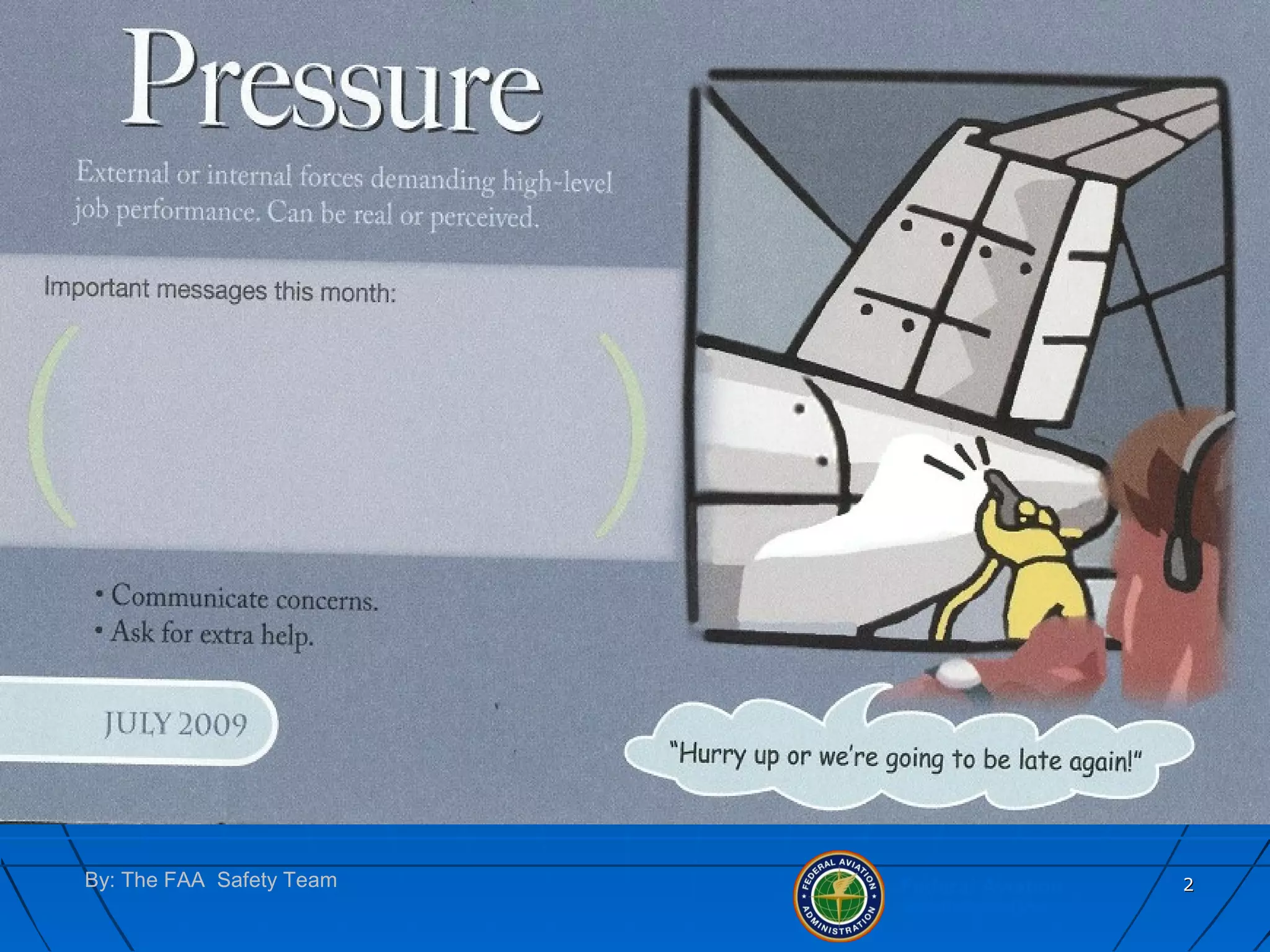
  • #3 Some of you may recognize image of this page taken from a pocket calendar previously offered by the FAASTeam. The calendar presented twelve causes for maintenance human error call the “Dirty Dozen”. Although the calendar went away the causes of maintenance error have not! The message the calendar provided is still valid and valuable. So much so we are re-emphasizing one of those twelve causes called “Pressure”.
  • #4 Pressure, may be defined as External or Internal forces demanding high-level job performance. It can be real or perceived. There are recommended actions that will help avoid or reduce maintenance error. If you feel the pressure, communicate your concerns to your supervisor or fellow AMT’s. You also can ask for help in completing the task. We all are subject to pressure. Some “External” Pressures may be: -Aircraft departure time provides limited time to complete the work -Your wife and children are waiting outside in the heat to go on vacation that cannot begin until you get the Annual completed -You had parts delays and now the impatient owner is demanding is aircraft be ready ASAP!! What about examples of “Internal” Pressure? Which more often than not are PERCEIVED ? Thinking the boss is wanting you to accomplish something illegal Like signing off something as completed when it wasn’t! Or maybe using a torque wrench that hasn’t had a calibration check for over two years
  • #5 One of the potential stressors in aircraft maintenance is time pressure, whether actual or self imposed. Unfortunately during live and busy aircraft maintenance environments it’s impossible to control all the variables contributing to time pressure errors. However you can learn to apply safeguards to reduce error during chaotic times.
  • #6 Note Click on the Red triangle to start video. You may have to right click and select Play. There is often pressure in maintenance organizations, which can come from many sources. Often, you put the greatest pressure on yourself. You press yourself for high quality performance in minimal time. Your managers may apply pressure. Pressures to meet a deadline are the most common. And your co-workers may also apply pressure. They can create a sense of urgency that forces you to work at a pace faster than you are comfortable with. Conditions cause pressure. The closer it gets to departure, the more pressure builds up to get the task completed quickly. So, pressure is one of the dirty dozen. It is a possible contributing factor to an event.
  • #7 Pressure originates from many sources. There is often pressure in maintenance organizations due to high expectations or goals such as increased productivity with adding resources. Often, you put the greatest pressure on yourself. You press yourself for high quality performance in minimal time. Your managers may apply pressure. Pressures to meet a deadline are the most common. And your co-workers may also apply pressure. They can create a sense of urgency that forces you to work at a pace faster than you are comfortable with. Conditions cause pressure. The closer it gets to departure, the more pressure builds up to get the task completed quickly. So, pressure is one of the dirty dozen. It is a possible contributing factor to an event.
  • #8 All levels of an organization are subject to pressures. Management and their staff have the pressure of getting an aircraft out on time. Aircraft Maintenance Technicians (AMT) have the pressure of being certain that the aircraft is airworthy. However there are significant differences in accountability if there is a failure. Unfortunately the AMT bears a higher level of negative impact if airworthiness is jeopardized or compromised and it results in an accident. This may include FAA investigation and/or enforcement, civil litigation, emotional and/or financial impact, etc.
  • #9 The potential conflict between the two driving pressures may cause problems. The need to meet a deadline verses the need to make certain all airworthiness and regulatory requirements are met. It would be great if the AMT could be insulated from these types of “Pressures” but that is not possible. What is possible is to educate the AMT how to recognize these pressures and more effectively deal with it while meeting the desired outcome without human error to maintain safety.
  • #10 An excerpt from the NTSB report on the Aloha accident refers to time pressure as a possible contributory factor in the accident. “ Aloha’s flying schedule involved full utilization of its airplane fleet in a daytime operation.” This is a political way to say tight scheduling practices allows no margin for safety.
  • #11 The majority of Aloha’s maintenance was normally conducted only during the night. It was considered important that the airplanes be available again for the next day’s flying schedule . Mechanics and inspectors were under constant time pressure to perform . Which of the Dirty Dozen, other than PRESSURE might play a role in this scenario? Fatigue – Lack of Sleep Stress – Caused by deadline or lack of sleep Complacency – Every night doing the same checks over and over Distraction – Sick child or wife at home Lack of Awareness – fatigue and the rest of these can and often does create a Lack of Awareness!
  • #12 The AMT force into a compromising position. The need to balance an appropriate length of time to perform the maintenance activity against the operational need for the aircraft. So, It is 12:00 a.m. and the plane has at least an estimated ten hours of work plus an engine run but must be on the gate by 6:00 a.m. How apprehensive are you and your crew feeling to make the gate time? Will there be temptation or pressure to cut corners? Will you be asked to falsify the paperwork and complete the task tomorrow night? You are in a tough spot but ultimately you must make the right decision. Maintain your professional and ethical and moral integrity. Do not give in to this PRESSURE! If you relent once it will be expected again and the next time you do so you will feel less guilty. This start of a serious unacceptable behavior.
  • #13 Human factors training is designed to teach AMTs to use sound judgment to consistently make right decisions. However all the training in the world is worthless unless the AMT uses it. You must be the one that takes the steps to ensure that you and your teammates do not allow one or more of the Dirty Dozen to create a situation that you will regret for the rest of your lives!
  • #14 Sometimes you can predict then avert pressure. For example, if you routinely perform annual inspections you probably can expect the owner to be anxious to get their plane back as quickly as possible. So before your next annual, conduct a thorough pre-inspection meeting with the owner. Review the records together, learn what the owner knows and expects. Let them know what you intend to do, itemize your work, focus on unusual or abnormal needs, discuss parts, research. Definitely inform them you will not compromise airworthiness and safety. Be sure you inform them you will keep them apprised daily of progress and advise if you encounter problems.
  • #15 Each one of us handles Pressure differently. Some work well under pressure but so get “rattled under Pressure. Some pressure is good but too much pressure is bad!. There are tactics you can learn to help handle pressure. These are called Safety Nets. Safety nets can be implemented at the overall organizational level or at the individual/personal level. First be sure the pressure isn’t self-induced. Communicate your concerns to management if you feel airworthiness or safety may be at risk. If you need help….ASK FOR IT! As last resort you CAN just say No!
  • #16 Organizational Safety Nets: A strong and robust safety culture throughout the Organization. Especially from top level down to the floor level. Use of Checklists Following Procedures Following the Regulations Open Reporting for Safety Issues. Training
  • #17 Technicians can do much to avert or reduce pressures both in the home and at work. This is important because your domestic pressures will not go away when you arrive to work. What will happen your pressures will elevate. Discuss these Personal Safety Nets: Task prioritization/organization Identifying stopping points Finding/expecting problems Health/Rest Situational awareness Ask participants to identify any more
  • #18 There is a Tool available to assist you in not falling prey to the “Pressure” as well as fending off the remaining 11 dreaded Dirty Dozen causes of maintenance human error? Has anyone seen this before? This is The Maintenance Personal Minimum Checklist- Before the Task checklist. Review each item and discuss
  • #19 This is the reverse side Maintenance Personal Minimum Checklist. However this is After the Task checklist. Review each item and discuss. If you do not have a copy of this “tool”……….. one get one…………………….and use it! It will make you think before you act and that is a good thing. It will keep you out of “hot water” and could even save a life!
  • #20 Solicit comments or questions. Promote the FAA SafetyTeam and www.faasafety.gov. Spend some time promoting remaining bullets on the slide. Promote WINGS if pilots in the group. Ask for feedback via phone, e-mail or website on slide.