Aircraft Structures-II Unit-1
10AE72 Introduction to Aircraft Structural Design
R.Suthan M.E Dept of Aeronautical Engg
Asst.Professor DSCE-Bangalore
Structural Layout of Airplane
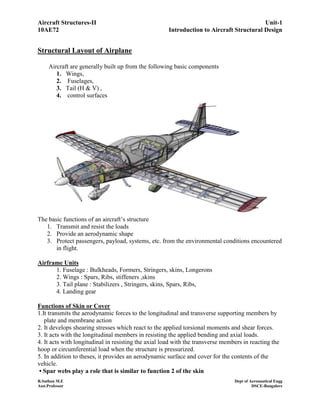
Aircraft are generally built up from the following basic components
1. Wings,
2. Fuselages,
3. Tail (H & V) ,
4. control surfaces
The basic functions of an aircraft’s structure
1. Transmit and resist the loads
2. Provide an aerodynamic shape
3. Protect passengers, payload, systems, etc. from the environmental conditions encountered
in flight.
Airframe Units
1. Fuselage : Bulkheads, Formers, Stringers, skins, Longerons
2. Wings : Spars, Ribs, stiffeners ,skins
3. Tail plane : Stabilizers , Stringers, skins, Spars, Ribs,
4. Landing gear
Functions of Skin or Cover
1.It transmits the aerodynamic forces to the longitudinal and transverse supporting members by
plate and membrane action
2. It develops shearing stresses which react to the applied torsional moments and shear forces.
3. It acts with the longitudinal members in resisting the applied bending and axial loads.
4. It acts with longitudinal in resisting the axial load with the transverse members in reacting the
hoop or circumferential load when the structure is pressurized.
5. In addition to theses, it provides an aerodynamic surface and cover for the contents of the
vehicle.
• Spar webs play a role that is similar to function 2 of the skin
Aircraft Structures-II Unit-1
10AE72 Introduction to Aircraft Structural Design
R.Suthan M.E Dept of Aeronautical Engg
Asst.Professor DSCE-Bangalore
Functions of Longitudinals, Stringers or Stiffenners (Longerons)
1. They resist bending and axial loads along with the skin.
2. They divide the skin into small panels and thereby increase its buckling and failure stresses.
3. They act with the skin in resisting axial loads caused by pressurization.
• The spar caps in an aerodynamic surface perform functions 1 and 2.
Functions of Frames, Rings (Bulkheads)
1. Maintain cross section shape
2. Distribute concentrated loads into the structure and redistribute stresses around structural
discontinuities.
3. Establish the column length and provide end restraint for the longitudinal to increase their
column buckling stress.
4. Provide edge restraint for the skin panels and thereby increase the plate buckling stress of
these elements.
5. Act with the skin in resisting the circumferential loads due to pressurization
Fuselage
 The fuselage is the main structure or body of the fixed-wing aircraft. It provides space and
support for cargo, controls, accessories, passengers, and other equipment.
 In single-engine aircraft, the fuselage houses the power plant. In multiengine aircraft, the
engines may be either in the fuselage, attached to the fuselage, or suspended from the wing
structure.
 A series of frames in the shape of the fuselage cross-sections are held in position on a rigid
fixture, or jig.
– These are then joined with lightweight longitudinal elements called stringers.
– These are then covered with a skin of sheet aluminum,attached by riveting or by bonding
with special adhesives.
– The fixture is then removed from the completed fuselage shell
Types of fuselage structure
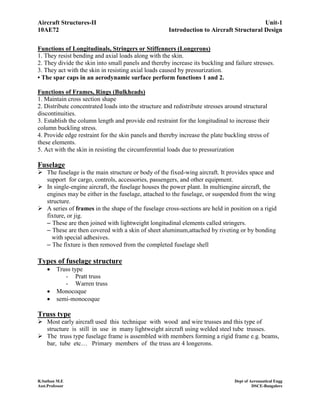
 Truss type
- Pratt truss
- Warren truss
 Monocoque
 semi-monocoque
Truss type
 Most early aircraft used this technique with wood and wire trusses and this type of
structure is still in use in many lightweight aircraft using welded steel tube trusses.
 The truss type fuselage frame is assembled with members forming a rigid frame e.g. beams,
bar, tube etc… Primary members of the truss are 4 longerons.
Aircraft Structures-II Unit-1
10AE72 Introduction to Aircraft Structural Design
R.Suthan M.E Dept of Aeronautical Engg
Asst.Professor DSCE-Bangalore
Pratt type
 Early days aircrafts used this type of construcion
 Its made up of Wooden or metal structure
 Great weight and Difficult to streamline
 Box with tubular longerons + vertical members
Warren type
 Longerons + only Diagonal Members
 Force transfer to every others structure
 Capable to carry tension + compression
 Reduce amount of webs work
 More space , strength , rigidity
 Better streamline
Aircraft Structures-II Unit-1
10AE72 Introduction to Aircraft Structural Design
R.Suthan M.E Dept of Aeronautical Engg
Asst.Professor DSCE-Bangalore
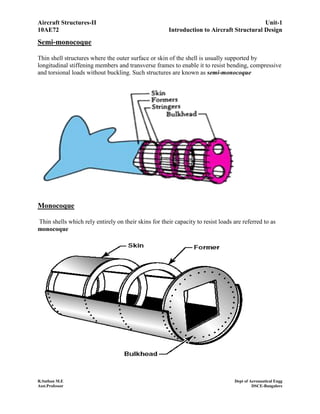
Semi-monocoque
Thin shell structures where the outer surface or skin of the shell is usually supported by
longitudinal stiffening members and transverse frames to enable it to resist bending, compressive
and torsional loads without buckling. Such structures are known as semi-monocoque
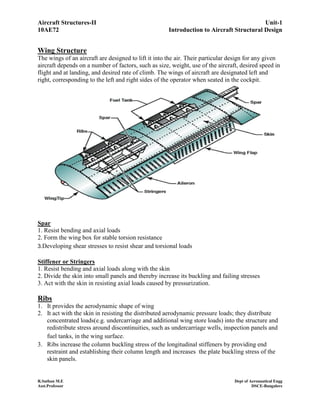
Monocoque
Thin shells which rely entirely on their skins for their capacity to resist loads are referred to as
monocoque
Aircraft Structures-II Unit-1
10AE72 Introduction to Aircraft Structural Design
R.Suthan M.E Dept of Aeronautical Engg
Asst.Professor DSCE-Bangalore
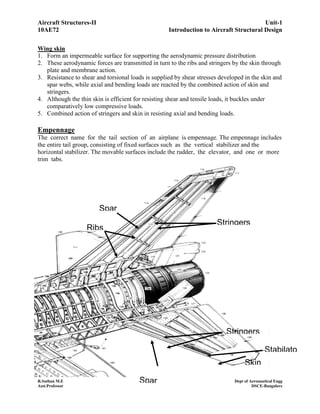
Wing Structure
The wings of an aircraft are designed to lift it into the air. Their particular design for any given
aircraft depends on a number of factors, such as size, weight, use of the aircraft, desired speed in
flight and at landing, and desired rate of climb. The wings of aircraft are designated left and
right, corresponding to the left and right sides of the operator when seated in the cockpit.
Spar
1. Resist bending and axial loads
2. Form the wing box for stable torsion resistance
3.Developing shear stresses to resist shear and torsional loads
Stiffener or Stringers
1. Resist bending and axial loads along with the skin
2. Divide the skin into small panels and thereby increase its buckling and failing stresses
3. Act with the skin in resisting axial loads caused by pressurization.
Ribs
1. It provides the aerodynamic shape of wing
2. It act with the skin in resisting the distributed aerodynamic pressure loads; they distribute
concentrated loads(e.g. undercarriage and additional wing store loads) into the structure and
redistribute stress around discontinuities, such as undercarriage wells, inspection panels and
fuel tanks, in the wing surface.
3. Ribs increase the column buckling stress of the longitudinal stiffeners by providing end
restraint and establishing their column length and increases the plate buckling stress of the
skin panels.
Aircraft Structures-II Unit-1
10AE72 Introduction to Aircraft Structural Design
R.Suthan M.E Dept of Aeronautical Engg
Asst.Professor DSCE-Bangalore
Wing skin
1. Form an impermeable surface for supporting the aerodynamic pressure distribution
2. These aerodynamic forces are transmitted in turn to the ribs and stringers by the skin through
plate and membrane action.
3. Resistance to shear and torsional loads is supplied by shear stresses developed in the skin and
spar webs, while axial and bending loads are reacted by the combined action of skin and
stringers.
4. Although the thin skin is efficient for resisting shear and tensile loads, it buckles under
comparatively low compressive loads.
5. Combined action of stringers and skin in resisting axial and bending loads.
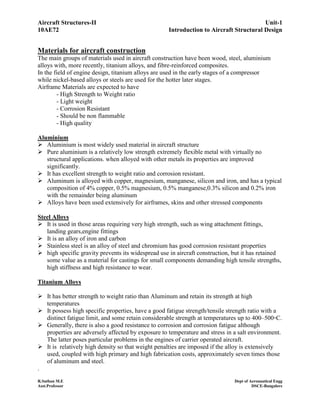
Empennage
The correct name for the tail section of an airplane is empennage. The empennage includes
the entire tail group, consisting of fixed surfaces such as the vertical stabilizer and the
horizontal stabilizer. The movable surfaces include the rudder, the elevator, and one or more
trim tabs.
Spar
Ribs
Stringers
Skin
Stringers
Stabilato
Aircraft Structures-II Unit-1
10AE72 Introduction to Aircraft Structural Design
R.Suthan M.E Dept of Aeronautical Engg
Asst.Professor DSCE-Bangalore
 Tail plane is mainly contributing for directional control
 The force on an aerodynamic surface (wing, vertical or horizontal tail) results from a
differential pressure distribution caused by incidence, camber or a combination of both.
Undercarriage
 Landing gear is the structure under a plane's fuselage that allows it to land safely. The
landing gear supports the aircraft during landing and while it is on the ground.
 Older landing gear had two wheels forward of the aircraft's center of gravity and a third,
smaller wheel at the tail.
 Tricycle landing gear consists of a forward (nose) wheel and a pair of wheels located midway
on the fuselage. The nose gear is steerable by means of the rudder pedals
 Landing gear must be strong enough to withstand the forces of landing when the aircraft is
fully loaded. In addition to strength, a major design goal is to have the gear assembly be as
light as possible.
 Landing gear are made from a wide range of materials including steel, aluminum,and
magnesium. Wheels and tires are designed specifically for aviation use and have unique
operating characteristics.
 Main wheel assemblies usually have a braking system. To aid with the potentially high
impact of landing, most landing gear have a means of either absorbing shock or accepting
shock and distributing it so that the structure is not damaged
Aircraft Structures-II Unit-1
10AE72 Introduction to Aircraft Structural Design
R.Suthan M.E Dept of Aeronautical Engg
Asst.Professor DSCE-Bangalore
Materials for aircraft construction
The main groups of materials used in aircraft construction have been wood, steel, aluminium
alloys with, more recently, titanium alloys, and fibre-reinforced composites.
In the field of engine design, titanium alloys are used in the early stages of a compressor
while nickel-based alloys or steels are used for the hotter later stages.
Airframe Materials are expected to have
- High Strength to Weight ratio
- Light weight
- Corrosion Resistant
- Should be non flammable
- High quality
Aluminium
 Aluminium is most widely used material in aircraft structure
 Pure aluminium is a relatively low strength extremely flexible metal with virtually no
structural applications. when alloyed with other metals its properties are improved
significantly.
 It has excellent strength to weight ratio and corrosion resistant.
 Aluminum is alloyed with copper, magnesium, manganese, silicon and iron, and has a typical
composition of 4% copper, 0.5% magnesium, 0.5% manganese,0.3% silicon and 0.2% iron
with the remainder being aluminum
 Alloys have been used extensively for airframes, skins and other stressed components
Steel Alloys
 It is used in those areas requiring very high strength, such as wing attachment fittings,
landing gears,engine fittings
 It is an alloy of iron and carbon
 Stainless steel is an alloy of steel and chromium has good corrosion resistant properties
 high specific gravity prevents its widespread use in aircraft construction, but it has retained
some value as a material for castings for small components demanding high tensile strengths,
high stiffness and high resistance to wear.
Titanium Alloys
 It has better strength to weight ratio than Aluminum and retain its strength at high
temperatures
 It possess high specific properties, have a good fatigue strength/tensile strength ratio with a
distinct fatigue limit, and some retain considerable strength at temperatures up to 400–500◦C.
 Generally, there is also a good resistance to corrosion and corrosion fatigue although
properties are adversely affected by exposure to temperature and stress in a salt environment.
The latter poses particular problems in the engines of carrier operated aircraft.
 It is relatively high density so that weight penalties are imposed if the alloy is extensively
used, coupled with high primary and high fabrication costs, approximately seven times those
of aluminum and steel.
.
Aircraft Structures-II Unit-1
10AE72 Introduction to Aircraft Structural Design
R.Suthan M.E Dept of Aeronautical Engg
Asst.Professor DSCE-Bangalore
Glass
 The majority of modern aircraft have cabins pressurized for flight at high altitudes.
 Windscreens and windows are therefore subjected to loads normal to their midplanes.
 Glass is frequently the material employed for this purpose in the form of plain or laminated
plate or heat-strengthened plate.
 The types of plate glass used in aircraft have a modulus of elasticity between 70 000 and
75 000 N/mm2
with a modulus of rupture in bending of 45 N/mm2.
Composite materials
 Composite materials consist of strong fibres such as glass or carbon set in a matrix of plastic
or epoxy resin, which is mechanically and chemically protective.
 The fibres may be continuous or discontinuous but possess a strength very much greater than
that of the same bulk materials. For example, carbon fibres have a tensile strength of the
order of 2400 N/mm2 and a modulus of elasticity of 400 000 N/mm2.
 This glass-reinforced plastic (GRP) was used for radomes and helicopter blades but found
limited use in components of fixed wing aircraft due to its low stiffness.
 Kevlar, is an aramid material with the same strength as glass but is stiffer. Kevlar composites
are tough but poor in compression and difficult to machine, so they were used in secondary
structures.
 Another composite, using boron fibre and developed in the USA, was the first to possess
sufficient strength and stiffness for primary structures.
 These composites have now been replaced by carbon-fibre-reinforced plastics (CFRP), which
have similar properties to boron composites but are very much cheaper.
 Typically, CFRP has a modulus of the order of three times that of GRP, one and a half times
that of a Kevlar composite and twice that of aluminium alloy. Its strength is three times that
of aluminium alloy, approximately the same as that of GRP, and slightly less than that of
Kevlar composites.
 CFRP is a brittle material and therefore does not yield plastically in regions of high stress
concentration. Its strength is reduced by impact damage which may not be visible and the
epoxy resin matrices can absorb moisture over a long period which reduces its matrix-
dependent properties, such as its compressive strength; this effect increases with increase of
temperature.
Aircraft Structures-II Unit-1
10AE72 Introduction to Aircraft Structural Design
R.Suthan M.E Dept of Aeronautical Engg
Asst.Professor DSCE-Bangalore
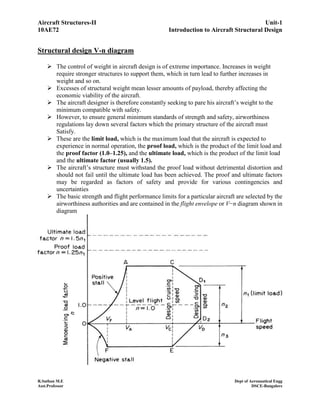
Structural design V-n diagram
 The control of weight in aircraft design is of extreme importance. Increases in weight
require stronger structures to support them, which in turn lead to further increases in
weight and so on.
 Excesses of structural weight mean lesser amounts of payload, thereby affecting the
economic viability of the aircraft.
 The aircraft designer is therefore constantly seeking to pare his aircraft’s weight to the
minimum compatible with safety.
 However, to ensure general minimum standards of strength and safety, airworthiness
regulations lay down several factors which the primary structure of the aircraft must
Satisfy.
 These are the limit load, which is the maximum load that the aircraft is expected to
experience in normal operation, the proof load, which is the product of the limit load and
the proof factor (1.0–1.25), and the ultimate load, which is the product of the limit load
and the ultimate factor (usually 1.5).
 The aircraft’s structure must withstand the proof load without detrimental distortion and
should not fail until the ultimate load has been achieved. The proof and ultimate factors
may be regarded as factors of safety and provide for various contingencies and
uncertainties
 The basic strength and flight performance limits for a particular aircraft are selected by the
airworthiness authorities and are contained in the flight envelope or V−n diagram shown in
diagram
Aircraft Structures-II Unit-1
10AE72 Introduction to Aircraft Structural Design
R.Suthan M.E Dept of Aeronautical Engg
Asst.Professor DSCE-Bangalore
 The curves OA and OF correspond to the stalled condition of the aircraft and are obtained
from the well-known aerodynamic relationship
Lift = nW = 0.5ρV2
SCL,max
 Therefore, for speeds below VA (positive wing incidence) and VF (negative incidence) the
maximum loads which can be applied to the aircraft are governed by CL,max.
 As the speed increases it is possible to apply the positive and negative limit loads,
corresponding to n1 and n3, without stalling the aircraft so that AC and FE represent
maximum operational load factors for the aircraft.
 Above the design cruising speed VC, the cut-off lines CD1 and D2E relieve the design cases
to be covered since it is not expected that the limit loads will be applied at maximum
speed.
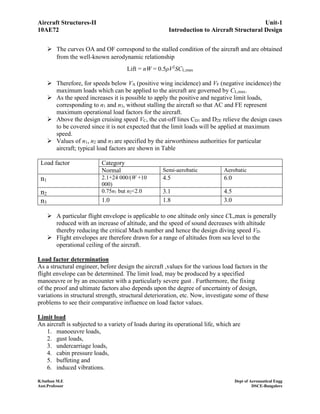
 Values of n1, n2 and n3 are specified by the airworthiness authorities for particular
aircraft; typical load factors are shown in Table
Load factor Category
Normal Semi-aerobatic Aerobatic
n1 2.1+24 000/(W +10
000)
4.5 6.0
n2 0.75n1 but n2˂2.0 3.1 4.5
n3 1.0 1.8 3.0
 A particular flight envelope is applicable to one altitude only since CL,max is generally
reduced with an increase of altitude, and the speed of sound decreases with altitude
thereby reducing the critical Mach number and hence the design diving speed VD.
 Flight envelopes are therefore drawn for a range of altitudes from sea level to the
operational ceiling of the aircraft.
Load factor determination
As a structural engineer, before design the aircraft ,values for the various load factors in the
flight envelope can be determined. The limit load, may be produced by a specified
manoeuvre or by an encounter with a particularly severe gust . Furthermore, the fixing
of the proof and ultimate factors also depends upon the degree of uncertainty of design,
variations in structural strength, structural deterioration, etc. Now, investigate some of these
problems to see their comparative influence on load factor values.
Limit load
An aircraft is subjected to a variety of loads during its operational life, which are
1. manoeuvre loads,
2. gust loads,
3. undercarriage loads,
4. cabin pressure loads,
5. buffeting and
6. induced vibrations.
Aircraft Structures-II Unit-1
10AE72 Introduction to Aircraft Structural Design
R.Suthan M.E Dept of Aeronautical Engg
Asst.Professor DSCE-Bangalore
 Manoeuvre, undercarriage and cabin pressure loads are determined with reasonable
simplicity since manoeuvre loads are controlled design cases, undercarriages are designed for
given maximum descent rates and cabin pressures are specified.
 The remaining loads depend to a large extent on the atmospheric conditions encountered
during flight.
 Estimates of the magnitudes of such loads are only possible therefore if in-flight data on
these loads is available. It requires a great number of hours of flying if the experimental data
are to include possible extremes of atmospheric conditions.
 The aim would be for a zero or negligible rate of occurrence of its ultimate load and an
extremely low rate of occurrence of its proof load.
.
Uncertainties in design and structural deterioration
 Modern methods of aircraft structural analysis are refined and, in any case, tests to determine
actual failure loads are carried out on representative full scale components to verify design
estimates.
 The problem of structural deterioration due to corrosion and wear may be largely eliminated
by close inspection during service and the application of suitable protective treatments.
Variation in structural strength
 To minimize the effect of the variation in structural strength between two apparently
identical components, strict controls are employed in the manufacture of materials and in the
fabrication of the structure.
 Material control involves the observance of strict limits in chemical composition and close
supervision of manufacturing methods such as machining, heat treatment, rolling, etc.
 In addition, the inspection of samples by visual, radiographic and other means, and the
carrying out of strength tests on specimens, enable below limit batches to be isolated and
rejected.
 Thus, if a sample of a batch of material falls below a specified minimum strength then the
batch is rejected.
 This means of course that an actual structure always comprises materials with properties
equal to or better than those assumed for design purposes, an added but unallowed for
‘bonus’ in considering factors of safety.
 Similar precautions are applied to assembled structures with regard to dimension tolerances,
quality of assembly, welding, etc. Again, visual and other inspection methods are employed
and, in certain cases, strength tests are carried out on sample structures.
Fatigue
 Although adequate precautions are taken to ensure that an aircraft’s structure possesses
sufficient strength to withstand the most severe expected gust or manoeuvre load, there still
remains the problem of fatigue.
 Practically all components of the aircraft’s structure are subjected to fluctuating loads which
occur a great many times during the life of the aircraft.
 It has been known for many years that materials fail under fluctuating loads at much lower
values of stress than their normal static failure stress.
Aircraft Structures-II Unit-1
10AE72 Introduction to Aircraft Structural Design
R.Suthan M.E Dept of Aeronautical Engg
Asst.Professor DSCE-Bangalore
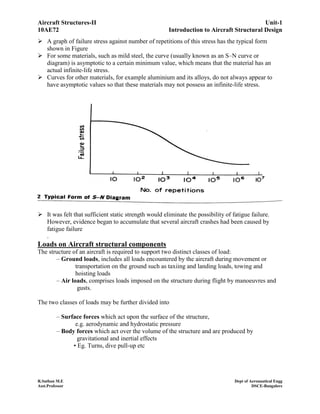
 A graph of failure stress against number of repetitions of this stress has the typical form
shown in Figure
 For some materials, such as mild steel, the curve (usually known as an S–N curve or
diagram) is asymptotic to a certain minimum value, which means that the material has an
actual infinite-life stress.
 Curves for other materials, for example aluminium and its alloys, do not always appear to
have asymptotic values so that these materials may not possess an infinite-life stress.
 It was felt that sufficient static strength would eliminate the possibility of fatigue failure.
However, evidence began to accumulate that several aircraft crashes had been caused by
fatigue failure
.
Loads on Aircraft structural components
The structure of an aircraft is required to support two distinct classes of load:
– Ground loads, includes all loads encountered by the aircraft during movement or
transportation on the ground such as taxiing and landing loads, towing and
hoisting loads
– Air loads, comprises loads imposed on the structure during flight by manoeuvres and
gusts.
The two classes of loads may be further divided into
– Surface forces which act upon the surface of the structure,
e.g. aerodynamic and hydrostatic pressure
– Body forces which act over the volume of the structure and are produced by
gravitational and inertial effects
• Eg. Turns, dive pull-up etc
Aircraft Structures-II Unit-1
10AE72 Introduction to Aircraft Structural Design
R.Suthan M.E Dept of Aeronautical Engg
Asst.Professor DSCE-Bangalore
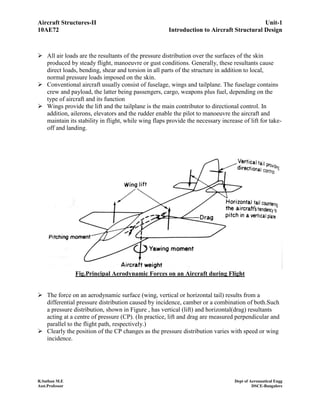
 All air loads are the resultants of the pressure distribution over the surfaces of the skin
produced by steady flight, manoeuvre or gust conditions. Generally, these resultants cause
direct loads, bending, shear and torsion in all parts of the structure in addition to local,
normal pressure loads imposed on the skin.
 Conventional aircraft usually consist of fuselage, wings and tailplane. The fuselage contains
crew and payload, the latter being passengers, cargo, weapons plus fuel, depending on the
type of aircraft and its function
 Wings provide the lift and the tailplane is the main contributor to directional control. In
addition, ailerons, elevators and the rudder enable the pilot to manoeuvre the aircraft and
maintain its stability in flight, while wing flaps provide the necessary increase of lift for take-
off and landing.
Fig.Principal Aerodynamic Forces on an Aircraft during Flight
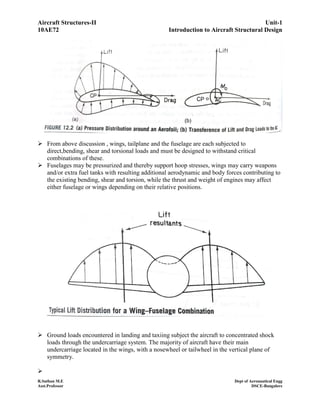
 The force on an aerodynamic surface (wing, vertical or horizontal tail) results from a
differential pressure distribution caused by incidence, camber or a combination of both.Such
a pressure distribution, shown in Figure , has vertical (lift) and horizontal(drag) resultants
acting at a centre of pressure (CP). (In practice, lift and drag are measured perpendicular and
parallel to the flight path, respectively.)
 Clearly the position of the CP changes as the pressure distribution varies with speed or wing
incidence.
Aircraft Structures-II Unit-1
10AE72 Introduction to Aircraft Structural Design
R.Suthan M.E Dept of Aeronautical Engg
Asst.Professor DSCE-Bangalore
 From above discussion , wings, tailplane and the fuselage are each subjected to
direct,bending, shear and torsional loads and must be designed to withstand critical
combinations of these.
 Fuselages may be pressurized and thereby support hoop stresses, wings may carry weapons
and/or extra fuel tanks with resulting additional aerodynamic and body forces contributing to
the existing bending, shear and torsion, while the thrust and weight of engines may affect
either fuselage or wings depending on their relative positions.
 Ground loads encountered in landing and taxiing subject the aircraft to concentrated shock
loads through the undercarriage system. The majority of aircraft have their main
undercarriage located in the wings, with a nosewheel or tailwheel in the vertical plane of
symmetry.

Aircraft Structures-II Unit-1
10AE72 Introduction to Aircraft Structural Design
R.Suthan M.E Dept of Aeronautical Engg
Asst.Professor DSCE-Bangalore
 Position of the main undercarriage should be such as to produce minimum loads on the wing
structure compatible with the stability of theaircraft during ground manoeuvres. This may be
achieved by locating the undercarriage just forward of the flexural axis of the wing and as
close to the wing root as possible.
 In this case the shock landing load produces a given shear, minimum bending plus torsion,
with the latter being reduced as far as practicable by offsetting the torque caused by the
vertical load in the undercarriage leg by a torque in an opposite sense due to braking.
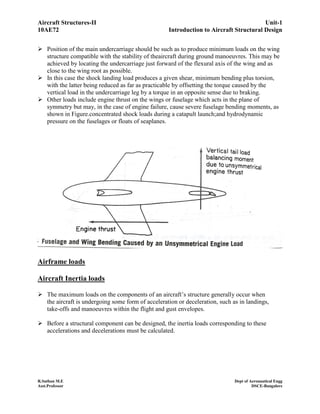
 Other loads include engine thrust on the wings or fuselage which acts in the plane of
symmetry but may, in the case of engine failure, cause severe fuselage bending moments, as
shown in Figure.concentrated shock loads during a catapult launch;and hydrodynamic
pressure on the fuselages or floats of seaplanes.
Airframe loads
Aircraft Inertia loads
 The maximum loads on the components of an aircraft’s structure generally occur when
the aircraft is undergoing some form of acceleration or deceleration, such as in landings,
take-offs and manoeuvres within the flight and gust envelopes.
 Before a structural component can be designed, the inertia loads corresponding to these
accelerations and decelerations must be calculated.
Aircraft Structures-II Unit-1
10AE72 Introduction to Aircraft Structural Design
R.Suthan M.E Dept of Aeronautical Engg
Asst.Professor DSCE-Bangalore
Symmetric manoeuvers load
 In symmetric manoeuvres we consider the motion of the aircraft initiated by movement of the
control surfaces in the plane of symmetry. Examples of such manoeuvres are loops, straight
pull-outs and bunts, and the calculations involve the determination of lift, drag and tailplane
loads at given flight speeds and altitudes.
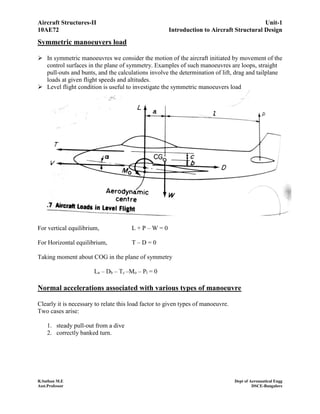
 Level flight condition is useful to investigate the symmetric manoeuvers load
For vertical equilibrium, L + P – W = 0
For Horizontal equilibrium, T – D = 0
Taking moment about COG in the plane of symmetry
La – Db – Tc –Mo – Pl = 0
Normal accelerations associated with various types of manoeuvre
Clearly it is necessary to relate this load factor to given types of manoeuvre.
Two cases arise:
1. steady pull-out from a dive
2. correctly banked turn.
Aircraft Structures-II Unit-1
10AE72 Introduction to Aircraft Structural Design
R.Suthan M.E Dept of Aeronautical Engg
Asst.Professor DSCE-Bangalore
Steady pull-out
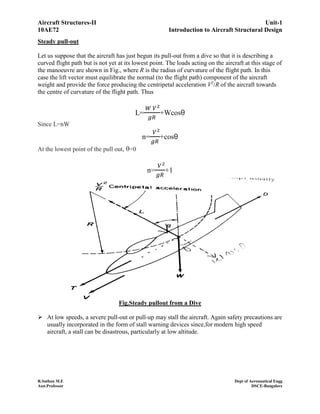
Let us suppose that the aircraft has just begun its pull-out from a dive so that it is describing a
curved flight path but is not yet at its lowest point. The loads acting on the aircraft at this stage of
the manoeuvre are shown in Fig., where R is the radius of curvature of the flight path. In this
case the lift vector must equilibrate the normal (to the flight path) component of the aircraft
weight and provide the force producing the centripetal acceleration V2
/R of the aircraft towards
the centre of curvature of the flight path. Thus
L=
𝑊 𝑉2
𝑔𝑅
+Wcosθ
Since L=nW
n=
𝑉2
𝑔𝑅
+cosθ
At the lowest point of the pull out, θ=0
n=
𝑉2
𝑔𝑅
+1
Fig.Steady pullout from a Dive
 At low speeds, a severe pull-out or pull-up may stall the aircraft. Again safety precautions are
usually incorporated in the form of stall warning devices since,for modern high speed
aircraft, a stall can be disastrous, particularly at low altitude.
Aircraft Structures-II Unit-1
10AE72 Introduction to Aircraft Structural Design
R.Suthan M.E Dept of Aeronautical Engg
Asst.Professor DSCE-Bangalore
Correctly banked turn
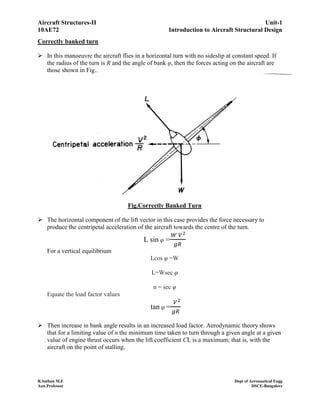
 In this manoeuvre the aircraft flies in a horizontal turn with no sideslip at constant speed. If
the radius of the turn is R and the angle of bank φ, then the forces acting on the aircraft are
those shown in Fig..
Fig.Correctly Banked Turn
 The horizontal component of the lift vector in this case provides the force necessary to
produce the centripetal acceleration of the aircraft towards the centre of the turn.
L sin φ =
𝑊 𝑉2
𝑔𝑅
For a vertical equilibrium
Lcos φ =W
L=Wsec φ
n = sec φ
Equate the load factor values
tan φ =
𝑉2
𝑔𝑅
 Then increase in bank angle results in an increased load factor. Aerodynamic theory shows
that for a limiting value of n the minimum time taken to turn through a given angle at a given
value of engine thrust occurs when the lift coefficient CL is a maximum; that is, with the
aircraft on the point of stalling.
Aircraft Structures-II Unit-1
10AE72 Introduction to Aircraft Structural Design
R.Suthan M.E Dept of Aeronautical Engg
Asst.Professor DSCE-Bangalore
Gust loads
 We considered aircraft loads resulting from prescribed manoeuvres in the longitudinal plane
of symmetry. Other types of in-flight load are caused by air turbulence.
 The movements of the air in turbulence are generally known as gusts and produce changes in
wing incidence, thereby subjecting the aircraft to sudden or gradual increases or decreases in
lift from which normal accelerations result.
 These may be critical for large, high speed aircraft and may possibly cause higher loads than
control initiated manoeuvres
Sharp-edged gust
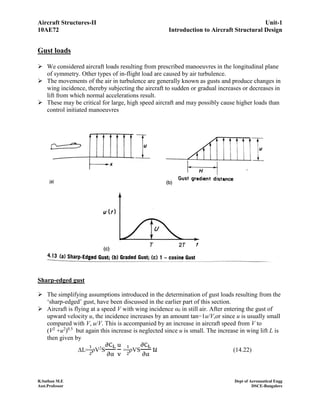
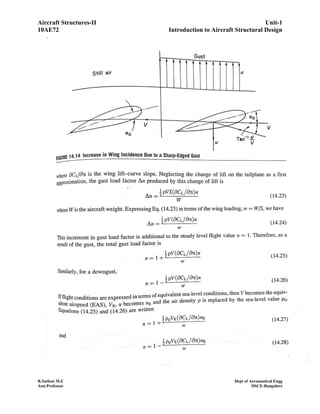
 The simplifying assumptions introduced in the determination of gust loads resulting from the
‘sharp-edged’ gust, have been discussed in the earlier part of this section.
 Aircraft is flying at a speed V with wing incidence α0 in still air. After entering the gust of
upward velocity u, the incidence increases by an amount tan−1u/V,or since u is usually small
compared with V, u/V. This is accompanied by an increase in aircraft speed from V to
(V2
+u2
)0.5
but again this increase is neglected since u is small. The increase in wing lift L is
then given by
∆L=
1
2
ρV2
S
∂CL
∂α
u
v
=
1
2
ρVS
∂CL
∂α
𝑢 (14.22)
Aircraft Structures-II Unit-1
10AE72 Introduction to Aircraft Structural Design
R.Suthan M.E Dept of Aeronautical Engg
Asst.Professor DSCE-Bangalore
Aircraft Structures-II Unit-1
10AE72 Introduction to Aircraft Structural Design
R.Suthan M.E Dept of Aeronautical Engg
Asst.Professor DSCE-Bangalore
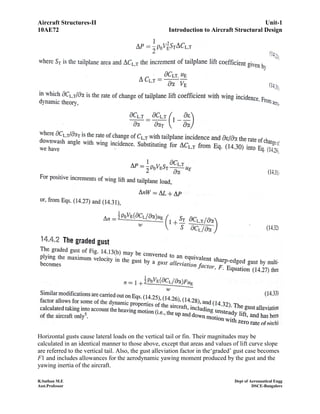
Horizontal gusts cause lateral loads on the vertical tail or fin. Their magnitudes may be
calculated in an identical manner to those above, except that areas and values of lift curve slope
are referred to the vertical tail. Also, the gust alleviation factor in the‘graded’ gust case becomes
F1 and includes allowances for the aerodynamic yawing moment produced by the gust and the
yawing inertia of the aircraft.
Aircraft Structures-II Unit-1
10AE72 Introduction to Aircraft Structural Design
R.Suthan M.E Dept of Aeronautical Engg
Asst.Professor DSCE-Bangalore
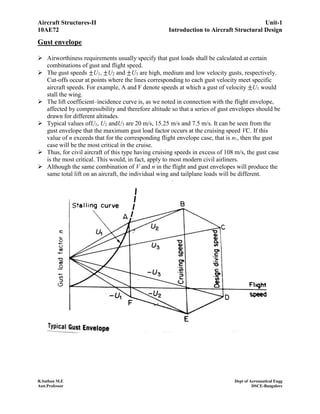
Gust envelope
 Airworthiness requirements usually specify that gust loads shall be calculated at certain
combinations of gust and flight speed.
 The gust speeds ±U1, ±U2 and ±U3 are high, medium and low velocity gusts, respectively.
Cut-offs occur at points where the lines corresponding to each gust velocity meet specific
aircraft speeds. For example, A and F denote speeds at which a gust of velocity ±U1 would
stall the wing.
 The lift coefficient–incidence curve is, as we noted in connection with the flight envelope,
affected by compressibility and therefore altitude so that a series of gust envelopes should be
drawn for different altitudes.
 Typical values ofU1, U2 andU3 are 20 m/s, 15.25 m/s and 7.5 m/s. It can be seen from the
gust envelope that the maximum gust load factor occurs at the cruising speed VC. If this
value of n exceeds that for the corresponding flight envelope case, that is n1, then the gust
case will be the most critical in the cruise.
 Thus, for civil aircraft of this type having cruising speeds in excess of 108 m/s, the gust case
is the most critical. This would, in fact, apply to most modern civil airliners.
 Although the same combination of V and n in the flight and gust envelopes will produce the
same total lift on an aircraft, the individual wing and tailplane loads will be different.
Aircraft Structures-II Unit-1
10AE72 Introduction to Aircraft Structural Design
R.Suthan M.E Dept of Aeronautical Engg
Asst.Professor DSCE-Bangalore
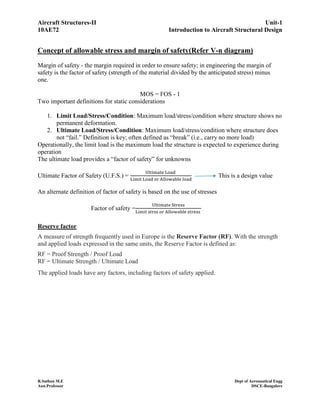
Concept of allowable stress and margin of safety(Refer V-n diagram)
Margin of safety ‐ the margin required in order to ensure safety; in engineering the margin of
safety is the factor of safety (strength of the material divided by the anticipated stress) minus
one.
MOS = FOS - 1
Two important definitions for static considerations
1. Limit Load/Stress/Condition: Maximum load/stress/condition where structure shows no
permanent deformation.
2. Ultimate Load/Stress/Condition: Maximum load/stress/condition where structure does
not “fail.” Definition is key; often defined as “break” (i.e., carry no more load)
Operationally, the limit load is the maximum load the structure is expected to experience during
operation
The ultimate load provides a “factor of safety” for unknowns
Ultimate Factor of Safety (U.F.S.) =
Ultimate Load
Limit Load or Allowable load
This is a design value
An alternate definition of factor of safety is based on the use of stresses
Factor of safety =
Ultimate Stress
Limit strss or Allowable stress
Reserve factor
A measure of strength frequently used in Europe is the Reserve Factor (RF). With the strength
and applied loads expressed in the same units, the Reserve Factor is defined as:
RF = Proof Strength / Proof Load
RF = Ultimate Strength / Ultimate Load
The applied loads have any factors, including factors of safety applied.

Introduction to Aircraft Structural Design

  • 1.
    Aircraft Structures-II Unit-1 10AE72Introduction to Aircraft Structural Design R.Suthan M.E Dept of Aeronautical Engg Asst.Professor DSCE-Bangalore Structural Layout of Airplane Aircraft are generally built up from the following basic components 1. Wings, 2. Fuselages, 3. Tail (H & V) , 4. control surfaces The basic functions of an aircraft’s structure 1. Transmit and resist the loads 2. Provide an aerodynamic shape 3. Protect passengers, payload, systems, etc. from the environmental conditions encountered in flight. Airframe Units 1. Fuselage : Bulkheads, Formers, Stringers, skins, Longerons 2. Wings : Spars, Ribs, stiffeners ,skins 3. Tail plane : Stabilizers , Stringers, skins, Spars, Ribs, 4. Landing gear Functions of Skin or Cover 1.It transmits the aerodynamic forces to the longitudinal and transverse supporting members by plate and membrane action 2. It develops shearing stresses which react to the applied torsional moments and shear forces. 3. It acts with the longitudinal members in resisting the applied bending and axial loads. 4. It acts with longitudinal in resisting the axial load with the transverse members in reacting the hoop or circumferential load when the structure is pressurized. 5. In addition to theses, it provides an aerodynamic surface and cover for the contents of the vehicle. • Spar webs play a role that is similar to function 2 of the skin
  • 2.
    Aircraft Structures-II Unit-1 10AE72Introduction to Aircraft Structural Design R.Suthan M.E Dept of Aeronautical Engg Asst.Professor DSCE-Bangalore Functions of Longitudinals, Stringers or Stiffenners (Longerons) 1. They resist bending and axial loads along with the skin. 2. They divide the skin into small panels and thereby increase its buckling and failure stresses. 3. They act with the skin in resisting axial loads caused by pressurization. • The spar caps in an aerodynamic surface perform functions 1 and 2. Functions of Frames, Rings (Bulkheads) 1. Maintain cross section shape 2. Distribute concentrated loads into the structure and redistribute stresses around structural discontinuities. 3. Establish the column length and provide end restraint for the longitudinal to increase their column buckling stress. 4. Provide edge restraint for the skin panels and thereby increase the plate buckling stress of these elements. 5. Act with the skin in resisting the circumferential loads due to pressurization Fuselage  The fuselage is the main structure or body of the fixed-wing aircraft. It provides space and support for cargo, controls, accessories, passengers, and other equipment.  In single-engine aircraft, the fuselage houses the power plant. In multiengine aircraft, the engines may be either in the fuselage, attached to the fuselage, or suspended from the wing structure.  A series of frames in the shape of the fuselage cross-sections are held in position on a rigid fixture, or jig. – These are then joined with lightweight longitudinal elements called stringers. – These are then covered with a skin of sheet aluminum,attached by riveting or by bonding with special adhesives. – The fixture is then removed from the completed fuselage shell Types of fuselage structure  Truss type - Pratt truss - Warren truss  Monocoque  semi-monocoque Truss type  Most early aircraft used this technique with wood and wire trusses and this type of structure is still in use in many lightweight aircraft using welded steel tube trusses.  The truss type fuselage frame is assembled with members forming a rigid frame e.g. beams, bar, tube etc… Primary members of the truss are 4 longerons.
  • 3.
    Aircraft Structures-II Unit-1 10AE72Introduction to Aircraft Structural Design R.Suthan M.E Dept of Aeronautical Engg Asst.Professor DSCE-Bangalore Pratt type  Early days aircrafts used this type of construcion  Its made up of Wooden or metal structure  Great weight and Difficult to streamline  Box with tubular longerons + vertical members Warren type  Longerons + only Diagonal Members  Force transfer to every others structure  Capable to carry tension + compression  Reduce amount of webs work  More space , strength , rigidity  Better streamline
  • 4.
    Aircraft Structures-II Unit-1 10AE72Introduction to Aircraft Structural Design R.Suthan M.E Dept of Aeronautical Engg Asst.Professor DSCE-Bangalore Semi-monocoque Thin shell structures where the outer surface or skin of the shell is usually supported by longitudinal stiffening members and transverse frames to enable it to resist bending, compressive and torsional loads without buckling. Such structures are known as semi-monocoque Monocoque Thin shells which rely entirely on their skins for their capacity to resist loads are referred to as monocoque
  • 5.
    Aircraft Structures-II Unit-1 10AE72Introduction to Aircraft Structural Design R.Suthan M.E Dept of Aeronautical Engg Asst.Professor DSCE-Bangalore Wing Structure The wings of an aircraft are designed to lift it into the air. Their particular design for any given aircraft depends on a number of factors, such as size, weight, use of the aircraft, desired speed in flight and at landing, and desired rate of climb. The wings of aircraft are designated left and right, corresponding to the left and right sides of the operator when seated in the cockpit. Spar 1. Resist bending and axial loads 2. Form the wing box for stable torsion resistance 3.Developing shear stresses to resist shear and torsional loads Stiffener or Stringers 1. Resist bending and axial loads along with the skin 2. Divide the skin into small panels and thereby increase its buckling and failing stresses 3. Act with the skin in resisting axial loads caused by pressurization. Ribs 1. It provides the aerodynamic shape of wing 2. It act with the skin in resisting the distributed aerodynamic pressure loads; they distribute concentrated loads(e.g. undercarriage and additional wing store loads) into the structure and redistribute stress around discontinuities, such as undercarriage wells, inspection panels and fuel tanks, in the wing surface. 3. Ribs increase the column buckling stress of the longitudinal stiffeners by providing end restraint and establishing their column length and increases the plate buckling stress of the skin panels.
  • 6.
    Aircraft Structures-II Unit-1 10AE72Introduction to Aircraft Structural Design R.Suthan M.E Dept of Aeronautical Engg Asst.Professor DSCE-Bangalore Wing skin 1. Form an impermeable surface for supporting the aerodynamic pressure distribution 2. These aerodynamic forces are transmitted in turn to the ribs and stringers by the skin through plate and membrane action. 3. Resistance to shear and torsional loads is supplied by shear stresses developed in the skin and spar webs, while axial and bending loads are reacted by the combined action of skin and stringers. 4. Although the thin skin is efficient for resisting shear and tensile loads, it buckles under comparatively low compressive loads. 5. Combined action of stringers and skin in resisting axial and bending loads. Empennage The correct name for the tail section of an airplane is empennage. The empennage includes the entire tail group, consisting of fixed surfaces such as the vertical stabilizer and the horizontal stabilizer. The movable surfaces include the rudder, the elevator, and one or more trim tabs. Spar Ribs Stringers Skin Stringers Stabilato
  • 7.
    Aircraft Structures-II Unit-1 10AE72Introduction to Aircraft Structural Design R.Suthan M.E Dept of Aeronautical Engg Asst.Professor DSCE-Bangalore  Tail plane is mainly contributing for directional control  The force on an aerodynamic surface (wing, vertical or horizontal tail) results from a differential pressure distribution caused by incidence, camber or a combination of both. Undercarriage  Landing gear is the structure under a plane's fuselage that allows it to land safely. The landing gear supports the aircraft during landing and while it is on the ground.  Older landing gear had two wheels forward of the aircraft's center of gravity and a third, smaller wheel at the tail.  Tricycle landing gear consists of a forward (nose) wheel and a pair of wheels located midway on the fuselage. The nose gear is steerable by means of the rudder pedals  Landing gear must be strong enough to withstand the forces of landing when the aircraft is fully loaded. In addition to strength, a major design goal is to have the gear assembly be as light as possible.  Landing gear are made from a wide range of materials including steel, aluminum,and magnesium. Wheels and tires are designed specifically for aviation use and have unique operating characteristics.  Main wheel assemblies usually have a braking system. To aid with the potentially high impact of landing, most landing gear have a means of either absorbing shock or accepting shock and distributing it so that the structure is not damaged
  • 8.
    Aircraft Structures-II Unit-1 10AE72Introduction to Aircraft Structural Design R.Suthan M.E Dept of Aeronautical Engg Asst.Professor DSCE-Bangalore Materials for aircraft construction The main groups of materials used in aircraft construction have been wood, steel, aluminium alloys with, more recently, titanium alloys, and fibre-reinforced composites. In the field of engine design, titanium alloys are used in the early stages of a compressor while nickel-based alloys or steels are used for the hotter later stages. Airframe Materials are expected to have - High Strength to Weight ratio - Light weight - Corrosion Resistant - Should be non flammable - High quality Aluminium  Aluminium is most widely used material in aircraft structure  Pure aluminium is a relatively low strength extremely flexible metal with virtually no structural applications. when alloyed with other metals its properties are improved significantly.  It has excellent strength to weight ratio and corrosion resistant.  Aluminum is alloyed with copper, magnesium, manganese, silicon and iron, and has a typical composition of 4% copper, 0.5% magnesium, 0.5% manganese,0.3% silicon and 0.2% iron with the remainder being aluminum  Alloys have been used extensively for airframes, skins and other stressed components Steel Alloys  It is used in those areas requiring very high strength, such as wing attachment fittings, landing gears,engine fittings  It is an alloy of iron and carbon  Stainless steel is an alloy of steel and chromium has good corrosion resistant properties  high specific gravity prevents its widespread use in aircraft construction, but it has retained some value as a material for castings for small components demanding high tensile strengths, high stiffness and high resistance to wear. Titanium Alloys  It has better strength to weight ratio than Aluminum and retain its strength at high temperatures  It possess high specific properties, have a good fatigue strength/tensile strength ratio with a distinct fatigue limit, and some retain considerable strength at temperatures up to 400–500◦C.  Generally, there is also a good resistance to corrosion and corrosion fatigue although properties are adversely affected by exposure to temperature and stress in a salt environment. The latter poses particular problems in the engines of carrier operated aircraft.  It is relatively high density so that weight penalties are imposed if the alloy is extensively used, coupled with high primary and high fabrication costs, approximately seven times those of aluminum and steel. .
  • 9.
    Aircraft Structures-II Unit-1 10AE72Introduction to Aircraft Structural Design R.Suthan M.E Dept of Aeronautical Engg Asst.Professor DSCE-Bangalore Glass  The majority of modern aircraft have cabins pressurized for flight at high altitudes.  Windscreens and windows are therefore subjected to loads normal to their midplanes.  Glass is frequently the material employed for this purpose in the form of plain or laminated plate or heat-strengthened plate.  The types of plate glass used in aircraft have a modulus of elasticity between 70 000 and 75 000 N/mm2 with a modulus of rupture in bending of 45 N/mm2. Composite materials  Composite materials consist of strong fibres such as glass or carbon set in a matrix of plastic or epoxy resin, which is mechanically and chemically protective.  The fibres may be continuous or discontinuous but possess a strength very much greater than that of the same bulk materials. For example, carbon fibres have a tensile strength of the order of 2400 N/mm2 and a modulus of elasticity of 400 000 N/mm2.  This glass-reinforced plastic (GRP) was used for radomes and helicopter blades but found limited use in components of fixed wing aircraft due to its low stiffness.  Kevlar, is an aramid material with the same strength as glass but is stiffer. Kevlar composites are tough but poor in compression and difficult to machine, so they were used in secondary structures.  Another composite, using boron fibre and developed in the USA, was the first to possess sufficient strength and stiffness for primary structures.  These composites have now been replaced by carbon-fibre-reinforced plastics (CFRP), which have similar properties to boron composites but are very much cheaper.  Typically, CFRP has a modulus of the order of three times that of GRP, one and a half times that of a Kevlar composite and twice that of aluminium alloy. Its strength is three times that of aluminium alloy, approximately the same as that of GRP, and slightly less than that of Kevlar composites.  CFRP is a brittle material and therefore does not yield plastically in regions of high stress concentration. Its strength is reduced by impact damage which may not be visible and the epoxy resin matrices can absorb moisture over a long period which reduces its matrix- dependent properties, such as its compressive strength; this effect increases with increase of temperature.
  • 10.
    Aircraft Structures-II Unit-1 10AE72Introduction to Aircraft Structural Design R.Suthan M.E Dept of Aeronautical Engg Asst.Professor DSCE-Bangalore Structural design V-n diagram  The control of weight in aircraft design is of extreme importance. Increases in weight require stronger structures to support them, which in turn lead to further increases in weight and so on.  Excesses of structural weight mean lesser amounts of payload, thereby affecting the economic viability of the aircraft.  The aircraft designer is therefore constantly seeking to pare his aircraft’s weight to the minimum compatible with safety.  However, to ensure general minimum standards of strength and safety, airworthiness regulations lay down several factors which the primary structure of the aircraft must Satisfy.  These are the limit load, which is the maximum load that the aircraft is expected to experience in normal operation, the proof load, which is the product of the limit load and the proof factor (1.0–1.25), and the ultimate load, which is the product of the limit load and the ultimate factor (usually 1.5).  The aircraft’s structure must withstand the proof load without detrimental distortion and should not fail until the ultimate load has been achieved. The proof and ultimate factors may be regarded as factors of safety and provide for various contingencies and uncertainties  The basic strength and flight performance limits for a particular aircraft are selected by the airworthiness authorities and are contained in the flight envelope or V−n diagram shown in diagram
  • 11.
    Aircraft Structures-II Unit-1 10AE72Introduction to Aircraft Structural Design R.Suthan M.E Dept of Aeronautical Engg Asst.Professor DSCE-Bangalore  The curves OA and OF correspond to the stalled condition of the aircraft and are obtained from the well-known aerodynamic relationship Lift = nW = 0.5ρV2 SCL,max  Therefore, for speeds below VA (positive wing incidence) and VF (negative incidence) the maximum loads which can be applied to the aircraft are governed by CL,max.  As the speed increases it is possible to apply the positive and negative limit loads, corresponding to n1 and n3, without stalling the aircraft so that AC and FE represent maximum operational load factors for the aircraft.  Above the design cruising speed VC, the cut-off lines CD1 and D2E relieve the design cases to be covered since it is not expected that the limit loads will be applied at maximum speed.  Values of n1, n2 and n3 are specified by the airworthiness authorities for particular aircraft; typical load factors are shown in Table Load factor Category Normal Semi-aerobatic Aerobatic n1 2.1+24 000/(W +10 000) 4.5 6.0 n2 0.75n1 but n2˂2.0 3.1 4.5 n3 1.0 1.8 3.0  A particular flight envelope is applicable to one altitude only since CL,max is generally reduced with an increase of altitude, and the speed of sound decreases with altitude thereby reducing the critical Mach number and hence the design diving speed VD.  Flight envelopes are therefore drawn for a range of altitudes from sea level to the operational ceiling of the aircraft. Load factor determination As a structural engineer, before design the aircraft ,values for the various load factors in the flight envelope can be determined. The limit load, may be produced by a specified manoeuvre or by an encounter with a particularly severe gust . Furthermore, the fixing of the proof and ultimate factors also depends upon the degree of uncertainty of design, variations in structural strength, structural deterioration, etc. Now, investigate some of these problems to see their comparative influence on load factor values. Limit load An aircraft is subjected to a variety of loads during its operational life, which are 1. manoeuvre loads, 2. gust loads, 3. undercarriage loads, 4. cabin pressure loads, 5. buffeting and 6. induced vibrations.
  • 12.
    Aircraft Structures-II Unit-1 10AE72Introduction to Aircraft Structural Design R.Suthan M.E Dept of Aeronautical Engg Asst.Professor DSCE-Bangalore  Manoeuvre, undercarriage and cabin pressure loads are determined with reasonable simplicity since manoeuvre loads are controlled design cases, undercarriages are designed for given maximum descent rates and cabin pressures are specified.  The remaining loads depend to a large extent on the atmospheric conditions encountered during flight.  Estimates of the magnitudes of such loads are only possible therefore if in-flight data on these loads is available. It requires a great number of hours of flying if the experimental data are to include possible extremes of atmospheric conditions.  The aim would be for a zero or negligible rate of occurrence of its ultimate load and an extremely low rate of occurrence of its proof load. . Uncertainties in design and structural deterioration  Modern methods of aircraft structural analysis are refined and, in any case, tests to determine actual failure loads are carried out on representative full scale components to verify design estimates.  The problem of structural deterioration due to corrosion and wear may be largely eliminated by close inspection during service and the application of suitable protective treatments. Variation in structural strength  To minimize the effect of the variation in structural strength between two apparently identical components, strict controls are employed in the manufacture of materials and in the fabrication of the structure.  Material control involves the observance of strict limits in chemical composition and close supervision of manufacturing methods such as machining, heat treatment, rolling, etc.  In addition, the inspection of samples by visual, radiographic and other means, and the carrying out of strength tests on specimens, enable below limit batches to be isolated and rejected.  Thus, if a sample of a batch of material falls below a specified minimum strength then the batch is rejected.  This means of course that an actual structure always comprises materials with properties equal to or better than those assumed for design purposes, an added but unallowed for ‘bonus’ in considering factors of safety.  Similar precautions are applied to assembled structures with regard to dimension tolerances, quality of assembly, welding, etc. Again, visual and other inspection methods are employed and, in certain cases, strength tests are carried out on sample structures. Fatigue  Although adequate precautions are taken to ensure that an aircraft’s structure possesses sufficient strength to withstand the most severe expected gust or manoeuvre load, there still remains the problem of fatigue.  Practically all components of the aircraft’s structure are subjected to fluctuating loads which occur a great many times during the life of the aircraft.  It has been known for many years that materials fail under fluctuating loads at much lower values of stress than their normal static failure stress.
  • 13.
    Aircraft Structures-II Unit-1 10AE72Introduction to Aircraft Structural Design R.Suthan M.E Dept of Aeronautical Engg Asst.Professor DSCE-Bangalore  A graph of failure stress against number of repetitions of this stress has the typical form shown in Figure  For some materials, such as mild steel, the curve (usually known as an S–N curve or diagram) is asymptotic to a certain minimum value, which means that the material has an actual infinite-life stress.  Curves for other materials, for example aluminium and its alloys, do not always appear to have asymptotic values so that these materials may not possess an infinite-life stress.  It was felt that sufficient static strength would eliminate the possibility of fatigue failure. However, evidence began to accumulate that several aircraft crashes had been caused by fatigue failure . Loads on Aircraft structural components The structure of an aircraft is required to support two distinct classes of load: – Ground loads, includes all loads encountered by the aircraft during movement or transportation on the ground such as taxiing and landing loads, towing and hoisting loads – Air loads, comprises loads imposed on the structure during flight by manoeuvres and gusts. The two classes of loads may be further divided into – Surface forces which act upon the surface of the structure, e.g. aerodynamic and hydrostatic pressure – Body forces which act over the volume of the structure and are produced by gravitational and inertial effects • Eg. Turns, dive pull-up etc
  • 14.
    Aircraft Structures-II Unit-1 10AE72Introduction to Aircraft Structural Design R.Suthan M.E Dept of Aeronautical Engg Asst.Professor DSCE-Bangalore  All air loads are the resultants of the pressure distribution over the surfaces of the skin produced by steady flight, manoeuvre or gust conditions. Generally, these resultants cause direct loads, bending, shear and torsion in all parts of the structure in addition to local, normal pressure loads imposed on the skin.  Conventional aircraft usually consist of fuselage, wings and tailplane. The fuselage contains crew and payload, the latter being passengers, cargo, weapons plus fuel, depending on the type of aircraft and its function  Wings provide the lift and the tailplane is the main contributor to directional control. In addition, ailerons, elevators and the rudder enable the pilot to manoeuvre the aircraft and maintain its stability in flight, while wing flaps provide the necessary increase of lift for take- off and landing. Fig.Principal Aerodynamic Forces on an Aircraft during Flight  The force on an aerodynamic surface (wing, vertical or horizontal tail) results from a differential pressure distribution caused by incidence, camber or a combination of both.Such a pressure distribution, shown in Figure , has vertical (lift) and horizontal(drag) resultants acting at a centre of pressure (CP). (In practice, lift and drag are measured perpendicular and parallel to the flight path, respectively.)  Clearly the position of the CP changes as the pressure distribution varies with speed or wing incidence.
  • 15.
    Aircraft Structures-II Unit-1 10AE72Introduction to Aircraft Structural Design R.Suthan M.E Dept of Aeronautical Engg Asst.Professor DSCE-Bangalore  From above discussion , wings, tailplane and the fuselage are each subjected to direct,bending, shear and torsional loads and must be designed to withstand critical combinations of these.  Fuselages may be pressurized and thereby support hoop stresses, wings may carry weapons and/or extra fuel tanks with resulting additional aerodynamic and body forces contributing to the existing bending, shear and torsion, while the thrust and weight of engines may affect either fuselage or wings depending on their relative positions.  Ground loads encountered in landing and taxiing subject the aircraft to concentrated shock loads through the undercarriage system. The majority of aircraft have their main undercarriage located in the wings, with a nosewheel or tailwheel in the vertical plane of symmetry. 
  • 16.
    Aircraft Structures-II Unit-1 10AE72Introduction to Aircraft Structural Design R.Suthan M.E Dept of Aeronautical Engg Asst.Professor DSCE-Bangalore  Position of the main undercarriage should be such as to produce minimum loads on the wing structure compatible with the stability of theaircraft during ground manoeuvres. This may be achieved by locating the undercarriage just forward of the flexural axis of the wing and as close to the wing root as possible.  In this case the shock landing load produces a given shear, minimum bending plus torsion, with the latter being reduced as far as practicable by offsetting the torque caused by the vertical load in the undercarriage leg by a torque in an opposite sense due to braking.  Other loads include engine thrust on the wings or fuselage which acts in the plane of symmetry but may, in the case of engine failure, cause severe fuselage bending moments, as shown in Figure.concentrated shock loads during a catapult launch;and hydrodynamic pressure on the fuselages or floats of seaplanes. Airframe loads Aircraft Inertia loads  The maximum loads on the components of an aircraft’s structure generally occur when the aircraft is undergoing some form of acceleration or deceleration, such as in landings, take-offs and manoeuvres within the flight and gust envelopes.  Before a structural component can be designed, the inertia loads corresponding to these accelerations and decelerations must be calculated.
  • 17.
    Aircraft Structures-II Unit-1 10AE72Introduction to Aircraft Structural Design R.Suthan M.E Dept of Aeronautical Engg Asst.Professor DSCE-Bangalore Symmetric manoeuvers load  In symmetric manoeuvres we consider the motion of the aircraft initiated by movement of the control surfaces in the plane of symmetry. Examples of such manoeuvres are loops, straight pull-outs and bunts, and the calculations involve the determination of lift, drag and tailplane loads at given flight speeds and altitudes.  Level flight condition is useful to investigate the symmetric manoeuvers load For vertical equilibrium, L + P – W = 0 For Horizontal equilibrium, T – D = 0 Taking moment about COG in the plane of symmetry La – Db – Tc –Mo – Pl = 0 Normal accelerations associated with various types of manoeuvre Clearly it is necessary to relate this load factor to given types of manoeuvre. Two cases arise: 1. steady pull-out from a dive 2. correctly banked turn.
  • 18.
    Aircraft Structures-II Unit-1 10AE72Introduction to Aircraft Structural Design R.Suthan M.E Dept of Aeronautical Engg Asst.Professor DSCE-Bangalore Steady pull-out Let us suppose that the aircraft has just begun its pull-out from a dive so that it is describing a curved flight path but is not yet at its lowest point. The loads acting on the aircraft at this stage of the manoeuvre are shown in Fig., where R is the radius of curvature of the flight path. In this case the lift vector must equilibrate the normal (to the flight path) component of the aircraft weight and provide the force producing the centripetal acceleration V2 /R of the aircraft towards the centre of curvature of the flight path. Thus L= 𝑊 𝑉2 𝑔𝑅 +Wcosθ Since L=nW n= 𝑉2 𝑔𝑅 +cosθ At the lowest point of the pull out, θ=0 n= 𝑉2 𝑔𝑅 +1 Fig.Steady pullout from a Dive  At low speeds, a severe pull-out or pull-up may stall the aircraft. Again safety precautions are usually incorporated in the form of stall warning devices since,for modern high speed aircraft, a stall can be disastrous, particularly at low altitude.
  • 19.
    Aircraft Structures-II Unit-1 10AE72Introduction to Aircraft Structural Design R.Suthan M.E Dept of Aeronautical Engg Asst.Professor DSCE-Bangalore Correctly banked turn  In this manoeuvre the aircraft flies in a horizontal turn with no sideslip at constant speed. If the radius of the turn is R and the angle of bank φ, then the forces acting on the aircraft are those shown in Fig.. Fig.Correctly Banked Turn  The horizontal component of the lift vector in this case provides the force necessary to produce the centripetal acceleration of the aircraft towards the centre of the turn. L sin φ = 𝑊 𝑉2 𝑔𝑅 For a vertical equilibrium Lcos φ =W L=Wsec φ n = sec φ Equate the load factor values tan φ = 𝑉2 𝑔𝑅  Then increase in bank angle results in an increased load factor. Aerodynamic theory shows that for a limiting value of n the minimum time taken to turn through a given angle at a given value of engine thrust occurs when the lift coefficient CL is a maximum; that is, with the aircraft on the point of stalling.
  • 20.
    Aircraft Structures-II Unit-1 10AE72Introduction to Aircraft Structural Design R.Suthan M.E Dept of Aeronautical Engg Asst.Professor DSCE-Bangalore Gust loads  We considered aircraft loads resulting from prescribed manoeuvres in the longitudinal plane of symmetry. Other types of in-flight load are caused by air turbulence.  The movements of the air in turbulence are generally known as gusts and produce changes in wing incidence, thereby subjecting the aircraft to sudden or gradual increases or decreases in lift from which normal accelerations result.  These may be critical for large, high speed aircraft and may possibly cause higher loads than control initiated manoeuvres Sharp-edged gust  The simplifying assumptions introduced in the determination of gust loads resulting from the ‘sharp-edged’ gust, have been discussed in the earlier part of this section.  Aircraft is flying at a speed V with wing incidence α0 in still air. After entering the gust of upward velocity u, the incidence increases by an amount tan−1u/V,or since u is usually small compared with V, u/V. This is accompanied by an increase in aircraft speed from V to (V2 +u2 )0.5 but again this increase is neglected since u is small. The increase in wing lift L is then given by ∆L= 1 2 ρV2 S ∂CL ∂α u v = 1 2 ρVS ∂CL ∂α 𝑢 (14.22)
  • 21.
    Aircraft Structures-II Unit-1 10AE72Introduction to Aircraft Structural Design R.Suthan M.E Dept of Aeronautical Engg Asst.Professor DSCE-Bangalore
  • 22.
    Aircraft Structures-II Unit-1 10AE72Introduction to Aircraft Structural Design R.Suthan M.E Dept of Aeronautical Engg Asst.Professor DSCE-Bangalore Horizontal gusts cause lateral loads on the vertical tail or fin. Their magnitudes may be calculated in an identical manner to those above, except that areas and values of lift curve slope are referred to the vertical tail. Also, the gust alleviation factor in the‘graded’ gust case becomes F1 and includes allowances for the aerodynamic yawing moment produced by the gust and the yawing inertia of the aircraft.
  • 23.
    Aircraft Structures-II Unit-1 10AE72Introduction to Aircraft Structural Design R.Suthan M.E Dept of Aeronautical Engg Asst.Professor DSCE-Bangalore Gust envelope  Airworthiness requirements usually specify that gust loads shall be calculated at certain combinations of gust and flight speed.  The gust speeds ±U1, ±U2 and ±U3 are high, medium and low velocity gusts, respectively. Cut-offs occur at points where the lines corresponding to each gust velocity meet specific aircraft speeds. For example, A and F denote speeds at which a gust of velocity ±U1 would stall the wing.  The lift coefficient–incidence curve is, as we noted in connection with the flight envelope, affected by compressibility and therefore altitude so that a series of gust envelopes should be drawn for different altitudes.  Typical values ofU1, U2 andU3 are 20 m/s, 15.25 m/s and 7.5 m/s. It can be seen from the gust envelope that the maximum gust load factor occurs at the cruising speed VC. If this value of n exceeds that for the corresponding flight envelope case, that is n1, then the gust case will be the most critical in the cruise.  Thus, for civil aircraft of this type having cruising speeds in excess of 108 m/s, the gust case is the most critical. This would, in fact, apply to most modern civil airliners.  Although the same combination of V and n in the flight and gust envelopes will produce the same total lift on an aircraft, the individual wing and tailplane loads will be different.
  • 24.
    Aircraft Structures-II Unit-1 10AE72Introduction to Aircraft Structural Design R.Suthan M.E Dept of Aeronautical Engg Asst.Professor DSCE-Bangalore Concept of allowable stress and margin of safety(Refer V-n diagram) Margin of safety ‐ the margin required in order to ensure safety; in engineering the margin of safety is the factor of safety (strength of the material divided by the anticipated stress) minus one. MOS = FOS - 1 Two important definitions for static considerations 1. Limit Load/Stress/Condition: Maximum load/stress/condition where structure shows no permanent deformation. 2. Ultimate Load/Stress/Condition: Maximum load/stress/condition where structure does not “fail.” Definition is key; often defined as “break” (i.e., carry no more load) Operationally, the limit load is the maximum load the structure is expected to experience during operation The ultimate load provides a “factor of safety” for unknowns Ultimate Factor of Safety (U.F.S.) = Ultimate Load Limit Load or Allowable load This is a design value An alternate definition of factor of safety is based on the use of stresses Factor of safety = Ultimate Stress Limit strss or Allowable stress Reserve factor A measure of strength frequently used in Europe is the Reserve Factor (RF). With the strength and applied loads expressed in the same units, the Reserve Factor is defined as: RF = Proof Strength / Proof Load RF = Ultimate Strength / Ultimate Load The applied loads have any factors, including factors of safety applied.