1
Linhas aéreas Inteligentes
BOEING-SRM COMPOSITE
STRUCTURAL REPAIR MANUAL
INTRODUCTION
Manufacturers publish Structural Repair Manual (SRM) to
provide data for the structural maintenance of commercial
airplanes which have sustained structural damage.
The Manuals are approved by the Aircraft Manufacturers
Aviation Authority, for example:
• DGCA Direction Générale De L’Aviation Civile ( France)
• FAA :Federal Aviation Administration( USA)
• The Structural Repair Manual contains : material
identification for structure subject to field repair, typical
repairs general applicable to structural components of the
airplane that are most likely to be damaged,
• information relative to material substitution, fastener
installation,
• airplane alignment check procedure
• and a brief description of procedures that must be
performed concurrently with structural repair, such as
protective treatment of repair parts and sealing of integral
fuel tanks.
Where repairs are not included, it does not follow that the
structure concerned is not repairable. Either it has not been
found practicable to design a typical repair, or service
experience has not yet indicated a requirement.
In some instances, an adequate repair design will require
evaluation by the Manufacturer.
Consider the following when typical repairs are not found:
• Accomplish a repair in accordance with the general repair
practices and procedures provided in chapter 51 - Structures
General - of the manual.
• Preparing a specific repair design for the damage not
covered.
• Replacing of the damaged part.
As service experience indicates a requirement, the manual
will be revised to include actual, specific repairs to both
primary and secondary structures. To ensure consistent
handling of these revisions, index categories have been
established for all known types of repairs, although some
information which falls within these categories will not be
released until warranty service experience.
It is indented that, in the event of a major damage, the
information included in the manual be supplemented as
required by direct liaison with the repair assigned
Manufacturer Customer Support Representative.
2
Linhas aéreas Inteligentes
BOEING-SRM COMPOSITE
STRUCTURAL REPAIR MANUAL
For ordering structural repair parts see Spare Parts
Identification, located in the 00- Introduction Part.
The manual will serve as a medium through which the
airplane operators will be advised of actual repairs with
general- interest nature, designed by the Manufacturer or by
the airplane operator.
SERVICE BULLETINS
Service bulletins which have incorporated are listed in the
00 - Introduction section.
Service Bulletins are recommendations from Manufacturer,
which are not urgent to put into action.
3
Linhas aéreas Inteligentes
BOEING-SRM COMPOSITE
REVISION SERVICE
LIST OF EFFECTIVE PAGES
The SRM is provided with a List of Effective Pages. All
pages are listed in sequence, together with their latest
revision date. In Airbus Manuals the list is located in every
ATA Chapter. Boeing provides it in the Manuals
Introduction.
The List of Effective Pages will be revised with each regular
revision of the Manual.
REGULAR REVISION SERVICE
Revision service to the manual will be issued periodically.
Each manual takes a revision number and date of issue on
the outside label, to check the effectivity of the hole Manual
by a document list.
Pages which are revised will be so indicated on the list of
effective pages by an asterisk (*) and identified by a date. A
revised page may be dated prior to, or as same as, the date
of the revision cycle.
On each individual page the revised area is indicated by a
revision bar on the left margin.
TEMPORARY REVISION SERVICE
Temporary revision service to the manual will be issued as
necessary to alert the customer of configuration differences
and to provide temporary instructions prior to the next
scheduled revision.
Temporary revision will also be issued as a result of a
customer request for planned incorporation of a service
bulletin.
Each temporary revision will be incorporated into the manual
within 90 days from date of issuance, except from those
temporary revisions, issued as a result of planned
incorporation of a service bulletin.
These service bulletin temporary revisions will remain active
until the Manufacturer has been advised by the customer
that incorporation of the service bulletin into the airplane has
been completed.
Each temporary revision will apply to one subject only and
will be keyed within this manual, so that the temporary
revision will be filed adjacent to the affected pages.
Temporary revisions will not be revised if changes are
required to an existing temporary revision, the temporary
revision will be reissued.
4
Linhas aéreas Inteligentes
BOEING-SRM COMPOSITE
CHAPTERIZATION
In accordance with the ATA Specification No. 100, the
material presented in this manual is divided into seven
chapters.
CHAPTER NUMBERS
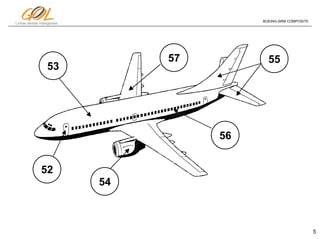
•Chapter 51 Structures - General
•Chapter 52 Doors
•Chapter 53 Fuselage
•Chapter 54 Nacelles I Pylons
•Chapter 55 Stabilizers
•Chapter 56 Windows
•Chapter 57 Wings
5
Linhas aéreas Inteligentes
BOEING-SRM COMPOSITE
53
57
52
54
56
55
6
Linhas aéreas Inteligentes
BOEING-SRM COMPOSITE
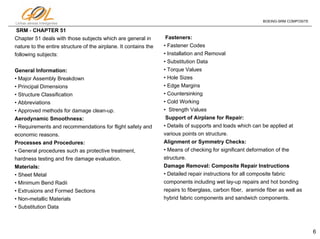
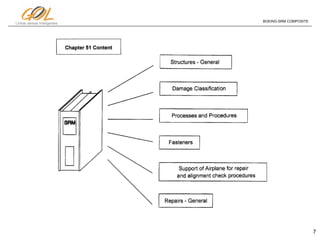
SRM - CHAPTER 51
Chapter 51 deals with those subjects which are general in
nature to the entire structure of the airplane. It contains the
following subjects:
General Information:
• Major Assembly Breakdown
• Principal Dimensions
• Structure Classification
• Abbreviations
• Approved methods for damage clean-up.
Aerodynamic Smoothness:
• Requirements and recommendations for flight safety and
economic reasons.
Processes and Procedures:
• General procedures such as protective treatment,
hardness testing and fire damage evaluation.
Materials:
• Sheet Metal
• Minimum Bend Radii
• Extrusions and Formed Sections
• Non-metallic Materials
• Substitution Data
Fasteners:
• Fastener Codes
• Installation and Removal
• Substitution Data
• Torque Values
• Hole Sizes
• Edge Margins
• Countersinking
• Cold Working
• Strength Values
Support of Airplane for Repair:
• Details of supports and loads which can be applied at
various points on structure.
Alignment or Symmetry Checks:
• Means of checking for significant deformation of the
structure.
Damage Removal: Composite Repair Instructions
• Detailed repair instructions for all composite fabric
components including wet lay-up repairs and hot bonding
repairs to fiberglass, carbon fiber, aramide fiber as well as
hybrid fabric components and sandwich components.
7
Linhas aéreas Inteligentes
BOEING-SRM COMPOSITE
8
Linhas aéreas Inteligentes
BOEING-SRM COMPOSITE
CHAPTER 52-57
Chapters 52 thru 57 deal with major airplane components. The section numbers are
assigned for specific components with the major grouping.
Section Numbering Boeing Aircraft Chapter 53, Fuselage
Section ATA Reference Designation
•41 53-10-00 Fuselage between BSTA 178 and BSTA 360
•43 53-30-00 Fuselage between BSTA 360 and BSTA 540
•44 53-40-00 Fuselage between BSTA 540 and BSTA 727
•46 53-60-00 Fuselage between BSTA 727 and BSTA 887
•47 53-70-00 Fuselage between BSTA 888 and BSTA 1016
•48 53-80-00 Fuselage between BSTA 1016 and BSTA 1156
9
Linhas aéreas Inteligentes
BOEING-SRM COMPOSITE
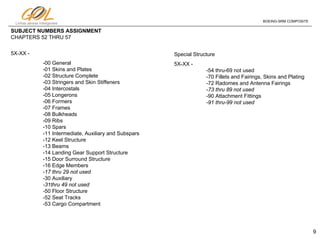
SUBJECT NUMBERS ASSIGNMENT
CHAPTERS 52 THRU 57
5X-XX -
-00 General
-01 Skins and Plates
-02 Structure Complete
-03 Stringers and Skin Stiffeners
-04 Intercostals
-05 Longerons
-06 Formers
-07 Frames
-08 Bulkheads
-09 Ribs
-10 Spars
-11 Intermediate, Auxiliary and Subspars
-12 Keel Structure
-13 Beams
-14 Landing Gear Support Structure
-15 Door Surround Structure
-16 Edge Members
-17 thru 29 not used
-30 Auxiliary
-31thru 49 not used
-50 Floor Structure
-52 Seat Tracks
-53 Cargo Compartment
Special Structure
5X-XX -
-54 thru-69 not used
-70 Fillets and Fairings, Skins and Plating
-72 Radomes and Antenna Fairings
-73 thru 89 not used
-90 Attachment Fittings
-91 thru-99 not used
10
Linhas aéreas Inteligentes
BOEING-SRM COMPOSITE
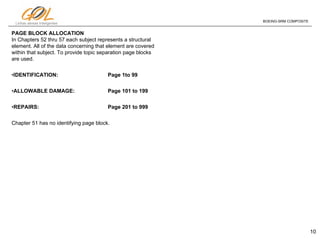
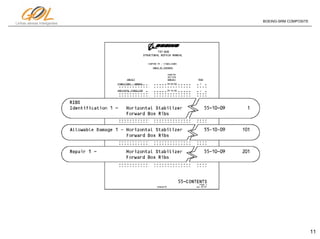
PAGE BLOCK ALLOCATION
In Chapters 52 thru 57 each subject represents a structural
element. All of the data concerning that element are covered
within that subject. To provide topic separation page blocks
are used.
•IDENTIFICATION: Page 1to 99
•ALLOWABLE DAMAGE: Page 101 to 199
•REPAIRS: Page 201 to 999
Chapter 51 has no identifying page block.
11
Linhas aéreas Inteligentes
BOEING-SRM COMPOSITE
12
Linhas aéreas Inteligentes
BOEING-SRM COMPOSITE
DAMAGE CLASSIFICATION
The term “damage” as used in the Structural Repair Manual
and other Manuals, is defined as including any and every
type of permanent deformation or alteration to any cross-
section of a structural component.
Deformation or alteration to the cross-section of a structural
component results from many causes which can be generally
categorized into four main groups:
• Mechanical action - includes brinelling, buckling,
burnishing, burring, chafing, cracking, distortion (twisting),
erosion, fretting, galling, gouging, indentation, misalignment,
nicking, rubbing, scoring, scratching, and general wear.
• Chemical or electro-chemical reaction - includes
corrosion, pinholes, pitting, and scaling.
• Thermal action or cycling - includes brittleness, buckling,
burning, heating, and pickup.
• Inherent metallurgical characteristics - includes cold
shut, creep (plastic flow), fatigue (cyclic stressing), inclusion,
and porosity.
Damage classified under the last two categories, in all areas,
is considered as being non repairable, and the structural
component must be replaced.
Damage classified under the first two categories in certain
specified areas of the airplane structure, is considered as
being repairable.
Investigation of Damage
In order that the necessary repair procedures can be
determined, the type and extent of damage must be
properly and thoroughly investigated.
In order to determine the damage category, the suspected
or affected area must be prepared by removing any foreign
matter deposits from the component surface, cutting out
any broken, bent, heated, burnt or otherwise obviously
damaged areas of the component, and removing loose
rivets where apparent.
• In addition to the damaged or affected area itself, any
adjacent attachment points and! or connections, through
which abnormal loads may have been transmitted, must be
fully investigated.
• If misalignment or twisting of the airplane structure is
suspected, alignment and! or leveling checks must be
carried out.
13
Linhas aéreas Inteligentes
BOEING-SRM COMPOSITE
DAMAGE CATEGORIES
After cleaning and investigating the damaged and
surrounding area, the damage must be classified into one
of the following three categories, also taking into account
the location of the damage.
REPAIRABLE DAMAGE
The damage must be classified either as “Allowable
Damage” or as damage which requires a repair.
Allowable Damage
Allowable damage is defined as damage which is slight or
of little significance, and is unlikely to be of sufficient
severity to propagate further damage in the immediate
vicinity.
Note: Allowable does not mean that repair is
unnecessary. For example, scratches and
burring are included in this category, and
it is necessary to remove rough and sharp
edges and smooth out the damage. In
addition, any damage to surface coatings
and/or protective treatment must be
repaired using an approved procedure
dealt with under SRM chapter 51.
Non-allowable Damage
Damage which exceeds the “Allowable Damage” limits
must be repaired by cutting out the damaged area of a
structural component and inserting or attaching a
reinforcing piece. These specific repairs are to be found in
each chapter of the SRM.
NON REPAIRABLE DAMAGE
Non repairable damage is defined as damage to structural
components which cannot be repaired and where
replacement of the complete component is recommended
as a repair is not practical or economical.
14
Linhas aéreas Inteligentes
BOEING-SRM COMPOSITE
15
Linhas aéreas Inteligentes
BOEING-SRM COMPOSITE
16
Linhas aéreas Inteligentes
BOEING-SRM COMPOSITE
TYPES OF STRUCTURAL DAMAGE
In order to facilitate the classification of different repair
procedures, the various types of damage are grouped as
follows:
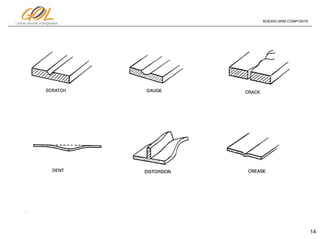
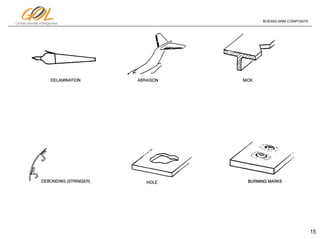
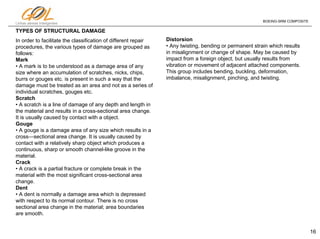
Mark
• A mark is to be understood as a damage area of any
size where an accumulation of scratches, nicks, chips,
burrs or gouges etc. is present in such a way that the
damage must be treated as an area and not as a series of
individual scratches, gouges etc.
Scratch
• A scratch is a line of damage of any depth and length in
the material and results in a cross-sectional area change.
It is usually caused by contact with a object.
Gouge
• A gouge is a damage area of any size which results in a
cross—sectional area change. It is usually caused by
contact with a relatively sharp object which produces a
continuous, sharp or smooth channel-like groove in the
material.
Crack
• A crack is a partial fracture or complete break in the
material with the most significant cross-sectional area
change.
Dent
• A dent is normally a damage area which is depressed
with respect to its normal contour. There is no cross
sectional area change in the material; area boundaries
are smooth.
Distorsion
• Any twisting, bending or permanent strain which results
in misalignment or change of shape. May be caused by
impact from a foreign object, but usually results from
vibration or movement of adjacent attached components.
This group includes bending, buckling, deformation,
imbalance, misalignment, pinching, and twisting.
17
Linhas aéreas Inteligentes
BOEING-SRM COMPOSITE
REPAIRS
Ideally, repairs are designed to meet static and fatigue
strength requirements for the service life of the airplane.
Practical solutions to repair problems sometimes require a
repair which will not necessarily be permanent.
These are:
Time Limited Repair
• Must be replaced after a specified time with a permanent
repair.
Interim Repair
• Must be inspected at specified intervals and replaced if
there is deterioration.
Chapter 52 - 57 of the SRM cover typical repairs for
general use and specific repairs for known problems
which are generally applicable to all operators. The
manual does not include specific repairs where a
preventive modification is provided in a service bulletin.
Repairs in the manual are authority approved.
18
Linhas aéreas Inteligentes
BOEING-SRM COMPOSITE
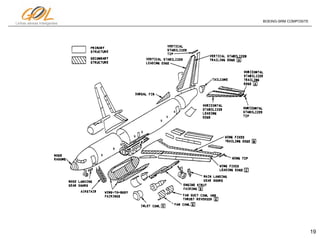
STRUCTURE CLASSIFICATION
A schematic breakdown of the aircraft structure showing the
relationship between primary and secondary structure and
‘Principal Structural Elements’ (PSE).
A List of PSE’s is given in the chapter where applicable.
The structure of the aircraft is classified either as primary or
secondary. Primary structure is that structure whlich
contributes significantly to carrying flight, ground and
pressurization loads.
Secondary structure is that structure which carries only air or
inertia Ioads generated on or within the secondary structure.
Within the primary structure there are elements that are
designated PSE; PSE’s are those elements that contribute
signiflcantly to carrying flight, ground and pressurization
Ioads, and whose integrity is essential in maintaining the
overall structural integrity of the airplane.
NOTE:
Where two items that are PSE are connected together and
the conconnecting item is removable then the connecting
item is also to be considered as PSE.
PSE parts are identified in Chapter 51 - Structure
Classification.
19
Linhas aéreas Inteligentes
BOEING-SRM COMPOSITE
20
Linhas aéreas Inteligentes
BOEING-SRM COMPOSITE
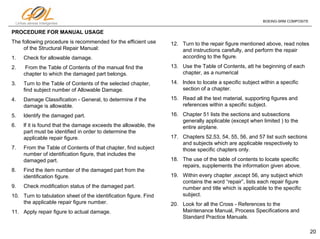
PROCEDURE FOR MANUAL USAGE
The following procedure is recommended for the efficient use
of the Structural Repair Manual:
1. Check for allowable damage.
2. From the Table of Contents of the manual find the
chapter to which the damaged part belongs.
3. Turn to the Table of Contents of the selected chapter,
find subject number of Allowable Damage.
4. Damage Classification - General, to determine if the
damage is allowable.
5. ldentify the damaged part.
6. lf it is found that the damage exceeds the allowable, the
part must be identified in order to determine the
applicable repair figure.
7. From the Table of Contents of that chapter, find subject
number of identification figure, that includes the
damaged part.
8. Find the item number of the damaged part from the
identification figure.
9. Check modification status of the damaged part.
10. Turn to tabulation sheet of the identification figure. Find
the applicable repair figure number.
11. Apply repair figure to actual damage.
12. Turn to the repair figure mentioned above, read notes
and instructions carefully, and perform the repair
according to the figure.
13. Use the Table of Contents, att he beginning of each
chapter, as a numerical
14. lndex to locate a specific subject within a specific
section of a chapter.
15. Read all the text material, supporting figures and
references within a specific subject.
16. Chapter 51 lists the sections and subsections
generally applicable (except when limited ) to the
entire airplane.
17. Chapters 52,53, 54, 55, 56, and 57 list such sections
and subjects which are applicable respectively to
those specific chapters only.
18. The use of the table of contents to locate specific
repairs, supplements the information given above.
19. Within every chapter ,except 56, any subject which
contains the word “repair”, lists each repair figure
number and title which is applicable to the specific
subject.
20. Look for all the Cross - References to the
Maintenance Manual, Process Specifications and
Standard Practice Manuals.
21
Linhas aéreas Inteligentes
BOEING-SRM COMPOSITE
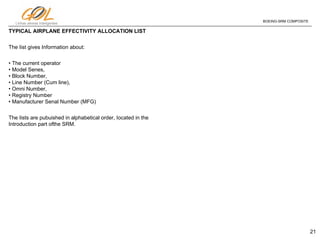
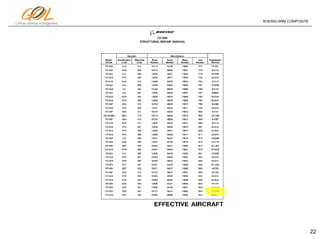
TYPICAL AIRPLANE EFFECTIVITY ALLOCATION LIST
The Iist gives Information about:
• The current operator
• Model Senes,
• Block Number,
• Line Number (Cum line),
• Omni Number,
• Registry Number
• Manufacturer Senal Number (MFG)
The Iists are pubuished in alphabetical order, Iocated in the
Introduction part ofthe SRM.
22
Linhas aéreas Inteligentes
BOEING-SRM COMPOSITE

7-srm_compress.pdf

  • 1.
    1 Linhas aéreas Inteligentes BOEING-SRMCOMPOSITE STRUCTURAL REPAIR MANUAL INTRODUCTION Manufacturers publish Structural Repair Manual (SRM) to provide data for the structural maintenance of commercial airplanes which have sustained structural damage. The Manuals are approved by the Aircraft Manufacturers Aviation Authority, for example: • DGCA Direction Générale De L’Aviation Civile ( France) • FAA :Federal Aviation Administration( USA) • The Structural Repair Manual contains : material identification for structure subject to field repair, typical repairs general applicable to structural components of the airplane that are most likely to be damaged, • information relative to material substitution, fastener installation, • airplane alignment check procedure • and a brief description of procedures that must be performed concurrently with structural repair, such as protective treatment of repair parts and sealing of integral fuel tanks. Where repairs are not included, it does not follow that the structure concerned is not repairable. Either it has not been found practicable to design a typical repair, or service experience has not yet indicated a requirement. In some instances, an adequate repair design will require evaluation by the Manufacturer. Consider the following when typical repairs are not found: • Accomplish a repair in accordance with the general repair practices and procedures provided in chapter 51 - Structures General - of the manual. • Preparing a specific repair design for the damage not covered. • Replacing of the damaged part. As service experience indicates a requirement, the manual will be revised to include actual, specific repairs to both primary and secondary structures. To ensure consistent handling of these revisions, index categories have been established for all known types of repairs, although some information which falls within these categories will not be released until warranty service experience. It is indented that, in the event of a major damage, the information included in the manual be supplemented as required by direct liaison with the repair assigned Manufacturer Customer Support Representative.
  • 2.
    2 Linhas aéreas Inteligentes BOEING-SRMCOMPOSITE STRUCTURAL REPAIR MANUAL For ordering structural repair parts see Spare Parts Identification, located in the 00- Introduction Part. The manual will serve as a medium through which the airplane operators will be advised of actual repairs with general- interest nature, designed by the Manufacturer or by the airplane operator. SERVICE BULLETINS Service bulletins which have incorporated are listed in the 00 - Introduction section. Service Bulletins are recommendations from Manufacturer, which are not urgent to put into action.
  • 3.
    3 Linhas aéreas Inteligentes BOEING-SRMCOMPOSITE REVISION SERVICE LIST OF EFFECTIVE PAGES The SRM is provided with a List of Effective Pages. All pages are listed in sequence, together with their latest revision date. In Airbus Manuals the list is located in every ATA Chapter. Boeing provides it in the Manuals Introduction. The List of Effective Pages will be revised with each regular revision of the Manual. REGULAR REVISION SERVICE Revision service to the manual will be issued periodically. Each manual takes a revision number and date of issue on the outside label, to check the effectivity of the hole Manual by a document list. Pages which are revised will be so indicated on the list of effective pages by an asterisk (*) and identified by a date. A revised page may be dated prior to, or as same as, the date of the revision cycle. On each individual page the revised area is indicated by a revision bar on the left margin. TEMPORARY REVISION SERVICE Temporary revision service to the manual will be issued as necessary to alert the customer of configuration differences and to provide temporary instructions prior to the next scheduled revision. Temporary revision will also be issued as a result of a customer request for planned incorporation of a service bulletin. Each temporary revision will be incorporated into the manual within 90 days from date of issuance, except from those temporary revisions, issued as a result of planned incorporation of a service bulletin. These service bulletin temporary revisions will remain active until the Manufacturer has been advised by the customer that incorporation of the service bulletin into the airplane has been completed. Each temporary revision will apply to one subject only and will be keyed within this manual, so that the temporary revision will be filed adjacent to the affected pages. Temporary revisions will not be revised if changes are required to an existing temporary revision, the temporary revision will be reissued.
  • 4.
    4 Linhas aéreas Inteligentes BOEING-SRMCOMPOSITE CHAPTERIZATION In accordance with the ATA Specification No. 100, the material presented in this manual is divided into seven chapters. CHAPTER NUMBERS •Chapter 51 Structures - General •Chapter 52 Doors •Chapter 53 Fuselage •Chapter 54 Nacelles I Pylons •Chapter 55 Stabilizers •Chapter 56 Windows •Chapter 57 Wings
  • 5.
    5 Linhas aéreas Inteligentes BOEING-SRMCOMPOSITE 53 57 52 54 56 55
  • 6.
    6 Linhas aéreas Inteligentes BOEING-SRMCOMPOSITE SRM - CHAPTER 51 Chapter 51 deals with those subjects which are general in nature to the entire structure of the airplane. It contains the following subjects: General Information: • Major Assembly Breakdown • Principal Dimensions • Structure Classification • Abbreviations • Approved methods for damage clean-up. Aerodynamic Smoothness: • Requirements and recommendations for flight safety and economic reasons. Processes and Procedures: • General procedures such as protective treatment, hardness testing and fire damage evaluation. Materials: • Sheet Metal • Minimum Bend Radii • Extrusions and Formed Sections • Non-metallic Materials • Substitution Data Fasteners: • Fastener Codes • Installation and Removal • Substitution Data • Torque Values • Hole Sizes • Edge Margins • Countersinking • Cold Working • Strength Values Support of Airplane for Repair: • Details of supports and loads which can be applied at various points on structure. Alignment or Symmetry Checks: • Means of checking for significant deformation of the structure. Damage Removal: Composite Repair Instructions • Detailed repair instructions for all composite fabric components including wet lay-up repairs and hot bonding repairs to fiberglass, carbon fiber, aramide fiber as well as hybrid fabric components and sandwich components.
  • 7.
  • 8.
    8 Linhas aéreas Inteligentes BOEING-SRMCOMPOSITE CHAPTER 52-57 Chapters 52 thru 57 deal with major airplane components. The section numbers are assigned for specific components with the major grouping. Section Numbering Boeing Aircraft Chapter 53, Fuselage Section ATA Reference Designation •41 53-10-00 Fuselage between BSTA 178 and BSTA 360 •43 53-30-00 Fuselage between BSTA 360 and BSTA 540 •44 53-40-00 Fuselage between BSTA 540 and BSTA 727 •46 53-60-00 Fuselage between BSTA 727 and BSTA 887 •47 53-70-00 Fuselage between BSTA 888 and BSTA 1016 •48 53-80-00 Fuselage between BSTA 1016 and BSTA 1156
  • 9.
    9 Linhas aéreas Inteligentes BOEING-SRMCOMPOSITE SUBJECT NUMBERS ASSIGNMENT CHAPTERS 52 THRU 57 5X-XX - -00 General -01 Skins and Plates -02 Structure Complete -03 Stringers and Skin Stiffeners -04 Intercostals -05 Longerons -06 Formers -07 Frames -08 Bulkheads -09 Ribs -10 Spars -11 Intermediate, Auxiliary and Subspars -12 Keel Structure -13 Beams -14 Landing Gear Support Structure -15 Door Surround Structure -16 Edge Members -17 thru 29 not used -30 Auxiliary -31thru 49 not used -50 Floor Structure -52 Seat Tracks -53 Cargo Compartment Special Structure 5X-XX - -54 thru-69 not used -70 Fillets and Fairings, Skins and Plating -72 Radomes and Antenna Fairings -73 thru 89 not used -90 Attachment Fittings -91 thru-99 not used
  • 10.
    10 Linhas aéreas Inteligentes BOEING-SRMCOMPOSITE PAGE BLOCK ALLOCATION In Chapters 52 thru 57 each subject represents a structural element. All of the data concerning that element are covered within that subject. To provide topic separation page blocks are used. •IDENTIFICATION: Page 1to 99 •ALLOWABLE DAMAGE: Page 101 to 199 •REPAIRS: Page 201 to 999 Chapter 51 has no identifying page block.
  • 11.
  • 12.
    12 Linhas aéreas Inteligentes BOEING-SRMCOMPOSITE DAMAGE CLASSIFICATION The term “damage” as used in the Structural Repair Manual and other Manuals, is defined as including any and every type of permanent deformation or alteration to any cross- section of a structural component. Deformation or alteration to the cross-section of a structural component results from many causes which can be generally categorized into four main groups: • Mechanical action - includes brinelling, buckling, burnishing, burring, chafing, cracking, distortion (twisting), erosion, fretting, galling, gouging, indentation, misalignment, nicking, rubbing, scoring, scratching, and general wear. • Chemical or electro-chemical reaction - includes corrosion, pinholes, pitting, and scaling. • Thermal action or cycling - includes brittleness, buckling, burning, heating, and pickup. • Inherent metallurgical characteristics - includes cold shut, creep (plastic flow), fatigue (cyclic stressing), inclusion, and porosity. Damage classified under the last two categories, in all areas, is considered as being non repairable, and the structural component must be replaced. Damage classified under the first two categories in certain specified areas of the airplane structure, is considered as being repairable. Investigation of Damage In order that the necessary repair procedures can be determined, the type and extent of damage must be properly and thoroughly investigated. In order to determine the damage category, the suspected or affected area must be prepared by removing any foreign matter deposits from the component surface, cutting out any broken, bent, heated, burnt or otherwise obviously damaged areas of the component, and removing loose rivets where apparent. • In addition to the damaged or affected area itself, any adjacent attachment points and! or connections, through which abnormal loads may have been transmitted, must be fully investigated. • If misalignment or twisting of the airplane structure is suspected, alignment and! or leveling checks must be carried out.
  • 13.
    13 Linhas aéreas Inteligentes BOEING-SRMCOMPOSITE DAMAGE CATEGORIES After cleaning and investigating the damaged and surrounding area, the damage must be classified into one of the following three categories, also taking into account the location of the damage. REPAIRABLE DAMAGE The damage must be classified either as “Allowable Damage” or as damage which requires a repair. Allowable Damage Allowable damage is defined as damage which is slight or of little significance, and is unlikely to be of sufficient severity to propagate further damage in the immediate vicinity. Note: Allowable does not mean that repair is unnecessary. For example, scratches and burring are included in this category, and it is necessary to remove rough and sharp edges and smooth out the damage. In addition, any damage to surface coatings and/or protective treatment must be repaired using an approved procedure dealt with under SRM chapter 51. Non-allowable Damage Damage which exceeds the “Allowable Damage” limits must be repaired by cutting out the damaged area of a structural component and inserting or attaching a reinforcing piece. These specific repairs are to be found in each chapter of the SRM. NON REPAIRABLE DAMAGE Non repairable damage is defined as damage to structural components which cannot be repaired and where replacement of the complete component is recommended as a repair is not practical or economical.
  • 14.
  • 15.
  • 16.
    16 Linhas aéreas Inteligentes BOEING-SRMCOMPOSITE TYPES OF STRUCTURAL DAMAGE In order to facilitate the classification of different repair procedures, the various types of damage are grouped as follows: Mark • A mark is to be understood as a damage area of any size where an accumulation of scratches, nicks, chips, burrs or gouges etc. is present in such a way that the damage must be treated as an area and not as a series of individual scratches, gouges etc. Scratch • A scratch is a line of damage of any depth and length in the material and results in a cross-sectional area change. It is usually caused by contact with a object. Gouge • A gouge is a damage area of any size which results in a cross—sectional area change. It is usually caused by contact with a relatively sharp object which produces a continuous, sharp or smooth channel-like groove in the material. Crack • A crack is a partial fracture or complete break in the material with the most significant cross-sectional area change. Dent • A dent is normally a damage area which is depressed with respect to its normal contour. There is no cross sectional area change in the material; area boundaries are smooth. Distorsion • Any twisting, bending or permanent strain which results in misalignment or change of shape. May be caused by impact from a foreign object, but usually results from vibration or movement of adjacent attached components. This group includes bending, buckling, deformation, imbalance, misalignment, pinching, and twisting.
  • 17.
    17 Linhas aéreas Inteligentes BOEING-SRMCOMPOSITE REPAIRS Ideally, repairs are designed to meet static and fatigue strength requirements for the service life of the airplane. Practical solutions to repair problems sometimes require a repair which will not necessarily be permanent. These are: Time Limited Repair • Must be replaced after a specified time with a permanent repair. Interim Repair • Must be inspected at specified intervals and replaced if there is deterioration. Chapter 52 - 57 of the SRM cover typical repairs for general use and specific repairs for known problems which are generally applicable to all operators. The manual does not include specific repairs where a preventive modification is provided in a service bulletin. Repairs in the manual are authority approved.
  • 18.
    18 Linhas aéreas Inteligentes BOEING-SRMCOMPOSITE STRUCTURE CLASSIFICATION A schematic breakdown of the aircraft structure showing the relationship between primary and secondary structure and ‘Principal Structural Elements’ (PSE). A List of PSE’s is given in the chapter where applicable. The structure of the aircraft is classified either as primary or secondary. Primary structure is that structure whlich contributes significantly to carrying flight, ground and pressurization loads. Secondary structure is that structure which carries only air or inertia Ioads generated on or within the secondary structure. Within the primary structure there are elements that are designated PSE; PSE’s are those elements that contribute signiflcantly to carrying flight, ground and pressurization Ioads, and whose integrity is essential in maintaining the overall structural integrity of the airplane. NOTE: Where two items that are PSE are connected together and the conconnecting item is removable then the connecting item is also to be considered as PSE. PSE parts are identified in Chapter 51 - Structure Classification.
  • 19.
  • 20.
    20 Linhas aéreas Inteligentes BOEING-SRMCOMPOSITE PROCEDURE FOR MANUAL USAGE The following procedure is recommended for the efficient use of the Structural Repair Manual: 1. Check for allowable damage. 2. From the Table of Contents of the manual find the chapter to which the damaged part belongs. 3. Turn to the Table of Contents of the selected chapter, find subject number of Allowable Damage. 4. Damage Classification - General, to determine if the damage is allowable. 5. ldentify the damaged part. 6. lf it is found that the damage exceeds the allowable, the part must be identified in order to determine the applicable repair figure. 7. From the Table of Contents of that chapter, find subject number of identification figure, that includes the damaged part. 8. Find the item number of the damaged part from the identification figure. 9. Check modification status of the damaged part. 10. Turn to tabulation sheet of the identification figure. Find the applicable repair figure number. 11. Apply repair figure to actual damage. 12. Turn to the repair figure mentioned above, read notes and instructions carefully, and perform the repair according to the figure. 13. Use the Table of Contents, att he beginning of each chapter, as a numerical 14. lndex to locate a specific subject within a specific section of a chapter. 15. Read all the text material, supporting figures and references within a specific subject. 16. Chapter 51 lists the sections and subsections generally applicable (except when limited ) to the entire airplane. 17. Chapters 52,53, 54, 55, 56, and 57 list such sections and subjects which are applicable respectively to those specific chapters only. 18. The use of the table of contents to locate specific repairs, supplements the information given above. 19. Within every chapter ,except 56, any subject which contains the word “repair”, lists each repair figure number and title which is applicable to the specific subject. 20. Look for all the Cross - References to the Maintenance Manual, Process Specifications and Standard Practice Manuals.
  • 21.
    21 Linhas aéreas Inteligentes BOEING-SRMCOMPOSITE TYPICAL AIRPLANE EFFECTIVITY ALLOCATION LIST The Iist gives Information about: • The current operator • Model Senes, • Block Number, • Line Number (Cum line), • Omni Number, • Registry Number • Manufacturer Senal Number (MFG) The Iists are pubuished in alphabetical order, Iocated in the Introduction part ofthe SRM.
  • 22.