Weight and Balance
Weight and Balance
We will mainly talk about:
● Weight
● Center of gravity
Weight - Structural Limitation
Weight of aircraft limited structurally by:
● Maximum structural resistance of the wings
● Maximum lift the wings are able to generate
● Maximum force the landing gear is able to
absorb
Weight - Structural Limitation
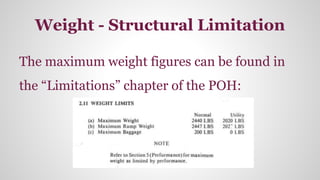
The maximum weight figures can be found in
the “Limitations” chapter of the POH:
Weight - Structural Limitation
● The amount of lift produced is limited by:
● airfoil design
● angle of attack (AOA)
● airspeed, and air density.
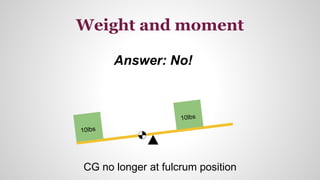
● We must ensure that lift generated is sufficient to
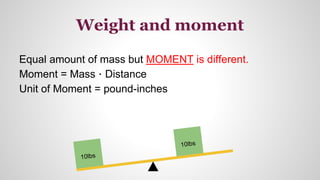
counteract weight.
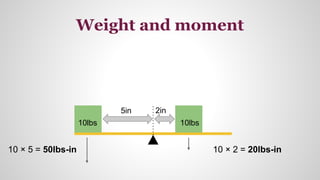
Weight - Structural Limitation
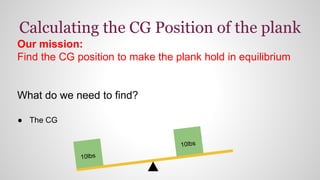
An overweight condition puts the airplane at
risk!
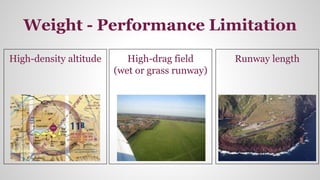
High-drag field
(wet or grass runway)
Runway lengthHigh-density altitude
Weight - Performance Limitation
Effects of Overweight
● Structural limits may be exceeded
● Stall speed increase
● T/O, Landing distances increase
● Rate of climb reduction
● Range and endurance reduce
● Excessive wear on brakes and tyres
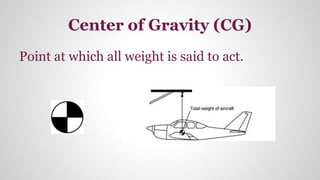
Center of Gravity (CG)
Point at which all weight is said to act.
Center Of Gravity Position
Primary importance to aircraft stability and
controllability
A CG beyond limit puts the aeroplane at risk!
Center Of Gravity Position
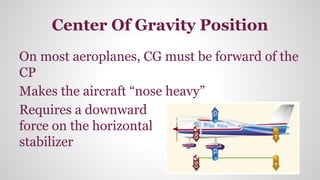
On most aeroplanes, CG must be forward of the
CP
Makes the aircraft “nose heavy”
Requires a downward
force on the horizontal
stabilizer
Center Of Gravity Position
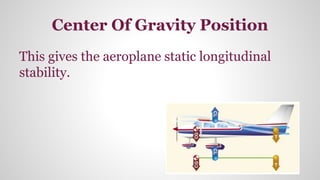
This gives the aeroplane static longitudinal
stability.
Center Of Gravity Position
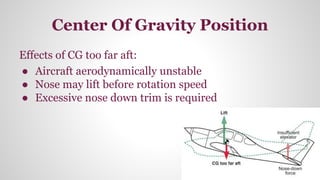
Effects of CG too far aft:
● Aircraft aerodynamically unstable
● Nose may lift before rotation speed
● Excessive nose down trim is required
Center Of Gravity Position
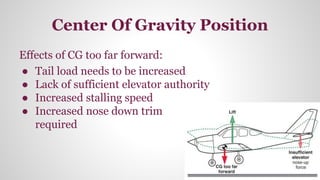
Effects of CG too far forward:
● Tail load needs to be increased
● Lack of sufficient elevator authority
● Increased stalling speed
● Increased nose down trim
required
Weight And Balance
Calculations
Weight and moment
10lbs 10lbs
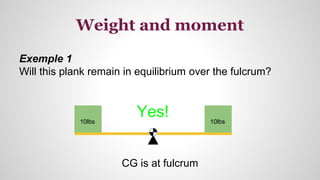
Exemple 1
Will this plank remain in equilibrium over the fulcrum?
Yes!
CG is at fulcrum
Weight and moment
10lbs 10lbs
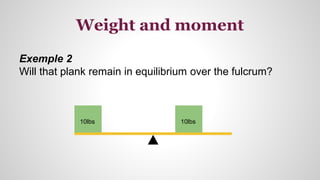
Exemple 2
Will that plank remain in equilibrium over the fulcrum?
Weight and moment
Answer: No!
CG no longer at fulcrum position
Weight and moment
Equal amount of mass but MOMENT is different.
Moment = Mass · Distance
Unit of Moment = pound-inches
Weight and moment
10lbs 10lbs
5in 2in
10 × 5 = 50lbs-in 10 × 2 = 20lbs-in
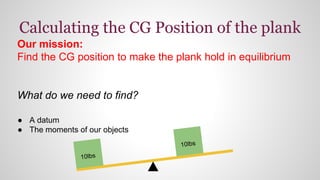
Calculating the CG Position of the plank
Our mission:
Find the CG position to make the plank hold in equilibrium
What do we need to find?
● The CG
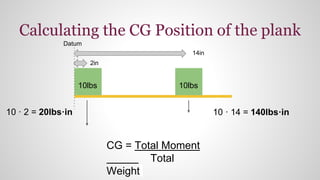
Calculating the CG Position of the plank
10lbs 10lbs
10 · 14 = 140lbs·in
Datum
2in
14in
CG = Total Moment
Total
Weight
10 · 2 = 20lbs·in
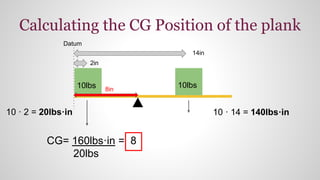
CG= 160lbs·in = 8
20lbs
Calculating the CG Position of the plank
10lbs 10lbs
10 · 2 = 20lbs·in 10 · 14 = 140lbs·in
Datum
2in
14in
8in
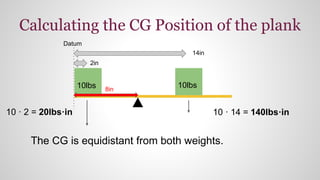
The CG is equidistant from both weights.
Calculating the CG Position of the plank
10lbs 10lbs
10 · 2 = 20lbs·in 10 · 14 = 140lbs·in
Datum
2in
14in
8in
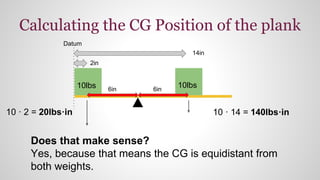
Calculating the CG Position of the plank
10lbs 10lbs
10 · 2 = 20lbs·in 10 · 14 = 140lbs·in
Datum
2in
14in
6in 6in
Does that make sense?
Yes, because that means the CG is equidistant from
both weights.
Weight and moment
Weight and moment
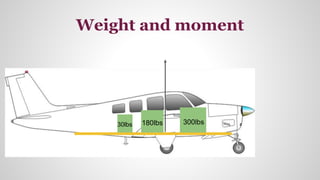
300lbs180lbs30lbs
Weight and moment
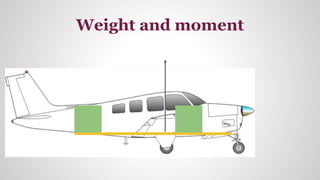
We need to know how much weight we put in
our aircraft to determine our CG:
● Passengers
● Baggage
● Fuel
Weight and moment
Before calculating the influence of our
passengers and cargo, we need to know:
● Basic Empty Weight of airplane (BEW)
● Empty CG
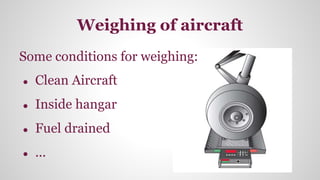
Weighing of aircraft
Some conditions for weighing:
● Clean Aircraft
● Inside hangar
● Fuel drained
● ...
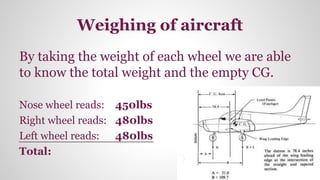
Weighing of aircraft
By taking the weight of each wheel we are able
to know the total weight and the empty CG.
Nose wheel reads: 450lbs
Right wheel reads: 480lbs
Left wheel reads: 480lbs
Total: 1410lbs
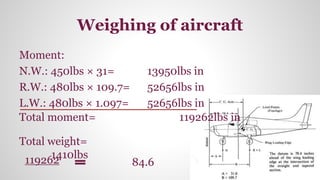
Weighing of aircraft
Moment:
N.W.: 450lbs × 31= 13950lbs in
R.W.: 480lbs × 109.7= 52656lbs in
L.W.: 480lbs × 1.097= 52656lbs in
Total moment= 119262lbs in
Total weight=
1410lbs119262 84.6
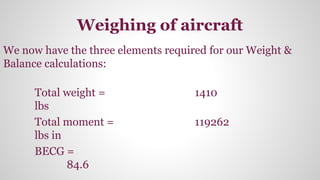
Weighing of aircraft
Total weight = 1410
lbs
Total moment = 119262
lbs in
BECG =
84.6
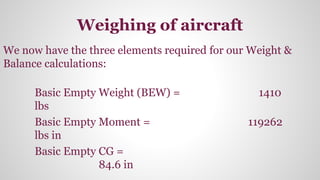
We now have the three elements required for our Weight &
Balance calculations:
Weighing of aircraft
Basic Empty Weight (BEW) = 1410
lbs
Basic Empty Moment = 119262
lbs in
Basic Empty CG =
84.6 in
We now have the three elements required for our Weight &
Balance calculations:
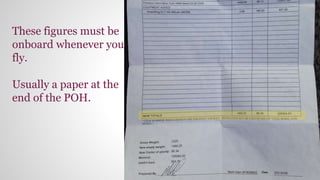
These figures must be
onboard whenever you
fly.
Usually a paper at the
end of the POH.
1460.3 126078
390 31395
160 18896
300 28500
20 2856
2330.3 207725.0
2323.3 207060.0
86.3
89.1
89.1
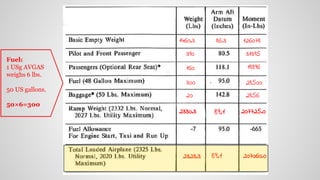
Fuel:
1 USg AVGAS
weighs 6 lbs.
50 US gallons.
50×6=300
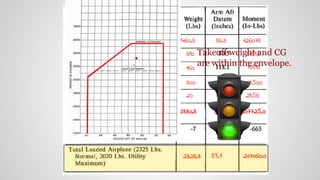
1460.3 126078
390 31395
160 18896
300 28500
20 2856
2330.3 207725.0
86.3
89.1
2323.3 207060.089.1
Takeoff weight and CG
are within the envelope.
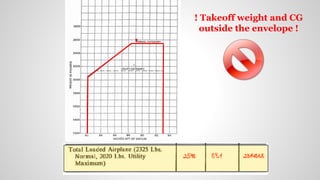
2598 231481.889.1
! Takeoff weight and CG
outside the envelope !
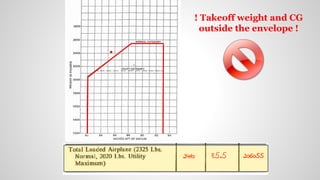
2410 20605585.5
! Takeoff weight and CG
outside the envelope !
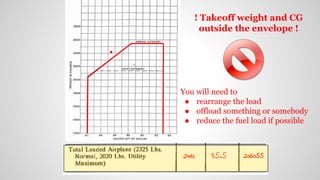
2410 20605585.5
! Takeoff weight and CG
outside the envelope !
You will need to
● rearrange the load
● offload something or somebody
● reduce the fuel load if possible
End
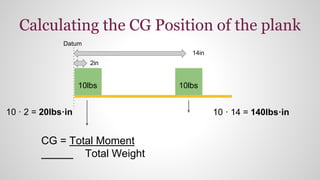
Calculating the CG Position of the plank
10lbs 10lbs
10 · 14 = 140lbs·in
Datum
2in
14in
CG = Total Moment
Total Weight
10 · 2 = 20lbs·in
Calculating the CG Position of the plank
Our mission:
Find the CG position to make the plank hold in equilibrium
What do we need to find?
● A datum
● The moments of our objects

Aircraft Weight & Balance

  • 1.
  • 2.
    Weight and Balance Wewill mainly talk about: ● Weight ● Center of gravity
  • 4.
    Weight - StructuralLimitation Weight of aircraft limited structurally by: ● Maximum structural resistance of the wings ● Maximum lift the wings are able to generate ● Maximum force the landing gear is able to absorb
  • 5.
    Weight - StructuralLimitation The maximum weight figures can be found in the “Limitations” chapter of the POH:
  • 6.
    Weight - StructuralLimitation ● The amount of lift produced is limited by: ● airfoil design ● angle of attack (AOA) ● airspeed, and air density. ● We must ensure that lift generated is sufficient to counteract weight.
  • 7.
    Weight - StructuralLimitation An overweight condition puts the airplane at risk!
  • 8.
    High-drag field (wet orgrass runway) Runway lengthHigh-density altitude Weight - Performance Limitation
  • 9.
    Effects of Overweight ●Structural limits may be exceeded ● Stall speed increase ● T/O, Landing distances increase ● Rate of climb reduction ● Range and endurance reduce ● Excessive wear on brakes and tyres
  • 10.
    Center of Gravity(CG) Point at which all weight is said to act.
  • 11.
    Center Of GravityPosition Primary importance to aircraft stability and controllability A CG beyond limit puts the aeroplane at risk!
  • 12.
    Center Of GravityPosition On most aeroplanes, CG must be forward of the CP Makes the aircraft “nose heavy” Requires a downward force on the horizontal stabilizer
  • 13.
    Center Of GravityPosition This gives the aeroplane static longitudinal stability.
  • 14.
    Center Of GravityPosition Effects of CG too far aft: ● Aircraft aerodynamically unstable ● Nose may lift before rotation speed ● Excessive nose down trim is required
  • 15.
    Center Of GravityPosition Effects of CG too far forward: ● Tail load needs to be increased ● Lack of sufficient elevator authority ● Increased stalling speed ● Increased nose down trim required
  • 16.
  • 17.
    Weight and moment 10lbs10lbs Exemple 1 Will this plank remain in equilibrium over the fulcrum? Yes! CG is at fulcrum
  • 18.
    Weight and moment 10lbs10lbs Exemple 2 Will that plank remain in equilibrium over the fulcrum?
  • 19.
    Weight and moment Answer:No! CG no longer at fulcrum position
  • 20.
    Weight and moment Equalamount of mass but MOMENT is different. Moment = Mass · Distance Unit of Moment = pound-inches
  • 21.
    Weight and moment 10lbs10lbs 5in 2in 10 × 5 = 50lbs-in 10 × 2 = 20lbs-in
  • 22.
    Calculating the CGPosition of the plank Our mission: Find the CG position to make the plank hold in equilibrium What do we need to find? ● The CG
  • 23.
    Calculating the CGPosition of the plank 10lbs 10lbs 10 · 14 = 140lbs·in Datum 2in 14in CG = Total Moment Total Weight 10 · 2 = 20lbs·in
  • 24.
    CG= 160lbs·in =8 20lbs Calculating the CG Position of the plank 10lbs 10lbs 10 · 2 = 20lbs·in 10 · 14 = 140lbs·in Datum 2in 14in 8in
  • 25.
    The CG isequidistant from both weights. Calculating the CG Position of the plank 10lbs 10lbs 10 · 2 = 20lbs·in 10 · 14 = 140lbs·in Datum 2in 14in 8in
  • 26.
    Calculating the CGPosition of the plank 10lbs 10lbs 10 · 2 = 20lbs·in 10 · 14 = 140lbs·in Datum 2in 14in 6in 6in Does that make sense? Yes, because that means the CG is equidistant from both weights.
  • 27.
  • 28.
  • 29.
    Weight and moment Weneed to know how much weight we put in our aircraft to determine our CG: ● Passengers ● Baggage ● Fuel
  • 30.
    Weight and moment Beforecalculating the influence of our passengers and cargo, we need to know: ● Basic Empty Weight of airplane (BEW) ● Empty CG
  • 31.
    Weighing of aircraft Someconditions for weighing: ● Clean Aircraft ● Inside hangar ● Fuel drained ● ...
  • 32.
    Weighing of aircraft Bytaking the weight of each wheel we are able to know the total weight and the empty CG. Nose wheel reads: 450lbs Right wheel reads: 480lbs Left wheel reads: 480lbs Total: 1410lbs
  • 33.
    Weighing of aircraft Moment: N.W.:450lbs × 31= 13950lbs in R.W.: 480lbs × 109.7= 52656lbs in L.W.: 480lbs × 1.097= 52656lbs in Total moment= 119262lbs in Total weight= 1410lbs119262 84.6
  • 34.
    Weighing of aircraft Totalweight = 1410 lbs Total moment = 119262 lbs in BECG = 84.6 We now have the three elements required for our Weight & Balance calculations:
  • 35.
    Weighing of aircraft BasicEmpty Weight (BEW) = 1410 lbs Basic Empty Moment = 119262 lbs in Basic Empty CG = 84.6 in We now have the three elements required for our Weight & Balance calculations:
  • 36.
    These figures mustbe onboard whenever you fly. Usually a paper at the end of the POH.
  • 37.
    1460.3 126078 390 31395 16018896 300 28500 20 2856 2330.3 207725.0 2323.3 207060.0 86.3 89.1 89.1 Fuel: 1 USg AVGAS weighs 6 lbs. 50 US gallons. 50×6=300
  • 38.
    1460.3 126078 390 31395 16018896 300 28500 20 2856 2330.3 207725.0 86.3 89.1 2323.3 207060.089.1 Takeoff weight and CG are within the envelope.
  • 39.
    2598 231481.889.1 ! Takeoffweight and CG outside the envelope !
  • 40.
    2410 20605585.5 ! Takeoffweight and CG outside the envelope !
  • 41.
    2410 20605585.5 ! Takeoffweight and CG outside the envelope ! You will need to ● rearrange the load ● offload something or somebody ● reduce the fuel load if possible
  • 42.
  • 43.
    Calculating the CGPosition of the plank 10lbs 10lbs 10 · 14 = 140lbs·in Datum 2in 14in CG = Total Moment Total Weight 10 · 2 = 20lbs·in
  • 44.
    Calculating the CGPosition of the plank Our mission: Find the CG position to make the plank hold in equilibrium What do we need to find? ● A datum ● The moments of our objects

Editor's Notes

  • #11 Talk about the fulcrum / pivot. If I were to pin the aircraft at the CG, it would hold in position