Virginia Tech 1 of 25
History of Air Transportation
Dr. Antonio A. Trani
Associate Professor
Department of Civil and Environmental Engineering
August 29, 2005
Virginia Tech 2 of 25
Early Developments
• 1903 - Wright Brothers’ first flight in North Carolina
• 1916 - First air mail service (Army)
• 1918 - US Postal Service takes over the mail system
• 1925 - Kelly Act (Air Mail Act) - allows private operators into
the air mail service
• 1926 - President Coolidge signs the first Air Commerce Act
- Establishes aids to air navigation
- Provided authority for traffic rules
- Mandatory registration of aircraft providing air services
- Certification of airmen
• 1927 - Pan American World Airways services Miami-La Habana
(Cuba)
Virginia Tech 3 of 25
Early Commercial Aircraft Development (20-30’s)
The late twenties and early thirties introduces important advances
in aircraft construction methods (monocoque and aluminum)
Ford (Fokker) Trimotor
175 kph
Runway length = 600 m
10-12 passengers
Virginia Tech 4 of 25
Early Developments (II)
• 1930s - U.S., Latin America and Europe airlines flourish
• 1935 - First air traffic control facility (Newark)
• 1936 - The Douglas DC-3 goes into service
Cruise speed = 300 kph
21-32 passengers
11,000 built
Some still fly today
Runway length = 800 m
Douglas DC-3
Virginia Tech 5 of 25
Early Airlines
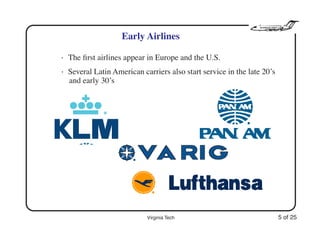
• The first airlines appear in Europe and the U.S.
• Several Latin American carriers also start service in the late 20’s
and early 30’s
Virginia Tech 6 of 25
Early Airports
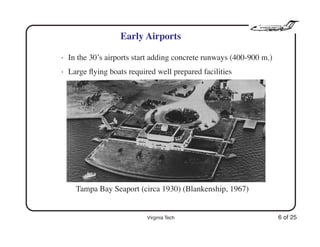
• In the 30’s airports start adding concrete runways (400-900 m.)
• Large flying boats required well prepared facilities
Tampa Bay Seaport (circa 1930) (Blankenship, 1967)
Virginia Tech 7 of 25
WWII Period
• 1938 - President Roosevelt creates the CAA (Civil Aeronautics
Authority) through the Civil Aeronautics Act of 1938
• 1939 - CAA splits into CAA and CAB (Civil Aeronautics Board)
• 1939-1945 Aircraft development during WWII
• 1939-1945 Hundreds of low cost airports are created around the
country to train pilots
• 1945-1947 Availability of surplus aircraft (specially many C-47
or DC-3)
• 500 airports are turned to local and state authorities
Virginia Tech 8 of 25
End of WWII Circa Aircraft
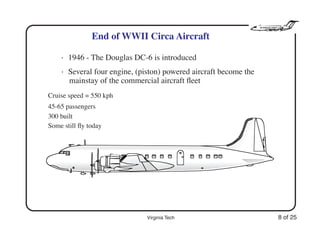
• 1946 - The Douglas DC-6 is introduced
• Several four engine, (piston) powered aircraft become the
mainstay of the commercial aircraft fleet
Cruise speed = 550 kph
45-65 passengers
300 built
Some still fly today
Virginia Tech 9 of 25
Development of the RADAR
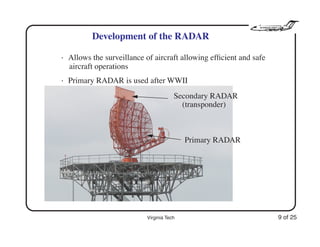
• Allows the surveillance of aircraft allowing efficient and safe
aircraft operations
• Primary RADAR is used after WWII
Primary RADAR
Secondary RADAR
(transponder)
Virginia Tech 10 of 25
Post War Period
• 1945 - First radar equipped control tower (Indianapolis)
• 1946 - Federal Airport Act of 1946
• 1951 - British launch the first commercial jet (Comet I)
- Airport runway lengths grow substantially
- More support equipment is needed
• 1958 - Federal Aviation Act of 1958
- Creates the Federal Aviation Agency (today’s FAA)
- Retains CAB for regulatory control
• 1967 - Department of Transportation emerges
- FAA becomes the Federal Aviation Administration
- NTSB is created (National Transportation Safety Board)
Virginia Tech 11 of 25
Airport and Airway Technologies (50’s)
Relevant airport/aviation technologies:
• Very High Frequency Omni-directional Range and Finding
(VOR’s and later VORTAC’s)
• Instrument Landing System (ILS)
• Approach lighting systems
VORTAC
ILS Antenna
Virginia Tech 12 of 25
Representative Aircraft of the Post War Period
Several successful four-engine, piston and turbo-propeller aircraft
are developed in this period
Vickers Viscount (Turboprop)
Lockheed Constellation (Piston)
Cruise speed = 600 kph
90-110 passengers
Runway length = 2,000 m
Virginia Tech 13 of 25
Long-Range Aircraft Development (50-60’s)
• The British Comet I is followed by very successful American
four-engine turbojet designs from Boeing and Douglas
Cruise speed = 950 kph
140-165 passengers
Runway length = 3,000 m
Boeing 707-320
Douglas DC-8-50
Virginia Tech 14 of 25
Short-Range Aircraft Development (60’s)
• Several short and medium-range aircraft are introduced in the
60’s
Cruise speed = 950 kph
140-165 passengers
Runway length = 2,200 m
Boeing 727-200
Boeing 737-100
Virginia Tech 15 of 25
Airport Development in the 60’s
Many of the most famous airports that we know today were
conceived in the late 50’s and early 60’s
• Washington Dulles International (1958-1962)
• Newark International (1967-1973)
• San Francisco International (1967)
• Chicago Ohare International (1959-1963)
• Los Angeles International (1957-1961)
• Paris Orly-Ouest (1966-1971)
• Houston Intercontinental (1964-1967)
• Kansas City (1965-1972)
• Dallas/Fort-Worth Regional (1965-1973)
Virginia Tech 16 of 25
Supersonic Aircraft (Late 60’s)
• 1968 - BAC/Aerospatiale introduce Concorde to the world
• Only 14 aircraft are ever built
Cruise speed = 2400 kph
90-110 passengers
7,000 km range
150,000 kg
Runway length = 3,200 m
Virginia Tech 17 of 25
Large Capacity Aircraft (60-70’s)
• 1969 - Boeing introduces the Boeing 747-100
• PanAm is the first airline to place it into service
• Airports have to adjust to this aircraft
Cruise speed = 985 kph
400 passengers
7,000 km range
320,000 kg
Runway length = 3,100 m
Virginia Tech 18 of 25
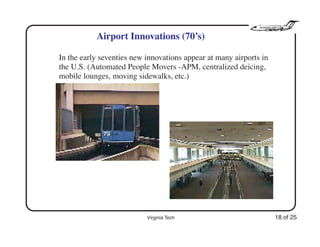
Airport Innovations (70’s)
In the early seventies new innovations appear at many airports in
the U.S. (Automated People Movers -APM, centralized deicing,
mobile lounges, moving sidewalks, etc.)
Virginia Tech 19 of 25
Important Airport Airway Development
• Airport and Airway development Act of 1970
- Creates the Aviation Trust Fund
- Provided assistance to airports for development
• Airline Deregulation Act of 1978
- Eliminates the regulation activities
- Phases out CAB in 1985
- Rise and decay of low fare airlines
- Consolidation of markets
- Growth in commuter markets
• 1981 - PATCO strike (11,000 ATC controllers fired by President
Reagan)
Virginia Tech 20 of 25
More Recent Issues
• Airport and Airway Improvement Act of 1982
- FAA’s Brown Book (National Airspace Systems Plan - NASP)
- Authorizes 11.1 billion dollars for improvements
• 1980s - Few megacarriers dominate the domestic market
• 1980-1990s More consolidations take place
• 1990s - International megacarrier arrangements
• 1993 - European liberalization starts
• 1990s - Commuter airlines seek alliances with majors
Virginia Tech 21 of 25
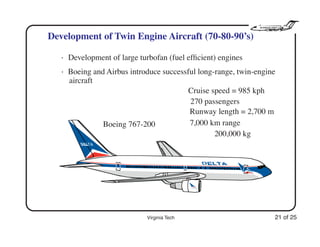
Development of Twin Engine Aircraft (70-80-90’s)
• Development of large turbofan (fuel efficient) engines
• Boeing and Airbus introduce successful long-range, twin-engine
aircraft
Cruise speed = 985 kph
270 passengers
7,000 km range
200,000 kg
Runway length = 2,700 m
Boeing 767-200
Virginia Tech 22 of 25
Satellite Revolution
• 1993 - GPS (Global Positioning System) touted as the next ATC
revolution
- SATNAV trails over the Pacific Ocean
- United predicts 40 million dollars in savings in the Pacific using
GPS
• 1994 - Satellite navigation trials start on Trans-Pacific routes
• 1996 - Trails to test DGPS for low visibility landings at airports
• 1998 - ADS-B Automated Dependance Surveillance mode B
• 1999 - DGPS offers near precision approaches (demonstrations
in the Ohio Valley)
• 2000 - Alaska trials of ADS-B (250 aircraft participating)
Virginia Tech 23 of 25
Development of Regional Aircraft (80-90’s)
• Today turbofan-powered regional aircraft are very successful at
replacing older turboprop technology
• Public’s perception of the turboprop as noisy and unsafe
Cruise speed = 850 kph
50 passengers
2,000 km range
32,000 kg
Runway length = 1,400 m
Bombardier RJ 100
Virginia Tech 24 of 25
Airports for General Aviation Use
The Small (or Smart) Air Transportation System (SATS) proposed
by NASA Langley could bring a new meaning to personal air
transportation
Virginia Tech 25 of 25
Very Long Range Aircraft
• In the early 2003 the introduction of Airbus A340-500 and
Boeing 777-200 ER aircraft allows airlines to fly routes of more
than 7,000 nm (New York-Delhi, New York-Singapore)
• New issues with human factors of long flight duration are being
addressed
Cruise speed = 910 kph
300 passengers
13,000 km range
325,000 kg
Runway length = 3,000 m
Boeing 777-200ER
Airbus A340-500