WELCOME TO
OUR
PRESENTATION
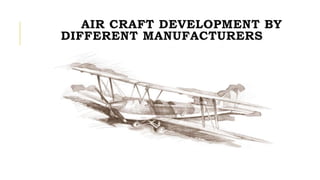
AIR CRAFT DEVELOPMENT BY
DIFFERENT MANUFACTURERS
HISTORY
The history of aviation(air craft) has extended over
more than two thousand years, from the earliest
forms of aviation, kites and attempts at tower
jumping, to supersonic, and hypersonic flight by
powered, heavier-than-air jets.
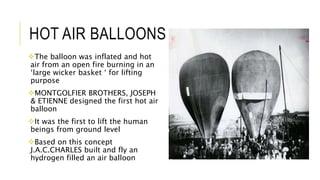
HOT AIR BALLOONS
The balloon was inflated and hot
air from an open fire burning in an
‘large wicker basket ‘ for lifting
purpose
MONTGOLFIER BROTHERS, JOSEPH
& ETIENNE designed the first hot air
balloon
It was the first to lift the human
beings from ground level
Based on this concept
J.A.C.CHARLES built and fly an
hydrogen filled an air balloon
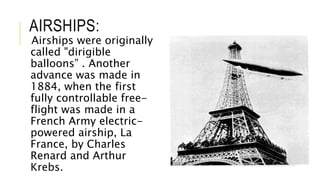
AIRSHIPS:
Airships were originally
called "dirigible
balloons” . Another
advance was made in
1884, when the first
fully controllable free-
flight was made in a
French Army electric-
powered airship, La
France, by Charles
Renard and Arthur
Krebs.
MULTI PLANES
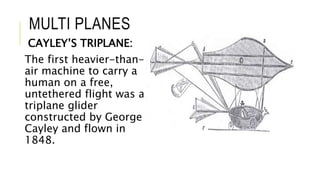
CAYLEY’S TRIPLANE:
The first heavier-than-
air machine to carry a
human on a free,
untethered flight was a
triplane glider
constructed by George
Cayley and flown in
1848.
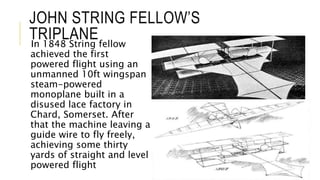
JOHN STRING FELLOW’S
TRIPLANEIn 1848 String fellow
achieved the first
powered flight using an
unmanned 10ft wingspan
steam-powered
monoplane built in a
disused lace factory in
Chard, Somerset. After
that the machine leaving a
guide wire to fly freely,
achieving some thirty
yards of straight and level
powered flight
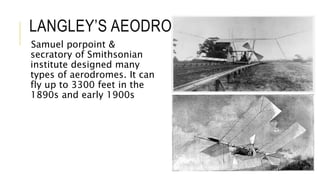
LANGLEY’S AEODROMES
Samuel porpoint &
secratory of Smithsonian
institute designed many
types of aerodromes. It can
fly up to 3300 feet in the
1890s and early 1900s
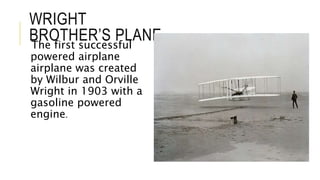
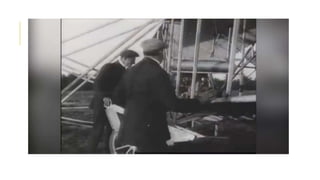
WRIGHT
BROTHER’S PLANEThe first successful
powered airplane
airplane was created
by Wilbur and Orville
Wright in 1903 with a
gasoline powered
engine.
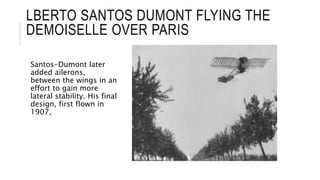
LBERTO SANTOS DUMONT FLYING THE
DEMOISELLE OVER PARIS
Santos-Dumont later
added ailerons,
between the wings in an
effort to gain more
lateral stability. His final
design, first flown in
1907,
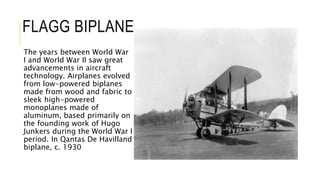
FLAGG BIPLANE
The years between World War
I and World War II saw great
advancements in aircraft
technology. Airplanes evolved
from low-powered biplanes
made from wood and fabric to
sleek high-powered
monoplanes made of
aluminum, based primarily on
the founding work of Hugo
Junkers during the World War I
period. In Qantas De Havilland
biplane, c. 1930
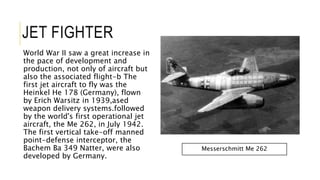
JET FIGHTER
World War II saw a great increase in
the pace of development and
production, not only of aircraft but
also the associated flight-b The
first jet aircraft to fly was the
Heinkel He 178 (Germany), flown
by Erich Warsitz in 1939,ased
weapon delivery systems.followed
by the world's first operational jet
aircraft, the Me 262, in July 1942.
The first vertical take-off manned
point-defense interceptor, the
Bachem Ba 349 Natter, were also
developed by Germany.
Messerschmitt Me 262
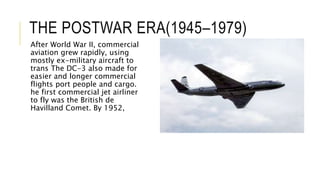
THE POSTWAR ERA(1945–1979)
After World War II, commercial
aviation grew rapidly, using
mostly ex-military aircraft to
trans The DC-3 also made for
easier and longer commercial
flights port people and cargo.
he first commercial jet airliner
to fly was the British de
Havilland Comet. By 1952,
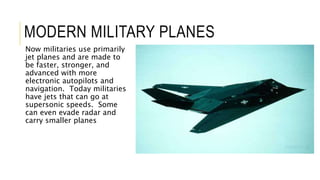
MODERN MILITARY PLANES
Now militaries use primarily
jet planes and are made to
be faster, stronger, and
advanced with more
electronic autopilots and
navigation. Today militaries
have jets that can go at
supersonic speeds. Some
can even evade radar and
carry smaller planes
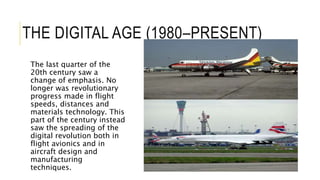
THE DIGITAL AGE (1980–PRESENT)
The last quarter of the
20th century saw a
change of emphasis. No
longer was revolutionary
progress made in flight
speeds, distances and
materials technology. This
part of the century instead
saw the spreading of the
digital revolution both in
flight avionics and in
aircraft design and
manufacturing
techniques.
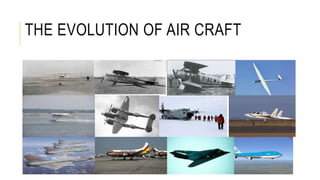
THE EVOLUTION OF AIR CRAFT
AIRPLANE HISTORY

AIRPLANE HISTORY

  • 1.
  • 2.
    AIR CRAFT DEVELOPMENTBY DIFFERENT MANUFACTURERS
  • 4.
    HISTORY The history ofaviation(air craft) has extended over more than two thousand years, from the earliest forms of aviation, kites and attempts at tower jumping, to supersonic, and hypersonic flight by powered, heavier-than-air jets.
  • 5.
    HOT AIR BALLOONS Theballoon was inflated and hot air from an open fire burning in an ‘large wicker basket ‘ for lifting purpose MONTGOLFIER BROTHERS, JOSEPH & ETIENNE designed the first hot air balloon It was the first to lift the human beings from ground level Based on this concept J.A.C.CHARLES built and fly an hydrogen filled an air balloon
  • 6.
    AIRSHIPS: Airships were originally called"dirigible balloons” . Another advance was made in 1884, when the first fully controllable free- flight was made in a French Army electric- powered airship, La France, by Charles Renard and Arthur Krebs.
  • 8.
    MULTI PLANES CAYLEY’S TRIPLANE: Thefirst heavier-than- air machine to carry a human on a free, untethered flight was a triplane glider constructed by George Cayley and flown in 1848.
  • 9.
    JOHN STRING FELLOW’S TRIPLANEIn1848 String fellow achieved the first powered flight using an unmanned 10ft wingspan steam-powered monoplane built in a disused lace factory in Chard, Somerset. After that the machine leaving a guide wire to fly freely, achieving some thirty yards of straight and level powered flight
  • 11.
    LANGLEY’S AEODROMES Samuel porpoint& secratory of Smithsonian institute designed many types of aerodromes. It can fly up to 3300 feet in the 1890s and early 1900s
  • 12.
    WRIGHT BROTHER’S PLANEThe firstsuccessful powered airplane airplane was created by Wilbur and Orville Wright in 1903 with a gasoline powered engine.
  • 15.
    LBERTO SANTOS DUMONTFLYING THE DEMOISELLE OVER PARIS Santos-Dumont later added ailerons, between the wings in an effort to gain more lateral stability. His final design, first flown in 1907,
  • 16.
    FLAGG BIPLANE The yearsbetween World War I and World War II saw great advancements in aircraft technology. Airplanes evolved from low-powered biplanes made from wood and fabric to sleek high-powered monoplanes made of aluminum, based primarily on the founding work of Hugo Junkers during the World War I period. In Qantas De Havilland biplane, c. 1930
  • 18.
    JET FIGHTER World WarII saw a great increase in the pace of development and production, not only of aircraft but also the associated flight-b The first jet aircraft to fly was the Heinkel He 178 (Germany), flown by Erich Warsitz in 1939,ased weapon delivery systems.followed by the world's first operational jet aircraft, the Me 262, in July 1942. The first vertical take-off manned point-defense interceptor, the Bachem Ba 349 Natter, were also developed by Germany. Messerschmitt Me 262
  • 19.
    THE POSTWAR ERA(1945–1979) AfterWorld War II, commercial aviation grew rapidly, using mostly ex-military aircraft to trans The DC-3 also made for easier and longer commercial flights port people and cargo. he first commercial jet airliner to fly was the British de Havilland Comet. By 1952,
  • 21.
    MODERN MILITARY PLANES Nowmilitaries use primarily jet planes and are made to be faster, stronger, and advanced with more electronic autopilots and navigation. Today militaries have jets that can go at supersonic speeds. Some can even evade radar and carry smaller planes
  • 22.
    THE DIGITAL AGE(1980–PRESENT) The last quarter of the 20th century saw a change of emphasis. No longer was revolutionary progress made in flight speeds, distances and materials technology. This part of the century instead saw the spreading of the digital revolution both in flight avionics and in aircraft design and manufacturing techniques.
  • 23.