The Benefits Versus the
Detriments
Nathan DeRosa
 Have the positive effects of airline deregulation
outweighed the negative effects?
 The role of government in economic affairs is
continuously debated
◦ Trade-offs between freer markets and government
intervention
 The federal government contracted with private
carriers to supplement military airmail carriage
starting in 1918 (Borenstein and Rose, 2007)
 Airlines started emerging in the 1920s
 Airlines became increasingly regulated during the
Great Depression
◦ 1938: Civil Aeronautics Board (CAB) was established
marking the official beginning of airline regulation
(Borenstein and Rose, 2007)
 High Barriers to entry into the marketplace
◦ Carriers established after the CAB had the most difficulty
entering the market
 Competition was largely absent
◦ Competition was based less on price and more on non-
price determinants (e.g. legroom, seat quality, in-flight
amenities, flight frequencies)
◦ Carriers needed approval from the CAB to expand
 Price controls were put into place to ensure
profitability and kept prices high (Borenstein and
Rose, 2011)
 Major carriers like American, Delta, and United
competed in the interstate market
 Smaller, local carriers like Pacific Southwest and
Texas International flew in the intrastate market
(Borenstein and Rose, 2007)
◦ Competed based on price, charged lower fares, and
turned higher profits than the major carriers
◦ Not subject to federal regulation
◦ Provided a glimpse of a deregulated airline market
 Regulated airlines turned lackluster profits
(Borenstein and Rose, 2011)
 High prices prompted consumer groups to support
deregulation
 High oil prices and stagflation in the 1970s further
pushed opinion towards deregulation (Eisner,
2008)
 The appointment of pro-deregulation officials such
as Alfred Kahn paved the way starting with
discount price experimentation (Winston, 1998)
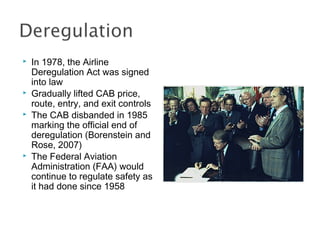
 In 1978, the Airline
Deregulation Act was signed
into law
 Gradually lifted CAB price,
route, entry, and exit controls
 The CAB disbanded in 1985
marking the official end of
deregulation (Borenstein and
Rose, 2007)
 The Federal Aviation
Administration (FAA) would
continue to regulate safety as
it had done since 1958
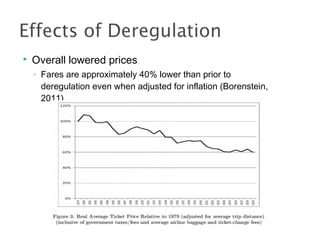
 Overall lowered prices
◦ Fares are approximately 40% lower than prior to
deregulation even when adjusted for inflation (Borenstein,
2011)
 Barriers to entry and exit were lowered
◦ Many existing airlines either have went bankrupt,
liquidated, or merged with other airlines while many new
airlines entered the market
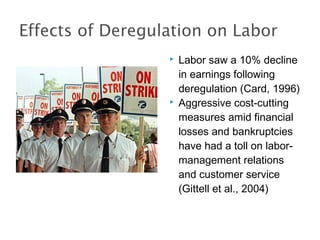
 Labor saw a 10% decline
in earnings following
deregulation (Card, 1996)
 Aggressive cost-cutting
measures amid financial
losses and bankruptcies
have had a toll on labor-
management relations
and customer service
(Gittell et al., 2004)
 Lowered prices and
barriers to entry were
expected to lead to traffic
growth and higher load
factors
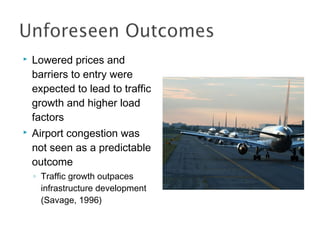
 Airport congestion was
not seen as a predictable
outcome
◦ Traffic growth outpaces
infrastructure development
(Savage, 1996)
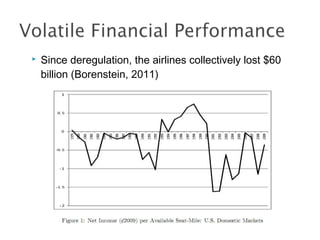
 Since deregulation, the airlines collectively lost $60
billion (Borenstein, 2011)
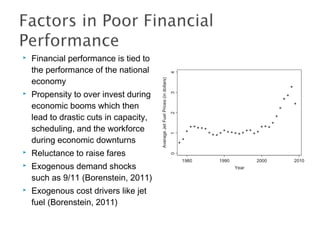
 Financial performance is tied to
the performance of the national
economy
 Propensity to over invest during
economic booms which then
lead to drastic cuts in capacity,
scheduling, and the workforce
during economic downturns
 Reluctance to raise fares
 Exogenous demand shocks
such as 9/11 (Borenstein, 2011)
 Exogenous cost drivers like jet
fuel (Borenstein, 2011)
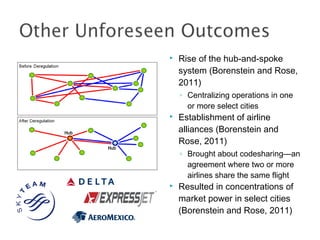
 Rise of the hub-and-spoke
system (Borenstein and Rose,
2011)
◦ Centralizing operations in one
or more select cities
 Establishment of airline
alliances (Borenstein and
Rose, 2011)
◦ Brought about codesharing—an
agreement where two or more
airlines share the same flight
 Resulted in concentrations of
market power in select cities
(Borenstein and Rose, 2011)
 Deregulation was successful in lowering prices
and barriers to entry and exit
 The Airline Industry has nonetheless suffered
financially. To ensure financial sustainability,
airlines must:
◦ Invest more moderately
◦ Work on improving relationships with labor
 Labor productivity is tied to customer service quality more
than cost-cutting measures (Gittell et al., 2004)
◦ Raise their price premiums (Borenstein and Rose, 2007)
 Raising quality and fares to cover operational costs
 Borenstein, Severin (2011). On the Persistent Financial Losses of U.S. Airlines: A
Preliminary Explanation. National Bureau of Economic Research, 1-17.
 Borenstein, Severin and Nancy L. Rose. How Airline Markets Work…Or Do They?
Regulatory Reform in the Airline Industry. National Bureau of Economic
Research. 1-82.
 Card, David (1996). Deregulation and Labor Earnings in the Airline Industry. National
Bureau of Economic Research. 1-58.
 Eisner, Marc Allen (2008). Markets in the Shadow of the State: An Appraisal of
Deregulation and Implications for Future Research. Tobin Project Conference. 1-28.
 Gittell, Jody Hoffer et al. (2004). Mutual Gains or Zero Sum? Labor Relations and
Firm Performance in the Airline Industry. Industrial and Labor Relations Review.
Vol. 57, No. 2. 163-80.
 Savage, Ian (1999). Aviation Deregulation and Safety in the United States: The
Evidence After Twenty Years. Taking Stock of Air Liberalization. 93-114.
 Winston, Clifford (1998). U.S. Industry Adjustment to Economic Deregulation. Journal
of Economic Perspectives. Vol. 12, No. 3. 89-110.

Airline Deregulation

  • 1.
    The Benefits Versusthe Detriments Nathan DeRosa
  • 2.
     Have thepositive effects of airline deregulation outweighed the negative effects?  The role of government in economic affairs is continuously debated ◦ Trade-offs between freer markets and government intervention
  • 3.
     The federalgovernment contracted with private carriers to supplement military airmail carriage starting in 1918 (Borenstein and Rose, 2007)  Airlines started emerging in the 1920s  Airlines became increasingly regulated during the Great Depression ◦ 1938: Civil Aeronautics Board (CAB) was established marking the official beginning of airline regulation (Borenstein and Rose, 2007)
  • 4.
     High Barriersto entry into the marketplace ◦ Carriers established after the CAB had the most difficulty entering the market  Competition was largely absent ◦ Competition was based less on price and more on non- price determinants (e.g. legroom, seat quality, in-flight amenities, flight frequencies) ◦ Carriers needed approval from the CAB to expand  Price controls were put into place to ensure profitability and kept prices high (Borenstein and Rose, 2011)
  • 5.
     Major carrierslike American, Delta, and United competed in the interstate market  Smaller, local carriers like Pacific Southwest and Texas International flew in the intrastate market (Borenstein and Rose, 2007) ◦ Competed based on price, charged lower fares, and turned higher profits than the major carriers ◦ Not subject to federal regulation ◦ Provided a glimpse of a deregulated airline market
  • 6.
     Regulated airlinesturned lackluster profits (Borenstein and Rose, 2011)  High prices prompted consumer groups to support deregulation  High oil prices and stagflation in the 1970s further pushed opinion towards deregulation (Eisner, 2008)  The appointment of pro-deregulation officials such as Alfred Kahn paved the way starting with discount price experimentation (Winston, 1998)
  • 7.
     In 1978,the Airline Deregulation Act was signed into law  Gradually lifted CAB price, route, entry, and exit controls  The CAB disbanded in 1985 marking the official end of deregulation (Borenstein and Rose, 2007)  The Federal Aviation Administration (FAA) would continue to regulate safety as it had done since 1958
  • 8.
     Overall loweredprices ◦ Fares are approximately 40% lower than prior to deregulation even when adjusted for inflation (Borenstein, 2011)
  • 9.
     Barriers toentry and exit were lowered ◦ Many existing airlines either have went bankrupt, liquidated, or merged with other airlines while many new airlines entered the market
  • 10.
     Labor sawa 10% decline in earnings following deregulation (Card, 1996)  Aggressive cost-cutting measures amid financial losses and bankruptcies have had a toll on labor- management relations and customer service (Gittell et al., 2004)
  • 11.
     Lowered pricesand barriers to entry were expected to lead to traffic growth and higher load factors  Airport congestion was not seen as a predictable outcome ◦ Traffic growth outpaces infrastructure development (Savage, 1996)
  • 12.
     Since deregulation,the airlines collectively lost $60 billion (Borenstein, 2011)
  • 13.
     Financial performanceis tied to the performance of the national economy  Propensity to over invest during economic booms which then lead to drastic cuts in capacity, scheduling, and the workforce during economic downturns  Reluctance to raise fares  Exogenous demand shocks such as 9/11 (Borenstein, 2011)  Exogenous cost drivers like jet fuel (Borenstein, 2011)
  • 14.
     Rise ofthe hub-and-spoke system (Borenstein and Rose, 2011) ◦ Centralizing operations in one or more select cities  Establishment of airline alliances (Borenstein and Rose, 2011) ◦ Brought about codesharing—an agreement where two or more airlines share the same flight  Resulted in concentrations of market power in select cities (Borenstein and Rose, 2011)
  • 15.
     Deregulation wassuccessful in lowering prices and barriers to entry and exit  The Airline Industry has nonetheless suffered financially. To ensure financial sustainability, airlines must: ◦ Invest more moderately ◦ Work on improving relationships with labor  Labor productivity is tied to customer service quality more than cost-cutting measures (Gittell et al., 2004) ◦ Raise their price premiums (Borenstein and Rose, 2007)  Raising quality and fares to cover operational costs
  • 16.
     Borenstein, Severin(2011). On the Persistent Financial Losses of U.S. Airlines: A Preliminary Explanation. National Bureau of Economic Research, 1-17.  Borenstein, Severin and Nancy L. Rose. How Airline Markets Work…Or Do They? Regulatory Reform in the Airline Industry. National Bureau of Economic Research. 1-82.  Card, David (1996). Deregulation and Labor Earnings in the Airline Industry. National Bureau of Economic Research. 1-58.  Eisner, Marc Allen (2008). Markets in the Shadow of the State: An Appraisal of Deregulation and Implications for Future Research. Tobin Project Conference. 1-28.  Gittell, Jody Hoffer et al. (2004). Mutual Gains or Zero Sum? Labor Relations and Firm Performance in the Airline Industry. Industrial and Labor Relations Review. Vol. 57, No. 2. 163-80.  Savage, Ian (1999). Aviation Deregulation and Safety in the United States: The Evidence After Twenty Years. Taking Stock of Air Liberalization. 93-114.  Winston, Clifford (1998). U.S. Industry Adjustment to Economic Deregulation. Journal of Economic Perspectives. Vol. 12, No. 3. 89-110.

Editor's Notes

  • #4 Severin Borenstein: UC Berkeley professor, CAB staff economist, and DOT Future of Aviation Advisory Committee member Nancy Rose: MIT economics professor
  • #7 Alfred Kahn was an economist appointed to the CAB and pushed for reforms Marc Eisner: Wesleyan Univ. Chair of Public Policy Clifford Winston: Brookings Institute Senior Research Fellow
  • #11 David Card: UC Berkeley economics professor Jody Gittell: Brandeis Univ. management professor
  • #12 Ian Savage: Northwestern Univ. economics professor