
DEPARTMENT OF
CIVIL ENGINEERING
Airport Engineering
Introduction: Requirements to Airport Planning,
Airport Classifications
PART: 1
Er. Ramprasad Kumawat
M.Tech
Airport Engineering
• Introduction: Requirements to Airport
Planning,
• Airport Classifications,
• Factors in Airport Site Selection,
• Airport Size.
• Planning of Airport: Requirements of Airport-
• Terminal Area,
• Runway Length etc.
Introduction
• Airport Engineering encompasses the
planning, design, and construction of
terminals, runways, and navigation aids to
provide for passenger and freight service.
• An airport is a facility where passengers
connect from ground transportation to air
transportation
• AIRFIELD is an area where an aircraft can
land and take off, which may or may not be
equipped with any navigational aids or
markings
• One system of transportation which tries to
improve the accessibility to inaccessible areas.
• Provides continuous connectivity over water
and land.
• Provide relief during emergencies and better
compared to others some times.
• Saves productive time, spent in journey.
• Increases the demand of specialized skill work
force.
Requirements to Airport Planning
• Helps tourism, generates foreign reserves.
• Requires heavy funds during provision and
maintenance.
• Highly dependent on weather conditions compared to
other modes.
• Requires highly sophisticated machinery.
• Adds to outward flow of foreign exchange
– Purchase of equipment, airbuses etc.
• Safety provisions are not adequate.
– Providing a support system during the flight is complicate
• Specific demarcation of flight paths and territories is
essential
Development of Air Transport
• 1903 – First successful flight by Wilbur and
Orville Wright at Kitty Hawk, North Carolina
• 1909 – Louis Bleriot crossed English channel
to England
• 1911 – Post was carried by air in India from
Allahabad to Naini (pilot: Henri Pequet)
crossing Ganga
• 1912 – Flight between Delhi and Karachi
• 1914 – Air passenger transport began in
Germany
• 1918 – First International service between
France and Spain
• 1919 – London – Paris flight
• 1919 – International Commission on Air
Navigation (ICAN) was established
• 1919 – 6 European airlines formed in Hague
the International Air Traffic Association
(IATA) to control the movement of air traffic
and have a coordinated approach
• 1928 – Havana Convention on civil aviation
• 1929 – Warsaw convention on civil aviation
• 1944 – international civil aviation convention
• 1944 – Chicago convention, establishing
provisional ICAO (International Civil Aviation
Organization)
• 1945 – International Air Transport Association
(IATA) established in meeting at Havana,
Cuba
• 1947 – ICAO was established as a body of
United Nations
• 27, July 1949 – worlds first jet airliner made
its journey from hat field airport
• 1954 – Boeing Dash 80 type prototype, B707
first flight
• 1969 – concorde first flight
• 2006 – Airbus A328 made first flight (one of
the biggest passenger air craft i.e., 800
persons)
Air Transport in India
• 1911 – post was carried by air in India from
Allahabad to Naini
• 1912 – flight between Delhi and Karachi
• 1927 – (ICAO) International Civil Aviation
Organization Department was established
• 1929 – Regular air service between Delhi and
Karachi
• 1932 – Tata airways Ltd was setup
• 1933 – Indian trans-continental airways Ltd was
formed
• 1938 – 153 aircrafts were registered
• 1946 – Air transport licensing board was
established
• 1947 – Tata changed its name to Air India Ltd
• 1948 – Air India International ltd was
established by government
• 1953 – Air Transport Corporation bill was
made, provision for establishing two
corporations, one for the domestic services and
other for the international services.
• 1972 - The International Airport Authority of
India (IAAI) was setup
– to coordinate the international aviation from
different locations of the country
• 1981 -Vayudoot service was started. It merged
into Indian Airlines in 1993
• 1985 - Air taxi policy
• 1994 -Airport Authority of India (AAI) was
formed by merging International Airport
Authority of India (IAAI) and National
Airports Authority (NAA).
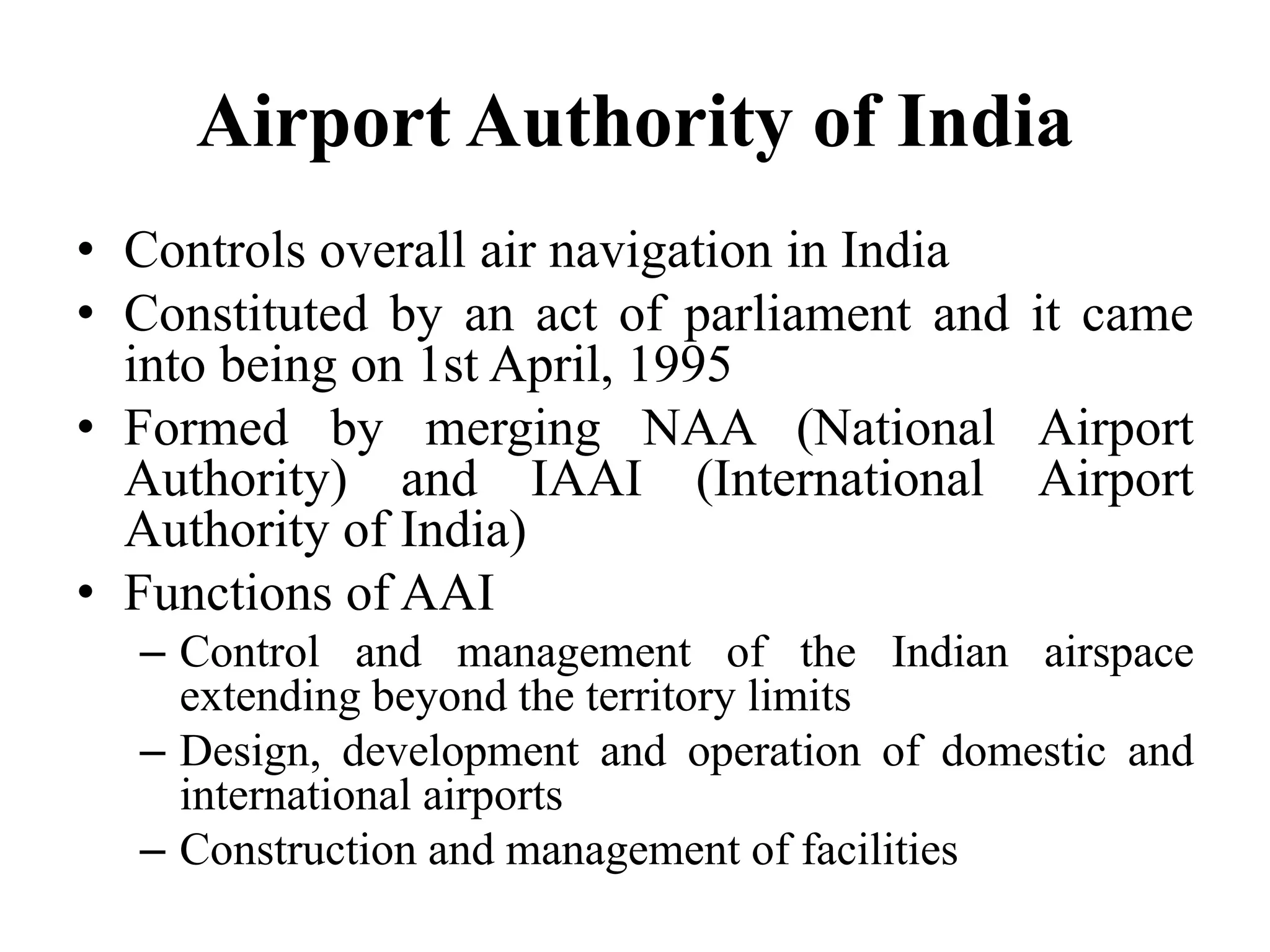
Airport Authority of India
• Controls overall air navigation in India
• Constituted by an act of parliament and it came
into being on 1st April, 1995
• Formed by merging NAA (National Airport
Authority) and IAAI (International Airport
Authority of India)
• Functions of AAI
– Control and management of the Indian airspace
extending beyond the territory limits
– Design, development and operation of domestic and
international airports
– Construction and management of facilities
– Development of cargo ports and facilities
– Provision of passenger facilities and information
systems
– Expansion and strengthening of operating area
– Provision of visual aids
– Provision of communication and navigational aids
(ex: Radar systems)
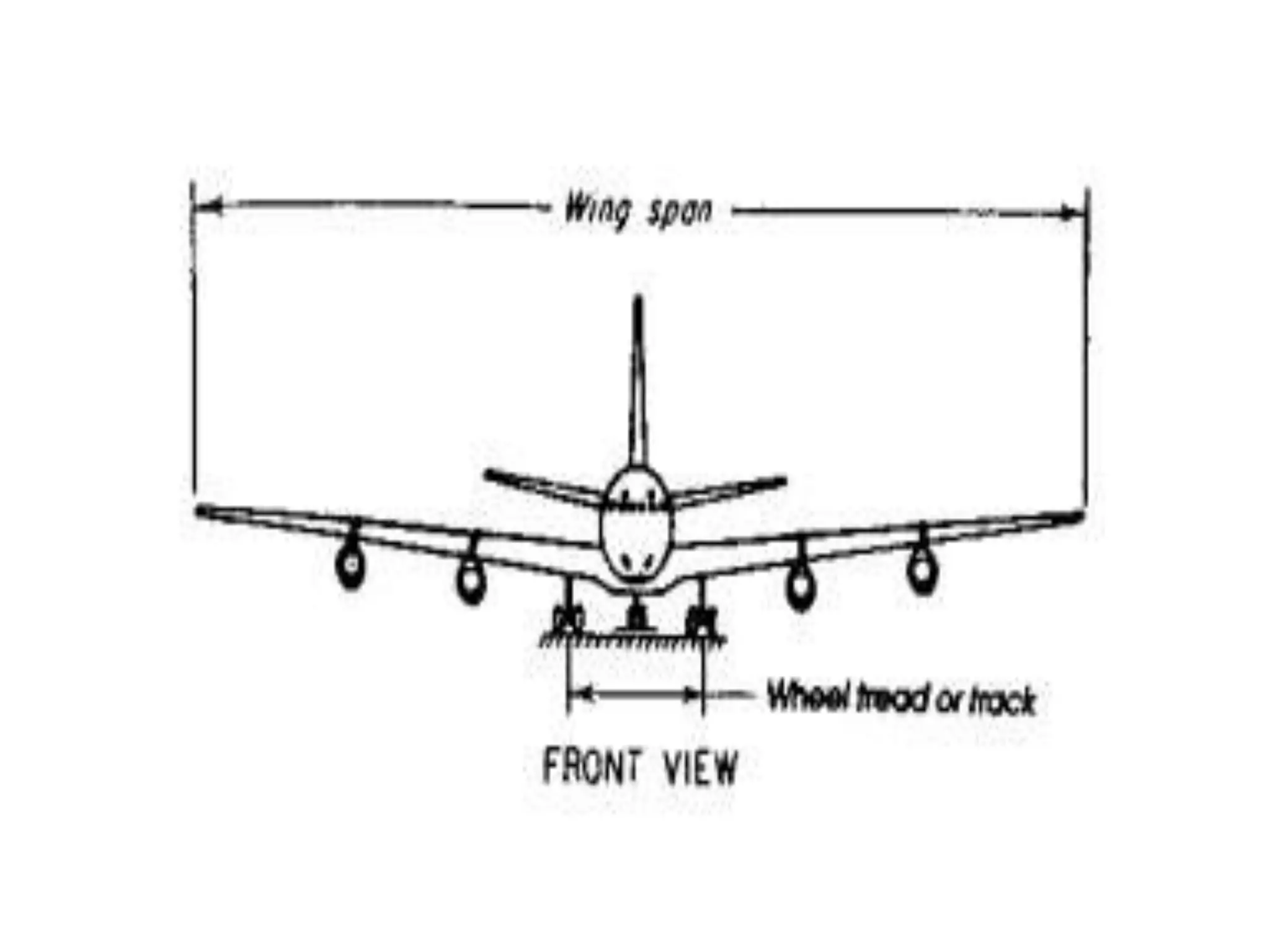
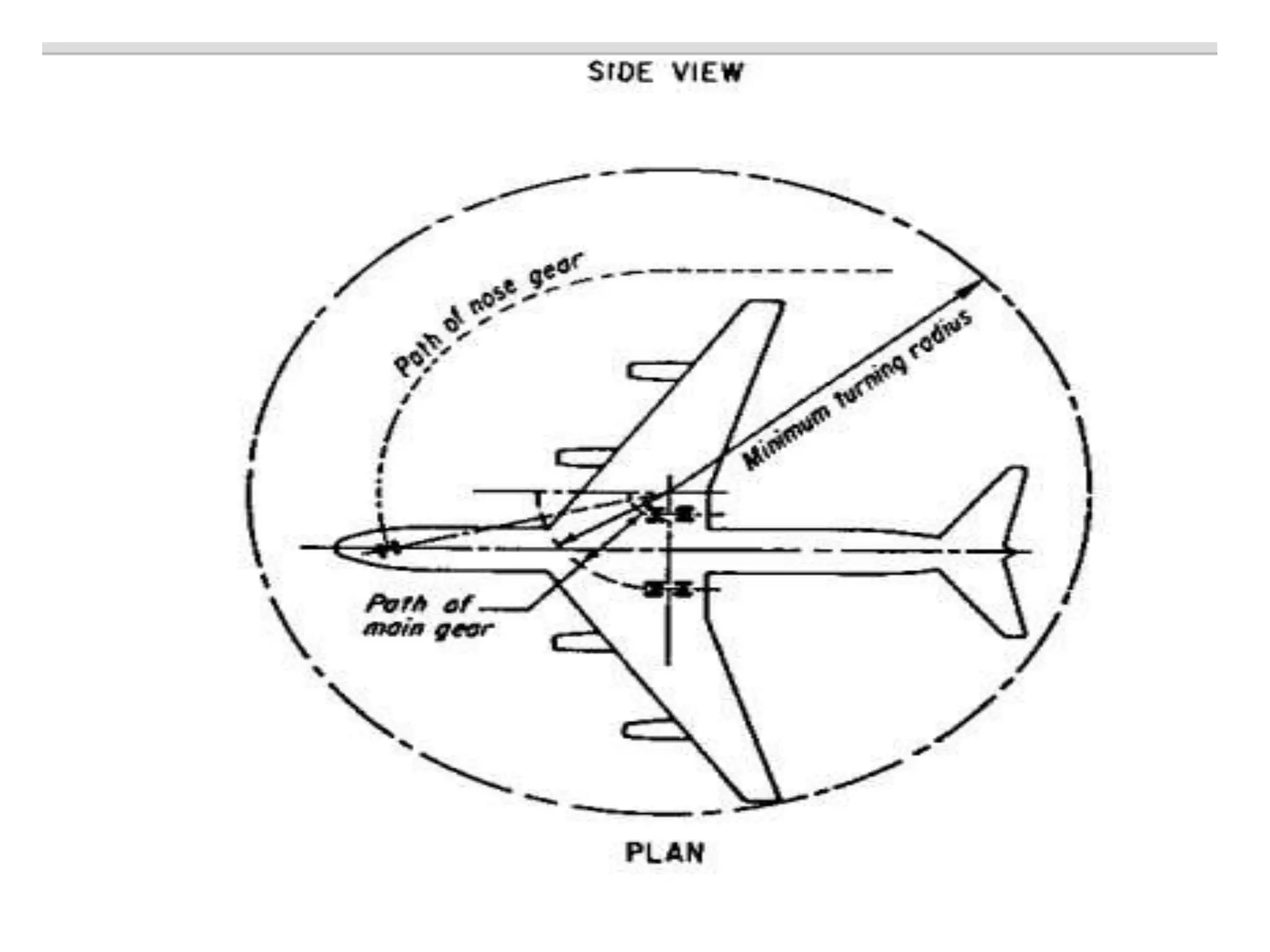
Aircraft components
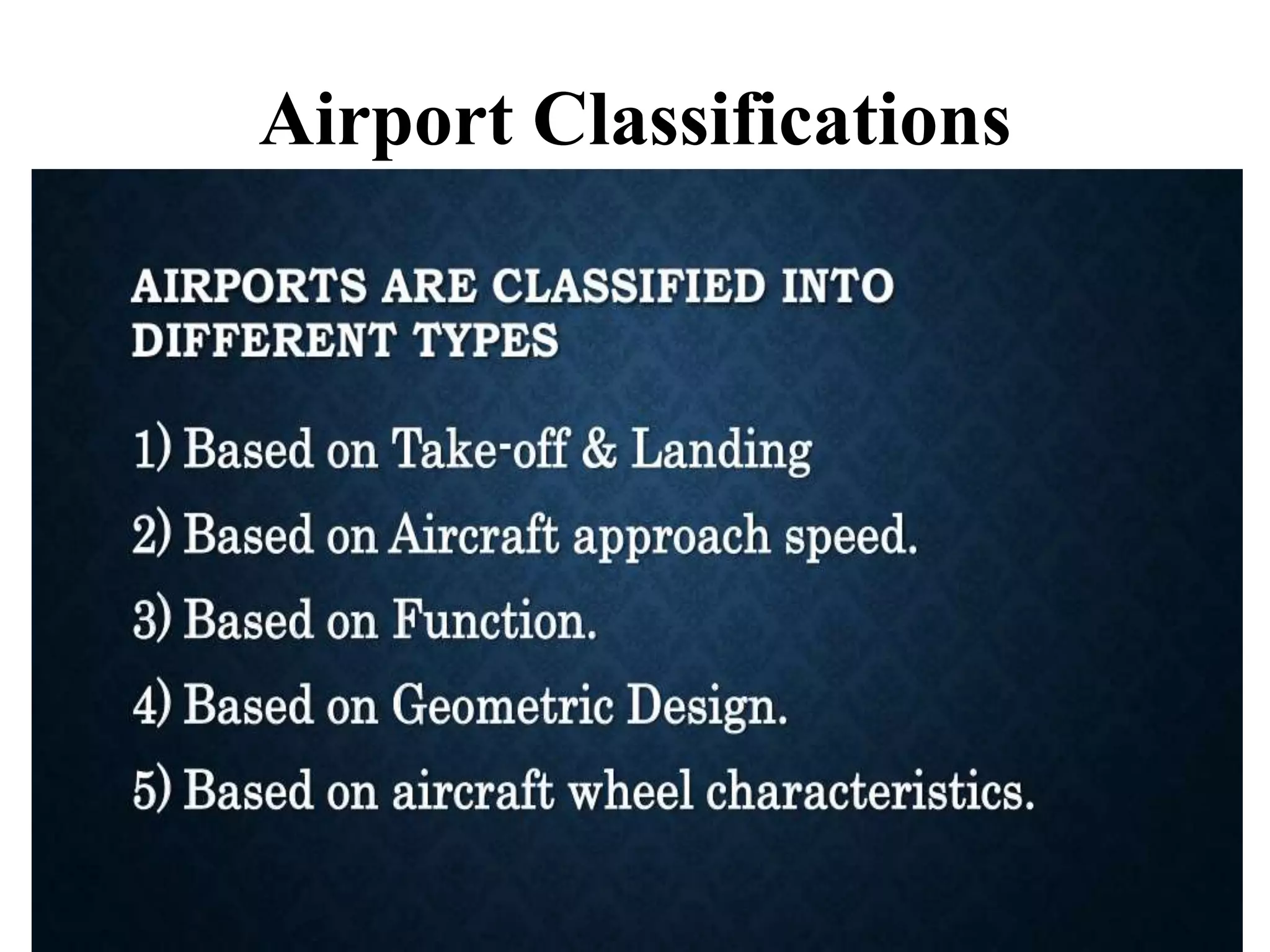
Airport Classifications
1. BASED ON TAKE-OFF &
LANDING
• Aircraft can have different ways to take off
and land. Conventional airplanes accelerate
along the ground until sufficient lift is
generated for takeoff, and reverse the process
to land. Some airplanes can take off at low
speed, this being a short takeoff.
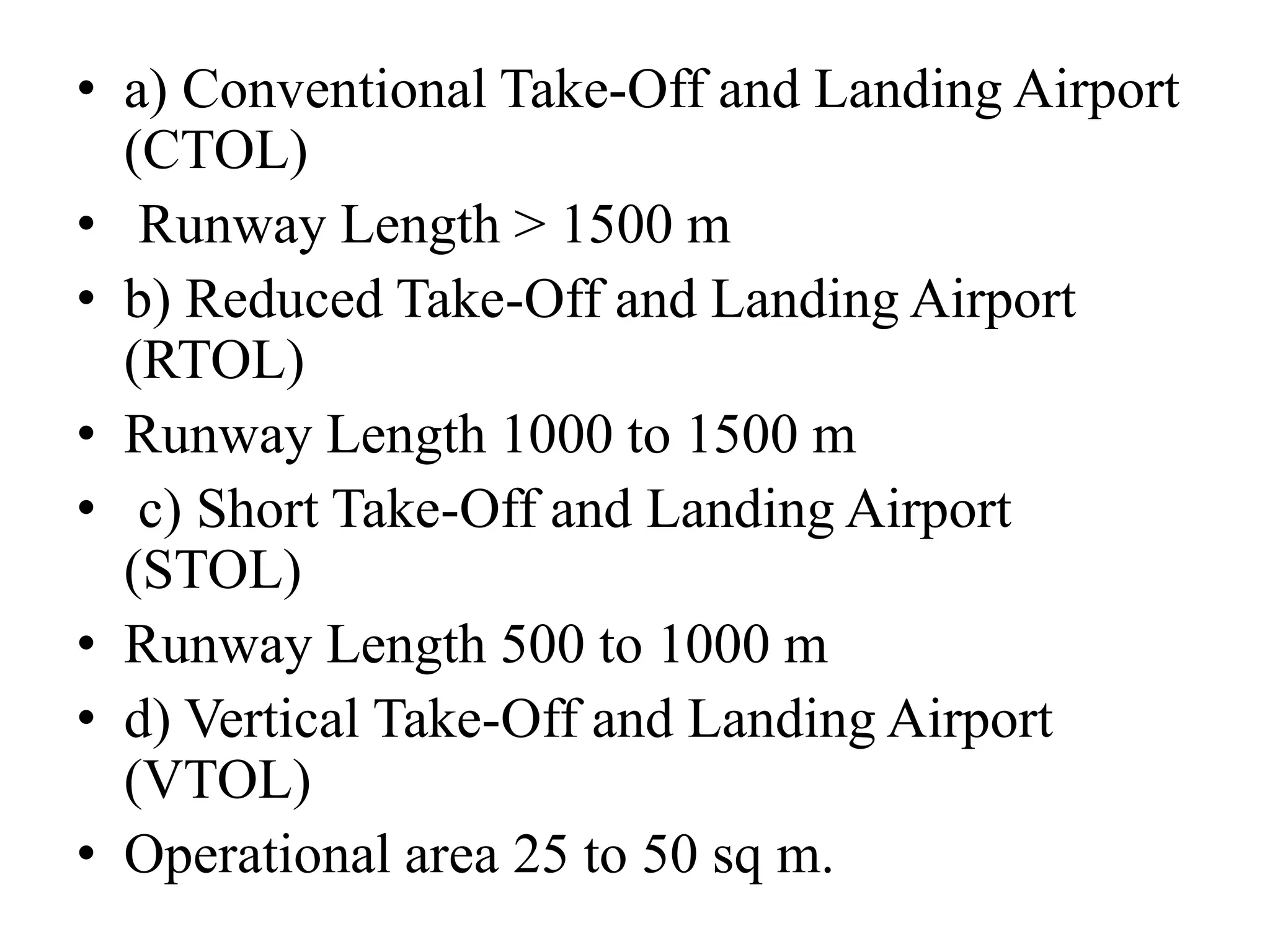
• a) Conventional Take-Off and Landing Airport
(CTOL)
• Runway Length > 1500 m
• b) Reduced Take-Off and Landing Airport
(RTOL)
• Runway Length 1000 to 1500 m
• c) Short Take-Off and Landing Airport
(STOL)
• Runway Length 500 to 1000 m
• d) Vertical Take-Off and Landing Airport
(VTOL)
• Operational area 25 to 50 sq m.
3. BASED ON FUNCTION
• a) Civil Aviation : It is one of two major
categories of flying, representing all non-
military aviation, both private and commercial.
• Domestic: A domestic airport is an airport that
handles only flights within the same country.
Domestic airports do not have customs and
immigration facilities.
• International: An international airport is an
airport with customs and border control
facilities enabling passengers to travel between
countries.
• b) Military Aviation: Military aviation is the
use of military aircraft and other flying
machines for the purposes of conducting or
enabling aerial warfare, including national
airlift capacity to provide logistical supply to
forces stationed in a theater or along a front.
THANKS!
Gmail: ramkumawat001@gmail.com
PART: 2

Airport engineering PART-1

  • 1.
    DEPARTMENT OF CIVIL ENGINEERING AirportEngineering Introduction: Requirements to Airport Planning, Airport Classifications PART: 1 Er. Ramprasad Kumawat M.Tech
  • 2.
    Airport Engineering • Introduction:Requirements to Airport Planning, • Airport Classifications, • Factors in Airport Site Selection, • Airport Size. • Planning of Airport: Requirements of Airport- • Terminal Area, • Runway Length etc.
  • 3.
    Introduction • Airport Engineeringencompasses the planning, design, and construction of terminals, runways, and navigation aids to provide for passenger and freight service. • An airport is a facility where passengers connect from ground transportation to air transportation • AIRFIELD is an area where an aircraft can land and take off, which may or may not be equipped with any navigational aids or markings
  • 4.
    • One systemof transportation which tries to improve the accessibility to inaccessible areas. • Provides continuous connectivity over water and land. • Provide relief during emergencies and better compared to others some times. • Saves productive time, spent in journey. • Increases the demand of specialized skill work force.
  • 5.
    Requirements to AirportPlanning • Helps tourism, generates foreign reserves. • Requires heavy funds during provision and maintenance. • Highly dependent on weather conditions compared to other modes. • Requires highly sophisticated machinery. • Adds to outward flow of foreign exchange – Purchase of equipment, airbuses etc. • Safety provisions are not adequate. – Providing a support system during the flight is complicate • Specific demarcation of flight paths and territories is essential
  • 6.
    Development of AirTransport • 1903 – First successful flight by Wilbur and Orville Wright at Kitty Hawk, North Carolina • 1909 – Louis Bleriot crossed English channel to England • 1911 – Post was carried by air in India from Allahabad to Naini (pilot: Henri Pequet) crossing Ganga • 1912 – Flight between Delhi and Karachi • 1914 – Air passenger transport began in Germany
  • 7.
    • 1918 –First International service between France and Spain • 1919 – London – Paris flight • 1919 – International Commission on Air Navigation (ICAN) was established • 1919 – 6 European airlines formed in Hague the International Air Traffic Association (IATA) to control the movement of air traffic and have a coordinated approach
  • 8.
    • 1928 –Havana Convention on civil aviation • 1929 – Warsaw convention on civil aviation • 1944 – international civil aviation convention • 1944 – Chicago convention, establishing provisional ICAO (International Civil Aviation Organization) • 1945 – International Air Transport Association (IATA) established in meeting at Havana, Cuba • 1947 – ICAO was established as a body of United Nations
  • 9.
    • 27, July1949 – worlds first jet airliner made its journey from hat field airport • 1954 – Boeing Dash 80 type prototype, B707 first flight • 1969 – concorde first flight • 2006 – Airbus A328 made first flight (one of the biggest passenger air craft i.e., 800 persons)
  • 10.
    Air Transport inIndia • 1911 – post was carried by air in India from Allahabad to Naini • 1912 – flight between Delhi and Karachi • 1927 – (ICAO) International Civil Aviation Organization Department was established • 1929 – Regular air service between Delhi and Karachi • 1932 – Tata airways Ltd was setup • 1933 – Indian trans-continental airways Ltd was formed
  • 11.
    • 1938 –153 aircrafts were registered • 1946 – Air transport licensing board was established • 1947 – Tata changed its name to Air India Ltd • 1948 – Air India International ltd was established by government • 1953 – Air Transport Corporation bill was made, provision for establishing two corporations, one for the domestic services and other for the international services.
  • 12.
    • 1972 -The International Airport Authority of India (IAAI) was setup – to coordinate the international aviation from different locations of the country • 1981 -Vayudoot service was started. It merged into Indian Airlines in 1993 • 1985 - Air taxi policy • 1994 -Airport Authority of India (AAI) was formed by merging International Airport Authority of India (IAAI) and National Airports Authority (NAA).
  • 13.
    Airport Authority ofIndia • Controls overall air navigation in India • Constituted by an act of parliament and it came into being on 1st April, 1995 • Formed by merging NAA (National Airport Authority) and IAAI (International Airport Authority of India) • Functions of AAI – Control and management of the Indian airspace extending beyond the territory limits – Design, development and operation of domestic and international airports – Construction and management of facilities
  • 14.
    – Development ofcargo ports and facilities – Provision of passenger facilities and information systems – Expansion and strengthening of operating area – Provision of visual aids – Provision of communication and navigational aids (ex: Radar systems)
  • 15.
  • 19.
  • 20.
    1. BASED ONTAKE-OFF & LANDING • Aircraft can have different ways to take off and land. Conventional airplanes accelerate along the ground until sufficient lift is generated for takeoff, and reverse the process to land. Some airplanes can take off at low speed, this being a short takeoff.
  • 21.
    • a) ConventionalTake-Off and Landing Airport (CTOL) • Runway Length > 1500 m • b) Reduced Take-Off and Landing Airport (RTOL) • Runway Length 1000 to 1500 m • c) Short Take-Off and Landing Airport (STOL) • Runway Length 500 to 1000 m • d) Vertical Take-Off and Landing Airport (VTOL) • Operational area 25 to 50 sq m.
  • 23.
    3. BASED ONFUNCTION • a) Civil Aviation : It is one of two major categories of flying, representing all non- military aviation, both private and commercial. • Domestic: A domestic airport is an airport that handles only flights within the same country. Domestic airports do not have customs and immigration facilities. • International: An international airport is an airport with customs and border control facilities enabling passengers to travel between countries.
  • 24.
    • b) MilitaryAviation: Military aviation is the use of military aircraft and other flying machines for the purposes of conducting or enabling aerial warfare, including national airlift capacity to provide logistical supply to forces stationed in a theater or along a front.
  • 27.