
Prateek Garodia

REVENUE PASSENGER
KILOMETER/MILE & YIELD
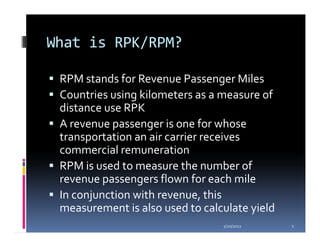
What is RPK/RPM?

 RPM stands for Revenue Passenger Miles
 Countries using kilometers as a measure of
 distance use RPK
 A revenue passenger is one for whose
 transportation an air carrier receives
 commercial remuneration
 RPM is used to measure the number of
 revenue passengers flown for each mile
 In conjunction with revenue, this
 measurement is also used to calculate yield
                                 1/20/2012     2
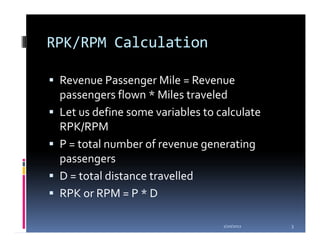
RPK/RPM Calculation

 Revenue Passenger Mile = Revenue
 passengers flown * Miles traveled
 Let us define some variables to calculate
 RPK/RPM
 P = total number of revenue generating
 passengers
 D = total distance travelled
 RPK or RPM = P * D

                                  1/20/2012   3
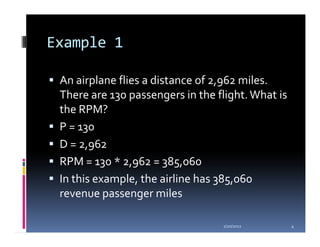
Example 1

 An airplane flies a distance of 2,962 miles.
 There are 130 passengers in the flight. What is
 the RPM?
 P = 130
 D = 2,962
 RPM = 130 * 2,962 = 385,060
 In this example, the airline has 385,060
 revenue passenger miles

                                  1/20/2012        4
What is FTK/FTM?

 FTM stands for Freight Tonne Miles
 Countries using kilometers as a measure of
 distance use FTK
 It is the equivalent of RPM for freight
 One Freight Tonne is one metric tonne of
 revenue load carried one mile
 In conjunction with revenue, this
 measurement is also used to calculate yield

                                 1/20/2012     5
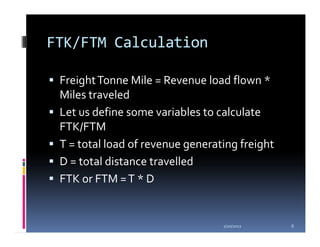
FTK/FTM Calculation

 Freight Tonne Mile = Revenue load flown *
 Miles traveled
 Let us define some variables to calculate
 FTK/FTM
 T = total load of revenue generating freight
 D = total distance travelled
 FTK or FTM = T * D


                                  1/20/2012     6
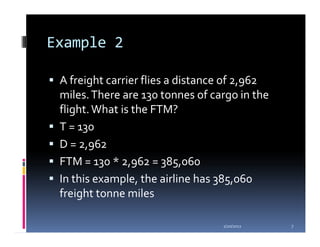
Example 2

 A freight carrier flies a distance of 2,962
 miles. There are 130 tonnes of cargo in the
 flight. What is the FTM?
 T = 130
 D = 2,962
 FTM = 130 * 2,962 = 385,060
 In this example, the airline has 385,060
 freight tonne miles

                                  1/20/2012    7
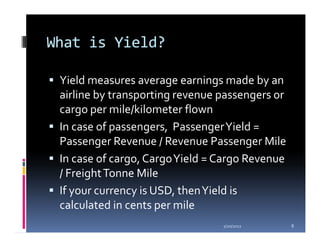
What is Yield?

 Yield measures average earnings made by an
 airline by transporting revenue passengers or
 cargo per mile/kilometer flown
 In case of passengers, Passenger Yield =
 Passenger Revenue / Revenue Passenger Mile
 In case of cargo, Cargo Yield = Cargo Revenue
 / Freight Tonne Mile
 If your currency is USD, then Yield is
 calculated in cents per mile
                                 1/20/2012       8
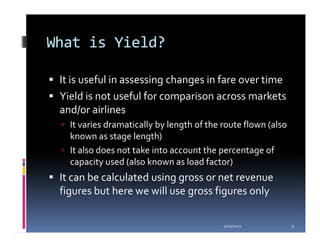
What is Yield?

 It is useful in assessing changes in fare over time
 Yield is not useful for comparison across markets
 and/or airlines
   It varies dramatically by length of the route flown (also
   known as stage length)
   It also does not take into account the percentage of
   capacity used (also known as load factor)
 It can be calculated using gross or net revenue
 figures but here we will use gross figures only

                                           1/20/2012           9
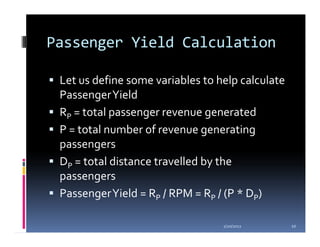
Passenger Yield Calculation

 Let us define some variables to help calculate
 Passenger Yield
 RP = total passenger revenue generated
 P = total number of revenue generating
 passengers
 DP = total distance travelled by the
 passengers
 Passenger Yield = RP / RPM = RP / (P * DP)

                                  1/20/2012       10
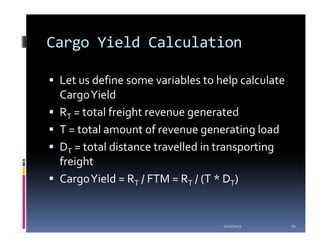
Cargo Yield Calculation

 Let us define some variables to help calculate
 Cargo Yield
 RT = total freight revenue generated
 T = total amount of revenue generating load
 DT = total distance travelled in transporting
 freight
 Cargo Yield = RT / FTM = RT / (T * DT)


                                  1/20/2012       11
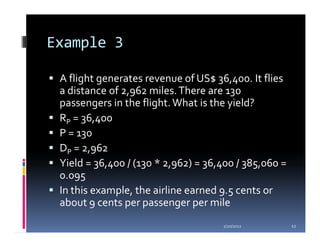
Example 3

 A flight generates revenue of US$ 36,400. It flies
 a distance of 2,962 miles. There are 130
 passengers in the flight. What is the yield?
 RP = 36,400
 P = 130
 DP = 2,962
 Yield = 36,400 / (130 * 2,962) = 36,400 / 385,060 =
 0.095
 In this example, the airline earned 9.5 cents or
 about 9 cents per passenger per mile
                                     1/20/2012         12
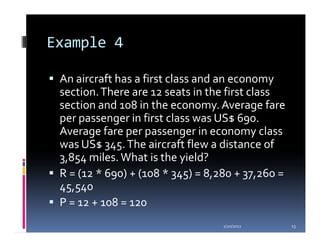
Example 4

 An aircraft has a first class and an economy
 section. There are 12 seats in the first class
 section and 108 in the economy. Average fare
 per passenger in first class was US$ 690.
 Average fare per passenger in economy class
 was US$ 345. The aircraft flew a distance of
 3,854 miles. What is the yield?
 R = (12 * 690) + (108 * 345) = 8,280 + 37,260 =
 45,540
 P = 12 + 108 = 120
                                   1/20/2012       13
Example 4

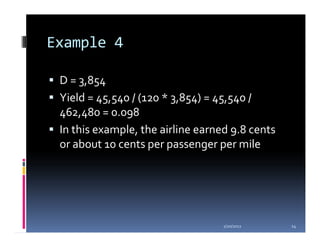
 D = 3,854
 Yield = 45,540 / (120 * 3,854) = 45,540 /
 462,480 = 0.098
 In this example, the airline earned 9.8 cents
 or about 10 cents per passenger per mile


                                   1/20/2012     14
Example 5

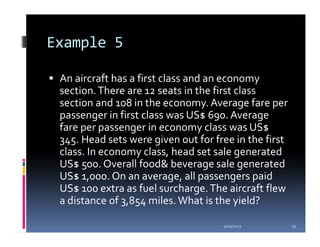
 An aircraft has a first class and an economy
 section. There are 12 seats in the first class
 section and 108 in the economy. Average fare per
 passenger in first class was US$ 690. Average
 fare per passenger in economy class was US$
 345. Head sets were given out for free in the first
 class. In economy class, head set sale generated
 US$ 500. Overall food& beverage sale generated
 US$ 1,000. On an average, all passengers paid
 US$ 100 extra as fuel surcharge. The aircraft flew
 a distance of 3,854 miles. What is the yield?

                                     1/20/2012         15
Example 5

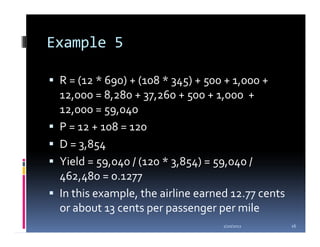
 R = (12 * 690) + (108 * 345) + 500 + 1,000 +
 12,000 = 8,280 + 37,260 + 500 + 1,000 +
 12,000 = 59,040
 P = 12 + 108 = 120
 D = 3,854
 Yield = 59,040 / (120 * 3,854) = 59,040 /
 462,480 = 0.1277
 In this example, the airline earned 12.77 cents
 or about 13 cents per passenger per mile
                                   1/20/2012       16
What is Revenue?

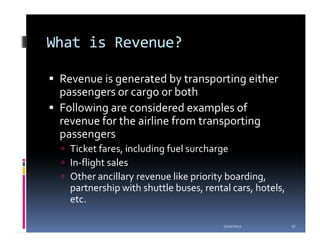
 Revenue is generated by transporting either
 passengers or cargo or both
 Following are considered examples of
 revenue for the airline from transporting
 passengers
   Ticket fares, including fuel surcharge
   In-flight sales
   Other ancillary revenue like priority boarding,
   partnership with shuttle buses, rental cars, hotels,
   etc.

                                        1/20/2012         17
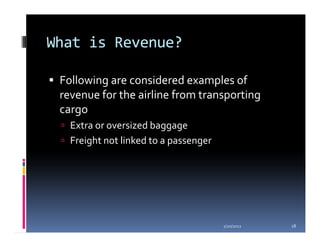
What is Revenue?

 Following are considered examples of
 revenue for the airline from transporting
 cargo
   Extra or oversized baggage
   Freight not linked to a passenger


                                       1/20/2012   18
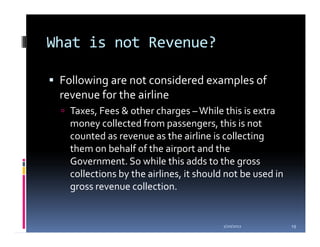
What is not Revenue?

 Following are not considered examples of
 revenue for the airline
   Taxes, Fees & other charges – While this is extra
   money collected from passengers, this is not
   counted as revenue as the airline is collecting
   them on behalf of the airport and the
   Government. So while this adds to the gross
   collections by the airlines, it should not be used in
   gross revenue collection.


                                         1/20/2012         19
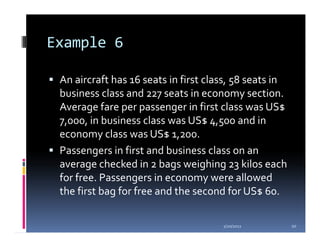
Example 6

 An aircraft has 16 seats in first class, 58 seats in
 business class and 227 seats in economy section.
 Average fare per passenger in first class was US$
 7,000, in business class was US$ 4,500 and in
 economy class was US$ 1,200.
 Passengers in first and business class on an
 average checked in 2 bags weighing 23 kilos each
 for free. Passengers in economy were allowed
 the first bag for free and the second for US$ 60.

                                      1/20/2012         20
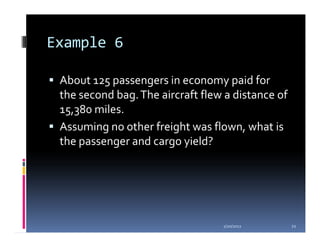
Example 6

 About 125 passengers in economy paid for
 the second bag. The aircraft flew a distance of
 15,380 miles.
 Assuming no other freight was flown, what is
 the passenger and cargo yield?


                                  1/20/2012        21
Example 6

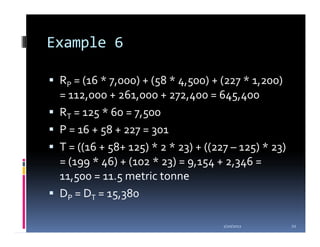
 RP = (16 * 7,000) + (58 * 4,500) + (227 * 1,200)
 = 112,000 + 261,000 + 272,400 = 645,400
 RT = 125 * 60 = 7,500
 P = 16 + 58 + 227 = 301
 T = ((16 + 58+ 125) * 2 * 23) + ((227 – 125) * 23)
 = (199 * 46) + (102 * 23) = 9,154 + 2,346 =
 11,500 = 11.5 metric tonne
 DP = DT = 15,380

                                     1/20/2012        22
Example 6

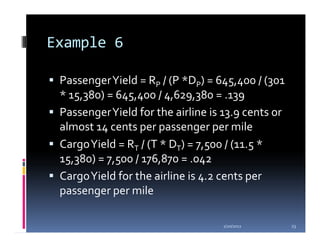
 Passenger Yield = RP / (P *DP) = 645,400 / (301
 * 15,380) = 645,400 / 4,629,380 = .139
 Passenger Yield for the airline is 13.9 cents or
 almost 14 cents per passenger per mile
 Cargo Yield = RT / (T * DT) = 7,500 / (11.5 *
 15,380) = 7,500 / 176,870 = .042
 Cargo Yield for the airline is 4.2 cents per
 passenger per mile

                                   1/20/2012        23
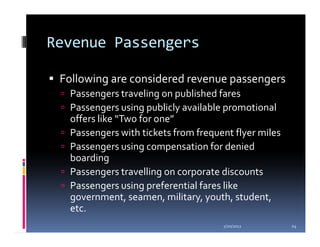
Revenue Passengers

 Following are considered revenue passengers
  Passengers traveling on published fares
  Passengers using publicly available promotional
  offers like “Two for one”
  Passengers with tickets from frequent flyer miles
  Passengers using compensation for denied
  boarding
  Passengers travelling on corporate discounts
  Passengers using preferential fares like
  government, seamen, military, youth, student,
  etc.
                                     1/20/2012        24
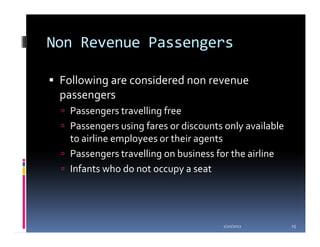
Non Revenue Passengers

 Following are considered non revenue
 passengers
  Passengers travelling free
  Passengers using fares or discounts only available
  to airline employees or their agents
  Passengers travelling on business for the airline
  Infants who do not occupy a seat


                                     1/20/2012         25
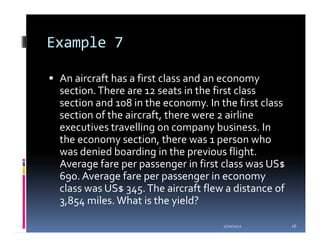
Example 7

 An aircraft has a first class and an economy
 section. There are 12 seats in the first class
 section and 108 in the economy. In the first class
 section of the aircraft, there were 2 airline
 executives travelling on company business. In
 the economy section, there was 1 person who
 was denied boarding in the previous flight.
 Average fare per passenger in first class was US$
 690. Average fare per passenger in economy
 class was US$ 345. The aircraft flew a distance of
 3,854 miles. What is the yield?

                                     1/20/2012        26
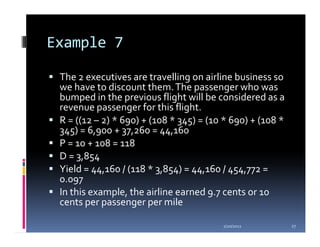
Example 7

 The 2 executives are travelling on airline business so
 we have to discount them. The passenger who was
 bumped in the previous flight will be considered as a
 revenue passenger for this flight.
 R = ((12 – 2) * 690) + (108 * 345) = (10 * 690) + (108 *
 345) = 6,900 + 37,260 = 44,160
 P = 10 + 108 = 118
 D = 3,854
 Yield = 44,160 / (118 * 3,854) = 44,160 / 454,772 =
 0.097
 In this example, the airline earned 9.7 cents or 10
 cents per passenger per mile

                                         1/20/2012          27
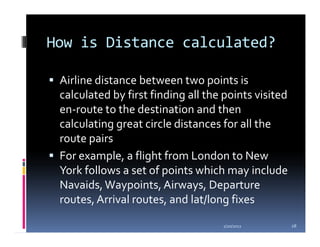
How is Distance calculated?

 Airline distance between two points is
 calculated by first finding all the points visited
 en-route to the destination and then
 calculating great circle distances for all the
 route pairs
 For example, a flight from London to New
 York follows a set of points which may include
 Navaids, Waypoints, Airways, Departure
 routes, Arrival routes, and lat/long fixes

                                    1/20/2012         28
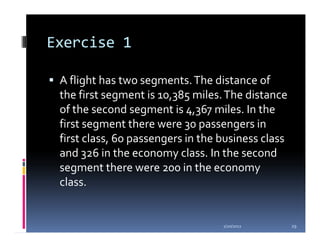
Exercise 1

 A flight has two segments. The distance of
 the first segment is 10,385 miles. The distance
 of the second segment is 4,367 miles. In the
 first segment there were 30 passengers in
 first class, 60 passengers in the business class
 and 326 in the economy class. In the second
 segment there were 200 in the economy
 class.


                                   1/20/2012        29
Exercise 1

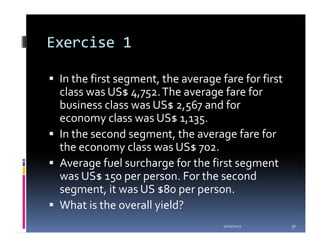
 In the first segment, the average fare for first
 class was US$ 4,752. The average fare for
 business class was US$ 2,567 and for
 economy class was US$ 1,135.
 In the second segment, the average fare for
 the economy class was US$ 702.
 Average fuel surcharge for the first segment
 was US$ 150 per person. For the second
 segment, it was US $80 per person.
 What is the overall yield?
                                    1/20/2012       30
Exercise 2

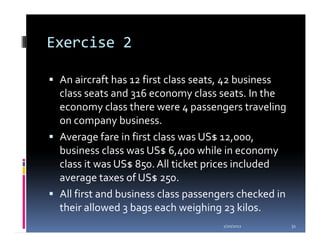
 An aircraft has 12 first class seats, 42 business
 class seats and 316 economy class seats. In the
 economy class there were 4 passengers traveling
 on company business.
 Average fare in first class was US$ 12,000,
 business class was US$ 6,400 while in economy
 class it was US$ 850. All ticket prices included
 average taxes of US$ 250.
 All first and business class passengers checked in
 their allowed 3 bags each weighing 23 kilos.
                                     1/20/2012        31
Exercise 2

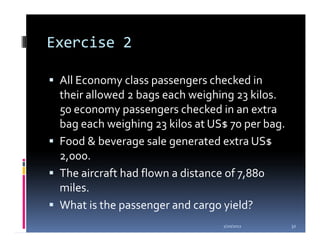
 All Economy class passengers checked in
 their allowed 2 bags each weighing 23 kilos.
 50 economy passengers checked in an extra
 bag each weighing 23 kilos at US$ 70 per bag.
 Food & beverage sale generated extra US$
 2,000.
 The aircraft had flown a distance of 7,880
 miles.
 What is the passenger and cargo yield?
                                 1/20/2012       32
References

 http://en.wikipedia.org/wiki/Revenue_passenger
 _mile
 http://moneyterms.co.uk/rpk-revenue-
 passenger-kilometres/
 http://icaodata.com/Terms.aspx#RevenuePasse
 nger
 http://www.airliners.net/aviation-
 forums/general_aviation/read.main/3582373/
 http://www.linkedin.com/groupAnswers?viewQu
 estionAndAnswers=&discussionID=76033155&gi
 d=59519&commentID=55329309&trk=view_disc
 &ut=1XhPa6HzrtskY1
                                  1/20/2012       33
References

 http://moneyterms.co.uk/ftk-freight-tonne-
 kilometres/http://icaodata.com/Terms.aspx#
 RevenuePassenger
 http://web.mit.edu/airlinedata/www/Res_Glo
 ssary.html
 http://travel.stackexchange.com/questions/2
 695/how-to-calculate-the-air-line-distance-
 between-two-places
 http://www.aa.com/i18n/amrcorp/corporateIn
 formation/facts/measurements.jsp
                               1/20/2012       34
Appreciation

 Dirk Albrecht, Partner, Head of Aviation
 Practice, Roland Berger Strategy Consultants,
 Belgium


                                 1/20/2012       35