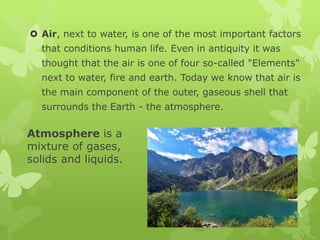
Air protection
"Ecology and environmental
protection are not only (…) a large
industry, mines and steel mills.
Those are also your and my everyday
gestures; it's your and my kitchen,
bathroom, garage, garden. It's the
choice of means of communication
for you and me, how to spend my
free time
…and such environmental protection
begins in your immediate vicinity: in
this room, apartment, house. "
Atmosphere is a
mixture of gases,
solids and liquids.
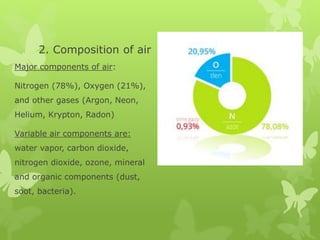
 Air, next to water, is one of the most important factors
that conditions human life. Even in antiquity it was
thought that the air is one of four so-called "Elements"
next to water, fire and earth. Today we know that air is
the main component of the outer, gaseous shell that
surrounds the Earth - the atmosphere.
2. Composition of air
Major components of air:
Nitrogen (78%), Oxygen (21%),
and other gases (Argon, Neon,
Helium, Krypton, Radon)
Variable air components are:
water vapor, carbon dioxide,
nitrogen dioxide, ozone, mineral
and organic components (dust,
soot, bacteria).
3. Air pollution
 Those are substances (gas,
liquid, solid) which are found
in the atmospheric air, but
are not its natural
components.
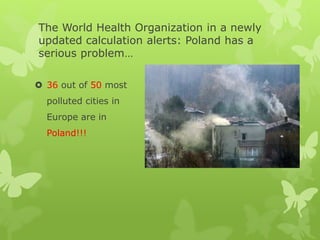
The World Health Organization in a newly
updated calculation alerts: Poland has a
serious problem…
 36 out of 50 most
polluted cities in
Europe are in
Poland!!!
4. Sources of pollution
 Sources of natural origin:
 volcanic eruptions (ash and volcanic
gases: carbon dioxide - CO2, sulfur
dioxide - SO2, hydrogen sulfide -
H2S
swamps (methane CH4, carbon
dioxide CO2, hydrogen sulfide H2S,
NH3 ammonia)
 forest, savannah, steppe fires
(carbon dioxide CO2, carbon
monoxide-CO, dust)
eroded soils and rocks, sandstorms
(dust)
 Anthropogenic sources;
 Energy - mining (mines, drilling shafts) and
fuel combustion processes.
 Industrial - heavy industry (petroleum
processing, metallurgy, cement plants,
organic chemistry industry), metallurgy,
production and use of solvents, food industry,
pharmaceutical industry and others.
 Transport - land (car, rail, air) and water
transport.
 Municipal and domestic - home furnaces, local
boiler rooms, farms, collection and utilization
of solid waste and sewage (landfills, treatment
plants).
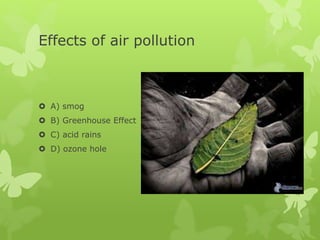
Effects of air pollution
 A) smog
 B) Greenhouse Effect
 C) acid rains
 D) ozone hole
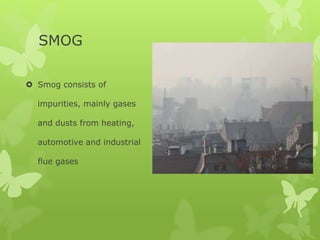
SMOG
 Smog consists of
impurities, mainly gases
and dusts from heating,
automotive and industrial
flue gases
 Why is the condition of air in Poland much worse
than in other European Union countries with larger
industrial centers, and with much higher density of
population?
 Neither large factories nor
car exhaust fumes have any
great impact on the poor
condition of air in Poland. In
case of Poland, pollution
occurs as a result of the so-
called "Low emissions"
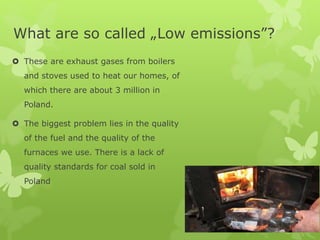
What are so called „Low emissions”?
 These are exhaust gases from boilers
and stoves used to heat our homes, of
which there are about 3 million in
Poland.
 The biggest problem lies in the quality
of the fuel and the quality of the
furnaces we use. There is a lack of
quality standards for coal sold in
Poland
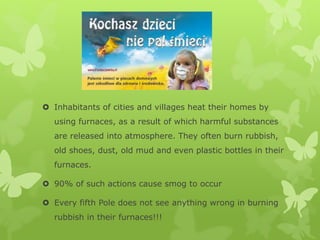
 Inhabitants of cities and villages heat their homes by
using furnaces, as a result of which harmful substances
are released into atmosphere. They often burn rubbish,
old shoes, dust, old mud and even plastic bottles in their
furnaces.
 90% of such actions cause smog to occur
 Every fifth Pole does not see anything wrong in burning
rubbish in their furnaces!!!
…a challenge 
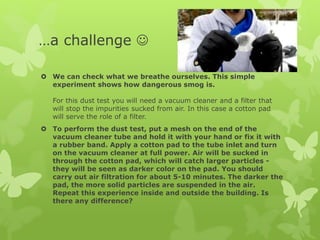
 We can check what we breathe ourselves. This simple
experiment shows how dangerous smog is.
For this dust test you will need a vacuum cleaner and a filter that
will stop the impurities sucked from air. In this case a cotton pad
will serve the role of a filter.
 To perform the dust test, put a mesh on the end of the
vacuum cleaner tube and hold it with your hand or fix it with
a rubber band. Apply a cotton pad to the tube inlet and turn
on the vacuum cleaner at full power. Air will be sucked in
through the cotton pad, which will catch larger particles -
they will be seen as darker color on the pad. You should
carry out air filtration for about 5-10 minutes. The darker the
pad, the more solid particles are suspended in the air.
Repeat this experience inside and outside the building. Is
there any difference?
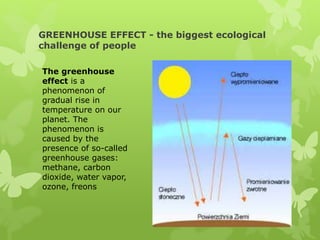
GREENHOUSE EFFECT - the biggest ecological
challenge of people
The greenhouse
effect is a
phenomenon of
gradual rise in
temperature on our
planet. The
phenomenon is
caused by the
presence of so-called
greenhouse gases:
methane, carbon
dioxide, water vapor,
ozone, freons
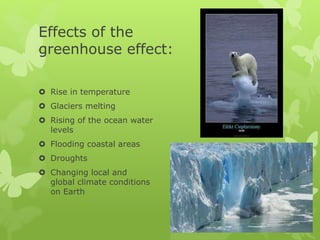
Effects of the
greenhouse effect:
 Rise in temperature
 Glaciers melting
 Rising of the ocean water
levels
 Flooding coastal areas
 Droughts
 Changing local and
global climate conditions
on Earth
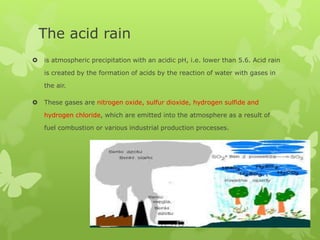
The acid rain
 is atmospheric precipitation with an acidic pH, i.e. lower than 5.6. Acid rain
is created by the formation of acids by the reaction of water with gases in
the air.
 These gases are nitrogen oxide, sulfur dioxide, hydrogen sulfide and
hydrogen chloride, which are emitted into the atmosphere as a result of
fuel combustion or various industrial production processes.
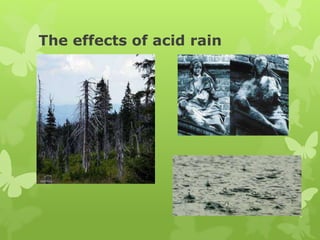
The effects of acid rain
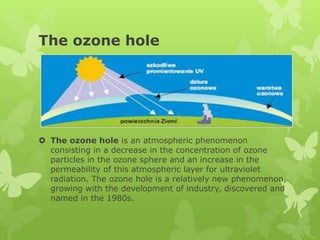
The ozone hole
 The ozone hole is an atmospheric phenomenon
consisting in a decrease in the concentration of ozone
particles in the ozone sphere and an increase in the
permeability of this atmospheric layer for ultraviolet
radiation. The ozone hole is a relatively new phenomenon,
growing with the development of industry, discovered and
named in the 1980s.
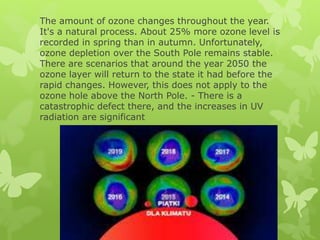
The amount of ozone changes throughout the year.
It's a natural process. About 25% more ozone level is
recorded in spring than in autumn. Unfortunately,
ozone depletion over the South Pole remains stable.
There are scenarios that around the year 2050 the
ozone layer will return to the state it had before the
rapid changes. However, this does not apply to the
ozone hole above the North Pole. - There is a
catastrophic defect there, and the increases in UV
radiation are significant
Thank you!
 A task (for volunteers)
 Think how we can limit the pollution of air
and its effects, i.e. smog, the greenhouse
effect etc.
 Prepare a poster, a presentation and send
me in e-mail to sp3m.pohl@gmail.com
 GOOD LUCK!

Air ptotection

  • 1.
  • 2.
    "Ecology and environmental protectionare not only (…) a large industry, mines and steel mills. Those are also your and my everyday gestures; it's your and my kitchen, bathroom, garage, garden. It's the choice of means of communication for you and me, how to spend my free time …and such environmental protection begins in your immediate vicinity: in this room, apartment, house. "
  • 3.
    Atmosphere is a mixtureof gases, solids and liquids.  Air, next to water, is one of the most important factors that conditions human life. Even in antiquity it was thought that the air is one of four so-called "Elements" next to water, fire and earth. Today we know that air is the main component of the outer, gaseous shell that surrounds the Earth - the atmosphere.
  • 4.
    2. Composition ofair Major components of air: Nitrogen (78%), Oxygen (21%), and other gases (Argon, Neon, Helium, Krypton, Radon) Variable air components are: water vapor, carbon dioxide, nitrogen dioxide, ozone, mineral and organic components (dust, soot, bacteria).
  • 5.
    3. Air pollution Those are substances (gas, liquid, solid) which are found in the atmospheric air, but are not its natural components.
  • 6.
    The World HealthOrganization in a newly updated calculation alerts: Poland has a serious problem…  36 out of 50 most polluted cities in Europe are in Poland!!!
  • 7.
    4. Sources ofpollution  Sources of natural origin:  volcanic eruptions (ash and volcanic gases: carbon dioxide - CO2, sulfur dioxide - SO2, hydrogen sulfide - H2S swamps (methane CH4, carbon dioxide CO2, hydrogen sulfide H2S, NH3 ammonia)  forest, savannah, steppe fires (carbon dioxide CO2, carbon monoxide-CO, dust) eroded soils and rocks, sandstorms (dust)  Anthropogenic sources;  Energy - mining (mines, drilling shafts) and fuel combustion processes.  Industrial - heavy industry (petroleum processing, metallurgy, cement plants, organic chemistry industry), metallurgy, production and use of solvents, food industry, pharmaceutical industry and others.  Transport - land (car, rail, air) and water transport.  Municipal and domestic - home furnaces, local boiler rooms, farms, collection and utilization of solid waste and sewage (landfills, treatment plants).
  • 8.
    Effects of airpollution  A) smog  B) Greenhouse Effect  C) acid rains  D) ozone hole
  • 9.
    SMOG  Smog consistsof impurities, mainly gases and dusts from heating, automotive and industrial flue gases
  • 10.
     Why isthe condition of air in Poland much worse than in other European Union countries with larger industrial centers, and with much higher density of population?  Neither large factories nor car exhaust fumes have any great impact on the poor condition of air in Poland. In case of Poland, pollution occurs as a result of the so- called "Low emissions"
  • 11.
    What are socalled „Low emissions”?  These are exhaust gases from boilers and stoves used to heat our homes, of which there are about 3 million in Poland.  The biggest problem lies in the quality of the fuel and the quality of the furnaces we use. There is a lack of quality standards for coal sold in Poland
  • 12.
     Inhabitants ofcities and villages heat their homes by using furnaces, as a result of which harmful substances are released into atmosphere. They often burn rubbish, old shoes, dust, old mud and even plastic bottles in their furnaces.  90% of such actions cause smog to occur  Every fifth Pole does not see anything wrong in burning rubbish in their furnaces!!!
  • 13.
    …a challenge  We can check what we breathe ourselves. This simple experiment shows how dangerous smog is. For this dust test you will need a vacuum cleaner and a filter that will stop the impurities sucked from air. In this case a cotton pad will serve the role of a filter.  To perform the dust test, put a mesh on the end of the vacuum cleaner tube and hold it with your hand or fix it with a rubber band. Apply a cotton pad to the tube inlet and turn on the vacuum cleaner at full power. Air will be sucked in through the cotton pad, which will catch larger particles - they will be seen as darker color on the pad. You should carry out air filtration for about 5-10 minutes. The darker the pad, the more solid particles are suspended in the air. Repeat this experience inside and outside the building. Is there any difference?
  • 14.
    GREENHOUSE EFFECT -the biggest ecological challenge of people The greenhouse effect is a phenomenon of gradual rise in temperature on our planet. The phenomenon is caused by the presence of so-called greenhouse gases: methane, carbon dioxide, water vapor, ozone, freons
  • 15.
    Effects of the greenhouseeffect:  Rise in temperature  Glaciers melting  Rising of the ocean water levels  Flooding coastal areas  Droughts  Changing local and global climate conditions on Earth
  • 16.
    The acid rain is atmospheric precipitation with an acidic pH, i.e. lower than 5.6. Acid rain is created by the formation of acids by the reaction of water with gases in the air.  These gases are nitrogen oxide, sulfur dioxide, hydrogen sulfide and hydrogen chloride, which are emitted into the atmosphere as a result of fuel combustion or various industrial production processes.
  • 17.
    The effects ofacid rain
  • 18.
    The ozone hole The ozone hole is an atmospheric phenomenon consisting in a decrease in the concentration of ozone particles in the ozone sphere and an increase in the permeability of this atmospheric layer for ultraviolet radiation. The ozone hole is a relatively new phenomenon, growing with the development of industry, discovered and named in the 1980s.
  • 19.
    The amount ofozone changes throughout the year. It's a natural process. About 25% more ozone level is recorded in spring than in autumn. Unfortunately, ozone depletion over the South Pole remains stable. There are scenarios that around the year 2050 the ozone layer will return to the state it had before the rapid changes. However, this does not apply to the ozone hole above the North Pole. - There is a catastrophic defect there, and the increases in UV radiation are significant
  • 20.
    Thank you!  Atask (for volunteers)  Think how we can limit the pollution of air and its effects, i.e. smog, the greenhouse effect etc.  Prepare a poster, a presentation and send me in e-mail to sp3m.pohl@gmail.com  GOOD LUCK!