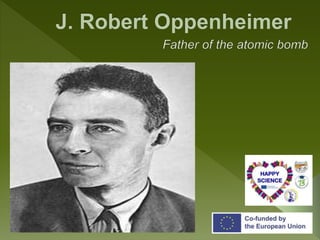
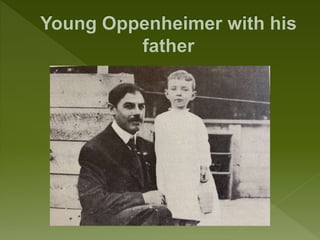
 Oppenheimer was born in New York City on
April 22, 1904.
 Oppenheimer was initially schooled at Alcuin
Preparatory School, and in 1911 entered
the Ethical Culture Society School
 He entered Harvard College a year later
finishing his previous school at 1921, at age 18
 In 1924 Oppenheimer was informed that he had
been accepted into Christ's College,
Cambridge.
In 1947, Oppenheimer became the director of the Institute for Advanced
Study in Princeton, New Jersey, and chaired the influential General
Advisory Committee of the newly created U.S. Atomic Energy Commission.
He lobbied for international control of nuclear power to avert nuclear
proliferation and a nuclear arms race with the Soviet Union. He opposed
the development of the hydrogen bomb during a 1949–1950 governmental
debate on the question and subsequently took positions on defense-
related issues that provoked the ire of some U.S. government and military
factions.
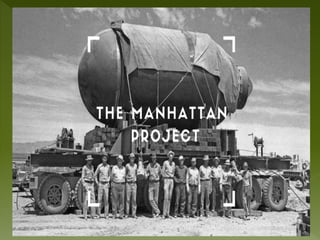
In 1939, in Germany the atomic nucleus was
split. Oppenheimer and other scientists have
guessed that they could get a controlled chain
reaction, which is the key of creating a new, very
destructive weapon.
On October 9, 1941, shortly before the United
States entered World War II, President Franklin
D. Roosevelt approved a crash program to
develop an atomic bomb.
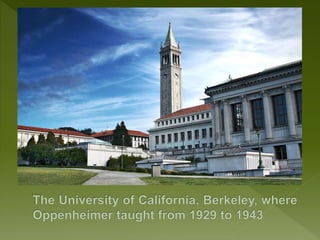
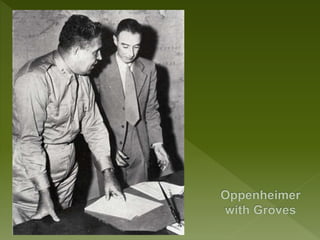
General Leslie Groves had met with J. Robert Oppenheimer, a physicist at
the University of California, Berkeley, and discussed the creation of a
laboratory where the bomb could be designed and tested. Groves was
impressed with the breadth of Oppenheimer's knowledge. Groves saw that
Oppenheimer thoroughly understood the issues involved in setting up a
laboratory in a remote area. These were features that Groves found
lacking in other scientists, and he knew that broad knowledge would be
vital in an interdisciplinary project that would involve not just physics,
but chemistry, metallurgy, ordnance, and engineering.
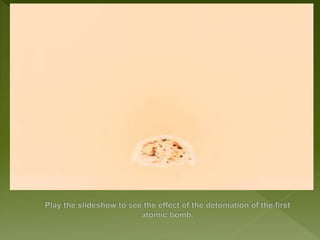
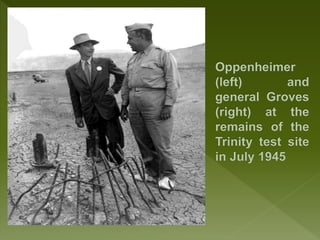
Trinity was the code name of the first detonation of a nuclear
weapon, conducted on July 16, 1945, as part of the Manhattan
Project. The test was of an implosion-design plutonium bomb,
nicknamed the "gadget", of the same design as the Fat
Man bomb later detonated over Nagasaki, Japan, on August 9,
1945. The code name "Trinity" was assigned by J. Robert
Oppenheimer, the director of the Los Alamos Laboratory,
inspired by the poetry of John Donne.
During the second Red Scare, Oppenheimer's stances, together with his
past associations with the Communist Party USA, led to the revocation of
his security clearance, following a 1954 security hearing. This effectively
ended his access to the government's atomic secrets and his career as a
nuclear physicist. Also stripped of his direct political influence,
Oppenheimer nevertheless continued to lecture, write, and work in physics.
In 1963, as a gesture of political rehabilitation, he was given the Enrico
Fermi Award. He died four years later, of throat cancer. In 2022, the federal
government vacated the 1954 revocation of his security clearance.
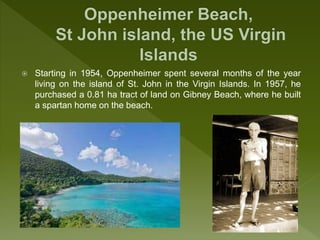
 Starting in 1954, Oppenheimer spent several months of the year
living on the island of St. John in the Virgin Islands. In 1957, he
purchased a 0.81 ha tract of land on Gibney Beach, where he built
a spartan home on the beach.
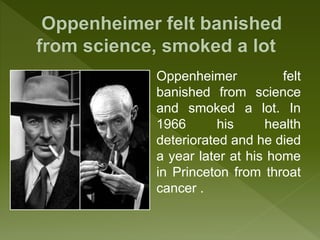
Oppenheimer felt
banished from science
and smoked a lot. In
1966 his health
deteriorated and he died
a year later at his home
in Princeton from throat
cancer .
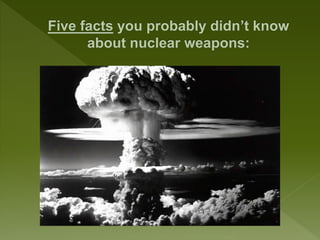
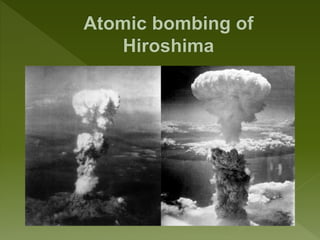
The two nuclear bombs dropped on
Hiroshima and Nagasaki in 1945 killed
nearly 200,000 people. Those bombs would
have been capable of taking out the entire
centre of one of the European capitals. Most
contemporary nuclear weapons are far more
powerful.
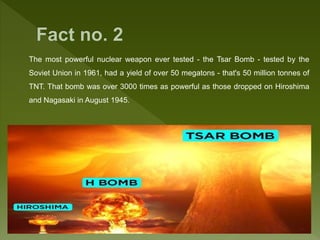
The most powerful nuclear weapon ever tested - the Tsar Bomb - tested by the
Soviet Union in 1961, had a yield of over 50 megatons - that's 50 million tonnes of
TNT. That bomb was over 3000 times as powerful as those dropped on Hiroshima
and Nagasaki in August 1945.
The United Kingdom has a stockpile of
approximately 200 nuclear weapons. 40 of
these are warheads deployed on one of its four
submarines, one of which is always on patrol
under the ocean ready to deliver the UK nuclear
weapons anywhere in the world in as little as a
manner of minutes.
While there have only ever been two uses of
nuclear weapons in warfare, there have
been over two thousand nuclear tests since
this time. Many of them in the atmosphere
releasing vast amounts of radiation, making
certain parts of the planet uninhabitable.
There is no proven defence against nuclear
attack, despite many efforts to try and do so.
Copy the link below to your browser and try
to solve the puzzle 
https://puzzlefactory.pl/pl/puzzle/graj/ludzie/5
76214-robert-oppenheimer#12x7

Robert Oppenheimer famous physicist - presentation

  • 2.
     Oppenheimer wasborn in New York City on April 22, 1904.  Oppenheimer was initially schooled at Alcuin Preparatory School, and in 1911 entered the Ethical Culture Society School  He entered Harvard College a year later finishing his previous school at 1921, at age 18  In 1924 Oppenheimer was informed that he had been accepted into Christ's College, Cambridge.
  • 5.
    In 1947, Oppenheimerbecame the director of the Institute for Advanced Study in Princeton, New Jersey, and chaired the influential General Advisory Committee of the newly created U.S. Atomic Energy Commission. He lobbied for international control of nuclear power to avert nuclear proliferation and a nuclear arms race with the Soviet Union. He opposed the development of the hydrogen bomb during a 1949–1950 governmental debate on the question and subsequently took positions on defense- related issues that provoked the ire of some U.S. government and military factions.
  • 7.
    In 1939, inGermany the atomic nucleus was split. Oppenheimer and other scientists have guessed that they could get a controlled chain reaction, which is the key of creating a new, very destructive weapon. On October 9, 1941, shortly before the United States entered World War II, President Franklin D. Roosevelt approved a crash program to develop an atomic bomb.
  • 8.
    General Leslie Groveshad met with J. Robert Oppenheimer, a physicist at the University of California, Berkeley, and discussed the creation of a laboratory where the bomb could be designed and tested. Groves was impressed with the breadth of Oppenheimer's knowledge. Groves saw that Oppenheimer thoroughly understood the issues involved in setting up a laboratory in a remote area. These were features that Groves found lacking in other scientists, and he knew that broad knowledge would be vital in an interdisciplinary project that would involve not just physics, but chemistry, metallurgy, ordnance, and engineering.
  • 10.
    Trinity was thecode name of the first detonation of a nuclear weapon, conducted on July 16, 1945, as part of the Manhattan Project. The test was of an implosion-design plutonium bomb, nicknamed the "gadget", of the same design as the Fat Man bomb later detonated over Nagasaki, Japan, on August 9, 1945. The code name "Trinity" was assigned by J. Robert Oppenheimer, the director of the Los Alamos Laboratory, inspired by the poetry of John Donne.
  • 14.
    During the secondRed Scare, Oppenheimer's stances, together with his past associations with the Communist Party USA, led to the revocation of his security clearance, following a 1954 security hearing. This effectively ended his access to the government's atomic secrets and his career as a nuclear physicist. Also stripped of his direct political influence, Oppenheimer nevertheless continued to lecture, write, and work in physics. In 1963, as a gesture of political rehabilitation, he was given the Enrico Fermi Award. He died four years later, of throat cancer. In 2022, the federal government vacated the 1954 revocation of his security clearance.
  • 15.
     Starting in1954, Oppenheimer spent several months of the year living on the island of St. John in the Virgin Islands. In 1957, he purchased a 0.81 ha tract of land on Gibney Beach, where he built a spartan home on the beach.
  • 16.
    Oppenheimer felt banished fromscience and smoked a lot. In 1966 his health deteriorated and he died a year later at his home in Princeton from throat cancer .
  • 18.
    The two nuclearbombs dropped on Hiroshima and Nagasaki in 1945 killed nearly 200,000 people. Those bombs would have been capable of taking out the entire centre of one of the European capitals. Most contemporary nuclear weapons are far more powerful.
  • 20.
    The most powerfulnuclear weapon ever tested - the Tsar Bomb - tested by the Soviet Union in 1961, had a yield of over 50 megatons - that's 50 million tonnes of TNT. That bomb was over 3000 times as powerful as those dropped on Hiroshima and Nagasaki in August 1945.
  • 21.
    The United Kingdomhas a stockpile of approximately 200 nuclear weapons. 40 of these are warheads deployed on one of its four submarines, one of which is always on patrol under the ocean ready to deliver the UK nuclear weapons anywhere in the world in as little as a manner of minutes.
  • 22.
    While there haveonly ever been two uses of nuclear weapons in warfare, there have been over two thousand nuclear tests since this time. Many of them in the atmosphere releasing vast amounts of radiation, making certain parts of the planet uninhabitable.
  • 23.
    There is noproven defence against nuclear attack, despite many efforts to try and do so.
  • 24.
    Copy the linkbelow to your browser and try to solve the puzzle  https://puzzlefactory.pl/pl/puzzle/graj/ludzie/5 76214-robert-oppenheimer#12x7