ROCKS REVIEW
16b – classify rocks by their formation
(igneous, metamorphic, sedimentary) (GPS)
16b1 – explain the rock cycle
16b2 – investigate the contributions of
minerals to rock composition (GPS)
16b3 – discuss the importance of mineral
and rock resources to society
PAGE 18
 Divide page 18 in your notebook in half (top and
bottom).
 On the top half, write and answer these questions
(be sure to leave room):
1. What are most rocks made up of?
2. How do we use rocks and minerals?
3. How are rocks classified?
PAGE 18
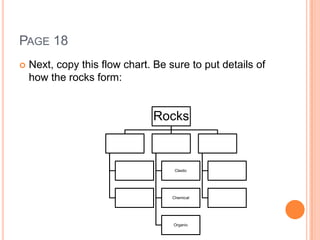
 Next, copy this flow chart. Be sure to put details of
how the rocks form:
Rocks
Clastic
Chemical
Organic
PAGE 18
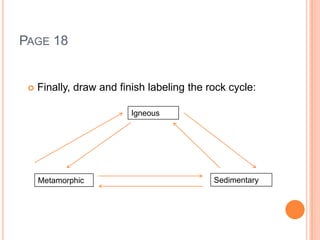
 Finally, draw and finish labeling the rock cycle:
Igneous
SedimentaryMetamorphic
REVIEW GAME
 For each question, confer with your group, and
write your answer on your white board.
 Be quiet or else you will give away answers!
 If you talk when Mrs. Wilson is talking, you will lose
points for your team.
QUESTION 1
 What type of rocks can igneous rocks change into
during the rock cycle?
ANSWER 1
 Igneous, sedimentary and metamorphic
QUESTION 2
 What is a rock generally made of?
ANSWER 2
 Minerals and other materials
QUESTION 3
 What will the texture of a rock look like if it has
cooled slowly from magma underground?
QUESTION 3
 Coarse, large, or medium grains
QUESTION 4
 What is the process called that glues sediment
together?
ANSWER 4
 Cementation
QUESTION 5
 Heat can change rocks into metamorphic rocks.
Where does the heat come from?
ANSWER 5
 Earth’s interior/core
QUESTION 6
 What does it mean if a metamorphic rock is
nonfoliated?
ANSWER 6
 The grains of the rock are arranged randomly
QUESTION 7
 True or false:
 Sandstone (sedimentary) changing into quartzite
(metamorphic) is an example of how sedimentary
rocks form.
ANSWER 7
 False
QUESTION 8
 What is the most common extrusive igneous rock?
ANSWER 8
 Basalt
QUESTION 9
 What are the five things a substance has to be in
order to be considered a mineral?
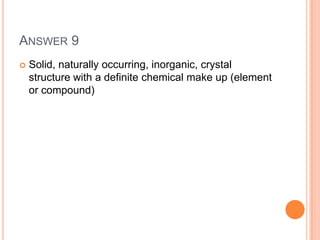
ANSWER 9
 Solid, naturally occurring, inorganic, crystal
structure with a definite chemical make up (element
or compound)
QUESTION 10
 If a rock cools quickly, what will its texture be like?
ANSWER 10
 Fine grained or glassy/smooth
QUESTION 11
 Where do most metamorphic rocks form?
ANSWER 11
 Deep underground
QUESTION 12
 The series of processes on the Earth and below the
Earth’s surface that slowly changes rock from one
kind to another is called what?
QUESTION 12
 The rock cycle
QUESTION 13
 What is the process where sediment settles out of
the wind or water carrying it and stops moving?
ANSWER 13
 Deposition
QUESTION 14
 What does weathering do?
ANSWER 14
 Breaks down rock into smaller pieces
QUESTION 15
 You visit a mine and find it has iron ore. What is an
ore?
ANSWER 15
 An economically useful mineral combined with rock
QUESTION 16
 What is the most abundant intrusive rock?
ANSWER 16
 Granite
QUESTION 17
 List three minerals you see in the classroom right
now and what items they make up.
ANSWER 17
 Answers will vary
QUESTION 18
 Why is ice in your freezer not a mineral but ice in
Antarctica is?
ANSWER 18
 In your freezer, it’s human made, in Antarctica, it is
naturally occurring
QUESTION 19
 Why is coal not a mineral?
ANSWER 19
 Because it is organic
QUESTION 20
 What does the “hardness” of a mineral describe?
ANSWER 20
 How easily scratched the mineral can be

Rocks Review 2013-2014