WEATHER
INTRODUCTION
This PowerPoint is designed to review different
types of fronts and severe weather. Please view
the PowerPoint in its entirety, as well as,
completing the activity and quizzes, and viewing
the simulation.
You may go back and review the PowerPoint at any
time.
This is intended to help you with your Chapter 24
test.
TABLE OF CONTENTS
Fronts
Activity: Predicting the Weather
Quiz: Fronts
Severe Weather
Simulation: How Cumulus Clouds Form
Quiz: Severe Weather
WEATHER
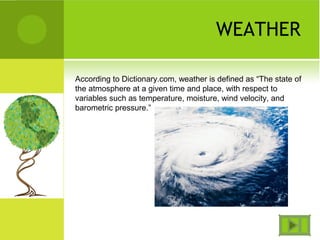
According to Dictionary.com, weather is defined as “The state of
the atmosphere at a given time and place, with respect to
variables such as temperature, moisture, wind velocity, and
barometric pressure.”
FRONTS
 Density differences keep two air masses separate
when they meet.
 One air mass must collide with another air mass.
 The kind of front that forms is determined by
how the air masses move in relationship to each
other.
TYPES OF FRONTS
 Cold Front - The front edge of a moving mass of
cold air that pushes beneath a warmer air mass
like a wedge.
 Warm Front – The front edge of advancing warm
air mass that replaces colder air with warmer air.
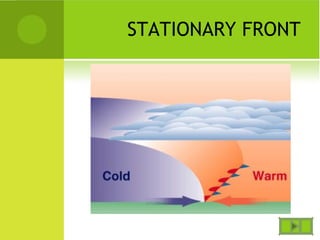
 Stationary Front – A front of air masses that
moves either very slowly or not at all.
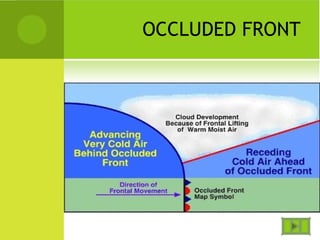
 Occluded Front – A front that forms when a cold
air mass overtakes a warm air mass and lifts the
warm air mass off the ground and over another
air mass.
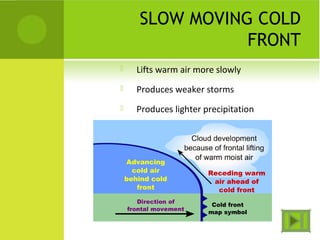
SLOW MOVING COLD
FRONT
 Lifts warm air more slowly
 Produces weaker storms
 Produces lighter precipitation
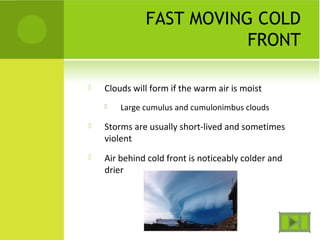
FAST MOVING COLD
FRONT
 Clouds will form if the warm air is moist
 Large cumulus and cumulonimbus clouds
 Storms are usually short-lived and sometimes
violent
 Air behind cold front is noticeably colder and
drier
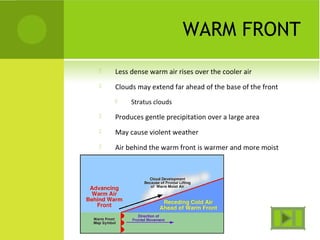
WARM FRONT
 Less dense warm air rises over the cooler air
 Clouds may extend far ahead of the base of the front
 Stratus clouds
 Produces gentle precipitation over a large area
 May cause violent weather
 Air behind the warm front is warmer and more moist
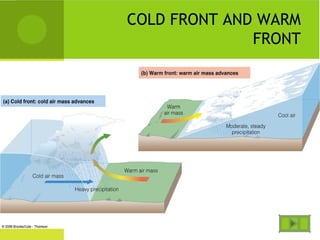
COLD FRONT AND WARM
FRONT
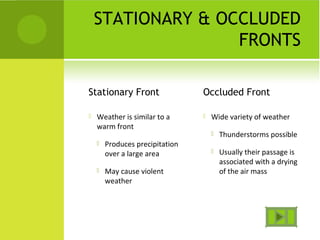
STATIONARY & OCCLUDED
FRONTS
Stationary Front
 Weather is similar to a
warm front
 Produces precipitation
over a large area
 May cause violent
weather
Occluded Front
 Wide variety of weather
 Thunderstorms possible
 Usually their passage is
associated with a drying
of the air mass
OCCLUDED FRONT
STATIONARY FRONT
PRACTICE PREDICTING
THE WEATHER
Predict the Weather
Directions:
1.) Click on the picture above
2.) Once the webpage is open, click on “Predict the Weather”
3.) Click on “Start Level 1”
4.) Once you are finished with level one, bring me your
computer so I can record your quiz score
5.) Repeat for Levels 2 & 3
QUIZ: FRONTS
CLICK ON THE CORRECT ANSWER
1.) What is most likely to occur when a mass of cold air
moves into a region occupied by warmer air?
A warm front will form, and there will be intense
precipitation.
The air masses will mix rapidly, forming an air mass of
intermediate temperature.
The boundary between the two air masses will be a zone
of intense high pressure.
A cold front will form, as warm air is forced upward.
All of the above.
QUIZ: FRONTS
Sorry!
Try Again.
QUIZ: FRONTS
GREAT
JOB!
QUIZ: FRONTS
CLICK ON THE CORRECT ANSWER
2.) A front that is characterized by stratus clouds, and
gentle precipitation for a long time is a(n)
_______________ front.
cold
stationary
warm
occluded
none of the above
QUIZ: FRONTS
Sorry!
Try Again.
QUIZ: FRONTS
Way to
Go!
QUIZ: FRONTS
CLICK ON THE CORRECT ANSWER
3.) Storms along a cold front are usually short-lived and
sometimes violent, while storms along a warm
front
are short-lived and weak.
produce precipitation over a large area, and are
sometimes violent.
are narrow, producing little rain and are always violent.
are long-lived, but always weak.
QUIZ: FRONTS
Sorry!
Try Again.
QUIZ: FRONTS
Excellent!
QUIZ: FRONTS
CLICK ON THE CORRECT ANSWER
4.) A front that forms when a cold air mass overtakes
a warm air mass and lifts the warm air mass off
the ground and over another air mass is called
a(n)
warm front.
stationary front.
occluded front.
cold front.
QUIZ: FRONTS
Sorry!
Try Again
QUIZ: FRONTS
Super!
SEVERE WEATHER
 Severe Weather – weather that may cause property
damage or loss of life.
 This type of weather causes billions in damage each year
 Sever Weather may include:
 Large quantities of rain
 Lightning
 Hail
 Strong Winds
 Tornadoes
THUNDERSTORMS
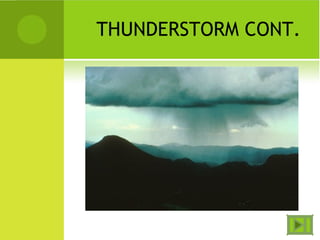
 Thunderstorm – a heavy storm that is accompanied by rain, thunder,
lightning, and strong winds.
 Thunderstorms develop in 3 stages
 Cumulus Stage – warm, moist air rises, and the water vapor within the air
condenses to form a cumulus cloud
 Mature Stage – condensation continues as the cloud rises and becomes a
dark cumulonimbus cloud
 Heavy, torrential rain and hailstones may fall
 Strong updrafts continue to rise, downdrafts form as air is dragged
downward by the falling precipitation
 Dissipating Stage – strong downdrafts stop air currents from rising
 Thunderstorm dissipates as the supply of water vapor decreases
THUNDERSTORM CONT.
LIGHTNING
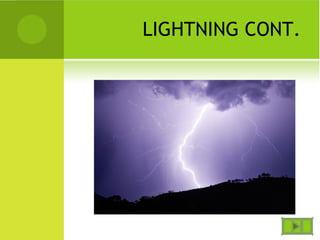
 When clouds discharge electricity
 Clouds must have areas that carry distinct electrical
charges
 Upper part of the cloud usually carries a positive
charge
 Lower part of the cloud mainly carries a negative
charge
 A huge spark travels within the cloud or between the
cloud and ground to equalize electrical charges
LIGHTNING CONT.
TORNADOES
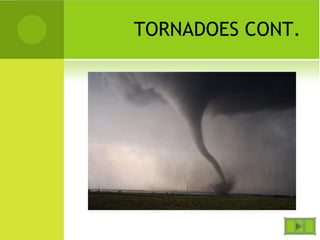
 Tornado – a destructive rotating column of air that has
very high wind speeds and that is visible as a funnel-
shaped cloud
 This is the most violent, and shortest-lived severe storm
 Forms when a thunderstorm meets high-altitude
horizontal winds
 Horizontal winds cause the rising air to rotate
 A storm cloud may develop a narrow, funnel-shaped,
rapidly spinning extension that reaches downward
TORNADOES CONT.
 Tunnel will move in a wandering, haphazard path if it
touches the ground
 Generally covers paths not more than 100 m wide
 Usually, everything in that path is destroyed
 Destructive power of a tornado is mainly due to the
speed of the winds in the funnel
 Winds may reach speeds of more than 400 km/h
 Most injuries and deaths caused by tornadoes occur
when people are trapped in collapsing buildings or are
struck by objects blown by the wind
TORNADOES CONT.
HURRICANES
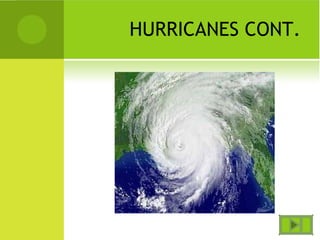
 Hurricane – a severe storm that develops over tropical
oceans and whose strong winds of more then 120 km/h
spiral in toward the intensely low-pressure storm center
 Warm, moist air over the ocean rises rapidly
 Fully developed hurricanes consist of a series of thick
cumulonimbus cloud bands that spiral upward around the
center of the storm
 Winds increase toward the center, or eye, of the storm
and reach speeds of up to 275 km/h along the eyewall
 The eye itself is a region of calm, clear, sinking air
HURRICANES CONT.
 About 700 km in diameter
 Most destructive storms that occur on Earth
 Most dangerous aspect is rising sea level and large waves, called a
storm surge
 Every hurricane is categorized on the Saffir-Simpson scale by using
several factors
 Central pressure
 Wind speed
 Storm surge
 Category 1 storms = least damage
 Category 5 storms = catastrophic damage
HURRICANES CONT.
HURRICANES CONT.
Click on the picture below to see how cumulus clouds form
QUIZ: SEVERE WEATHER
CLICK ON THE CORRECT ANSWER
1.) The eye of the hurricane is a region of
hailstorms.
torrential rainfall.
calm, clear air.
strong winds.
QUIZ: SEVERE WEATHER
Sorry!
Try Again
QUIZ: SEVERE WEATHER
Exceptional!
QUIZ: SEVERE WEATHER
CLICK ON THE CORRECT ANSWER
2.) In the mature stage of a thunderstorm, a cumulus
cloud grows until it becomes a
stratocumulus cloud.
altocumulus cloud.
cumulonimbus cloud.
cirrocumulus cloud.
QUIZ: SEVERE WEATHER
Sorry!
Try Again
QUIZ: SEVERE WEATHER
Out of Sight!
QUIZ: SEVERE WEATHER
CLICK ON THE CORRECT ANSWER
3.) What type of path does a tornado take if it
touches down?
haphazard
extremely wide
straight
predictable
QUIZ: SEVERE WEATHER
Sorry!
Try Again
QUIZ: SEVERE WEATHER
Sensational!
QUIZ: SEVERE WEATHER
CLICK ON THE CORRECT ANSWER
4.) Lightning is caused by
heavy precipitation.
electrical differences within clouds or between the
ground and a cloud.
thunder.
strong winds.
QUIZ: SEVERE WEATHER
Sorry!
Try Again
QUIZ: SEVERE WEATHER
Stupendous!
REFERENCES
Allison, M. A., DeGaetano, A. T., Pasachoff, J. A. (2008). Earth Science. Holt, Rinehart and
Winston.
Bell, J., Prawat, R., et. al. A realist-constructivist approach to weather. (23 Feb., 2005). Retrieved
April 19, 2010 from http://www.mltoolbox.org/wx/
Dictionary.com. (2010). Retrieved April 17, 2010 from
http://dictionary.reference.com/browse/weather
Freedom Communications, Inc. “Occluded front.” Image. (2010). Retrieved April 19, 2010 from
http://www.cbs6albany.com/images/research/Occluded_Schematic.JPG
Geography for kids, the study of our earth. “Stationary front.” Image. (1998). Retrieved April 20,
2010 from http://www.kidsgeo.com/images/stationary-front_sm.jpg
“Hurricane.” Image. Retrieved April 19, 2010 from
http://blog.lib.umn.edu/olso4158/architecture/katrina-hurricane-pic3%5B1%5D.jpg
Impact Lab. “Tornadoes.” Image. (8 April 2009). Retrieved April 20, 2010 from
http://www.impactlab.com/wp-content/uploads/2009/04/tornado.JPG
Mudra, P. “Squall line.” Image. (2010). Retrieved April 20, 2010 from
http://www.bom.gov.au/weather/wa/sevwx/sevtspd.jpg
REFERENCES CONT.
Short, N. M. “Warm front.” Image. (2010). Retrieved April 19, 2010 from
http://www.fas.org/irp/imint/docs/rst/Sect14/warmfront.jpg
UCAR Communications. “Thunderstorm.” Image. 2002. Retrieved April 19, 2010 from
http://www.ucar.edu/communications/newsreleases/2002/thunderstorm.jpg
Van Dam, J. “Lightning.” Image. (2 June 2008). Retrieved April 20, 2010 from
http://www.myscience.nl/wp-content/gallery/lightning/800px-
lightning_strike_jan_2007.jpg
“Warm and cold front.” Image. (2006). Retrieved April 19, 2010 from
http://www.suu.edu/faculty/colberg/Hazards/Weather/fronts1.jpg
Wheatley, G. EdHeads. (2000). Retrieved April 19, 2010 from http://www.edheads.org/
Wikipedia. (2 April 2008). Retrieved April 20, 2010 from
http://en.wikipedia.org/wiki/Weather_front
Wikipedia. “Cold front.” Image. (2 April 2008). Retrieved April 20, 2010 from
http://en.wikipedia.org/wiki/File:Example_of_a_cold_front.svg

Weather

  • 1.
    WEATHER INTRODUCTION This PowerPoint isdesigned to review different types of fronts and severe weather. Please view the PowerPoint in its entirety, as well as, completing the activity and quizzes, and viewing the simulation. You may go back and review the PowerPoint at any time. This is intended to help you with your Chapter 24 test.
  • 2.
    TABLE OF CONTENTS Fronts Activity:Predicting the Weather Quiz: Fronts Severe Weather Simulation: How Cumulus Clouds Form Quiz: Severe Weather
  • 3.
    WEATHER According to Dictionary.com,weather is defined as “The state of the atmosphere at a given time and place, with respect to variables such as temperature, moisture, wind velocity, and barometric pressure.”
  • 4.
    FRONTS  Density differenceskeep two air masses separate when they meet.  One air mass must collide with another air mass.  The kind of front that forms is determined by how the air masses move in relationship to each other.

  • 5.
    TYPES OF FRONTS Cold Front - The front edge of a moving mass of cold air that pushes beneath a warmer air mass like a wedge.  Warm Front – The front edge of advancing warm air mass that replaces colder air with warmer air.  Stationary Front – A front of air masses that moves either very slowly or not at all.  Occluded Front – A front that forms when a cold air mass overtakes a warm air mass and lifts the warm air mass off the ground and over another air mass.
  • 6.
    SLOW MOVING COLD FRONT Lifts warm air more slowly  Produces weaker storms  Produces lighter precipitation
  • 7.
    FAST MOVING COLD FRONT Clouds will form if the warm air is moist  Large cumulus and cumulonimbus clouds  Storms are usually short-lived and sometimes violent  Air behind cold front is noticeably colder and drier
  • 8.
    WARM FRONT  Lessdense warm air rises over the cooler air  Clouds may extend far ahead of the base of the front  Stratus clouds  Produces gentle precipitation over a large area  May cause violent weather  Air behind the warm front is warmer and more moist
  • 9.
    COLD FRONT ANDWARM FRONT
  • 10.
    STATIONARY & OCCLUDED FRONTS StationaryFront  Weather is similar to a warm front  Produces precipitation over a large area  May cause violent weather Occluded Front  Wide variety of weather  Thunderstorms possible  Usually their passage is associated with a drying of the air mass
  • 11.
  • 12.
  • 13.
    PRACTICE PREDICTING THE WEATHER Predictthe Weather Directions: 1.) Click on the picture above 2.) Once the webpage is open, click on “Predict the Weather” 3.) Click on “Start Level 1” 4.) Once you are finished with level one, bring me your computer so I can record your quiz score 5.) Repeat for Levels 2 & 3
  • 14.
    QUIZ: FRONTS CLICK ONTHE CORRECT ANSWER 1.) What is most likely to occur when a mass of cold air moves into a region occupied by warmer air? A warm front will form, and there will be intense precipitation. The air masses will mix rapidly, forming an air mass of intermediate temperature. The boundary between the two air masses will be a zone of intense high pressure. A cold front will form, as warm air is forced upward. All of the above.
  • 15.
  • 16.
  • 17.
    QUIZ: FRONTS CLICK ONTHE CORRECT ANSWER 2.) A front that is characterized by stratus clouds, and gentle precipitation for a long time is a(n) _______________ front. cold stationary warm occluded none of the above
  • 18.
  • 19.
  • 20.
    QUIZ: FRONTS CLICK ONTHE CORRECT ANSWER 3.) Storms along a cold front are usually short-lived and sometimes violent, while storms along a warm front are short-lived and weak. produce precipitation over a large area, and are sometimes violent. are narrow, producing little rain and are always violent. are long-lived, but always weak.
  • 21.
  • 22.
  • 23.
    QUIZ: FRONTS CLICK ONTHE CORRECT ANSWER 4.) A front that forms when a cold air mass overtakes a warm air mass and lifts the warm air mass off the ground and over another air mass is called a(n) warm front. stationary front. occluded front. cold front.
  • 24.
  • 25.
  • 26.
    SEVERE WEATHER  SevereWeather – weather that may cause property damage or loss of life.  This type of weather causes billions in damage each year  Sever Weather may include:  Large quantities of rain  Lightning  Hail  Strong Winds  Tornadoes
  • 27.
    THUNDERSTORMS  Thunderstorm –a heavy storm that is accompanied by rain, thunder, lightning, and strong winds.  Thunderstorms develop in 3 stages  Cumulus Stage – warm, moist air rises, and the water vapor within the air condenses to form a cumulus cloud  Mature Stage – condensation continues as the cloud rises and becomes a dark cumulonimbus cloud  Heavy, torrential rain and hailstones may fall  Strong updrafts continue to rise, downdrafts form as air is dragged downward by the falling precipitation  Dissipating Stage – strong downdrafts stop air currents from rising  Thunderstorm dissipates as the supply of water vapor decreases
  • 28.
  • 29.
    LIGHTNING  When cloudsdischarge electricity  Clouds must have areas that carry distinct electrical charges  Upper part of the cloud usually carries a positive charge  Lower part of the cloud mainly carries a negative charge  A huge spark travels within the cloud or between the cloud and ground to equalize electrical charges
  • 30.
  • 31.
    TORNADOES  Tornado –a destructive rotating column of air that has very high wind speeds and that is visible as a funnel- shaped cloud  This is the most violent, and shortest-lived severe storm  Forms when a thunderstorm meets high-altitude horizontal winds  Horizontal winds cause the rising air to rotate  A storm cloud may develop a narrow, funnel-shaped, rapidly spinning extension that reaches downward
  • 32.
    TORNADOES CONT.  Tunnelwill move in a wandering, haphazard path if it touches the ground  Generally covers paths not more than 100 m wide  Usually, everything in that path is destroyed  Destructive power of a tornado is mainly due to the speed of the winds in the funnel  Winds may reach speeds of more than 400 km/h  Most injuries and deaths caused by tornadoes occur when people are trapped in collapsing buildings or are struck by objects blown by the wind
  • 33.
  • 34.
    HURRICANES  Hurricane –a severe storm that develops over tropical oceans and whose strong winds of more then 120 km/h spiral in toward the intensely low-pressure storm center  Warm, moist air over the ocean rises rapidly  Fully developed hurricanes consist of a series of thick cumulonimbus cloud bands that spiral upward around the center of the storm  Winds increase toward the center, or eye, of the storm and reach speeds of up to 275 km/h along the eyewall  The eye itself is a region of calm, clear, sinking air
  • 35.
    HURRICANES CONT.  About700 km in diameter  Most destructive storms that occur on Earth  Most dangerous aspect is rising sea level and large waves, called a storm surge  Every hurricane is categorized on the Saffir-Simpson scale by using several factors  Central pressure  Wind speed  Storm surge  Category 1 storms = least damage  Category 5 storms = catastrophic damage
  • 36.
  • 37.
    HURRICANES CONT. Click onthe picture below to see how cumulus clouds form
  • 38.
    QUIZ: SEVERE WEATHER CLICKON THE CORRECT ANSWER 1.) The eye of the hurricane is a region of hailstorms. torrential rainfall. calm, clear air. strong winds.
  • 39.
  • 40.
  • 41.
    QUIZ: SEVERE WEATHER CLICKON THE CORRECT ANSWER 2.) In the mature stage of a thunderstorm, a cumulus cloud grows until it becomes a stratocumulus cloud. altocumulus cloud. cumulonimbus cloud. cirrocumulus cloud.
  • 42.
  • 43.
  • 44.
    QUIZ: SEVERE WEATHER CLICKON THE CORRECT ANSWER 3.) What type of path does a tornado take if it touches down? haphazard extremely wide straight predictable
  • 45.
  • 46.
  • 47.
    QUIZ: SEVERE WEATHER CLICKON THE CORRECT ANSWER 4.) Lightning is caused by heavy precipitation. electrical differences within clouds or between the ground and a cloud. thunder. strong winds.
  • 48.
  • 49.
  • 50.
    REFERENCES Allison, M. A.,DeGaetano, A. T., Pasachoff, J. A. (2008). Earth Science. Holt, Rinehart and Winston. Bell, J., Prawat, R., et. al. A realist-constructivist approach to weather. (23 Feb., 2005). Retrieved April 19, 2010 from http://www.mltoolbox.org/wx/ Dictionary.com. (2010). Retrieved April 17, 2010 from http://dictionary.reference.com/browse/weather Freedom Communications, Inc. “Occluded front.” Image. (2010). Retrieved April 19, 2010 from http://www.cbs6albany.com/images/research/Occluded_Schematic.JPG Geography for kids, the study of our earth. “Stationary front.” Image. (1998). Retrieved April 20, 2010 from http://www.kidsgeo.com/images/stationary-front_sm.jpg “Hurricane.” Image. Retrieved April 19, 2010 from http://blog.lib.umn.edu/olso4158/architecture/katrina-hurricane-pic3%5B1%5D.jpg Impact Lab. “Tornadoes.” Image. (8 April 2009). Retrieved April 20, 2010 from http://www.impactlab.com/wp-content/uploads/2009/04/tornado.JPG Mudra, P. “Squall line.” Image. (2010). Retrieved April 20, 2010 from http://www.bom.gov.au/weather/wa/sevwx/sevtspd.jpg
  • 51.
    REFERENCES CONT. Short, N.M. “Warm front.” Image. (2010). Retrieved April 19, 2010 from http://www.fas.org/irp/imint/docs/rst/Sect14/warmfront.jpg UCAR Communications. “Thunderstorm.” Image. 2002. Retrieved April 19, 2010 from http://www.ucar.edu/communications/newsreleases/2002/thunderstorm.jpg Van Dam, J. “Lightning.” Image. (2 June 2008). Retrieved April 20, 2010 from http://www.myscience.nl/wp-content/gallery/lightning/800px- lightning_strike_jan_2007.jpg “Warm and cold front.” Image. (2006). Retrieved April 19, 2010 from http://www.suu.edu/faculty/colberg/Hazards/Weather/fronts1.jpg Wheatley, G. EdHeads. (2000). Retrieved April 19, 2010 from http://www.edheads.org/ Wikipedia. (2 April 2008). Retrieved April 20, 2010 from http://en.wikipedia.org/wiki/Weather_front Wikipedia. “Cold front.” Image. (2 April 2008). Retrieved April 20, 2010 from http://en.wikipedia.org/wiki/File:Example_of_a_cold_front.svg