Minerals Review
Write your answer on your white
board.
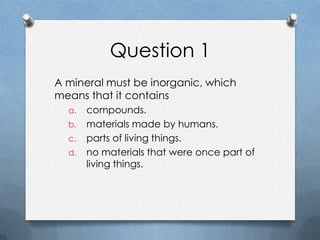
Question 1
A mineral must be inorganic, which
means that it contains
a. compounds.
b. materials made by humans.
c. parts of living things.
d. no materials that were once part of
living things.
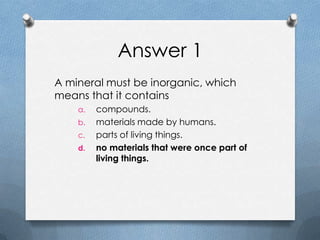
Answer 1
A mineral must be inorganic, which
means that it contains
a. compounds.
b. materials made by humans.
c. parts of living things.
d. no materials that were once part of
living things.
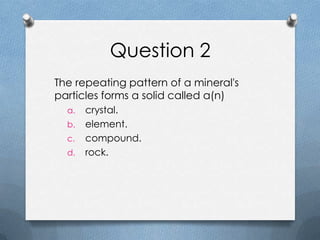
Question 2
The repeating pattern of a mineral's
particles forms a solid called a(n)
a. crystal.
b. element.
c. compound.
d. rock.
Answer 2
The repeating pattern of a mineral's
particles forms a solid called a(n)
a. crystal.
b. element.
c. compound.
d. rock.
Question 3
What is the hardest known mineral?
a. talc
b. quartz
c. diamond
d. gold
Answer 3
What is the hardest known mineral?
a. talc
b. quartz
c. diamond
d. gold
Question 4
The color of a mineral's powder is called
its
a. streak.
b. luster.
c. density.
d. hardness.
Answer 4
The color of a mineral's powder is called
its
a. streak.
b. luster.
c. density.
d. hardness.
Question 5
Minerals can form deep inside Earth's
crust by
a. cleavage and fracture.
b. friction along faults.
c. crystallization of melted materials.
d. evaporation of ancient seas.
Answer 5
Minerals can form deep inside Earth's
crust by
a. cleavage and fracture.
b. friction along faults.
c. crystallization of melted materials.
d. evaporation of ancient seas.
Question 6
Magma that cools very slowly deep
beneath the surface forms minerals with
what type of crystals?
a. small
b. large
c. very hard
d. cubic
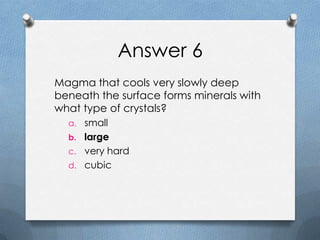
Answer 6
Magma that cools very slowly deep
beneath the surface forms minerals with
what type of crystals?
a. small
b. large
c. very hard
d. cubic
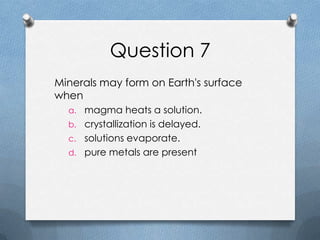
Question 7
Minerals may form on Earth's surface
when
a. magma heats a solution.
b. crystallization is delayed.
c. solutions evaporate.
d. pure metals are present
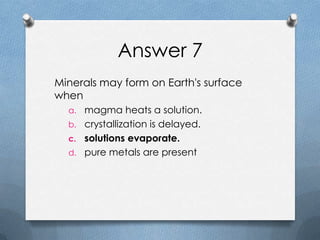
Answer 7
Minerals may form on Earth's surface
when
a. magma heats a solution.
b. crystallization is delayed.
c. solutions evaporate.
d. pure metals are present
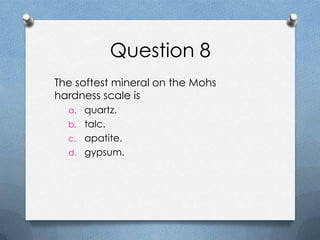
Question 8
The softest mineral on the Mohs
hardness scale is
a. quartz.
b. talc.
c. apatite.
d. gypsum.
Answer 8
The softest mineral on the Mohs
hardness scale is
a. quartz.
b. talc.
c. apatite.
d. gypsum.
Question 9
Although cement, brick, steel, and glass
all come from substances found in
Earth's crust, they are NOT classified as
minerals because
a. they are organic.
b. they are not naturally occurring.
c. they are too hard.
d. they have many uses.
Answer 9
Although cement, brick, steel, and glass
all come from substances found in
Earth's crust, they are NOT classified as
minerals because
a. they are organic.
b. they are not naturally occurring.
c. they are too hard.
d. they have many uses.
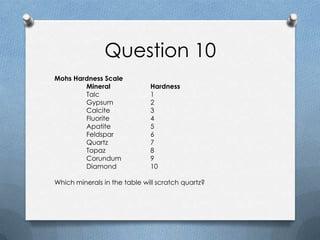
Question 10
Mohs Hardness Scale
Mineral Hardness
Talc 1
Gypsum 2
Calcite 3
Fluorite 4
Apatite 5
Feldspar 6
Quartz 7
Topaz 8
Corundum 9
Diamond 10
Which minerals in the table will scratch quartz?
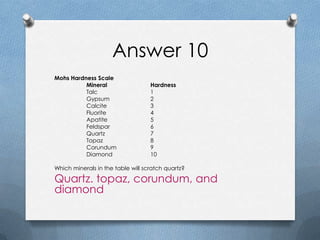
Answer 10
Mohs Hardness Scale
Mineral Hardness
Talc 1
Gypsum 2
Calcite 3
Fluorite 4
Apatite 5
Feldspar 6
Quartz 7
Topaz 8
Corundum 9
Diamond 10
Which minerals in the table will scratch quartz?
Quartz. topaz, corundum, and
diamond

Minerals Review

  • 1.
    Minerals Review Write youranswer on your white board.
  • 2.
    Question 1 A mineralmust be inorganic, which means that it contains a. compounds. b. materials made by humans. c. parts of living things. d. no materials that were once part of living things.
  • 3.
    Answer 1 A mineralmust be inorganic, which means that it contains a. compounds. b. materials made by humans. c. parts of living things. d. no materials that were once part of living things.
  • 4.
    Question 2 The repeatingpattern of a mineral's particles forms a solid called a(n) a. crystal. b. element. c. compound. d. rock.
  • 5.
    Answer 2 The repeatingpattern of a mineral's particles forms a solid called a(n) a. crystal. b. element. c. compound. d. rock.
  • 6.
    Question 3 What isthe hardest known mineral? a. talc b. quartz c. diamond d. gold
  • 7.
    Answer 3 What isthe hardest known mineral? a. talc b. quartz c. diamond d. gold
  • 8.
    Question 4 The colorof a mineral's powder is called its a. streak. b. luster. c. density. d. hardness.
  • 9.
    Answer 4 The colorof a mineral's powder is called its a. streak. b. luster. c. density. d. hardness.
  • 10.
    Question 5 Minerals canform deep inside Earth's crust by a. cleavage and fracture. b. friction along faults. c. crystallization of melted materials. d. evaporation of ancient seas.
  • 11.
    Answer 5 Minerals canform deep inside Earth's crust by a. cleavage and fracture. b. friction along faults. c. crystallization of melted materials. d. evaporation of ancient seas.
  • 12.
    Question 6 Magma thatcools very slowly deep beneath the surface forms minerals with what type of crystals? a. small b. large c. very hard d. cubic
  • 13.
    Answer 6 Magma thatcools very slowly deep beneath the surface forms minerals with what type of crystals? a. small b. large c. very hard d. cubic
  • 14.
    Question 7 Minerals mayform on Earth's surface when a. magma heats a solution. b. crystallization is delayed. c. solutions evaporate. d. pure metals are present
  • 15.
    Answer 7 Minerals mayform on Earth's surface when a. magma heats a solution. b. crystallization is delayed. c. solutions evaporate. d. pure metals are present
  • 16.
    Question 8 The softestmineral on the Mohs hardness scale is a. quartz. b. talc. c. apatite. d. gypsum.
  • 17.
    Answer 8 The softestmineral on the Mohs hardness scale is a. quartz. b. talc. c. apatite. d. gypsum.
  • 18.
    Question 9 Although cement,brick, steel, and glass all come from substances found in Earth's crust, they are NOT classified as minerals because a. they are organic. b. they are not naturally occurring. c. they are too hard. d. they have many uses.
  • 19.
    Answer 9 Although cement,brick, steel, and glass all come from substances found in Earth's crust, they are NOT classified as minerals because a. they are organic. b. they are not naturally occurring. c. they are too hard. d. they have many uses.
  • 20.
    Question 10 Mohs HardnessScale Mineral Hardness Talc 1 Gypsum 2 Calcite 3 Fluorite 4 Apatite 5 Feldspar 6 Quartz 7 Topaz 8 Corundum 9 Diamond 10 Which minerals in the table will scratch quartz?
  • 21.
    Answer 10 Mohs HardnessScale Mineral Hardness Talc 1 Gypsum 2 Calcite 3 Fluorite 4 Apatite 5 Feldspar 6 Quartz 7 Topaz 8 Corundum 9 Diamond 10 Which minerals in the table will scratch quartz? Quartz. topaz, corundum, and diamond