Title Page Photo “ Sunshine is delicious, rain is refreshing, wind braces us up, snow is exhilarating; there is really no such thing as bad weather, only different kinds of good weather.”— John Ruskin (Brainyquote.com)
Chapter Seven Vocabulary air mass  (p. 179) cold front  (p. 183) easterly wave  (p. 191) eye (of a hurricane)  (p. 195) eye wall  (p. 195) front  (p. 182) Fujita tornado intensity scale  (p. 204) funnel cloud  (p. 204) hurricane  (p. 193) lightning  (p. 201) mesocyclone  (p. 207) midlatitude anticyclone  (p. 191) midlatitude cyclone  (p. 185) occluded front  (p. 188) occlusion  (p. 188) Saffir-Simpson Hurricane Scale (p. 198) stationary front  (p. 185) storm surge  (p. 198) thunder  (p. 203) thunderstorm  (p. 200) tornado  (p. 204) tropical cyclone  (p. 193) tropical depression  (p. 193) tropical storm  (p. 193) warm front  (p. 183) waterspout  (p. 207) wind shear  (p. 195)
The Impact of Storms on the Landscape Storms are phenomena that are more limited than the broad-scale wind and pressure systems.  They are transient and temporary. Storms involve the flow of air masses as well as a variety of atmospheric disturbances.
The Impact of Storms on the Landscape They have short-run and long-run impacts.  In some parts of world, have major influence on weather, some on climate. Long-run includes both positive and negative impacts on landscape. Positive: promote diversity in vegetative cover, increase size of lakes and ponds, and stimulate plant growth
Air Masses Air mass —a large parcel of air that has relatively uniform properties in the horizontal dimension and moves as an entity. Such extensive bodies are distinct from one another and compose the troposphere. Fig. 7-1
Air Masses Characteristics  Air mass must meet three requirements: Must be large (horizontal and vertical). Horizontal dimension must have uniform properties (temperature, humidity, and stability). Must be distinct from surrounding air, and when moves, must retain that distinction (not be torn apart).
Air Masses Origin Formation occurs if air remains over a uniform land or sea surface long enough to acquire uniform properties. S ource regions —parts of Earth’s surface that are particularly suited to generate air masses because they are Extensive Physically uniform Associated with air that is stationary or anticyclonic.
Air Masses Classification Because source region determines properties of air masses, it is the basis for classifying them.  Use a one- or two-letter code. Table 7–1 provides a simplified classification of air masses, along with the properties associated with each.
Classification Letter System c = continental (dry air) m = maritime (moist air) First Letter – Humidity indicator Land or water Second Letter (capitalized) –  Temperature indicator Latitude E = 0 º    10º Equatorial  T =  10º    35º  Tropical P =  55º    70º  Polar A =  70º    90º  Arctic / Antarctic * Middle latitudes (35º    55º) not a major source region
Types E  –  Equatorial mT – maritime Tropical cT – continental Tropical mP – maritime Polar cP – continental Polar A  –   Arctic / Antarctic
Air Masses Movement and Modification Some air masses remain in source region indefinitely. Movement prompts structural change: Thermal modification—heating or cooling from below; Dynamic modification—uplift, subsidence, convergence, turbulence; Moisture modification—addition or subtraction of moisture. Moving air mass modifies the weather of region it moves through.
Air Masses North American Air Masses Physical geography of U.S. landscape plays a critical role in air-mass interaction. No east–west mountains to block polar and tropical air flows, so they affect U.S. weather/climate. North–south mountain ranges in west modify the movement, therefore the characteristics, of Pacific air masses. North American Air Masses cA and cP mP mT cT
Air Masses North American Air Masses (con’t) Maritime tropical (mT) air from the Atlantic, Caribbean/Gulf of Mexico strongly influences climate east of the Rockies in the United States, southern Canada, and much of Mexico.  Primary source of precipitation. Also brings periods of uncomfortable humid heat in summer.
Air Masses North American Air Masses (con’t) Continental tropical (cT) air has insignificant influence on North America, except for bringing occasional heat waves and drought conditions to the southern Great Plains. Equatorial (E) air affects North America only through hurricanes.
Fronts Front —a zone of discontinuity between unlike air masses where properties of air change rapidly. It’s narrow but three-dimensional. Typically several kilometers wide (even tens of kilometers wide). Functions as a barrier between two air masses, preventing their mingling except in this narrow transition zone.
Fronts Fronts (con’t) Though all primary physical properties are involved in a front, temperature provides the most conspicuous difference. Fronts lean, which allows air masses to be uplifted and adiabatic cooling to take place. Lean so much, closer to horizontal than vertical. Always slopes so that warmer air overlies cooler air. Fronts move in association with the direction of the more active air mass, which displaces the less active.
Fronts Warm Fronts Warm Front —the leading edge of an advancing warm air mass. Brings warm air. Results in clouds and precipitation, usually broad, protracted, and gentle, without much convective activity. Unstable rising air can result in showery and even violent precipitation. Weather maps show ground-level position of warm front; precipitation usually falls ahead of this position.
Fronts Cold Fronts Cold Front —the leading edge of a cool air mass actively displacing warm air mass. Brings cold air. Leads to rapid lifting of warm air, which makes it unstable and thus results in blustery and violent weather along cold front. Weather maps show ground-level position of cold front (usually has a protruding “nose”); clouds and precipitation tend to be concentrated along and immediately behind the ground-level position.
Fronts Stationary Fronts Stationary Front —the common “boundary” between two air masses in a situation in which neither air mass displaces the other. Occluded Front Occluded Front —a complex front formed when a cold front overtakes a warm front.
Atmospheric Disturbances Two types of disturbances: stormy and calm. Both types have common characteristics: Smaller than components of general circulation, but extremely variable in size; Migratory and transient; Relatively brief in duration; Produce characteristic and relatively predictable weather conditions  Source: NOAA Photo Library http://www.photolib.noaa.gov/collections.html
Atmospheric Disturbances Midlatitude Disturbances Many kinds of atmospheric disturbances are associated with midlatitudes, which are principal battleground for tropospheric phenomena. Midlatitude cyclones and midlatitude anticyclones are more significant because of size and prevalence. August 7, 2005 Source: http://www.nnvl.noaa.gov/ Middle Latitudes (35º    55º) Battleground between tropical and polar air masses
Atmospheric Disturbances Tropical Disturbances Low latitudes are characterized by monotony of weather with the same consistent weather.  The only breaks in this pattern are provided by transient disturbances such as hurricanes. Katrina August 28, 2005 Source: NOAA, http://www.nnvl.noaa.gov/
Atmospheric Disturbances Localized Severe Weather Occur in many parts of the world. Constitute short-lived but severe weather phenomena such as thunderstorms and tornadoes. Thunderstorms and Tornadoes
Midlatitude Cyclones Midlatitude cyclone —large migratory low-pressure system that occurs within the middle latitudes and moves generally with the westerlies; also called lows or wave cyclones, depressions.  Probably most significant of all atmospheric disturbances. Basically responsible for most day-to-day weather changes. Bring precipitation to much of the world’s populated regions.
Midlatitude Cyclones Characteristics Typical mature midlatitude cycle is 1,600 kilometers (1,000 miles) in diameter; has oval shape. Patterns of isobars, fronts, and wind flow in Southern Hemisphere are mirror images of those in Northern Hemisphere. In Northern Hemisphere:  Circulation pattern converges counterclockwise; Wind-flow pattern attracts cool air from north and warm air from south; creates two fronts.
Midlatitude Cyclones These two fronts divide the cyclone into a cool sector north and west of center and a warm sector south and east. Size of sectors varies with location: on ground, cool sector is larger, but in atmosphere, warm sector is more extensive. Warm air rises along both fronts, causing cloudiness and precipitation, which follows patterns of cold and warm fronts. Much of cool sector is typified by clear, cold, stable air, while air of warm sector is often moist and tending toward instability, so may have sporadic thunderstorms. May have squall fronts of intense thunderstorms.
Midlatitude Cyclones Weather Changes with a Passing Front With a passage of a cold front, the following changes typically occur: The temperature decreases sharply. Winds shift from southerly ahead of the front to northwesterly following it (in the Northern Hemisphere) The pressure falls as the front approaches and then rises after it passes. Generally clear skies are replaced by cloudiness and precipitation at the front.
Movements Midlatitude cyclones move throughout their existence.
Midlatitude Anticyclones An extensive migratory high-pressure cell of the midlatitudes that moves generally with the westerlies. Characteristics Typically larger than a midlatitude cyclone, but also moves west to east. Travels at same rate, or little slower, than midlatitude cyclone. Is prone to stagnate or remain over same region (while cyclones do not). Can cause concentration of air pollutants.
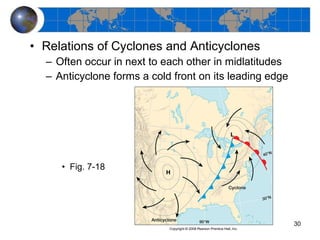
Fig. 7-18 Relations of Cyclones and Anticyclones Often occur in next to each other in midlatitudes Anticyclone forms a cold front on its leading edge
Major Tropical Disturbances: Hurricanes Tropical cyclone —a storm most significantly affecting the tropics and subtropics, which is intense, revolving, rain-drenched, migratory, destructive, and erratic. Such a storm system consists of a prominent low-pressure center that is essentially circular in shape and has a steep pressure gradient outward from the center. Tropical cyclones provide the only break in weather in low latitudes. Also called  Hurricanes  in North and Central America Typhoons  in western North Pacific Baguios  in Philippines Tropical cyclones  in Indian Ocean and Australia
Fig. 7-20 Hurricane Katrina, August 29, 2005
Major Tropical Disturbances: Hurricanes Having diameters of between 160 and 1000 kilometers, tropical cyclones are smaller than midlatitude cyclones. Three categories of tropical cyclones: Tropical depression—winds of 33 knots (61 kilometers or 38 miles) per hour or less. Tropical storm—winds between 34 and 63 knots ([63 and 117 kilometers] or [39 and 73 miles]) per hour. Hurricane—winds of 64 knots (119 kilometers or 74 miles) per hour or more; can double and even triple that minimum.
Major Tropical Disturbances: Hurricanes Characteristics The hurricane pulls in warm, moist air for fuel, and this air rises and cools adiabatically. This causes condensation and this in turn releases heat, which further increases the instability of the air.
Major Tropical Disturbances: Hurricanes Eye of a Hurricane Eye —the nonstormy center of a tropical cyclone, which has a diameter of 16 to 40 kilometers (10 to 25 miles). In the eye, there are no updrafts, but instead a downdraft that inhibits cloud formation. Eye wall —peripheral zone at the edge of the eye where winds reach their highest speed and where updrafts are most prominent. Weather pattern within a hurricane is symmetrical. Comprised of bands of dense cumulus and cumulonimbus clouds called  spiral rain bands . Eyewall replacement —the process in which a new wall of storms surrounds the wall of storms circling the hurricane’s eye. When this occurs, the inner wall disintegrates so the new wall replaces it. This process tends to weaken the storm
Major Tropical Disturbances: Hurricanes Origin Form only over warm oceans and where there is no significant  wind shear . Coriolis effect plays key role: it’s at minimum at equator, and no hurricane has been observed to form within 3˚ of equator or cross over it.  Rare to have hurricane closer than 8˚ to 10˚ of equator. The exact mechanism of formation is not clear, but they always grow from some preexisting disturbance
Major Tropical Disturbances: Hurricanes Movement Most common in North Pacific basin (origination in Philippines and west of southern Mexico and Central America): West central portion of the North Atlantic basin, extending into Caribbean and Gulf of Mexico is third in prevalence. Totally absent from the South Atlantic and from the southeastern part of the Pacific. Absent apparently because the water is too cold and because high pressure dominates.
Major Tropical Disturbances: Hurricanes General pattern of movement is highly predictable: About one-third travel east to west without much latitudinal change. About two-thirds start off on an east–west path and then curve poleward. Exception occurs in southwestern Pacific Ocean north and northeast of New Zealand, where general circulation pattern steers hurricanes, so they travel west to east. Average hurricane lasts a week; those that remain over tropical oceans can live up to 4 weeks. Dies down over continents because energy source of warm, moist air is cut off. Dies down in midlatitudes because cooler environment.  In midlatitudes, can diminish in intensity but grow in size and become a midlatitude cyclone.
Major Tropical Disturbances: Hurricanes Damage and Destruction High seas, or  storm surge  cause the most damage. Storm size is key to how much damage is caused, then physical configuration of landscape and population size and density of affected area. Saffir-Simpson Hurricane Scale has been established to rank the intensity of hurricanes. Ranges from 1 to 5, with 5 being the most severe
Saffir-Simpson Hurricane Scale
Source Areas
Pattern of Movement
Fig. 7-27 Greatest disasters Galveston, TX (1900) Ganges-Brahmaputra delta U.S. Gulf Coast (Katrina, 2005)
Fig. 7-C Hurricanes and Global Warming Number of hurricanes increasing
Table 7-A Intensity of hurricanes increasing
Fig. 7-D, Hurricane Wilma (Oct. 20, 2005) Hurricane Wilma, strongest North Atlantic-Caribbean hurricane on record
Localized Severe Weather Fig. 7-31 Occur on a more localized scale than do tropical and midlatitude cyclones and anticyclones.
Thunderstorms Thunderstorm —violent convective storm accompanied by thunder and lightning; usually localized and short lived. Vertical air motion, considerable humidity, and instability combine to create towering cumulonimbus clouds, so thunderstorms are always associated with this combination. Frequently occur in conjunction with other kinds of storms (hurricanes, tornadoes, fronts [especially cold fronts]) in midlatitude cyclones, and orographic lifting. Associated with other mechanisms that can trigger unstable uplift.
Thunderstorms Mechanism triggers uplift of warm, moist air. Cumulus stage—updrafts prevail and clouds grow. Rise to above freezing level, where supercooled water droplets and ice crystals coalesce, then fall. Initiate a downdraft. Mature state—updrafts and downdrafts coexist as cloud continues to enlarge (but precipitation is leaving bottom of cloud). Most active time. Dissipating state—downdrafts dominate, and turbulence ceases. Virtually unknown poleward of 60˚ of latitude.
Fig. 7-28 Sequential Development
Fig. 7-29 Frequency by latitude (per year)
Fig. 7-30 Frequency of hailstorms in the United States (per year)
Lightning More than 8.5 million lightning bolts daily in world. Most frequently, lightning occurs as exchanges between adjacent clouds or between the upper and lower portions of the same cloud; it also occurs as an electrical connection of ionized air from cloud to ground. The sequence that leads to lightning discharge is known, but the mechanism for electrification is not.
Lightning Sequence: Large cumulonimbus cloud experiences a separation of electrical charges. Positively charged particles are mostly high in cloud, while negatively charged particles tend to concentrate in base. Growing negative charge in base attracts a growing positive charge on Earth’s surface immediately below cloud. An insulating barrier lies between cloud base and surface. Contrast between cloud base and surface builds to tens of million volts and overcomes the insulating barrier. Finger of negative current flicks down from cloud and meets a positively charge darting upward from the ground, causing lightning.
Lightning Cause is unknown; different theories. Most popular theory: updrafts carry positively charged particles to top, while falling ice pellets gather negative charges and transport them downward.
Thunder Thunder —an instantaneous expansion of air caused by the abrupt heating that lightning bolt produces.  This expansion creates a shock wave that becomes a sound wave. Can time the distance that lightning is away because of the different rates thunder and lightning travel at (speed of sound vs. speed of light). Five-second interval equals about a mile; three-second interval equals about a kilometer.
Tornadoes
Tornadoes Tornado —a localized cyclonic low-pressure cell surrounded by a whirling cylinder of wind spinning so violently that partial vacuum develops within the funnel. Has the most extreme pressure gradients known (as much as 100-millibar difference between tornado center and air immediately outside funnel). Extreme pressure difference produces winds of extraordinary speed. How fast are winds? No one knows, because tornadoes blow to bits the anemometer (instrument for measuring speed). Maximum estimates range from 320 to 800 kilometers (200 to 500 miles) per hour.  The strength of a tornado is described using the  Fujita tornado intensity scale  (Table 7-3).
Table 7-3 Classification Fujita tornado intensity scale
Tornadoes Formation Exact mechanism of formation is unknown. Usually develops in warm, moist, unstable air associated with midlatitude cyclone.  High wind shear (horizontally rotating air) may cause strong updrafts to form in a supercell thunderstorm. The rotating air may then be tilted vertically forming a  mesocyclone . About 50% of all mesocyclones formed result in tornadoes. Waterspouts  occur over ocean; have less pressure gradient, gentler winds, and reduced destructive capability.
Tornadoes: Formation (con’t) Most often develops along a squall line that preceded a rapidly advance cold front, or along the cold front. Spring and early summer are favorable for development because there’s considerable air-mass contrast present in the midlatitudes at that time. Most occur in midafternoon, at time of maximum heating. More than 90% of all reported tornadoes occur in United States, Reflects optimum environmental conditions: Relatively flat terrain of central and southeastern U.S. provides uninhibited interaction of Canadian cP and Gulf mT air masses.
Tornadoes Waterspouts  occur over ocean; have less pressure gradient, gentler winds, and reduced destructive capability

Chapter seven

  • 1.
    Title Page Photo“ Sunshine is delicious, rain is refreshing, wind braces us up, snow is exhilarating; there is really no such thing as bad weather, only different kinds of good weather.”— John Ruskin (Brainyquote.com)
  • 2.
    Chapter Seven Vocabularyair mass (p. 179) cold front (p. 183) easterly wave (p. 191) eye (of a hurricane) (p. 195) eye wall (p. 195) front (p. 182) Fujita tornado intensity scale (p. 204) funnel cloud (p. 204) hurricane (p. 193) lightning (p. 201) mesocyclone (p. 207) midlatitude anticyclone (p. 191) midlatitude cyclone (p. 185) occluded front (p. 188) occlusion (p. 188) Saffir-Simpson Hurricane Scale (p. 198) stationary front (p. 185) storm surge (p. 198) thunder (p. 203) thunderstorm (p. 200) tornado (p. 204) tropical cyclone (p. 193) tropical depression (p. 193) tropical storm (p. 193) warm front (p. 183) waterspout (p. 207) wind shear (p. 195)
  • 3.
    The Impact ofStorms on the Landscape Storms are phenomena that are more limited than the broad-scale wind and pressure systems. They are transient and temporary. Storms involve the flow of air masses as well as a variety of atmospheric disturbances.
  • 4.
    The Impact ofStorms on the Landscape They have short-run and long-run impacts. In some parts of world, have major influence on weather, some on climate. Long-run includes both positive and negative impacts on landscape. Positive: promote diversity in vegetative cover, increase size of lakes and ponds, and stimulate plant growth
  • 5.
    Air Masses Airmass —a large parcel of air that has relatively uniform properties in the horizontal dimension and moves as an entity. Such extensive bodies are distinct from one another and compose the troposphere. Fig. 7-1
  • 6.
    Air Masses Characteristics Air mass must meet three requirements: Must be large (horizontal and vertical). Horizontal dimension must have uniform properties (temperature, humidity, and stability). Must be distinct from surrounding air, and when moves, must retain that distinction (not be torn apart).
  • 7.
    Air Masses OriginFormation occurs if air remains over a uniform land or sea surface long enough to acquire uniform properties. S ource regions —parts of Earth’s surface that are particularly suited to generate air masses because they are Extensive Physically uniform Associated with air that is stationary or anticyclonic.
  • 8.
    Air Masses ClassificationBecause source region determines properties of air masses, it is the basis for classifying them. Use a one- or two-letter code. Table 7–1 provides a simplified classification of air masses, along with the properties associated with each.
  • 9.
    Classification Letter Systemc = continental (dry air) m = maritime (moist air) First Letter – Humidity indicator Land or water Second Letter (capitalized) – Temperature indicator Latitude E = 0 º  10º Equatorial T = 10º  35º Tropical P = 55º  70º Polar A = 70º  90º Arctic / Antarctic * Middle latitudes (35º  55º) not a major source region
  • 10.
    Types E – Equatorial mT – maritime Tropical cT – continental Tropical mP – maritime Polar cP – continental Polar A – Arctic / Antarctic
  • 11.
    Air Masses Movementand Modification Some air masses remain in source region indefinitely. Movement prompts structural change: Thermal modification—heating or cooling from below; Dynamic modification—uplift, subsidence, convergence, turbulence; Moisture modification—addition or subtraction of moisture. Moving air mass modifies the weather of region it moves through.
  • 12.
    Air Masses NorthAmerican Air Masses Physical geography of U.S. landscape plays a critical role in air-mass interaction. No east–west mountains to block polar and tropical air flows, so they affect U.S. weather/climate. North–south mountain ranges in west modify the movement, therefore the characteristics, of Pacific air masses. North American Air Masses cA and cP mP mT cT
  • 13.
    Air Masses NorthAmerican Air Masses (con’t) Maritime tropical (mT) air from the Atlantic, Caribbean/Gulf of Mexico strongly influences climate east of the Rockies in the United States, southern Canada, and much of Mexico. Primary source of precipitation. Also brings periods of uncomfortable humid heat in summer.
  • 14.
    Air Masses NorthAmerican Air Masses (con’t) Continental tropical (cT) air has insignificant influence on North America, except for bringing occasional heat waves and drought conditions to the southern Great Plains. Equatorial (E) air affects North America only through hurricanes.
  • 15.
    Fronts Front —azone of discontinuity between unlike air masses where properties of air change rapidly. It’s narrow but three-dimensional. Typically several kilometers wide (even tens of kilometers wide). Functions as a barrier between two air masses, preventing their mingling except in this narrow transition zone.
  • 16.
    Fronts Fronts (con’t)Though all primary physical properties are involved in a front, temperature provides the most conspicuous difference. Fronts lean, which allows air masses to be uplifted and adiabatic cooling to take place. Lean so much, closer to horizontal than vertical. Always slopes so that warmer air overlies cooler air. Fronts move in association with the direction of the more active air mass, which displaces the less active.
  • 17.
    Fronts Warm FrontsWarm Front —the leading edge of an advancing warm air mass. Brings warm air. Results in clouds and precipitation, usually broad, protracted, and gentle, without much convective activity. Unstable rising air can result in showery and even violent precipitation. Weather maps show ground-level position of warm front; precipitation usually falls ahead of this position.
  • 18.
    Fronts Cold FrontsCold Front —the leading edge of a cool air mass actively displacing warm air mass. Brings cold air. Leads to rapid lifting of warm air, which makes it unstable and thus results in blustery and violent weather along cold front. Weather maps show ground-level position of cold front (usually has a protruding “nose”); clouds and precipitation tend to be concentrated along and immediately behind the ground-level position.
  • 19.
    Fronts Stationary FrontsStationary Front —the common “boundary” between two air masses in a situation in which neither air mass displaces the other. Occluded Front Occluded Front —a complex front formed when a cold front overtakes a warm front.
  • 20.
    Atmospheric Disturbances Twotypes of disturbances: stormy and calm. Both types have common characteristics: Smaller than components of general circulation, but extremely variable in size; Migratory and transient; Relatively brief in duration; Produce characteristic and relatively predictable weather conditions Source: NOAA Photo Library http://www.photolib.noaa.gov/collections.html
  • 21.
    Atmospheric Disturbances MidlatitudeDisturbances Many kinds of atmospheric disturbances are associated with midlatitudes, which are principal battleground for tropospheric phenomena. Midlatitude cyclones and midlatitude anticyclones are more significant because of size and prevalence. August 7, 2005 Source: http://www.nnvl.noaa.gov/ Middle Latitudes (35º  55º) Battleground between tropical and polar air masses
  • 22.
    Atmospheric Disturbances TropicalDisturbances Low latitudes are characterized by monotony of weather with the same consistent weather. The only breaks in this pattern are provided by transient disturbances such as hurricanes. Katrina August 28, 2005 Source: NOAA, http://www.nnvl.noaa.gov/
  • 23.
    Atmospheric Disturbances LocalizedSevere Weather Occur in many parts of the world. Constitute short-lived but severe weather phenomena such as thunderstorms and tornadoes. Thunderstorms and Tornadoes
  • 24.
    Midlatitude Cyclones Midlatitudecyclone —large migratory low-pressure system that occurs within the middle latitudes and moves generally with the westerlies; also called lows or wave cyclones, depressions. Probably most significant of all atmospheric disturbances. Basically responsible for most day-to-day weather changes. Bring precipitation to much of the world’s populated regions.
  • 25.
    Midlatitude Cyclones CharacteristicsTypical mature midlatitude cycle is 1,600 kilometers (1,000 miles) in diameter; has oval shape. Patterns of isobars, fronts, and wind flow in Southern Hemisphere are mirror images of those in Northern Hemisphere. In Northern Hemisphere: Circulation pattern converges counterclockwise; Wind-flow pattern attracts cool air from north and warm air from south; creates two fronts.
  • 26.
    Midlatitude Cyclones Thesetwo fronts divide the cyclone into a cool sector north and west of center and a warm sector south and east. Size of sectors varies with location: on ground, cool sector is larger, but in atmosphere, warm sector is more extensive. Warm air rises along both fronts, causing cloudiness and precipitation, which follows patterns of cold and warm fronts. Much of cool sector is typified by clear, cold, stable air, while air of warm sector is often moist and tending toward instability, so may have sporadic thunderstorms. May have squall fronts of intense thunderstorms.
  • 27.
    Midlatitude Cyclones WeatherChanges with a Passing Front With a passage of a cold front, the following changes typically occur: The temperature decreases sharply. Winds shift from southerly ahead of the front to northwesterly following it (in the Northern Hemisphere) The pressure falls as the front approaches and then rises after it passes. Generally clear skies are replaced by cloudiness and precipitation at the front.
  • 28.
    Movements Midlatitude cyclonesmove throughout their existence.
  • 29.
    Midlatitude Anticyclones Anextensive migratory high-pressure cell of the midlatitudes that moves generally with the westerlies. Characteristics Typically larger than a midlatitude cyclone, but also moves west to east. Travels at same rate, or little slower, than midlatitude cyclone. Is prone to stagnate or remain over same region (while cyclones do not). Can cause concentration of air pollutants.
  • 30.
    Fig. 7-18 Relationsof Cyclones and Anticyclones Often occur in next to each other in midlatitudes Anticyclone forms a cold front on its leading edge
  • 31.
    Major Tropical Disturbances:Hurricanes Tropical cyclone —a storm most significantly affecting the tropics and subtropics, which is intense, revolving, rain-drenched, migratory, destructive, and erratic. Such a storm system consists of a prominent low-pressure center that is essentially circular in shape and has a steep pressure gradient outward from the center. Tropical cyclones provide the only break in weather in low latitudes. Also called Hurricanes in North and Central America Typhoons in western North Pacific Baguios in Philippines Tropical cyclones in Indian Ocean and Australia
  • 32.
    Fig. 7-20 HurricaneKatrina, August 29, 2005
  • 33.
    Major Tropical Disturbances:Hurricanes Having diameters of between 160 and 1000 kilometers, tropical cyclones are smaller than midlatitude cyclones. Three categories of tropical cyclones: Tropical depression—winds of 33 knots (61 kilometers or 38 miles) per hour or less. Tropical storm—winds between 34 and 63 knots ([63 and 117 kilometers] or [39 and 73 miles]) per hour. Hurricane—winds of 64 knots (119 kilometers or 74 miles) per hour or more; can double and even triple that minimum.
  • 34.
    Major Tropical Disturbances:Hurricanes Characteristics The hurricane pulls in warm, moist air for fuel, and this air rises and cools adiabatically. This causes condensation and this in turn releases heat, which further increases the instability of the air.
  • 35.
    Major Tropical Disturbances:Hurricanes Eye of a Hurricane Eye —the nonstormy center of a tropical cyclone, which has a diameter of 16 to 40 kilometers (10 to 25 miles). In the eye, there are no updrafts, but instead a downdraft that inhibits cloud formation. Eye wall —peripheral zone at the edge of the eye where winds reach their highest speed and where updrafts are most prominent. Weather pattern within a hurricane is symmetrical. Comprised of bands of dense cumulus and cumulonimbus clouds called spiral rain bands . Eyewall replacement —the process in which a new wall of storms surrounds the wall of storms circling the hurricane’s eye. When this occurs, the inner wall disintegrates so the new wall replaces it. This process tends to weaken the storm
  • 36.
    Major Tropical Disturbances:Hurricanes Origin Form only over warm oceans and where there is no significant wind shear . Coriolis effect plays key role: it’s at minimum at equator, and no hurricane has been observed to form within 3˚ of equator or cross over it. Rare to have hurricane closer than 8˚ to 10˚ of equator. The exact mechanism of formation is not clear, but they always grow from some preexisting disturbance
  • 37.
    Major Tropical Disturbances:Hurricanes Movement Most common in North Pacific basin (origination in Philippines and west of southern Mexico and Central America): West central portion of the North Atlantic basin, extending into Caribbean and Gulf of Mexico is third in prevalence. Totally absent from the South Atlantic and from the southeastern part of the Pacific. Absent apparently because the water is too cold and because high pressure dominates.
  • 38.
    Major Tropical Disturbances:Hurricanes General pattern of movement is highly predictable: About one-third travel east to west without much latitudinal change. About two-thirds start off on an east–west path and then curve poleward. Exception occurs in southwestern Pacific Ocean north and northeast of New Zealand, where general circulation pattern steers hurricanes, so they travel west to east. Average hurricane lasts a week; those that remain over tropical oceans can live up to 4 weeks. Dies down over continents because energy source of warm, moist air is cut off. Dies down in midlatitudes because cooler environment. In midlatitudes, can diminish in intensity but grow in size and become a midlatitude cyclone.
  • 39.
    Major Tropical Disturbances:Hurricanes Damage and Destruction High seas, or storm surge cause the most damage. Storm size is key to how much damage is caused, then physical configuration of landscape and population size and density of affected area. Saffir-Simpson Hurricane Scale has been established to rank the intensity of hurricanes. Ranges from 1 to 5, with 5 being the most severe
  • 40.
  • 41.
  • 42.
  • 43.
    Fig. 7-27 Greatestdisasters Galveston, TX (1900) Ganges-Brahmaputra delta U.S. Gulf Coast (Katrina, 2005)
  • 44.
    Fig. 7-C Hurricanesand Global Warming Number of hurricanes increasing
  • 45.
    Table 7-A Intensityof hurricanes increasing
  • 46.
    Fig. 7-D, HurricaneWilma (Oct. 20, 2005) Hurricane Wilma, strongest North Atlantic-Caribbean hurricane on record
  • 47.
    Localized Severe WeatherFig. 7-31 Occur on a more localized scale than do tropical and midlatitude cyclones and anticyclones.
  • 48.
    Thunderstorms Thunderstorm —violentconvective storm accompanied by thunder and lightning; usually localized and short lived. Vertical air motion, considerable humidity, and instability combine to create towering cumulonimbus clouds, so thunderstorms are always associated with this combination. Frequently occur in conjunction with other kinds of storms (hurricanes, tornadoes, fronts [especially cold fronts]) in midlatitude cyclones, and orographic lifting. Associated with other mechanisms that can trigger unstable uplift.
  • 49.
    Thunderstorms Mechanism triggersuplift of warm, moist air. Cumulus stage—updrafts prevail and clouds grow. Rise to above freezing level, where supercooled water droplets and ice crystals coalesce, then fall. Initiate a downdraft. Mature state—updrafts and downdrafts coexist as cloud continues to enlarge (but precipitation is leaving bottom of cloud). Most active time. Dissipating state—downdrafts dominate, and turbulence ceases. Virtually unknown poleward of 60˚ of latitude.
  • 50.
  • 51.
    Fig. 7-29 Frequencyby latitude (per year)
  • 52.
    Fig. 7-30 Frequencyof hailstorms in the United States (per year)
  • 53.
    Lightning More than8.5 million lightning bolts daily in world. Most frequently, lightning occurs as exchanges between adjacent clouds or between the upper and lower portions of the same cloud; it also occurs as an electrical connection of ionized air from cloud to ground. The sequence that leads to lightning discharge is known, but the mechanism for electrification is not.
  • 54.
    Lightning Sequence: Largecumulonimbus cloud experiences a separation of electrical charges. Positively charged particles are mostly high in cloud, while negatively charged particles tend to concentrate in base. Growing negative charge in base attracts a growing positive charge on Earth’s surface immediately below cloud. An insulating barrier lies between cloud base and surface. Contrast between cloud base and surface builds to tens of million volts and overcomes the insulating barrier. Finger of negative current flicks down from cloud and meets a positively charge darting upward from the ground, causing lightning.
  • 55.
    Lightning Cause isunknown; different theories. Most popular theory: updrafts carry positively charged particles to top, while falling ice pellets gather negative charges and transport them downward.
  • 56.
    Thunder Thunder —aninstantaneous expansion of air caused by the abrupt heating that lightning bolt produces. This expansion creates a shock wave that becomes a sound wave. Can time the distance that lightning is away because of the different rates thunder and lightning travel at (speed of sound vs. speed of light). Five-second interval equals about a mile; three-second interval equals about a kilometer.
  • 57.
  • 58.
    Tornadoes Tornado —alocalized cyclonic low-pressure cell surrounded by a whirling cylinder of wind spinning so violently that partial vacuum develops within the funnel. Has the most extreme pressure gradients known (as much as 100-millibar difference between tornado center and air immediately outside funnel). Extreme pressure difference produces winds of extraordinary speed. How fast are winds? No one knows, because tornadoes blow to bits the anemometer (instrument for measuring speed). Maximum estimates range from 320 to 800 kilometers (200 to 500 miles) per hour. The strength of a tornado is described using the Fujita tornado intensity scale (Table 7-3).
  • 59.
    Table 7-3 ClassificationFujita tornado intensity scale
  • 60.
    Tornadoes Formation Exactmechanism of formation is unknown. Usually develops in warm, moist, unstable air associated with midlatitude cyclone. High wind shear (horizontally rotating air) may cause strong updrafts to form in a supercell thunderstorm. The rotating air may then be tilted vertically forming a mesocyclone . About 50% of all mesocyclones formed result in tornadoes. Waterspouts occur over ocean; have less pressure gradient, gentler winds, and reduced destructive capability.
  • 61.
    Tornadoes: Formation (con’t)Most often develops along a squall line that preceded a rapidly advance cold front, or along the cold front. Spring and early summer are favorable for development because there’s considerable air-mass contrast present in the midlatitudes at that time. Most occur in midafternoon, at time of maximum heating. More than 90% of all reported tornadoes occur in United States, Reflects optimum environmental conditions: Relatively flat terrain of central and southeastern U.S. provides uninhibited interaction of Canadian cP and Gulf mT air masses.
  • 62.
    Tornadoes Waterspouts occur over ocean; have less pressure gradient, gentler winds, and reduced destructive capability