Day and Night
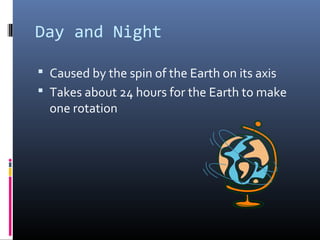
 Caused by the spin of the Earth on its axis
 Takes about 24 hours for the Earth to make
one rotation
Weeks
 7 days for the…
 7 non star visible objects in the sky
 Although not all connections are obvious in
English!
Day Object
Sunday Sun
Monday Moon
Tuesday Mars
Wednesday Mercury
Thursday Jupiter
Friday Venus
Saturday Saturn
Months
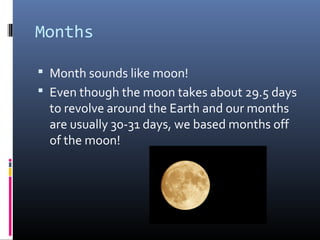
 Month sounds like moon!
 Even though the moon takes about 29.5 days
to revolve around the Earth and our months
are usually 30-31 days, we based months off
of the moon!
Years
 Years are based on how long it takes the
Earth to make one complete orbit around the
sun
 It takes the Earth 365.2422 days to orbit the
sun
 Because of that, we have leap year every four
years
 On years that end in a 00, it must also be
divisible by 400 to be a leap year (1900 was
not a leap year but 2000 was).
Years
 Years are based on how long it takes the
Earth to make one complete orbit around the
sun
 It takes the Earth 365.2422 days to orbit the
sun
 Because of that, we have leap year every four
years
 On years that end in a 00, it must also be
divisible by 400 to be a leap year (1900 was
not a leap year but 2000 was).

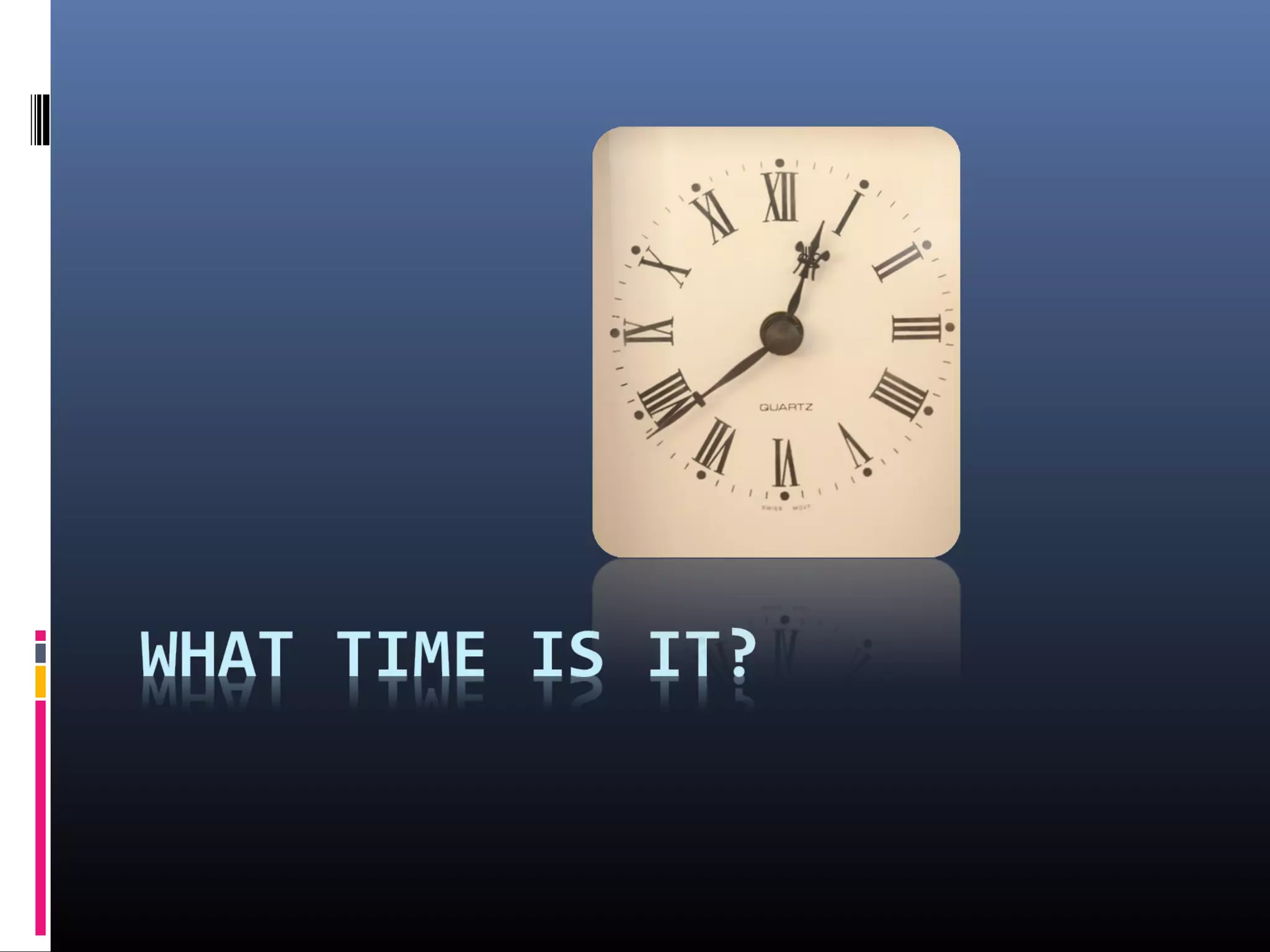
Why do we measure time the way that we do

  • 2.
    Day and Night Caused by the spin of the Earth on its axis  Takes about 24 hours for the Earth to make one rotation
  • 3.
    Weeks  7 daysfor the…  7 non star visible objects in the sky  Although not all connections are obvious in English! Day Object Sunday Sun Monday Moon Tuesday Mars Wednesday Mercury Thursday Jupiter Friday Venus Saturday Saturn
  • 4.
    Months  Month soundslike moon!  Even though the moon takes about 29.5 days to revolve around the Earth and our months are usually 30-31 days, we based months off of the moon!
  • 5.
    Years  Years arebased on how long it takes the Earth to make one complete orbit around the sun  It takes the Earth 365.2422 days to orbit the sun  Because of that, we have leap year every four years  On years that end in a 00, it must also be divisible by 400 to be a leap year (1900 was not a leap year but 2000 was).
  • 6.
    Years  Years arebased on how long it takes the Earth to make one complete orbit around the sun  It takes the Earth 365.2422 days to orbit the sun  Because of that, we have leap year every four years  On years that end in a 00, it must also be divisible by 400 to be a leap year (1900 was not a leap year but 2000 was).