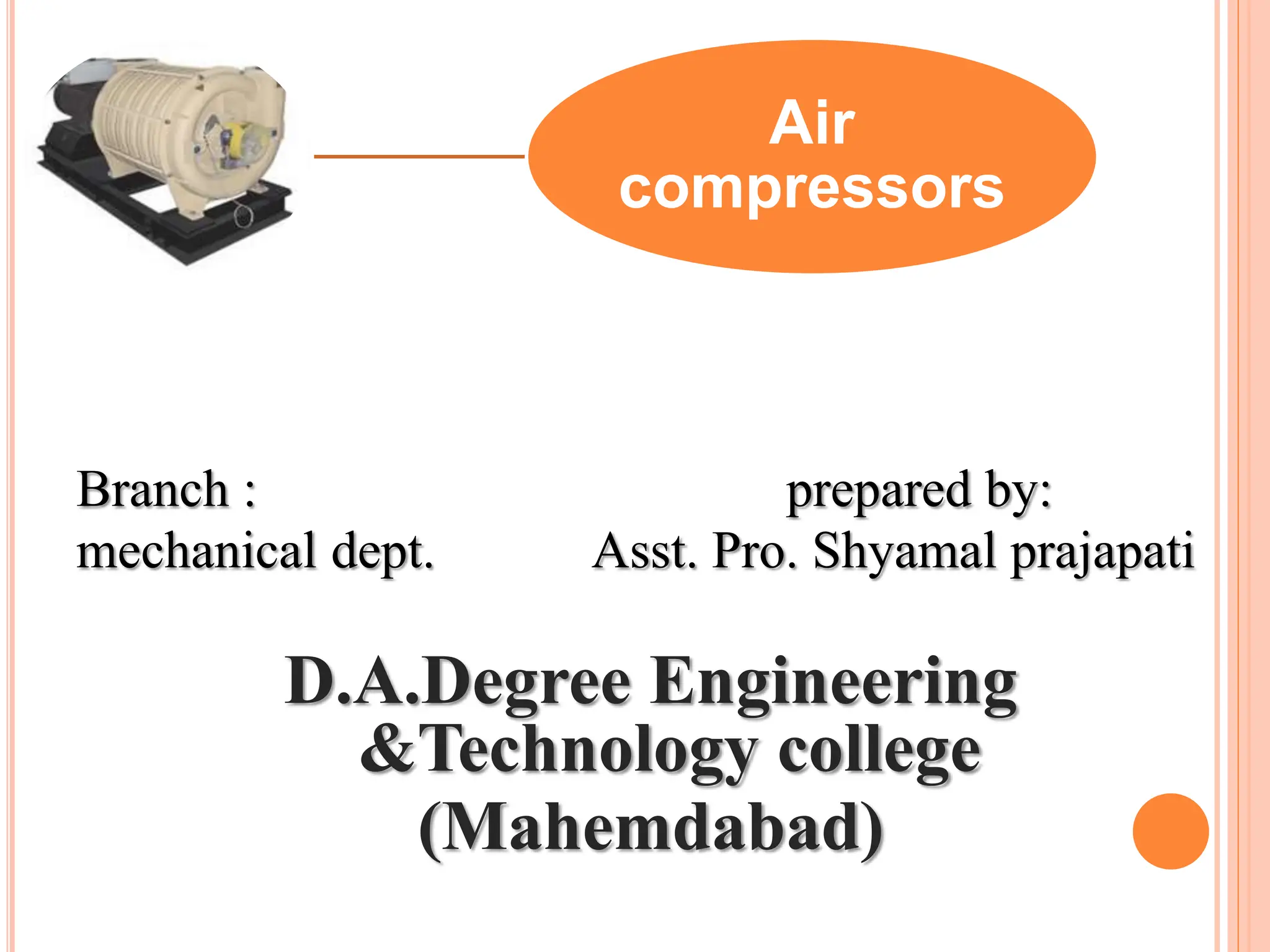
Air
compressors
Branch : prepared by:
mechanical dept. Asst. Pro. Shyamal prajapati
D.A.Degree Engineering
&Technology college
(Mahemdabad)
INTRODUCTION
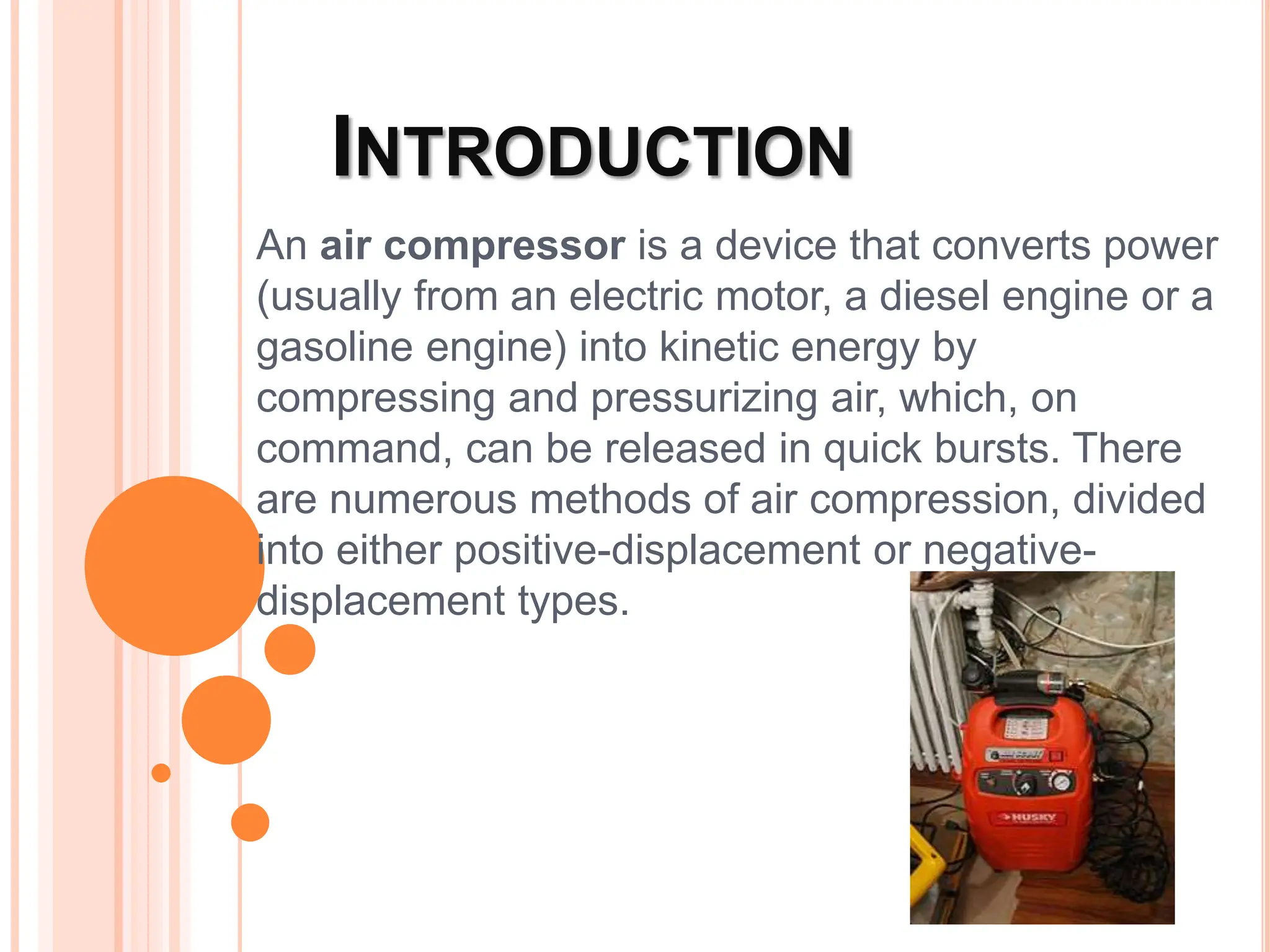
An air compressor is a device that converts power
(usually from an electric motor, a diesel engine or a
gasoline engine) into kinetic energy by
compressing and pressurizing air, which, on
command, can be released in quick bursts. There
are numerous methods of air compression, divided
into either positive-displacement or negative-
displacement types.
OBJECTIVE
Introduction
Reciprocating Pump
 Rotary Pump
Significance of multistaging in Air compressor
pump
APPLICATION OF RECIPROCATING AIR
COMPRESSOR.
 Reciprocating compressors utilize crankshaft driven
pistons to compress gases for use in various processes.
 Much like internal combustion engines, an offset crankshaft
causes rotary motion of a piston rod which is converted to
linear motion via a crosshead.
 The crosshead can only move in a linear motion so that the
rotary motion of the crankshaft is transformed into linear
motion of the piston.
 As the piston moves to and fro, it takes in low pressure gas
and increases its pressure.
Unlike an internal combustion engine, the gas is not ignited.
It is allowed to leave the compressor cylinder at a higher level
of pressure than when it went in.
SINGLE STAGE RECIPROCATING AIR
COMPRESSOR.
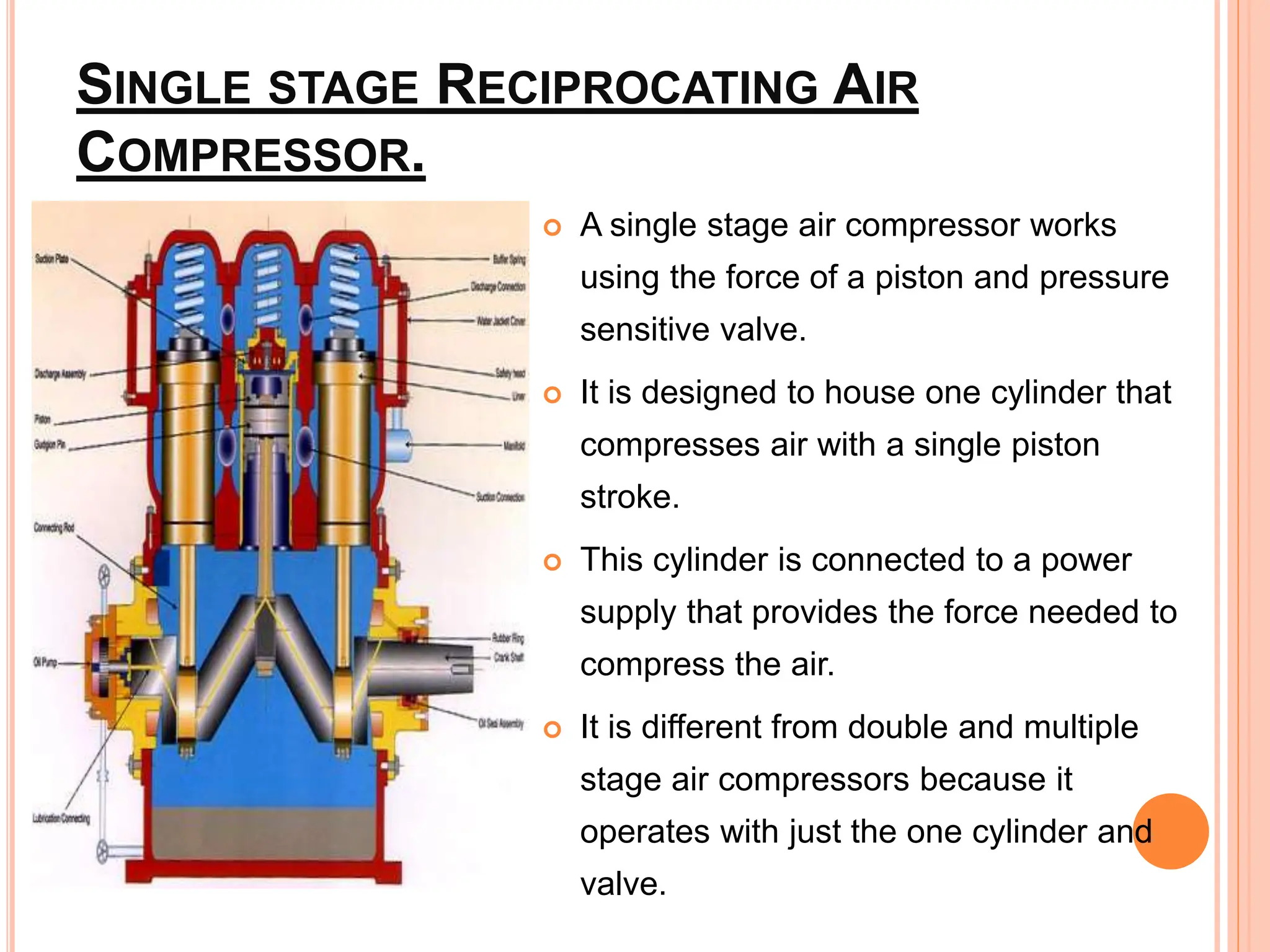
 A single stage air compressor works
using the force of a piston and pressure
sensitive valve.
 It is designed to house one cylinder that
compresses air with a single piston
stroke.
 This cylinder is connected to a power
supply that provides the force needed to
compress the air.
 It is different from double and multiple
stage air compressors because it
operates with just the one cylinder and
valve.
MULTI STAGE RECIPROCATING AIR
COMPRESSOR.
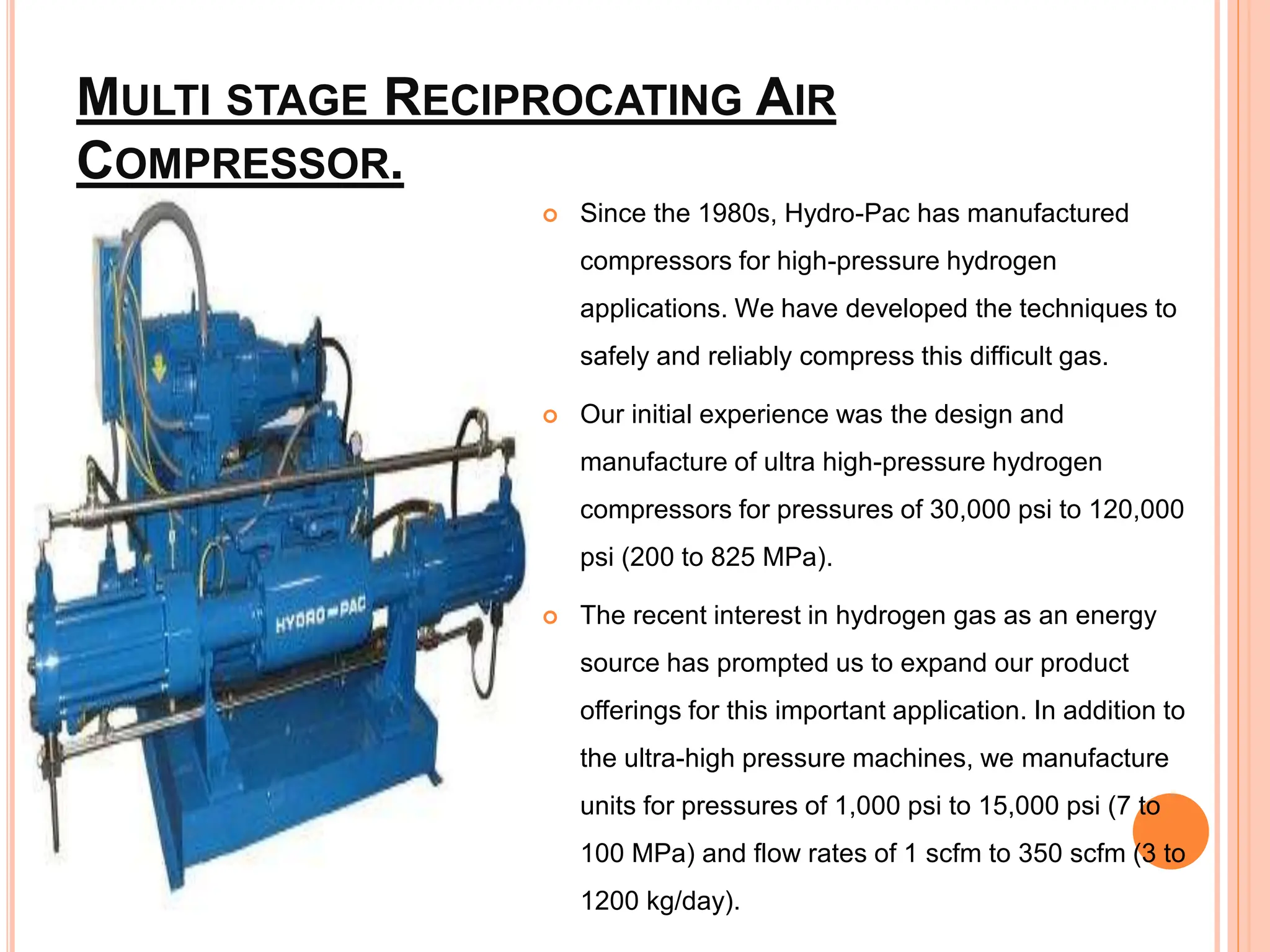
 Since the 1980s, Hydro-Pac has manufactured
compressors for high-pressure hydrogen
applications. We have developed the techniques to
safely and reliably compress this difficult gas.
 Our initial experience was the design and
manufacture of ultra high-pressure hydrogen
compressors for pressures of 30,000 psi to 120,000
psi (200 to 825 MPa).
 The recent interest in hydrogen gas as an energy
source has prompted us to expand our product
offerings for this important application. In addition to
the ultra-high pressure machines, we manufacture
units for pressures of 1,000 psi to 15,000 psi (7 to
100 MPa) and flow rates of 1 scfm to 350 scfm (3 to
1200 kg/day).
DIFFERENCE BETWEEN SINGLE AND MULTI STAGE
RECIPROCATING AIR COMPRESSOR
 Traditional single-stage
furnaces are designed to
heat your home during
the absolute coldest
weather in your
geographic area.
Therefore, they run at
their fullest capacity
whenever they are in
operation, regardless of
the temperature outside.
 A two-stage furnace has two
heating stages: low and high.
The low stage runs at a lower
capacity, and will heat your
home as long as possible
until it needs extra power to
keep your home at the same
temperature set on your
thermostat. This is when the
high stage kicks in. On
average, a two-stage furnace
only runs at high capacity
25% of the time it is on.
Single Stage Multi Stage
ADAVANTAGES &DISADAVANTAGES
 Simple design
 Lower initial cost
 Easy to install
 Two stage models offer the
highest efficiency
 Large rage of horse powers
 Special machines can reach
extremely high pressures
 Higher maintenance cost
 Potential for vibration
problems
 Foundation may be
required depending on size
 Many are not designed to
run at full capacity 100% of
the time
ADAVANTAGES DISADAVANTAGES
DEFINITION
 A COMPRESSOR THAT DERIVES ITS
PRESSURIZING ABLILLITY FROM A SPINNING
COMPONANT.
 AN AIR COMPRESSOR USING A ROTARY
IMPELLRE DRIVING AIR THROUGH A CURVED
CHAMBER TO COMPRESS THE AIR.
WORKING PRINCIPLE
 THE COMPRESSOR TAKES IN A LOW PRESSURE
GAS PASSES IT THROUGH A HIGH PRESSURE.
 ROTARY COMPRESSOR USE TWO MESHING
HELICAL SCREWS,KNOWN AS ROTORS,TO
COMPRESSOR THE GAS.
ROTARY COMPRESSOR USED FOR MOVING A
FLUID A SYSTEM AND USED FOR COPMRESSING
AIR.
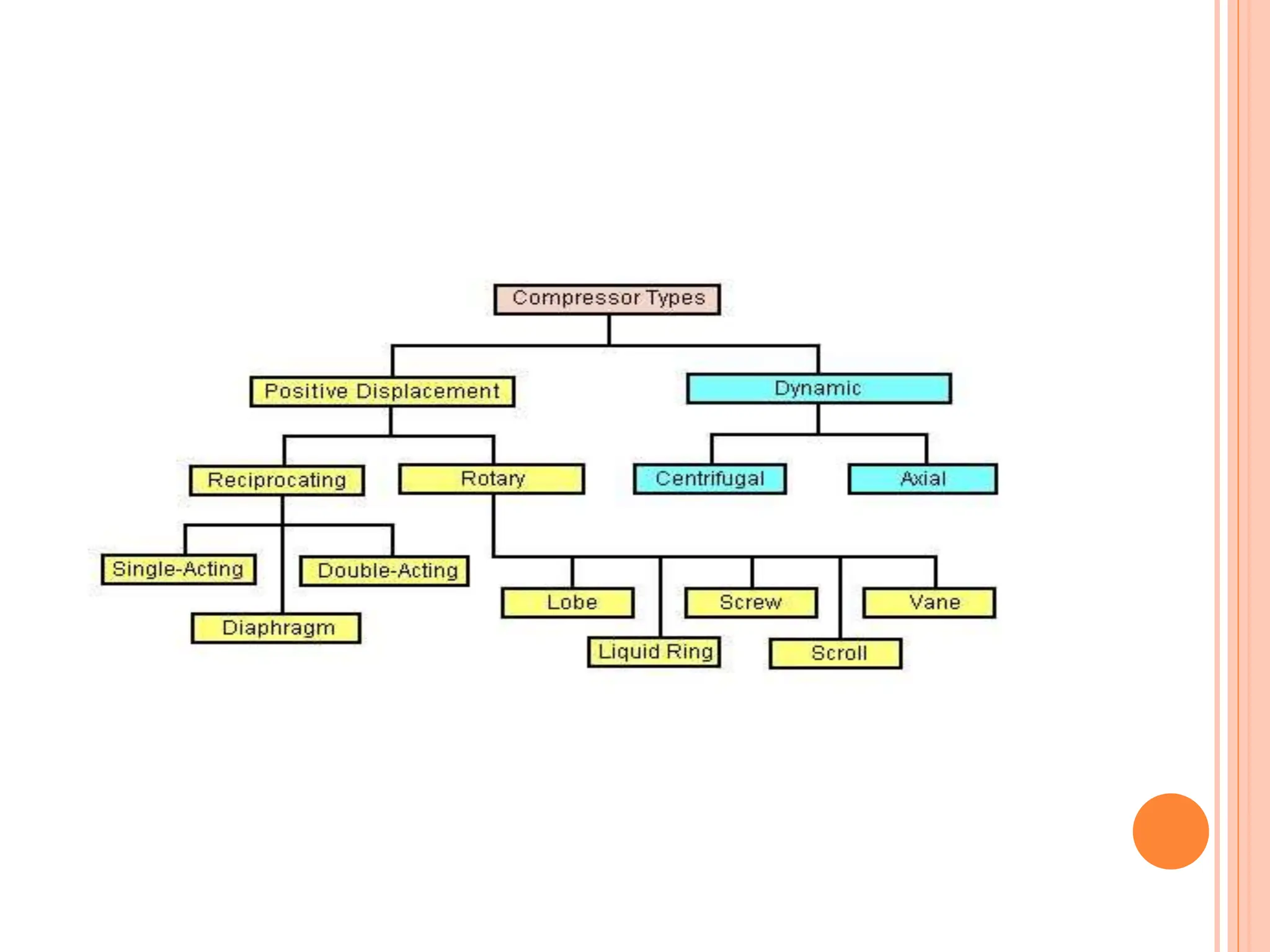
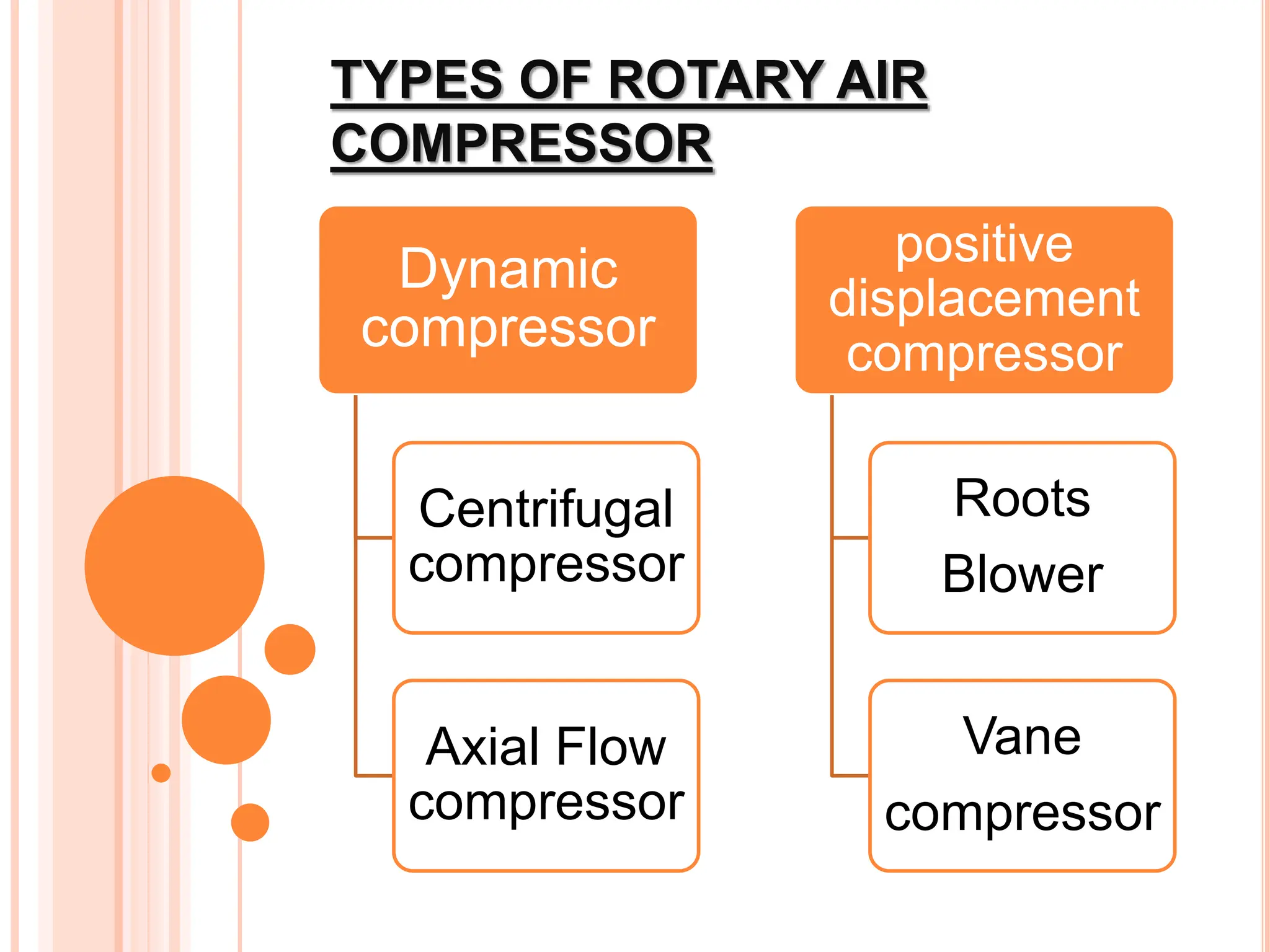
TYPES OF ROTARY AIR
COMPRESSOR
Dynamic
compressor
Centrifugal
compressor
Axial Flow
compressor
positive
displacement
compressor
Roots
Blower
Vane
compressor
ADVANTAGES
 MINIMUM MECHANICAL MAINTENANCE.
 ZERO WEAR.
 MAXIMUM RELIABILITY.
 LESS INSTALLATION COST.
 LOW OPRATING COSTS.
 ROTARY AIR COMPRESSOR HAVE GREATER AIR
CAPACITY.
 PROTABILLITY AND VERSATILLITY.
DISADVANTAGES
 THEY TEND TO BE MORE EXPENCIVE.
 THEY TEND TO BE MORE NOISY.
 POWERFUL,MULTISTAGE PROTABLE.
UNITS MUST BE GAS POWERD AND ARE HEAVY.
PROTABLE UNIT ARE LESS POWERFUL THEN GAS
COMPRESSOR.
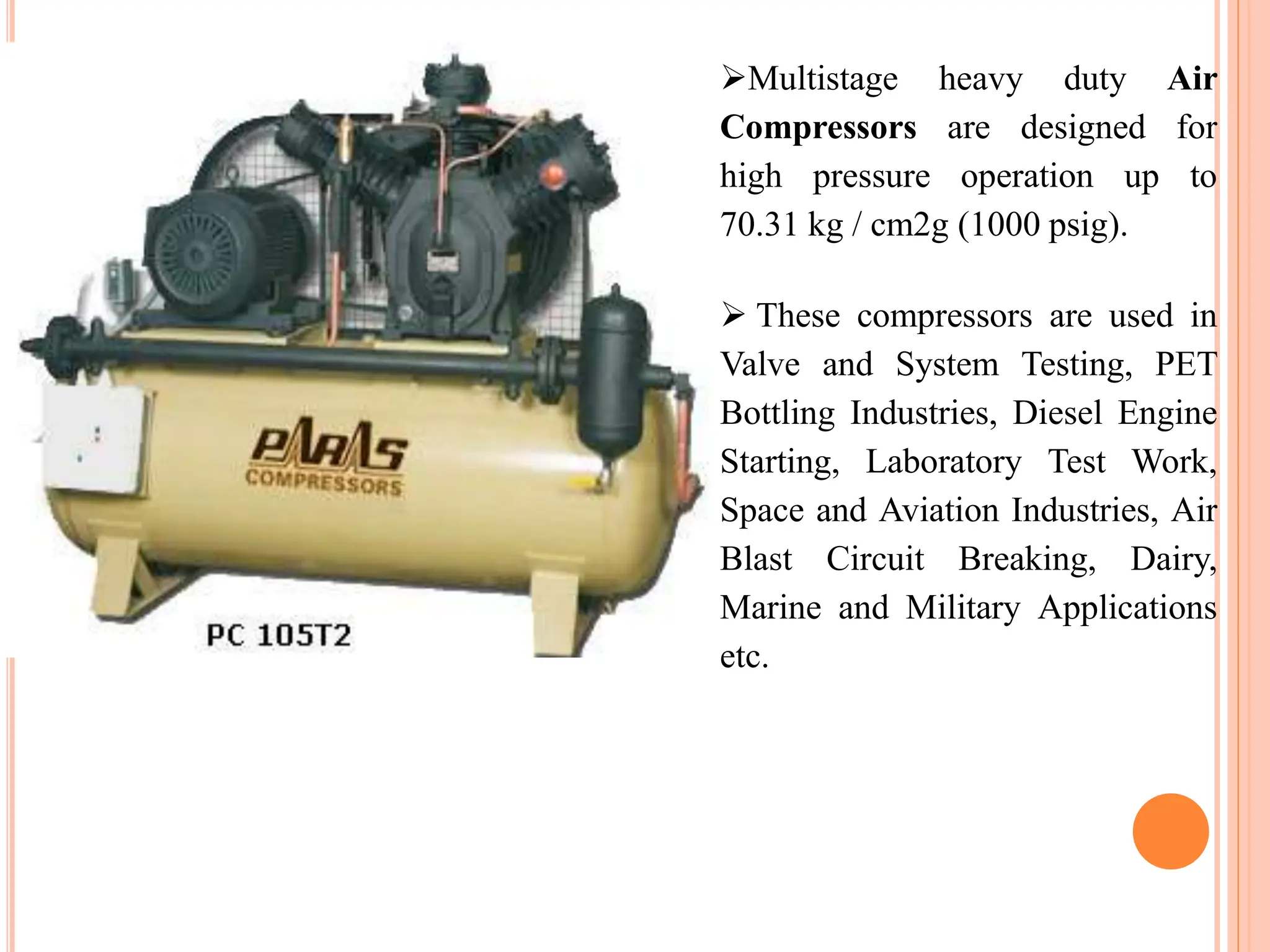
Multistage heavy duty Air
Compressors are designed for
high pressure operation up to
70.31 kg / cm2g (1000 psig).
 These compressors are used in
Valve and System Testing, PET
Bottling Industries, Diesel Engine
Starting, Laboratory Test Work,
Space and Aviation Industries, Air
Blast Circuit Breaking, Dairy,
Marine and Military Applications
etc.
 A multi-stage compressor is one in which there are several
cylinders of different diameters.
 The intake of air in the first stage gets compressed and then it
is passed over a cooler to achieve a temperature very close to
ambient air.
 This cooled air is passed to the intermediate stage where it is
again getting compressed and heated.
 This air is again passed over a cooler to achieve a
temperature as close to ambient as possible.
 Then this compressed air is passed to the final or the
third stage of the air compressor where it is compressed to the
required pressure and delivered to the air receiver after cooling
sufficiently in an after- cooler.
Advantages of Multi-stage compression:
 The work done in compressing the air is reduced, thus power can be saved
 Prevents mechanical problems as the air temperature is controlled
 The suction and delivery valves remain in cleaner condition as the
temperature and vaporization of lubricating oil is less
 The machine is smaller and better balanced
 Effects from moisture can be handled better, by draining at each stage
 Compression approaches near isothermal
 Compression ratio at each stage is lower when compared to a single-stage
machine
 Light moving parts usually made of aluminum, thus less cost and better
maintenance
Air Compressor reciprocating single stage

Air Compressor reciprocating single stage

  • 1.
    Air compressors Branch : preparedby: mechanical dept. Asst. Pro. Shyamal prajapati D.A.Degree Engineering &Technology college (Mahemdabad)
  • 2.
    INTRODUCTION An air compressoris a device that converts power (usually from an electric motor, a diesel engine or a gasoline engine) into kinetic energy by compressing and pressurizing air, which, on command, can be released in quick bursts. There are numerous methods of air compression, divided into either positive-displacement or negative- displacement types.
  • 3.
    OBJECTIVE Introduction Reciprocating Pump  RotaryPump Significance of multistaging in Air compressor pump
  • 6.
    APPLICATION OF RECIPROCATINGAIR COMPRESSOR.  Reciprocating compressors utilize crankshaft driven pistons to compress gases for use in various processes.  Much like internal combustion engines, an offset crankshaft causes rotary motion of a piston rod which is converted to linear motion via a crosshead.  The crosshead can only move in a linear motion so that the rotary motion of the crankshaft is transformed into linear motion of the piston.  As the piston moves to and fro, it takes in low pressure gas and increases its pressure. Unlike an internal combustion engine, the gas is not ignited. It is allowed to leave the compressor cylinder at a higher level of pressure than when it went in.
  • 7.
    SINGLE STAGE RECIPROCATINGAIR COMPRESSOR.  A single stage air compressor works using the force of a piston and pressure sensitive valve.  It is designed to house one cylinder that compresses air with a single piston stroke.  This cylinder is connected to a power supply that provides the force needed to compress the air.  It is different from double and multiple stage air compressors because it operates with just the one cylinder and valve.
  • 8.
    MULTI STAGE RECIPROCATINGAIR COMPRESSOR.  Since the 1980s, Hydro-Pac has manufactured compressors for high-pressure hydrogen applications. We have developed the techniques to safely and reliably compress this difficult gas.  Our initial experience was the design and manufacture of ultra high-pressure hydrogen compressors for pressures of 30,000 psi to 120,000 psi (200 to 825 MPa).  The recent interest in hydrogen gas as an energy source has prompted us to expand our product offerings for this important application. In addition to the ultra-high pressure machines, we manufacture units for pressures of 1,000 psi to 15,000 psi (7 to 100 MPa) and flow rates of 1 scfm to 350 scfm (3 to 1200 kg/day).
  • 9.
    DIFFERENCE BETWEEN SINGLEAND MULTI STAGE RECIPROCATING AIR COMPRESSOR  Traditional single-stage furnaces are designed to heat your home during the absolute coldest weather in your geographic area. Therefore, they run at their fullest capacity whenever they are in operation, regardless of the temperature outside.  A two-stage furnace has two heating stages: low and high. The low stage runs at a lower capacity, and will heat your home as long as possible until it needs extra power to keep your home at the same temperature set on your thermostat. This is when the high stage kicks in. On average, a two-stage furnace only runs at high capacity 25% of the time it is on. Single Stage Multi Stage
  • 10.
    ADAVANTAGES &DISADAVANTAGES  Simpledesign  Lower initial cost  Easy to install  Two stage models offer the highest efficiency  Large rage of horse powers  Special machines can reach extremely high pressures  Higher maintenance cost  Potential for vibration problems  Foundation may be required depending on size  Many are not designed to run at full capacity 100% of the time ADAVANTAGES DISADAVANTAGES
  • 12.
    DEFINITION  A COMPRESSORTHAT DERIVES ITS PRESSURIZING ABLILLITY FROM A SPINNING COMPONANT.  AN AIR COMPRESSOR USING A ROTARY IMPELLRE DRIVING AIR THROUGH A CURVED CHAMBER TO COMPRESS THE AIR.
  • 13.
    WORKING PRINCIPLE  THECOMPRESSOR TAKES IN A LOW PRESSURE GAS PASSES IT THROUGH A HIGH PRESSURE.  ROTARY COMPRESSOR USE TWO MESHING HELICAL SCREWS,KNOWN AS ROTORS,TO COMPRESSOR THE GAS. ROTARY COMPRESSOR USED FOR MOVING A FLUID A SYSTEM AND USED FOR COPMRESSING AIR.
  • 14.
    TYPES OF ROTARYAIR COMPRESSOR Dynamic compressor Centrifugal compressor Axial Flow compressor positive displacement compressor Roots Blower Vane compressor
  • 15.
    ADVANTAGES  MINIMUM MECHANICALMAINTENANCE.  ZERO WEAR.  MAXIMUM RELIABILITY.  LESS INSTALLATION COST.  LOW OPRATING COSTS.  ROTARY AIR COMPRESSOR HAVE GREATER AIR CAPACITY.  PROTABILLITY AND VERSATILLITY.
  • 16.
    DISADVANTAGES  THEY TENDTO BE MORE EXPENCIVE.  THEY TEND TO BE MORE NOISY.  POWERFUL,MULTISTAGE PROTABLE. UNITS MUST BE GAS POWERD AND ARE HEAVY. PROTABLE UNIT ARE LESS POWERFUL THEN GAS COMPRESSOR.
  • 18.
    Multistage heavy dutyAir Compressors are designed for high pressure operation up to 70.31 kg / cm2g (1000 psig).  These compressors are used in Valve and System Testing, PET Bottling Industries, Diesel Engine Starting, Laboratory Test Work, Space and Aviation Industries, Air Blast Circuit Breaking, Dairy, Marine and Military Applications etc.
  • 19.
     A multi-stagecompressor is one in which there are several cylinders of different diameters.  The intake of air in the first stage gets compressed and then it is passed over a cooler to achieve a temperature very close to ambient air.  This cooled air is passed to the intermediate stage where it is again getting compressed and heated.  This air is again passed over a cooler to achieve a temperature as close to ambient as possible.  Then this compressed air is passed to the final or the third stage of the air compressor where it is compressed to the required pressure and delivered to the air receiver after cooling sufficiently in an after- cooler.
  • 20.
    Advantages of Multi-stagecompression:  The work done in compressing the air is reduced, thus power can be saved  Prevents mechanical problems as the air temperature is controlled  The suction and delivery valves remain in cleaner condition as the temperature and vaporization of lubricating oil is less  The machine is smaller and better balanced  Effects from moisture can be handled better, by draining at each stage  Compression approaches near isothermal  Compression ratio at each stage is lower when compared to a single-stage machine  Light moving parts usually made of aluminum, thus less cost and better maintenance