Atmiya College of Science & Technology
Air Compressors
Elements of Mechanical Engineering
Roll NO. Name Enrollment no.
56 Bhavya Vasani (GL) 130030117058
33 Meet Patel 130030117036
51 Bhargav Thakur 130030117055
55 Hitesh Vavnotiya 130030117059
56 Chintan Vyas 130030117060
08 Deep Vyas 130030117009
4
• Intake air filters
• Inter-stage coolers
• After coolers
• Air dryers
• Moisture drain traps
• Receivers
Main Components in Compressed Air Systems
Introduction
 The machine which takes in air or any other gas at low pressure
and compresses it to high pressure are called compressors.
 A compressor is used for increasing the pressure of air is called
Air compressor.
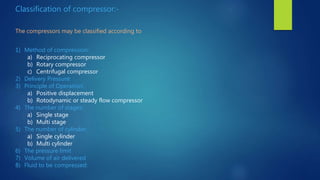
Classification of compressor:-
The compressors may be classified according to
1) Method of compression:
a) Reciprocating compressor
b) Rotary compressor
c) Centrifugal compressor
2) Delivery Pressure:
3) Principle of Operation:
a) Positive displacement
b) Rotodynamic or steady flow compressor
4) The number of stages:
a) Single stage
b) Multi stage
5) The number of cylinder:
a) Single cylinder
b) Multi cylinder
6) The pressure limit
7) Volume of air delivered
8) Fluid to be compressed:
6
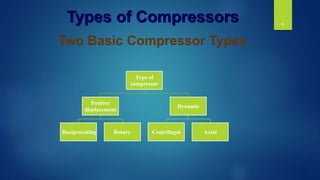
Two Basic Compressor Types
Types of Compressors
Type of
compressor
Positive
displacement
Reciprocating Rotary
Dynamic
Centrifugal Axial
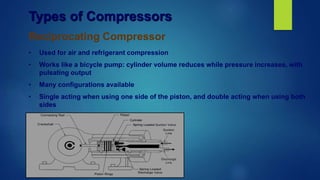
• Used for air and refrigerant compression
• Works like a bicycle pump: cylinder volume reduces while pressure increases, with
pulsating output
• Many configurations available
• Single acting when using one side of the piston, and double acting when using both
sides
Reciprocating Compressor
Types of Compressors
8
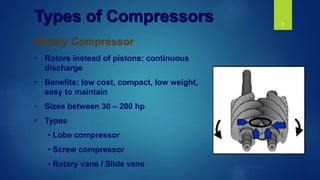
Screw compressor
• Rotors instead of pistons: continuous
discharge
• Benefits: low cost, compact, low weight,
easy to maintain
• Sizes between 30 – 200 hp
• Types
• Lobe compressor
• Screw compressor
• Rotary vane / Slide vane
Rotary Compressor
Types of Compressors
9
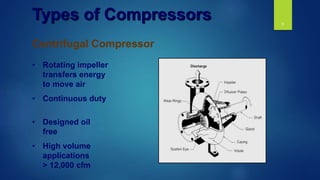
• Rotating impeller
transfers energy
to move air
• Continuous duty
Centrifugal Compressor
Types of Compressors
• Designed oil
free
• High volume
applications
> 12,000 cfm
10
© UNEP 2006
• Efficiency at full, partial and no load
• Noise level
• Size
• Oil carry-over
• Vibration
• Maintenance
• Capacity
• Pressure
Comparison of Compressors
Types of Compressors
11
© UNEP 2006
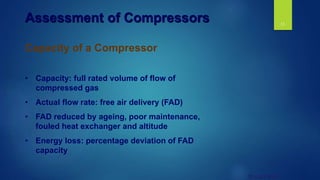
• Capacity: full rated volume of flow of
compressed gas
• Actual flow rate: free air delivery (FAD)
• FAD reduced by ageing, poor maintenance,
fouled heat exchanger and altitude
• Energy loss: percentage deviation of FAD
capacity
Capacity of a Compressor
Assessment of Compressors
12
© UNEP 2006
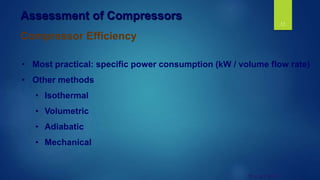
Compressor Efficiency
Assessment of Compressors
• Most practical: specific power consumption (kW / volume flow rate)
• Other methods
• Isothermal
• Volumetric
• Adiabatic
• Mechanical
13
© UNEP 2006
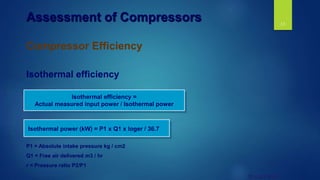
Isothermal efficiency
P1 = Absolute intake pressure kg / cm2
Q1 = Free air delivered m3 / hr
r = Pressure ratio P2/P1
Compressor Efficiency
Assessment of Compressors
Isothermal efficiency =
Actual measured input power / Isothermal power
Isothermal power (kW) = P1 x Q1 x loger / 36.7
14
© UNEP 2006
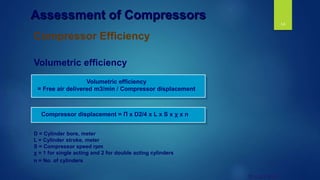
Volumetric efficiency
D = Cylinder bore, meter
L = Cylinder stroke, meter
S = Compressor speed rpm
χ = 1 for single acting and 2 for double acting cylinders
n = No. of cylinders
Compressor Efficiency
Assessment of Compressors
Volumetric efficiency
= Free air delivered m3/min / Compressor displacement
Compressor displacement = Π x D2/4 x L x S x χ x n
15
© UNEP 2006
• Consequences
• Energy waste: 20 – 30% of output
• Drop in system pressure
• Shorter equipment life
• Common leakage areas
• Couplings, hoses, tubes, fittings
• Pressure regulators
• Open condensate traps, shut-off valves
• Pipe joints, disconnects, thread sealants
Leaks
Assessment of Compressors
16
© UNEP 2006
• Higher pressure
• More power by compressors
• Lower volumetric efficiency
• Operating above operating pressures
• Waste of energy
• Excessive wear
Energy Efficiency Opportunities
 . Pressure Settings
17
© UNEP 2006
 . Minimizing Leakage
• Use ultrasonic acoustic detector
• Tighten joints and connections
• Replace faulty equipment
Energy Efficiency Opportunities
18
© UNEP 2006
 . Controlled usage
• Do not use for low-pressure
applications: agitation, combustion air,
pneumatic conveying
• Use blowers instead
 . Compressor controls
• Automatically turns off compressor
when not needed
Energy Efficiency Opportunities
19
© UNEP 2006
 . Maintenance Practices
• Lubrication: Checked regularly
• Air filters: Replaced regularly
• Condensate traps: Ensure drainage
• Air dryers: Inspect and replace filters
Energy Efficiency Opportunities
20
Compressors &
Compressed Air
Systems
THANK YOU FOR YOUR ATTENTION
© UNEP GERIAP

Air Compressor

  • 1.
    Atmiya College ofScience & Technology
  • 2.
    Air Compressors Elements ofMechanical Engineering
  • 3.
    Roll NO. NameEnrollment no. 56 Bhavya Vasani (GL) 130030117058 33 Meet Patel 130030117036 51 Bhargav Thakur 130030117055 55 Hitesh Vavnotiya 130030117059 56 Chintan Vyas 130030117060 08 Deep Vyas 130030117009
  • 4.
    4 • Intake airfilters • Inter-stage coolers • After coolers • Air dryers • Moisture drain traps • Receivers Main Components in Compressed Air Systems Introduction  The machine which takes in air or any other gas at low pressure and compresses it to high pressure are called compressors.  A compressor is used for increasing the pressure of air is called Air compressor.
  • 5.
    Classification of compressor:- Thecompressors may be classified according to 1) Method of compression: a) Reciprocating compressor b) Rotary compressor c) Centrifugal compressor 2) Delivery Pressure: 3) Principle of Operation: a) Positive displacement b) Rotodynamic or steady flow compressor 4) The number of stages: a) Single stage b) Multi stage 5) The number of cylinder: a) Single cylinder b) Multi cylinder 6) The pressure limit 7) Volume of air delivered 8) Fluid to be compressed:
  • 6.
    6 Two Basic CompressorTypes Types of Compressors Type of compressor Positive displacement Reciprocating Rotary Dynamic Centrifugal Axial
  • 7.
    • Used forair and refrigerant compression • Works like a bicycle pump: cylinder volume reduces while pressure increases, with pulsating output • Many configurations available • Single acting when using one side of the piston, and double acting when using both sides Reciprocating Compressor Types of Compressors
  • 8.
    8 Screw compressor • Rotorsinstead of pistons: continuous discharge • Benefits: low cost, compact, low weight, easy to maintain • Sizes between 30 – 200 hp • Types • Lobe compressor • Screw compressor • Rotary vane / Slide vane Rotary Compressor Types of Compressors
  • 9.
    9 • Rotating impeller transfersenergy to move air • Continuous duty Centrifugal Compressor Types of Compressors • Designed oil free • High volume applications > 12,000 cfm
  • 10.
    10 © UNEP 2006 •Efficiency at full, partial and no load • Noise level • Size • Oil carry-over • Vibration • Maintenance • Capacity • Pressure Comparison of Compressors Types of Compressors
  • 11.
    11 © UNEP 2006 •Capacity: full rated volume of flow of compressed gas • Actual flow rate: free air delivery (FAD) • FAD reduced by ageing, poor maintenance, fouled heat exchanger and altitude • Energy loss: percentage deviation of FAD capacity Capacity of a Compressor Assessment of Compressors
  • 12.
    12 © UNEP 2006 CompressorEfficiency Assessment of Compressors • Most practical: specific power consumption (kW / volume flow rate) • Other methods • Isothermal • Volumetric • Adiabatic • Mechanical
  • 13.
    13 © UNEP 2006 Isothermalefficiency P1 = Absolute intake pressure kg / cm2 Q1 = Free air delivered m3 / hr r = Pressure ratio P2/P1 Compressor Efficiency Assessment of Compressors Isothermal efficiency = Actual measured input power / Isothermal power Isothermal power (kW) = P1 x Q1 x loger / 36.7
  • 14.
    14 © UNEP 2006 Volumetricefficiency D = Cylinder bore, meter L = Cylinder stroke, meter S = Compressor speed rpm χ = 1 for single acting and 2 for double acting cylinders n = No. of cylinders Compressor Efficiency Assessment of Compressors Volumetric efficiency = Free air delivered m3/min / Compressor displacement Compressor displacement = Π x D2/4 x L x S x χ x n
  • 15.
    15 © UNEP 2006 •Consequences • Energy waste: 20 – 30% of output • Drop in system pressure • Shorter equipment life • Common leakage areas • Couplings, hoses, tubes, fittings • Pressure regulators • Open condensate traps, shut-off valves • Pipe joints, disconnects, thread sealants Leaks Assessment of Compressors
  • 16.
    16 © UNEP 2006 •Higher pressure • More power by compressors • Lower volumetric efficiency • Operating above operating pressures • Waste of energy • Excessive wear Energy Efficiency Opportunities  . Pressure Settings
  • 17.
    17 © UNEP 2006 . Minimizing Leakage • Use ultrasonic acoustic detector • Tighten joints and connections • Replace faulty equipment Energy Efficiency Opportunities
  • 18.
    18 © UNEP 2006 . Controlled usage • Do not use for low-pressure applications: agitation, combustion air, pneumatic conveying • Use blowers instead  . Compressor controls • Automatically turns off compressor when not needed Energy Efficiency Opportunities
  • 19.
    19 © UNEP 2006 . Maintenance Practices • Lubrication: Checked regularly • Air filters: Replaced regularly • Condensate traps: Ensure drainage • Air dryers: Inspect and replace filters Energy Efficiency Opportunities
  • 20.
    20 Compressors & Compressed Air Systems THANKYOU FOR YOUR ATTENTION © UNEP GERIAP