Group No:2
M SOHAIB 2015-CH-705
M KAMRAN 2015-CH-722
M AKBAR 2015-CH-728
FARHAN MASOOD 2015-CH-727
MUDASSER HUSSAIN 2015-CH-723
M BILAL 2015-CH-709
Topics:
INTRODUCTION
TYPES OF GASES THAT COMPRESSOR CAN
HANDLE
EFFICIENCY
CLASSIFICATION
ADVANTAGES & DISADVANTAGES
COMPARISON
CHOICE OF SELECTION
INDUSTRIAL APPLICATIONS
Air compressor
 Pneumatics: A system which uses
compressed air is called
pneumatics.
 It deals with the study of behavior &
application of compressed air
 A basic pneumatic system consist
of a source of compressed air,
control valves, pipelines & pipe
fittings and pneumatic accessories
like filter, regulator and lubricator
Introduction to compressors
 An air compressor is a mechanical
device that increases the pressure
of air by reducing volume.
 Air is compressible, the compressor
reduces the volume of air and
induces pressure in the air
 An air compressor converts
electrical energy into kinetic
energy in the form of the air
Instead, a single motor on the
compressor converts the electrical
energy into kinetic energy.
Introduction to compressors
 The compressed air is stored in the
air receiver and can be used for
cleaning under pressure,
generating torque and develop
force using actuators
 This source is free of cost, safe,
flexible and convenient
 Air compressor has very few parts
hence maintenance is very low
OUR COMPRESSORS CAN HANDLE THE FOLLOWING
GASES;
• AIR • ARGON •
BIOGAS •
CARBON DIOXIDE • HELIUM •
HYDROGEN • METHANE
• NATURAL GAS •
NITROGEN (BOTH COMPRESSION AND GENERATION)
Compressor Efficiency
THE RATIO OF THEORETICAL WORK ( FLUID POWER)
TO ACTUAL WORK ( TOTAL POWER INPUT ) .FOR
CENTRIFUGAL COMPRESSORS, IT IS 90 %. 85%, FOR
RECIPROCATING.
Vacuum pumps:
COMPRESSOR THAT TAKES SUCTION AT PRESSURE
BELOW ATMOSPHERIC AND DISCHARGE AGAINST
ATMOSPHERIC PRESSURE , CALLED VACUUM PUMP.
ANY COMPRESSOR CAN BE MADE BY ACCEPTING
VERY LOW DENSITY GAS AT THE SUCTION.
Jet ejector:
IMPORTANT KIND OF VACUUM PUMP THAT DOES
NOT USE MOVING PARTS IS THIS IN WHICH FLUID TO
BE MOVED IS ENTRAINED IN HIGH VELOCITY STREAM
OF SECOND FLUID.
Isothermal
Compression:
WHEN COOLING DURING COMPRESSION IS
COMPLETE , TEMPERATURE REMAINS CONSTANT,
PROCESS IS CALLED ISOTHERMAL.
Classification of air compressor
 Air compressors are classified
according to method of energy
transfer and pressure generation i.e.
positive displacement and
dynamic compressors
 Positive displacement compressors
work on the principle of increasing
the pressure of air by reducing the
volume of air in an enclosed
chamber
Classification of air compressor
 Dynamic compressors works on the
principle of imparting the energy
by rotating vanes of impeller on air
flowing through casing that
increases pressure in air
Classification of air compressor
 According to number of stages
Single stage, double stage, three
stage of multiple stage
 According to action
Single acting or double acting
 According to position of cylinder
w.r.t. crankshaft
Cylinders inline, vertical, radial
position, V-type cylinder
arrangement
Classification of air compressor
 According to prime mover
Electric motor drive or IC engine
drive, Gas turbine drives
 According to cooling medium
Air cooled, water cooled air
compressors
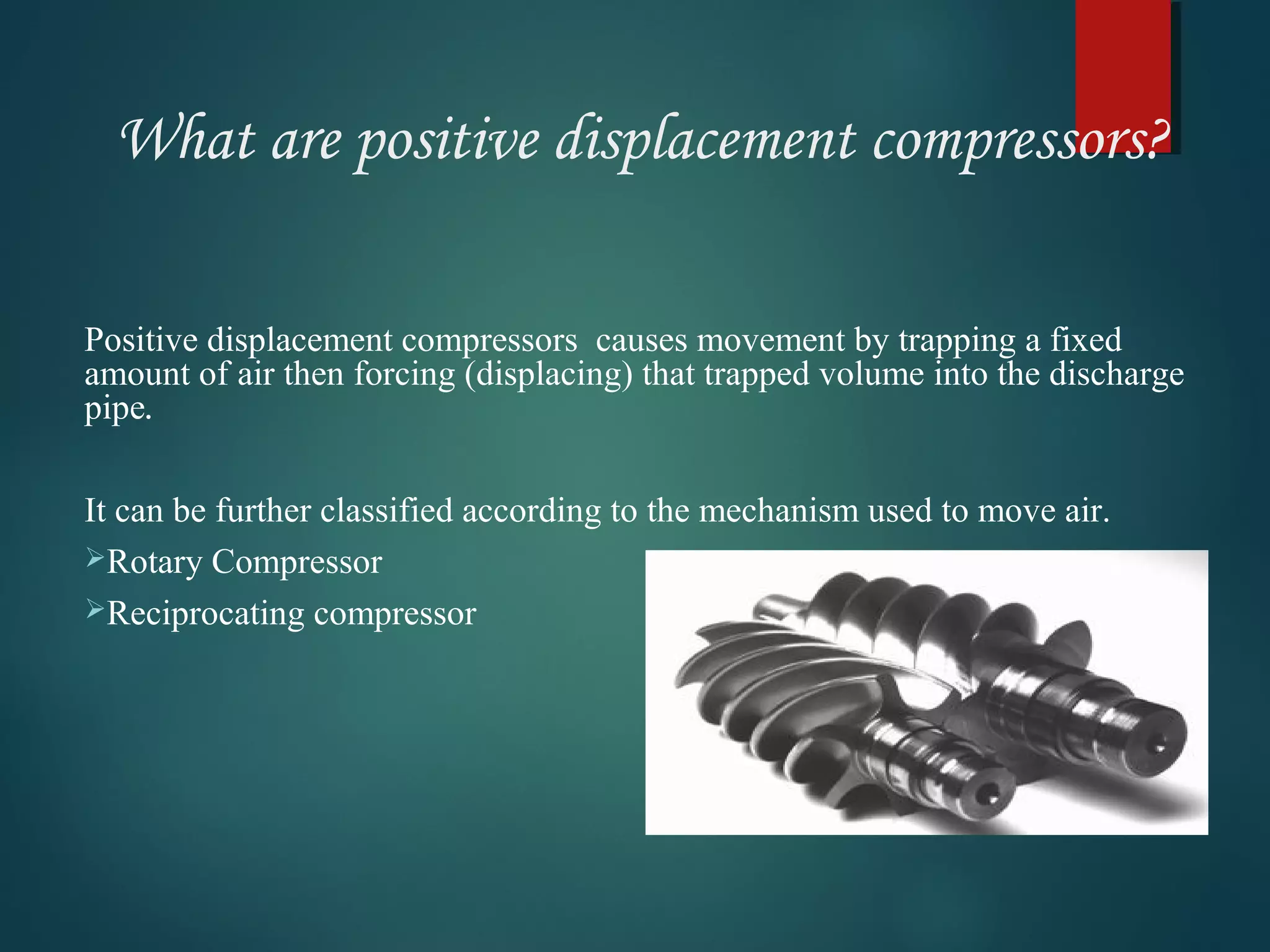
What are positive displacement compressors?
Positive displacement compressors causes movement by trapping a fixed
amount of air then forcing (displacing) that trapped volume into the discharge
pipe.
It can be further classified according to the mechanism used to move air.
Rotary Compressor
Reciprocating compressor
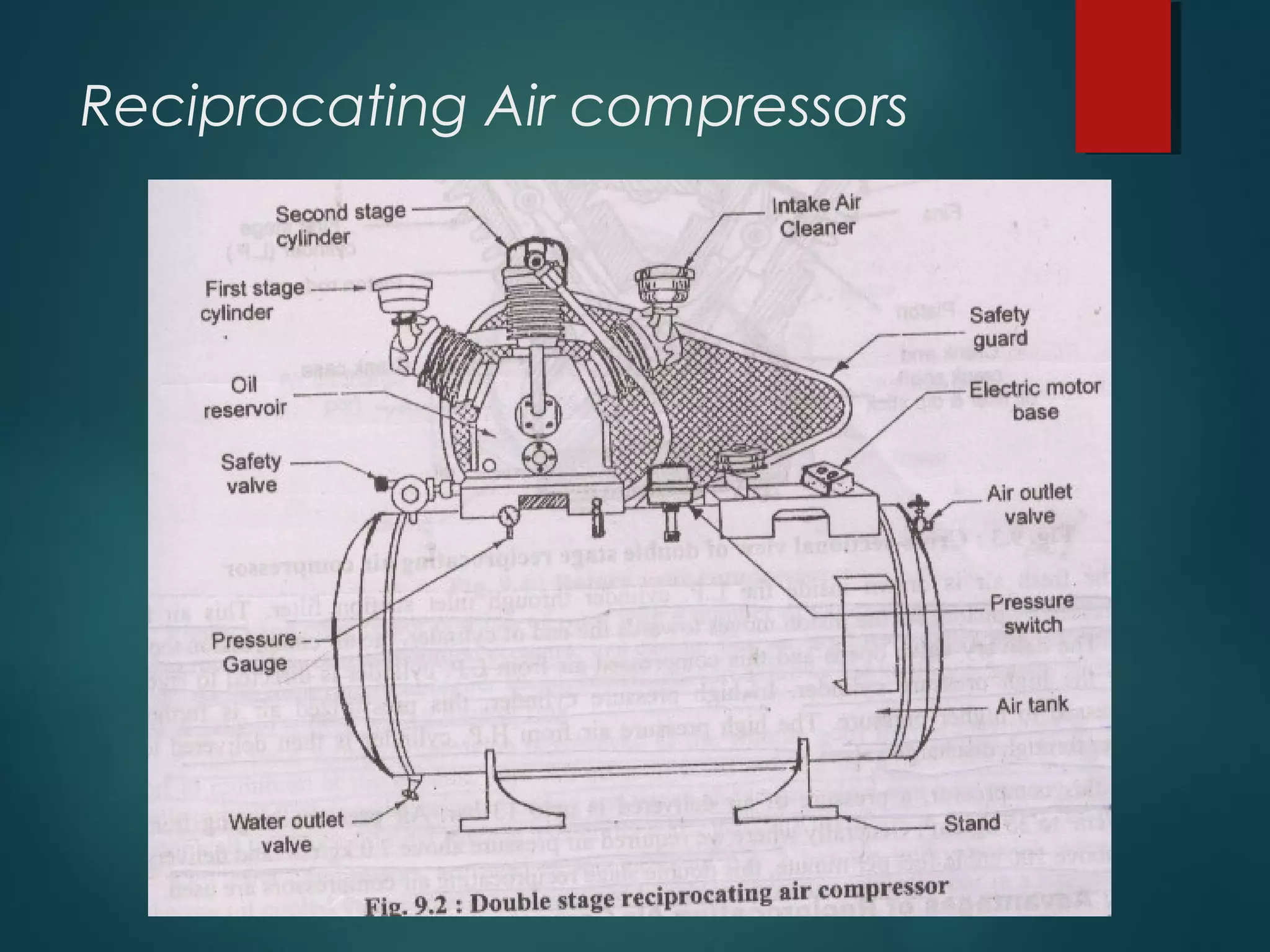
Reciprocating Air compressors
 Reciprocating air compressors are
positive displacement type of air
compressors.
 These are piston & diaphragm type,
vane type, gear type, screw type
compressors.
Reciprocating Air compressors
 The principle of operation is same
but according to stages the
delivery pressure is different in each
compressor.
Reciprocating Air compressors
 A reciprocating air compressor
consist of a piston which is
enclosed within a cylinder and
equipped with suction and
discharge valve
 The piston receives power from
electric motor or IC engine.
Reciprocating Air compressors
 The compression of air is done by
first drawing a volume of air into the
cylinder through suction valve
during suction stroke of piston and
then compressed and discharged
through delivery valve during
delivery stroke
Single stage Reciprocating Air
compressors
 In this type the entire compression is
carried out in a single cylinder
Single stage reciprocating air
compressor
Single stage Reciprocating Air
compressors
 When piston starts moving
downwards, the pressure inside the
cylinder falls below atmospheric
pressure that opens suction valve.
 The pressure of the air in the
cylinder rises during compression
and at the end of compression,
delivery valve opens and
discharges the compressed air into
the receiver tank.
Single stage Reciprocating Air
compressors
 Single stage air compressor develop
pressure upto 7 bar.
 For higher pressures multistage compressors
are suitable
 Single-stage compressors are generally used
for pressures of 70 psi (pounds per square
inch) to 135 psi.
Double stage Reciprocating Air
compressors
 It consist of two cylinders – low
pressure cylinder and high pressure
cylinder
 Piston, crankcase, piston rod,
crank, crankshaft, oil, fins etc.
Double stage reciprocating air
compressor
Double stage Reciprocating Air
compressors
 The fresh air is drawn inside the L.P.
cylinder through inlet suction filter.
 This air is compressed by piston
 As the piston moves towards the
end of cylinder, the air compression
took place.
Video for double acting compressor
Double stage Reciprocating Air
compressors
 The delivery valve opens and this
compressed air from L.P. cylinder is
directed to enter inside the high
pressure cylinder.
 In high pressure cylinder this
pressurised air is further compressed
to higher pressure.
Double stage Reciprocating Air
compressors
 The high pressure air from H.P.
cylinder is then delivered to
receiver through discharge valves.
 In this compressor, a pressure of air
delivered is upto 13 bar.
Advantages
 Simple in design
 Lower initial cost
 Easy to install
 Higher effeiciency
Disadvantages
 Number of moving parts are more
 Higher maintenance cost
 Heavy foundation is required as it
has vibration problem
 Cannot run at full capacity
Diaphragm type:
DIAPHRAGM COMPRESSORS (FIGURE 5) ARE A VARIATION OF
RECIPROCATING COMPRESSORS. THE DIAPHRAGM
COMPRESSOR DEVELOPS PRESSURE THROUGH A
RECIPROCATING OR OSCILLATING ACTION OF A FLEXIBLE
DISC ACTUATED BY AN ECCENTRIC. SINCE A SLIDING SEAL IS
NOT REQUIRED BETWEEN MOVING PARTS, THIS DESIGN IS NOT
LUBRICATED. DIAPHRAGM COMPRESSORS ARE OFTEN
SELECTED
when no contamination is allowed in the
output air or atmosphere, such as hospital
and laboratory applications. Diaphragm
compressors are limited in output and
pressure and they are used most often for
light-duty applications
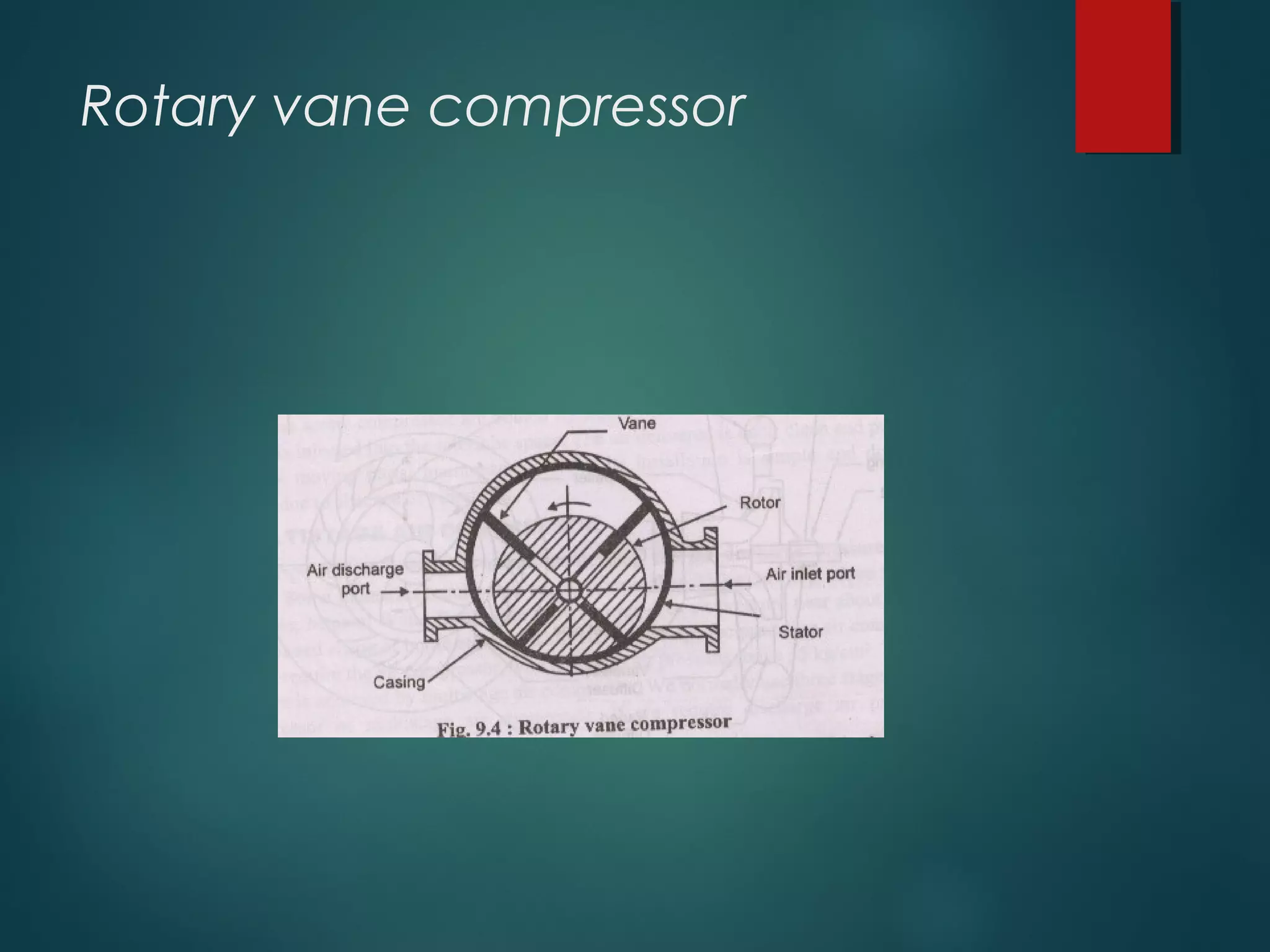
Rotary vane compressor
 It is positive displacement type
compressor.
 It provides higher efficiency and
flow rates over a wide range of
pressure
 Rotary vane compressor consist of
rotor with a number of vanes
inserted in the radial slots cut in
rotor.
Rotary vane compressor
 The rotor is mounted eccentric in a
casing.
 The vanes slides radially in and out
of the rotor.
 As the rotor rotates at higher
speed, centrifugal force throws the
vanes outward keeping the end of
vane in contact with the stator ring.
Rotary vane compressor
 As the rotor turns, compression is
achieved as the volume goes from
a maximum at intake port to
minimum at the exhaust port.
 An oil is injected into the air intake
and along the stator walls to cool
the air and lubricate bearing and
vanes and to provide a seal
between the vane and stator wall
to reduce internal leakage.
Advantages:
 Simple design
 Compact in size
 Light in weight
 Easy to install
 Low cost
 Low maintenance cost
 Longer life
 Few moving parts
 Low rotational speed
 Expensive foundation not required
Disadvantages:
 Lower efficiency
 Difficulty with higher pressure
above 200 psi
 Oil injected designs have oil
carryover
Vane type rotary
compressor
Video of rotary compressor
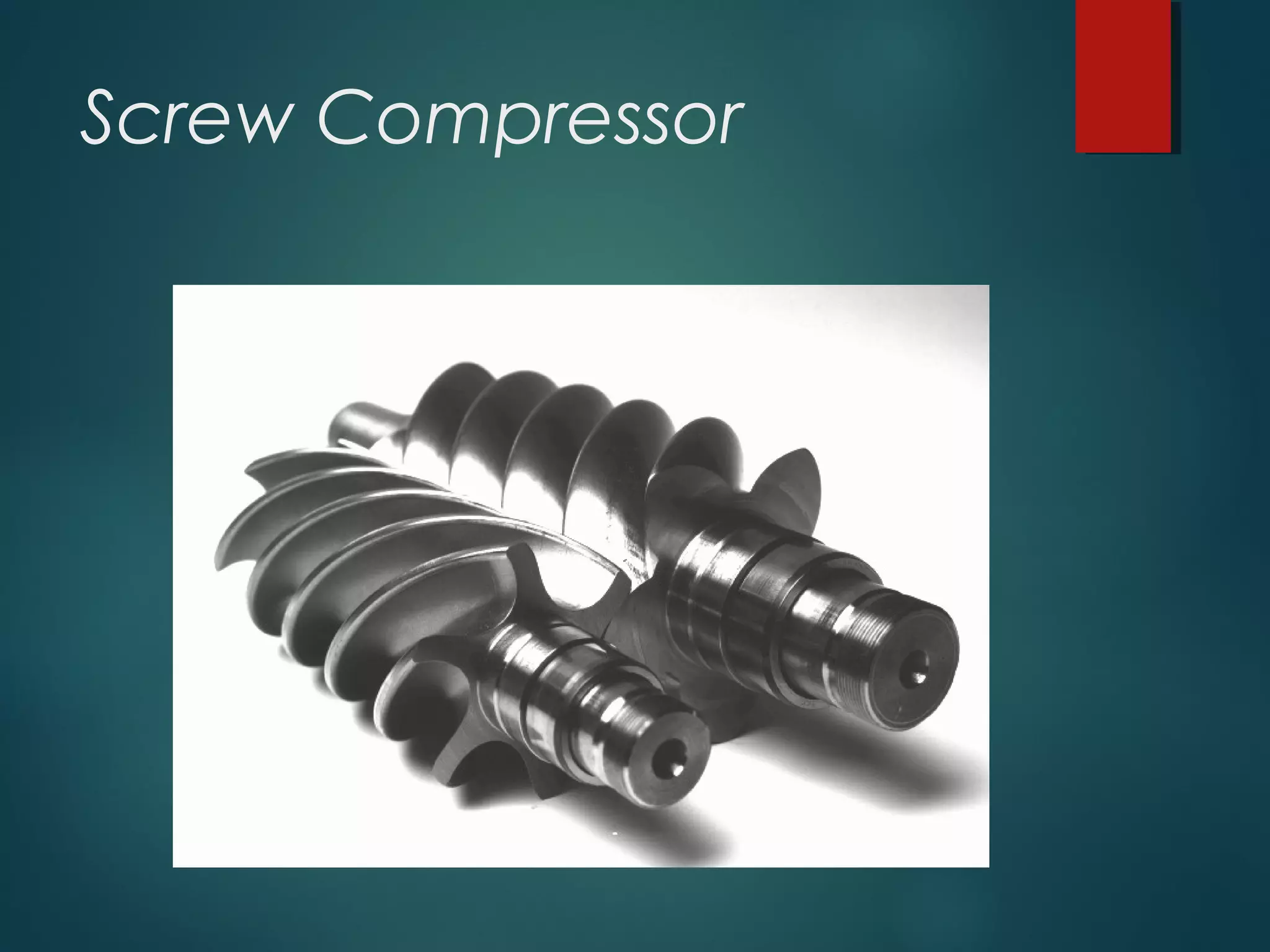
Screw compressor
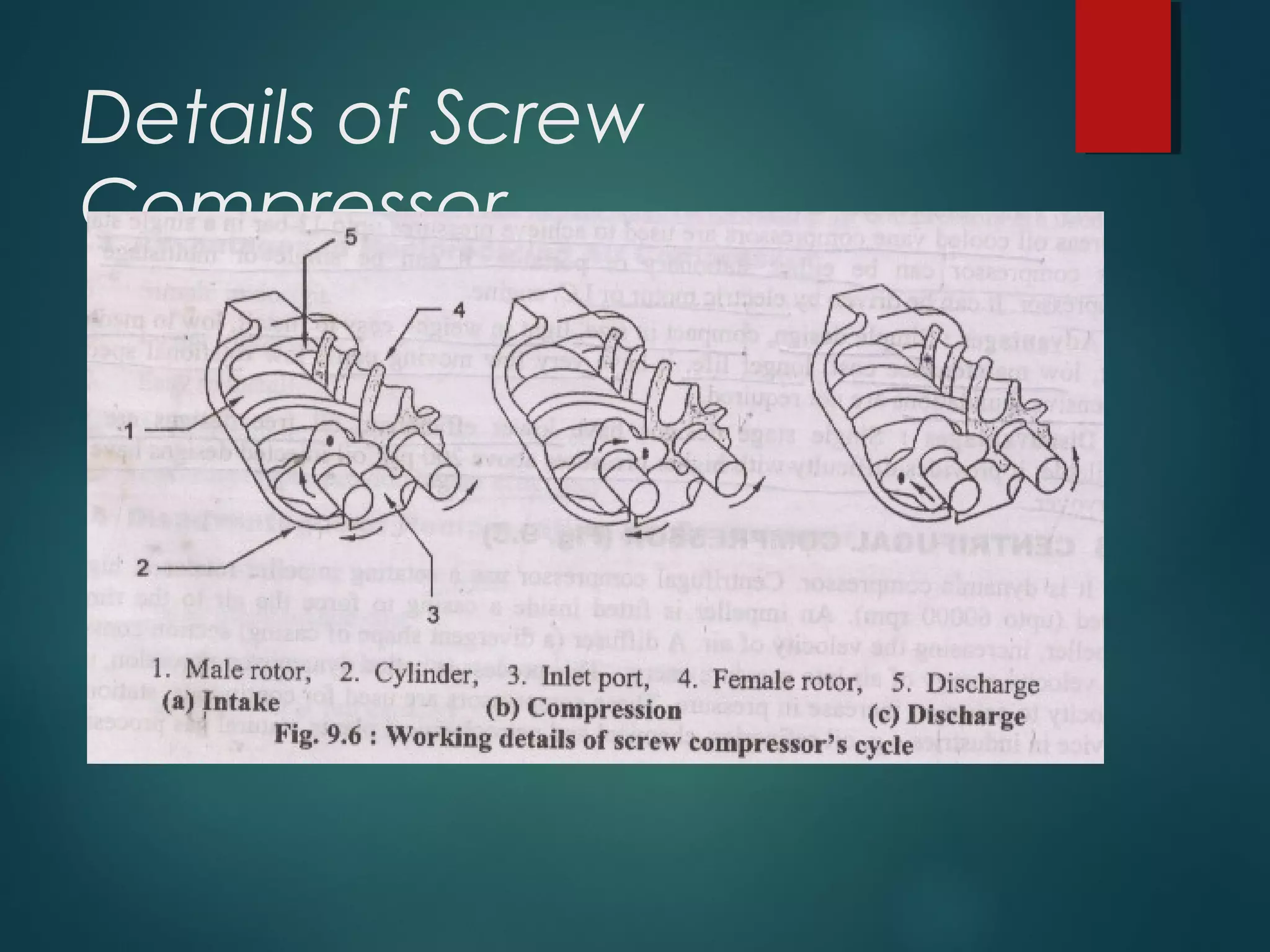
 It consist of two screws - one with
convex and the other with
concave contour mostly called
male and female rotor respectively.
 These two screws gets rotating by
means of gear trips there by
sucking the air through an inlet port
in chamber and then compressing
the same
Screw compressor
Screw compressor
 The helix of the male and female
rotor screw is designed to permit
complete charging of the inter lobe
space before the re-mesh.
 On completion of the filling
operation the inlet end of male and
female lobes begins to re-engage
thus reduces the volume of air
continuously.
Screw Compressor
Screw compressor
 Thus compression begins and air is
discharged at the end of other
side.
 There is no contact between male
and female rotors and casing.
Hence no lubrication require but oil
may injected for the purpose of
cooling.
Details of Screw
Compressor
Details of Screw
Compressor
Video of screw compressor
Twin lobe compressor
 It is used in applications where
higher flow at comparatively low
pressure is required.
Twin lobe compressor
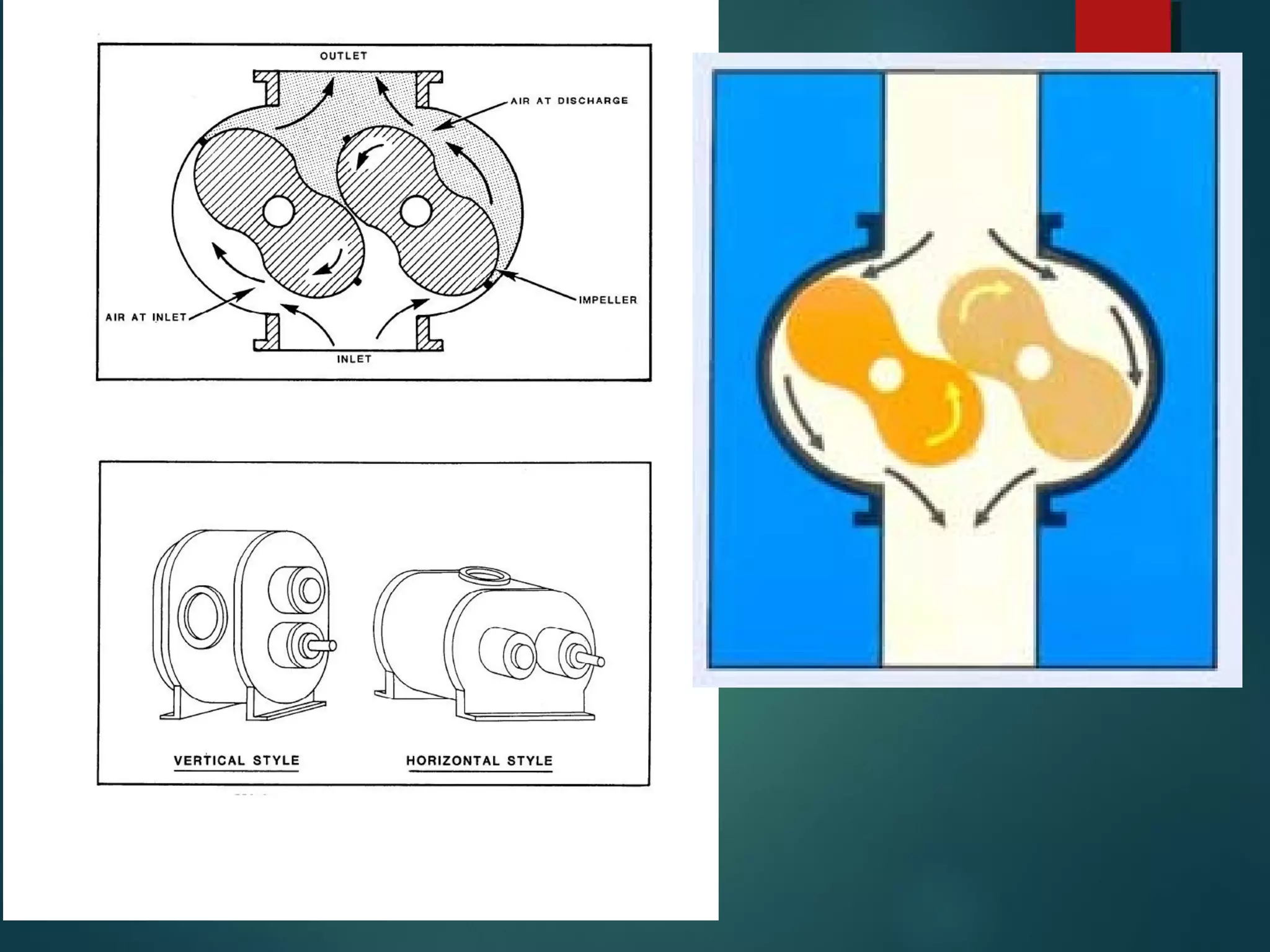
 Here two lobes are placed in a casing
 The air is transferred from suction side
to the delivery side with continuous
rotation of two lobes
 The lobes are precisely maintained
and the casing also maintained to
close tolerances
 It has limited compression ratio @ 1.7
Centrifugal compressor
 It is dynamic compressor.
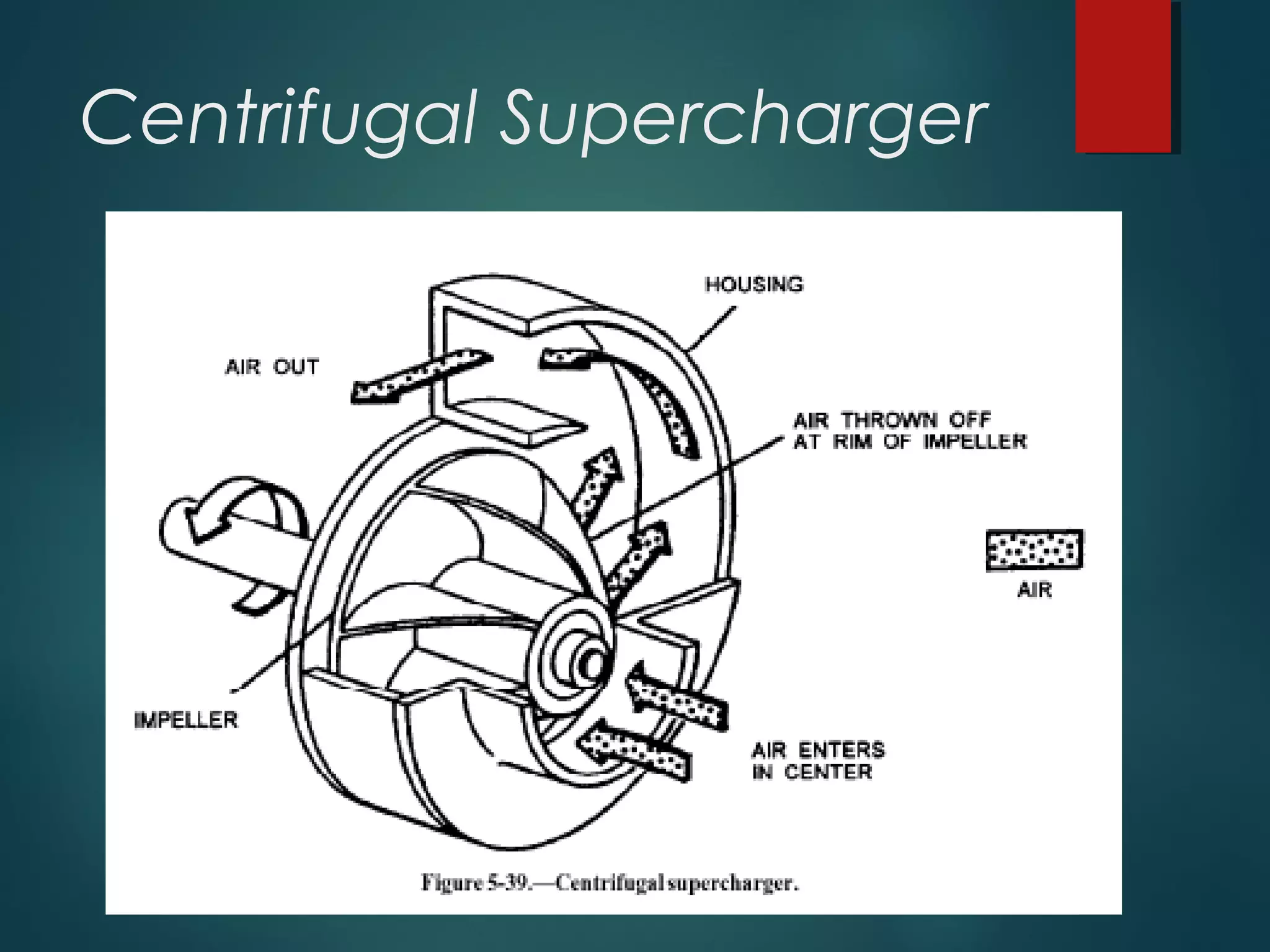
 It consist of a rotating impeller which rotates
at higher speed (upto 60000 rpm)
 An impeller fitted inside casing force the air
to the rim of impeller, increasing velocity of
air.
Centrifugal compressor
Centrifugal Supercharger
Centrifugal compressor
 A diffuser (divergent shape of
casing) section converts the
velocity of air to cause an increase
in pressure. This process is called
dynamic compression.
 These compressors are used for
continuous, stationary services in
industries like oil refineries, chemical
and petrochemical plants, natural
gas processing plants.
Centrifugal compressor
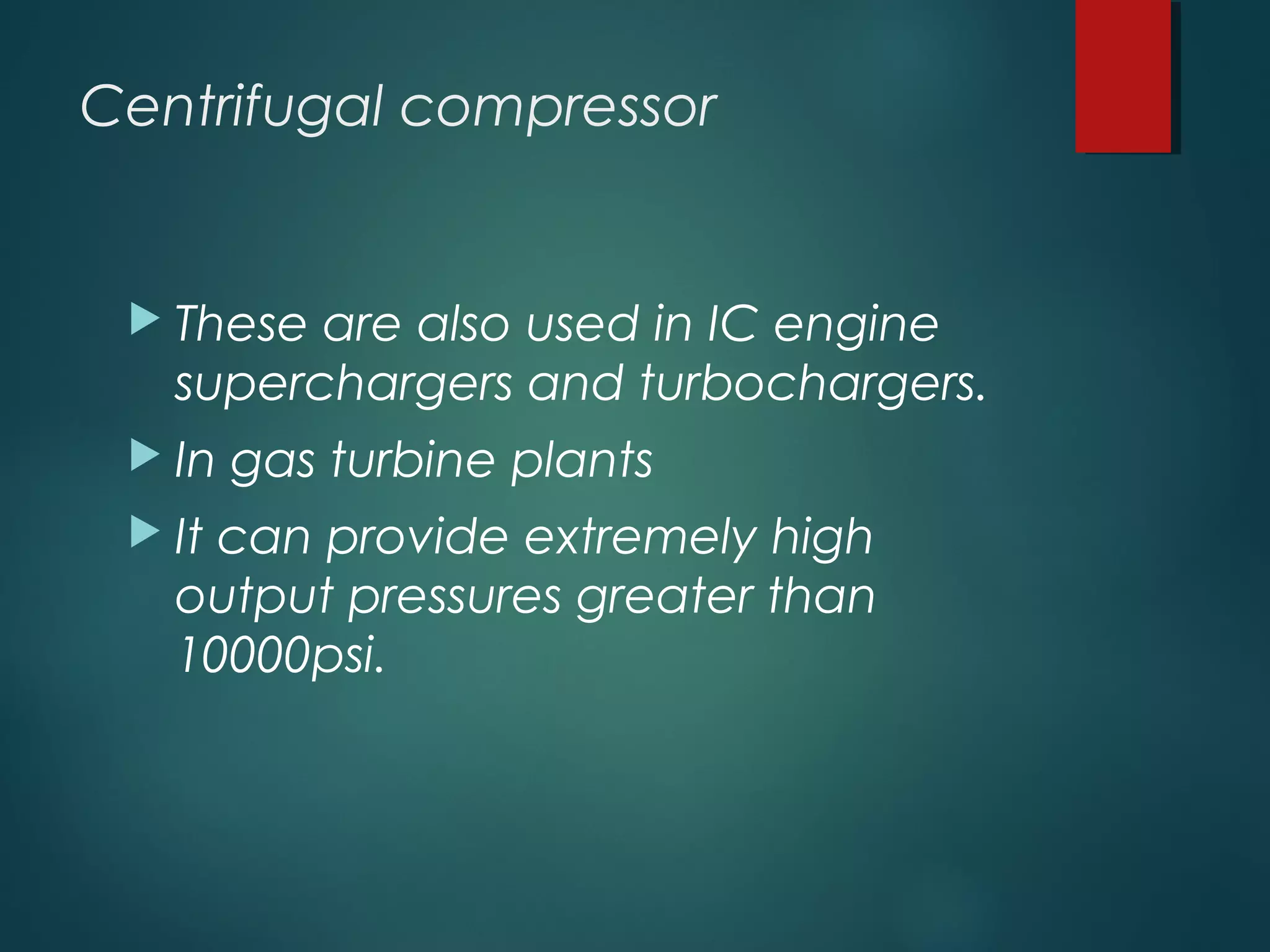
 These are also used in IC engine
superchargers and turbochargers.
 In gas turbine plants
 It can provide extremely high
output pressures greater than
10000psi.
Axial flow compressorAxial flow compressor
Working fluid principally flows parallel to the axis of rotation.
 The energy level of air or gas flowing through it is increased by the
action of the rotor blades which exert a torque on the fluid
Have the benefits of high efficiency and
large mass flow rate
Require several rows of airfoils to achieve
large pressure rises making them complex and
expensive
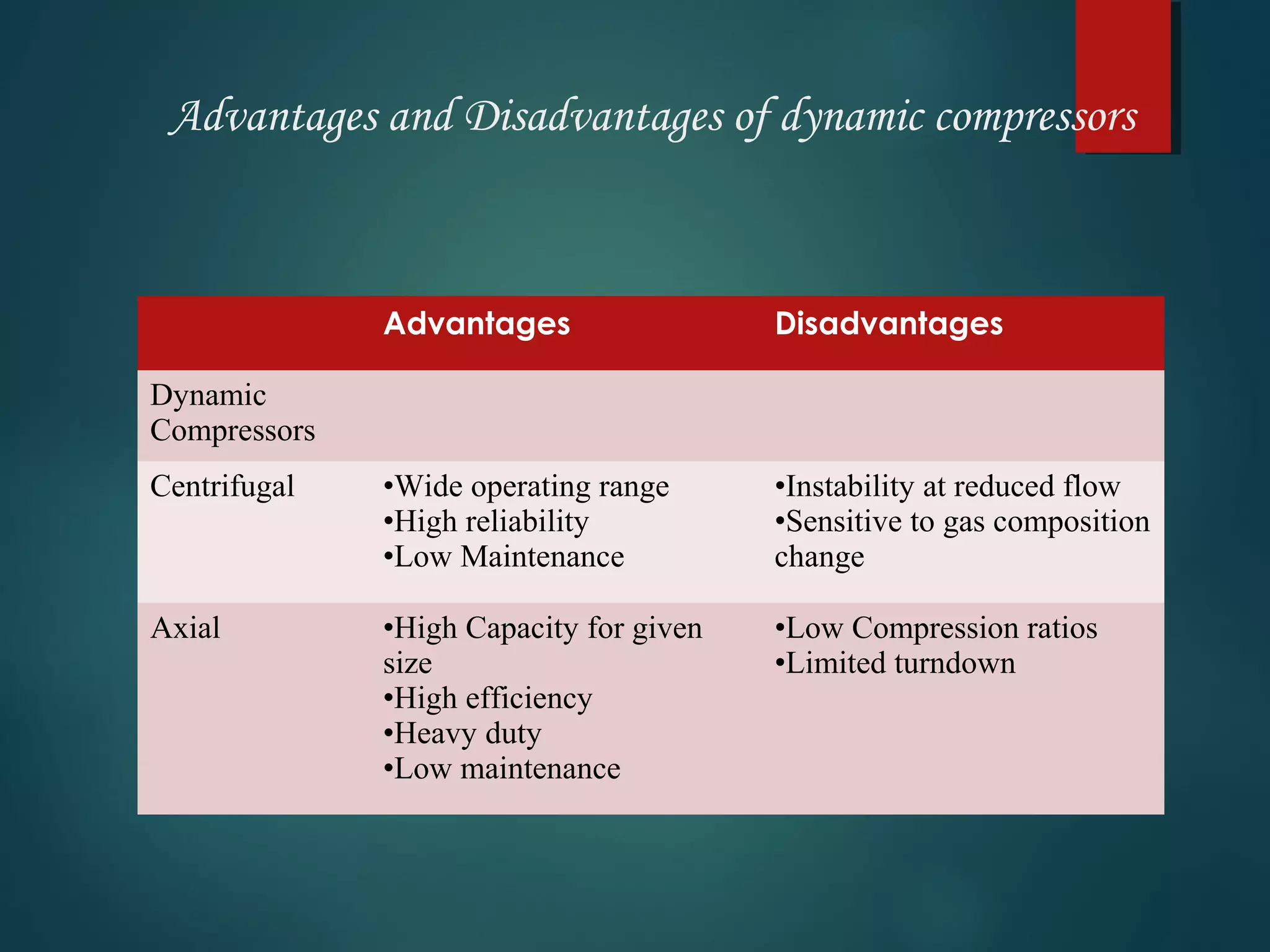
Advantages and Disadvantages of dynamic compressors
Advantages Disadvantages
Dynamic
Compressors
Centrifugal •Wide operating range
•High reliability
•Low Maintenance
•Instability at reduced flow
•Sensitive to gas composition
change
Axial •High Capacity for given
size
•High efficiency
•Heavy duty
•Low maintenance
•Low Compression ratios
•Limited turndown
Multistage compressor
 Multi stage compressor is use to develop
pressures more than 35 kg/cm2
.
 For preparation of mineral water bottle,
air pressure more than 40 kg/cm2
is
required to produce desired shape of
bottle at bottom side.
 Here two stage compressor is not used as
it produces pressure up to 35 kg/cm2
.
 Three stage compressor is use as it
produces pressure up to 85 kg/cm2
.
 Above four stage compressor is used.
Multistage compressor
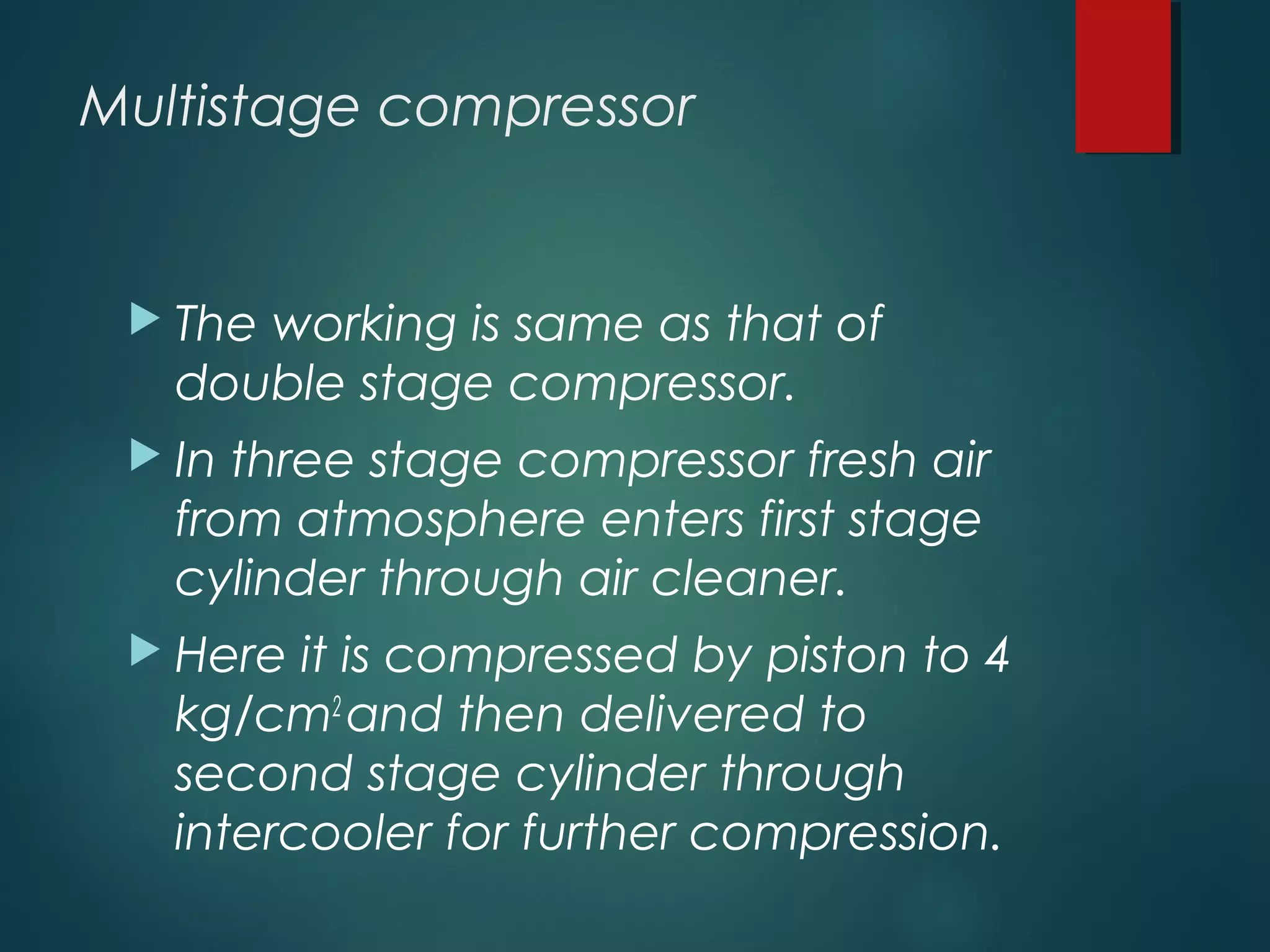
 The working is same as that of
double stage compressor.
 In three stage compressor fresh air
from atmosphere enters first stage
cylinder through air cleaner.
 Here it is compressed by piston to 4
kg/cm2
and then delivered to
second stage cylinder through
intercooler for further compression.
Multistage compressor
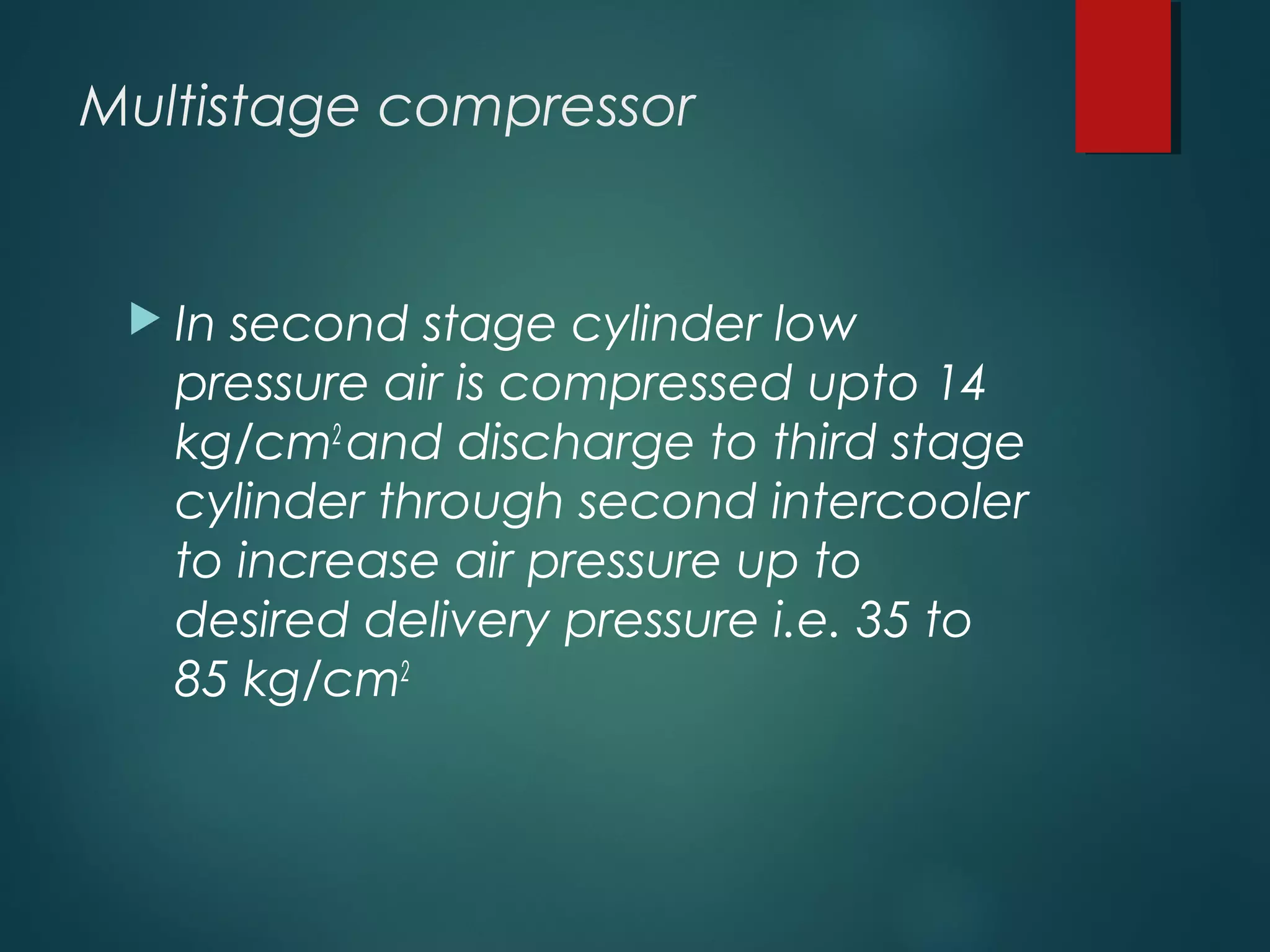
 In second stage cylinder low
pressure air is compressed upto 14
kg/cm2
and discharge to third stage
cylinder through second intercooler
to increase air pressure up to
desired delivery pressure i.e. 35 to
85 kg/cm2
Selection of compressors
 Selection of air compressor for given
application is governed by several
factors as below
 Pressure
 Flow rates or capacity
 Geometry of cylinder
 Speed of piston
 The layout of pipe line, system
requirement and the distance of user
machine from compressor plant
Selection of compressors
 Pressure :
 The discharge pressure from the
compressor should be decided first
considering the needs of the cylinder,
air motor & pressure drop in the circuit.
 Most of pneumatic systems and tools
are designed for pressure of 6 – 7 bar.
 A compressor used should meet the
requirement.
Selection of compressors
 Pressure :
 Pneumatic circuit requiring air at high
pressure can be supplied with air by a
separate high pressure compressor
 While any low pressure can be met by
availing a reducing valve.
 For huge air flow rates at pressures
below 2 bar, a turbo-blower or low
pressure rotary compressor may be
used.
Selection of compressors
 Flow rates or capacity:-
 Volume of air required per minute is
also an important factor for selection.
 The capacity should be adequate
enough to supply air to all devices
operating simultaneously.
 In many plants where pneumatic tools
are operated intermittently, in such
cases maximum instantaneous
demand of the compressed air has to
be find first.
Selection of compressors
 Geometry of cylinder:-
 For single cylinder geometric fashion :-
vertical-single acting or double
acting
horizontal- single or double acting
 For two cylinders geometric fashion:-
- vertical inline, single or double
acting
- V-type, single or double acting
- horizontal duplex, double acting
Selection of compressors
 Speed of piston:-
 The speed of piston inside the cylinder
must also be considered.
 For small capacity compressor, the piston
speed 300 m/min, whereas for large
capacity compressor piston speed 250
m/min.
 The layout of pipe line, system
requirement and the distance of user
machine from compressor plant
Advantages of
Air Power
WHEN THERE ARE A DOZEN OR MORE FORMS OF ENERGY TO
CHOOSE FROM, WHAT ADVANTAGES DOES AIR POWER
OFFER? HERE, COMPRESSED AIR STACKS UP AGAINST TWO OF
ITS COMPETITORS – ELECTRICITY
Air Power versus
Electric Power
COST: AIR TOOLS HAVE FEWER MOVING PARTS AND ARE
SIMPLER IN DESIGN, PROVIDING LOWER COST MAINTENANCE
AND OPERATION THAN ELECTRIC TOOLS.
.SAFETY: AIR-POWERED EQUIPMENT ELIMINATES THE DANGERS
OF ELECTRIC SHOCK AND FIRE HAZARD. AIR TOOLS ALSO RUN
COOLER THAN ELECTRIC TOOLS AND HAVE THE ADVANTAGE
OF NOT BEING DAMAGED FROM OVERLOAD OR STALLING.
.WEIGHT: AIR TOOLS ARE LIGHTER IN WEIGHT THAN ELECTRIC
TOOLS, ALLOWING FOR A HIGHER RATE OF PRODUCTION PER
MAN-HOUR WITH LESS WORKER FATIGUE.
Application of compressed air
 For operating pneumatic tools such
as drills, screw drivers, hammers,
chiessels
 For pneumatic cranes
 For pneumatic brakes of
automobiles, railways and presses
 For agricultural accessories such as
dusters and sprayers
Application of compressed air
 For drive of CNC machine tools
 For pneumatic conveying of
materials
 For pneumatic gauging, inspection
and low cost automation systems
What are its applications?
Hydraulic compressors for industrial
machines
Air compressors for industrial manufacturing
What are its applications?
Compressors have many everyday uses, such as in :
Air conditioners, (car, home)
Home and industrial refrigeration
Refrigeration compressor
Applications:
THE APPLICATIONS FOR OIL-FREE COMPRESSED AIR AND GAS
ARE WIDE-RANGING AND CONTINUALLY EXPANDING.
COMPRESSED AIR IS FREQUENTLY USED TO POWER OPERATING
TOOLS, PROCESS CONTROL AUTOMATION, AND CHEMICAL
PRODUCTION PROCESSES. THE FOLLOWING LIST DETAILS SOME
EXAMPLES OF INDUSTRIES AND APPLICATIONS WHERE
COMPRESSED AIR AND GAS ARE INTEGRAL.
The usage of compressed air is not limited only to industries,
but they are also used in manufacturing, welding,
constructions, power plants, ships, automobile plants,
painting shops, and for filling breathing apparatus too. Thus
there are so many types of air compressors used specifically
for the above purposes. Let us discuss on various types of
air compressors.
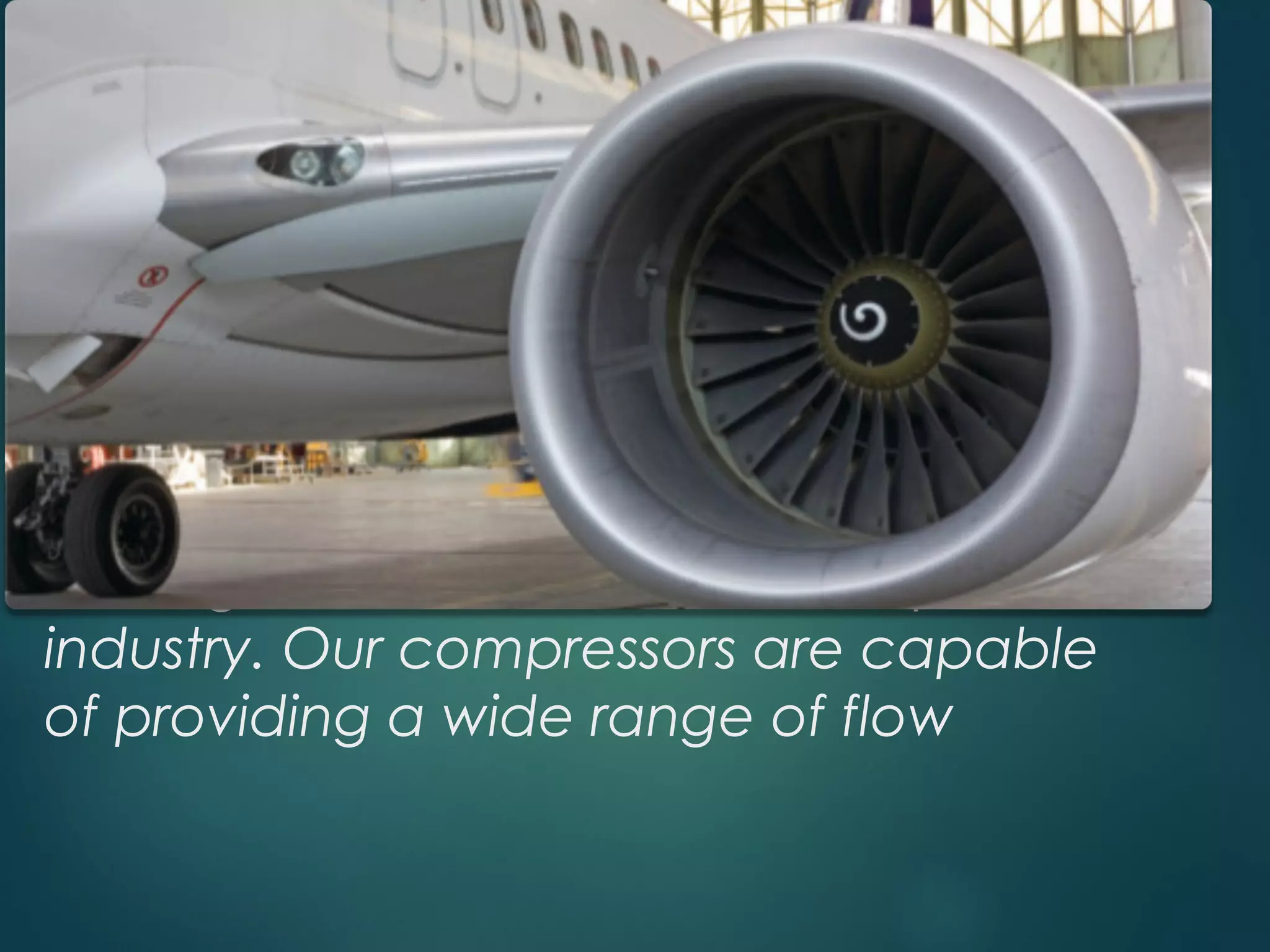
Aerospace
TURBO-AIR® and MSG® compressors
are a great match for the aerospace
industry. Our compressors are capable
of providing a wide range of flow
Automotive
We have worked closely with the automotive industry for over 50 years, tailoring
our standardized products along the way to maximize our value...
Cement
TURBO-AIR and MSG compressors provide reliable operation in demanding
cement manufacturing environments.
Electronics
TURBO-AIR and MSG centrifugal compressors are ideally designed for the
manufacturing of electronics.
Food and
Beverage
TURBO-AIR and MSG compressors are designed to meet strict food and
beverage industry regulations.
Glass
TURBO-AIR and MSG compressors trusted by glass manufacturing companies
worldwide for reliable operation in the demanding environment
Mining
Mining has many diverse applications for compressed air, and requires a safe
and reliable source.
Pharmaceutical
TURBO-AIR and MSG compressors provide 100% oil-free compressed air for
pharmaceutical applications.
Plastics and
Rubber
TURBO-AIR and MSG compressors provide 100% oil-free compressed air for
applications in plastic and/or rubber manufacturing environments.
Power Generation
TURBO-AIR and MSG compressors provide reliable operation in many different types of
power generation applications.

compressors types

  • 1.
    Group No:2 M SOHAIB2015-CH-705 M KAMRAN 2015-CH-722 M AKBAR 2015-CH-728 FARHAN MASOOD 2015-CH-727 MUDASSER HUSSAIN 2015-CH-723 M BILAL 2015-CH-709
  • 2.
    Topics: INTRODUCTION TYPES OF GASESTHAT COMPRESSOR CAN HANDLE EFFICIENCY CLASSIFICATION ADVANTAGES & DISADVANTAGES COMPARISON CHOICE OF SELECTION INDUSTRIAL APPLICATIONS
  • 3.
    Air compressor  Pneumatics:A system which uses compressed air is called pneumatics.  It deals with the study of behavior & application of compressed air  A basic pneumatic system consist of a source of compressed air, control valves, pipelines & pipe fittings and pneumatic accessories like filter, regulator and lubricator
  • 4.
    Introduction to compressors An air compressor is a mechanical device that increases the pressure of air by reducing volume.  Air is compressible, the compressor reduces the volume of air and induces pressure in the air  An air compressor converts electrical energy into kinetic energy in the form of the air Instead, a single motor on the compressor converts the electrical energy into kinetic energy.
  • 5.
    Introduction to compressors The compressed air is stored in the air receiver and can be used for cleaning under pressure, generating torque and develop force using actuators  This source is free of cost, safe, flexible and convenient  Air compressor has very few parts hence maintenance is very low
  • 6.
    OUR COMPRESSORS CANHANDLE THE FOLLOWING GASES; • AIR • ARGON • BIOGAS • CARBON DIOXIDE • HELIUM • HYDROGEN • METHANE • NATURAL GAS • NITROGEN (BOTH COMPRESSION AND GENERATION)
  • 7.
    Compressor Efficiency THE RATIOOF THEORETICAL WORK ( FLUID POWER) TO ACTUAL WORK ( TOTAL POWER INPUT ) .FOR CENTRIFUGAL COMPRESSORS, IT IS 90 %. 85%, FOR RECIPROCATING.
  • 8.
    Vacuum pumps: COMPRESSOR THATTAKES SUCTION AT PRESSURE BELOW ATMOSPHERIC AND DISCHARGE AGAINST ATMOSPHERIC PRESSURE , CALLED VACUUM PUMP. ANY COMPRESSOR CAN BE MADE BY ACCEPTING VERY LOW DENSITY GAS AT THE SUCTION.
  • 9.
    Jet ejector: IMPORTANT KINDOF VACUUM PUMP THAT DOES NOT USE MOVING PARTS IS THIS IN WHICH FLUID TO BE MOVED IS ENTRAINED IN HIGH VELOCITY STREAM OF SECOND FLUID.
  • 10.
    Isothermal Compression: WHEN COOLING DURINGCOMPRESSION IS COMPLETE , TEMPERATURE REMAINS CONSTANT, PROCESS IS CALLED ISOTHERMAL.
  • 11.
    Classification of aircompressor  Air compressors are classified according to method of energy transfer and pressure generation i.e. positive displacement and dynamic compressors  Positive displacement compressors work on the principle of increasing the pressure of air by reducing the volume of air in an enclosed chamber
  • 12.
    Classification of aircompressor  Dynamic compressors works on the principle of imparting the energy by rotating vanes of impeller on air flowing through casing that increases pressure in air
  • 13.
    Classification of aircompressor  According to number of stages Single stage, double stage, three stage of multiple stage  According to action Single acting or double acting  According to position of cylinder w.r.t. crankshaft Cylinders inline, vertical, radial position, V-type cylinder arrangement
  • 14.
    Classification of aircompressor  According to prime mover Electric motor drive or IC engine drive, Gas turbine drives  According to cooling medium Air cooled, water cooled air compressors
  • 15.
    What are positivedisplacement compressors? Positive displacement compressors causes movement by trapping a fixed amount of air then forcing (displacing) that trapped volume into the discharge pipe. It can be further classified according to the mechanism used to move air. Rotary Compressor Reciprocating compressor
  • 16.
  • 17.
    Reciprocating Air compressors Reciprocating air compressors are positive displacement type of air compressors.  These are piston & diaphragm type, vane type, gear type, screw type compressors.
  • 18.
    Reciprocating Air compressors The principle of operation is same but according to stages the delivery pressure is different in each compressor.
  • 19.
    Reciprocating Air compressors A reciprocating air compressor consist of a piston which is enclosed within a cylinder and equipped with suction and discharge valve  The piston receives power from electric motor or IC engine.
  • 20.
    Reciprocating Air compressors The compression of air is done by first drawing a volume of air into the cylinder through suction valve during suction stroke of piston and then compressed and discharged through delivery valve during delivery stroke
  • 21.
    Single stage ReciprocatingAir compressors  In this type the entire compression is carried out in a single cylinder
  • 22.
  • 23.
    Single stage ReciprocatingAir compressors  When piston starts moving downwards, the pressure inside the cylinder falls below atmospheric pressure that opens suction valve.  The pressure of the air in the cylinder rises during compression and at the end of compression, delivery valve opens and discharges the compressed air into the receiver tank.
  • 24.
    Single stage ReciprocatingAir compressors  Single stage air compressor develop pressure upto 7 bar.  For higher pressures multistage compressors are suitable  Single-stage compressors are generally used for pressures of 70 psi (pounds per square inch) to 135 psi.
  • 25.
    Double stage ReciprocatingAir compressors  It consist of two cylinders – low pressure cylinder and high pressure cylinder  Piston, crankcase, piston rod, crank, crankshaft, oil, fins etc.
  • 26.
  • 27.
    Double stage ReciprocatingAir compressors  The fresh air is drawn inside the L.P. cylinder through inlet suction filter.  This air is compressed by piston  As the piston moves towards the end of cylinder, the air compression took place.
  • 28.
    Video for doubleacting compressor
  • 29.
    Double stage ReciprocatingAir compressors  The delivery valve opens and this compressed air from L.P. cylinder is directed to enter inside the high pressure cylinder.  In high pressure cylinder this pressurised air is further compressed to higher pressure.
  • 30.
    Double stage ReciprocatingAir compressors  The high pressure air from H.P. cylinder is then delivered to receiver through discharge valves.  In this compressor, a pressure of air delivered is upto 13 bar.
  • 31.
    Advantages  Simple indesign  Lower initial cost  Easy to install  Higher effeiciency
  • 32.
    Disadvantages  Number ofmoving parts are more  Higher maintenance cost  Heavy foundation is required as it has vibration problem  Cannot run at full capacity
  • 33.
    Diaphragm type: DIAPHRAGM COMPRESSORS(FIGURE 5) ARE A VARIATION OF RECIPROCATING COMPRESSORS. THE DIAPHRAGM COMPRESSOR DEVELOPS PRESSURE THROUGH A RECIPROCATING OR OSCILLATING ACTION OF A FLEXIBLE DISC ACTUATED BY AN ECCENTRIC. SINCE A SLIDING SEAL IS NOT REQUIRED BETWEEN MOVING PARTS, THIS DESIGN IS NOT LUBRICATED. DIAPHRAGM COMPRESSORS ARE OFTEN SELECTED
  • 34.
    when no contaminationis allowed in the output air or atmosphere, such as hospital and laboratory applications. Diaphragm compressors are limited in output and pressure and they are used most often for light-duty applications
  • 35.
  • 36.
    Rotary vane compressor It is positive displacement type compressor.  It provides higher efficiency and flow rates over a wide range of pressure  Rotary vane compressor consist of rotor with a number of vanes inserted in the radial slots cut in rotor.
  • 37.
    Rotary vane compressor The rotor is mounted eccentric in a casing.  The vanes slides radially in and out of the rotor.  As the rotor rotates at higher speed, centrifugal force throws the vanes outward keeping the end of vane in contact with the stator ring.
  • 38.
    Rotary vane compressor As the rotor turns, compression is achieved as the volume goes from a maximum at intake port to minimum at the exhaust port.  An oil is injected into the air intake and along the stator walls to cool the air and lubricate bearing and vanes and to provide a seal between the vane and stator wall to reduce internal leakage.
  • 39.
    Advantages:  Simple design Compact in size  Light in weight  Easy to install  Low cost  Low maintenance cost  Longer life  Few moving parts  Low rotational speed  Expensive foundation not required
  • 40.
    Disadvantages:  Lower efficiency Difficulty with higher pressure above 200 psi  Oil injected designs have oil carryover
  • 41.
  • 43.
    Video of rotarycompressor
  • 44.
    Screw compressor  Itconsist of two screws - one with convex and the other with concave contour mostly called male and female rotor respectively.  These two screws gets rotating by means of gear trips there by sucking the air through an inlet port in chamber and then compressing the same
  • 45.
  • 46.
    Screw compressor  Thehelix of the male and female rotor screw is designed to permit complete charging of the inter lobe space before the re-mesh.  On completion of the filling operation the inlet end of male and female lobes begins to re-engage thus reduces the volume of air continuously.
  • 47.
  • 48.
    Screw compressor  Thuscompression begins and air is discharged at the end of other side.  There is no contact between male and female rotors and casing. Hence no lubrication require but oil may injected for the purpose of cooling.
  • 49.
  • 50.
  • 51.
    Video of screwcompressor
  • 52.
    Twin lobe compressor It is used in applications where higher flow at comparatively low pressure is required.
  • 53.
    Twin lobe compressor Here two lobes are placed in a casing  The air is transferred from suction side to the delivery side with continuous rotation of two lobes  The lobes are precisely maintained and the casing also maintained to close tolerances  It has limited compression ratio @ 1.7
  • 55.
    Centrifugal compressor  Itis dynamic compressor.  It consist of a rotating impeller which rotates at higher speed (upto 60000 rpm)  An impeller fitted inside casing force the air to the rim of impeller, increasing velocity of air.
  • 56.
  • 57.
  • 58.
    Centrifugal compressor  Adiffuser (divergent shape of casing) section converts the velocity of air to cause an increase in pressure. This process is called dynamic compression.  These compressors are used for continuous, stationary services in industries like oil refineries, chemical and petrochemical plants, natural gas processing plants.
  • 59.
    Centrifugal compressor  Theseare also used in IC engine superchargers and turbochargers.  In gas turbine plants  It can provide extremely high output pressures greater than 10000psi.
  • 60.
    Axial flow compressorAxialflow compressor Working fluid principally flows parallel to the axis of rotation.  The energy level of air or gas flowing through it is increased by the action of the rotor blades which exert a torque on the fluid Have the benefits of high efficiency and large mass flow rate Require several rows of airfoils to achieve large pressure rises making them complex and expensive
  • 61.
    Advantages and Disadvantagesof dynamic compressors Advantages Disadvantages Dynamic Compressors Centrifugal •Wide operating range •High reliability •Low Maintenance •Instability at reduced flow •Sensitive to gas composition change Axial •High Capacity for given size •High efficiency •Heavy duty •Low maintenance •Low Compression ratios •Limited turndown
  • 62.
    Multistage compressor  Multistage compressor is use to develop pressures more than 35 kg/cm2 .  For preparation of mineral water bottle, air pressure more than 40 kg/cm2 is required to produce desired shape of bottle at bottom side.  Here two stage compressor is not used as it produces pressure up to 35 kg/cm2 .  Three stage compressor is use as it produces pressure up to 85 kg/cm2 .  Above four stage compressor is used.
  • 63.
    Multistage compressor  Theworking is same as that of double stage compressor.  In three stage compressor fresh air from atmosphere enters first stage cylinder through air cleaner.  Here it is compressed by piston to 4 kg/cm2 and then delivered to second stage cylinder through intercooler for further compression.
  • 64.
    Multistage compressor  Insecond stage cylinder low pressure air is compressed upto 14 kg/cm2 and discharge to third stage cylinder through second intercooler to increase air pressure up to desired delivery pressure i.e. 35 to 85 kg/cm2
  • 65.
    Selection of compressors Selection of air compressor for given application is governed by several factors as below  Pressure  Flow rates or capacity  Geometry of cylinder  Speed of piston  The layout of pipe line, system requirement and the distance of user machine from compressor plant
  • 66.
    Selection of compressors Pressure :  The discharge pressure from the compressor should be decided first considering the needs of the cylinder, air motor & pressure drop in the circuit.  Most of pneumatic systems and tools are designed for pressure of 6 – 7 bar.  A compressor used should meet the requirement.
  • 67.
    Selection of compressors Pressure :  Pneumatic circuit requiring air at high pressure can be supplied with air by a separate high pressure compressor  While any low pressure can be met by availing a reducing valve.  For huge air flow rates at pressures below 2 bar, a turbo-blower or low pressure rotary compressor may be used.
  • 68.
    Selection of compressors Flow rates or capacity:-  Volume of air required per minute is also an important factor for selection.  The capacity should be adequate enough to supply air to all devices operating simultaneously.  In many plants where pneumatic tools are operated intermittently, in such cases maximum instantaneous demand of the compressed air has to be find first.
  • 69.
    Selection of compressors Geometry of cylinder:-  For single cylinder geometric fashion :- vertical-single acting or double acting horizontal- single or double acting  For two cylinders geometric fashion:- - vertical inline, single or double acting - V-type, single or double acting - horizontal duplex, double acting
  • 70.
    Selection of compressors Speed of piston:-  The speed of piston inside the cylinder must also be considered.  For small capacity compressor, the piston speed 300 m/min, whereas for large capacity compressor piston speed 250 m/min.  The layout of pipe line, system requirement and the distance of user machine from compressor plant
  • 71.
    Advantages of Air Power WHENTHERE ARE A DOZEN OR MORE FORMS OF ENERGY TO CHOOSE FROM, WHAT ADVANTAGES DOES AIR POWER OFFER? HERE, COMPRESSED AIR STACKS UP AGAINST TWO OF ITS COMPETITORS – ELECTRICITY
  • 72.
    Air Power versus ElectricPower COST: AIR TOOLS HAVE FEWER MOVING PARTS AND ARE SIMPLER IN DESIGN, PROVIDING LOWER COST MAINTENANCE AND OPERATION THAN ELECTRIC TOOLS.
  • 73.
    .SAFETY: AIR-POWERED EQUIPMENTELIMINATES THE DANGERS OF ELECTRIC SHOCK AND FIRE HAZARD. AIR TOOLS ALSO RUN COOLER THAN ELECTRIC TOOLS AND HAVE THE ADVANTAGE OF NOT BEING DAMAGED FROM OVERLOAD OR STALLING.
  • 74.
    .WEIGHT: AIR TOOLSARE LIGHTER IN WEIGHT THAN ELECTRIC TOOLS, ALLOWING FOR A HIGHER RATE OF PRODUCTION PER MAN-HOUR WITH LESS WORKER FATIGUE.
  • 75.
    Application of compressedair  For operating pneumatic tools such as drills, screw drivers, hammers, chiessels  For pneumatic cranes  For pneumatic brakes of automobiles, railways and presses  For agricultural accessories such as dusters and sprayers
  • 76.
    Application of compressedair  For drive of CNC machine tools  For pneumatic conveying of materials  For pneumatic gauging, inspection and low cost automation systems
  • 77.
    What are itsapplications? Hydraulic compressors for industrial machines Air compressors for industrial manufacturing
  • 78.
    What are itsapplications? Compressors have many everyday uses, such as in : Air conditioners, (car, home) Home and industrial refrigeration Refrigeration compressor
  • 79.
    Applications: THE APPLICATIONS FOROIL-FREE COMPRESSED AIR AND GAS ARE WIDE-RANGING AND CONTINUALLY EXPANDING. COMPRESSED AIR IS FREQUENTLY USED TO POWER OPERATING TOOLS, PROCESS CONTROL AUTOMATION, AND CHEMICAL PRODUCTION PROCESSES. THE FOLLOWING LIST DETAILS SOME EXAMPLES OF INDUSTRIES AND APPLICATIONS WHERE COMPRESSED AIR AND GAS ARE INTEGRAL.
  • 80.
    The usage ofcompressed air is not limited only to industries, but they are also used in manufacturing, welding, constructions, power plants, ships, automobile plants, painting shops, and for filling breathing apparatus too. Thus there are so many types of air compressors used specifically for the above purposes. Let us discuss on various types of air compressors.
  • 81.
    Aerospace TURBO-AIR® and MSG®compressors are a great match for the aerospace industry. Our compressors are capable of providing a wide range of flow
  • 82.
    Automotive We have workedclosely with the automotive industry for over 50 years, tailoring our standardized products along the way to maximize our value...
  • 83.
    Cement TURBO-AIR and MSGcompressors provide reliable operation in demanding cement manufacturing environments.
  • 84.
    Electronics TURBO-AIR and MSGcentrifugal compressors are ideally designed for the manufacturing of electronics.
  • 85.
    Food and Beverage TURBO-AIR andMSG compressors are designed to meet strict food and beverage industry regulations.
  • 86.
    Glass TURBO-AIR and MSGcompressors trusted by glass manufacturing companies worldwide for reliable operation in the demanding environment
  • 87.
    Mining Mining has manydiverse applications for compressed air, and requires a safe and reliable source.
  • 88.
    Pharmaceutical TURBO-AIR and MSGcompressors provide 100% oil-free compressed air for pharmaceutical applications.
  • 89.
    Plastics and Rubber TURBO-AIR andMSG compressors provide 100% oil-free compressed air for applications in plastic and/or rubber manufacturing environments.
  • 90.
    Power Generation TURBO-AIR andMSG compressors provide reliable operation in many different types of power generation applications.