
BECOMING A
FIERCE LEADER

Veronica Carroll, MBA CFRE
Executive Director, Delta Hospital
Foundation
AGENDA
 The importance of Leadership
 Background
 Discussion on Leadership Styles
 Defining and Using a Coach Approach
 Introduction to Fierce Leadership
WHY IS GOOD/GREAT LEADERSHIP
IMPORTANT?
 Leadership tenure/Leadership burnout
 Leadership deficit - baby boom deficit cannot be filled

by gen X
 Leadership succession – hot topic
 The challenge to attract and retain talent
 Scarcity of resources
 Younger leaders interested in new ways to structure
work – shared leadership and participatory structures
 It makes good business sense
BACKGROUND
 When the 75 members of Stanford Graduate School of

Business’s Advisory Council were asked to
recommend the most important capability for leaders
to develop, their answer was nearly unanimous: selfawareness.
 My own story
LEADERSHIP MODELS
 Authentic Leadership
 Level 5 Leadership
 Fierce Leadership
LEADERSHIP STYLES
AUTHENTIC LEADERSHIP- SIMS, MCLEAN
AND MAYER
 “The challenge is to understand ourselves well enough

to discover where we can use our leadership gifts to
serve others.”
 Understand your personal narrative
 Need to devote yourself to personal growth
 “Like elite athletes, you must devote yourself to a
lifetime of realizing your potential”.
LEADERSHIP STYLES
LEVEL 5 LEADERSHIP – JIM COLLINS
 Based on work around Good to Great
 A leader in whom genuine personal humility blends

with intense professional will
 A Level 5 Leader is a study in duality:
 Modest and willful
 Shy and fearless
 Ambition not for themselves but for the organization
LEADERSHIP STYLES
FIERCE LEADERSHIP – SUSAN SCOTT
 “A Fierce Leader commits to a way of life, not a

business strategy.” Susan Scott
 Really asking, really listening, then directing (in that
order)
 Feedback rich, on-going personal growth, culture of
passionate engagement, sharing resources,
collaborating, open, transparent, respectful culture,
shared values and ethics guide decisions, and
shared enthusiasm for agility and original thinking
Dialogue # 1
DEFINITION OF COACHING
 “Coaching is a process that supports individuals to

make more conscious decisions and to take new
action. It helps them to identify and build on their
strengths and internal resources and moves them
forward from where they are to where they want or
need to be. Coaching supports reflection, awareness,
communication, and accountability.”
WHY COACHING?
 In response to all of the pressures that we talked about

– younger leaders expect shared
leadership/participatory opportunities

 A central task of leadership is learning to support the

growth of others – Preskill & Brookfield

 Coaching is unlocking a person’s potential to maximize

their own performance. It is helping them to learn
rather than teaching them - Whitmore
USING A COACH APPROACH
 3 Elements:
 Mindset – Believing in Others, Being Curious,

Managing Needs, Earning Trust and Showing
Respect, and Staying Connected
 Skills – Listening, Inquiring, Giving Feedback, and
Sharing
 Framework – Clarify the focus, Identify the Goal,
Develop Solutions, and Create Accountability
Dialogue #2
Fierce Conversations – Fierce Leadership

Susan Scott
http://www.fierceinc.com/leadership-training-audio-video
FIERCE CONVERSATIONS
 “In its simplest form, a fierce conversation is one in

which we come out from behind ourselves into the
conversation and make it real.” Susan Scott
 Every organization wants to feel like it’s having a real

conversation with its employees, its customers, and
with the unknown future
 Each individual wants to have conversations that are

somehow building his or her world of meaning
WHAT DO THEY LOOK LIKE?
 What are my goals when I converse with people?
 How many meetings have I sat in where I knew the

real issues where not being discussed? What issues
are we avoiding?
 If I were guaranteed honest responses to any three
questions, whom would I question and what would I
ask?
 What has been the economical, emotional, and
intellectual cost to the organization of not identifying
and tackling the real issues?
 How would I describe the level of collaboration,
alignment, and accountability of my executive team?
MORE QUESTIONS…
 If nothing changes regarding the outcomes of the

conversations within my organization, what are the
implications for my own success and career?
 What is the conversation I’ve been unable to have with
senior executives, with my colleagues, with my direct
reports, with my donors, and most important, with
myself, with my own aspirations, that if I were able to
have, might make the difference, might change
everything?
FIERCE LEADERSHIP
 From Susan Scott’s “Fierce Leadership”:
 “A fast acting antivenom to the business as usual

mode of high task/low relationship, self serving
agendas, directing and telling, anonymous
feedback, holding people accountable, excessive
use of jargon, and mandating initiatives that cause
people to weep on too many fine days. The act of
acquiring your most valuable currency – emotional
capital. “
TOP TEN FIERCE LEADERSHIP
TRAITS
Memo to Leaders
 1. Stay awake
 2. People to keep and people to free up to industry
 3. Surround yourself with good people

 4. Role is to engineer the culture
 5. Pay attention to your emotional wake
 6. Keep describing reality without laying blame
 7. It’s not about reorganization
 8. Do not, under any circumstances, tell a lie – of

either commission or omission
 9. Show up as yourself consistently
 10. Take one conversation at a time. Make them fierce.
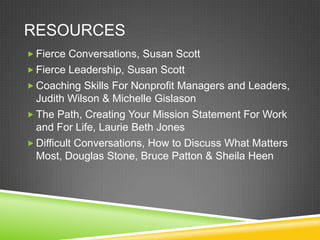
RESOURCES
 Fierce Conversations, Susan Scott
 Fierce Leadership, Susan Scott

 Coaching Skills For Nonprofit Managers and Leaders,

Judith Wilson & Michelle Gislason
 The Path, Creating Your Mission Statement For Work
and For Life, Laurie Beth Jones
 Difficult Conversations, How to Discuss What Matters
Most, Douglas Stone, Bruce Patton & Sheila Heen
 The Pause Principle, Step Back to Lead Forward,

Kevin Cashman
 The Power of Habit, Why We Do What We Do In Life
and Business, Charles Duhigg
 Mother’s Pearls, 27 Aha Moments of Realization,
Kevin J. Cottam
 You Already Know How To Be Great, A Simple Way to
Remove Interference and Unlock Your Greatest
Potential, Alan Fine with Rebecca R. Merrill
Thank You!
veronica.carroll@dhfoundation.ca

Becoming a Fierce Leader

  • 1.
    BECOMING A FIERCE LEADER VeronicaCarroll, MBA CFRE Executive Director, Delta Hospital Foundation
  • 2.
    AGENDA  The importanceof Leadership  Background  Discussion on Leadership Styles  Defining and Using a Coach Approach  Introduction to Fierce Leadership
  • 3.
    WHY IS GOOD/GREATLEADERSHIP IMPORTANT?  Leadership tenure/Leadership burnout  Leadership deficit - baby boom deficit cannot be filled by gen X  Leadership succession – hot topic  The challenge to attract and retain talent  Scarcity of resources  Younger leaders interested in new ways to structure work – shared leadership and participatory structures  It makes good business sense
  • 4.
    BACKGROUND  When the75 members of Stanford Graduate School of Business’s Advisory Council were asked to recommend the most important capability for leaders to develop, their answer was nearly unanimous: selfawareness.  My own story
  • 5.
    LEADERSHIP MODELS  AuthenticLeadership  Level 5 Leadership  Fierce Leadership
  • 6.
    LEADERSHIP STYLES AUTHENTIC LEADERSHIP-SIMS, MCLEAN AND MAYER  “The challenge is to understand ourselves well enough to discover where we can use our leadership gifts to serve others.”  Understand your personal narrative  Need to devote yourself to personal growth  “Like elite athletes, you must devote yourself to a lifetime of realizing your potential”.
  • 7.
    LEADERSHIP STYLES LEVEL 5LEADERSHIP – JIM COLLINS  Based on work around Good to Great  A leader in whom genuine personal humility blends with intense professional will  A Level 5 Leader is a study in duality:  Modest and willful  Shy and fearless  Ambition not for themselves but for the organization
  • 8.
    LEADERSHIP STYLES FIERCE LEADERSHIP– SUSAN SCOTT  “A Fierce Leader commits to a way of life, not a business strategy.” Susan Scott  Really asking, really listening, then directing (in that order)  Feedback rich, on-going personal growth, culture of passionate engagement, sharing resources, collaborating, open, transparent, respectful culture, shared values and ethics guide decisions, and shared enthusiasm for agility and original thinking
  • 9.
  • 10.
    DEFINITION OF COACHING “Coaching is a process that supports individuals to make more conscious decisions and to take new action. It helps them to identify and build on their strengths and internal resources and moves them forward from where they are to where they want or need to be. Coaching supports reflection, awareness, communication, and accountability.”
  • 11.
    WHY COACHING?  Inresponse to all of the pressures that we talked about – younger leaders expect shared leadership/participatory opportunities  A central task of leadership is learning to support the growth of others – Preskill & Brookfield  Coaching is unlocking a person’s potential to maximize their own performance. It is helping them to learn rather than teaching them - Whitmore
  • 12.
    USING A COACHAPPROACH  3 Elements:  Mindset – Believing in Others, Being Curious, Managing Needs, Earning Trust and Showing Respect, and Staying Connected  Skills – Listening, Inquiring, Giving Feedback, and Sharing  Framework – Clarify the focus, Identify the Goal, Develop Solutions, and Create Accountability
  • 13.
  • 14.
    Fierce Conversations –Fierce Leadership Susan Scott
  • 15.
  • 16.
    FIERCE CONVERSATIONS  “Inits simplest form, a fierce conversation is one in which we come out from behind ourselves into the conversation and make it real.” Susan Scott  Every organization wants to feel like it’s having a real conversation with its employees, its customers, and with the unknown future  Each individual wants to have conversations that are somehow building his or her world of meaning
  • 17.
    WHAT DO THEYLOOK LIKE?  What are my goals when I converse with people?  How many meetings have I sat in where I knew the real issues where not being discussed? What issues are we avoiding?  If I were guaranteed honest responses to any three questions, whom would I question and what would I ask?  What has been the economical, emotional, and intellectual cost to the organization of not identifying and tackling the real issues?  How would I describe the level of collaboration, alignment, and accountability of my executive team?
  • 18.
    MORE QUESTIONS…  Ifnothing changes regarding the outcomes of the conversations within my organization, what are the implications for my own success and career?  What is the conversation I’ve been unable to have with senior executives, with my colleagues, with my direct reports, with my donors, and most important, with myself, with my own aspirations, that if I were able to have, might make the difference, might change everything?
  • 19.
    FIERCE LEADERSHIP  FromSusan Scott’s “Fierce Leadership”:  “A fast acting antivenom to the business as usual mode of high task/low relationship, self serving agendas, directing and telling, anonymous feedback, holding people accountable, excessive use of jargon, and mandating initiatives that cause people to weep on too many fine days. The act of acquiring your most valuable currency – emotional capital. “
  • 20.
    TOP TEN FIERCELEADERSHIP TRAITS Memo to Leaders  1. Stay awake  2. People to keep and people to free up to industry  3. Surround yourself with good people  4. Role is to engineer the culture  5. Pay attention to your emotional wake
  • 21.
     6. Keepdescribing reality without laying blame  7. It’s not about reorganization  8. Do not, under any circumstances, tell a lie – of either commission or omission  9. Show up as yourself consistently  10. Take one conversation at a time. Make them fierce.
  • 22.
    RESOURCES  Fierce Conversations,Susan Scott  Fierce Leadership, Susan Scott  Coaching Skills For Nonprofit Managers and Leaders, Judith Wilson & Michelle Gislason  The Path, Creating Your Mission Statement For Work and For Life, Laurie Beth Jones  Difficult Conversations, How to Discuss What Matters Most, Douglas Stone, Bruce Patton & Sheila Heen
  • 23.
     The PausePrinciple, Step Back to Lead Forward, Kevin Cashman  The Power of Habit, Why We Do What We Do In Life and Business, Charles Duhigg  Mother’s Pearls, 27 Aha Moments of Realization, Kevin J. Cottam  You Already Know How To Be Great, A Simple Way to Remove Interference and Unlock Your Greatest Potential, Alan Fine with Rebecca R. Merrill
  • 24.