An intro to radical
candor
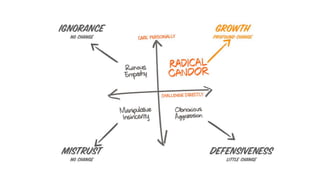
Radical Candor
The book, by Kim Scott, provides a
framework for making the most enjoyable
and productive interpersonal relationships
and conversations in the workplace.
This framework fits in very well with the
idea of psychological safety because it
emphasizes the human element of being
compassionate while still speaking your
mind and getting to the truth.
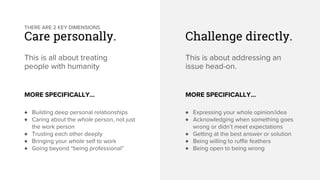
THERE ARE 2 KEY DIMENSIONS
Care personally.
This is all about treating
people with humanity
MORE SPECIFICALLY…
♦ Building deep personal relationships
♦ Caring about the whole person, not just
the work person
♦ Trusting each other deeply
♦ Bringing your whole self to work
♦ Going beyond “being professional”
Challenge directly.
This is about addressing an
issue head-on.
MORE SPECIFICALLY…
♦ Expressing your whole opinion/idea
♦ Acknowledging when something goes
wrong or didn’t meet expectations
♦ Getting at the best answer or solution
♦ Being willing to ruffle feathers
♦ Being open to being wrong
Some important things to know
when using this framework
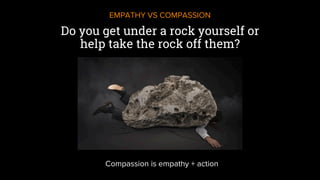
Do you get under a rock yourself or
help take the rock off them?
EMPATHY VS COMPASSION
Compassion is empathy + action
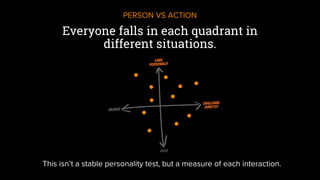
Everyone falls in each quadrant in
different situations.
PERSON VS ACTION
This isn’t a stable personality test, but a measure of each interaction.
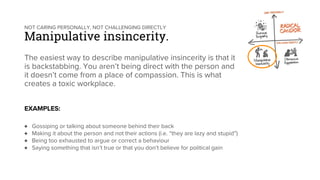
NOT CARING PERSONALLY, NOT CHALLENGING DIRECTLY
Manipulative insincerity.
The easiest way to describe manipulative insincerity is that it
is backstabbing. You aren’t being direct with the person and
it doesn’t come from a place of compassion. This is what
creates a toxic workplace.
EXAMPLES:
♦ Gossiping or talking about someone behind their back
♦ Making it about the person and not their actions (i.e. “they are lazy and stupid”)
♦ Being too exhausted to argue or correct a behaviour
♦ Saying something that isn’t true or that you don’t believe for political gain
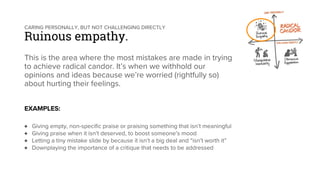
CARING PERSONALLY, BUT NOT CHALLENGING DIRECTLY
Ruinous empathy.
This is the area where the most mistakes are made in trying
to achieve radical candor. It’s when we withhold our
opinions and ideas because we’re worried (rightfully so)
about hurting their feelings.
EXAMPLES:
♦ Giving empty, non-specific praise or praising something that isn’t meaningful
♦ Giving praise when it isn’t deserved, to boost someone’s mood
♦ Letting a tiny mistake slide by because it isn’t a big deal and “isn’t worth it”
♦ Downplaying the importance of a critique that needs to be addressed
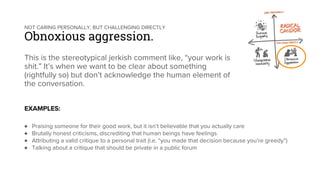
NOT CARING PERSONALLY, BUT CHALLENGING DIRECTLY
Obnoxious aggression.
This is the stereotypical jerkish comment like, “your work is
shit.” It’s when we want to be clear about something
(rightfully so) but don’t acknowledge the human element of
the conversation.
EXAMPLES:
♦ Praising someone for their good work, but it isn’t believable that you actually care
♦ Brutally honest criticisms, discrediting that human beings have feelings
♦ Attributing a valid critique to a personal trait (i.e. “you made that decision because you’re greedy”)
♦ Talking about a critique that should be private in a public forum
CARING PERSONALLY, CHALLENGING DIRECTLY
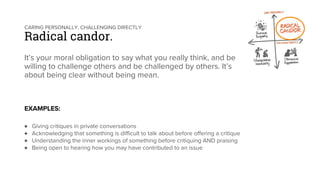
Radical candor.
It’s your moral obligation to say what you really think, and be
willing to challenge others and be challenged by others. It’s
about being clear without being mean.
EXAMPLES:
♦ Giving critiques in private conversations
♦ Acknowledging that something is difficult to talk about before offering a critique
♦ Understanding the inner workings of something before critiquing AND praising
♦ Being open to hearing how you may have contributed to an issue
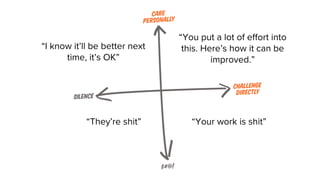
“Your work is shit”“They’re shit”
“I know it’ll be better next
time, it’s OK”
“You put a lot of effort into
this. Here’s how it can be
improved.”
Giving praise with radical candor
LESSON 1
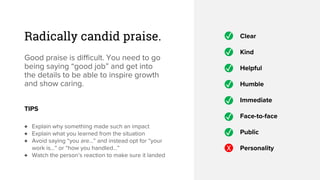
Radically candid praise.
Good praise is difficult. You need to go
being saying “good job” and get into
the details to be able to inspire growth
and show caring.
TIPS
♦ Explain why something made such an impact
♦ Explain what you learned from the situation
♦ Avoid saying “you are…” and instead opt for “your
work is…” or “how you handled…”
♦ Watch the person’s reaction to make sure it landed
✓ Clear
Kind
Helpful
Humble
Immediate
Face-to-face
Public
Personality
✓
✓
✓
✓
✓
X
✓
Giving criticism with radical candor
LESSON 2
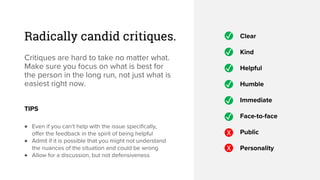
Radically candid critiques.
Critiques are hard to take no matter what.
Make sure you focus on what is best for
the person in the long run, not just what is
easiest right now.
✓ Clear
Kind
Helpful
Humble
Immediate
Face-to-face
Public
Personality
✓
✓
✓
✓
✓
X
X
TIPS
♦ Even if you can’t help with the issue specifically,
offer the feedback in the spirit of being helpful
♦ Admit if it is possible that you might not understand
the nuances of the situation and could be wrong
♦ Allow for a discussion, but not defensiveness
Wanna learn more?
The book is geared towards bosses, but anyone who is interested in building
better working relationships can benefit a lot from the ideas in it.
BLOGVIDEO

An intro to radical candor

  • 1.
    An intro toradical candor
  • 2.
    Radical Candor The book,by Kim Scott, provides a framework for making the most enjoyable and productive interpersonal relationships and conversations in the workplace. This framework fits in very well with the idea of psychological safety because it emphasizes the human element of being compassionate while still speaking your mind and getting to the truth.
  • 4.
    THERE ARE 2KEY DIMENSIONS Care personally. This is all about treating people with humanity MORE SPECIFICALLY… ♦ Building deep personal relationships ♦ Caring about the whole person, not just the work person ♦ Trusting each other deeply ♦ Bringing your whole self to work ♦ Going beyond “being professional” Challenge directly. This is about addressing an issue head-on. MORE SPECIFICALLY… ♦ Expressing your whole opinion/idea ♦ Acknowledging when something goes wrong or didn’t meet expectations ♦ Getting at the best answer or solution ♦ Being willing to ruffle feathers ♦ Being open to being wrong
  • 5.
    Some important thingsto know when using this framework
  • 6.
    Do you getunder a rock yourself or help take the rock off them? EMPATHY VS COMPASSION Compassion is empathy + action
  • 7.
    Everyone falls ineach quadrant in different situations. PERSON VS ACTION This isn’t a stable personality test, but a measure of each interaction.
  • 8.
    NOT CARING PERSONALLY,NOT CHALLENGING DIRECTLY Manipulative insincerity. The easiest way to describe manipulative insincerity is that it is backstabbing. You aren’t being direct with the person and it doesn’t come from a place of compassion. This is what creates a toxic workplace. EXAMPLES: ♦ Gossiping or talking about someone behind their back ♦ Making it about the person and not their actions (i.e. “they are lazy and stupid”) ♦ Being too exhausted to argue or correct a behaviour ♦ Saying something that isn’t true or that you don’t believe for political gain
  • 9.
    CARING PERSONALLY, BUTNOT CHALLENGING DIRECTLY Ruinous empathy. This is the area where the most mistakes are made in trying to achieve radical candor. It’s when we withhold our opinions and ideas because we’re worried (rightfully so) about hurting their feelings. EXAMPLES: ♦ Giving empty, non-specific praise or praising something that isn’t meaningful ♦ Giving praise when it isn’t deserved, to boost someone’s mood ♦ Letting a tiny mistake slide by because it isn’t a big deal and “isn’t worth it” ♦ Downplaying the importance of a critique that needs to be addressed
  • 10.
    NOT CARING PERSONALLY,BUT CHALLENGING DIRECTLY Obnoxious aggression. This is the stereotypical jerkish comment like, “your work is shit.” It’s when we want to be clear about something (rightfully so) but don’t acknowledge the human element of the conversation. EXAMPLES: ♦ Praising someone for their good work, but it isn’t believable that you actually care ♦ Brutally honest criticisms, discrediting that human beings have feelings ♦ Attributing a valid critique to a personal trait (i.e. “you made that decision because you’re greedy”) ♦ Talking about a critique that should be private in a public forum
  • 11.
    CARING PERSONALLY, CHALLENGINGDIRECTLY Radical candor. It’s your moral obligation to say what you really think, and be willing to challenge others and be challenged by others. It’s about being clear without being mean. EXAMPLES: ♦ Giving critiques in private conversations ♦ Acknowledging that something is difficult to talk about before offering a critique ♦ Understanding the inner workings of something before critiquing AND praising ♦ Being open to hearing how you may have contributed to an issue
  • 12.
    “Your work isshit”“They’re shit” “I know it’ll be better next time, it’s OK” “You put a lot of effort into this. Here’s how it can be improved.”
  • 13.
    Giving praise withradical candor LESSON 1
  • 14.
    Radically candid praise. Goodpraise is difficult. You need to go being saying “good job” and get into the details to be able to inspire growth and show caring. TIPS ♦ Explain why something made such an impact ♦ Explain what you learned from the situation ♦ Avoid saying “you are…” and instead opt for “your work is…” or “how you handled…” ♦ Watch the person’s reaction to make sure it landed ✓ Clear Kind Helpful Humble Immediate Face-to-face Public Personality ✓ ✓ ✓ ✓ ✓ X ✓
  • 15.
    Giving criticism withradical candor LESSON 2
  • 16.
    Radically candid critiques. Critiquesare hard to take no matter what. Make sure you focus on what is best for the person in the long run, not just what is easiest right now. ✓ Clear Kind Helpful Humble Immediate Face-to-face Public Personality ✓ ✓ ✓ ✓ ✓ X X TIPS ♦ Even if you can’t help with the issue specifically, offer the feedback in the spirit of being helpful ♦ Admit if it is possible that you might not understand the nuances of the situation and could be wrong ♦ Allow for a discussion, but not defensiveness
  • 17.
    Wanna learn more? Thebook is geared towards bosses, but anyone who is interested in building better working relationships can benefit a lot from the ideas in it. BLOGVIDEO