Understanding Communication Preferences Shannon L. Oborne MB351 June 26, 2008
Why are you here? You are the leadership team expected to drive this organization’s goals Staffing – 40% growth in FY2008-2009 Revenue – 85% growth (3x market share) Marketing –4 new products; U.K. expansion People are the engine
Why am I here? Vice President/General Manager, College Loan Corporation (2002-2007) Expanded from 8 to 72 sales executives Moved from 63 rd  to 8 th  largest education lender in U.S. Launched 2 new brands and 6 successful products Director of Marketing/eCommerce, Collegiate Funding Services (1999-2002) Expanded from 60 to 1200 employees Increased annual loan originations from $850,000 to $2Billion Launched 15 successful products; expanded into BPO market
It’s a Fact: Individuals have various preferences for both communicating with others and interpreting the communications from others.
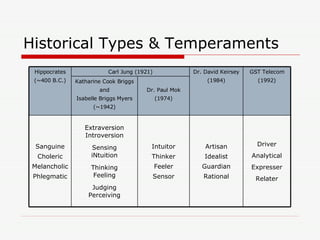
Historical Types & Temperaments Carl Jung (1921) Extraversion Introversion Sensing iNtuition Thinking Feeling Judging Perceiving Katharine Cook Briggs and Isabelle Briggs Myers (~1942) Driver Analytical Expresser Relater Artisan Idealist Guardian Rational Intuitor Thinker Feeler Sensor Sanguine Choleric Melancholic Phlegmatic GST Telecom (1992) Dr. David Keirsey (1984) Dr. Paul Mok (1974) Hippocrates (~400 B.C.)
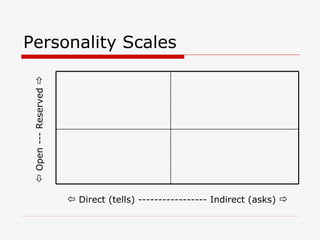
Personality Scales    Open --- Reserved      Direct (tells) ----------------- Indirect (asks)  
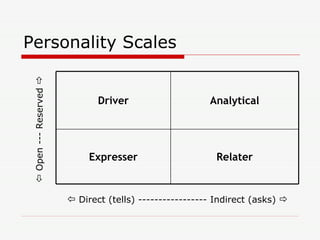
Personality Scales    Open --- Reserved      Direct (tells) ----------------- Indirect (asks)   Relater Expresser Analytical Driver
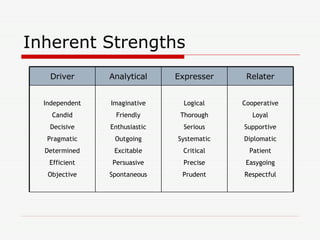
Inherent Strengths Cooperative Loyal Supportive Diplomatic Patient Easygoing Respectful Logical Thorough Serious Systematic Critical Precise Prudent Imaginative Friendly Enthusiastic Outgoing Excitable Persuasive Spontaneous Independent Candid Decisive Pragmatic Determined Efficient Objective Relater Expresser Analytical Driver
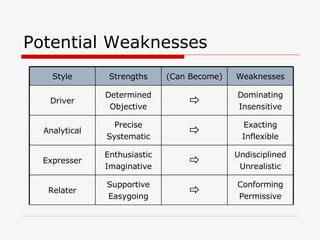
Potential Weaknesses Dominating Insensitive  Determined Objective Driver Conforming Permissive  Supportive Easygoing Relater Undisciplined Unrealistic  Enthusiastic Imaginative Expresser Exacting Inflexible  Precise Systematic Analytical Weaknesses (Can Become) Strengths Style
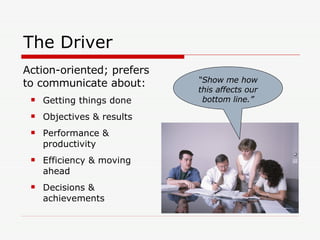
The Driver Action-oriented; prefers to communicate about: Getting things done Objectives & results Performance & productivity Efficiency & moving ahead Decisions & achievements “ Show me how this affects our bottom line.”
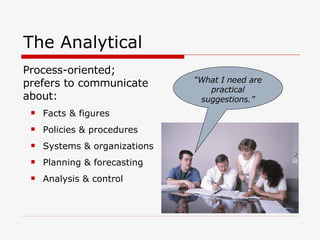
The Analytical Process-oriented; prefers to communicate about: Facts & figures Policies & procedures Systems & organizations Planning & forecasting Analysis & control “ What I need are practical suggestions.”
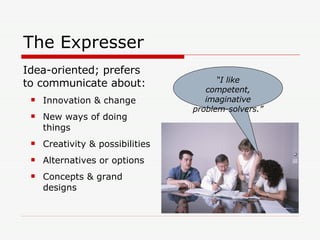
The Expresser Idea-oriented; prefers to communicate about: Innovation & change New ways of doing things Creativity & possibilities Alternatives or options Concepts & grand designs “ I like competent, imaginative problem-solvers.”
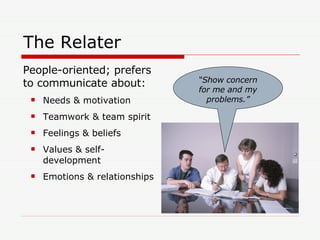
The Relater People-oriented; prefers to communicate about: Needs & motivation Teamwork & team spirit Feelings & beliefs Values & self-development Emotions & relationships “ Show concern for me and my problems.”
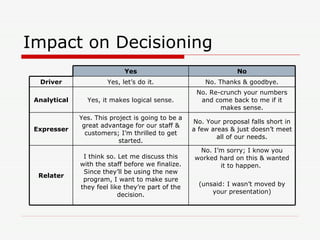
Impact on Decisioning No. I’m sorry; I know you worked hard on this & wanted it to happen.  (unsaid: I wasn’t moved by your presentation) I think so. Let me discuss this with the staff before we finalize. Since they’ll be using the new program, I want to make sure they feel like they’re part of the decision. Relater No. Your proposal falls short in a few areas & just doesn’t meet all of our needs. Yes. This project is going to be a great advantage for our staff & customers; I’m thrilled to get started. Expresser No. Re-crunch your numbers and come back to me if it makes sense. Yes, it makes logical sense. Analytical No. Thanks & goodbye. Yes, let’s do it. Driver No Yes
Questions?
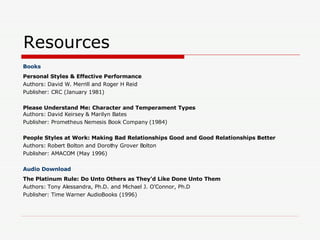
Resources Books Personal Styles & Effective Performance Authors: David W. Merrill and Roger H Reid Publisher: CRC (January 1981) Please Understand Me: Character and Temperament Types   Authors: David Keirsey & Marilyn Bates Publisher: Prometheus Nemesis Book Company (1984) People Styles at Work: Making Bad Relationships Good and Good Relationships Better Authors: Robert Bolton and Dorothy Grover Bolton  Publisher: AMACOM (May 1996) Audio Download The Platinum Rule: Do Unto Others as They'd Like Done Unto Them  Authors: Tony Alessandra, Ph.D. and Michael J. O'Connor, Ph.D  Publisher: Time Warner AudioBooks (1996)
Resources Internet Articles Versatile Leadership Michael Leimbach, Ph.D., Wilson Learning http://wilsonlearning.com/images/uploads/pdf/versatile_leadership_en.pdf Communication Styles David G. Jensen, Search Masters International http://www.searchmastersinternational.com/web/us/smi/en/pages/careers_career_dev_commun_styles.html Leading Up In The Organization: A Model For Increased Effectiveness John R. Darling and W. Earl Walker http://lta.hse.fi/2003/3/lta_2003_03_a1.pdf
Understanding Communication Preferences Shannon L. Oborne MB351 June 26, 2008

Communication Styles

  • 1.
    Understanding Communication PreferencesShannon L. Oborne MB351 June 26, 2008
  • 2.
    Why are youhere? You are the leadership team expected to drive this organization’s goals Staffing – 40% growth in FY2008-2009 Revenue – 85% growth (3x market share) Marketing –4 new products; U.K. expansion People are the engine
  • 3.
    Why am Ihere? Vice President/General Manager, College Loan Corporation (2002-2007) Expanded from 8 to 72 sales executives Moved from 63 rd to 8 th largest education lender in U.S. Launched 2 new brands and 6 successful products Director of Marketing/eCommerce, Collegiate Funding Services (1999-2002) Expanded from 60 to 1200 employees Increased annual loan originations from $850,000 to $2Billion Launched 15 successful products; expanded into BPO market
  • 4.
    It’s a Fact:Individuals have various preferences for both communicating with others and interpreting the communications from others.
  • 5.
    Historical Types &Temperaments Carl Jung (1921) Extraversion Introversion Sensing iNtuition Thinking Feeling Judging Perceiving Katharine Cook Briggs and Isabelle Briggs Myers (~1942) Driver Analytical Expresser Relater Artisan Idealist Guardian Rational Intuitor Thinker Feeler Sensor Sanguine Choleric Melancholic Phlegmatic GST Telecom (1992) Dr. David Keirsey (1984) Dr. Paul Mok (1974) Hippocrates (~400 B.C.)
  • 6.
    Personality Scales  Open --- Reserved   Direct (tells) ----------------- Indirect (asks) 
  • 7.
    Personality Scales  Open --- Reserved   Direct (tells) ----------------- Indirect (asks)  Relater Expresser Analytical Driver
  • 8.
    Inherent Strengths CooperativeLoyal Supportive Diplomatic Patient Easygoing Respectful Logical Thorough Serious Systematic Critical Precise Prudent Imaginative Friendly Enthusiastic Outgoing Excitable Persuasive Spontaneous Independent Candid Decisive Pragmatic Determined Efficient Objective Relater Expresser Analytical Driver
  • 9.
    Potential Weaknesses DominatingInsensitive  Determined Objective Driver Conforming Permissive  Supportive Easygoing Relater Undisciplined Unrealistic  Enthusiastic Imaginative Expresser Exacting Inflexible  Precise Systematic Analytical Weaknesses (Can Become) Strengths Style
  • 10.
    The Driver Action-oriented;prefers to communicate about: Getting things done Objectives & results Performance & productivity Efficiency & moving ahead Decisions & achievements “ Show me how this affects our bottom line.”
  • 11.
    The Analytical Process-oriented;prefers to communicate about: Facts & figures Policies & procedures Systems & organizations Planning & forecasting Analysis & control “ What I need are practical suggestions.”
  • 12.
    The Expresser Idea-oriented;prefers to communicate about: Innovation & change New ways of doing things Creativity & possibilities Alternatives or options Concepts & grand designs “ I like competent, imaginative problem-solvers.”
  • 13.
    The Relater People-oriented;prefers to communicate about: Needs & motivation Teamwork & team spirit Feelings & beliefs Values & self-development Emotions & relationships “ Show concern for me and my problems.”
  • 14.
    Impact on DecisioningNo. I’m sorry; I know you worked hard on this & wanted it to happen. (unsaid: I wasn’t moved by your presentation) I think so. Let me discuss this with the staff before we finalize. Since they’ll be using the new program, I want to make sure they feel like they’re part of the decision. Relater No. Your proposal falls short in a few areas & just doesn’t meet all of our needs. Yes. This project is going to be a great advantage for our staff & customers; I’m thrilled to get started. Expresser No. Re-crunch your numbers and come back to me if it makes sense. Yes, it makes logical sense. Analytical No. Thanks & goodbye. Yes, let’s do it. Driver No Yes
  • 15.
  • 16.
    Resources Books PersonalStyles & Effective Performance Authors: David W. Merrill and Roger H Reid Publisher: CRC (January 1981) Please Understand Me: Character and Temperament Types Authors: David Keirsey & Marilyn Bates Publisher: Prometheus Nemesis Book Company (1984) People Styles at Work: Making Bad Relationships Good and Good Relationships Better Authors: Robert Bolton and Dorothy Grover Bolton Publisher: AMACOM (May 1996) Audio Download The Platinum Rule: Do Unto Others as They'd Like Done Unto Them Authors: Tony Alessandra, Ph.D. and Michael J. O'Connor, Ph.D Publisher: Time Warner AudioBooks (1996)
  • 17.
    Resources Internet ArticlesVersatile Leadership Michael Leimbach, Ph.D., Wilson Learning http://wilsonlearning.com/images/uploads/pdf/versatile_leadership_en.pdf Communication Styles David G. Jensen, Search Masters International http://www.searchmastersinternational.com/web/us/smi/en/pages/careers_career_dev_commun_styles.html Leading Up In The Organization: A Model For Increased Effectiveness John R. Darling and W. Earl Walker http://lta.hse.fi/2003/3/lta_2003_03_a1.pdf
  • 18.
    Understanding Communication PreferencesShannon L. Oborne MB351 June 26, 2008